Disease – after-effects for uranium miners decades later
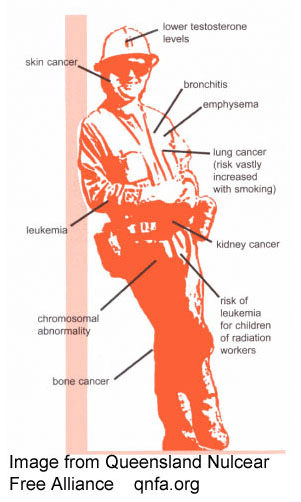 Uranium workers can face illnesses decades
  later. Many workers don’t know that help is available.Star Tribune, Heather Richards 307-266-0592, Heather.Richards@trib.com, Jan 14, 2019
Japan faces huge costs as nuclear reactors are scrapped
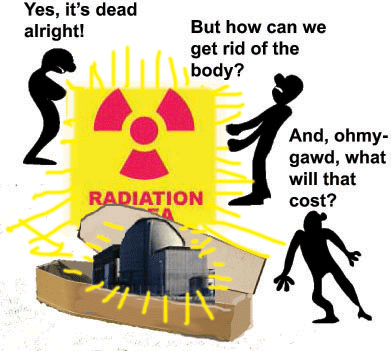 Japan News 14th Jan 2019 The total cost for scrapping the nation’s nuclear power facilities —
excluding Fukushima No. 1 nuclear power plants and other facilities under construction — is estimated to be about ¥6.72 trillion, according to a tally by The Yomiuri Shimbun.
The assessment only includes dismantlements of nuclear power facilities for which the cost can currently be estimated. Among these estimates, the cost for closing a spent nuclear fuel reprocessing plant now being built by Japan Nuclear Fuel Ltd. (JNFL) in Rokkasho, Aomori Prefecture, accounts for the largest amount at ¥1.6 trillion.
The cost for decommissioning 53 commercial nuclear reactors is estimated to total about ¥3.58 trillion, for an average at ¥57.7 billion per reactor. Of the 53 reactors, 19 reactors are scheduled or are likely to be scrapped.
http://the-japan-news.com/news/article/0005476533
UK’s “nuclear renaissance” now collapsing as Hitachi looks like dumping Moorside nuclear project
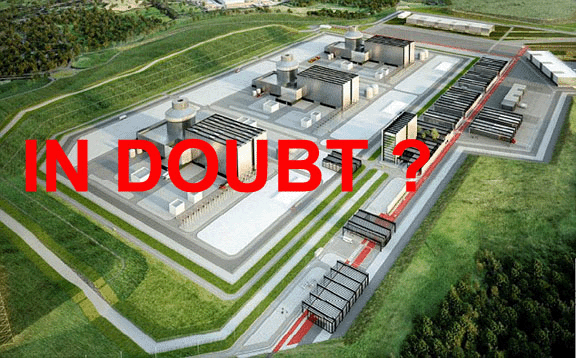
 FT 13th Jan 2019 Nick Butler: Who could blame the board of the Japanese company Hitachi if
its members decide at their meeting this week to scrap plans for a new nuclear power station at Wylfa on the North Wales island of Anglesey?
Hitachi has invested more than £840m in the project over the past six years. The technology has passed all the tests set by the UK’s nuclear regulator. But the company has been unable to get the government to put in place the clear and credible financial structure necessary to underpin the investment.
That failure has already led other investors to abandon the new plant planned at Moorside in Cumbria. Talk of scrapping the Wylfa project could be a bargaining tactic on the part of Hitachi but the reality is probably much simpler. Hitachi’s doubts have been well signalled during the
past few months and the company’s purchase of ABB’s power grid business at the end of last year gives it a range of investment choices.
Given Whitehall’s chronic indecision, the company is ready to use its capital elsewhere. Hitachi’s withdrawal would mark the collapse of the energy policy adopted in 2013 by the UK’s coalition government. Facing what were believed to be ever-rising energy prices the policy plumped for new nuclear, promising that 35 gigawatts of new capacity would be on stream by the mid 2030s – more than replacing the first generation of nuclear plants, which would by then have reached the end of their useful lives.
Because the price of gas seemed doomed to keep rising, new nuclear would come to look highly competitive over time as well as reducing dependence on imports. Since then much has changed, and the assumptions which underpinned the old policy now look laughably wrong.
The costs of all forms of energy (apart from nuclear) have fallen dramatically and there is no shortage of supply. Electricity demand is down thanks to efficiency gains and new technology.
The contract for the first new nuclear station being built at Hinkley Point in Somerset, which enjoys a guaranteed index-linked price for 35 years from the moment the plant is commissioned, looks exorbitant. The demise of Wylfa forces the need for a comprehensive review of energy policy.
Since the UK government is too busy preparing for Brexit to focus seriously on any other issue, the review should be conducted independently. Advances in energy technology offer more
possibilities each year. But those options will never be taken up unless the old outdated policy is scrapped and a more realistic approach put in place.
https://www.ft.com/content/7b33e9fa-1648-11e9-9e64-d150b3105d21
Desalination pours more toxic brine into the ocean than previously thought
|
https://www.sciencenews.org/article/desalination-pours-more-toxic-brine-ocean-previously-thought The supersalty water is a byproduct in producing potable water Technology meant to help solve the world’s growing water shortage is producing a salty environmental dilemma. Desalination facilities, which extract drinkable water from the ocean, discharge around 142 billion liters of extremely salty water called brine back into the environment every day, a study finds. That waste product of the desalination process can kill marine life and detrimentally alter the planet’s oceans, researchers report January 14 in Science of the Total Environment. “On the one hand, we are trying to provide populations — particularly in dry areas — with the needed amount of good quality water. But at the same time, we are also adding an environmental concern to the process,” says study coauthor Manzoor Qadir, an environmental scientist at the United Nations University Institute for Water, Environment and Health in Hamilton, Canada. Between human population growth and climate change, water is becoming increasingly scarce (SN: 8/18/18, p. 14). Desalination technology has become a viable solution to this problem and has grown exponentially in popularity since the 1980s. Almost 16,000 plants now operate worldwide. Desalination relies on evaporation or specialized membranes to either chemically or electrically separate pure water from a stream of saltwater. But two streams always flow out of the system: one that becomes water that people can use, and another with the leftover, extra-salty brine, which is released back into the environment. Previous evaluations didn’t assess how much brine these facilities produced, Qadir says. Scientists assumed that desalination facilities on average equally produced brine and pure water — one liter of brine for every liter of pure water. That turned out to be wrong. Using data on the water sources and technology used at desalination facilities around the globe, Qadir and his colleagues estimated for the first time how much brine is discharged daily. For every liter of pure water made, they found that on average 1.5 liters of highly concentrated brine is released back into the environment. Per day, that value translates to more than half the daily volume of water pouring over Niagara Falls, with 70 percent of it originating from desalination plants in arid North Africa and the Middle East. As brine re-enters the ocean, “it creates a kind of local environment,” Qadir says. The highly concentrated discharge, which can also contain metals and antifouling chemicals, is denser than seawater, so it flows as a salty plume to the seafloor and can poison marine organisms living nearby. Some brine can also still be hot from evaporative processes during desalination. Because hot water doesn’t hold oxygen as well as cold water, ocean areas where brine enters can become depleted of oxygen. An international standard requiring wastewater treatment and the use of environmentally friendly chemicals in desalination discharge does exist, says Yoram Cohen, a chemical engineer at UCLA. “But whether all people follow it, I don’t know.” Save for some scientific studies, not much is being done to resolve the issue, Qadir says. “At the government level, I don’t see that there is a serious attempt that has been made.” Suggestions have been proposed for repurposing the brine, including for watering salt-tolerant agricultural fields, extracting metals such as magnesium or uranium, or harvesting salt versus mining for it. In terms of technology, you can take the brine “and evaporate it to recover the salt,” Cohen says. “But the price is huge.” Depending on location and type of technology, desalination alone can cost between $0.50 and over $2 to produce 1,000 liters of drinkable water — about what two people in the United States use in a day. Further evaporating the brine waste only increases the cost. Modern desalination technologies, such as graphene oxides, are becoming more cost effective and releasing less brine discharge (SN: 8/20/16, p. 22). But they are not universally distributed and are uncommon in the Middle East where desalination is most used. “We need to make sure that with our efforts, we are able to use more of those types of technology which produce more desalinated water than brine,” Qadir says. |
|
Washington State opposes Trump administration’s plan to reclassify large amount of Hanford nuclear waste as ‘low level’
 Trump administration wants to reclassify leaking nuclear waste to avoid cleaning it up, say officials
‘This is unacceptable, and we will not stand by while this administration plans to abandon its responsibility to clean up their mess’, Independent UK Josh GabbatissScience Correspondent
UK’s plans for a nuclear powered future are collapsing
 U.K’s Nuclear Future Fades as Hitachi Exit Follows Toshiba, Bloomberg, By Lars Paulsson and Mathew Carr January 11, 2019,
EDF’s atomic plants need to be replaced by new generation
Offshore wind could be the winner from withdrawal, RBC says
…….Japanese conglomerate Hitachi Ltd. will halt work on the Wylfa project and take a one-time charge as negotiations with the British government over funding stalled, the Nikkei newspaper reported. After Toshiba Corp.’s withdrawal from its Moorside plant in November, it leaves the nation with just Electricite de France SA’s Hinkley Point project underway and that’s been mired in controversy because of delays and the cost to the U.K. consumer.
……..The Nikkei report said the company’s board will make a decision next week and cited an unidentified executive saying the project isn’t being abandoned entirely and could be restarted in the future.
Toshiba said in November it planned to liquidate NuGeneration Ltd., its U.K. nuclear power developer, after failing to find a partner or a buyer for the Moorside project. In September, China General Nuclear said it may give upthe chance to operate a nuclear plant at Bradwell amid political sensitivities over Chinese investments, the Financial Times reported.
As the U.K. is running out of nuclear options, other technologies stand to benefit.
“We see offshore wind as increasingly viable,” said John Musk, utilities analyst at RBC Europe Ltd. Natural gas power will probably provide a significant amount of the baseload power not met by renewables……..https://www.bloomberg.com/news/articles/2019-01-11/u-k-s-nuclear-future-fades-as-hitachi-exit-follows-toshiba
Broad support in USA for a Green New Deal
However, the poll, conducted by the Yale Program on Climate Change Communication (YCCC), also found that very few voters were aware of the Green New Deal: 82 percent said they “knew nothing” of the proposal. Notably, the poll’s language focused on renewable electricity and job creation, but made no mention of the full decarbonization and social overhaul of the American economy that also are central tenets of the full Green New Deal.
In reporting the results, the YCCC noted the likelihood that once Republican voters became aware that the Green New Deal is being championed by Democrats, their support for the idea will decrease. This survey asked respondents about support for some of the basic concepts of the Green New Deal without associating it with either major political party.
Even though polls have shown that the majority of Republicans believe in climate change, research shows that if a proposal is made by the Democrats, Republican voters are less likely to support it. The same was true of Democratic voters and proposals made by Republicans.
Naturally, climate deniers and right-wing media like Fox News and The New York Post already are attacking the concept and its most visible champion, Rep. Alexandria Ocasio-Cortez (D-NY), foreshadowing the GND‘s slide into the partisan.
What Exactly Is the Green New Deal?
Many in the climate and energy media sphere already have attempted to pin down what exactly the Green New Deal is and how it came to be, with David Roberts at Vox going deep and long, and Tim Dickinson at Rolling Stone diving in this week because “The Green New Deal is suddenly on everyone’s lips.”
In the Yale survey, however, respondents were told that members of Congress say the Green New Deal “will produce jobs and strengthen America’s economy by accelerating the transition from fossil fuels to clean, renewable energy.”
Survey respondents were given some specifics for how this would be accomplished, which included generating 100 percent of America’s electricity from renewable sources within 10 years, upgrading the nation’s energy grid, focusing on energy efficiency, and training for jobs in the new green economy.
While this is a good general description of the GND, there is much more detail in a draft bill from Rep. Ocasio-Cortez, which even has an FAQ section………… https://www.desmogblog.com/2019/01/09/green-new-deal-bipartisan-support-yale-survey?utm_source=dsb%20newsletter
Climate denial’s successful tactic – demanding “balance” in media coverage
 By demanding “balance,” the industry transformed climate change into a partisan issue. We know that was a deliberate strategy because various internal documents from ExxonMobil, Shell, the American Petroleum Institute and a handful of now-defunct fossil fuel industry groups reveal not only the industry’s strategy to target media with this message and these experts, but also its own preemptive debunking of the very theories it went on to support.
many took the industry’s bait, routinely inserting denialist claims into stories about climate science in the interest of providing balance:
How the fossil fuel industry got the media to think climate change was debatable, WP, By Amy Westervelt, Amy Westervelt is an audio and print reporter who covers climate and gender, and sometimes the intersection of the two. Her podcast Drilled is about the creation and spread of climate denial and her first book “Forget ‘Having It All'” was published by Seal Press in November 2018., January 10 2019
Late last year, the Trump administration released the latest national climate assessment on Black Friday in what many assumed was an attempt to bury the document. If that was the plan, it backfired, and the assessment wound up earning more coverage than it probably would have otherwise. But much of that coverage perpetuated a decades-old practice, one that has been weaponized by the fossil fuel industry: false equivalence.
Although various business interests began pushing back against environmental action in general in the early 1970s as part of the conservative “war of ideas” launched in response to the social movements of the 1960s, when global warming first broke into the public sphere, it was a bipartisan issue and remained so for years. On the campaign trail in 1988, George H.W. Bush identified as an environmentalist and called for action on global warming, framing it as a technological challenge that American innovation could address. But fossil fuel interests were shifting as the industry and its allies began to push back against empirical evidence of climate change, taking many conservatives along with them.
Documents uncovered by journalists and activists over the past decade lay out a clear strategy: First, target media outlets to get them to report more on the “uncertainties” in climate science, and position industry-backed contrarian scientists as expert sources for media. Second, target conservatives with the message that climate change is a liberal hoax, and paint anyone who takes the issue seriously as “out of touch with reality.” In the 1990s, oil companies, fossil fuel industry trade groups and their respective PR firms began positioning contrarian scientists such as Willie Soon, William Happer and David Legates as experts whose opinions on climate change should be considered equal and opposite to that of climate scientists. The Heartland Institute, which hosts an annual International Conference on Climate Change known as the leading climate skeptics conference, for example, routinely calls out media outlets (including The Washington Post) for showing “bias” in covering climate change when they either decline to quote a skeptic or question a skeptic’s credibility. Continue reading
Decentralising the energy supply system – renewables are creating a new world order

 Rise of renewables creating a ‘new world’: report, A new report by the International Renewable Energy Agency (IRENA) is predicting a new world order as a consequence of the renewables boom. SBS News 13 Jan 19, The rapid growth of renewable energy sources and the demise of fossil fuels are causing major changes in global politics, a special commission has said in a report.
The shift “will alter the global distribution of power, relations between states, the risk of conflict, and the social, economic and environmental drivers of geopolitical instability,” said the commission set up by the International Renewable Energy Agency (IRENA).
Solar, wind and other renewables, which currently make up around a fifth of global energy production, are growing faster than any other source, the report said.
Commission chairman and former president of Iceland, Olafur Ragnar, said the shift will likely cause China to eclipse the United States, place oil-dependent Gulf states at risk and help impoverished African nations achieve energy independence.
“It is difficult to predict when, but this change is happening comprehensively and fast,” Ragnar told AFP.
The report, entitled “A New World”, was launched at IRENA’s ninth general assembly in Abu Dhabi…….
Renewables will be a powerful vehicle of democratisation because they make it possible to decentralise the energy supply. https://www.sbs.com.au/news/rise-of-renewables-creating-a-new-world-report
Japan backing away from nuclear power build in UK: this could derail UK’s nuclear ambitions
Japan’s nuclear rethink could derail UK energy plans, https://unearthed.greenpeace.org/2019/01/09/japan-uk-nuclear-plans-go-awry/, Doug Parr, 11 Jan 19, Reports in the Japanese press claim Hitachi is set to suspend all work on Wylfa, its nuclear power project in Wales.
Japan’s prime minister Shinzo Abe is in London this week, and it seems likely in his meeting with Theresa May that the Japanese-backed nuclear power plant in Wales will come up.
 The Wylfa project, to be built by Hitachi and its subsidiary Horizon, is one of a clutch of planned nuclear power stations which the UK government has heavily prioritised for security of power supply, and meeting the country’s climate obligations.
Late last year another of the 6 major projects, the proposed Moorside plant in Cumbria, was effectively abandoned after Toshiba pulled out. And another has come under fire as questions are raised about security issues flowing from the Chinese builders.
These developments effectively illustrate that UK nuclear power policy is heavily dependent on overseas developers. What is less understood is that there are significant shifts underway in Japan which strongly suggest Hitachi’s projects may too be at risk.
‘Nuclear export superpower’ The most advanced of Horizon’s nuclear plans is a large power station to be built at Wylfa on Anglesey, North Wales.
In fact, with the collapse of Moorside, the Wylfa plant is the only nuclear project that could realistically be built before 2030, in addition to the plant already under construction at Hinkley Point in Somerset.
Japan, however, is reconsidering its nuclear export strategy. Because it keeps going wrong.
Until recently it had 3 companies interested in building nuclear power stations abroad: Toshiba, Mitsubishi and Hitachi.
These companies have experience building nuclear stations at home but since the Fukushima disaster in 2011, they have had to look elsewhere. Seeking to help these giants of Japanese industry to maintain their businesses, Prime Minister Abe reportedly wanted to turn Japan into a “nuclear export superpower”.
Misfires Toshiba pulled out of Moorside last year because it had run up huge losses in building 2 nuclear plants in USA. One, the Summer project in South Carolina, was abandoned altogether despite it being nearly half-built. Toshiba has pulled out not just of Moorside, but of building new nuclear power stations altogether.
Meanwhile, another of Japan’s nuclear groups, Mitsubishi Heavy Industries (MHI), has also been struggling to get its international project off-the-ground. It had one nuclear power station in the offing, at Sinop in Turkey, following an agreement years ago between the two countries’ prime ministers. However it seems clear that MHI is preparing to leave the project amid its “ballooning costs”. This is the only nuclear power station project MHI had an interest in.
The last of the companies involved in Japan’s nuclear export push is Hitachi. It has one active overseas nuclear project in UK at Wylfa, North Wales, and one more speculatively planned at Oldbury in Gloucestershire.
Hitachi, however, are reportedly be thinking of scrapping the project as its costs and risks become unmanageable. Hitachi could be looking at Toshiba’s near-bankruptcy and thinking ‘let’s not go there’. According to their chairman the project was in “an extremely severe situation” as it struggled to attract investors, even though UK government may have promised as much as two thirds of the build cost.
Despite this already generous largesse (on behalf of UK taxpayers, not offered to any other energy projects) Hitachi are intending to come back to UK government and ask for more. It looks like no assessment of the risks by a private funder come back looking good, and the only way nuclear plants can be built is with government stepping into very risky projects that require taxpayers to shoulder the risk.
The aversion from private investors may not only be because of the rising costs, but also that the operating performance of the proposed reactor is pretty poor (albeit partly due to earthquakes). Notably Hitachi continues to be happy to spend many billions of pounds on power grid investments, but not its own nuclear reactor, which it wants UK taxpayers to fund.
Second thoughts Unsurprisingly this tale is making many in Japan have second thoughts.
Major Japanese newspapers have opposed their own taxpayers lending supportto the Wylfa project, even though a home-grown company would be getting the benefits. And during the Xmas break, Japan’s third largest newspaper called for the nuclear export strategy to be abandoned. Another paper attacks the ‘bottomless swamp’ of nuclear funding in UK and remarks upon how few countries seem to be following the UK-style nuclear-focused policy.
Reportedly Japanese government has asked its development banks to fund the ‘nuclear export strategy’, and Wylfa in particular, but they don’t want to. It is quite difficult to see how Hitachi can manage the risks of this project without some home support, and support in Japan is ebbing away.
Few other countries will be stepping into the UK’s nuclear hole. The South Korean company KEPCO – that once might have taken over the Moorside project – is also finding exporting nuclear power tough to export, as ‘shoddy’ construction in a nuclear plant in United Arab Emirates, with attendant delays and extra costs, is showing.
For the UK, which has made a heavy bet on new nuclear to cover for retiring plants and make up a significant share of its decarbonisation targets, news from the other side of the world makes that bet look a dodgy one.
Over 600 Environmental Groups support Green New Deal, in USA Congress
More Than 600 Environmental Groups Just Backed Ocasio-Cortez’s Green New Deal, Gizmodo, Brian Kahn , 11 Jan 19, Pressure continues to mount on Congress to get its act together on climate change. The latest salvo came on Thursday, as 626 groups delivered a letter to every member of Congress laying out their support for a Green New Deal and their demands.
Dr Gordon Edwards explains the background to former NRC chairman’s opposition to nuclear power
 Nuclear Regulatory Commission ex-Chairman Gregory Jaczko is adamantly opposed to the idea of keeping existing nuclear reactors running as a way to offset climate change, because each reactor is like a time bomb ready to explode if the cooling is cut off by a total station blackout, by equipment failure, by major pipe breaks, or by acts of warfare, sabotage, or terrorism. The societal dislocation caused by the spread of radioactive material over wide areas, affecting drinking water, food and habitation for decades or centuries, is as bad as the ravages of climate change for the communities so affected.
Pope Francis’ strong statement condemning nuclear wesapons
Pope Francis Rejects Existence of Nuclear weapons, https://www.plenglish.com/index.php?o=rn&id=37433&SEO=pope-francis-rejects-existence-of-nuclear-weapons Vatican City, Jan 7 (Prensa Latina) Pope Francis said on Monday that the existence of nuclear weapons is functional to a logic of fear that has to do not only with parties in conflict, but with the entire human race.
In this regard, he pointed out that it is sad to see how the arms market not only does not stop, but there is an increasingly widespread tendency for individuals and states to arm themselves.
Francis pointed out that ‘it is especially worrying that nuclear disarmament, so desired and pursued in part in the past decades, is now giving way to new, increasingly sophisticated and destructive weapons.
The Pope referred, on the other hand, to the floods, floods, fires, earthquakes and droughts suffered in 2018 by regions of the Latin American continent and South-East Asia, for which he considered urgent an agreement of the international community on environmental issues and climate change.
He also stressed that in the light of the consensus reached at the recent International Climate Conference (COP-24) in Katowice, he expected a more decisive commitment from states to strengthen collaboration to urgently address the worrying phenomenon of global warming.
Why sea levels aren’t rising at the same rate globally
Explainer: Why sea levels aren’t rising at the same rate globally, A spinning planet, melting ice sheets and warmer waters all contribute to sea level rise, Science news for Students, KATY DAIGLE, CAROLYN GRAMLING, JAN 10, 2019 The sea is coming for the land. In the 20th century, ocean levels rose by a global average of about 14 centimeters (some 5.5 inches). Most of that came from warming water and melting ice. But the water didn’t rise the same amount everywhere. Some coastal areas saw more sea level rise than others. Here’s why:
Swelling seawater As water heats up, its molecules spread out. That means warmer water takes up slightly more space. It’s just a tiny bit per water molecule. But over an ocean, it’s enough to bump up global sea levels……..
Land a-rising Heavy ice sheets — glaciers — covered much of the Northern Hemisphere about 20,000 years ago. The weight of all that ice compressed the land beneath it in areas such as the northeastern United States. Now that this ice is gone, the land has been slowly rebounding to its former height. So in those areas, because the land is rising, sea levels appear to be rising more slowly.
But regions that once lay at the edges of the ice sheets are sinking. ……..
Land a-falling, Earthquakes can make land levels rise and fall…….
Glaciers begone Melting glaciers also can add water to the oceans. But these huge ice slabs affect sea levels in other ways, too.
Huge glaciers can exert a gravitational tug on nearby coastal waters. ……. https://www.sciencenewsforstudents.org/article/explainer-why-sea-level-rise-rate-varies-globally
2019 As coal and nuclear power stations retire, 2019 U.S. renewable generation additions expected to far outpace gas
 2019 US renewable generation additions expected to far outpace gas: EIA https://www.utilitydive.com/news/2019-us-renewable-generation-additions-expected-to-far-outpace-gas-eia/545836/ AUTHOR, Iulia Gheorghiu @IMGheorghiu

Dive Brief:
- 23.7 GW of new U.S. electric generating capacity, mostly from wind, natural gas and solar, are expected in 2019, according to the U.S. Energy Information Administration (EIA) inventory of electric generators.
- In addition, EIA data shows 8 GW of primarily coal, nuclear and natural gas generation are expected to retire this year, though that number could increase as utilities continue to evaluate their generating portfolios.
- The expected retirements include Arizona’s 2.3 GW Navajo coal-burning power plant, Exelon’s 819 MW Three Mile Island nuclear power plant in Pennsylvania and Entergy’s 677 MW Pilgrim nuclear power station in Massachusetts.
Dive Insight:
Cheaper prices of natural gas and renewable energy have impacted the competitiveness of more traditional generation fuels.
Renewable additions are projected to more than double gas in 2019. Last year, natural gas capacity additions outpaced renewable energy additions for the first time since 2013. 2018 was also a landmark year for new capacity additions, as EIA expected nearly 32 GW of new capacity — the most in a decade.
The estimates, based on EIA data, do not include additions in the residential and commercial solar sectors, which are expected to be an additional 3.9 GW by the end of 2019.
In 2019, EIA is tracking about 6.1 GW of combined-cycle gas plants and 1.4 GW of combustion-turbine gas plants, expected to be mostly online by June, in order to meet high energy demand during the summer peak. The rest of the expected additions include wind, solar and about 2% of other renewable and battery storage capacity.
Renewable capacity typically comes online at the end of the year, according to the EIA. This matches the upcoming changes in renewable energy tax credits. The wind production tax credit will phase out completely at the end of the year from its current status at 40% of 2015 levels. On the solar side, this is the last year for a full 30% investment tax credit for developing solar energy systems, which will begin to phase down in 2020.
Utility integrated resource plans (IRPs) are beginning to show that renewables can beat out older coal plants, as the Northern Indiana Public Service Company demonstrated through its 2018 IRP analysis last fall, assessing a scenario to eliminate the resource by 2028.
Half of the 4.5 GW of coal-fired capacity expected to retire in 2019 comes from the Navajo Generation Station (NGS), which has not found enough customers for its power generation despite support from a number of groups and the Trump administration to keep it open. Last September, private equity firm Middle River Power dropped its bid to purchase the plant.
In addition, the Pilgrim nuclear plant, set to retire in May, and Three Mile Island, scheduled to retire in September, follow announcements from the plant operators of “severe economic challenges.” Exelon’s Three Mile Island failed to clear the PJM Interconnection capacity market auction in 2017 and Entergy based the decision for Pilgrim on a range of financial factors, including low current and forecast wholesale energy prices.
While the Trump administration has worked to support existing coal and nuclear power plants and to create economic conditions to add new coal and nuclear capacity, trends are pointing away from nuclear and coal additions.
“I don’t think there are any trends in the current electricity market that favor the idea of building new coal or nuclear power plants,” Tim Fox, vice president of ClearView Energy Partners, told Utility Dive.
The natural gas plants set for retirement largely consist of steam turbine plants, mostly located in California. They are older units that came online more than 50 years ago. Other capacity retirements for the year include a hydroelectric plant in Washington state and smaller renewable and petroleum capacity.
Follow Iulia Gheorghiu on Twitter
1 This month

of the week – Australians for War Powers Reform (AWPR)
To see nuclear-related stories in greater depth and intensity
 Antinuclear