 NUCLEAR MONITOR Author: Nuclear and Information and Resource Service NM870.4766 NUCLEAR MONITOR Author: Nuclear and Information and Resource Service NM870.4766
Nuclear power is frequently promoted as a necessary msolution to global warming, and a key means to achieve emissions goals. This is a major mistake, according to a new report published by the Rosa Luxemburg Stiftung‒ New York City. The report ‒ “Nuclear Power and Climate Action: An Assessment for the Future” ‒ presents an industrial analysis of nuclear energy to assess its viability as a climate solution. From real and practical evidence, the report concludes that nuclear power is not a viable tool in the climate solutions toolbox, and that nuclear- free paths to phasing out greenhouse gas emissions are necessary, feasible, and cost-effective.
The report evaluates the technology from all sides: the potential for building new reactors, the prospects for continuing to operate existing reactors, and the commercialization of so-called “advanced reactor designs” in the mid-century timeframe. Analysis shows that nuclear power may not be available in any meaningful capacity by 2050. Existing reactor fleets in most of the world are already reaching the end of their mechanical lives and will mostly phase out within the critical climate timeframe, and strategies to reduce gas reduction must take this into account.
“Those who argue that nuclear power is necessary to reduce GHG emissions are gravely mistaken,” said author of the report Tim Judson, Executive Director of the Nuclear and Information and Resource Service (NIRS). “The practical realities about nuclear energy show that it is a failed technology, which is on its way out. We have many more effective and promising tools in the climate action toolbox,” continued Judson. “We must not waste time and money on trying to preserve a role for nuclear power, and align energy policies and investments with rapidly transitioning to renewables, efficiency, and carbon-free, nuclear-free climate solutions.”
With the immense threats of climate change, it is tempting to overlook other environmental hazards in the effort to address it. That is a mistake with nuclear power especially, because its environmental impacts are so severe and long-lasting and so many of them intersect with and compound impacts of global warming as well as issues of climate justice. At every stage of its production ‒ from uranium mining to the production of radioactive wastes ‒ nuclear power pollutes the environment with some of the most dangerous, long-lived contaminants in the world and places undue stress on water resources.
Because fossil fuels make up 86% of global energy, decarbonization will require a total transformation of energy systems in most parts of the world. Renewable energies have proven to be the most promising option ‒ complemented by investments in energy efficiency, development of complementary technologies, and integrated reliably and resiliently. Evidence from places like Germany and California shows that nuclear power does not integrate well with renewables and phasing it out is likely to create greater opportunities to accelerate the phaseout of fossil fuels and the transformation of the energy system.
The report includes case studies showing that promotion of nuclear power entails significant climate opportunity costs, wasting time and financial investments that could reduce greenhouse gas emissions and decarbonize energy systems much more rapidly and cost-effectively.
For instance, in the United States, the Summer 2 and 3 reactors were cancelled after major cost overruns and construction delays bankrupted their manufacturer, after US$9 billion had already been spent. Had utilities invested in energy efficiency and renewables, the report finds, the utilities would have made substantial reductions in emissions and reduced electricity costs for their consumers.
Similarly, the state of New York in the US decided in 2016 to subsidize four aging, uneconomical reactors, at a projected cost of $7.6 billion by 2029 ‒ three times as much as will be spent to achieve 50% renewable energy standard in 2030. Had New York invested in energy efficiency instead of nuclear, it could achieve greater emissions reductions in 2030, at a cost reduction of $10.6 billion.
“The pursuit of nuclear power in South Africa would have permanently locked us into complicity in putting our country as a radioactive waste zone for centuries,” said Makoma Lekalakala, Director, Earthlife Africa Johannesburg, and 2018 awardee of the Goldman Environmental Prize for Africa. “By challenging the secret $76 billion agreement between South Africa and Rosatom, we exposed the role of corruption at the highest level of our government. The agreement would have forced South Africans to pay all the costs of a nuclear disaster, contaminated our environment and water with radioactive waste, and made electricity unaffordable for generations,” continued Lekalakala. “We have all of the clean, affordable wind and solar energy we need in South Africa, and overturning the nuclear agreement has put us back on track for a healthy, sustainable future, free of fossil fuels.”
“The imperatives of rapidly eliminating greenhouse gas emissions demand greater ambition in the implementation of the Paris Agreement,” said Kerstin Rudek of Bürgerinitiative Umweltschutz Lüchow-Dannenberg of Germany, on behalf of the international Don’t Nuke the Climate Coalition (a global network working to keep nuclear out of the climate agreements ‒ http://www.dont- nuke-the-climate.org). “Nuclear power has proved too expensive, too slow, and too unreliable to rapidly reduce emissions, and the vast majority of reactors around the world are likely to retire before 2050. A carbon-free, nuclear-free world is possible, but we can’t get there by wasting time, money, and political will on failed technologies and false solutions like nuclear power.”
The report concludes that the primary obstacles to rapidly phasing out fossil fuels and greenhouse gas emissions are political, not technological or economic. In particular, deceptive interventions by corporations invested in fossil fuels and nuclear energy have engendered inertia and confused the debate by, alternately, denying the reality of global warming and by presenting false solutions.
Mitigating the economic and social impacts of climate action by ensuring a just transition for workers and impacted communities is key to charting a clear vision and building and sustaining the political will to accelerate emissions reductions and the phase-out of greenhouse gas emissions.
The report is online: Tim Judson, Nov 2018, ‘NuclearPower and Climate Action: An Assessment for the Future’, Rosa Luxemburg Stiftung: New York, http://www.rosalux-nyc. org/wp-content/files_mf/judson_eng.pdf
|
|
|
December 22, 2018
Posted by Christina Macpherson |
General News |
Leave a comment
 Risks of ‘domino effect’ of tipping points greater than thought, study says, https://www.theguardian.com/environment/2018/dec/20/risks-of-domino-effect-of-tipping-points-greater-than-thought-study-says Jonathan Watts
The authors said their paper, published in the journal Science, highlights how overstressed and overlapping natural systems are combining to throw up a growing number of unwelcome surprises.
“The risks are greater than assumed because the interactions are more dynamic,” said Juan Rocha of the Stockholm Resilience Centre. “The important message is to recognise the wickedness of the problem that humanity faces.”
The study collated existing research on ecosystem transitions that can irreversibly tip to another state, such as coral reefs bleaching and being overrun by algae, forests becoming savannahs and ice sheets melting into oceans. It then cross-referenced the 30 types of shift to examine the impacts they might have on one another and human society.
Only 19% were entirely isolated. Another 36% shared a common cause, but were not likely to interact. The remaining 45% had the potential to create either a one-way domino effect or mutually reinforcing feedbacks.
Among the latter pairings were Arctic ice sheets and boreal forests. When the former melt, there is less ice to reflect the sun’s heat so the temperature of the planet rises. This increases the risks of forest fires, which discharge carbon into the air that adds to the greenhouse effect, which melts more ice. Although geographically distant, each amplifies the other.
By contrast, a one-way domino-type impact is that between coral reefs and mangrove forests. When the former are destroyed, it weakens coastal defences and exposes mangroves to storms and ocean surges.
The deforestation of the Amazon is responsible for multiple “cascading effects” – weakening rain systems, forests becoming savannah, and reduced water supplies for cities like São Paulo and crops in the foothills of the Andes. This, in turn, increases the pressure for more land clearance.
Until recently, the study of tipping points was controversial, but it is increasingly accepted as an explanation for climate changes that are happening with more speed and ferocity than earlier computer models predicted. The loss of coral reefs and Arctic sea ice may already be past the point of no return. There are signs the Antarctic is heading the same way faster than thought.
Co-author Garry Peterson said the tipping of the west Antarctic ice shelf was not on the radar of many scientists 10 years ago, but now there was overwhelming evidence of the risks – including losses of chunks of ice the size of New York – and some studies now suggest the tipping point may have already been passed by the southern ice sheet, which may now be releasing carbon into the atmosphere.
“We’re surprised at the rate of change in the Earth system. So much is happening at the same time and at a faster speed than we would have thought 20 years ago. That’s a real concern,” said Peterson. “We’re heading ever faster towards the edge of a cliff.”
The fourth most downloaded academic research of 2018 was the Hothouse Earth paper, which considered how tipping points could combine to push the global climate into an uninhabitable state.
The authors of the new paper say their work goes beyond climate studies by mapping a wider range of ecological stress points, such as biodiversity loss, agricultural expansion, urbanisation and soil erosion. It also focuses more on what is happening at the local level now, rather than projecting geo-planetary trends into the future.
“We’re looking at things that affect people in their daily lives. They’re things that are happening today,” said Peterson. “There is a positive message as it expands the range of options for action. It is not just at an international level. Mayors can also make a difference by addressing soil erosion, or putting in place social policies that place less stress on the environment, or building up natural coastal defences.”
Rocha has spent 10 years building a database of tipping points, or “regime shifts” as he calls them. He urges policymakers to adopt a similar interdisciplinary approach so they can better grasp what is happening.
“We’re trying to connect the dots between different research communities,” said Rocha. “Governments also need to look more at interactions. They should stop compartmentalising ministries like agriculture, fisheries and international relations and try to manage environmental problems by embracing the diversity of causes and mechanisms underlying them. Policies need to match the scale of the problem.
“It’s a little depressing knowing we are not on a trajectory to keep our ecosystem in a functional state, but these connections are also a reason for hope; good management in one place can prevent severe environmental degradation elsewhere. Every action counts.”
December 22, 2018
Posted by Christina Macpherson |
General News |
Leave a comment
the broad infrastructure legislation that Democrats put forward last year makes no mention of nuclear.
Nuclear Industry Hopes for More Legislation in 2019, but Path Uncertain, Incoming Congress’ climate focus seen as beneficial to industry, but lawmakers noncommittal , Morning Consult BY JACQUELINE TOTH, December 21, 2018
Nuclear advocates hope 2019 will bring the passage of new legislation to support the industry in the United States as Democrats turn their focus toward addressing climate change.
But experts say it’s not a certainty that Congress will enact or fund nuclear technology and research and development to the extent necessary to get new concepts to market. And spokespeople for key lawmakers are close-lipped when it comes to specific energy policies they will back next year. Continue reading →
December 22, 2018
Posted by Christina Macpherson |
General News |
Leave a comment
Climate change and the risk to civilisation: the doctors’ prescriptionCanberra Times , By Colin Butler, 21 December 2018 The 2018 State of the Climate report, released yesterday, again highlights the risk to human wellbeing from our love affair with fossil fuels. Coal, oil and gas have underpinned the incredible advances in affluence, population size, and health since development of the steam engine. But fossil fuel use has an optimum dose, which is now well past.
We are metaphorically drowning in carbon dioxide, the invisible, odourless waste product of burning fossil fuel. As the report notes, this is increasing heatwaves, acidifying the oceans and raising the sea level. It is also lowering the micronutrient concentrations of food.
The report cites growing effects on human and animal health, including from increased fires and flooding, and says extreme heat days are rising alarmingly. This month, dozens of Australians were rescued from the Hume Highway, stranded by intense rainfall. Record heat and fire ravaged north Queensland. A third of the spectacled flying fox population died from heat, possibly exposing animal rescuers to viral diseases.
In November, San Francisco air was worse than Delhi, due to fires that ruined the Californian city of Paradise, recently home for 30,000 people.
Earlier this month, at the Katowice conference, held in the heartland of Polish coal seams, David Attenborough called climate change the greatest threat to humanity in thousands of years. He warned that, without action, “the collapse of our civilisations, and the extinction of much of the natural world, is on the horizon”.
Attenborough’s warnings have a distinguished pedigree. In 2010, Frank Fenner, the great Australian scientist who helped eradicate smallpox, warned that humans risked total extinction due to overpopulation, resource over-consumption, environmental destruction and climate change. Martin Rees, a past president of the world’s oldest scientific organisation, the Royal Society, has warned this century might be our last. ……
The physical climate is changing, so fast that more and more people, including many children, can now recognise it. If we can harness the internet, new technology, and the common sense of ordinary people then we will we at least have a reasonable chance. Recognising the validity of these warnings is a vital step if we are to survive.
Colin Butler is an epidemiologist and member of the scientific advisory committee of Doctors for the Environment, Australia. He is an honorary professor in public health at the Australian National University. https://www.canberratimes.com.au/environment/climate-change/climate-change-and-the-risk-to-civilisation-the-doctors-prescription-20181220-p50nfl.html
December 22, 2018
Posted by Christina Macpherson |
General News |
Leave a comment
|
Is the Pacific island nation of Tuvalu growing, and not sinking, as Craig Kelly says? RMIT ABC Fact Check , 19 Dec 18
The claim
Liberal MP and climate sceptic Craig Kelly made headlines in November when he was caught on tape mocking “lefties” for exaggerating the effects of climate change.
Speaking at a local party event, audio of which was leaked to the Guardian, Mr Kelly set out to debunk several justifications for climate change action, including the argument that Tuvalu, the Pacific island nation, was slipping beneath the sea.
“The science tells us that Tuvalu, which I often hear about, is actually growing not sinking,” he told colleagues.
Is Tuvalu growing? RMIT ABC Fact Check investigates.
The verdict
Mr Kelly’s claim checks out.
In the four decades to 2014, Tuvalu’s total land area grew by 73 hectares, or 2.9 per cent.
The expert behind this research told Fact Check the nation’s islands were continually adjusting, and that the new land was habitable.
But that’s not to say Pacific nations are not at risk from rising seas.
One expert told Fact Check that among the Solomon Islands, for example, reef and volcanic islands had disappeared or been eroded, in some cases displacing indigenous communities.
Smaller islands in Tuvalu, though uninhabited, have also shrunk.
The research cited by Mr Kelly suggests certain islands — specifically, larger atolls and reef platforms — can adapt to the current pace of sea level rise.
However, the United Nations Intergovernmental Panel on Climate Change (IPCC) sets out four scenarios for future rises, three of them more severe than what Tuvalu has so far faced.
Why is Tuvalu important?
Halfway between Australia and Hawaii lies the tiny Pacific nation of Tuvalu………
Why is Tuvalu growing?
The study looked at Tuvalu’s two island types, atolls and reef platforms.
Though both are formed from coral reefs, atolls are ring-shaped formations of islets or islands surrounding a lagoon, whereas reef platform islands are solid, single structures.
Their expansion, the study suggests, is the result of sediment, corals and other debris being washed ashore by storms and waves.
Coastal geomorphologist Paul Kench, who led the research team, told Fact Check that Tuvalu’s islands had “always been changeable” and that they “adjust their position on the reef surface” as waves, currents and sea levels change.
“This is a continual adjustment process,” he added.
Notably, Tuvalu Prime Minister Enele Sopoaga criticised the research, claiming it had not considered the habitability of the new land area.
But Professor Kench told Fact Check this was not the case:
“These islands are essentially deposits of gravel and sand,” he said.
“The accreted material is no different to the older material.”
His previous research demonstrated similar growth in the atoll islands of Kiribati……
University of NSW Professor John Church, who is an IPCC lead contributor on rising seas, told Fact Check that sea levels did not rise uniformly but varied depending on factors such as ocean currents, surface winds and water temperature.
“There is a tendency for sea level rise to be less than the global average near regions of mass loss,” Professor Church said, explaining that rises were greater in places further from melting glaciers and ice sheets……..
What about other Pacific islands?
In his speech, Mr Kelly went on to say “sinking Pacific islands” were getting bigger.
Simon Albert, an expert in marine ecology and climate change at the University of Queensland, told Fact Check that the threat to low-lying Pacific islands was not the possibility of sinking but of erosion.
He said that although Tuvalu’s experience was largely true of the Pacific, the Solomon Islands offered a bleaker window into the future. There, sea levels had risen much faster than the global average.
Between 1994 and 2014, according to Dr Albert’s research, the Solomons experienced sea level rises averaging 7-10mm per year.
Meanwhile, between 1993 and 2018, the global average was 3.2mm per year.
While Tuvalu recorded a total rise of 15cm over four decades, the Solomons managed that in just two.
Dr Albert said that in parts of the Solomons, rising seas had combined with wave exposure to cause “dramatic coastal erosion leading to recession of coastlines and in some cases the loss of entire islands”.
His research has shown that some of the Solomons’ uninhabited reef islands, similar in structure to those in Tuvalu, had completely disappeared due to erosion.
The country’s volcanic islands, generally larger and steeper than atoll or reef islands, had also experienced coastal erosion. As a result, local indigenous communities — some of which had inhabited the islands for over 100 years — had been destroyed or displaced.
n the Tuvalu study, referring to the Pacific more generally, Professor Kench noted:
“Commonly, the densest populations are located in the economic and political centres, situated on smaller and less stable islands, which represent less than 1 per cent of the land available in the archipelagos.”
Principal researchers: David Campbell, Billy Phillips
factcheck@rmit.edu.au https://www.abc.net.au/news/2018-12-19/fact-check-is-the-island-nation-tuvalu-growing/10627318
|
|
December 20, 2018
Posted by Christina Macpherson |
General News |
Leave a comment
|
  Search to find community host for nuclear dump expected to kick off today https://www.newsandstar.co.uk/news/17308038.search-to-find-community-host-for-nuclear-dump-expected-to-kick-off-today/
By John Connell The Government is expected to announce plans today to re-open the search for a host community for a controversial underground nuclear waste dump in Cumbria.Sources within Copeland council, the nuclear industry and Government have confirmed that the Department for Business, Energy and Nuclear Strategy will make a statement at around 2.30pm today.
Council chiefs at Copeland have as yet expressed “no preference” for the whereabouts of a repository for radioactive materials.
But speaking at a meeting yesterday of the authority’s Strategic Nuclear and Energy Board, the council’s chief executive Pat Graham warned that the borough will be affected whatever the outcome because the waste is “already here” [at Sellafield].
From today the council is expected to roll out a programme of member workshops to thrash out a formal position.
Confirming Copeland’s current position after the meeting, a spokesman said: “The council supports the Government’s approach to the safe disposal of higher radioactive wastes through the provision of a Geological Disposal Facility (GDF) and, as host community for the vast majority of the wastes that would be disposed of in the GDF, we will continue to press the Government to progress the process, recognising the risk to the environment and local communities that the current interim storage of this waste and the continued delay in bringing forward a site for a GDF, presents.
“At this stage, the council has no preference or position with regard to the location of the GDF locally or nationally but recognise that the Copeland community is affected regardless of the final choice of site for a GDF.
“The council takes the view that the current planning assumption date for the provision of the GDF of 2040 is unrealistic and will seek from Government a more realistic timescale and information on what the plans are for long-term storage of these waste materials.”
|
|
December 20, 2018
Posted by Christina Macpherson |
General News |
Leave a comment
KAZUNARI HANAWA and SHIORI GOSO, Nikkei staff writers DECEMBER 19, 2018 TOKYO — Supplies of uranium, used to fire nuclear power plants, are becoming increasingly plentiful globally, threatening to make redundant Japan’s long-standing policy of recycling spent nuclear fuel…… (
https://asia.nikkei.com/Economy/Japan-s-nuclear-recycling-policy-runs-aground
December 20, 2018
Posted by Christina Macpherson |
General News |
Leave a comment
 http://www.atimes.com/article/sun-
 setting-on-japans-nuclear-export-sector/
Post-Fukushima cost overruns may kill a giant power project in Turkey, and there are few other deals to replace it
By TODD CROWELL DECEMBER 16, 2018 10:29 AM (UTC+8) apan’s nuclear export industry could be dealt a fatal blow if Mitsubishi Heavy Industries pulls out of a massive project to build four large power plants on Turkey’s Black Sea coast, as reports have suggested.
The Sinop plant project in Turkey was seen as Japan’s best chance for an industry – battered and bruised after the 2011 tsunami and triple meltdown at Fukushima – to put together a workable export strategy that did not break the bank of potential international customers.
Aside from Sinop, the Japanese industry has only one viable export project still upcoming: Hitachi’s bid to build two reactors on the island of Anglesey in Britain. And even that deal is looking shaky.
Mitsubishi Heavy Industries (MHI) has not pulled the plug yet on its stake in the four-reactor project on Turkey’s Black Sea coast, but a slew of domestic media reports and talk in Tokyo, suggests that, in the face of seemingly ever-rising construction costs to meet new safety standards that have been put in place since the 2011 Fukushima disaster, the company will bail.
Fukushima legacy
When the deal was signed with Ankara in 2013, the ownership profile was: 65% awarded to a consortium made up of MHI, Itochu, France’s Areva, and GDF Suez. The other 35% was covered by Turkey’s electric power utility, Elektrik Uretim.
However, in April, Itochu pulled out of the consortium, citing cost overruns. That left the consortium with 51%, and the remaining 49% owned by the Turkish utility.
Without Mitsubishi the viability of the project is in question, sources say, unless Turkey can find a new partner or is willing to take on the project without its largest foreign partner. The Russians, who are building a nuclear complex on Turkey’s southern Mediterranean coast, might be interested.
According to Kyodo, a thorough cost evaluation was to be completed by the end of this year. Itochu waited for the report to be released before bailing out of the deal. MHI is apparently waiting for the study to be completed before deciding its next move.
When the deal with Mitsubishi was signed in 2013, the estimated cost was $18 billion for four 1,100-megawatt nuclear power plants. But overall costs have soared, passing $42 billion in April – when Itochu withdrew, and is now put at about $44 billion.
Cost increases are nothing new in the nuclear power industry, but have been exacerbated in recent years by expensive adjustments phased in to meet more stringent safety concerns following the earthquake and tsunami that destroyed four units of the Fukushima Daiichi plant. The Sinop cost rises, however, also encompass other problems encountered in construction.
Fukushima, one of the most serious nuclear accidents in history, turned most of Japan against nuclear power. Before March 11, 2011, Japan had 54 nuclear plants. All were shut down after the accident and some are slowly returning to service having passed scrutiny by the regulator. Five are expected to restart within the next five years, and eight will likely be decommissioned. But prospects for the remaining plants are unclear.
Aware that no new nuclear plant may ever be built at home amid the anti-atomic public mood, Japan’s nuclear vendors have turned to overseas exports as the Fukushima accident does not appear to have destroyed the Japanese industry brand in other countries.
Endgame for nuclear exports?
If Mitsubishi does pull out of the huge project in Turkey it will be a blow to Prime Minister Shinzo Abe, who sees international exports of nuclear technology as an important way to boost the economy. On his many trips abroad, he often acts as a salesman for nuclear exports. For example, it was a topic of discussion with Turkish President Recep Erdogan on the sidelines of the G-20 meeting in Argentina.
Details of the conversation were not revealed, but it would be a good bet that they discussed the Sinop project with the threat of Mitsubishi hanging over them, and that Abe sought ways to keep the project viable.
Meanwhile, it is not just MHI that may have doubts about the sector. Japan’s nuclear export industry has suffered plenty of setbacks in the seven years since Fukushima. Questions about the future of the sector hang over all three main players in the sector.
Toshiba, one of Japan’s big-three nuclear constructors, recently pulled out of the nuclear power business overseas after incurring huge losses in the United States.
Toshiba has also suffered something of an administrative meltdown in its quest to win construction contracts in the US. In February it finally unloaded it money-losing American subsidiary, Westinghouse, for $1 billion less than it paid to acquire the company 10 years ago.
If the export program is to remain viable, it may be in Wales, where the British government is seeking to build a two-reactor nuclear power plant on the island of Anglesey. Among those bidding for the project is Japan’s third nuclear constructor, Hitachi, through a subsidiary called Horizon Nuclear.
In the nuclear world, there are constructors – like MHI, Toshiba and Hitachi – and operators, who run the plant after it is completed, and they are not always the same. Japan learned from Korea’s successful bid to build six nuclear plants in the United Arab Emirates that offering to build and also run them – a one-stop service – is key to making sales.
Hitachi is teaming up with the Japan Atomic Power Company, which operates two plants in Japan (although both are currently shut down pending the review by regulators). The plan is to present the British with a package deal.
Now, there are worries that Hitachi might pull out of the British project. Chairman Hiroaka Nakanishi was quoted in the Times of London saying his company was “facing an extreme situation,” and that a final decision on whether to stay with the project or leave it will be made next year.
If Mitsubishi does, as is widely expected, pull out of the huge project in Turkey, the only egg left in Japan’s overseas nuclear export basket will be Wales.
December 18, 2018
Posted by Christina Macpherson |
General News |
Leave a comment
Explosive Accidents: The Lost Nuclear Arsenal at the Bottom of the Sea https://www.thevintagenews.com/2018/09/03/nuclear-arsenal/?fbclid=IwAR1dPU13kVGGrYK–PFmFciWyMO28xaa1nU7OFMlC7UfuQwjMFh4
Sep 3, 2018 Ian Harvey In July of 2018, Andrew Thaler wrote for Southern Fried Science that there were at least two nuclear capsules, four unarmed weapons, and one armed nuclear weapon sitting on the ocean floor, that he was aware of.
His information was based on declassified U.S. Department of Defense narrative summaries of accidents involving U.S. nuclear weapons.
He noted that the documents he had access to only covered the period of time between 1950 and 1980. Any more recent data would still be classified. There is reason to believe that his estimated numbers for nuclear material in the oceans are far too low.
Business Insider in 2013 wrote that since 1950 there have been 32 nuclear weapon accidents, known as Broken Arrows, where an unexpected event involving nuclear weapons resulted in the firing, launching, theft, or loss of said weapon.
BI reported in this piece that there were six nuclear weapons that have been lost and never recovered. The time frames for the BI list continued into the 2000’s, but this is also a lowball number.
According to a 1989 article in the New York Times, however, there have been at least 50 nuclear warheads and nine reactors scattered on the ocean floors since 1956.
These were the result of various accidents on the part of U.S. and Soviet bombers, ships, and rockets, according to a study of naval accidents that was published by Greenpeace and the Institute for Policy Studies.
The study outlines 1,276 accidents, both nuclear and non-nuclear, on the part of the world’s navies, and has some, more limited, information on another 1,000 accidents. The study points out that the total number of incidents amounts to one major peacetime accident a week
Information for the study was gathered mostly through the Freedom of Information Act, which included American intelligence assessments of Soviet naval accidents.
Eighty days after it fell into the ocean following the January 1966 midair collision between a nuclear-armed B-52G bomber and a KC-135 refueling tanker over Palomares, Spain, this B28RI nuclear bomb was recovered from 2,850 feet (869 meters) of water and lifted aboard the USS Petrel (note the missing tail fins and badly dented “false nose”).
The authors also received information from the governments of other nations. The report said that the worst accident occurred in 1986, when a Soviet submarine sank 600 miles northeast of the Bermuda coast, depositing two nuclear reactors and 32 nuclear warheads on the bottom of the ocean.
That one accident left more nuclear material under the sea than the authors of the first two pieces posited, combined. The study also notes that it doesn’t reflect data on any of the “many hundreds” of Soviet accidents about which little is known, and suggested that the Soviet Navy has far more accidents than those of America.
The accidents are, for the most part, due to human factors, ranging from issues of faulty navigation to outright sabotage.
So far, the U.S. has admitted to knowing of one hydrogen bomb that is leaking radioactive material. That bomb was accidentally dropped into the sea south of Japan in 1965 by an aircraft carrier.
Read another story from us: The Missing Nuclear Weapons Lost Off The Coast Of Bermuda
There is some likelihood that other bombs may have also begun to leak radiation into the water, and are just unknown as yet. Even if it hasn’t happened yet, the chances of such leaks will increase over time as the weapons degrade, having the potential to cause untold harm to the oceans and our planet as a whole.
December 18, 2018
Posted by Christina Macpherson |
General News |
Leave a comment
 Countries breathe life into the Paris climate agreement http://www.climatechangenews.com/2018/12/15/countries-breathe-life-paris-climate-agreement/ 15/12/2018, Countries breathe life into the Paris climate agreement http://www.climatechangenews.com/2018/12/15/countries-breathe-life-paris-climate-agreement/ 15/12/2018,
At a summit in Katowice, Poland, nearly 200 governments agreed rules to put the historic pact into action, but failed to make strong push for faster emissions cuts. By Karl Mathiesen, Megan Darby and Sara Stefanini
At a moment of deep global division, governments have made a deal on climate rules that was immediately hailed as a victory for multilateralism.
The rules will define nations’ responsibilities for tackling climate change, reporting their progress and upping their efforts for decades to come. They will put the 2015 Paris Agreement into action.
Whereas past UN climate talks have been dominated by global heavyweights – mainly the US and China – this one struck a delicate balance between the concerns of the smallest, poorest and most vulnerable countries, the developed nations most responsible for global warming and the emerging economies wary of being saddled with a bigger burden to act.
Success here also means success for the rules-based global order at a time when multilateralism is so fiercely challenged. Climate change has a global impact so it requires a global response,” Miguel Arias Cañete, the EU’s climate action and energy commissioner, told Climate Home News.
“Katowice has shown once more the resilience of the Paris Agreement, our solid roadmap for climate action,” said UN chief Antonio Guterres, in a statement read out in the plenary were the deal was adopted. “From now on my five priorities will be ambition, ambition, ambition, ambition and ambition.”
Experienced negotiators told Climate Home News they had expected the result of this meeting to be far, far weaker: just a few dozen pages of rules and many issues left until later to resolve.
Laurence Tubiana, a former French diplomat who helped craft the Paris Agreement said the 133 pages of completed rules agreed by every country was “really striking”.
“Probably today this process, this agreement, is certainly more complete, ambitious and engaging than any other [global deal],” said Tubiana.
“This is a very important achievement that shows a strong willingness from the international community, even in a context where there are leaders that challenge multilateralism,” said Teresa Ribera, Spain’s energy and environment minister.
The build-up to the conference was dominated by major public concern after a UN science report found warming even 0.5C beyond today’s global temperature would cause widespread damage and human suffering.
The first week of the meeting saw a bitter fight over the language used to adopt the report. Eventually, it welcomed its “timely completion”, but not the findings. The US, Saudis, Kuwaitis and Russians resisted a full acclamation of the science.
Diplomats believe that the rulebook is a strong enough tool that, if it is coupled with political leadership, can prevent the worst impacts.
That leadership is lacking, said Amjad Abdulla, the chair of the Alliance of Small Island States. He said the group was “not entirely happy”, but the deal was something they “can work with”.
“It’s not a bible we are drafting,” said Gebru Jember Endalew, the chair of the least developed countries group. “It’s something that we can revise.”
National climate pledges to date put the world on track for 3-4C of warming, double the target agreed in Paris. Many hoped for a political statement in Katowice urging governments to commit to increased ambition before 2020, which did not materialise.
The next stop on the climate roadshow is a summit in New York in September hosted by Guterres. He flew into the Katowice conference three times to draw a commitment from the parties to arrive at that conference with new, tougher climate pledges. Their response, in the main, was non-committal.
While the most vulnerable countries were dissatisfied with the level of ambition on show, they won a few concessions, including more predictability of financial aid and a toehold for recognising the damages caused by climate change in the process.
Countries could not agree on everything, however. A package of rules on trading carbon credits across borders was deferred to 2019, after a standoff between Brazil and a coalition of European and climate-vulnerable countries.
Brazil was lobbying for looser rules to benefit its carbon offset industry, which the latter group said undermined the environmental integrity of the Paris Agreement. That disagreement led the end of the meeting to be delayed by more than 24 hours, with the Polish presidency trying to broker agreement on how to take the negotiation forward.
“We all worked very hard to find compromises, but the wise decision is to defer,” a Brazilian negotiator told CHN.
Observers do not see much prospect of those tensions easing next year. Jair Bolsonaro, incoming president of Brazil, tends to favour business interests over environmental protection.
Concerns that US indifference could turn into hostility proved mostly unfounded. Multiple sources said the state department was a constructive force in the talks.
White House advisor Wells Griffith oversaw a pro-fossil fuel event, that was supported by the Australian delegation. But that happened on the sidelines of the conference. Within the talks, the White House chose collaboration over confrontation. Beside China, the US oversaw the drafting of the rules governing transparency, a central aspect of the rulebook.
A compromise reached through diplomacy between the two major powers saw further blurring of a two-tier system that has governed climate politics since the early 1990s. The split between developed and developing countries was shifted to a common set of rules that can be flexed for those who need it.
|
|
|
December 17, 2018
Posted by Christina Macpherson |
General News |
Leave a comment
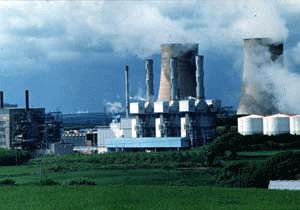 UK’s dream is now its nuclear nightmare https://climatenewsnetwork.net/uks-dream-is-now-its-nuclear-nightmare/?fbclid=IwAR3CEunSXXOxdK_-N8Ka9kwpCMzvHFXNkZf23VGjd6oFuDecember 14, 2018, by Paul Brown
Nobody knows what to do with a vast uranium and plutonium stockpile built up in the UK by reprocessing spent fuel. It is now a nuclear nightmare.
LONDON, 14 December, 2018 − Thirty years ago it seemed like a dream: now it is a nuclear nightmare. A project presented to the world in the 1990s by the UK government as a £2.85 billion triumph of British engineering, capable of recycling thousands of tons of spent nuclear fuel into reusable uranium and plutonium is shutting down – with its role still controversial.
Launched amid fears of future uranium shortages and plans to use the plutonium produced from the plant to feed a generation of fast breeder reactors, the Thermal Oxide Reprocessing Plant, known as THORP, was thought to herald a rapid expansion of the industry.
In the event there were no uranium shortages, fast breeder reactors could not be made to work, and nuclear new build of all kinds stalled. Despite this THORP continued as if nothing had happened, recycling thousands of tons of uranium and producing 56 tons of plutonium that no one wants. The plutonium, once the world’s most valuable commodity, is now classed in Britain as “an asset of zero value.” Continue reading →
December 17, 2018
Posted by Christina Macpherson |
General News |
Leave a comment
https://beyondnuclearinternational.org/2018/12/16/rudolph-the-radioactive-reindeer/ Dosed by Chernobyl and atomic tests, reindeer and their herders are carrying a heavy nuclear burden, By Linda Pentz Gunter, December 16, 2018 by beyondnuclearinternational
Fallout from Soviet atomic bomb tests over the Arctic Ocean, compounded by the 1986 Chernobyl nuclear power plant explosion, have left reindeer too radioactive to eat, even today. That may be good news for the reindeer, sort of. But it’s bad news for the indigenous Laplanders in Finland and Sami herders in Norway, who carry high levels of radiation in their own bodies as well as in the reindeer on which they depend for sustenance and sales.
Reindeer carry heavy radioactive doses, mainly of cesium-137, because they devour lichen, moss and fungi, which bioaccumulate radioactive deposits from fallout. Norway’s radioactive contamination is primarily from Chernobyl, made worse because it was snowing heavily at the time of the April 26 accident.
The Sami story is beautifully explained in this stunning photo essay by Amos Chapple and Wojtek Grojec for Radio Free Europe/Radio Liberty.
As the essay describes it, despite the length of time since the Chernobyl disaster, the fallout is a nasty gift that keeps on giving. “In 2014, there was a huge spike in radiation levels that scientists put down to a bumper season for mushrooms. Hundreds of Norwegian reindeer intended for slaughter had to be released back into the wild.” Levels apparently shot from 1,500 becquerels per kilogram to 8,200.
A video of Chapple and Grojec’s work, on Tech Insider, also explains the impact of cesium-137 fallout on reindeer and their herders. [0n originall]
Unfortunately, Norway’s “allowable” radiation standards are far higher than in other parts of Europe, at 3,000 becquerels per kilogram of food compared to the EU standard of 600 becquerels. When Chapple and Grojec were compiling their story, the herd they visited was testing at 2,100 becquerels, passing the Norwegian test for “safe”. The authors say that the higher levels were established by the Norwegian government in “response to radiation levels in reindeer that threatened the very existence of the Sami herders.”
This practice of simply moving the radiation goalposts to make dangerous levels safe still goes on today, of course, most notably in Japan. As was pointed out in an earlier story on our site, the Japanese government, eager to show the world that the Fukushima region could quickly be made safe for habitation, simply raised the “allowable” annual exposure rate from 1 millisievert to 20, an entirely unacceptable dose for most people, especially women and children.
In Finland, most of the persistent radiation levels are due to atomic testing during the Cold War. Measurements continue to be taken among the Lapland reindeer herders where cesium levels are ten times higher than in the rest of Finland. Although cesium levels in humans were a shocking 45,000 becquerels per kilo in the 1960s according to one report, they still hover at over 1,000 today.
The reduction in slaughter of reindeer comes with other side effects as well. As far back as 1997, it was already being observed that the increase in reindeer population, leading to “Over-grazing and trampling, is causing more damage to the fragile tundra than some of the world’s most seriously polluting factories,” wrote Geoffrey Lean in The Independent.
Now, as Russia begins using floating nuclear reactors to plunder the Arctic Ocean for oil, the region has been placed under threat of a radioactive catastrophe again. From both an economic and health perspective, neither the reindeer nor their indigenous herders can afford a second assault.
December 17, 2018
Posted by Christina Macpherson |
General News |
Leave a comment
Global uranium supply sufficient to meet future demand – NEA14th December 2018 BY: MARLENY ARNOLDI Mining Weekly
CREAMER MEDIA ONLINE WRITER Intergovernmental agency, the Nuclear Energy Association (NEA), says the world’s supply of uranium is more than adequate to meet projected requirements for the foreseeable future, regardless of the role that nuclear energy will play in meeting future electricity demand …..http://m.miningweekly.com/article/global-uranium-supply-sufficient-to-meet-future-demand-nea-2018-12-14/rep_id:3861
December 17, 2018
Posted by Christina Macpherson |
General News |
Leave a comment
To understand the implications of JEDI, we must realize that the information being gathered and sorted will inevitably be used for the targeting and killing of not only opposing government-based military forces, but also nongovernmental individuals and groups who are viewed as political or potential military threats by the US.
The transfer of a massive amount of military information into a privately owned and built cloud, as will happen with the creation of JEDI, raises the possibility that the owner or owners of that cloud will — because of their knowledge of the cloud structure, capabilities and content — become more powerful than military and elected officials.
 “Alexa, Drop a Bomb”: Amazon Wants in on US Warfare, Nick Mottern, Truthout https://truthout.org/articles/alexa-drop-a-bomb-amazon-wants-in-on-us-warfare/December 16, 2018
Amazon is seeking to build a global “brain” for the Pentagon called JEDI, a weapon of unprecedented surveillance and killing power, a profoundly aggressive weapon that should not be allowed to be created.
Founded in 1994 as an online book seller, Amazon is now the world’s largest online retailer, with more than 300 million customers worldwide, and net sales of $178 billion in 2017.
Amazon has built a vast, globally distributed data storage capacity and sophisticated artificial intelligence programs to propel its retail business that it hopes to use to win a $10 billion Pentagon contract to create the aforementioned “brain” that goes by the project name Joint Enterprise Defense Infrastructure, a moniker obviously concocted to yield the Star Wars acronym — JEDI.
As of the October 12, 2018, deadline for submitting proposals for JEDI, Amazon is the betting favorite for the contract, which will go to just one bidder, in spite of protests by competitors, chief among them Microsoft and IBM. The Pentagon appears likely to select a winner for the contract in 2019.
Jedi Powers? Continue reading →
December 17, 2018
Posted by Christina Macpherson |
General News |
Leave a comment





 Antinuclear