A youth activist on the climate crisis: politicians won’t save us
As wildfires burn, as temperatures rise, as the last remaining old-growth forests in Poland are logged, world leaders are in Katowiceto negotiate the implementation of the Paris climate agreement. To outsiders, UN climate talks may seem like a positive step. Unfortunately, this is COP24.
For 24 years, world leaders have annually talked at each other instead of to one another in hopes of reaching an agreement on how to mitigate the climate crisis. In all that time, they have barely scratched the surface of an issue that the world’s top climate scientists say we now have 12 years to stop – and that is an optimistic estimate.
There’s an urgency in my heart being here in Katowice, knowing that this negotiation process is supposed to protect my generation and ones thereafter. I am afraid of the lack of accountability in the space, knowing that the people with power will be patted on the back for simply coming together without making meaningful policy commitments.
When the news stories come out about successful negotiations, we forget about when leaders pushed to leave “human rights” out of policy wording, or stood on the floor advocating for fossil fuels as a solution (hint: they’re not), all to placate to their own interest in power and maintaining it. They are voluntarily blind to the suffering their decisions cause. Homes will be lost, families will be torn apart by displacement and at borders, and the sea will encroach upon whole societies, exterminating cultures and livelihoods. Developed countries like the US, corrupted by fossil fuel interests, are to blame.
UN negotiators have been trying to solve the climate crisis since before I was born. When will global leaders admit that this is a broken and dysfunctional charade instead of burying the reality under false solutions and jargon? What will be the catalyst for people in power to do what is right? Do millions of people have to be displaced? Do we have to be stealing a livable planet from people not even born yet? How many millions of people will have to die from climate damage such as drought, famine, superstorms and wildfires before world leaders commit to implementing real solutions to defeat this crisis?
I’ve been doing this work for five years and have given up a lot to do the things I know are right. I’ve given up personal finances, friendships, a normal adolescence and more to get up on the global stage. I’ve taken breaks from school, failed a few classes.
Youth activists everywhere make personal sacrifices every day in order to protect the world we’ll inherit and our governments can’t do the same for us. The institutions meant to protect me don’t seem to care as much as I do and it’s a burden I carry everyday.
I watch my government and governments around the world trade my future for profit. A future my mother fought hard to secure through sacrifice, when she made the journey to immigrate to the United States. There’s a lot of anger and depression inside of me because of this, but I found happiness and reward in seeing the solutions, power and love in the climate movement.
Though political institutions have fallen short, being on the ground here does offer hope: it proves the strength of people power. Politicians will never be the core of this movement. We need to highlight and uplift genuine grassroots movements that properly address the lived experiences of the people they protect. We need to turn our attention and our energy into communities that are helping themselves in the best ways that they can.
The marginalized communities on the frontlines know what it actually means to sacrifice in order to uphold future generations and young people. They understand giving up their own comforts to protect lives.
We have called on our political leaders to demonstrate a similar understanding. But resilience can’t be taught, and it doesn’t come from a president, minister or monarch: it comes from the adversity you have faced. This is why, to fight the powers that hand away pieces of our environment for profit, we must enlist the people who have lived on the margins of society. People power will always be stronger than the people in power.
Victoria Barrett is one of the 21 plaintiffs, aged 10 to 21, in the high-profileJuliana v the United States lawsuit, which faulted the US government for failing to protect its citizens from climate change. She represents marginalized voices at international conferences and has addressed the United Nations general assembly on the topic of youth involvement in its sustainable development goals.
The South Australian farmers taking the fight to mining companies
There’s a sound some South Australian farmers are absolutely terrified of hear — it threatens their properties, their families and ultimately, their livelihood. The Sunday Mail explores life on the land, and how mining exploration is impacting our farmers… (subscribers only)
Whyalla powering ahead – with renewable energy!
Why Tony, Whyalla’s still on the map … and powering ahead, Brisbane Times, By Peter FitzSimons, 15 December 2018 The irony is exquisite. Back in 2011 when he was opposition leader, Tony Abbott visited the famed industrial town and warned darkly: “Whyalla will be wiped off the map by Julia Gillard’s carbon tax. Whyalla risks becoming a ghost town, an economic wasteland if this carbon tax goes ahead.”
You get the drift. Back then, the leader of the Libs was sounding the clarion call we still hear in certain sections today: turn your back on the whole idea of a green economy, of lowering emissions, of embracing renewable energy, or face economic Armageddon. But what actually happened? Well, funny you should ask. For just last week, as reported by the‘Tiser, the British steel magnate Sanjeev Gupta has announced his plans “to build one of the biggest steelworks in the world in Whyalla, which would aim to pump billions of dollars into the state’s economy and quadruple the city’s population”.
How will those steelworks be powered? Mostly by renewable energy! But wait, there’s more.
There are also plans to sink $145 million into an “intensive horticulture project, powered by solar energy and backed by Chinese investors; a new $45 million hotel on the foreshore to be built by the Pelligra Group, owners of the Holden site in Elizabeth; and a $6 million green organics recycling plant”. You get the drift. Far from being destroyed by the embrace of renewables, Whyalla is heading towards being a national powerhouse, and a renewable powerhouse at that!…… https://www.brisbanetimes.com.au/national/why-tony-whyalla-s-still-on-the-map-and-powering-ahead-20181214-p50me7.html
Some good news in the climate battle – over 1000 institutions to divest from fossil fuels
 Climate change: More than 1000 institutions pledge to withdraw investment from fossil fuels https://www.independent.co.uk/environment/fossil-fuels-divest-climate-change-global-warming-emissions-campaign-a8681931.html ‘This is a moral movement as well as a financial one,’ campaigners say Josh Gabbatiss Science Correspondent @josh_gabbatiss 14 Dec 18, Governments, universities and banks have quit fossil fuels in their hundreds after a global campaign to convince institutions to pull their investments. Climate change: More than 1000 institutions pledge to withdraw investment from fossil fuels https://www.independent.co.uk/environment/fossil-fuels-divest-climate-change-global-warming-emissions-campaign-a8681931.html ‘This is a moral movement as well as a financial one,’ campaigners say Josh Gabbatiss Science Correspondent @josh_gabbatiss 14 Dec 18, Governments, universities and banks have quit fossil fuels in their hundreds after a global campaign to convince institutions to pull their investments.
|
|
|
Want to solve climate problem? Nuclear isn’t the answer
 Want to solve climate problem? Nuclear isn’t the answer https://www.downtoearth.org.in/blog/energy/want-to-solve-climate-problem-nuclear-isn-t-the-answer-62428 Want to solve climate problem? Nuclear isn’t the answer https://www.downtoearth.org.in/blog/energy/want-to-solve-climate-problem-nuclear-isn-t-the-answer-62428
Alternatives to nuclear energy, in particular renewable sources of electricity like wind and solar energy, have become drastically cheaper. By M V Ramana December 2018 “It is nuclear power that will be the main tool to reduce emissions” said Poland’s Minister of Energy, Krzysztof Tchórzewski, in keynote remarks at a meeting during the 24th Conference of Parties to the United Nations Framework Convention on Climate Change (COP 24) being held in Katowice, Poland. There is more than a little irony in that statement. To start with, Poland, which is invested heavily in coal, has no nuclear power plants; its current plans call for starting nuclear power generation in 2030. That projection has to be taken with more than a pinch of salt. In 2002, even the International Atomic Energy Agency (IAEA), whose official objective is “to accelerate and enlarge the contribution of atomic energy”, concluded that nuclear power in Poland was not viable because of “insufficient economic competitiveness of nuclear plants, availability of cheaper alternatives and the absence of environmental motivation”. The second irony was that Tchórzewski was speaking at an event organised by an initiative called Nuclear Innovation: Clean Energy Future, that was set up in May 2018 by the country that is withdrawing from the Paris climate accord, the United States of America. The United States, under the Trump administration, has been engaged in the perverse pursuit of various efforts that will result in increased emissions. Such an administration touting nuclear power suggests a basis for scepticism about nuclear energy being a tool to reduce emissions. The final, and the most important, irony is that nuclear energy is fading in importance globally. The peak in nuclear power’s share of global electricity generation was 17.5 percent in 1996. Since then this fraction has steadily declined, reaching 10.3 percent in 2017. For a variety of reasons, the downward trend is expected to continue. Although nuclear energy’s share of electricity generation has been continuously declining, expectations for how nuclear energy will fare in the future went up in the first decade of this millennium, thanks to propaganda from nuclear advocates about an impending nuclear renaissance. That supposed resurgence came to a crashing halt after multiple devastating accidents at the Fukushima Daiichi nuclear plant in Japan that started in 2011, which reminded the world about the hazardous technology involved in the generation of nuclear power. Even the IAEA’s average projections for nuclear power for the year 2050 have decreased from 1,002 gigawatts (GW) as laid out in 2010 to 552 GW in its 2018 publication. This decline reflects the corresponding declines in future projections of nuclear power in many individual countries as exemplified by India and China. In 2010, the secretary of India’s Department of Atomic Energy (DAE) announced a target of 35 GW by 2020. The DAE is nowhere near that target and, as of December 2018, the current capacity is only 6.8 GW. If all the currently under-construction plants are ready in time, the total installed capacity will reach 13.5 GW by 2024-25, a far cry from earlier projections. In China, the country constructing the largest number of nuclear plants, the official target as of 2010 was 70 GW by 2020, and the expectation was that “reaching 70GW before 2020 will not be a big problem”. That proved not to be the case and China’s current target for 2020 is only 58 GW and it is unlikely to meet that target. India and China are often considered the poster children for nuclear energy growth—and even there the picture is quite dismal. The outlook in other countries is worse. Operating nuclear capacity in the two countries with the largest deployments of nuclear power plants, the United States and France, is expected to decline. What is behind this trend? Fukushima is only a minor part of the story. The primary reason is that nuclear power is no longer financially viable. Because they are hugely expensive, it has been known for a while that building new nuclear power plants makes little economic sense. What has changed in the last decade is that it is not just constructing new reactors, but just operating one, even one that is old and has its capital costs paid off, that has ceased to make economic sense. This is because alternatives to nuclear energy, in particular renewable sources of electricity like wind and solar energy, have become drastically cheaper. In contrast, just about every nuclear plant that was constructed in the last decade has proven more expensive than initially projected. This economic reality adds to the other well-known problems associated with nuclear energy—the absence of any demonstrated solutions to managing radioactive waste in the long run, the linkage with nuclear weapons, and the potential for catastrophic accidents. The bottom line is that nuclear power cannot be a tool to decrease emissions. If we want to solve the climate problem, we will have to look elsewhere. |
Between 340,000 and 690,000 Americans died from radioactive fallout from 1951 to 1973.
In the 1950s, the U.S. government downplayed the danger of radioactive fallout, asserting that all radioactivity was confined to the Nevada test site. Despite this, a national estimate attributed 49,000 cancer deaths to nuclear testing in the area.
But the results of new research suggest that this number is woefully inaccurate. Using a novel method, and today’s improved understanding of radioactive fallout, Keith Meyers from the University of Arizona  discovered that U.S. nuclear testing was responsible for the deaths of at least as many — and likely more — as those killed by the nuclear bombs in Hiroshima and Nagasaki.
Specifically, between 340,000 and 690,000 Americans died from radioactive fallout from 1951 to 1973.
At least 340,000 Americans died from radioactive fallout between 1951 and 1973 https://bigthink.com/politics-current-affairs/new-estimate-deaths-from-us-nuclear-tests?rebelltitem=2#rebelltitem2 Domestic nuclear testing wreaked havoc on thousands of families. MATTHEW DAVIS 14 December, 2018
- Hiroshima and Nagasaki resulted in the deaths of hundreds of thousands. But new research
 shows that domestic U.S. nuclear tests likely killed more.
 - The new research tracked an unlikely vector for radioactive transmission: dairy cows.
- The study serves as a reminder of the insidious and deadly nature of nuclear weapons.

When we think of nuclear disasters, a few names probably come to mind. There’s the Chernobyl disaster, which killed around 27,000 people, although estimates are fuzzy. After Fukushima, there were no deaths due to radiation poisoning, but this event occurred relatively recently, and radiation poisoning often kills slowly over decades. When the U.S. dropped atomic bombs on Hiroshima and Nagasaki, estimates put the death toll at around 200,000 people, but again, exact numbers are difficult to calculate.
One name that almost certainly didn’t come to mind is Nevada. When the Soviet Union detonated their first atomic bomb in 1949, the U.S. was shocked into action. America’s prior nuclear testing had been carried out in the Pacific, but it was logistically slow and costly to conduct tests there. In order to maintain dominance over the growing Soviet threat, the U.S. selected a 1,375 square-mile area in Nye County, Nevada. Continue reading
Time for the world to remember the movie “The Day After”
It’s Time to Face Up to Our Nuclear Reality
The made-for-TV movie The Day After had an enormous impact on America’s national conversation about nuclear weapons in 1983. Resuming that conversation today is essential, and the movie holds some lessons about what that would take. The Nation, By Dawn Stover– 14 Dec 18 This article originally appeared as part of a special section on The Day After at the Bulletin of the Atomic Scientists “…….The television movie The Day After depicted a full-scale nuclear war and its impacts on people living in and around Kansas City. Continue reading
Climate change: global heating is drying soils, causing shrinking of world’s water supply
The long dry: why the world’s water supply is shrinking, EurekAlert, : 13-DEC-2018
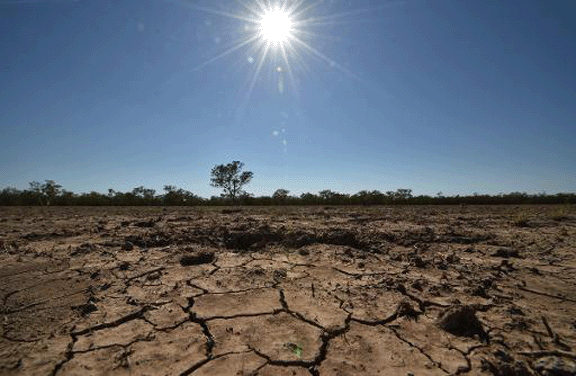 Global water supplies are shrinking, even as rainfall is rising; the culprit? The drying of soils due to climate change
UNIVERSITY OF NEW SOUTH WALES A global study has found a paradox: our water supplies are shrinking at the same time as climate change is generating more intense rain. And the culprit is the drying of soils, say researchers, pointing to a world where drought-like conditions will become the new normal, especially in regions that are already dry.
The study – the most exhaustive global analysis of rainfall and rivers – was conducted by a team led by Professor Ashish Sharma at Australia’s University of New South Wales (UNSW) in Sydney. It relied on actual data from 43,000 rainfall stations and 5,300 river monitoring sites in 160 countries, instead of basing its findings on model simulations of a future climate, which can be uncertain and at times questionable
“This is something that has been missed,” said Sharma, an ARC Future Fellow at UNSW’s School of Civil and Environmental Engineering. “We expected rainfall to increase, since warmer air stores more moisture – and that is what climate models predicted too. What we did not expect is that, despite all the extra rain everywhere in the world, is that the large rivers are drying out.
“We believe the cause is the drying of soils in our catchments. Where once these were moist before a storm event – allowing excess rainfall to run-off into rivers – they are now drier and soak up more of the rain, so less water makes it as flow.
“Less water into our rivers means less water for cities and farms. And drier soils means farmers need more water to grow the same crops. Worse, this pattern is repeated all over the world, assuming serious proportions in places that were already dry. It is extremely concerning,” he added.
For every 100 raindrops that fall on land, only 36 drops are ‘blue water’ – the rainfall that enters lakes, rivers and aquifers – and therefore, all the water extracted for human needs. The remaining two thirds of rainfall is mostly retained as soil moisture – known as ‘green water’ – and used by the landscape and the ecosystem.
As warming temperatures cause more water to evaporate from soils, those dry soils are absorbing more of the rainfall when it does occur – leaving less ‘blue water’ for human use.
“It’s a double whammy,” said Sharma. “Less water is ending up where we can store it for later use. At the same time, more rain is overwhelming drainage infrastructure in towns and cities, leading to more urban flooding.”
Professor Mark Hoffman, UNSW’s Dean of Engineering, welcomed Sharma’s research and called for a global conversation about how to deal with this unfolding scenario, especially in Australia, which is already the driest inhabited continent (apart from Antarctica).
“It’s clear there’s no simple fix, so we need to start preparing for this,” he said. “Climate change keeps delivering us unpleasant surprises. Nevertheless, as engineers, our role is to identify the problem and develop solutions. Knowing the problem is often half the battle, and this study has definitely identified some major ones.”
The findings were made over the past four years, in research that appeared in Nature Geoscience, Geophysical Research Letters, Scientific Reports and, most recently, in the American Geophysical Union’s Water Resources Research………..
Sharma said the answer was not just more dams. “Re-engineering solutions are not simple, they have to be analysed on a region-by-region basis, looking at the costs and the benefits, looking at the change expected into the future, while also studying past projects so mistakes are not repeated. There are no silver bullets. Any large-scale re-engineering project will require significant investment, but the cost of inaction could be monstrous.”
In urban areas, the reverse will be needed: flooding is becoming more common and more intense. Global economic losses from flooding have risen from an average of $500 million a year in the 1980s to around $20 billion annually by 2010; by 2013, this rose to more than US$50 billion. The Intergovernmental Panel on Climate Change expects this to more than double in the next 20 years as extreme storms and rainfall intensify and growing numbers of people move into urban centres.
Adapting to this is possible, but will require large-scale re-engineering of many cities, says Sharma. “Tokyo used to get clobbered by floods every year, but they built a massive underground tank beneath the city that stores the floodwater, and releases it later. You never see floods there now.” https://www.eurekalert.org/pub_releases/2018-12/uons-tld121118.php
Dreaming of a sustainable Christmas: How to reduce your ecological footprint this festive season
But the good news is that you can still live a little this festive season without having a big ecological impact.
Key points:
- Make sure your seafood is nice, not naughty — local fish is best
- Reduce or re-use plastic wrapping and decorations, or use paper alternatives
- Consider vouchers, jars of food or experiences as presents, rather than plastic gifts…….https://www.abc.net.au/news/2018-12-14/how-to-celebrate-a-sustainable-christmas/10617782
‘There should be no nuclear in climate financing’
 https://www.dw.com/en/there-should-be-no-nuclear-in-climate-financing/a-46740978
Prize-winning South African activist Makoma Lekalakala’s successful legal battle to stop a secret nuclear power deal in her homeland won her international acclaim. She tells DW about defending the environment in court.
Makoma Lekalakala: My major campaigning issue, it’s mitigation against climate change and with a specific focus on electricity generation in the country [South Africa] — it’s almost 90 percent from coal. And we know that coal is a major contributor of greenhouse gas emissions, so our campaign has been for a just transition towards a low carbon development.
We’re demanding a greater investment in renewable energy technologies, particularly that we can have a decentralized electricity system where solar and wind would play a major role. Continue reading
Climate change talks result in renewed pledge to cut emissions

 EU, Canada, New Zealand and developing countries to keep global warming below 1.5C Guardian, Fiona Harvey, Ben Doherty and Jonathan Watts in Katowice, 13 Dec 2018
The promise, which follows increasingly dire scientific warnings, was the most positive message yet to come from the ongoing talks in Poland.
The announcement came at the end of a day in which the UN secretary general made an impassioned intervention to rescue the talks, which have been distracted by US, Russian and Saudi moves to downgrade scientific advice.
“We’re running out of time,” António Guterres told the plenary. “To waste this opportunity would compromise our last best chance to stop runaway climate change. It would not only be immoral, it would be suicidal.”
The talks have centred on devising a rulebook for implementing the 2015 Paris agreement and raising countries’ level of ambition to counter climate change, but progress has been slow on several key issues and divisions have emerged between four fossil fuel powers – the US, Russia, Saudi Arabia and Kuwait – and the rest of the world.
The UN believes China could play a stronger role in the absence of leadership from the US. Sources said Guterres would make a telephone call to Xi to ask for his help in nudging talks forward.
The EU also wants China, which is a key member of the block of 77 developing countries, to step up to ensure that countries all follow the same rules in being transparent over their greenhouse gas emissions.
Campaigners praised the decision by the High Ambition Coalition group of countries, made up of the EU and four other developed countries, including Canada and New Zealand, as well as the large grouping of least developed countries and several other developing nations, to scale up their emissions-cutting efforts in line with a 1.5C temperature rise limit.
Wendel Trio, director of the Climate Action Network Europe, said: “The spirit of Paris is back. The statement will boost greater ambition at the crunch time of these so far underwhelming talks. For the EU this must mean a commitment to significantly increase its 2030 target by 2020, even beyond the 55% reduction some member states and the European parliament are calling for. We call upon the countries that have not signed the statement so far to stop ignoring the science.”
Guterres, in a pointed criticism aimed at the four countries that have been refusing to “welcome” the Intergovernmental Panel on Climate Change’s special report on 1.5-degree warming, said rejecting climate science was indefensible.
He added: “The IPCC special report is a stark acknowledgment of what the consequences of global warming beyond 1.5 degrees will mean for billions of people around the world, especially those who call small island states home. This is not good news, but we cannot afford to ignore it.”
Frank Bainimarama, the prime minister of Fiji and the outgoing chair of COP23, amplified Guterres’ message. He told delegates they risked going down in history as “the generation that blew it – that sacrificed the health of our world and ultimately betrayed humanity because we didn’t have the courage and foresight to go beyond our short-term individual concerns: craven, irresponsible and selfish”.
The former US vice-president Al Gore told delegates they faced “the single most important moral choice in history of humanity”.
Behind the scenes, delegates said there had been strong progress on finance thanks to a doubling of commitments by Germany and Norway to help poorer nations adapt to climate change and build institutions capable of monitoring emissions. Nicholas Stern, the author of a landmark review on the economics of climate change, praised “the level of ideas and cooperation”.
But others said there were still many disputed brackets in the negotiating text on transparency and other elements of the rulebook……..
“The window for action is closing fast. We need to do more and we need to do it now,” said the document, which would form part of the official statement from this conference. https://www.theguardian.com/environment/2018/dec/12/un-chief-antonio-guterres-attempts-to-revive-flagging-climate-change-talks
High alert as bushfire risk reaches Black Saturday levels
 12 Dec 18, The bushfire risk is back to Black Saturday levels in Victoria’s most dangerous and populous zone, stretching from Kilmore to Morwell and covering 59 per cent of the state’s population… . (subscribers only)
Maine watchdogs keep close eye on Trump’s bid to change nuclear waste storage rules
 https://bangordailynews.com/2018/12/12/news/midcoast/maine-watchdogs-keep-close-eye-on-trumps-bid-to-change-nuclear-waste-storage-rules/ • December 12 2018, A new proposal by President Donald Trump’s administration to reclassify some high-level nuclear waste to reduce cleanup costs will not affect the 550 metric tons of spent nuclear fuel stored in more than 60 airtight steel canisters near the former Maine Yankee nuclear reactor in Wiscasset. https://bangordailynews.com/2018/12/12/news/midcoast/maine-watchdogs-keep-close-eye-on-trumps-bid-to-change-nuclear-waste-storage-rules/ • December 12 2018, A new proposal by President Donald Trump’s administration to reclassify some high-level nuclear waste to reduce cleanup costs will not affect the 550 metric tons of spent nuclear fuel stored in more than 60 airtight steel canisters near the former Maine Yankee nuclear reactor in Wiscasset.
The new proposal focuses on waste generated by nuclear weapons, not power plants. But Mainers tasked with advocating for safe handling of atomic waste voiced concern that it could foretell changes that would affect the Maine Yankee waste.
“Safety costs money; environmental protection costs money,” said Edgecomb resident Ray Shadis, technical adviser to the New England Coalition on Nuclear Pollution in Brattleboro, Vermont, and founder of the group Maine’s Friends of the Coast that eventually got Maine Yankee shut down. “I think that’s the next shoe. This initiative at the weapons’ facilities is very likely the first step.” The U.S. Department of Energy has proposed reclassifying some high-level radioactive waste in various U.S. locations to low-level, allowing the department to leave the waste buried in the ground and save $40 billion in cleanup costs, the Associated Press reported Tuesday. Per the Atomic Energy Act of 1954 and the Nuclear Waste Policy of 1982, high-level radioactive waste is currently defined as waste resulting from processing irradiated nuclear fuel that is highly radioactive. Shadis said the proposal would not affect waste at the former Maine Yankee plant, which closed in 1996. Trump’s current proposal would only affect high-level radioactive waste generated by nuclear weapons production — currently stored in South Carolina, Idaho, Washington and New York — not waste generated by civilian nuclear production. “The terms ‘highly radioactive’ and ‘sufficient concentrations’ are not defined in the [Atomic Energy Act] or the [Nuclear Waste Policy Act],” the proposal states. It goes on to argue that “Congress left it to [Department of Energy] to determine when these standards are met. Given Congress’ intent that not all reprocessing waste is [high-level waste], it is appropriate for DOE to use its expertise to interpret the definition of [high-level waste], consistent with proper statutory construction, to distinguish waste that is non-HLW from waste that is HLW.” According to Shadis, industry officials and regulators have insisted since the beginning of the nuclear age that civilian nuclear production and weapons production for defense have nothing to do with each other. They are not integrated in any way and are handled separately. In fact, waste generated by civilian nuclear reactors is regulated by the U.S. Nuclear Regulatory Commission. Eric Howes, spokesman for Maine Yankee, said Tuesday he is not aware of any proposals to reclassify waste stored at Maine Yankee. Nevertheless, Shadis said, “I will say that we could simply wait for the other shoe to drop, because the Trump administration has rushed to the rescue of commercial power plants, which are shutting down all over the country because they are no longer competitive … it’s one way of fixing the game. One way of adjusting the cost of nuclear is to be more lenient when it comes to environmental regulations, including regulations regarding nuclear waste.” “That’s completely outrageous,” Don Hudson, chairman of the Maine Yankee Community Advisory Panel, said of the proposal. “They couldn’t have done that with a straight face. But it doesn’t affect Maine Yankee’s waste.” A federal judge has already awarded Maine Yankee $24.6 million in a decision based on the federal government’s failure to remove and dispose of the spent nuclear fuel. But Hudson said again on Tuesday there is no viable solution for the waste in Wiscasset, although “there are a couple of potential projects that might get built sometime in the next decade for above-ground storage near Carlsbad, New Mexico, and west Texas.” Previous administrations have said “stranded” nuclear waste — hazardous materials stored where there is no operating nuclear plant such as Maine Yankee, Yankee Rowe in Massachusetts and several others — would be the first to be removed, according to Hudson. But he said he isn’t holding his breath. “The impasse on the nuclear waste issue continues,” Howes said. “Congress to date has not provided any funding in the fiscal year 2019 budget for consolidated interim storage or the Yucca Mountain license application process. Maine Yankee and many others are urging Congress to provide fiscal year 2019 funding for nuclear waste management during this lame duck session of Congress.” “I hate to sound cynical, but I’m not going to believe it’s going to happen until I actually hear there’s a bulldozer on the ground,” Hudson said. “It’s really dangerous stuff, and it needs to be taken care of … depending on who you ask, it’s going to be multi tens of thousands of years before you could assign just casual care of this waste.” |
|
TRUMP WANTS TO RECLASSIFY RADIOACTIVE WASTE FROM NUCLEAR WEAPONS TO ‘LOW LEVEL’ SO DISPOSAL IS CHEAPER
|
NEWSWEEK, BY ON 12/11/18President Donald Trump’s administration reportedly plans to reclassify high-level radioactive waste scattered around the U.S. in order to make it easier and cheaper to dispose of. The Department of Energy intends to relabel high-level radioactive waste left over from the production of nuclear weapons as low-level, the Associated Press reported. Currently, high-level radioactive waste is defined as that which is a byproduct of fuel reprocessing (where leftover fissionable material is separated from the waste) or from nuclear reactors. Low-level waste, on the other hand, represents around 90 percent of all such waste, according to the American Nuclear Society, and generally comes from facilities where radioisotopes are used, such as nuclear power stations, and local hospitals. Items often include wipes, clothes and plastic. In the U.S., 90,000 metric tons of nuclear waste is being temporarily stored as successive administrations have grappled to find a long-term solution. Storing nuclear waste safely presents a number of challenges: it needs to be protected from natural disasters, and stopped from seeping into the surrounding water and soil, while its radiation blocked. Thieves must be kept from accessing it, and so too future generations who may not understand how toxic such materials are. The Associated Press reported the agency said the reclassification would shave $40 billion off the cost of cleaning up after the production of nuclear weapons. A Department of Energy official told Newsweek it is requesting public comment on its interpretation of the meaning of the statutory term of high-level radioactive waste through the federal register. …….. Facilities which would be affected include the country’s most highly contaminated: the Hanford Nuclear Reservation in Washington state, which takes up an area half the size of Rhode Island. Opened in 1943, the site produced the plutonium for the atomic bomb dropped on Nagasaki, Japan in 1945, according to its website. The production of nuclear materials carried on until 1987, leaving behind waste that threatened the local environment, prompting the state and federal authorities — including the Department of Energy, the Environmental Protection Agency — to pledge in 1987 to clean up the site, without success. Other facilities mentioned in the plans are the Savannah River Plant, South Carolina and the Idaho National Laboratory, according to the Associated Press……. Alex Smith, Program Manager of the State of Washngton Department of Ecology Nuclear Waste Program, which is involved in the Hanford project, told the Associated Press: “They see it as a way to get cleanup done faster and less expensively.” The consultation originally ran from October 10 until December 10. Democratic Senator Ron Wyden for Oregon requested a public consultation on the proposal be extended to January 9……..https://www.newsweek.com/trump-reclassify-radioactive-waste-nuclear-weapons-low-level-disposal-cheaper-1253063?fbclid=IwAR1H-mvAOsdN24NT1pKy3MGAuVDn_q_siZc67iXsl-eLkKNFNMeZ4F8xKgA |
|
|
Pacific island countries accuse USA of obstructing talks at UN climate change summit
Vanuatu’s foreign minister says worst offenders on global warming are blocking progress, Guardian, Ben Doherty in Katowice@bendohertycorro, Wed 12 Dec 2018
“It pains me deeply to have watched the people of the United States and other developed countries across the globe suffering the devastating impacts of climate-induced tragedies, while their professional negotiators are here at COP24 putting red lines through any mention of loss and damage in the Paris guidelines and square brackets around any possibility for truthfully and accurately reporting progress against humanity’s most existential threat,” he said.
Regenvanu said the countries most responsible for climate change were now frustrating efforts to counter it.
The UN’s climate change talks in Poland have been distracted by a semantic debate over whether the conference should “welcome” or “note” the IPCC’s special report warning of dire consequences if global warming rises more than 1.5C above pre-industrial levels, with a bloc of four oil-producing countries – the US, Saudi Arabia, Russia, and Kuwait – insisting the report be only “noted”.
Documents from the conference presidency, seen by the Guardian, indicate the issue of how to acknowledge the report will be returned to later in the week and is likely to further slow progress on negotiating a final outcome. Negotiators said they are growing increasingly pessimistic that talks can be concluded by their deadline on Friday…….
As 193 countries at the climate talks seek to establish a “rule book” on how to implement the commitments made in the Paris agreement three years ago, Regenvanu condemned a two-tier system that exempted high-emissions countries from reductions obligations, saying the world needed “one common rule book, in which rules apply to all”.
The US state department declined to comment on his remarks……https://www.theguardian.com/environment/2018/dec/11/us-accused-of-obstructing-talks-at-un-climate-change-summit
1 This month

of the week – Australians for War Powers Reform (AWPR)
To see nuclear-related stories in greater depth and intensity
 Antinuclear