Antinuclear

Australian news, and some related international items

World running out of time to combat climate change, warns meteorological organisation

Past four years hottest on record, data shows https://www.theguardian.com/environment/2018/nov/29/four-years-hottest-record-climate-change Fiona HarveyEnvironment correspondent 29 Nov 2018 

World running out of time to combat climate change, warns meteorological organisation Global temperatures have continued to rise in the past 10 months, with 2018 expected to be the fourth warmest year on record.

Average temperatures around the world so far this year were nearly 1C (1.8F) above pre-industrial levels. Extreme weather has affected all continents, while the melting of sea ice and glaciers and rises in sea levels continue. The past four years have been the hottest on record, and the 20 warmest have occurred in the past 22 years.

The warming trend is unmistakeable and shows we are running out of time to tackle climate change, according to the World Meteorological Organization, which on Thursday published its provisional statement on the State of the Climate in 2018. The WMO warned that, on current trends, warming could reach 3C to 5C by the end of this century. Continue reading

December 1, 2018 Posted by | General News | 1 Comment

Climate Change is the World’s Worst Public Health Crisis – new report finds

A New Report Finds That Climate Change is the World’s Worst Public Health Crisis https://www.motherjones.com/environment/2018/11/climate-change-public-health-report/

Researchers forecast more disease and disaster as the planet warms.

The report, written by a team of international researchers, focuses on several climate-related impacts, including extreme heat and its effect on labor productivity and the spread of disease. In 2017, 153 billion hours of labor were lost due to heat—an increase of more than 62 billion hours since 2000. This correlates with a rise in exposure to heat waves and extreme weather events such as hurricanes and wildfires that have already made thousands of climate refugees and are expected to create millions more.

Many of those refugees, one of the report’s author notes, are American. In a press call on Tuesday, Renee Salas, a doctor of emergency medicine at Massachusetts General Hospital and lead author of the Lancet Countdown US Brief, described a recent experience close to home. “I had a patient who came from Puerto Rico, came with bag of luggage, bag of medication she hasn’t taken in days. She was truly a climate refugee who was in my emergency department,” Salas said. “I can’t think of a population more at risk of health effects than a displaced individual.”

Even small changes in temperature and precipitation can result in large changes in the transmission of vector-borne and water-borne diseases, the report notes. In 2016, there were significant increases in the the capacity for insect-borne bacteria and viruses—especially those that cause dengue fever, cholera, and malaria—to be transmitted. (This finding was echoed in last week’s federal climate assessment, which found that climate change would “alter the geographic range and distribution of disease-carrying insects and pests” in the United States.)

Meanwhile, the world’s capacity to grow food also appears to be under threat. An examination of agricultural yields shows declines in every region; 30 countries produced less food in recent years.

The Lancet Countdown’s report does include cause for hope. More electric vehicles were on the road in a 2017 than ever before, and investment in renewable energy has significantly increased, while coal consumption continues to decline. China is responsible for many of these changes. It claims more than 40 percent of all electric cars sold, and it is leading in the installation of renewable energy sources.

Yet spending on climate change adaptation remains well below the amount outlined by the 2015 Paris Agreement, which President Donald Trump has announced the United States will not abide by. And only 3.8 percent of that spending is dedicated to human health. Former Environmental Protection Agency Administrator Gina McCarthy, now the director of the Center for Climate, Health and the Global Environment at Harvard University, says it is crucial to recognize the impacts of climate change on health. She describes visiting California in the midst of the recent wildfire that spread smoke across the state. “It was so clear to see people with masks on literally walking on the streets of San Francisco and downtown Palo Alto,” McCarthy says. “This didn’t look like the United States of America.”

Fine particulate matter—what the masks McCarthy saw Californians wearing are designed to filter out—accounted for nearly 3 million premature deaths in 2015, according to the report. Pollution has actually worsened in nearly three-quarters of the world’s cities since 2010. Road fuel use increased by 2 percent from 2013 to 2015, and cycling—a main alternative to driving in cities—made up less than 10 percent of commutes.

The report, which is aimed at health professionals, argues that they must do more to educate the public about climate change. The impacts of inaction, the report’s authors write, cannot be overstated. As McCarthy notes, “I don’t think people question a diagnosis from their physicians just because a president decides he might not believe in something. This is not about a belief system. This is about science and facts.”

December 1, 2018 Posted by | General News | 1 Comment

The Holtec nuclear waste storage canisters at San Onofre are lemons and must be replaced with thick-wall casks.

  NRC admits San Onofre Holtec nuclear waste canisters are all damaged San Onofre Safety, November 29, 2018 by Donna Gilmore

The Holtec nuclear waste storage canisters at San Onofre are lemons and must be replaced with thick-wall casks. Oceanside:   The Nuclear Regulatory Commission (NRC) admits in their November 28, 2018 NRC Inspection Report and Notice of Violation, ML18332A357 (page 8 and 9) every Holtec canister downloaded into the storage holes is damaged due to inadequate clearance between the canister and the divider shell in the storage hole (vault).  The NRC states canister walls are already “worn”.  This results in cracks. Once cracks start, they continue to grow through the wall.

The NRC stated Southern California Edison (and Holtec) knew about this since January 2018, but continued to load 29 canisters anyway.  Edison’s August 24, 2018 press release states they plan to finish loading mid 2019.

The NRC states Edison must stop loading canisters until this issue is resolved.  However, there is no method to inspect or repair cracking canisters and the NRC knows this.

Instead, the NRC should admit the Holtec system is a lemon — a significant defective engineering design — and revoke both San Onofre and Holtec dry storage system licenses.

The NRC should require all San Onofre thin-wall canisters be replaced with thick-wall transportable storage casks.  These are the only proven dry storage systems that can be inspected, maintained, repaired and monitored in a manner to prevent major radiological releases and explosions.

California state agencies should revoke San Onofre permits and withhold Decommissioning Trust Funds until these issues are resolved.

The Navy should consider revoking the San Onofre Camp Pendleton lease until Edison agrees to replace thin-wall canisters with proven thick-wall transportable storage casks.  This is a national security issue. If the NRC cannot do their job, maybe it’s time to bring in the Marines. The Navy has nuclear experts. Sign petition to recall and replace San Onofre defective thin-wall canisters with proven thick-wall casks     https://sanonofresafety.org/2018/11/29/11-29-2018-nrc-admits-san-onofre-holtec-nuclear-waste-canisters-are-all-damaged/

November 30, 2018 Posted by | General News | Leave a comment

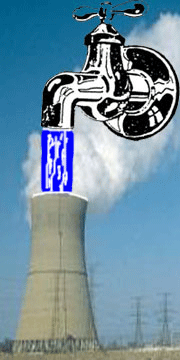
Water-guzzling nuclear reactors should have no place in a global warming world

For nuclear plants, that warning is particularly grave.  Reactors require 720 gallons of water per megawatt-hour of electricity they produce……Solar plants, by contrast, use approximately 20 gallons per megawatt-hour, mostly for cleaning equipment

Trump Administration’s Climate Report Raises New Questions About Nuclear Energy’s Future
The thirstiest source of electricity is already struggling, and greater risk of droughts will only add to those woes. Huffington Post.
By Alexander C. Kaufman, 28 Nov 18, 

Call it the nuclear power industry’s thirst trap. Continue reading

November 29, 2018 Posted by | General News | Leave a comment

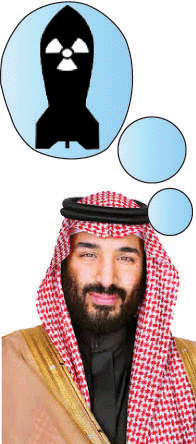
A nuclear kingdom for Saudi Arabia’s Crown Prince Mohammad Bin Salman (MbS)?

The Crown Prince May Build Himself a Nuclear Kingdom https://nationalinterest.org/blog/middle-east-watch/crown-prince-may-build-himself-nuclear-kingdom-37292 The Trump administration should keep a close eye on Saudi Arabia’s nuclear connections and activities. by Ronen Dangoor, 28 Nov 18

The horrific murder of Jamal Khashoggi shed light on the reckless and dangerous decisionmaking process of Saudi Arabia’s Crown Prince Mohammad Bin Salman (MbS). In addition to the latest crisis The New York Times recently published a story about how the prince’s closest security personnel sought to hire private foreign companies to assassinate senior Iranian officials—an act that could have trigger a regional military conflict. This conduct follows a string of other bizarre events in the last few months, initiated by MbS.

The crown prince has demonstrated arrogant, cruel, amateur and capricious behavior. His aggression has been left almost unmonitored by checks and balances inside the Saudi hierarchy. Indeed, MbS has constrained all his potential rivals and has taken full controlof Saudi Arabia’s security and intelligence bodies. As the Khashoggi scandal has proven—such power enables dictators to secretly execute dangerous operations. In parallel, he managed to become the darling of the West after he initiated economic reforms and launched his so called modern 2030 vision .

Now add Saudi’s long history of nuclear ambitions to the mix. For years, Saudi officials have warned that Saudi Arabia will not curb its nuclear ambitions if it will sense a threat to its national security, or if Iran advances in its nuclear program. Rumors were that Pakistan was obliged to provide the Saudis a ready-for-use nuclear weapon if and when the time comes. Things only got more complicated once the nuclear agreement (JCPOA) with Iran was signed in 2015, practically legitimizing Iran’s rights to maintain and develop its uranium enrichment capabilities. At the beginning of November 2018, the crown prince participated in the opening ceremony marking the launch of construction of Riyadh’s first research reactor . It’s still early days and only a symbolic act—the Saudis lack knowhow, technicians, infrastructure and academic expertise—but the country has both enough ambition and funds to advance anyway. Shortly after that the Saudi energy minister said the kingdom launches uranium exploration program.

Over the last decade, purchasing sixteen nuclear power reactors—later scaled back to two reactors—plus uranium enrichment capabilities preferably from the United States, has featured prominently on the Saudi agenda. The official rationale is the country’s future needs to supply energy —with self-sufficient nuclear materials. While having enrichment capabilities can serve to counterbalance Iran, it may also constitute a future military nuclear program. During previous negotiations with Saudi officials, the Obama administration insisted that Saudi Arabia must comply with the “ gold standard ,” reflective of the conditions imposed on the UAE when it agreed to buy U.S. reactors in 2009. This standard requires a commitment not to enrich uranium or to produce plutonium as a strict condition for any agreement to sell nuclear reactors. According to current Secretary of State Mike Pompeo, the Trump administration has maintained this policy . In an interview with CBS in March 2018, MbS maintained that “without a doubt, if Iran developed a nuclear bomb, we would follow suit as soon as possible.”

Following the murder of Khashoggi, Senate members urged the Trump administration to curb any intention to sell nuclear reactors to the Saudi regime. This move is certainly necessary, but not nearly enough. An American refusal to his demands can push the prince to seek an alternative option elsewhere, with producers that will be all too happy to assist—for the right price.

Much of MbS’s current conduct lies parallel to previous experience with three other Middle East tyrants: former Iraqi president Saddam Hussein, Libya’s leader Muammar el-Qaddafi, and Syrian president Bashar al-Assad. These cynical dictators have a common denominator in their infinite ambitions, which ultimately led them to secretly promote a nuclear weapons program. They all relied heavily on their security systems in initiating these plans. Libya and Syria had no sufficient nuclear infrastructure, so they bought a turnkey nuclear project from Pakistan’s A.Q. Khan Network, and in the Syrian case from North Korea .

The Saudi nuclear issue has placed a challenge before the administration. If the prince is successful in surviving the current crisis, then that could prompt him to make even riskier decisions, including taking the nuclear path. Much like in Iraq, Libya and Syria, all the necessary components for that are now in place: A de facto dictator with delusions of grandeur and poor judgment, full control over the security services, unlimited funds for the purpose, a national sense of isolation, an acute threat, and a long-term nuclear vision. As Iran seems to be complying with the JCPOA, a Saudi move could instigate a nuclear arms race in the Middle East. To avoid this, the Trump administration should warn and restrict the Saudi heir. It should also keep a very close eye on Saudi Arabia’s nuclear connections and activities.

Ronen Dangoor is the former deputy head of the research and analysis division at the Israeli prime minister’s office.


November 29, 2018 Posted by | General News | Leave a comment

TRUMP SAYS HIS ‘VERY HIGH LEVELS OF INTELLIGENCE’ MEANS HE CAN’T BELIEVE IN CLIMATE CHANGE

November 29, 2018 Posted by | General News | Leave a comment

France to close 14 nuclear reactors by 2035 and all coal-fired power plants by 2022

The Local   28 Nov 18 President Emmanuel Macron said on Tuesday that France would shut down 14 of the country’s 58 nuclear reactors currently in operation by 2035, of which between four and six will be closed by 2030.

The total includes the previously announced shutdown of France’s two oldest reactors in Fessenheim, eastern France, which Macron said was now set for summer 2020.

He also announced that France would close its remaining four coal-fired power plants by 2022 as part of the country’s anti-pollution efforts……

Macron said France would aim to triple its wind power electricity output by 2030, and increase solar energy output fivefold in that period.

He added that he would ask French electricity giant EDF to study the feasibility of more next-generation EPR nuclear reactors, but will wait until
2021 before deciding whether to proceed with construction.

EDF has been building the first EPR reactor at Flamanville along the Atlantic coast of northwest France — originally set to go online in 2012 — but the project has been plagued by technical problems and budget overruns. https://www.thelocal.fr/20181127/france-to-close-14-nuclear-reactors-by-2035

November 29, 2018 Posted by | General News | Leave a comment

Revisiting the Treaty on the Prohibition of Nuclear Weapons

November 29, 2018 Posted by | General News | Leave a comment

California Wildfire Likely Spread Nuclear Contamination From Toxic Site

There has been great concern about extensive and extremely toxic and radioactive waste at the SSFL for years.

According to Daniel Hirsch, who recently retired as director of the Program on Environmental and Nuclear Policy at the University of California, Santa Cruz, SSFL is “one of the most contaminated sites in the country

There are multiple human health impacts that have been known to stem from the site well before the Woolsey Fire began.

study prepared by Professor Hal Morgenstern for the federal Agency for Toxic Substances and Disease Registry studied the community surrounding SSFL and found a greater than 60 percent increase in incidence of key cancers associated with proximity to the site.

“DTSC is a classically captured regulatory agency, captured by the polluters it is supposed to regulate,”

 https://truthout.org/articles/california-wildfire-likely-spread-nuclear-contamination-from-toxic-site/, Dahr Jamail,, November 26, 2018The incredibly destructive Woolsey Fire in southern California has burned nearly 100,000 acres in Los Angeles and Ventura counties, killed three people, destroyed more than 400 structures, and at the time of this writing, was finally nearly completely contained.

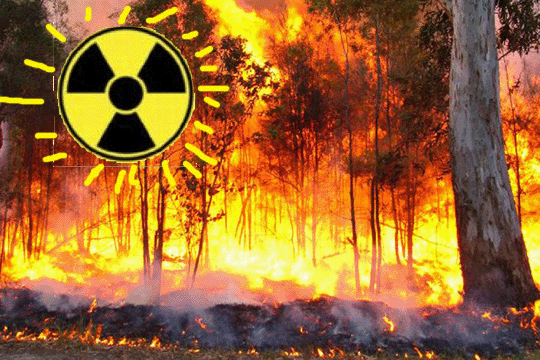
The fire may also have released large amounts of radiation and toxins into the air after burning through a former rocket engine testing site where a partial nuclear meltdown took place nearly six decades ago.

“The Woolsey Fire has most likely released and spread both radiological and chemical contamination that was in the Santa Susana Field Laboratory’s soil and vegetation via smoke and ash,” Dr. Bob Dodge, president of Physicians for Social Responsibility-Los Angeles (PSR-LA), told Truthout.

The fire has been widely reported to have started “near” the Santa Susana Field Laboratory site (SSFL), but according to PSR-LA, it appears to have started at the site itself.

The contaminated site — a 2,849-acre former rocket engine test site and nuclear research facility — is located just 30 miles northwest of downtown Los Angeles.

press release issued by PSR-LA on November 12 stated: Continue reading

November 26, 2018 Posted by | General News | 1 Comment

I’m striking from school to protest inaction on climate change – Australian students should too

 https://www.theguardian.com/commentisfree/2018/nov/26/im-striking-from-school-for-climate-change-too-save-the-world-australians-students-should-too, 

Every Friday, I miss classes to sit outside my country’s parliament. I will continue to do so until leaders come into line with the Paris agreement

I first learnt about climate change when I was eight years old. I learnt that this was something humans had created. Growing up in Sweden my family was environmentally conscious. I was told to turn off the lights to save energy and recycle paper to save resources.

I remember thinking it was very strange that we were capable of changing the entire face of the Earth and the precious thin layer of atmosphere that makes it our home.

Because if we were capable of doing this, then why weren’t we hearing about it everywhere? As soon as you turned on the television, why wasn’t the climate crisis the first thing you heard about? Headlines, radio programmes, newspapers, you would never hear about anything else, as if there was a world war going on.

Yet our leaders never talked about it.

If burning fossil fuels threatened our very existence, then how could we continue to burn them? Why were there no restrictions? Why wasn’t it illegal to do this? Why wasn’t anyone talking about the dangerous climate change we have already locked in? And what about the fact that 200 species are going extinct every single day?

I have Aspergers syndrome so, for me, most things are black or white. I look at the people in power and wonder how they have made things so complicated. I hear people saying that climate change is an existential threat, yet I watch as people carry on like nothing is happening.

If I live to be 100, I will be alive in 2103. Adults often don’t think beyond the year 2050. But by then, I will, in the best case, not have lived half of my life. What we do or don’t do right now will affect my entire life and the lives of my friends, our children and their grandchildren.

When school started in August this year, I decided enough was enough. Sweden had just experienced its hottest summer ever. The election was coming up. No one was talking about climate change as a crisis.

So I decided to walk out of school and sit on the ground outside the Swedish parliament to demand our politicians treat climate change for what it is: the biggest issue we have ever faced.

Because if climate change has to stop, then we must stop it. It is black and white. There are no grey areas when it comes to survival. Either we continue as a civilisation or we don’t. One way or another, we have to change. Countries like mine and Australia must start reducing our emissions dramatically if we believe in equality and climate justice.

But instead of talking about this, all our politicians go on about is economic growth, energy prices and shareholder value. What value is there in a future where hundreds of millions of people suffer?

Rich countries like Sweden and Australia must get down to zero emissions within six to 12 years so that people in poorer countries can have a decent future and build some of the infrastructure that we already enjoy. How can we expect countries such as India or Nigeria to care about the climate crisis if we, who already have everything, are not living up to our commitments?

Australia is the world’s biggest exporter of coal, one of the leading cause of climate change. Your politicians want to help Adani build one of the biggest coal mines in the world. Right now, there are no policies to change this. There are no rules to keep coal in the ground. We can no longer save the world by playing by the rules because the rules have to be changed.

And it has to start today. As a student, one way I can push for urgent change is to go on strike from school. I’ll be sitting outside the Swedish parliament every Friday from now until my country is in line with the Paris agreement.

Passing the baton: will young people take up the fight to save the planet?

I urge other students to join me: Sit outside your parliament or local government wherever you are and demand that they get on track to keep the world below 1.5 degrees.

Some say I should be in school. But why should any young person be made to study for a future when no one is doing enough to save that future? What is the point of learning facts when the most important facts given by the finest scientists are ignored by our politicians?

We are running out of time. Failure means disaster. The changes required are enormous and we must all contribute to the solutions, especially those of us in rich countries like Australia.

The adults have failed us. And since most of them, including the press and the politicians, keep ignoring the situation, we must take action into our own hands, starting today.

• Greta Thunberg is 15 years old and lives in Stockholm, Sweden

November 26, 2018 Posted by | General News | Leave a comment

Climate change, rising sea levels, salty drinking water and increased miscarriages

How climate change could be causing miscarriages in Bangladesh, BBC News , 26 November 2018 

In small villages along the eastern coast of Bangladesh, researchers have noticed an unexpectedly high rate of miscarriage. As they investigated further, scientists reached the conclusion that climate change might be to blame. Journalist Susannah Savage went into these communities to find out more.

“….in a small village on the east coast of Bangladesh… While miscarriages are not out of the ordinary, scientists who follow the community have noticed an increase, particularly compared to other areas. The reason for this, they believe, is climate change….

“Nothing grows here anymore,” says Al-Munnahar. Not many years ago – up until the 1990s – these swamp lands were paddy fields.  If rice production back then was not profitable, it was at least viable. Not anymore. Rising waters and increasing salinity have forced the wealthiest among the villagers to change to shrimp farming or salt harvesting. Today, few paddy fields remain.

“This is climate change in action,” says Dr Manzoor Hanifi, a scientist from the International Centre for Diarrhoeal Disease Research Bangladesh (ICDDRB), a research institute. “The effect on the land is visible, but the effect on the body: that we don’t see.”

Brine and bribery

ICDDRB have been running a health and demographic surveillance site in and around the district of Chakaria, near Cox’s Bazaar, for the last thirty years, enabling them to detect even small changes in the health of the communities they monitor.

Over the last few years, many families have left the plains and moved inland, into the forest hill area—mostly those with enough money to bribe forest wardens…….

In particular, women inland are less likely to miscarry. ……..

Moreover, when comparing the whole Chakaria region to Matlab, another area monitored by ICDDRB, in a part of Bangladesh far removed from the coast, the scientists also saw a noticeable difference.

In Chakaria, 11% of pregnancies end in miscarriage. In Matlab it is 8%.

This difference, the scientists believe, is to do with the amount of salt in the water the women drink – the increase of which is caused by climate change.

Families with no choice

Sea levels are rising, in part because of the melting of icecaps, but also because the earth’s rising temperature affects atmospheric pressure: even a small change in this causes an inverse effect on the sea level.

“With a one millibar decrease in atmosphere pressure,” says Dr Hanifi, “the sea level rises by ten millimetres: a series of depressions in atmospheric pressure can cause a considerable rise in water levels in shallow ocean basins.”

When sea levels rise, salty sea water flows into fresh water rivers and streams, and eventually into the soil. Most significantly, it also flows into underground water stores – called aquifers – where it mixes with, and contaminates, the fresh water. It is from this underground water that villages source their water, via tube wells.

The water that the village pump in Failla Para spews out is a little red in colour. It is also full of salt. This does not stop villagers drinking from the pump, though – nor from bathing in it and washing and cooking their food in it.

The World Health Organization (WHO) recommends that people consume no more than 5g of salt per day. In Chakaria, those living in the coastal zone consume up to 16g per day – over three times what those in the hilly areas do.

In countries like the UK, health campaigns have cautioned against excessive salt consumption for years. It causes hypertension, increasing the risk of strokes and heart attacks, and, among pregnant women, miscarriages and preeclampsia.

These Bangladeshi families have no idea of the health risk from the water they are drinking, and even if they did, they have little choice……….
At the moment, the chance of miscarriage for women like Sharmin and Al-Munnahar is only slightly elevated. But unless something is done, says Dr Hanifi, “this will only get worse, as Bangladesh feels the effects of climate change more and more.”

As a low-lying country, full of flood plain land, Bangladesh is particularly vulnerable to changes caused by global warming.

But other countries elsewhere, are also likely to experience similar repercussions from rising sea level…….https://www.bbc.com/news/world-asia-45715550

November 26, 2018 Posted by | General News | Leave a comment

Victorian elections – Greens helped Labor to a big victory

It’s pretty churlish of Labor to criticise The Greens, as they did throughout the Victorian state election campaign.

In the first place, Labor had some pretty good climate and renewable energy policies –   much of this copied from The Greens.

Secondly – there are some seats now held by Labor, that owe that Labor victory to preferences from The Greens.

November 25, 2018 Posted by | General News | Leave a comment

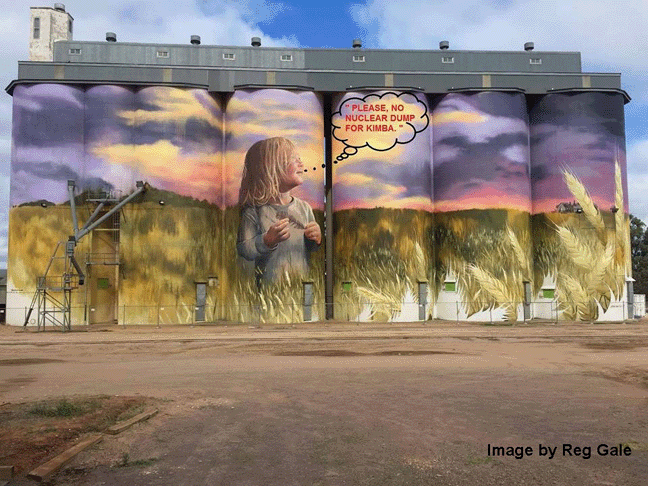
Government organising CLOSED GATHERINGS of nuclear waste dump supporters in South Australia

Katrina Bohr   No Nuclear Waste Dump Anywhere in South Australia, 22 Nov 18 
Most recent update on Committee meetings in the Flinders and Kimba-

Kimba’s meeting on the 28/11, I believe is cancelled.
However, a proposed Committee meeting in Quorn is likely to be between 2 and 4pm on the 27/11.
As I understand this is a closed gathering.
Those of us who wish to attend, believe that the nuclear waste dump process should be completely transparent.
Especially at this stage of proceedings.
I hope to have confirmation of location in Quorn. more https://www.facebook.com/groups/1314655315214929/

November 22, 2018 Posted by | General News | Leave a comment

American politicians demand transparency on the radiation risks from old nuclear site and the Californian wildfire

Public Risks from the Woolsey Fire and the Santa Susana Field Laboratory: A Letter to DTSC https://www.indybay.org/newsitems/2018/11/20/18819268.php, by Bradley Allen (bradley [at] bradleyallen.net)  Nov 20th, 2018    

On November 19, representatives Henry Stern and Jesse Gabriel authored a joint letter to Barbara Lee, Director of the California Department of Toxic Substances Control (DTSC). In their letter, Senator Stern and Assembly member Gabriel call for “full transparency” to “ensure the public is fully aware of any public health risks posed by the Woolsey Fire on Santa Susana Field Laboratory.”

Prior to the first round of data analysis, the California Department of Toxic Substances Control reported that its scientists “do not believe the fire caused any releases of hazardous materials that would pose a risk to people exposed to the smoke.”

“A common denominator in every single nuclear accident – a nuclear plant or on a nuclear submarine – is that before the specialists even know what has happened, they rush to the media saying, ‘There’s no danger to the public.’ They do this before they themselves know what has happened because they are terrified that the public might react violently, either by panic or by revolt.” 

—Jacques-Yves Cousteau

On November 19, representatives Henry Stern and Jesse Gabriel authored a joint letter to Barbara Lee, Director of the California Department of Toxic Substances Control (DTSC). In their letter, posted to social media, Senator Stern and Assemblymember Gabriel call for “full transparency” to “ensure the public is fully aware of any public health risks posed by the Woolsey Fire on Santa Susana Field Laboratory.”

Henry Stern represents nearly 1 million residents of the 27th Senate District, which includes Agoura Hills, Calabasas, Hidden Hills, Malibu, Moorpark, Simi Valley, Thousand Oaks, Westlake Village, part of Santa Clarita and the following Los Angeles communities: Canoga Park, Chatsworth, Encino, Porter Ranch, Reseda, Lake Balboa, Tarzana, West Hills, Winnetka, and Woodland Hills.

Jesse Gabriel represents Assembly District 45 comprised of the cities of Calabasas and Hidden Hills, a small portion of unincorporated Ventura County and several neighborhoods in the City of Los Angeles: Canoga Park, Chatsworth, Encino, Northridge, Reseda, Tarzana, Warner Center, West Hills, Winnetka, and Woodland Hills.

Senator Stern and Assemblymember Gabriel outline five specific requests regarding transparency from the DTSC, and conclude, “Given the serious and unsettling nature of this situation, we respectfully request that all information and data be disclosed as quickly as possible. Our community—and the broader public—deserve answers.”

Letter from Senator Stern and Assembly member Gabriel to DTSC,  Continue reading

November 22, 2018 Posted by | General News | Leave a comment

Research shows that women are more concerned about climate change, than men are

Gender Differences in Public Understanding of Climate Change, Yale Program on Climate Change Communication By Matthew BallewJennifer MarlonAnthony Leiserowitz and Edward Maibach , 21 Nov 18, While political views play a strong role in Americans’ opinions on climate change, there are many other individual, social, and cultural factors that influence public understanding of the issue. Here we explore how views on climate change differ between men and women. A large body of research shows a small—but consistent—gender gap in environmental views and climate change opinions. On average, women are slightly more likely than men to be concerned about the environment and have stronger pro-climate opinions and beliefs. Scholars have proposed several explanations for this gender gap, including differences in gender socialization and resulting value systems (e.g., altruism, compassion), perceptions of general risk and vulnerability, and feminist beliefs including commitment to egalitarian values of fairness and social justice. Some researchers also note that some of the strongest gender differences are found in concern about specific environmental problems, particularly local problems that pose health risks.In our research, we find that, although a similar proportion of men and women think global warming is happening and is human-caused, women consistently have higher risk perceptions that global warming will harm them personally, and will harm people in the U.S., plants and animals, and future generations of people (Fig. 1 on original). Also compared with men, a greater proportion of women worry about global warming, think that it is currently harming the U.S., and support certain climate change mitigation policies, specifically regulating CO 2 as a pollutant and setting strict CO 2 limits on coal power plants……….

on average, women scored lower than men in scientific knowledge on climate change ……..Women were also more likely than men to express uncertainty about a variety of questions. For instance, respondents were asked how much several factors contribute to global warming (e.g., deforestation, nuclear power plants, burning fossil fuels, the sun, cars and trucks). Across many of these questions, a greater proportion of women said “don’t know” than did men

Closing gender gaps in knowledge and understanding of the problem, therefore, ought to receive more attention in climate education and outreach efforts to further engage and empower women in climate issues. This is especially important because women are more likely than men to be harmed by environmental problems like climate change—both nationally and globally. In a recent BBC News Science & Environment article, U.N. data show that globally women make up 80% of people who are displaced by climate change. Because women in many countries tend to have roles as primary caregivers and food providers—and tend to have less socioeconomic power than men—they are more vulnerable to climate problems including natural hazards like flooding, droughts, and hurricanes. In the U.S., for instance, the Institute for Women’s Policy Research reported that 83% of low-income, single mothers did not return to their homes in New Orleans after Hurricane Katrina hit in 2005. In terms of public health, air pollution is considered a leading threat to pregnant women and their babies-to-be.

Women play an essential role in responding to climate change. In fact, out of 100 substantive climate solutions identified through rigorous empirical modeling, improving the education of women and girls represents one of the top solutions (#6) to reducing greenhouse gas emissions that cause global warming—similar in ranking to restoring tropical forests and ranking above increased solar energy generation. Women in leadership positions can also foster climate policy solutions. A study on gender equality and state-level environmentalism found that, across 130 countries, women in government positions were more likely to sign on to international treaties to reduce global warming than men. Promoting the participation of diverse women in leadership positions, as well as climate science, can also inspire young women to participate too.

……… For more information on survey methods, please review the 2010 Americans’ Knowledge of Climate Change report and 2018 Climate Change in the American Mind reporthttp://climatecommunication.yale.edu/publications/gender-differences-in-public-understanding-of-climate-change/

November 22, 2018 Posted by | General News | Leave a comment