

Antinuclear

Australian news, and some related international items

Toshiba dumps nuclear business

Toshiba Ditches UK Nuclear Business, U.S. LNG Operations, Oil Price.com 

Toshiba will also liquidate another nuclear subsidiary in the UK, Advance Energy UK Limited. The loss that the company will book from the wind-ups will come in at US$130 million (15 billion yen) and will be booked in its 2018/19 results………

Earlier this year, Toshiba sold its U.S. nuclear power business, Westinghouse, for US$4.6 billion to a group of investment companies led by Brookfield Asset Management. The deal puts an end to a major headache for the Japanese conglomerate, which last year warned that it might have trouble surviving if it didn’t find a buyer for the nuclear power plant constructor, which it acquired in 2006 for US$5 billion.

Plagued by project delays and cost overruns that came up to US$6 billion for two large-scale projects in the United States, Westinghouse filed for Chapter 11 bankruptcy protection last March. The business had by that time generated US$6.3 billion in writedowns for the parent company that resulted in Toshiba reporting a net loss of US$9.1 billion for 2016……..https://oilprice.com/Latest-Energy-News/World-News/Toshiba-Ditches-UK-Nuclear-Business-US-LNG-Operations.html

November 9, 2018 Posted by | General News | Leave a comment

Friday deadline for nuclear waste dump vote in Flinders Ranges Council area

Ellenor Day Fight To Stop Nuclear Waste In The Flinders Ranges, November 6 

Just a reminder for people living in The Flinders Ranges Council area – if you haven’t voted yet, remember 5pm Friday 9 November is the deadline.

Probably best to lodge your voting slips at the Council office in Quorn if you still want to vote (or the election box at Hawker Motors in Hawker), as if you mail it now, it may not make it in time for the 5pm Friday deadline!

Make your vote count!  https://www.facebook.com/groups/344452605899556/

November 8, 2018 Posted by | General News | Leave a comment

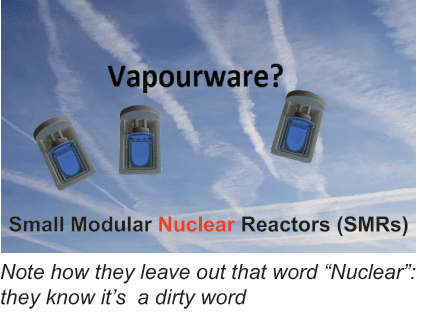
Canada’s government to embrace small nuclear reactors that do not make economic sense.

there is no market for the expensive electricity that SMRs will generate. Many companies presumably enter this business because of the promise of government funding. No company has invested large sums of its own money to commercialize SMRs.
NRCan and other such institutions are regurgitating industry propaganda and wasting money on technologies that will never be economical or contribute to any meaningful mitigation of climate change. There is no justification for such expensive distractions, especially as the climate problem becomes more urgent. 
Are Thousands of New Nuclear Generators in Canada’s Future? https://thetyee.ca/Opinion/2018/11/07/Nuclear-Generators-Canada-Future/

Ottawa is pushing a new smaller, modular nuclear plant that could only pay off if mass produced. By M.V. RamanaToday | TheTyee.ca, 7 Nov 18  M. V. Ramana is the Simons Chair in Disarmament, Global and Human Security at the School of Public Policy and Global Affairs at UBC, and the author of The Power of Promise: Examining Nuclear Energy in India, Penguin Books, New Delhi (2012)

Canada’s government is about to embrace a new generation of small nuclear reactors that do not make economic sense.

Amidst real fears that climate change will wreak devastating effects if we don’t shift away from fossil fuels, the idea that Canada should get deeper into nuclear energy might seem freshly attractive to former skeptics.

For a number of reasons, however, skepticism is still very much warranted.

On Nov. 7, Natural Resources Canada will officially launch something called the Small Modular Reactor Roadmap. The roadmap was previewed in February of this year and is the next step in the process set off by the June 2017 “call for a discussion around Small Modular Reactors in Canada” issued by Canadian Nuclear Laboratories, which is interested in figuring out the role the organization “can play in bringing this technology to market.”

Environmental groups and some politicians have spoken out against this process. A petition signed by nearly two dozen civil society groups has opposed the “development and deployment of SMRs when renewable, safer and less financially, socially and environmentally costly alternatives exist.”

SMRs, as the name suggests, produce relatively small amounts of electricity in comparison with currently common nuclear power reactors. Continue reading

November 8, 2018 Posted by | General News | Leave a comment

Huge solar farm planned for Murray Bridge 

A jobs boom may soon be coming for Murray Bridge as developers aim to begin work on a $350 million solar farm next year — if it gets the go-ahead from the state’s peak planning body…. (subscribers only) 

https://www.adelaidenow.com.au/business/sa-business-journal/work-for-200-on-res-australias-planned-350m-solar-farm-near-murray-bridge/news-story/d8374245817cfafb763771a4f3f658d4


November 8, 2018 Posted by | General News | Leave a comment

Greenland’s Melting Ice Sheets: The Beautiful but Harrowing Changes Seen from Above

The Weather Channel, By Drew MacFarlane, 7 Nov 18 

Greenland’s ice sheet lost up to 270 billion tons of ice every year between 2012 and 2014, according to a study in Geophysical Research Letters. Currently, it’s losing ice at a rate faster than any time in the last 400 years, and the melt is accelerating, a separate study stated.

This is what Tom Hegen, a photographer from Munich, Germany, takes to the skies to document.

Hegen buzzes some 3,000 feet above Greenland’s seemingly endless sheet of ice before having the pilot tip the plane on its side so he can snap a photo. If the light or angle isn’t to his liking, he asks to circle around to do it again………https://weather.com/science/environment/news/2018-11-06-greenland-melting-ice-sheet-photos-tom-hegen/

November 8, 2018 Posted by | General News | Leave a comment

Global nuclear lobby should drop its climate change propaganda – pro nuclear expert advises

Steve Kidd, writing in a pro nuclear essay in Compelo Energy, 5 Nov 18, urges the global nuclear industry to improve its propaganda.  He especially advises them to drop their argument about climate change!

“The climate change argument is where the industry is majoring its efforts. Industry bodies point out that some of the countries with the best records on carbon emissions use a combination of nuclear and renewables, while claiming that nuclear plants have avoided carbon dioxide emissions.

This is, at best, disingenuous. None of the nuclear reactors around the world were built to abate carbon. They were built for other reasons, such as energy security and economics. Admittedly, it was believed that their environmental impact would mainly be benign, but investments are made for what a technology does, rather than what it does not do. ” 

November 6, 2018 Posted by | General News | Leave a comment

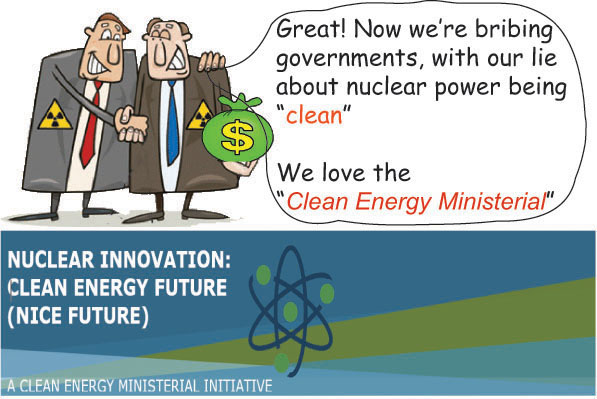
Global nuclear industry white ants its way into “Clean” Energy Ministerial

USA – Canada – Japan – the ministerial nuclear suckers came out of the woodwork –  Dan Brouillette, Kim Rudd, Masaki Ogushi, Rick Perry … and also Dr. Matar Al Neyadi, and  Denis Janin, immediate past President of the International Youth Nuclear Congress, and who else – in this secretive nuclear white anting of the global movement?

November 6, 2018 Posted by | General News | Leave a comment

Climate change is now making things too hot for nuclear reactors to cope

The Climate’s Already Too Hot for Nuclear Power http://nukewatchinfo.org/the-climates-already-too-hot-for-nuclear-power/Fall Quarterly 2018 By John LaForge, Nukewatch

With the summer’s record high temp’s all over the world, Andy Rowell asked this pointed question in Oil Change International: “For the last decade the nuclear industry has been telling us it is the solution to climate change. But if their reactors can’t work in our rapidly warming world, are we just building a whole new generation of expensive white elephants?”

Indeed, Reuters reported Aug. 4 that Electricity de France (EDF) in Paris shut down four nuclear reactors at three sites due to the heat summer wave. EDF, the mostly government-owned utility, ordered the shut downs because the scorching summer heat that slammed Europe drastically raised temperatures in the Rhone and Rhine Rivers. Temperatures reached 98.6°F in the Rhone valley, home to 14 reactors. Highs in Spain and Portugal in early August hovered around 104°F and reached 116.6°F.

The warming of seawater caused by Europe’s heat wave forced Finland’s two Loviisa reactors, about 65 miles outside Helsinki, to reduce power in July, just as it did before, in 2010 and 2011, Reuters reported.

The July 2006 heat wave also forced European reactor operators to reduce or halt production due to dramatic increases in the temperature of river waters. The Guardian reported back then that Spain shut down its reactor on the River Ebro. Reactor operators in Germany also cut output then, and several German and French units were allowed to temporarily violate temperature limits on the hot water the reactors return to rivers.

Nuclear reactors exacerbate global warming In 2003, temperatures in French rivers reached record highs that also forced the temporary powering down of four reactors. France’s nuclear oversight authority then gave some reactor operators permission to return the river water at temperatures not normally allowed, a move that critics said would endanger fish and add to global warming.

Meanwhile, rising sea levels threaten to shutter one-out-of-four of the world’s 460 power reactors currently built on coastlines. John Vidal reports in the Aug. 21 edition of Hakai magazinethat experts have warned that even newly built seawalls may not provide sufficient protection. Vidal interviewed Pete Roche, a former adviser to the UK government and Greenpeace, who pointed out that the seawall at the $25-billion “Hinkley Point C” nuclear station being built in southwest England “does not adequately take into account sea-level rise due to climate change.”

“In fact,” Vidal reports, research by Ensia — a nonprofit environmental magazine published at the University of Minnesota — suggests that “at least 100 US, European, and Asian nuclear power stations built just a few meters above sea level could be threatened by serious flooding caused by accelerating sea-level rise and more frequent storm surges.”

The two St. Lucie reactors in Florida are among the US coastal nuclear sites considered most vulnerable to storm surges. While no US reactors have been “in imminent danger of a meltdown because of a storm surge,” Vidal notes, there have been many close calls. “Three US reactors were temporarily shut down because of Hurricane Sandy in 2012 and a fourth, Oyster Creek in New Jersey, was put on alert when water levels rose dramatically, according to the US Nuclear Regulatory Commission.”

But the NRC is not concerned about storm surges. In August 2017, as Hurricane Harvey pummeled east Texas, environmental groups called for the immediate shutdown of the two South Texas Project reactors near Bay City. Instead, the twin, 42-year-old behemoths were kept running at full capacity throughout the disaster, the wettest tropical cyclone on record in the United States.

 

November 6, 2018 Posted by | General News | 1 Comment

Sweden’s concerns over speed of corrosion of copper nuclear waste canisters

GDF Watch 4th Nov 2018 , The company responsible for delivering Sweden’s deep geological repository, SKB, is planning to subject their research into copper
corrosion to international peer review in the new year. SKB believe this is
the most transparent and open way in which to address concerns about the
contentious issue, which has held up final decision-making on the Swedish
national repository for higher activity radioactive waste.
Earlier this year the Swedish Environmental Court largely approved SKB’s plans for a
geological disposal facility in Osthammar. However, the Court had concerns
about the speed at which copper canisters corrode and the potential
consequential environmental impact. Conflicting scientific evidence was
presented to the Court. The Court decided that this was something the
Swedish Government needed to consider further before any approval was given
to the planned radioactive waste disposal facility. The Swedish Government
asked SKB to provide additional information by 31 March 2019.
http://www.gdfwatch.org.uk/2018/11/04/sweden-copper-corrosion-update/

November 6, 2018 Posted by | General News | Leave a comment

Rapid warming of the oceans

Oceans Are Warming Up Much Faster Than Previously Thought https://e360.yale.edu/digest/oceans-are-warming-up-much-faster-than-previously-thought The world’s oceans have soaked up much more excess heat in recent decades than scientists previously thought — as much as 60 percent more, according to a new study published in the journal Nature. The new research suggests the global could warm even faster in the coming decades than researchers originally predicted, The Washington Post reported.The researchers, led by geoscientist Laure Resplandy of Princeton University, found that oceans absorbed 13 zettajoules — a joule, the standard unit of energy, followed by 21 zeroes — of heat energy each year between 1991 and 2016. Based on these findings, they argue, nations must reduce their greenhouse gas emissions 25 percent more than previously estimated if they hope to keep global warming below 2 degrees Celsius.“Imagine if the ocean was only 30 feet deep,” Resplandy said in a statement. “Our data show that it would have warmed by 6.5 degrees C [11.7 degrees Fahrenheit] every decade since 1991. In comparison, the estimate of the last IPCC assessment report would correspond to a warming of only 4 degrees C [7.2 degrees F] every decade.”

Scientists have long struggled to quantify ocean warming before 2007 — the year that a network of robotic sensors known as Argo were deployed into the world’s oceans to track things like temperature and salinity. For pre-2007 data, the new research examined the volume of oxygen and carbon dioxide released from the oceans as they heated up, providing scientists an indicator for ocean temperature change.

“We thought that we got away with not a lot of warming in both the ocean and the atmosphere for the amount of CO2 that we emitted,” Resplandy told The Washington Post. “But we were wrong. The planet warmed more than we thought. It was hidden from us just because we didn’t sample it right. But it was there. It was in the ocean already.”

November 6, 2018 Posted by | General News | 3 Comments

Some good news – the healing of the ozone layer

Ozone layer finally healing after damage caused by aerosols, UN says https://www.theguardian.com/environment/2018/nov/05/ozone-layer-healing-after-aerosols-un-northern--hemisphere Fiona  HarveyEnvironment correspondent

November 6, 2018 Posted by | General News | Leave a comment

Night Sky  13 October – 25 November A Blue Mountains City Art Gallery exhibition

Night Sky  13 October – 25 November here: bluemountainsculturalcentre.com.au/exhibition/night-sky/  Night Sky documents the 2018 NAIDOC celebrations at the Blue Mountains Cultural Centre which saw multi-media planetarium screenings and stargazing from the viewing platform with Penrith Observatory. The NAIDOC public programs included Indigenous Astronomy talks by local artist John South (Barkindji),
Astronomer & Science Communicator Kirsten Banks (Wiradjuri) and Aboriginal Cosmology expert Duane Hamacher.

The exhibition features photographs by young Aboriginal artists Rebecca Chatfield, Darcee Golian, Gemma Matheson, Nicholas Moyle, Alaura Neville and Mea-Mei Stanbury who participated in a night sky astrophotography course with Gary P. Hayes. Photographic documentation of the NAIDOC events by Ben Pearse and the documentary Star Stories of the Dreaming (2016) featuring Senior Euahlayi Law Man and elder Ghillar Michael Anderson will also be on view.

A Blue Mountains City Art Gallery exhibition

November 6, 2018 Posted by | General News | Leave a comment

Global Warming Is Messing with the Jet Stream. That Means More Extreme Weather.

Global Warming Is Messing with the Jet Stream. That Means More Extreme Weather.
A new study links the buildup of greenhouse gas emissions to more frequent heat waves, floods and droughts in the Northern Hemisphere.

The findings suggest that summers like 2018, when the jet stream drove extreme weather on an unprecedented scale across the Northern Hemisphere, will be 50 percent more frequent by the end of the century if emissions of carbon dioxide and other climate pollutants from industry, agriculture and the burning of fossil fuels continue at a high rate.

In a worst-case scenario, there could be a near-tripling of such extreme jet stream events, but other factors, like aerosol emissions, are a wild card, according to the research, published today in the journal Science Advances.

The study identifies how the faster warming of the Arctic twists the jet stream into an extreme pattern that leads to persistent heat and drought extremes in some regions, with flooding in other areas.

The researchers said they were surprised by how big a role other pollutants play in the jet stream’s behavior, especially aerosols—microscopic solid or liquid particles from industry, agriculture, volcanoes and plants. Aerosols have a cooling effect that partially counteracts the jet stream changes caused by greenhouse gases, said co-author Dim Comou, a climate and extreme weather researcher at the Potsdam Institute for Climate Impacts Research and the Vrije Universiteit Amsterdam.

“The aerosols forcing was a bit of a surprise to us,” Comou said. “Those emissions are expected to decrease rapidly in the mid-latitude regions in the next 10 to 30 years” because of phasing out of pollution to protect people from breathing unhealthy air.

In recent decades, aerosol pollution has actually been slowing down the global warming process across the Northern Hemisphere’s mid-latitude industrial regions. If aerosol emissions drop rapidly, as projected, these regions would warm faster.

That would change the temperature contrast between the Arctic and mid-latitudes, which would dampen the warming effect of greenhouse gases on the jet stream. By how much depends on the rate, location and timing of the reductions, and the offset would end by mid-century, when man-made aerosols are expected to be mostly gone and no longer reflecting incoming solar radiation, said Pennsylvania State University climate scientist and study lead author Michael Mann. ……….

The new study focuses on summer extremes, while other research has looked at how global warming affects the jet stream in winter.

What Happens in the Arctic Doesn’t Stay There

Daniel Swain, a climate scientist at UCLA and the National Center for Atmospheric Research who was not involved with the new research, said the study has some “compelling new evidence on the link between amplified Arctic warming and extreme mid-latitude weather during the summer months.”

What happens in the Arctic doesn’t stay there. Increased melting of reflective sea ice in summer exposes more dark-colored ocean to absorb heat, and that heats the surrounding land. As Arctic warming races ahead of the rest of the global average, the temperature contrasts that drive the jet stream are reduced, and the river of wind more frequently twists into sharp and slow-moving or stationary waves.

“When the jet stream enters this wavy state, extreme weather tends to occur on either side of the amplified ridges and troughs as the storm track becomes locked in place,” Swain said. Then, specific regions experience long periods of cool and stormy or, contrarily, hot and dry weather, he added. https://insideclimatenews.org/news/31102018/jet-stream-climate-change-study-extreme-weather-arctic-amplification-temperature

November 5, 2018 Posted by | General News | Leave a comment

What We Know About the Chernobyl Animal Mutations

 https://www.thoughtco.com/chernobyl-animal-mutations-4155348?utm_source=facebook&utm_medium=social&utm_campaign=shareurlbuttons&fbclid=IwAR0ML06KNkYYmozGbreM6e9ApQ9154nFmnYLxzZFUkK0pznLEi2X9FM-FHQ by Anne Marie Helmenstine, Ph.D. September 10, 2018

The 1986 Chernobyl accident resulted in one of the highest unintentional releases of radioactivity in history. The graphite moderator of reactor 4 was exposed to air and ignited, shooting plumes of radioactive fallout across what is now Belarus, Ukraine, Russia, and Europe. While few people live near Chernobyl now, animals living in the vicinity of the accident allow us to study the effects of radiation and gauge recovery from the disaster.

Most domestic animals have moved away from the accident, and those deformed farm animals that were born did not reproduce. After the first few years following the accident, scientists focused on studies of wild animals and pets that had been left behind, in order to learn about Chernobyl’s impact.

Although the Chernobyl accident can’t be compared to effects from a nuclear bombbecause the isotopes released by the reactor differ from those produced by a nuclear weapon, both accidents and bombs cause mutations and cancer.

It’s crucial to study the effects of the disaster to help people understand the serious and long-lasting consequences of nuclear releases. Moreover, understanding the effects of Chernobyl may help humanity react to other nuclear power plant accidents.

The Relationship Between Radioisotopes and Mutations

You may wonder how, exactly, radioisotopes (a radioactive isotope) and mutations are connected. The energy from radiation can damage or break DNA molecules. If the damage is severe enough, cells can’t replicate and the organism dies. Sometimes DNA can’t be repaired, producing a mutation. Mutated DNA may result in tumors and affect an animal’s ability to reproduce. If a mutation occurs in gametes, it can result in a nonviable embryo or one with birth defects.

Additionally, some radioisotopes are both toxic and radioactive. The chemical effects of the isotopes also impact the health and reproduction of affected species.

The types of isotopes around Chernobyl change over time as elements undergo radioactive decay. Cesium-137 and iodine-131 are isotopes that accumulate in the food chain and produce most of the radiation exposure to people and animals in the affected zone.

Examples of Domestic Genetic Deformities

Ranchers noticed an increase in genetic abnormalities in farm animals immediately following the Chernobyl accident. In 1989 and 1990, the number of deformities spiked again, possibly as a result of radiation released from the sarcophagus intended to isolate the nuclear core. In 1990, around 400 deformed animals were born. Most deformities were so severe the animals only lived a few hours.

Examples of defects included facial malformations, extra appendages, abnormal coloring, and reduced size. Domestic animal mutations were most common in cattle and pigs. Also, cows exposed to fallout and fed radioactive feed produced radioactive milk.

The health and reproduction of animals near Chernobyl were diminished for at least the first six months following the accident. Since that time, plants and animals have rebounded and largely reclaimed the region. Scientists collect information about the animals by sampling radioactive dung and soil and watching animals using camera traps.

The Chernobyl exclusion zone is a mostly-off-limits area covering over 1,600 square miles around the accident. The exclusion zone is a sort of radioactive wildlife refuge. The animals are radioactive because they eat radioactive food, so they may produce fewer young and bear mutated progeny. Even so, some populations have grown. Ironically, the damaging effects of radiation inside the zone may be less than the threat posed by humans outside of it. Examples of animals seen within the zone include Przewalksi’s horses, wolves, badgers, swans, moose, elk, turtles, deer, foxes, beavers, boars, bison, mink, hares, otters, lynx, eagles, rodents, storks, bats, and owls.

Not all animals fare well in the exclusion zone. Invertebrate populations (including bees, butterflies, spiders, grasshoppers, and dragonflies) in particular have diminished. This is likely because the animals lay eggs in the top layer of soil, which contains high levels of radioactivity.

Radionuclides in water have settled into the sediment in lakes. Aquatic organisms are contaminated and face ongoing genetic instability. Affected species include frogs, fish, crustaceans, and insect larvae.

While birds abound in the exclusion zone, they are examples of animals that still face problems from radiation exposure. A study of barn swallows from 1991 to 2006 indicated birds in the exclusion zone displayed more abnormalities than birds from a control sample, including deformed beaks, albinistic feathers, bent tail feathers, and deformed air sacs. Birds in the exclusion zone had less reproductive success. Chernobyl birds (and also mammals) often had smaller brains, malformed sperm, and cataracts. Continue reading

November 5, 2018 Posted by | General News | Leave a comment

Nuclear Power Will Not Save Us From Climate Change 

The starting point of any serious discussion of climate change must be to recognize that it is not possible to limit global warming to either 1.5 or 2°C in any “resource- and energy-intensive scenario” where economic growth continues in the usual fashion. 

How the IPCC’s solutions for reversing the Earth’s warming encourage business as usual. Yes Magazine,  Nov 02, 2018 The Intergovernmental Panel on Climate Change’s special report released in October rightfully elicited much public commentary about global warming and its truly frightening impacts. But in those initial reactions, less attention was paid to the unnerving implications of the report’s suggested solutions, which encourage us to roll the dice on unproven technologies and double down on nuclear power.

Underlying the IPCC report’s claims is the belief that technological solutions can fix the climate problem. Yet these fixes don’t address the root cause of climate change……….

The report outlines four broad pathways to stay within that limit, all of which include large-scale deployment of various technological fixes to climate change.  ………

The scariest of the four pathways outlined in the report is a “resource- and energy-intensive scenario in which economic growth and globalization lead to widespread adoption of greenhouse-gas-intensive lifestyles, including high demand for transportation fuels and livestock products.” In other words, business as usual in a world where the usual business leads to the edge of a cliff. What could justify such an approach? The belief that technology will save us.

These technologies would have to be deployed at massive scales. Continue reading

November 3, 2018 Posted by | General News | Leave a comment
