Call for inquiry Into AUKUS nuclear subs
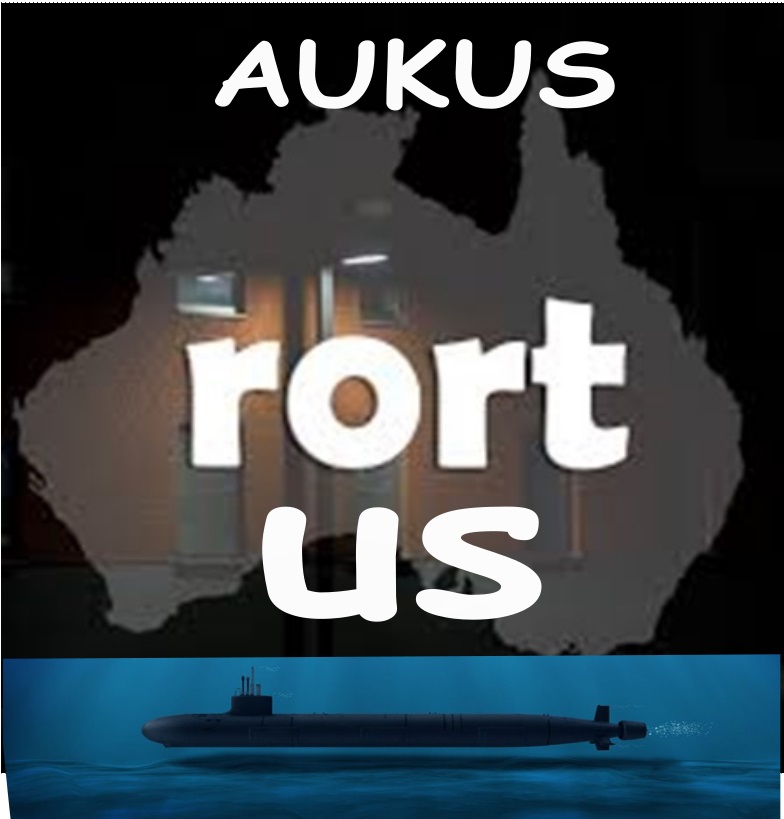
, Kenneth HIGGS, Port Stephens News of the Area, https://portstephens.newsofthearea.com.au/letter-to-the-editor-call-for-inquiry-into-aukus-nuclear-subs
DEAR News Of The Area,
IN May’s Federal Election, Australians voted against dangerous nuclear reactors, so why is the Australian Government persisting with the AUKUS nuclear submarines deal?
More than 30,000 people have signed a petition calling for an independent parliamentary inquiry into the AUKUS pact.
Is it in our national security and best interests?
Now is the time for a parliamentary, given our UK and US partners are also reviewing AUKUS “anomalies”.
Why should Australia splurge $368 billion on submarines that might never be delivered?
Are they the most effective defence strategy or are there better, less expensive options? Submarine reactors use weapons-grade, highly enriched uranium (HEU), so what are the potential environmental and health impacts if they leak radioactive material?
his has been a recurring problem with nuclear reactors in UK submarines.
Submarine patrol routes, exercise and training areas are necessarily secretive, so what are the risks to civilian vessels navigating the same waters?
Between 1982 and 2015, UK civilian sources documented 170 “interactions” between civilian vessels and nuclear submarines including net “snaggings”, collisions, near misses and at least 30 suspicious unexplained sinkings in UK waters.
These incidents have led to loss of life, total loss of vessels and loss of fishing gear.
We need answers and I urge people to sign the AUKUS inquiry petition on the Australia Institute website.
Illawarra groups want Port Kembla ruled out for AUKUS nuclear submarine base
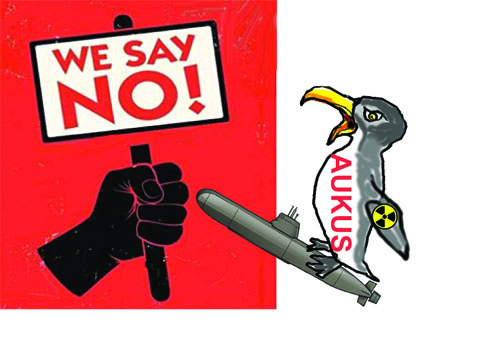
By Penny Burfitt, 26 Sept 25, https://www.abc.net.au/news/2025-09-26/port-kembla-declaration-against-aukus-nuclear-submarine-base/105815986
In short:
More than 40 organisations have signed a declaration calling on the federal government to rule out Port Kembla as a future nuclear submarine base.
The site was shortlisted as a possible location for an east coast base in 2022, but local groups say it would harm the community and industry.
What’s next?
The federal government says it will not make a decision on the location of the east coast base until later this decade.
More than 40 organisations have called on the federal government to rule out Port Kembla as a future location for a nuclear submarine base under the AUKUS deal.
The Port Kembla Declaration — signed by 43 local, state and national organisations — was launched as Prime Minister Anthony Albanese locked in a meeting with US President Trump in October, amid uncertainty around the future of the AUKUS deal.
The declaration was unveiled at a memorial to the historic Dalfram strike at the port.
The 1938 anti-war strike saw wharfies at Port Kembla refuse to load pig iron onto steamships bound for Japan, including the Dalfram, amid concerns about its use in the military conflict with China at the time.
“We’re here in the same spirit, to launch the Port Kembla Declaration,” South Coast Labour Council president Tina Smith said.
“Port Kembla is not for sale, we want no nuclear base here.”
The declaration was signed by trade unions, church groups, local Australian Greens branches, Health Cities Australia and dozens of other groups.
It raises concerns about health, safety, industry jobs and transparency around plans for the site, as well as the potential for Wollongong to become a military target if the base goes ahead.
“You’ve got one of the major trading ports in the country that would be impacted — I don’t think it makes any sense to anybody,” the NSW Maritime Union’s Garry Keane said.
“Our union has always supported peace over confrontation and the Dalfram dispute is a prime example of that — we will stand by those principles and do everything we can to oppose a nuclear submarine base in Port Kembla.”
In 2023, defence, government and industry figures told the ABC that Port Kembla, shortlisted as a possible site for a new east coast submarine base by the Morrison government in 2022, was the strongly favoured option.
Wollongong Against War and Nukes president Gem Romuld said in the absence of any consultation or clarity since then, the community was using the declaration to make its stance clear.
“We’re concerned that plans are being made behind closed doors to advance the case for a nuclear submarine base in Port Kembla,” she said.
“The government is not transparent about this, and we’re concerned that they could go ahead with an announcement and override local opposition to establish a base here at any time.”
Planning for ports raises questions
In August, the NSW Department of Planning refused a Freedom of Information application by former South Australian Senator Rex Patrick for records pertaining to a submarine base at either Newcastle or Port Kembla.
In documents shared with the ABC, the department’s solicitor said that “premature disclosure” of the requested information could prejudice cabinet deliberations, as the records included information which revealed “the methodology of analysis used for inputs into the final business case being prepared for cabinet on this issue”.
NSW Planning Minister Paul Scully dismissed as baseless any speculation that the government was secretly preparing a business case for Port Kembla at the time.
In a statement, the state government reinforced the position, denying any work was being done on a case for Port Kembla or Newcastle.
“These documents all relate to the Perrottet government and cabinet relations from that period,” a spokesperson said.
The federal government said in a statement it had agreed in principle to establishing an east coast facility for Australia’s future submarine capability.
“A decision won’t be taken until later in the decade,” a spokesperson said.
Ms Romuld said the declaration did not just oppose a base in Port Kembla, but also supported opposition in Newcastle or other ports.
“We’ll work with other communities … along the east coast as well,” she said.
“We’re saying not here, not anywhere.”
Opposition to proposed nuclear submarine base at Port Kembla
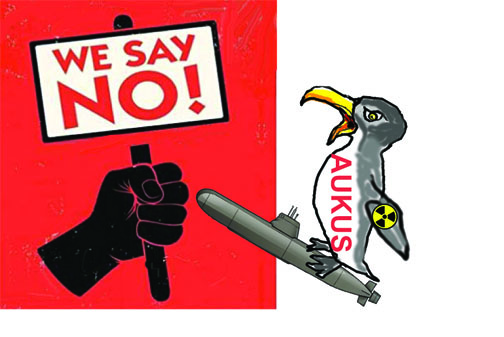
September 25, 2025 , by David Clark, https://www.wavefm.com.au/local-news/opposition-to-proposed-nuclear-submarine-base-at-port-kembla/
Forty local organisations and community groups are launching a joint Port Kembla Declaration today, opposing the establishment of a nuclear submarine base at Port Kembla.
They’re calling for the federal government to rule it out, saying the risks are far too great, the declaration has been endorsed by many organisations, including health, faith, and social justice.
Tina Smith, President of the South Coast Labour Council, said they reject the idea of turning the region into a frontline for war games or nuclear escalation.
Aboriginal group from Port Augusta joins experts in explaining the impact of the nuclear industry

Philip White, 1 May 25
I’ve just returned from a powerful community meeting where a group of Aboriginal people came down from Port Augusta to tell people in the marginal SA electorate of Sturt about their opposition to the Coalition’s plans to build a nuclear reactor in their town.
Clinton (Stano) Dadleh, Aunty June Lennon, Aunty Vivienne McKenzie, Uncle Lindsay Thomas, Glen Wingfield (via Zoom) and Rhenee Lester gave moving accounts of their lived experience of Port Augusta and the impact of the nuclear industry on their families, while Dr Kate Wylie (Doctors for the Environment) and Dr Jim Green (Friends of the Earth) critiqued the Coalition’s nuclear plan in detail.
For those who couldn’t make it, the meeting was live streamed and can now be viewed on the following link:
The meeting begins at the 29 minute mark of the recording and the presentations begin at the 37 minute mark.
Australian civil society groups unite against nuclear as pre-polling begins.
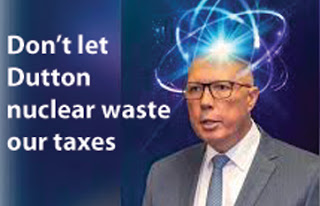
As early voting opens in the federal election, leading Australian civil society groups have released a joint statement calling for an end to any plans for domestic nuclear power.
The call sees major trade union, faith, environment, First Nation and public health bodies unite in support of the clean energy transition and opposition to the nuclear industry playing a spoiling role in this transition.
The statement is supported by a diverse range of groups including the ACTU, Electrical Trades Union, Greenpeace, Uniting Church, Solar Citizens, Gundjeihmi Aboriginal Corporation, Doctors for the Environment, Friends of the Earth and the Australian Conservation Foundation.
The statement says:
Nuclear power is too slow, costly and inflexible to play any meaningful role in decarbonisation efforts. Nuclear also brings unique risks and long-lived wastes.
Given the environmental, economic and human urgency of addressing climate change and advancing the energy transition we must not allow nuclear promotion to cause any further complication or delay.
Nuclear costs. In all ways, and always. Australia cannot afford this delay.
As well as the start of pre-polling, 22 April is also Earth Day. The 2025 theme of this long-standing global day of action is Our Power, Our Planet and includes an international call for the promotion of renewable energy sources with a view to tripling clean electricity production around the world.
“This statement unites diverse organisations representing millions of Australians in a common and clear call against nuclear power,” Australian Conservation Foundation nuclear analyst Dave Sweeney.
“Our energy future is renewable, not radioactive.
“Nuclear is one of the major policy differences in this election and our organisations will be working to highlight the costs, risks and unsuitability of this costly and risky energy option.”
Dr Jim Green, nuclear campaigner with Friends of the Earth Australia said:
“From Perth to Penrith, from Darwin to Devonport, Australians are cautious and concerned about nuclear power – and this election we are urging them to say no.
“Our country is blessed with renewable energy options which are demonstrably cheaper, safer, faster and are already powering around 45% of our homes and workplaces.
“As the coal era ends we don’t have time to waste and we don’t want radioactive waste.”
Response to Submarine Construction Yard Environmental Impact Statement

Friends of the Earth Adelaide 31 Mar 2025
Our submission raised questions about assumptions made about the nuclear submarine agreements:
“The Environmental Impact Statement (EIS) is premised on the assumption that the proposed AUKUS nuclear submarines are in Australia’s strategic interest (pp. 9-10) and South Australia’s economic interests (pp. 12-13). Both these premises are false.
Many highly qualified defence experts argue that nuclear submarines are not in Australia’s strategic interest. [1]
Along with these experts, and retired senior politicians like Paul Keating, Gareth Evans and Malcolm Turnbull, we believe that Australia will be less safe if it acquires nuclear powered submarines. Although it is the federal government that has made this strategic blunder, the EIS should not lend it any credence (as in section 1.5.4).…
AUKUS submarines will also be prejudicial to our economic interest. Some of the abovementioned analysts don’t think Australia will actually ever get the promised nuclear submarines, certainly not in a reasonable time frame. This is a view not restricted to left-leaning people. Conservative commentator Greg Sheridan has criticised AUKUS for this reason.[2]”
[1] Hugh White, “From the submarine to the ridiculous”, The Saturday Paper, 18 September 2021 https://www.thesaturdaypaper.com.au/2021/09/18/the-submarine-the-ridiculous/163188720012499#mtr
Major General Michael G Smith AO (Ret’d), ‘How should Australia defend itself in the 21st century? Silencing the drums and dogs of war’, The New Daily, May 26, 2023 https://thenewdaily.com.au/news/world/2023/05/26/how-should-australia-defend-itself-in-the-21st-century-silencingthe-drums-and-dogs-of-war/
Sam Roggeveen, ‘Spiky questions remain for AUKUS proponents’, Inside Story, 19 March 2024 https://insidestory.org.au/spiky-questions-remain-for-aukus-proponents/[2] Greg Sheridan, ‘Our nuclear subs fantasy adds up to military net zero’, The Australian, 6 October 2021. https://www.theaustralian.com.au/commentary/our-nuclear-subs-fantasy-adds-up-to-military-net-zero/newsstory/cec3b5e94c5bacac405a5eb535b3a628
Read our full submission: 250314AUKUS EIS – FoEAdelaide
Response to Osborne Submarine Construction Yard Strategic Assessment
Friends of the Earth Adelaide 1 April 25
Our recommendations:
1. Correct the factual errors regarding the effects of radiation.
2. Include active commissioning in the assessment.
3. Include the disposal of radioactive waste in the assessment and publish plans for management, storage and disposal of all streams of radioactive waste, including intermediate and high-level waste and spent nuclear fuel.
4. Include a proper analysis of the risks and consequences of incidents and accidents that could lead to a release of radioactive material into the environment.
5. Inform the public about the potential for exposure to radiation and the levels of radiation they could be exposed to.
6. The Commonwealth Government should consult with other levels of government, the Australian Radiation Protection and Nuclear Safety Agency, emergency services and with the general public to develop a response plan for radiological emergencies.
7. Publish the Strategic Assessment Plan before finalizing the Strategic Impact Assessment Report.
Read our full submission: https://adelaidefoe.org/wp-content/uploads/2025/03/250314AUKUS-SIA-FoEAdelaide.pdf
End AUKUS

more https://ipan.org.au/no-aukus-no-nuclear-submarines/
AUKUS is a military agreement between Australia, the United Kingdom and the United States with two “pillars”.
1. The first pillar is a Federal Government commitment to spend $368 billion to purchase and construct 8 nuclear powered submarines to be part of the US nuclear submarine fleet surrounding the People’s Republic of China.
2. The second pillar to to collaborate with the Governments of UK and USA to “develop and provide joint advanced military capabilities” involving computer, missile and artificial intelligence technologies.
A widespread campaign is developing across Australia to have the AUKUS pact dissolved completely……………………………………………………………..more https://ipan.org.au/no-aukus-no-nuclear-submarines/
Nuclear power has no place in Australia’s energy transition
Doctors for the Environment Australia (accessed) 31st March 2025
https://www.dea.org.au/nuclear_energy_in_australia_position_statement
Doctors for the Environment Australia (DEA) does not support nuclear energy as a means of decarbonising Australia’s stationary energy generation and mitigating climate change. All Australia’s energy needs can ultimately be met from renewable sources, in combination with storage technology and energy efficiencies.
DEA does not support nuclear energy because it:
- is unnecessary, uneconomical, and not flexible enough for changing energy needs
- carries high health and safety risks
- is a significant security risk
- creates high-level radioactive waste, which cannot be safely disposed of and for which there is no known secure long-term storage
- requires large amounts of water
- cannot decarbonise the energy sector fast enough to avert catastrophic climate change
- is neither renewable nor a low emissions energy source, if the entire nuclear life cycle from mining fuel to decommissioning of the reactor is considered
- distracts from and delays more reliable, safer and less costly existing and developing technologies
- emerges from the history of nuclear weapons testing and uranium mining on First Nations lands without consent, and may continue to disproportionately affect First Nations people.
Nuclear Energy in Australia Position Statement – PDF (April 2025)
Communities vent frustration at Coalition’s nuclear plan for their towns
By Joanna Woodburn, ABC Central West, 22 Dec 24,
In short:
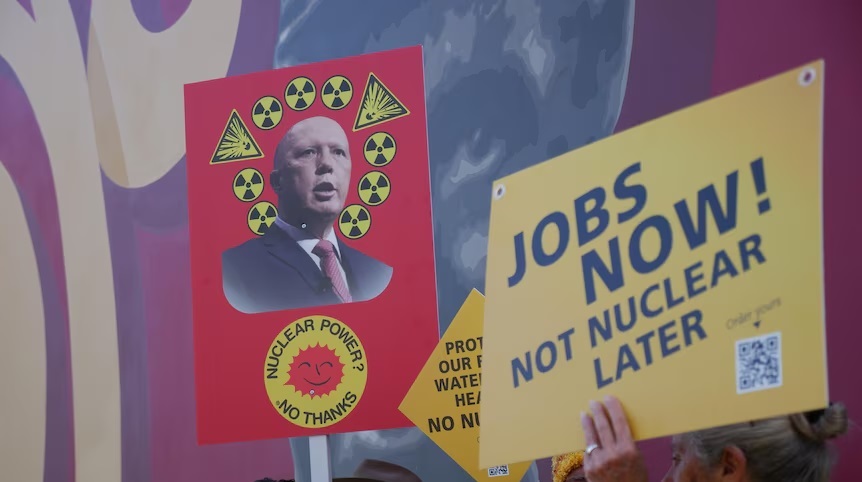
Regional communities have shared their views on the federal Coalition’s plan for seven nuclear reactors around Australia.
A parliamentary inquiry has heard pleas for more detail about the proposal, but people have been told to wait for “all the facts”.
What’s next?
The federal committee is due to deliver its report by April 2025.
Opposition leader Peter Dutton has promised his vision to build seven nuclear reactors around Australia will “keep the lights on”.
But people in the communities earmarked to host the plants feel they are being left in the dark as to what the Coalition’s plan means for them.
“What are we actually signing up for?” New South Wales Hunter Valley resident Tony Lonergan said.
Mr Dutton has so far released the locations of the proposed reactors and the costings.
The Coalition wants to build nuclear plants on the sites of seven coal-fired power stations which have shut, or are earmarked to close, at Tarong and Callide in Queensland, Mount Piper near Lithgow and Liddell in NSW, Port Augusta in South Australia, Loy Yang in Victoria’s Latrobe Valley and Muja near Collie in Western Australia.
“I can’t help but feel that politicians see our region as apathetic, desperate and an easy target,” Lithgow resident Tom Evangelidis said.
In the absence of few other details, Labor established a federal inquiry into nuclear power which generated more than 800 submissions from individuals, business owners, industry groups and MPs.
The House Select Committee on Nuclear Energy, which will cease to exist after the inquiry, has toured Australia to hear from the residents whose towns have been selected to host the nuclear reactors.
Wait for ‘the facts’
A repeated request throughout the inquiry has been for the Coalition to explain what technology would be used, how much water would be needed, where the waste would be stored, how it would be transported and whether the infrastructure and technology were safe.
“Even after [the Lithgow hearing] there’s very poor details on will there be one here? When? And those concerns [about] land, safety concerns, environmental concerns; those are all very major concerns and I’ve seen no answers here today,” former NSW mining union executive Wayne McAndrew said.
“The Coalition is proposing the seven sites and I’ve seen nothing from them either.”
The inquiry’s deputy chair, Liberal MP Ted O’Brien, repeatedly told witnesses their communities would have access to a two-and-a-half year “on the ground” consultation process where people’s questions would be answered.
Outside the Port Augusta hearing, SA Liberal MP for Grey, Rowan Ramsey, urged people to wait.
But these assurances have not pacified witnesses.
“That’s not adequate in supporting the general public in forming opinions on things that affect everyone and nor is it adequate for people just to be expected to read or interpret a lengthy report,” Patsy Wolfenden from the Mingaan Wiradjuri Aboriginal Corporation in NSW said at the Lithgow hearing.
“We have agendas that are political and are imposed upon communities without their engagement and without their initial consent in the first place,” Associate Professor Naomi Godden from Edith Cowan University told the Collie hearing in WA.
Jobs promise
One of the Coalition’s key promises is secure employment for coal industry workers who will be out of a job when their power stations close.
In the Latrobe Valley, the Loy Yang power station in Traralgon is due to shut in 2035, which is the same year the Coalition wants its first reactors to be operating.
Local resident Adrian Cosgriff said power station workers were being given false hope, and instead should be encouraged to consider transitioning to the burgeoning renewable energy industry. “Get our coal workers involved, attract other industries as much as we can, so that when they start coming out of those power stations there’s actually work for them,” Mr Cosgriff said.
At Collie in WA, Daniel Graham from the Australian Manufacturing Workers’ Union shared some of the questions and concerns being posed by members.
“What am I going to do? Looking at the nuclear timeline, [I’m] just not sure how that matches up and how that’s going to help Collie,” Mr Graham told the inquiry…………………………………………………. https://www.abc.net.au/news/2024-12-22/coalitions-nuclear-plan-frustrates-communities-at-inquiry/104730522
Community alliance against Coalition’s nuclear policy

ABC Listen, 22 July 24
Political friction appears to be building in the seven regions set to host government-built nuclear reactors as part of the Coalition’s vision for the future of Australia’s energy mix.
Opposition leader Peter Dutton has visited the Callide coal-fired power station in Queensland, where he has talked up job creation and cheaper energy.
Meanwhile, community organisations in the areas selected in the Coalition’s nuclear policy have joined forces in an anti-nuclear campaign.
Featured:
Peter Dutton, Opposition leader
Wendy Farmer, Voices of the Valley president
James Khan, Collie traditional owner
Credits, Jon Daly, Reporter
Transcript
……………………………….Jon Daly: The Coalition’s earmarked seven sites across five states where it wants to co-locate nuclear reactors with retiring coal-fired power stations. Two will be in Queensland, two in New South Wales and one each for Victoria, South Australia and West Australia. The Opposition claims the sites would make good use of existing transmission lines and local workforces, though Mr Dutton is yet to reveal how much the nuclear builds would cost taxpayers.
Peter Dutton: We’ll have more to say about costings in due course and again as we know in somewhere like Ontario they’re paying a fraction for electricity compared to what we’re paying here. It’s a really important point that nuclear provides cheaper electricity. There’s a big up-front capital cost.
Jon Daly: The Coalition claims the first nuclear plant could be up and running by 2035. The Coalition has flagged two and a half years of local community consultation, but communities would not ultimately be given a chance to veto nuclear plans in their area. In Victoria’s coal heartland of the La Trobe Valley, Voices of the Valley President Wendy Farmer says that’s not consultation, that’s dictation.
Wendy Farmer: In other words, we are going into communities to tell them exactly what the Coalition wants to do and don’t argue with us because that’s what we’re going to do to your regions. That is not the way any community would expect to be treated.
Jon Daly: Voices of the Valley and other community organisations in the seven selected regions have launched an alliance opposing the current plan.
Wendy Farmer: So we thought that by the seven regions getting together, it just gives strength to all the regions and we can support each other. And we can actually do a much louder call for Australians to support the regions to say no to nuclear.
Jon Daly: What’s been the reaction from, say, your local community as the details of this proposal have unfolded?
Wendy Farmer: There’s a mixed reaction, Jon. You know, some do support having nuclear. They want the jobs. Then you’ve got the other people that are just saying we do not want nuclear reactors at all, ever, in our region.
Jon Daly: In West Australia, Collie’s coal-fired power station is closing by 2029 and the town is trying to find industries to replace those lost jobs. The Coalition has picked the town as a site for nuclear power. James Khan is a traditional owner of the area. He’s a Wilman man of the Bibbulmun Nation and he says he’s dead against nuclear energy being built there.
James Khan: Well, my thoughts on that there is negative. It’s a negative. It’s why are we going into something that we don’t know nothing about and it could affect everything, the vicinity of it. Nuclear reactors is too dangerous, too slow and it’s too expensive.
Samantha Donovan: Traditional owner James Khan speaking to our reporter Jon Daly. https://www.abc.net.au/listen/programs/pm/community-alliance-against-coalition-s-nuclear-policy/104128606
No to nuclear in the Latrobe Valley
9 July 2024, Cormac Mills Ritchard, https://redflag.org.au/article/no-to-nuclear-in-the-latrobe-valley
“Don’t dump on us again”, says Wendy Farmer, president of the Latrobe Valley community group Voices of the Valley and a local community organiser for Friends of the Earth. The Latrobe Valley is one of Liberal Party leader Peter Dutton’s proposed sites for nuclear power reactors, which would replace the Loy Yang coal power station.
The region is already saddled with several toxic industries. As Farmer explains to Red Flag, “We have a waste-to-energy, we have a lead smelter, we have a magnesium smelter, we have the power stations … Just today I’ve gone outside and you should see the coal dust on my rubbish bins. It is just everywhere. People are like, ‘Why are we being the dumping ground again? Why are we just being told once again what’s good for us and what we need?’”
Wendy knows what it’s like for a community to be treated as expendable. She became an activist in 2014 during the Hazelwood coal mine fire, which lasted for 45 days. The fire blanketed the area with smoke, causing the deaths of at least 60 people according to extensive research carried out by Voices of the Valley. This was no accident, but a result of the owner ENGIE’s cost-cutting and negligence. “They knew the risks two days before the fire got into the mine and chose to ignore it. I think they put a couple of extra staff on over the weekend, when we were gonna have the hottest, windiest weekend. Any fool could have read that.”
The fire might also have been prevented through the mine’s watering system, a critical safety measure meant to keep the coal face wet and guard against bushfires, which the owners had previously dismantled.
“My husband at the time worked at Hazelwood”, Wendy says. “Hazelwood knew that things needed to be repaired. Hazelwood knew that they didn’t have the water where they needed it.” You can never completely trust a company, she says. “Industry has known about asbestos, yet they’ve used it. Industry has known about the stone [in kitchen bench-tops], yet they’ve used it. Industry has known about dangers before and covered them up.”
If companies like ENGIE axe safety measures and governments cover up their crimes, why should we expect nuclear to be any different? Wendy describes Dutton’s nuclear proposal as a fantasy: “No plan, no proposal, no detail”. But her objections run deeper than that. The risks of a nuclear failure weigh heavily on a community with such a recent history of disaster and injustice.
“If there’s a failure and the kids are at school or anywhere else”, Wendy says, “nuclear disaster would kill … That sort of radiation you don’t have much chance. If the kids are at school, it’s too late to go and get them. And if they’re not dead, the damage is done. You can’t reverse the damage”. Worse still, Wendy explains, the valley sits on an earthquake fault line. “We’ve had many earthquakes. It’s only a matter of time before we have a big one.”
Fortunately, through Hazelwood the community taught itself how to fight toxic industries. On the morning Dutton’s proposed sites were revealed, Wendy organised a snap protest outside local Nationals MP Darren Chester’s office. “The people who joined the anti-nuclear rally were pretty upset, pretty pissed off”, Wendy says. “‘How dare they? We don’t want nuclear reactors.’”
Not everyone is opposed to nuclear, however; the community’s views are mixed. According to a News Corp survey last month (which polled only 113 people), 59 percent of Latrobe Valley residents would be comfortable with a nuclear reactor being built in their state or region. “A lot of people who support nuclear are supporting it because there will be jobs. But in fact there won’t be jobs for 30 or 40 years”, says Wendy. Construction on the nuclear power plant cannot begin, Wendy explains, until after Loy Yang has been shut down and rehabilitated, which won’t be for at least a decade.
Affordable energy is the other argument opening people to nuclear. But nuclear-generated power is far more expensive than renewables, given the extensive capital costs. According to the GenCost 2023-24 report published by the CSIRO and the Australian Energy Market Operator (AEMO), while wind and solar PV combined are estimated to cost between $73 and $128/MWh, large-scale nuclear will cost between $141 and $233/MWh, or $230 to $382/MWh for small modular reactors.
“Hazelwood was a David and Goliath”, Wendy says. “I felt the community won. For sure the company weren’t punished enough, but the community won. We have to stand together and we can win this.”
Australian conservation groups slam Federal Coalition’s “nuclear fantasy” plan as “a poison pill”
Craig Duncan, South Western Times, 4 July 24 https://www.swtimes.com.au/news/south-western-times/australian-conservation-groups-slam-federal-coalitions-nuclear-fantasy-plan-as-a-poison-pill-c-15218900
Conservation groups across Australia have slammed the Federal Coalition’s nuclear plans, describing them as “a poison pill” locking the country into fossil fuels for decades to come.
Opposition Leader Peter Dutton announced the party’s nuclear plans last month, which would see a reactor built at Collie’s Muja Power Station and several other locations across the country if the Coalition returns to power at the next Federal election.
Soon after the plans were revealed, conservation groups from across the country called out the proposal.
Conservation groups across Australia have slammed the Federal Coalition’s nuclear plans, describing them as “a poison pill” locking the country into fossil fuels for decades to come.
Opposition Leader Peter Dutton announced the party’s nuclear plans last month, which would see a reactor built at Collie’s Muja Power Station and several other locations across the country if the Coalition returns to power at the next Federal election.
Soon after the plans were revealed, conservation groups from across the country called out the proposal.
The Conservation Council of WA stated nuclear was no climate solution, with campaign director Mia Pepper calling the proposal a clear plan to distract and delay real action on climate change.
Conservation groups across Australia have slammed the Federal Coalition’s nuclear plans, describing them as “a poison pill” locking the country into fossil fuels for decades to come.
Opposition Leader Peter Dutton announced the party’s nuclear plans last month, which would see a reactor built at Collie’s Muja Power Station and several other locations across the country if the Coalition returns to power at the next Federal election.
Soon after the plans were revealed, conservation groups from across the country called out the proposal.
The Conservation Council of WA stated nuclear was no climate solution, with campaign director Mia Pepper calling the proposal a clear plan to distract and delay real action on climate change.
Journalism for the curious Australian across politics, business, culture and opinion.READ NOW
“Nuclear power is expensive, slow and dangerous, and simply cannot deliver the energy needed in the time frame we have to decarbonise,” she said.
“We have cheaper, safer, cleaner alternatives that are already delivering energy to hundreds of thousands of Australians.”
Ms Pepper said all West Australians had every right to be alarmed and concerned by the plan, which she said showed a complete disregard for the Collie community’s safety and input into future energy options.
“So, if you’re promoting nuclear, you are prolonging the use of fossil fuels,” she said.
Ms O’Shanassy said nuclear power was also dramatically more costly than investment in solar or wind.
“CSIRO modelling shows nuclear power is five to 10 times more expensive to generate than solar or wind power,” she said.
“Be in no doubt that extra costs of nuclear would be passed on to electricity users.
“On environmental and economic grounds, our energy future is renewable, not radioactive.”
Also dismissing the nuclear plans was Greenpeace Australia Pacific, which also described the plan as a bad-faith tactic to prop up climate-wrecking coal, oil and gas for as long as possible.
Chief executive David Ritter said there was not a “shred of credibility” to the Federal Coalition’s claims nuclear was a climate solution in Australia.
“Australians want and need credible climate action from their elected leaders,” he said.
Conservation groups across Australia have slammed the Federal Coalition’s nuclear plans, describing them as “a poison pill” locking the country into fossil fuels for decades to come.
Opposition Leader Peter Dutton announced the party’s nuclear plans last month, which would see a reactor built at Collie’s Muja Power Station and several other locations across the country if the Coalition returns to power at the next Federal election.
Soon after the plans were revealed, conservation groups from across the country called out the proposal.
The Conservation Council of WA stated nuclear was no climate solution, with campaign director Mia Pepper calling the proposal a clear plan to distract and delay real action on climate change.
Get in front of tomorrow’s news for FREE
Journalism for the curious Australian across politics, business, culture and opinion.READ NOW
“Nuclear power is expensive, slow and dangerous, and simply cannot deliver the energy needed in the time frame we have to decarbonise,” she said.
“We have cheaper, safer, cleaner alternatives that are already delivering energy to hundreds of thousands of Australians.”
Ms Pepper said all West Australians had every right to be alarmed and concerned by the plan, which she said showed a complete disregard for the Collie community’s safety and input into future energy options.
“There is no workforce, there are huge complexities with safety and security, the need for new laws and regulators who understand them,” she said.
“We don’t have 15 years to wait for an energy option that is dirty, dangerous, thirsty and increasingly insecure in a changing climate.”
The Australian Conservation Foundation was also quick to critique the Coalition’s proposal, pointing out the significant costs associated with the development of reactors and the increased reliance on fossil fuels which would be in place during their development.
Chief executive Kelly O’Shanassy said there was no chance a nuclear power station could be built before the mid-2040s.
“So, if you’re promoting nuclear, you are prolonging the use of fossil fuels,” she said.
Ms O’Shanassy said nuclear power was also dramatically more costly than investment in solar or wind.
“CSIRO modelling shows nuclear power is five to 10 times more expensive to generate than solar or wind power,” she said.
“Be in no doubt that extra costs of nuclear would be passed on to electricity users.
“On environmental and economic grounds, our energy future is renewable, not radioactive.”
Also dismissing the nuclear plans was Greenpeace Australia Pacific, which also described the plan as a bad-faith tactic to prop up climate-wrecking coal, oil and gas for as long as possible.
Chief executive David Ritter said there was not a “shred of credibility” to the Federal Coalition’s claims nuclear was a climate solution in Australia.
“Australians want and need credible climate action from their elected leaders,” he said.
“It is impossible to take the Coalition seriously on climate while it backs a doomed-to-fail technology like nuclear, while threatening to scrap renewable projects if elected.”
Mr Ritter said Greenpeace had a long and proud history of fighting against nuclear power and would continue to challenge the technology when cleaner, safer and cheaper renewable solutions existed.
“Let’s name the Coalition’s nuclear fantasy for what it is,” he said.
“A poison pill that claims to reduce emissions but instead locks us into coal and gas for decades.”
WATCH: Nabbed Australian Protestors Stopping Military Shipment to Israel
Video and article by Cathy Vogan, Consortium News https://consortiumnews.com/2024/03/25/watch-nabbed-stopping-military-shipment-to-israel/
Paul Keating, branch secretary of the Australian Maritime Union (AMU) spoke for fellow members in solidarity with the Palestinian community and faced off with police, when he and several hundred protestors blockaded Sydney’s Port Botany on Sunday to protest Australia’s export of military aid to Israel.
The protestors’ target is ZIM Shipping, a well known Israeli company that trade unionist Ian Rintoul says supports and is connected with Israel. “It offered its services to the Israeli state for the conduct of the genocide,” he told Consortium News. “Zim Shipping has actually been a target of protests at ports all around the world in the United States and Italy, Europe [and elsewhere in Australia]”.
Keating, who also spoke to CN, called on all of the other workers’ unions to stand with the AMU and for Prime Minister Anthony Albanese to place sanctions on Israel for what the International Court of Justice has called a plausible case of genocide.
He told the police chief at the scene: “This is an international working class issue”, and in his speech reiterated:
“On behalf of the MUA, we stand with our communities and throughout the generations we fought against the establishment who have supported apartheid, like we saw with South Africa, like we’ve seen with the wars that have forced ordinary working class men and women like ourselves and our communities into the most desperate of situations. We oppose war. Peace is union business, and this is our business”.
Deputy Leader of the Greens Mehreen Faruqi also spoke in favour of the blockade and condemned the government’s current policy. She said:
“It’s been 169 days of Israel’s genocide on Gaza. 169 horror-filled days for Palestinians. More than 30,000 Palestinians have been slaughtered by Israel. More than 1 million Palestinians are being starved by Israel. Famine and disease loom large in the ruins of Gaza. That’s the reality on the ground right at this moment. And how bereft, how bereft of humanity, of morality, of head and heart can the Labor government be to not do anything to stop these war crimes, this collective punishment, these atrocities and this genocide? How ruthless and cruel can you be to aid, abet and arm Israel?”
The blockade was short-lived and was broken up by police. Keating and 18 others were arrested and now face fines of up to AUS $22K and two years jail for obstructing traffic in the maritime zone.
Cathy Vogan is the executive producer of CN Live!
Let’s Label #USPropaganda – Call it out. Our crews at Boeing and disrupting General Mick Ryan/
Age Peace 21 Sept 23
Wage Peace friends have been out disrupting the US propaganda machine.
Last week our friends interrupted this public lecture. General Mick Ryan is there at the lectern. He’s an ex-ADF General – now a #USPropagandist – and he’s about to tell people about why we must prepare for war by buying more US weapons.
ALP stalwart Paul Lucas moves in. But even 30 minutes later we were still there telling an alternative story about what is going on!
| –Last week our friends interrupted this public lecture. General Mick Ryan is there at the lectern. He’s an ex-ADF General – now a #USPropagandist – and he’s about to tell people about why we must prepare for war by buying more US weapons. ALP stalwart Paul Lucas moves in. But even 30 minutes later we were still there telling an alternative story about what is going on!Watch on YouTube as we disrupt his latest propaganda engagement. #BewareBoeingsWars Boeing is a weapons companyOur friends also attended Boeing slowly walking up to their suburban location in Brisbane. We prevented the weapons dealers arriving for work. Beware Boeing’s wars we warned. Boeing is a weapons company. With BAE, Thales, and General Dynamics, Boeing is pushing for war while taking the big bucks from Australians. #EarthCareNotWarfare |
1 This month
7 April – WEBINAR – Australia and the Doomsday Clock – Preventing nuclear war through NoFirstUse and other policies
Online | Tuesday April 7, 4:00-5:30pm, Australian Eastern Time / 8:00-9:30am Central Europe Time
– Access the registration link
15 April – Zoom –Nuclear Power is Not the Solution
Apr 15, 2026 01:00 AM in Canberra, Melbourne, Sydney

Join the International Physicians for the Prevention of Nuclear War (IPPNW) on Tuesday, April 14th for a timely webinar exploring the risks associated with nuclear power and challenging the myth that it offers a simple, safe, carbon-free solution to the climate crisis

21 April Webinar: No Nuclear Weapons in Australia
Start: 2026-04-21 18:00:00 UTC Canberra, Melbourne, Sydney (GMT+10:00)
End: 2026-04-21 19:30:00 UTC Canberra, Melbourne, Sydney (GMT+10:00)
Event Type: Virtual
A virtual link will be communicated before the event.
Host Contact Info: australia@icanw.org

of the week – Australians for War Powers Reform (AWPR)
To see nuclear-related stories in greater depth and intensity
 Antinuclear