South Australia’s Nuclear Royal Commission was a nuclear lobby set-up from the beginning
There is no logical reason to believe that the SA government would perform any better than the U.S. government. On the contrary, there are good reasons to believe that nuclear waste management would be more difficult here given that the U.S. has vastly more nuclear waste management expertise and experience than Australia.
 SA nuclear Royal Commission is a snow job Jim Green, 29 April 2016 http://reneweconomy.com.au/2016/sa-nuclear-royal-commission-is-a-snow-job-18368
The South Australian Nuclear Fuel Cycle Royal Commission (RC) will release its final report on May 6. It was established to investigate opportunities for SA to expand its role in the nuclear industry beyond uranium mining.
Before his appointment as the Royal Commissioner, Rear Admiral Kevin Scarce said little about nuclear issues but what he did say should have excluded him from consideration. Speaking in November 2014 at a Flinders University guest lecture, Scarce acknowledged being an “an advocate for a nuclear industry”. Just four months later, after his appointment as the Royal Commissioner, he said the exact opposite: “I have not been an advocate and never have been an advocate of the nuclear industry.”
Other than generalisations, and his acknowledgement that he is a nuclear advocate, Scarce’s only comment of substance on nuclear issues in his 2014 lecture was to claim that work is “well underway” on a compact fusion reactor “small enough to fit in a truck”, that it “may be less than a decade away” and could produce power “without the risk of Fukushima-style meltdowns.” Had he done just a little research, Scarce would have learnt that Lockheed Martin’s claims about its proposed compact fusion reactor were met with universal scepticism and ridicule by scientists and even by nuclear industry bodies.
So the SA government appointed Scarce as Royal Commissioner despite knowing that he is a nuclear advocate who has uncritically promoted discredited claims by the nuclear industry. Scarce appointed an Expert Advisory Committee. Despite claiming that he was conducting a “balanced” RC, he appointed three nuclear advocates to the Committee and just one critic. The bias is all too apparent and Scarce’s claim to be conducting a balanced inquiry is demonstrably false.
Given the make-up of the RC, it came as no surprise that numerous questionable claims by the nuclear industry were repeated in the RC’sinterim report released in February. A detailed critique of the interim report is available online, as is a critique of the RC process.
The RC’s interim report was actually quite downbeat about the economic prospects for a nuclear industry in SA. It notes that the market for uranium conversion and enrichment services is oversupplied and that a spent fuel reprocessing plant would not be commercially viable. The interim report also states that “it would not be commercially viable to generate electricity from a nuclear power plant in South Australia in the foreseeable future.”
In a nutshell, the RC rejected proposals for SA to play any role in the nuclear fuel cycle beyond uranium mining. But that still leaves the option of SA offering to store and dispose of foreign high-level nuclear waste (HLW) and the RC strongly promotes a plan to import 138,000 tonnes of HLW for storage and deep underground disposal.
SA as the world’s nuclear waste dump The RC insists that a nuclear waste storage and dumping business could be carried out safely. But would it be carried out safely? The RC ought to have considered evidence that can be drawn upon to help answer the question, especially since Kevin Scarce has repeatedly insisted that he is running an evidence-based inquiry.
So what sort of evidence might be considered? The experience of the world’s one and only deep underground nuclear waste dump ‒ the Waste Isolation Pilot Plan (WIPP) in the U.S. ‒ is clearly relevant. And Australia’s past experience with nuclear waste management is clearly relevant, with the clean-up of nuclear waste at the Maralinga nuclear test site in SA being an important case study.
But the RC completely ignores all this evidence in its interim report. We can only assume that the evidence is ignored because it raises serious doubts about the environmental and public health risks associated with the proposal to import, store and dispose of HLW. Continue reading
What does the Australian govt REALLY plan about long-lived intermediate-level nuclear waste
What should the government do about LLILW?
First, the government needs to carry out a thorough audit/inventory of LLILW, considering the following issues:
- volume/mass and radioactivity of LLILW at each current storage site;
- whether waste production is ongoing at each particular site and if so, whether storage capacity has been reached or is approaching and if so, whether increasing storage capacity is an option;
- nature and adequacy/inadequacy of current storage conditions;
- nature and adequacy/inadequacy of institutional control.
Second, the government should initiate a thorough, transparent process to consider all options for management of LLILW. There is no logical reason for the initiation of that process to wait until “the National Facility Project is underway” as the government now states. The delay is not only illogical, it also feeds uncertainty and suspicion.
What does the government plan to do with long-lived intermediate-level waste (LLILW)?

 Jim Green, Friends of the Earth, 8/3/2016. Here is the government’s formal position (8/3/16 email from Department of Industry, Innovation and Science):
“Australia’s current management approach toward long-lived intermediate-level waste is for long-term above ground storage pending future disposal. The preferred option for the National Radioactive Waste Management Facility, as identified in the Initial Business Case, provides for the centralised management of intermediate-level waste in a purpose-built storage facility. The Department of Industry, Innovation and Science will undertake a detailed consideration of disposal pathways for Australian generated intermediate level waste once the National Facility Project is underway.”
What is the government really planning?
1. The government is already considering deep borehole disposal of LLILW. It might be at intermediate depth, perhaps 200 metres underground.
2. Deep borehole disposal of LLILW could possibly be pursued at the same site as a shallow repository for lower-level radioactive waste. That option is floated in an ARPANSA document (see below).
3. Or the government could go in a very different direction – a stand-alone shallow repository for lower-level wastes without co-location of a LLILW store (or a deep borehole for LLILW disposal). Government representatives have said in public meetings that ILW would not be moved to the shallow repository site (for above-ground storage) for 10-20-30 years after the shallow repository is established, and presumably the reason for that is that the government is considering alternative options (borehole disposal at a different site, or perhaps above-ground storage at a different site). Or perhaps the statement that ILW wouldn’t be moved to the site for 10-20-30 years isn’t true, or at least it certainly isn’t locked in, and it is simply designed to quell public opposition.
4. Even if the government does decide that borehole disposal of LLILW is the best way forward, it would likely take decades to progress that project. So above-ground storage of LLILW for many decades at the same site as the shallow repository remains a distinct possibility.
5. The government must be considering the potential to reduce opposition to a shallow repository for lower-level wastes by separating that project completely from its half-baked plans for LLILW. That separation could be enshrined in the MoU that the government plans to establish with the host community for the shallow repository. It could also be enshrined in legislation.
That separation might indeed reduce public opposition, although it wasn’t effective in SA in the early 2000s. From 1998–2003, the Howard government planned co-location, and by the time it reversed that position and decided to separate management of lower level wastes from LLILW, opposition was so entrenched and widespread that it made little difference. The Howard government established a National Store Committee to develop plans for LLILW disposal, but it was disbanded in 2004, at the same time as the government abandoned its plan to impose a repository for lower-level wastes in SA……… Continue reading
Australian uranium fuelled Fukushima nuclear reactors at time of the catastrophe
Fukushima five years on, and the lessons we failed to learn, Guardian, Dave Sweeney, 11 Mar 16 “…….In October 2011 it was formally confirmed to the Australian parliament that not only was Australian uranium routinely sold to the corner-cutting Tepco but that a load of true blue yellowcake was fuelling the Fukushima complex at the time of the disaster. Australian radioactive rocks were the source of Fukushima’s fallout.
Surely after directly fuelling disaster Australia would have taken some steps to review and possibly reconsider our role in the global nuclear trade?
The UN thought so. In September 2011 the UN secretary-general called on Australia to conduct “an in-depth assessment of the net cost impact of the impacts of mining fissionable material on local communities and ecosystems”.
This has never happened. It needs to, and Australia’s uranium sector deserves some long overdue scrutiny.
The most recent independent assessment of the Australian uranium industry – a Senate inquiry in October 2003 – found the sector characterised by underperformance and non-compliance, an absence of reliable data to measure contamination or its impact on the environment and an operational culture focussed on short term considerations…….http://www.theguardian.com/commentisfree/2016/mar/11/fukushima-five-years-on-and-the-lessons-we-failed-to-learn
Genetic damage to later generations from Maralinga radiation fallout
New generations of Australian families suffering deformities and early deaths because of ‘genetic transfer’,news.com.au MARCH 10, 2016 [EXCELLENT PHOTOS] PEOPLE who worked at Australian atomic bomb test sites claim they have produced generations of children with severe deformities and suffered a high number of stillbirths.
Documents obtained exclusively by news.com.au show hundreds of children and grandchildren of veterans exposed to radiation were born with shocking illnesses including tumours, Down syndrome, cleft palates, cerebral palsy, autism, missing bones and heart disease.
One veteran, who was posted to the Maralinga nuclear test site in South Australia in the 1950s as part of the British Nuclear Test (BNT) program, says the radiation contaminated his sperm and is to blame for the death of a child he never got to know.
But he is not alone, with the documents detailing a litany of miscarriages and stillbirths that has allegedly passed the devastation from generation to generation.
Australian ex-servicemen and their families originally made submissions to a Federal Government review in 2003 over deaths and disabilities they believe were caused by exposure to radiation from nuclear testing in South Australia and Western Australia in the 1950s and 60s.
The submissions were later compiled to use in a class action against the British Ministry of Defence, but the case was not allowed to proceed because it was deemed impossible to prove radiation caused their illnesses. Continue reading
Australia’s uneconomic and declining uranium industry
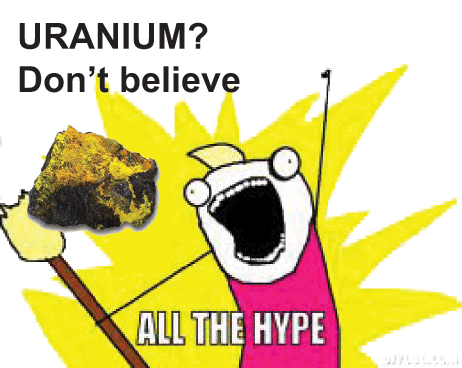 Fukushima five years on, and the lessons we failed to learn, Guardian, Dave Sweeney, 11 Mar 16 “…….As home to around 35% of the world’s uranium reserves, Australia has long been a significant player in the global nuclear trade.
Since the 1980s Australian uranium mining has been dominated by two major operations – Ranger in Kakadu and Olympic Dam in northern South Australia. Both operations and their heavyweight owners have been voting with their feet and their finances since 2011. Processing of stockpiled ore continues at Ranger but mining has ended and parent company Rio Tinto is now preparing to commence costly and complex rehabilitation work.
At Olympic Dam the world’s biggest mining company BHP Billiton stunned the South Australian government in 2012 when it shelved an approved and long planned multi-billion dollar mine expansion.
Smaller mines like Honeymoon in South Australia have been placed on extended care and maintenance, junior companies have abandoned the field and the sectors prevailing business model is to get the paperwork in order and wait in hope for better times.
Historically the sector has been constrained by political uncertainty, restrictions on the number of mines, a consistent lack of social license and strong Aboriginal and community resistance.
Recent years have seen fewer political constraints but a dramatic decline in the price of uranium and popularity of nuclear power following Fukushima.
Australia now accounts for approximately 11% of global uranium production, down from over 18% a decade earlier. Australia’s uranium production of 5,000 tonnes in 2014 was the lowest for 16 years.The industry generates less than 0.2% of national export revenue and accounts for less than 0.02% of jobs in Australia. Less than one thousand people are employed in Australia’s uranium industry.
In an attempt to jump start the flat-lining uranium trade, successive federal governments have preferred enthusiasm to evidence. They have failed to conduct the requested industry review and instead fast-tracked increasingly irresponsible uranium sales deals, most recently with India.
Approvals are fast-tracked, regulators are complacent, community concerns are air-brushed away and all for a sector that never really made sense and now doesn’t even make dollars.
In short, Australia’s uranium sector is high risk and low return. It leaves polluted mine sites and home and drives nuclear risk and insecurity abroad. And it fuelled Fukushima – a profound environmental, economic and human disaster that continues to negatively impact lives in Japan and far beyond.http://www.theguardian.com/commentisfree/2016/mar/11/fukushima-five-years-on-and-the-lessons-we-failed-to-learn
The myth that a nuclear reactor is needed for medical uses
A very comprehensive 2010 OECD Nuclear Energy Agency report found reactor based isotope production requires significant taxpayer subsidies, as the cost of sale does not cover the cost of production.
The report concludes: “In many cases the full impact of Mo-99/Tc-99m provision was not transparent to or appreciated by governments… The full costs of waste management, reactor operations, fuel consumption, etc were not included in the price structure. This is a subsidisation by one country’s taxpayers of another country’s health care system. Many governments have indicated that they are no longer willing to provide such subsidisation.”
What is needed urgently is a debate about how much waste we make. We have a choice: whether we follow ANSTO’s expensive business model to ramp up reactor manufacture (and the long-lived radioactive waste that goes with it), or collaborate with Canada to develop cyclotron manufacture of isotopes that does not produce long-lived nuclear waste.
Debunking the myths around medicine and a nuclear waste dump
The Federal government is seeking a location for a nuclear waste facility. But the provision of information to communities has been problematic, with some major flaws.
Claims have been made that provision of nuclear medicine services is a key reason to build it, but existing medical waste makes up a very small proportion of the total waste requiring disposal.
In addition, little has been said about ANSTO’s business plan to greatly ramp up Australia’s reactor based production of isotopes from 1 per cent to over 25 per cent of the world’s market, which will massively increase the amount of long-lived radioactive waste produced in the future.
A new process may reduce the volume of the waste, but the actual quantity of radioactive material to store will be significantly greater, and will become most of the radioactive waste Australia produces.
In Australia nuclear medicine isotopes are indeed useful, but according to Medicare figures represent less than 3 per cent of medical imaging. They are most commonly used for bone scans and some specialised heart scans. They are not needed (as claimed by government) for normal X-rays, most heart scans and the vast majority of cancer treatments (surgery, chemotherapy and radiotherapy). Continue reading
From politician to mining executive and back again: how miners control Australian government policy
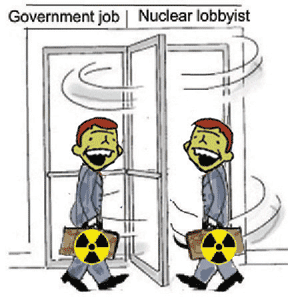 Larissa Waters: Ban donations from mining companies and stop ministers working for them, Larissa Waters, Guardian, 1 Mar 16 “……….The revolving door
Former politicians:
- Former Nationals leader and deputy prime minister John Anderson became chairman of Eastern Star Gas, the company behind the Narrabri Gas Project (which is now owned by Santos) about two years after leaving politics.
- Former Nationals leader and deputy prime minister Mark Vaile became a director and then chairman of Whitehaven coal.
- Former Labor resources minister Martin Ferguson became chairman of the APPEA Advisory Board – in October 2013 – just six months after he stopped being the minister. (The lobbying code of conduct requires an 18-month cooling-off period for ex-ministers).
- Craig Emerson, a former federal Labor trade minister went on to be a consultant for AGL Energy and Santos.
- Former foreign minister Alexander Downer was at one point a registeredlobbyist with Bespoke Approach, which included the likes of Woodside Petroleum, Xstrata, Petrochina and Yancoal among its clients.
- Greg Combet, the federal Labor climate change minister, went on to be a consultant to AGL Energy and Santos.
Political staffers:
- Bill Shorten’s current chief of staff, former Queensland Labor state secretaryCameron Milner, has also worked with Adani. He was director of Milner Strategic Services & Next Level Holdings, which is co-owned by former Liberal staffer David Moore and was reportedly providing advice to Adani on the controversial Adani Carmichael coal project.
- Ben Myers worked for Queensland Gas Company, and went on be Queensland LNP premier Campbell Newman’s chief of staff.
- Mitch Grayson worked as a staffer for Queensland LNP premier Campbell Newman in 2012 and, by early 2013, had joined Santos. Later, he re-joined Premier Newman’s office.
- Stephen Galilee, who worked as chief of staff to Ian Macfarlane as Liberal federal resources minister for three years, and chief of staff to Mike Baird as NSW treasurer and shadow treasurer, went on to be CEO of the NSW Minerals Council.
- Geoff Walsh, former adviser to Labor prime ministers Paul Keating and Bob Hawke, and a former national secretary of the Labor party, was made director of public affairs at BHP in 2007.
- Claire Wilkinson, spent a year as a senior media adviser for Labor resources minister Martin Ferguson before getting a job as a senior external affairs adviser for Royal Dutch Shell. She is now at Total E&P.
- Brad Williams, who spent four years as Mark Vaile’s chief of staff, went on to become the manager for government affairs at Inpex – an oil and gas company that has approval for a $34bn LNG project near Darwin. He is now working in government relations at another mining company, South32.
- Shaughn Morgan worked as adviser to Jeff Shaw, NSW Labor’s attorney general, before becoming the manager of government and external relations at AGL.
- Lisa Harrington was a senior adviser to Mike Baird before becoming the head of government relations at AGL Energy.
- Sarah Macnamara worked at AGL before becoming chief of staff to federal Liberal resources minister Ian Macfarlane, and was resource policy adviser to Liberal PM Tony Abbott.
- Robert Underdown was senior adviser to Liberal resources minister Ian Macfarlane before becoming the manager of the government and public policy group at Santos.
-
- Caroline Hutcherson was senior media adviser to the then Liberal NSW resources minister Chris Hartcher before working as a senior adviser to Santos, and going on to work as a senior adviser to NSW Liberal premier Mike Baird.
- Alexandra Gibson was an adviser to Christopher Pyne, before becoming a policy adviser to APPEA, the oil and gas lobby group.
- Paul Fennelly was the director of the Queensland Department of State Development, Trade and Innovation before becoming the CEO of APPEA.
- Chris Ward was an adviser to the Queensland treasurer and to the consumer affairs minister in the federal Labor government under Kevin Rudd and Julia Gillard, before taking a job as media manager at APPEA.
- Charles Perrottet was senior media adviser to the then Liberal NSW resources minister Chris Hartcher, then an executive of the NSW Liberal party before becoming a government affairs analyst at BP Australia.
- Andrew Humpherson was chief of staff to the then Liberal NSW resources minister Chris Hartcher before working as a consultant to the NSW Minerals Council.
- Emma Browning was a media adviser for the then Liberal NSW resources minister Chris Hartcher before becoming director of government relations at the NSW Minerals Council.
- Brad Emery was a media adviser to federal Liberal minister Peter Dutton before working as director of media and public affairs at the NSW Minerals Council.
- Chris Rath was media and public affairs manager at the NSW Minerals Council before working as an adviser to NSW Liberal resources minister Anthony Roberts.
- Lindsay Hermes was media and communications manager at the NSW Minerals Council before working as an adviser to federal Liberal resources minister Ian Macfarlane. http://www.theguardian.com/commentisfree/2016/mar/01/larissa-waters-ban-donations-from-mining-companies-and-stop-ministers-working-for-them
ARPANSA: a not so independent radiation regulator
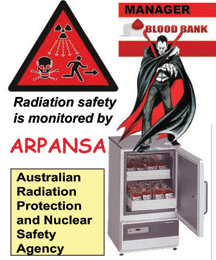 Jim Green 21 Feb 16 Bruce Wilson (from the federal government’s Department of Industry, Innovation and Science) and other governments reps were keen to talk up the role of the ‘independent’ regulator, the Australian Radiation Protection and Nuclear Safety Agency (ARPANSA). But ARPANSA has a troubled history. Its troubles began immediately: the government allowed ANSTO a direct role in selecting the founding CEO of ARPANSA, so ARPANSA’s independence was undermined from the start.
Here’s a more recent example of problems with ARPANSA, summarised in a 2011 ABC article:
“A review of Australia’s nuclear industry regulator, ARPANSA, has found an improper relationship with the main agency it monitors [ANSTO]. The Health Department’s audit and fraud control branch has been investigating how ARPANSA handled allegations of safety breaches and bullying at the nation’s only nuclear reactor in Sydney. Whistleblowers had alleged ARPANSA was too close to the Australian Nuclear Science and Technology Organisation (ANSTO), which runs the Lucas Heights research facility.”
ABC, 8 July 2011, Nuclear regulator ‘too close’ to ANSTO, www.abc.net.au/news/stories/2011/07/07/3264086.htm
An independent regulator could provide some confidence. But a not-so-independent regulator with a poor track record …
More information about ARPANSA:
- www.foe.org.au/anti-nuclear/issues/oz/arpansa
- ANSTO / ARPANSA whistleblower saga: www.foe.org.au/ansto-whistleblower-saga-2007-ongoing
Nuclear waste dump plan for Kimba – govt ignores relevant standards and codes
Jim Green 21 Feb 16 Some comments on the 18 Feb 2016 government ‘information session’ in Kimba regarding plans for a radioactive waste repository and above-ground ‘interim’ store for long-lived intermediate-level waste.
 1. The government ignores and breaches relevant standards and codes when it suits.
As a Kimba resident noted at the meeting, the National Health and Medical Research Council’s (NH&MRC) ‘Code of Practice for Near-Surface Disposal of Radioactive Waste in Australia (1992)’ states that “the site for the facility should be located in a region which has no known significant natural resources, including potentially valuable mineral deposits, and which has little or no potential for agriculture or outdoor recreational use”.
So the government has breached the NH&MRC Code of Practice by short-listing the Kimba sites.
Following the so-called clean-up of the Maralinga nuclear test site in the late 1990s, nuclear engineer Alan Parkinson wrote: “The Department has claimed that burial is a safe disposal method consistent with “the [NH&MRC] Code.” This was the first time that the Code had been mentioned in relation to the Maralinga project. When three of the five authors said that it was not applicable (the other two were Commonwealth public servants and would not comment), the Department claimed that it did not have to follow the Code but had chosen to do so. It made this statement despite the fact that not a single requirement of that Code was satisfied.”
(Alan Parkinson, “The Maralinga Rehabilitation Project: Final Report”,
http://www.ippnw.org/pdf/mgs/7-2-parkinson.pdf)
So the government ignores relevant standards and codes when it suits, and the government breaches relevant standards and codes when it suits. Why would anyone trust the government to safely operate a radioactive waste facility in the Kimba region in those circumstances?
Alan Parkinson summarises the problem (keep in mind that he is pro-nuclear and a nuclear engineer): “The disposal of radioactive waste in Australia is ill-considered and irresponsible. Whether it is short-lived waste from Commonwealth facilities, long-lived plutonium waste from an atomic bomb test site on Aboriginal land, or reactor waste from Lucas Heights. The government applies double standards to suit its own agenda; there is no consistency, and little evidence of logic.”
(Alan Parkinson, 2002, ‘Double standards with radioactive waste’, Australasian Science, www.foe.org.au/anti-nuclear/issues/oz/britbombs/clean-up)
Barry Brook, Pinchy Lobster and Clive Palmer: Three ‘Outstanding Scientists/Intellectuals’
 Jim Green, 19 Feb 16 Tas Uni academic Barry Brook’s university webpage says that in 2005 he was listed as one of the “2000 Outstanding Scientists of the 21st Century” by the International Biographical Centre (IBC). But the IBC is a zero-credibility money making operation.
The WA Government’s Dept of Commerce ‘ScamNet’ website states: “The material promoting the International Biographical Centre creates a false impression about the credentials of the organisation. It also wrongly implies that the receiver of the letter has been picked through a special research process considering their work and qualifications.”
If there was any doubt about the IBC’s illegitimacy, one of Brook’s academic colleagues nominated a squeaky toy lobster and Prof. Lobster was accepted for inclusion as one of the ‘2000 Outstanding Scientists of the 21st Century’. And the IBC has accepted a nomination for Clive Palmer to be listed as one of the ‘2000 Outstanding Intellectuals of the 21st Century’. A ‘Medal of Intellect’ will be sent to Palmer on payment of a $240 fee.
Feel free to test the IBC’s credibility yourself … you’ll have no trouble getting the Wiggles or the Bananas in Pyjamas or Thomas the Tank Engine accepted as Outstanding Scientists or Outstanding Intellectuals.
Given that the illegitimacy of the IBC is beyond doubt, why does the IBC accolade remain on Brook’s university webpage?
Sources:
- Brook’s Tas Uni website (see the Career tab, under “Awards and Prizes”): https://secure.utas.edu.au/profiles/staff/plant-science/barry-brook
- IBC: www.internationalbiographicalcentre.com/2000_outstanding_scientists_of_the_21st_c.php
- WA Government ‘scamnet’ website: http://www.scamnet.wa.gov.au/scamnet/Scam_Types-Directory_Listings_and_registry_schemes-International_Biographical_Centre.htm
- Wikipedia IBC entry: https://en.wikipedia.org/wiki/International_Biographical_Centre
- Critique of Brook’s nuclear propaganda: www.foe.org.au/anti-nuclear/issues/oz/barry-brook-bravenewclimate
Barry Brook, Pinchy Lobster and Clive Palmer: Three ‘Outstanding Scientists/Intellectuals
Jim Green, 19 Feb 16 Tas Uni academic Barry Brook’s university webpage says that in 2005 he was listed as one of the “2000 Outstanding Scientists of the 21st Century” by the International Biographical Centre (IBC). But the IBC is a zero-credibility money making operation.
The WA Government’s Dept of Commerce ‘ScamNet’ website states: “The material promoting the International Biographical Centre creates a false impression about the credentials of the organisation. It also wrongly implies that the receiver of the letter has been picked through a special research process considering their work and qualifications.”
If there was any doubt about the IBC’s illegitimacy, one of Brook’s academic colleagues nominated a squeaky toy lobster and Prof. Lobster was accepted for inclusion as one of the ‘2000 Outstanding Scientists of the 21st Century’. And the IBC has accepted a nomination for Clive Palmer to be listed as one of the ‘2000 Outstanding Intellectuals of the 21st Century’. A ‘Medal of Intellect’ will be sent to Palmer on payment of a $240 fee.
Feel free to test the IBC’s credibility yourself … you’ll have no trouble getting the Wiggles or the Bananas in Pyjamas or Thomas the Tank Engine accepted as Outstanding Scientists or Outstanding Intellectuals.
Given that the illegitimacy of the IBC is beyond doubt, why does the IBC accolade remain on Brook’s university webpage?
Sources:
- Brook’s Tas Uni website (see the Career tab, under “Awards and Prizes”): https://secure.utas.edu.au/profiles/staff/plant-science/barry-brook
- IBC: www.internationalbiographicalcentre.com/2000_outstanding_scientists_of_the_21st_c.php
- WA Government ‘scamnet’ website: http://www.scamnet.wa.gov.au/scamnet/Scam_Types-Directory_Listings_and_registry_schemes-International_Biographical_Centre.htm
- Wikipedia IBC entry: https://en.wikipedia.org/wiki/International_Biographical_Centre
- Critique of Brook’s nuclear propaganda: www.foe.org.au/anti-nuclear/issues/oz/barry-brook-bravenewclimate
South Australian nuclear waste import plan simply cannot succeed
Given the wildly optimistic price for waste modelled by the mid-scenario, not to mention the 56,000 tonnes of waste left over with no costed solution, and with all the uncertainties in developing the new technologies required, the simple conclusion is that this plan is simply all risk with no reward.
No-one else will line up to take advantage of this “once in a lifetime opportunity”, because the opportunity does not exist. The plan simply cannot succeed.

The impossible dream Free electricity sounds too good to be true. It is. A plan to produce free electricity for South Australia by embracing nuclear waste sounds like a wonderful idea. But it won’t work. THE AUSTRALIA INSTITUTE Dan Gilchrist February 2016
“……NO GOOD OUTCOME The free energy utopia depends on two new, as yet unproven technologies: PRISM reactors, and cheap borehole disposal. The Edwards plan appears to rely on these technologies not only being successfully developed, but remaining entirely in Australian hands. Competition is certainly not addressed in the plan.
Exploding Senator Edward’s plan for nuclear waste importing
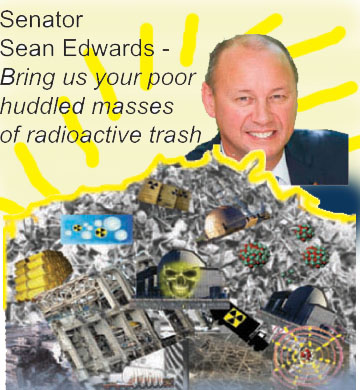 The impossible dream Free electricity sounds too good to be true. It is. A plan to produce free electricity for South Australia by embracing nuclear waste sounds like a wonderful idea. But it won’t work. THE AUSTRALIA INSTITUTE Dan Gilchrist February 2016
The massive holes in Senator Edward’s arguments for “new nuclear” technology for South Australia
not a single PRISM [ (Power Reactor Innovative Small Module] has actually been built…. the commercial viability of these technologies is unproven
Crucially, under the plan, Australia would have been taking spent fuel for 4 years before the first PRISM came online, assuming the reactors were built on time.
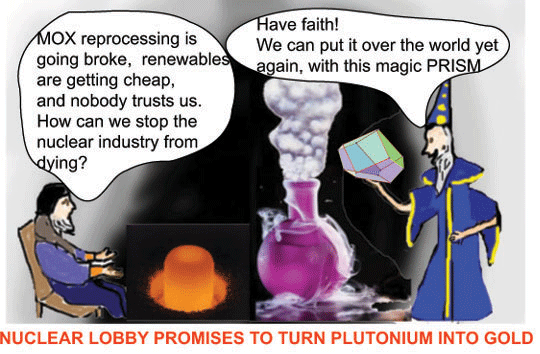
if borehole technology works as intended, and at the prices hoped for, why would any country pay another to take their waste for $1,370,000 a tonne, when a solution exists that only costs $216,000 a tonne, less than one sixth of the price?
The impossible dream Free electricity sounds too good to be true. It is. A plan to produce free electricity for South Australia by embracing nuclear waste sounds like a wonderful idea. But it won’t work. THE AUSTRALIA INSTITUTE Dan Gilchrist February 2016
“……NEW TECHNOLOGY This comprehensively researched submission asserts that a transformative opportunity is to be found in pairing established, mature practices with cuspof-commercialisation technologies to provide an innovative model of service to the global community. (emphasis added) Edwards’ submission to the Royal Commission
Cyclotrons able to produce medical isotopes; no need for Lucas Heights nuclear reactor
 This production method for Tc-99m can be used by retrofitting various brands of conventional cyclotrons already in use in hospitals and health centres across Canada.
1 This month

of the week – Australians for War Powers Reform (AWPR)
To see nuclear-related stories in greater depth and intensity
 Antinuclear