Some important details on the Trans Pacific Partnership
 Article 12.8 gives rights holders the right to demand personal information about customers of Internet Service Providers – or other service providers – on a mere accusation. . This is a fundamental attack on the privacy of the citizens of all signatory countries. There is nothing to stop rights holders going on extensive fishing expeditions, searching through millions of users, looking for people to sue. This power is not granted to law enforcement without due process. Handing such powers to corporations without any requirement to show a breach has occurred is an attack upon the process of law. We have a right to not be placed under surveillance by companies based upon their word that illegal activity has occurred
 Pirate Party Australia’s Presentation to Trans-Pacific Partnership Stakeholders Meeting in Melbourne March 4, 2012 Here is the speech that was presented by Pirate Party Australia President David Campbell at 11.45am at the TPPA stakeholders meeting in Melbourne. Thanks to Simon Frew (Deputy President) for authoring the speech and Mozart Palmer (Media Relations) for his contributions.
Pirate Party Australia, like many other attendees at the intellectual property section of this Agreement negotiation, first became aware of the proposed intellectual property provisions of the Trans-Pacific Partnership Agreement when the United States negotiating position was leaked last year.[1]
Much of the content of the leak is a wish-list for old media corporations who refuse to adapt to the Internet and instead pay massive “donations” to their government in order to push their legislative agenda against the interests of modern society. This wish-list echoes that of the intellectual property segments of the Stop Online Piracy Act – known as SOPA – and the Anti-Counterfeiting Trade Agreement – known as ACTA. The US TPPA provisions have been nicknamed “the son of ACTA”. The proposed solutions to online file-sharing will fundamentally change the operation of the Internet, to its detriment.
The extreme position of the leaked United States’ Intellectual Property chapter is highlighted by the unprecedented request for the negotiating texts to remain secret for four years after the agreement is signed. This secrecy is a perversion of democracy. The public would not be given a chance to oppose such a draconian attack on both the Internet and the civil liberties of citizens in all of the signatory countries. All of this to protect the corporate interests of a small sector of one industry? What about the cost to our democratic rights?……..
In Australia, we have seen the harm that tighter intellectual property restrictions can cause through the Australia–US Free Trade Agreement. The Productivity Commission, a body that investigates the economic benefit or hindrance of various Australian economic policies, warned that agreeing to intellectual property provisions in free trade agreements needs to be subjected to a rigorous cost/benefit analysis.
The Australia–US Free Trade Agreement is believed to cost the Australian economy between 88 million and 763 million dollars a year in copyright enforcement alone. This is wealth being directly transferred from Australia to the United States – there is no net benefit to Australia derived from the tighter restrictions.[2]
If the US delegation gets its way, that and more will be forced upon your people and local economy, to what benefit? We urge delegates to reject the inclusion of any intellectual property provisions in your own national interests as they WILL harm your economies. Continue reading
St George and Sutherland Shire still want ANSTO’s nuclear facilities – just not the wastes!
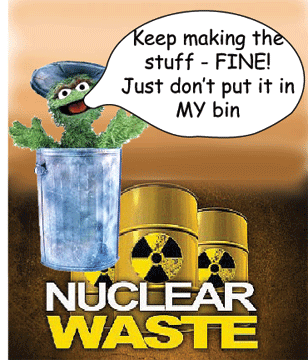
‘The people of Sutherland Shire call on the government to address the long-term future of nuclear waste associated with the continued operation of the ANSTO reactor and increased waste production associated with the new nuclear medicine centre.’
‘‘The continued transportation of intermediate level radioactive waste to Lucas Heights in the form of reprocessed fuel represents an unnecessary risk to the surrounding residents and communities.’’.
Mayor reacts to ANSTO licence for new nuclear medicine facility at Lucas Heights St George and Sutherland Shire Leader Oct. 4, 2013, .The Australian Radiation Protection and Nuclear Safety Agency (ARPANSA) has issued a licence to the Australian Nuclear Science and Technology Organisation to prepare a site for the ANSTO Nuclear Medicine Molybdenum-99 Facility at Lucas Heights.
The move prompted Sutherland Shire mayor Steve Simpson to renew the council’s calls for the federal government to address the problem of long-term management of radioactive waste from the Lucas Heights centre and establish a national nuclear waste repository as priority.
Indigenous Land Under Attack through ILUA Indigenous Land Use Agreement
 Australia: ILUA Indigenous Land Use Agreement Equals Indigenous Land Under Attack http://indigenouspeoplesissues.com/index.php?option=com_content&view=article&id=17864:australia-ilua-indigenous-land-use-agreement-equals-indigenous-land-under-attack&catid=24&Itemid=57 Native Title lawyers and anthropologists are deceiving claimants of their true Native Title rights and interests Michael Anderson said from Goodooga on July 2:2013
Radio: Adelaide the hub of military industrial intelligence nuclear complex
The issue isn’t nuclear power. The issue is processing uranium for nuclear power that then can be used for defence
You have to understand this in terms of in terms of Adelaide, -it’s a military industrial intelligence complex
Simons is connected to the University College of London but basically he’s a front man for business interests, We can clearly question what he is doing given the fact that he’s getting funding from indirect corporate sources.

 AUDIO: https://radio.adelaide.edu.au/nuclear-power-in-south-australia-a-golden-age/ Nuclear Power in South Australia – a golden age? Radio Adelaide 23 Aug 13 Chris Komorek spoke with Dr David Palmer from Flinders University to explore the changing landscape. Produced by Ian Newton. TRANSCRIPT by Christina Macpherson
Chris Komorek As the uranium debate heats up, so does the destroyed reactor in Fukushima, Japan.The International Energy Policy Institute at the University College London’s Adelaide campus is advocating a ramped up nuclear industry here in South Australia. We’re joined by Dr David Palmer from Flinders University.
Australian company Paladin’s uranium contract with Malawi -the “worst possible swindle”
 Malawi gov’t and Paladin: Act on Kayelekera uranium raw deal now! By Veronica Maele-Magombe Nyasa Times, By Veronica Maele-Magombe July 30, 2013 Since last week’s stinging observation by UnitedNations (UN) Special Raportuer on the Right to Food Olivier De Schutter regarding Malawi’s Kayelekera Uranium Mine deal, two elusive culprits remain pretty much intact in their hard shells. It is as if the country’s most guarded contract between government and Australiancompany, Paladin Africa Ltd has not been unravelled as the worst possible swindle. Continue reading
Australia’s “Northern Territory Intervention” trashed the reputation of Aboriginals on behalf of mining industries
 Government had made it clear that it wished to re-engage itself more directly in the control of community land through leasing options as well as to open up Aboriginal land for development and mining purposes.
The plan was to empty the homelands, and this has not changed. However, it was recognised that achieving this would be politically fraught – it would need to be accomplished in a manner that would not off-side mainstream Australia. Removing Aboriginal people from their land and taking control over their communities would need to be presented in a way that Australians would believe it to be to Aboriginal advantage, whatever the tactics.
So began the campaign to discredit the people and to publicly stigmatise Aboriginal men of the Northern Territory
And even in 2009 when the CEO of the Australian Crime Commission, John Lawler, reported that his investigation had shown there were no organised paedophile rings operating in the NT, no formal apology was ever made to the Aboriginal men and their families who were brutally shamed by the false claims.
Sixth Anniversary of the Northern Territory Intervention – Striking the Wrong Note Lateral Love Australia‘concerned Australians’ Michele Harris, 21 June 13 Aboriginal advocate Olga Havnen, in her Lowitja O’Donoghue oration has asked a critical question. She asks what has been the psychological impact of the Intervention on Aboriginal people of the Northern Territory. It is surprising that so little attention has been given to this critical, yet in some ways tenuous, link before now.
Even before the Intervention began in June 2007, government had long planned a new approach to the ‘management’ of Aboriginal people in the Northern Territory. It was no longer part of government thinking that self-determination and Aboriginal control over land could be allowed to continue. These were the Whitlam notions of 1975 and they were no longer acceptable.
Early inklings of change occurred in 2004 with the management of grants being transferred from communities to Government’s newly established Indigenous Co-ordination Centres. More ominous were the Amendments of 2006 to the Aboriginal Land Rights Act and the memoranda of agreements that followed. Government had made it clear that it wished to re-engage itself more directly in the control of community land through leasing options as well as to open up Aboriginal land for development and mining purposes. Continue reading
Retransfer of Australian obligated plutonium to Australia’s major uranium market, Japan
 Australia-Euratom Nuclear Safeguards: Plutonium Retransfers …..The Agreement will enter into force when Australia notifies the Delegation to the European Commission that all domestic requirements necessary to give effect to the Agreement have been satisfied…. Department of Foreign Affairs and Trade – Australian Government 01/06/2013 | Press release distributed by noodls http://www.noodls.com/view/2FBAFE516E5E78B9F15B62CBEB136F9A32994CC7
Australia and the European Atomic Energy Community (Euratom) exchanged diplomatic notes in Canberra on 28 May 1998 as the first step towards bringing into force an Agreement under which Australia will – subject to certain conditions – broaden its consent for the return from the European Union to Japan of Australian obligated plutonium following the reprocessing of Japanese spent fuel in Europe. The European Union is an important provider of nuclear fuel cycle services for countries purchasing Australian uranium and Japan is a major market for Australian uranium exports. Continue reading
The dirt on Australia’s uranium industry, as it holds its “Paydirt” conference
 Yellowcake Fever. Exposing the Uranium Industry’s Economic Myths Report in full at: http://www.acfonline.org.au/sites/default/files/resources/ACF_uranium_economics_Yellowcake_Fever.pdf by Dr Jim Green (FoEA) & Dave Sweeney (ACF), Australian Conservation Foundation, April 2013 (33 page PDF) Executive Summary: The Australian uranium industry involves serious and unresolved domestic and international security, environmental and inter-generational concerns and remains a contested and controversial sector that lacks a secure social license. This report examines the sectors small economic and employment contribution in relation to its significant risks and legacies and seeks to build the case for an independent cost-benefit analysis and a comprehensive and transparent assessment of the impacts and implications of Australia’s uranium trade.
Uranium is a small contributor to Australian export revenue and employment. From 2002 to 2011, uranium sales averaged $627 million annually and accounted for only 0.29% of all national export revenue. In the 2011/12 financial year, uranium revenue of $607 million was 4.4 times lower than Australia’s 20th biggest export earner, 8.7 times lower than Australia’s 10th biggest export earner and 103 times lower than the biggest earner, iron ore. Small industrial sectors can play an important economic role but the unique properties and risks of uranium mining relative to any benefits means its role requires particular scrutiny.
The industry’s contribution to employment is also underwhelming. The World Nuclear Association estimates 1,760 jobs in Australia’s uranium industry. That is the highest of all estimates yet it represents just 0.015% of all jobs in Australia. The industry’s primary promotional body, the Australian Uranium Association (AUA), claims its members are “significant employers of First Australians”
however the sector only provides around one job for every three thousand Indigenous Australians.
In the mid-2000s, there was a speculative uranium price bubble. Since this bubble burst the uranium industry has been battered by a falling commodity price, rising production costs, the Global Financial Crisis (and associated credit crisis), the failure of the global nuclear power ‘renaissance’ to materialise, the failure to develop new mines and serious production shortfalls……. Continue reading
Lynas rare earths company DOES have a radioactive waste problem
 Lynas was attracted to Malaysia because it was offered tax free status for 10 years.
there was little mention of the waste — or “residue”, as Lynas prefers to call it.
Lynas and its supporters assert its operations are completely safe, but as NM reported on Monday, others — including scientists — are less confident.
The IAEA also recommended that Lynas proceed no further until it had filed comprehensive plans for the permanent disposal of waste, decommissioning of the plant and remediation of the site at the end of its life.
 Lynas’ waste plans a toxic pipe dream Aliran, 19 December 2012 Scientists and community leaders are concerned about radioactive waste from Lynas’ Malaysian plant but the company representative who took Wendy Bacon’s questions brushed off the criticism. This is the second of two articles about Lynas by Wendy Bacon. Read the first here.http://aliran.com/11005.html Australian rare earth company Lynas has always known it had a waste problem.
It plans to process rare earth concentrate, imported from its mine at Mount Weld in Western Australia, at its Lynas Advanced Materials Plant (Lamp) in Malaysia. It will not only produce rare earths for export but also a huge amount of waste, including more than a million cubic metres of low level radioactive material.
Lynas was originally going to build its Lamp plant in China, which produces more than 90 per cent of global rare earths. But according to its 2007 annual report, it decided to move to Malaysia, because the Chinese government was increasing its control over production, including applying environmental standards more strictly. Continue reading
Radioactive toxicity from rare earths processing – gamma radiation
Hello, didn’t Lynas say wastes to be exported? Malaysiakini Dec 10, 2012 Swipenter: Spending another RM2 million to install two units of radioactive detecting machinery is “unnecessary” expenditure. That is one callous and contemptous attitude towards the safety of Malaysians.
An Old Malaysian: The raw materials imported are not a danger to us due to the very low concentration of the radioactive elements.
However, if the raw materials are processed and the waste radioactive elements are being concentrated, they will become a threat to the environment, humans, animals, etc.
The danger is from the gamma radiation emitted by these radioactive elements. If in low concentration and exposure time is short, gamma radiation will be low and will not be harmful to us (for example, X-ray) but if the radioactive elements concentration is high (for example, Lynas waste products) they will be hazardous to all of us and the environment.
Why are the two radioactive detection monitoring systems – installed at Lamp and at the Kuantan police station – valued at RM2 million?
A Geiger-Mueller radiation detector will tell you if there is radiation emitted from the raw material.http://www.malaysiakini.com/news/216281
How Aborigines were cheated out of their land in Victoria
The most important outcome of this event was that Batman became the first and possibly the only early Anglo-Australian to formally recognise the indigenous Aboriginal population as property owners.
 On this day: annulment of the Batman treaty AUSTRALIAN GEOGRAPHIC 27 Aug 12 IN 2012, MOST MELBOURNIANS would be confused if you offered them a handful of tomahawks, a few handkerchiefs, some blankets and some scissors for their land. One hundred and seventy-seven years ago in the rough-shod days of early Australian settlement, however, they
represented a princely sum. And that is exactly what settler John Batman used for currency to acquire the 250,000ha on which Melbourne and Geelong sit. Continue reading
Rare Earths Reprocessing in Australia
Note – I am not opposed to the mining and reprocessing of rare earths. I recognise that they are a necessary “lesser evil” in the development of modern and renewable technologies. BUT – rare earths reprocessing does produce toxic radioactive wastes, and the disposal of these wastes is an important issue that must be adressed, and clearly shown [ rather than spun] to the public. – Christina Macpherson
 Whilst working with Alkane on a pilot rare earths processing plant, ANSTO has previously partnered with BHP Billiton at the Olympic Dam mine, Energy Resources Australia at the Ranger uranium mine, and a number of other Australian-based miners.
Chalmers marked final government approvals as other major hurdles beyond the research with ANSTO.
And while so far steering clear of local opposition, the company remains mindful of the importance of keeping those outside the industry on side.
All eyes on ANSTO, Australian Mining, 10 August, 2012 Andrew Duffy “….. On a tour of its ANSTO pilot plant Alkane managing director Ian Chalmers told Australian Mining the company [ Alkane Resources ] was aiming to be producing rare earths by 2015…..
The company also runs tours for schools and interested community members to ensure everyone’s well informed.
Chalmers told Australian Mining Alkane’s close relationship with the community had been part of the reason why the company had avoided the difficulties faced by Lynas. Lynas has faced significant community opposition to its rare earth
processing plant in Malaysia, and protestors have been the source of ongoing delays, cost blowouts, and multiple court battles. ….
while the company’s community and environmental relations are a focus, the research at its ANSTO plant is all about the science behind rare earths processing. Continue reading
Poor safety record of Australian Nuclear Science and Technology Organisation (ANSTO) and Australian Radiation Protection and Nuclear Safety Agency (ARPANSA)
 Inadequate Safety Practices at Lucas Heights and Inadequate Regulation by ARPANSA, Friends of the Earth 10 Aug 12 Since 2007, a saga has been unfolding regarding contamination accidents at the Australian Nuclear Science and Technology Organisation (ANSTO), ANSTO’s handling of those incidents, ANSTO’s treatment of whistleblowers, the handling of the matter by the Australian Radiation Protection and Nuclear Safety Agency (ARPANSA), and the
 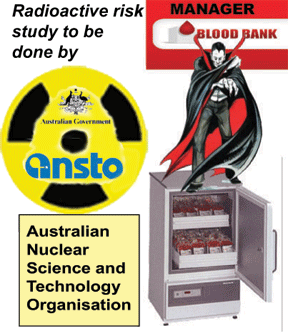 independence or otherwise of ARPANSA.
The saga has exposed inadequate safety practices at ANSTO and an inadequate performance by the regulator ARPANSA. The problems would not have been exposed and partially rectified if not for a number of ANSTO whistleblowers.
A few snapshots of this saga are noted below and more details can be found on the Friends of the Earth website:
28 August 2008 − Incident at ANSTO involving a vial of molybdenum-99. An audit found that proper processes were not followed: evacuation of the area did not occur, timely communication and event reporting, thorough investigation and follow-up did not occur. The staff member in question had not completed occupational health and safety induction training or a radiation safety course.
June 2009 − David Reid, an ANSTO employee and staff-elected health and safety officer, was suspended in June 2009 and sacked in June 2011. He repeatedly raised concerns about contamination incidents and some of his concerns were later vindicated. ANSTO states that his suspension and dismissal were unrelated to his statements regarding safety problems at ANSTO.
5 May 2010 − The ABC report states: “ARPANSA is Australia’s nuclear industry watchdog and Lateline has obtained a copy of its report into the accident. It largely supports David Reid’s concerns and raises further questions about safety at Lucas Heights. Continue reading
Doctors slam uranium miner Toro Energy for promoting junk science on radiation safety:
 We call on Toro Energy to stop promoting fringe scientific views to uranium industry workers and to the public at large.
The Medical Association for Prevention of War has released a statement signed by 45 medical doctors calling on uranium mining company Toro Energy to stop promoting the view that low-level radiation is beneficial to human health. Toro Energy, which plans to mine uranium at Wiluna in WA and has interests in uranium exploration ventures in the NT and SA, has sponsored speaking tours by controversial Canadian scientist Doug Boreham. The joint statement notes that recent research has heightened rather than reduced concern about the adverse health impacts of low-level radiation.
TORO ENERGY PROMOTES RADIATION JUNK SCIENCE , Statement by 45 doctors – (signatures at end ) 1 May 2012
Toro Energy is an Australian company involved in uranium exploration in Western Australia, the Northern Territory, South Australia and in Namibia, Africa. The company’s most advanced project is the proposed Wiluna uranium mine in the WA Goldfields.
Toro Energy has consistently promoted the fringe scientific view that exposure to low-level radiation is harmless. Toro Energy has sponsored at least three speaking visits to Australia by Canadian scientist Dr Doug Boreham, who argues that low-level radiation is actually beneficial to human health.
Those views are at odds with mainstream scientific evidence and expert assessment. For example: Continue reading
Australia obliged to take back Lucas Heights nuclear waste – it will go to Lucas Heights
 The Australian Greens want to close the Lucas Heights reactor and ban the import and export of nuclear waste …...
Nuclear waste will be stored in Sydney at Lucas Heights BY: IMRE SALUSINSZKY, NSW POLITICAL REPORTER The Australian May 01, 2012 NUCLEAR waste due to boomerang back to Australia in 2015 will be stored in metropolitan Sydney, after decades of political dithering over a national radioactive waste repository in the outback.
The Australian Nuclear Science and Technology Organisation will today launch its application for a licence to build an 800 sq m interim warehouse on the premises of the research reactor at Lucas Heights, which has generated the waste during the 50 years of its operation. Continue reading
1 This month

of the week – Australians for War Powers Reform (AWPR)
To see nuclear-related stories in greater depth and intensity
 Antinuclear