60 years ago, Aborginal people’s land desecrated by nuclear bombs. Now a new desecration – nuclear wastes?
Even I know off by heart the supercilious tones of the Chief Scientist of the British nuclear tests, Ernest Titterton’s on-screen completely false declaration: ‘No Aboriginal people were harmed.’ The discovery of Edie Milpuddie and family as they camped on the edge of the Marcoo bomb crater was dramatic exposure of that cruel fiction. It is extraordinary to see the actual footage of this moment in the film; and so sobering to hear again the terrible repercussions among her descendants.
‘No Aboriginal people were harmed.’ Add into that mix, English and Australian servicemen and the various pastoral landholders; and from the strong desert winds including across the APY Lands, we will never know the results of the further fallout across the state and nation.
Wind forward another 30 years again and the well being of another almost neighbouring group of Aboriginal people is threatened with nuclear repercussions: this time by the plan for the nation’s nuclear waste ‘stored’ (dumped) on their Country. Again as Traditional Owners, the Barngarla denied a say on their own Country, while a few white ‘latecomers’ were given theirs.
The nuclear fight: then and now, Eureka Street Michele Madigan, 04 June 2020 heeded? https://www.eurekastreet.com.au/article/the-nuclear-fight–then-and-now?utm_medium=email&utm_campaign=Eureka%20Street%20Daily%20-%20Thursday%204%20June%202020&utm_content=Eureka%20Street%20Daily%20-%20Thursday%204%20June%202020+CID_d497ae8df79099faf8643a0a84a8536d&utm_source=Jescom%20Newsletters&utm_term=READ%20MORE On Sunday 24th May, the ABC showed the documentary Maralinga Tjarutja produced and directed by lawyer, academic, filmmaker and Eualeyai/Kamillaroi woman Larissa Berendt. It was wonderful to see the Traditional Owners including the women given a current national voice as survivors of the British nuclear tests on their lands. Mima Smart OAM former long-term chairperson of Yalata Community was co-presenter with the chair of Maralinga Tjarutja, Jeremy Lebois; Mima’s Maralinga art, painted in collaboration with other Yalata minyma tjuta — women artists, becoming an integral background story — sometimes even in animation.
A reality check on the cost of nuclear power for Australia
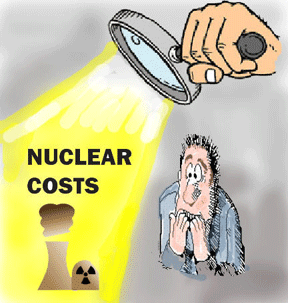 Nuclear cost and water consumption – The elephants in the control room, Open Forum.com.au. Peter Farley | December 20, 2019 Nuclear cost and water consumption – The elephants in the control room, Open Forum.com.au. Peter Farley | December 20, 2019 Cost There are four nuclear plants being built around the world where public information on costs is reasonably reliable.
These are Plant Vogtle in the US (US$27.5bn, 2.2GW), Framanville France (€12.4bn+, 1.6 GW), Olkiluoto in Finland (around €10 bn+, 1.6 GW) and Hinckley Point in the UK (₤22 bn+, 3.2 GW). There are two further plants whose power costs have been published, Akkuyu in Turkey US$127/MWh and Barakah in the Emirates US$110/MWh. It should be emphasised that none of these costs are the full cost recovery. For example in the British case it is estimated that some $10 bn has been spent by others on upgrading the grid and backup power supplies. In Turkey the cost of the plant is just that, and doesn’t include civil works, grid connections, cooling water supply. In the US plant Vogtle has benefited from some US$8bn of federal government loan guarantees and an unusual form of financing where customers have paid about 8% premium on their bills for 10-12 years before the plant is to be commissioned. All of the plants get catastrophe insurance and some security from their government and most have inadequate bond structures for long term waste storage. They also rarely pay for cooling water. Many have preferential supply agreements which will require other cheaper sources of power to turn off to allow the nuclear plants to keep running. However, even on the published information, nuclear power plants in democracies are running at about A$13m/MW. In our case we do not have an experienced nuclear workforce, Australian construction costs are higher by 20-30% for large projects – and there are 5,000 tradesmen on site at Plant Vogtle out of a workforce of 9,000 as nuclear power plants are very large projects. We do not have the heavy fabrication facilities required, and these cost hundreds of millions to build For example the Osborne Naval Shipyard design for 1/10th of the throughput of a nuclear fab shop cost $380m. Even the inspectors would have to be imported. So it is reasonable to suggest that new nuclear in Australia would cost at least A$16m per MW including subsidised construction finance, resulting in a first day of operation cost of a 2.2 GW plant of A$41 bn. Amortised over 50 years station life at a very low weighted average cost of capital at 5.5% – lower than plant Vogtle – that still works out at about $2.4 bn/yr. Due to the variability of demand in Australia the plants would be unlikely to be able to achieve a capacity factor above about 80% – halfway between the US and France and higher than Korea. So over a typical year a two unit 2.2 GW plant would be expected to generate about 15,500,000 MWh meaning the fixed costs per MWh would be $2.4bn/15.5m or $156/MWh. The daily running costs of US nuclear plants average out at US$40/MWh. This is lower than France and almost certainly lower than any new nuclear plant in Australia could achieve due to the much larger American skill base, higher utilisation and lower operating temperatures. The best case for Australia would be A$60+ for maintenace and operation. Thus an Australian nuclear power station could be expected to deliver power at a cost of A$216/MWh. Now if you use the cheaper Barrakah design at about US$5,300/MW and allow for 15 years of inflation at 1.5% to allow time for the project to come online, and a modest 10% Australian premium, power here could be produced at about A$10.4 bn per GW. After a slightly lower capacity factor of 75%, about the same as Korea, and a realistic WACC of 6.5% the ammortisation amounts to $107/MWh with a similar A$60/MWh operating and maintenance cost and the total delivered cost of power is a mere A $167/MWh. This figure aligns closely with the figure quoted by the CEO of the Barrakah plant some years ago at US$110/MWh The costs of a renewable alternative It should be noted that many of the arguments about relative costs are based on the figures used in the Finkel report. These are well out of date. Nuclear power has become even more expensive and actual renewable contracts in Australia are down 40-50% on the Finkel figures. Thus if we dispersed 2 GW of wind $3.6 bn, 1.2 GW of tracking solar $1.8bn, 2 GW of rooftop solar $2.5 bn, 1 GW of waste/biomass/geothermal $2.5bn and 1 GW/15GWh of pumped hydro $1.8 bn and 1 GW/ 2 GWh of batteries $1.2bn across the NEM the total cost would be $13.5 bn. Annual generation would be 17,500 GWh – more than the nuclear plant – and minimum available output would be 2.5 GW+. Typical hot day peak demand at 5pm would be about 4GW. About 30% of generation would go through storage at 85% efficiency, so net output would be around 16,500 GWh. Some would be curtailed so we can assume a similar annual output to the nuclear plant. However the operating costs average around $18 and the capital, even if amortised over 30 years are only $59/MWh for a total of $77 including backup. In summary, for 1/3rd of the investment, in one third of the time, we can get renewable power and backup for 1/3rd of the cost of nuclear power……https://www.openforum.com.au/nuclear-cost-and-water-consumption-the-elephants-in-the-control-room/?fbclid=IwAR2M3NxMjfrDJNWTG9tatKSARHGUKWVcG_CE-bSW5wtnAbwhGnYxd1ElugU |
|
Australia must not forget – the plutonium abuse of an Australian child, by Argonne National Laboratory

Paul Langley, https://www.facebook.com/paul.langley.9822/posts/10213752429593121CAL-2, 14 Aug 17, 5 yr-old Simon Shaw and his mum. Simon was flown from Australia to the US on the pretext of medical treatment for his bone cancer. Instead, he was secretly injected with plutonium to see what would happen. His urine was measured, and he was flown back to Australia.
Though his bodily fluids remained radioactive, Australian medical staff were not informed. No benefit was imparted to Simon by this alleged “medical treatment” and he died of his disease after suffering a trip across the world and back at the behest of the USA despite his painful condition. The USA merely wanted a plutonium test subject. They called him CAL-2. And did their deed under the cover of phony medicine.
“Congress of the United States, House of Representatives, Washington, DC 20515-2107, Edward J. Markey, 7th District, Massachusetts Committees, [word deleted] and Commerce, Chairman Subcommittee on Telecommunications and Finance, Natural Resources, Commission on Security and Cooperation in Europe] MEMORANDUM To: Congressman Edward J. Markey From: Staff Subject: The Plutonium Papers Date: 4/20/94
Staff Memo on Plutonium Papers
The medical file for Cal-2 also contains correspondence seeking follow-up from Argonne National Laboratory in the 1980s. Cal-2 was an Australian boy, not quite five years old, who was flown to the U.S. in 1946 for treatment of bone cancer. During his hospitalization in San Francisco, he was chosen as a subject for plutonium injection. He returned to Australia, where he died less than one year later.
Document 700474 is a letter from Dr. Stebbings to an official at the Institute of Public Health in Sydney, Australia, in an attempt to reach the family of Cal-2. This letter reports that the child was “injected with a long-lived alpha-emitting radionuclide.” Document 700471 is a letter from Dr. Stebbings to New South Wales, Australia (names and town deleted), inquiring about recollections of the boy’s hospitalization in 1946. The letter notes that, “those events have become rather important in some official circles here,” but provides few details to the family.
A hand-written note on the letter reports no response through October 8, 1987. Considering the history on the lack of informed consent with these experiments, it is surprising that the letters to Australia failed to mention the word “plutonium.”
The Australian news media has since identified Cal-2 as Simeon Shaw, the son of a wool buyer in New South Wales, and information on the injection created an international incident. The information in the medical file does indicate that at a time when Secretary Herrington told you that no follow-up would be conducted on living subjects, the Department of Energy was desperately interested in conducting follow-up on a deceased Australian patient.
In an effort to determine the full extent of follow-up by the Department after 1986, your staff has requested, through the Department’s office of congressional affairs, the opportunity to speak with Dr. Stebbings, Dr. Robertson, and any other officials who may have been involved in the follow-up. So far, that request has been unsuccessful. It remains an open question as to what was the full extent of follow-up performed in the 1980s, and whether the efforts then would facilitate any further follow-up on subjects now. It seems appropriate for the Interagency Working Group to address these questions as its efforts continue.”
Source: National Security Archives, George Washington University, http://www.gwu.edu/…/…/mstreet/commeet/meet1/brief1/br1n.txt
See also ACHRE Final Report.
NO MORE DUAL USE ABUSE OF AUSTRALIANS MR PRESIDENT. STOP FUNDING SYKES AND FLINDERS UNIVERSITY IN THE DOE QUEST FOR CHEAP CLEANUP OF URANIUM CONTAMINATED SITES.
Mr. President, you are wrong if you think you can do the same again re hormesis funding in Australia as the USA did with CAL-2. We have not forgotten and do not trust you or your paid agents in Australian universities such as Flinders.
An Email from Stichting Thorium MSR — The Industry Push to Force Nuclear Power in Australia

Why is the Majority Report of the Australian Senate here: https://www.aph.gov.au/-/media/02_Parliamentary_Business/24_Committees/243_Reps_Committees/EnvironmentEnergy/Nuclear_energy/Full_Report.pdf?la=en&hash=2826513C078551487B8265502776DAD5D23EB71D so full of misinformation and a totally false set of technical assertions???
via An Email from Stichting Thorium MSR — The Industry Push to Force Nuclear Power in Australia
A tribute to the Maralinga traditional owners
This is a critical and never-ending land management responsibility which the Maralinga people, who suffered the environmental and health effects of the nuclear tests, have shouldered on behalf of the Australian community.
He was able to relate to Aboriginal and non-Aboriginal people, cabinet ministers and homeless people alike. He treated everyone with candour and respect.
By word and deed he refused to accept that Aboriginal people were inferior
 Why Archie Barton and the Maralinga traditional owners are the unsung heroes of the British nuclear test program in Australia https://www.abc.net.au/news/2020-05-25/andrew-collett-on-archie-barton-unsung-heroes-of-maralinga-tests/12272284 By Andrew Collett
Politicians, bureaucrats, scientists and advisers come and go. The traditional owners must plug on with the management and rehabilitation of their land — on behalf of us all.
Andrew Collett is an Adelaide barrister and one of the lawyers who has represented the Maralinga traditional owners since 1984. Find out more about the story of the people of Oak Valley and Yalata in a new ABC TV documentary, Maralinga Tjarutja, available to stream now on iview.
The traditional owners of the 100,000 square kilometre Maralinga Lands didn’t only shoulder the harsh legacy of the British nuclear testing while it was happening in the 1950s and 60s.
To this day, they are managing the still contaminated test sites in far-west South Australia on behalf of Australia and Britain.
For this they receive little recognition and inadequate financial assistance — despite having established extremely constructive and enduring relationships with Australian scientists and government representatives.
Aboriginal and Torres Strait Islander readers are advised that the following article contains names and images of people who have died.
The Maralinga people were kept away from their lands and from any knowledge about what happened in the nuclear tests from 1955 until they obtained land rights and finally returned to their lands in 1985 — an isolation of 30 years, or well over a generation in Aboriginal terms.
For that 30 years the Maralinga people were kept at the Lutheran Mission at Yalata, away from their traditional lands, isolated from their Pitjantjatjara and Yankunytjatjara communities over 400 kilometres to the north and from much of their vibrant Western Desert tradition and ceremony.
They fell prey to social and cultural isolation and deteriorating health outcomes.
When they returned to their traditional lands in 1985, having been granted land rights to all their lands apart from the test sites, a royal commission was sitting in London examining what had happened during the Maralinga nuclear tests and why.
A constructive partnership with governmen Continue reading
13 Australian peak Non Government Organisations seek stronger Environmental Law on Nuclear Issues

Joint ENGO Submission on Nuclear Issues as they Relate to the Environmental Protection & Biodiversity Conservation Act Review 2020
This submission is made on behalf of the following national and state peak environment groups:
-
- Australian Conservation Foundation,
- Australian Nuclear Free Alliance,
- Friends of the Earth Australia,
- Greenpeace Australia Pacific,
- Mineral Policy Institute,
- The Wilderness Society,
- Arid Lands Environment Centre,
- Environment Centre NT,
- Environment Victoria,
- Conservation Council SA,
- Conservation Council WA,
- Nature Conservation Council NSW and Queensland Conservation Council.
This submission outlines the importance of retaining s140A of the EPBC Act which prohibits nuclear power; the retention of uranium exploration and mining in the definition of a Nuclear Action and the inclusion of Nuclear Actions as a Matter of National Environmental Significance (MNES).
This submission is made in consideration of the broader objects and principles of the Act and is based on evidence from recent inquiries into both nuclear power and uranium mining. There is clear evidence that nuclear activities can have a significant environmental and public health risk and, in many cases, irreversible impacts, and this is consistent with the current dedicated legislative prohibitions for both nuclear power and scrutiny for uranium mining.
While the current Act does not include a prohibition on uranium mining we strongly advocate that there be a national ban on uranium mining consistent with state legal or policy prohibitions in New South Wales, Queensland, Tasmania, Victoria and West Australia Written by Mia Pepper, Jim Green, Dave Sweeney, David Noonan & Annica Schoo.
Summary of Recommendations
Uranium:
• that uranium mining and milling be included in s140A prohibitions as nuclear actions that the Minister must not approve, on the basis that the nuclear industry has failed to successfully remediate any uranium mine in Australia and has impacts inconsistent with the objects and principles of the EPBC Act.
• if the above recommendation is not adopted that uranium mining and milling remains within the definition of a ‘nuclear action’ and that nuclear actions continue to be listed as MNES and the protected matters continue to be listed as the ‘environment’ and so be subject to full environmental assessment at the state level
• DAWE to initiate an inquiry into the human and environmental impacts of uranium mining, as advised by the UN Secretary General following the Fukushima nuclear disaster, noting that Australian uranium was present in each of the Fukushima Daiichi reactors at the time of multiple reactor meltdowns
. • regulatory reform for existing operating mines • that the review committee recommend DAWE prioritise the rehabilitation of abandoned uranium mines and processing facilities, exploration sites and uranium mines that have been in care and maintenance for more than two years.
Nuclear Power:
• the retention of s140A of the EPBC Act 1999 which states “No approval for certain nuclear installations: The Minister must not approve an action consisting of or involving the construction or operation of any of the following nuclear installations: (a) a nuclear fuel fabrication plant; (b) a nuclear power plant; (c) an enrichment plant; (d) a reprocessing facility.”
Other Matters:
• a National Environmental Protection Authority be established
• the effectiveness of assessment bilateral agreements be reviewed, and approval bilateral agreements are not pursued
• legislate requirements for mine closure, address activities that are used to avoid mine closure and to work with states and territories to remediate existing legacy mine sites
• there be established internal process for DAWE to pursue the listing of newly identified species by referring to the Threatened Species Scientific Committee
• that the principles of free, prior and informed consent become a mandatory operational principle within the EPBC Act along with a governance mechanism to operationalise this principle……… . https://dont-nuke-the-climate.org.au/wp-content/uploads/2020/04/Joint_Sub_EPBC_Nukes_FINAL.pdf
Global heating is intensifying a rare natural phenomenon that brings severe drought to Australia.
 A rare natural phenomenon brings severe drought to Australia. Climate change is making it more common, The Conversation, Nicky Wright, Research Fellow, Australian National University, Bethany Ellis, PhD Candidate, Australian National University, Nerilie Abram, Professor; ARC Future Fellow; Chief Investigator for the ARC Centre of Excellence for Climate Extremes, Australian National University, March 10, 2020
Weather-wise, 2019 was a crazy way to end a decade. Fires spread through much of southeast Australia, fuelled by dry vegetation from the ongoing drought and fanned by hot, windy fire weather.
On the other side of the Indian Ocean, torrential rainfall and flooding devastated parts of eastern Africa. Communities there now face a locust plague and food shortages.
These intense events can partly be blamed on the extreme positive Indian Ocean Dipole, a climate phenomenon that unfolded in the second half of 2019.
The Indian Ocean Dipole refers to the difference in sea surface temperature on either side of the Indian Ocean, which alters rainfall patterns in Australia and other nations in the region. The dipole is a lesser-known relative of the Pacific Ocean’s El Niño.
In research published today in Nature, we reconstructed Indian Ocean Dipole variability over the last millennium. We found “extreme positive” Indian Ocean Dipole events like last year’s are historically very rare, but becoming more common due to human-caused climate change. This is big news for a planet already struggling to contain global warming.
So what does this new side-effect of climate change mean for the future?
The Indian Ocean brings drought and flooding rain
First, let’s explore what a “positive” and “negative” Indian Ocean Dipole means.
During a “positive” Indian Ocean Dipole event, waters in the eastern Indian Ocean become cooler than normal, while waters in the western Indian Ocean become warmer than normal.
Warmer water causes rising warm, moist air, bringing intense rainfall and flooding to east Africa. At the same time, atmospheric moisture is reduced over the cool waters of the eastern Indian Ocean. This turns off one of Australia’s important rainfall sources.
In fact, over the past century, positive Indian Ocean Dipoles have led to the worst droughts and bushfires in southeast Australia.
The Indian Ocean Dipole also has a negative phase, which is important to bring drought-breaking rain to Australia. But the positive phase is much stronger and has more intense climate impacts.
We’ve experienced extreme positive Indian Ocean Dipole events before. Reliable instrumental records of the phenomenon began in 1958, and since then a string of very strong positive Indian Ocean Dipoles have occurred in 1961, 1994, 1997 and now 2019.
But this instrumental record is very short, and it’s tainted by the external influence of climate change.
This means it’s impossible to tell from instrumental records alone how extreme Indian Ocean Dipoles can be, and whether human-caused climate change is influencing the phenomenon.
Diving into the past with corals
To uncover just how the Indian Ocean Dipole has changed, we looked back through the last millennium using natural records: “cores” taken from nine coral skeletons (one modern, eight fossilised)……….
positive Indian Ocean Dipole events have been occurring more often in recent decades, and becoming more intense…….
climate change is causing the western side of the Indian Ocean to warm faster than in the east, making it easier for positive Indian Ocean Dipole events to establish.
In other words, drought-causing positive Indian Ocean Dipole events will become more frequent as our climate continues to warm. In fact, climate model projections indicate extreme positive Indian Ocean Dipole events will occur three times more often this century than last, if high greenhouse gas emissions continue.
This means events like last year will almost certainly unfold again soon, and we’re upping the odds of even worse events that, through the fossil coral data, we now know are possible.
Knowing we haven’t yet seen the worst of the Indian Ocean Dipole is important in planning for future climate risks. Future extremes from the Indian Ocean will act on top of long-term warming, giving a double-whammy effect to their impacts in Australia, like the record-breaking heat and drought of 2019.
But perhaps most importantly, rapidly cutting greenhouse gas emissions will limit how often positive Indian Ocean Dipole events occur in future.https://theconversation.com/a-rare-natural-phenomenon-brings-severe-drought-to-australia-climate-change-is-making-it-more-common-133058
“NuclearHistory” exposes the unpleasant facts about liquid fluoride thorium nuclear reactors

Some people believe that liquid fluoride thorium reactors, which would use a high temperature liquid fuel made of molten salt, would be significantly safer than current generation reactors. However, such reactors have major flaws. There are serious safety issues associated with the retention of fission products in the fuel, and it is not clear these problems can be effectively resolved. Such reactors also present proliferation and nuclear terrorism risks because they involve the continuous separation, or “reprocessing,” of the fuel to remove fission products and to efficiently produce U-233, which is a nuclear weapon-usable material. Moreover, disposal of theused fuel has turned out to be a major challenge. Stabilization and disposal of the
remains of the very small “Molten Salt Reactor Experiment” that operated at Oak
Ridge National Laboratory in the 1960s has turned into the most technically challenging cleanup problem that Oak Ridge has faced, and the site has still not been cleaned up. Last updated March 14, 2019″ Source: Union of Concerned Scientists, at https://www.ucsusa.org/sites/default/files/legacy/assets/documents/nuclear_power/thorium-reactors-statement.pdf I wonder who is correct, The Union of Scientists or Mr. O’Brien and ScoMo?
The Industry Push to Force Nuclear Power in Australia, Part 1 of A Study of the “Report of the inquiry into the prerequisites for nuclear energy in Australia” Australian Parliamentary Committee 2020.by nuclearhistory, February 29, 2020, “………Nuclear power enables the great powers to project power. It is a crucial geo-political influencer. If the committee has it’s way, we will be working with Russia and China and others on reactors they want to develop, that their own people have not had a say in, that are all based upon reactor designs first thought of in the 1950s, and where actual examples were built at that time, turned out to be unsafe failures which continue to present cost and risk at their sites to this day.
The committee’s first recommendation to government includes the following two sub parts:
c. procuring next-of-a-kind nuclear reactors only, not first-of-a- kind.” end quote.
“procuring next-of-a-kind nuclear reactors only, not first-of-a- kind” How refreshing that the Committee does not want the first gen iv type reactors – the Fermi 1 and Monju type for example. Those dangerous failures that sit like wounded Albatross in the US and Japan and continue to demand taxpayer funds. The failure of Monju, which has long been foreseen by many, renders the original basis for the Japanese nuclear industry subject to severe doubt. As result of vastly improved safety standards, fuel reprocessing in Japan is in doubt, its future course uncertain, and the nature of high level waste management has been an even more pressing issue.
Flinders University, South Australia: collusion with nuclear power promotion, Prof Pam Sykes, and the scam of “hormesis”
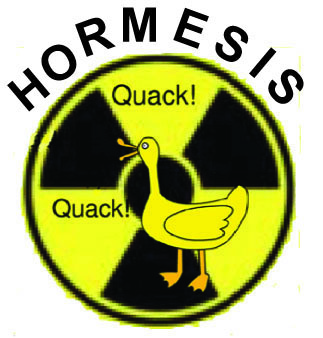
The Industry Push to Force Nuclear Power in Australia, Part 1 of A Study of the “Report of the inquiry into the prerequisites for nuclear energy in Australia” Australian Parliamentary Committee 2020.by nuclearhistory, February 29, 2020“………….The most recent nuclear collaboration between Australia and a nuclear power for nuclear purposes commenced in the year 2000. At that time a US Department of Energy Contractor named Bobby Scott, based at Los Alamos and at Lovelace Respiratory Research Laboratory, New Mexico, came to Adelaide carrying contract documents. The documents were to be signed by the US DOE and involved personnel of Flinders University. Bobby Scott is a well known (to people in the field) as a leading advocate for the theory of radiation hormesis. The contract to be signed was the first of a number. From the time of the signing of that contract, Flinders University engaged in very strong advocacy of the expansion of nuclear industry in South Australia. Prof Pam Sykes was flown from Adelaide to Los Almos and undertook training and seminars in Hormesis. The concept that radioactive substances are, in her words, “like vitamins”.
I have fully explained that this unproven theory flies in the face of reality in terms of radiological safety and data from monitoring of dose and disease all over the world, including, contrary to the claims of the school hormesis, the naturally high background radiation regions of Iran and India. In those parts of Iran and India, (the five northern provinces in Iran, and Kerala in India) some cancer rates are among the highest in the world. Further, in those Iranian provinces breast cancer in teenage women is more common than it is even in the West. And so on. There are five types of cancer in northern Iran which have very high rates. In south western Kerala, the rates of female thyroid cancer is very, very high.
Contrary the to statements made by the school of hormesis, headquartered at Los Alamos, USA and Flinders University Adelaide. From 2000 on, Flinders University promoted the idea of radioactive substances such as uranium and its decay products and the fission products as being “like vitamins”, necessary for life. By 2011 the university was promoting the idea that an expansion of the state’s uranium mines would be good for the health of South Australians, because the natural background here is “too low” for good health. Presumably the transport of tons of additional uranium ore by train from the mines to the ports in open railway trucks would result in faint clouds of radionuclide “vitamins” being dispersed over the whole population of the state in precisely the right theoretical dose, taking into account, somehow, automatically, the age, gender and health status of each South Australian. (I didn’t write what Sykes did, so don’t blame me.). In 2011 the US DOE funded Flinders University put its pedal to the metal and flew into the debate, labelling South Australians who disagreed with it’s position in words which were insulting and which labelled us as lunatics, radiophobes and totally ignorant of radiological safety principles, cowardly, and devoid of reason. Read it here: https://news.flinders.edu.au/blog/2011/07/14/radiation-response-a-meltdown-in-reason/
Australia’s early nuclear history – a scandalously crooked co-operation with Britain
The British also deliberately spread plutonium dust over the outback in so called safety tests. Although a number of Australians had knowledge they desperately wanted to share with the Australian people, the Australian government threatened these people with many years jail if they spoke out.
Australian service personnel and their health status records were treated and kept at the Maralinga Hospital. John Hutton was the only involved person to ever see his Maralinga file and actually get to retain a page from it. (He nicked it).
Australia and Britain perfected a medical regime in which medical responses to radiation induced syndromes were solved without documenting the actual diagnosis. The afflicted personnel, with the exception of Mr. Hutton, never got to read their own medical records, all of which disappeared when the British Bombardiers left Australia in the 1960s. And some say they took the Maralinga medical records with them. That’s very close collaboration, isn’t it?
|
Part 1 of A Study of the “Report of the inquiry into the prerequisites for nuclear energy in Australia” Australian Parliamentary Committee 2020. Nuclear History, 29 Feb 2020 “………..Australia cooperated with the United Kingdom in that nations’ successful attempt to duplicate the Manhattan’s Project plutonium bomb. Prime Minister Menzies, without the approval of ordinary Australians, agreed to the British request to detonate atomic bombs over and on Australia. This involved excluding the Australian Sir Mark Oliphant from participating in the Atomic Weapons Safety Committee (AWTSC). Instead following British desires, Australia appointed the Englishman Professor Titterton, a radar and timing expert, to that committee. Even though the Committee was not a British Committee, but one which was paid for by Australians, and which reported to, and was subordinate to, the Australian government. Titterton rose quickly to head the committee. Justice Jim McClelland, during the Royal Commission into the British Nuclear Bombing of Australia, concluded that Titterton deliberately with held important safety information from the safety committee, the Australian government and the Australian people. Justice McClelland found that Titterton was acting under security protocols imposed by Britain and the United States. And that this was counter to Australian interests and to the safety and security of Australians. The results of this deception against Australia continue to resonant in Australia today. Continue reading
|


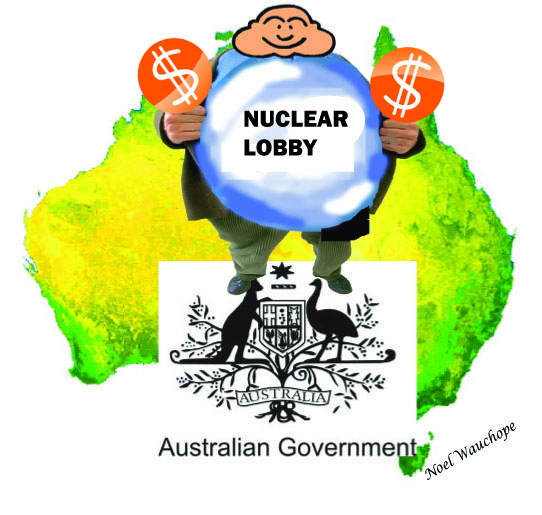
Kimba nuclear waste dump – a total mishandling of the truth from Australian government.
|
IN DAILY – YOUR VIEWS – 25TH FEBRUARY 2020 Fight To Stop Nuclear Waste In The Flinders Ranges
 Leon Ashton, When will the Federal Government finally acknowledge publicly that their process to establish a nuclear waste dump has not worked.? All that they have done to date is to destroy the community bond which is the glue that holds any small community together. Leon Ashton, When will the Federal Government finally acknowledge publicly that their process to establish a nuclear waste dump has not worked.? All that they have done to date is to destroy the community bond which is the glue that holds any small community together.They have portrayed the dump to the key communities as a win-win for all.
This they can do easily because they have only told half the story. The good bits.
They have the money to do this as its taxpayers’ money. If the people of South Australia only delved a bit deeper into the nuclear issue, they would soon discover a total mishandling of the truth from our government.
A few unanswered concerns are:
1) Why won’t the department tell the people of Kimba what the CEO of Lucas Heights told the doctor from Hawker in May 2018 that we are lucky to now be receiving intermediate-level waste, because without it there are very little economic benefits to any community.
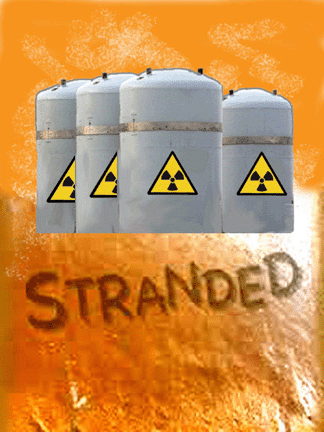 2) The department will not tell the community how long the highly dangerous intermediate nuclear waste will be temporarily stored. There are no such plans in place at the present to permanently bury this waste as it is too cost prohibitive to do so. This could easily end up stranded for hundreds of years to come in the centre of Eyre Peninsula. If the government watchdog ARPANSA agrees that it is to remain at Lucas Heights, where does that leave the community. 2) The department will not tell the community how long the highly dangerous intermediate nuclear waste will be temporarily stored. There are no such plans in place at the present to permanently bury this waste as it is too cost prohibitive to do so. This could easily end up stranded for hundreds of years to come in the centre of Eyre Peninsula. If the government watchdog ARPANSA agrees that it is to remain at Lucas Heights, where does that leave the community.3) Why won’t Sam Chard (Your views, February 19) tell the communities that once legacy waste is collected and stored at the dump, then there will only be about two and a quarter containers annually of low-level waste delivered provided every one chooses to use the dump. This will never provide 45 jobs.
4. A parliamentary enquiry in 2004 in NSW acknowledged it was misleading to the public by ANSTO, rebadging the high-level waste being returned from France and England as intermediate waste.
If Australia has to have a single waste dump for our low and intermediate-level waste then all Australians need to be involved. Not just kept low key on the few hundred citizens that are at present bulldozed into the decision that needs a national answer. https://www.facebook.com/groups/941313402573199/
|
Australian public unaware of the dangers of small nuclear reactors
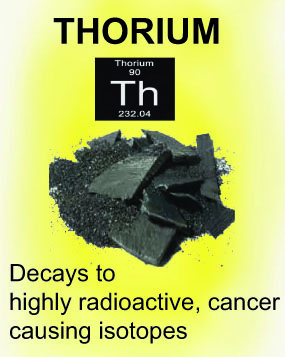 Thorium advocates say that thorium reactors produce little radioactive waste, however, they simply produce a different spectrum of waste from traditional reactors, including many dangerous isotopes with extremely long half-lives. Technetium 99 has a half-life of 300,000 years and iodine 129 a half-life of 15.7 million years.
|
HELEN CALDICOTT: The dangers of nuclear power in Australia https://independentaustralia.net/environment/environment-display/helen-caldicott-the-dangers-of-nuclear-power-in-australia,13597
By Helen Caldicott | 16 February 2020 Long-time anti-nuclear campaigner and writer Dr Helen Caldicott believes the risks of nuclear power outweigh the benefits.
AS AUSTRALIA grapples with the notion of introducing nuclear power as an energy source, it is imperative that people understand the intricacies of these new technologies including small modular reactors (SMR) and thorium reactors. There are basically three types of SMRs which generate less than 300 megawatts of electricity compared to current 1000 megawatt reactors. Light water reactors designs – smaller versions of present-day pressurised water reactors – will be built underground but with the same attendant problems as those at Fukushima and Three Mile Island. They will be mass-produced, so large numbers must be sold yearly to make a profit, and should a safety problem arise like the Boeing Dreamliner plane, they all will have to be shut down interfering substantially with electricity supply. SMRs will be expensive because the cost of unit capacity increases with decrease in the size of the reactor. To alleviate costs, it is suggested that safety rules be relaxed including reducing security requirements and a reduction in the 10-mile emergency planning zone to 1000 feet. High-temperature gas-cooled reactors (HTGR) or pebble bed reactors Continue reading |
High Level Nuclear Waste: Believe Canavan’s Queensland mate or official sources?
DEFINITION OF HIGH LEVEL RADIOACTIVE WASTE :
Source : US Nuclear Regulatory Commission (USNRC) :
High-level radioactive wastes are the highly radioactive materials produced as a byproduct of the reactions that occur inside nuclear reactors. High-level wastes take one of two forms:
1) Spent (used) reactor fuel when it is accepted for disposal.
2) Waste materials remaining after spent fuel is reprocessed.
Source : International Atomic Energy Agency (IAEA) :
High-Level Radioactive Waste (HLW) is produced from the burning of uranium fuel in nuclear power reactors. It is of two kinds:
1) Spent nuclear fuel.
2) Waste resulting from the reprocessing of spent nuclear fuel.
Due to its high radioactivity and very long half-life, HLW has to be well contained and isolated from the human environment.
RADIOACTIVE WASTE 10,000 X MORE RADIOACTIVE THAN URANIUM ORE
Source: Nuclear


Australia’s extreme bushfires – forests might not recover
 Wildfires have spread dramatically—and some forests may not recover. An explosion in the frequency and extent of wildfires worldwide is hindering recovery even in ecosystems that rely on natural blazes to survive. https://www.nationalgeographic.com/science/2020/01/extreme-wildfires-reshaping-forests-worldwide-recovery-australia-climate/
|
BY JOHN PICKRELL, JANUARY 30, 2020, Pungent and damp, the so-called tall, wet forests of southeastern Australia are home to the tallest flowering plants on Earth. Eucalyptus regnans, the Latin name of the mountain ash, means “ruler of the gum trees”—which is fitting, given these giants can reach more than 300 feet high.
Many of Australia’s gum trees, particularly those in drier forest types, are famously able to tolerate fire, throwing out new buds and shoots within weeks of being engulfed in flames. But even these tenacious species have their limits. Old-growth forests of the mountain ash and a related species, the alpine ash, are among the gum trees that are less tolerant of intense blazes. In the state of Victoria, these trees had already been severely depleted by logging and land clearing. Now, the bushfires that have burned more than 26 million acres of eastern Australia in recent months are putting the forests at even greater risk. Some of the forests razed this year have experienced four bushfires in the past 25 years, meaning they’ve had no chance to recover, says David Lindenmayer, an ecologist at the Australian National University in Canberra. “They should be burning no more than every 75 to 125 years, so that’s just an extraordinary change to fire regimes,” he says. “Mountain ash need to be about 15 to 30 years old before they can produce viable amounts of seed to replace themselves following fire.” The loss of these dominant trees is a significant problem, since they provide vital habitat for threatened animal species such as the sooty owl, the giant burrowing frog, and a fluffy arboreal marsupial called the greater glider. (Also find out how Australia’s fires can create big problems for freshwater supplies.) |
|
Australia’s fire-driven storms are pumping smoke into the stratosphere
Blazes across the country in the past few weeks have been so intense they have generated their own weather. They create rising air mixed with ash and smoke that results in thunderstorm clouds above the fires called pyrocumulonimbus (pyroCbs).
Some of these are strong enough and rise high enough to have channelled smoke into the stratosphere, a plume of which has crossed the Atlantic Ocean in an eastward direction. NASA says this plume has now made a full circuit around the Earth. There were at least 20 pyroCbs between 28 and 31 December, and more on 4 January, some of which injected smoke into the stratosphere.
The scale of the smoke in the stratosphere has now been calculated by David Peterson at the US Naval Research Laboratory, who is presenting his preliminary findings to the American Meteorological Society at a meeting in Boston later today.
“It’s very likely on a volcanic scale,” he says. “The big thing here is really the impact that this is having on the stratosphere.” Although not of the scale of the 1991 eruption of Mount Pinatubo, the largest in modern history, the effect is similar to a more moderate eruption, Peterson says.
In 2017, Peterson found that Canadian wildfires put as much smoke as a volcano into the stratosphere. He is now working to apply the same technique to the Australian fires and thunderstorms. “At this point I can tell you that this event is one of the largest, it’s very near the top. I can’t say for sure if it’s the biggest,” he says, in terms of the amount of smoke injected into the stratosphere.
While it is well known that a volcanic eruption can put enough aerosols into the atmosphere to have a cooling effect, the different chemistry of pyroCbs means the impacts of the fires on global temperatures aren’t yet entirely clear.
They may have a warming or cooling effect, and it isn’t known how long the smoke will persist at heights of between around 10 and 50 kilometres high, which is roughly where the stratosphere starts and finishes. Peterson says the biggest question is what role proyCbs are playing in the climate system. Some of the smoke plumes are also getting high enough to affect the ozone layer.
We may have answers to some of these unknowns soon though, thanks to NASA flying a plane earlier this year through the upper level of a pyroCb generated by US wildfires. “It wasn’t as massive as these Australia plumes but fortunately at an altitude the aircraft could get to it,” says Peterson. The resulting direct observations of the chemistry will, along with satellite measurements, help unlock the answers.
Alan Robock at Rutgers University in New Jersey says any potential cooling effect from the bushfire smoke is unlikely to be huge at a global level, but could cause cooling of several degrees Celsius at a local level. If the Australian pyroCbs produce twice as much smoke as those from Canada in 2017, “it still would not be a large or long-lasting impact on climate,” he says.
However, the smoke can persist in the stratosphere for half a year or longer, as at such heights it can be heated by the sun and lofted even further up, prolonging its lifetime.
“This is the same process we have modelled in our studies of the climatic consequences of nuclear war in which much more smoke from burning cities and industrial areas would be lofted into the stratosphere and last for years,” says Robock. As such, analysis of the smoke from the bushfires could help improve simulations of the impact of nuclear Armageddon.
Our knowledge of pyroCbs is at an early stage. These thunderstorms and the smoke they put into the stratosphere have only been detectable via satellite instruments since the early 2000s, and previously were thought to be the result of volcanic eruptions, until analysis traced them back to wildfires.
1 This month

of the week – Australians for War Powers Reform (AWPR)
To see nuclear-related stories in greater depth and intensity
 Antinuclear