Effects of ionising radiation on wild Japanese monkey fetuses
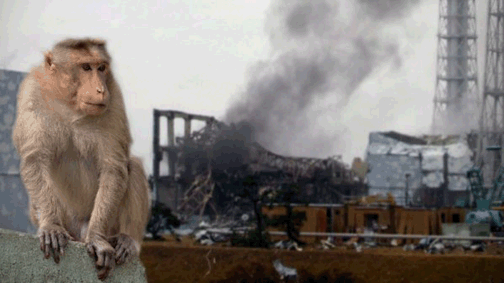
Small head size and delayed body weight growth in wild Japanese monkey fetuses after the Fukushima Daiichi nuclear disaster , Nature, Scientific Reports,
Scientific Reports 7, 1June2017
Abstract
To evaluate the biological effect of the Fukushima Daiichi nuclear disaster, relative differences in the growth of wild Japanese monkeys (Macaca fuscata) were measured before and after the disaster of 2011 in Fukushima City, which is approximately 70 km from the nuclear power plant, by performing external measurements on fetuses collected from 2008 to 2016. Comparing the relative growth of 31 fetuses conceived prior to the disaster and 31 fetuses conceived after the disaster in terms of body weight and head size (product of the occipital frontal diameter and biparietal diameter) to crown-rump length ratio revealed that body weight growth rate and proportional head size were significantly lower in fetuses conceived after the disaster. No significant difference was observed in nutritional indicators for the fetuses’ mothers. Accordingly, radiation exposure could be one factor contributed to the observed growth delay in this study.
Introduction
The Fukushima Daiichi nuclear power plant (NPP) disaster that occurred in March 2011 exposed a large number of humans and wild animals to radioactive substances. Several studies of wild animals in Fukushima investigated health effects of the disaster, such as morphological abnormalities in gall-forming aphids (Tetraneura sorini, T. nigriabdominalis)1 and pale grass blue butterfly (Zizeeria maha)2, hematological abnormalities in carp (Cyprinus carpio)3, and chromosomal aberrations in wild mice (Apodemus argenteus, Mus musculus)4. However, there is no research investigating long-term exposure to radiation on mammals that typically have long life-span to date. This study is the first report to observe long-term biological effects of the pre- and post-NPP disaster on non-human primates in Fukushima.
We previously studied radioactive exposure and its effect on health of Japanese monkeys (Macaca fuscata) inhabiting Fukushima City, which is located approximately 70 km from the Fukushima Daiichi NPP5, 6. After the NPP disaster, the range of radiocesium soil concentrations in Fukushima City was 10,000–300,000 Bq/m2. Hayama et al.5 investigated chronological changes in muscle radiocesium concentrations in monkeys inhabiting Fukushima City from April 2011 to June 2012. The cesium concentration in monkeys’ muscle captured at locations with 100,000–300,000 Bq/m2 was 6000–25,000 Bq/kg in April 2011 and decreased over 3 months to approximately 1000 Bq/kg. However, the concentration increased again to 2000–3000 Bq/kg in some animals during and after December 2011, before returning to 1000 Bq/kg in April 2012, after which it remained constant.
Fukushima monkeys had significantly lower white and red blood cell counts, hemoglobin, and hematocrit, and the white blood cell count in immature monkeys showed a significant negative correlation with muscle cesium concentration6. These results suggested that the short-term exposure to some form of radioactive material resulted in hematological changes in Fukushima monkeys.
The effects associated with long-term low-dose radiation exposure on fetuses are among the many health concerns. Children born to atomic bomb survivors from Hiroshima and Nagasaki showed low birth weight, high rates of microcephaly7, and reduced intelligence due to abnormal brain development8. Experiments with pregnant mice or rats and radiation exposure had been reported to cause low birth weight9, 10, microcephaly11,12,13, or both14, 15. We identified one similar study on wild animals16, which reported that the brains of birds captured in the vicinity of the Chernobyl NPP weighted lower compared to those of birds captured elsewhere. Continue reading
Map of Aboriginal massacres shows that these colonial wars should be recognised
For the full map by the Centre for 21st Century Humanities and the Centre for the History of Violence, visit https://c21ch.newcastle.edu.au
 Mapping Aboriginal massacres makes it time to recognise the colonial wars, say leading historians http://www.smh.com.au/national/mapping-aboriginal-massacres-makes-it-time-to-recognise-the-colonial-wars-say-leading-historians-20170705-gx4y3m.html, Julie Power. 5 July 17, Almost every Aboriginal clan experienced massacres at the hands of early settlers in the “colonial wars”, according to the first stage of a new online mapping project.
So far the project has documented 150 massacres resulting in at least 6000 deaths in the early years of the colony. Most happened at dawn with a surprise attack on an Aboriginal camp where people “simply couldn’t defend themselves”, said University of Newcastle historian Professor Lyndall Ryan, who has been developing the online digital map for nearly four years.
Yet those who died defending their people and land have rarely been recognised. Professor Ryan and Tasmanian author Professor Henry Reynolds – whose books documented the “forgotten” and “silent” colonial wars against Aboriginal people – said it was time for the Australia War Memorial to recognise this war. Continue reading
Australian Greens REJECT Australia joining Generation IV Nuclear Energy Accession
 Dissenting Report – Australian Greens, Senator Sarah Hanson-Young Australian Greens Senator,
 Unchecked capacity and resourcing
Prohibited Technology
Lack of Procedural Fairness and over reliance on evidence from ANSTO
Australia’s accessibility to nuclear technology and standing on nuclear non-proliferation
The facts on wind farms and bird deaths
 Wind farms are hardly the bird slayers they’re made out to be. Here’s why, The Conversation, Emeritus Professor in Public Health, University of Sydney, June 16, 2017, People who oppose wind farms often claim wind turbine blades kill large numbers of birds, often referring to them as “bird choppers”. And claims of dangers to iconic or rare birds, especially raptors, have attracted a lot of attention.
Wind turbine blades do indeed kill birds and bats, but their contribution to total bird deaths is extremely low, as these three studies show.
A 2009 study using US and European data on bird deaths estimated the number of birds killed per unit of power generated by wind, fossil fuel and nuclear power systems.
It concluded:
wind farms and nuclear power stations are responsible each for between 0.3 and 0.4 fatalities per gigawatt-hour (GWh) of electricity while fossil-fuelled power stations are responsible for about 5.2 fatalities per GWh.
That’s nearly 15 times more. From this, the author estimated:
wind farms killed approximately seven thousand birds in the United States in 2006 but nuclear plants killed about 327,000 and fossil-fuelled power plants 14.5 million.
In other words, for every one bird killed by a wind turbine, nuclear and fossil fuel powered plants killed 2,118 birds……
And in Australia?
In Australia in 2006 a proposal for a 52-turbine wind farm plan on Victoria’s south-east coast at Bald Hills (now completed) was overruled by the then federal environment minister Ian Campbell.
He cited concerns about the future of the endangered orange-bellied parrot (Neophema chrysogaster), a migratory bird said to be at risk of extinction within 50 years. The Tarwin Valley Coastal Guardians, an anti wind farm group that had been opposing the proposed development…….
Perhaps the final word on this topic should go to the British Royal Society for the Protection of Birds. It built a wind turbine at its Bedfordshire headquarters to reduce its carbon emissions (and in doing so, aims to minimise species loss due to climate change). It recognised that wind power is far more beneficial to birds than it is harmful.
Simon Chapman and Fiona Crichton’s book, Wind Turbine Syndrome: a communicated disease, will be published by Sydney University Press later this year.
South Australians very definitely dumped the nuclear dump plan, but a new battle looms.
Australia’s handful of self-styled ‘ecomodernists’ or ‘pro-nuclear environmentalists’ united behind a push to import spent fuel and to use some of it to fuel Generation IV fast neutron reactors. They would have expected to persuade the stridently pro-nuclear Royal Commission to endorse their ideas. But the Royal Commission completely rejected the proposal
Another dump proposal is very much alive: the federal government’s plan to establish a national nuclear waste dump in SA, either in the Flinders Ranges or on farming land near Kimba, west of Port Augusta.
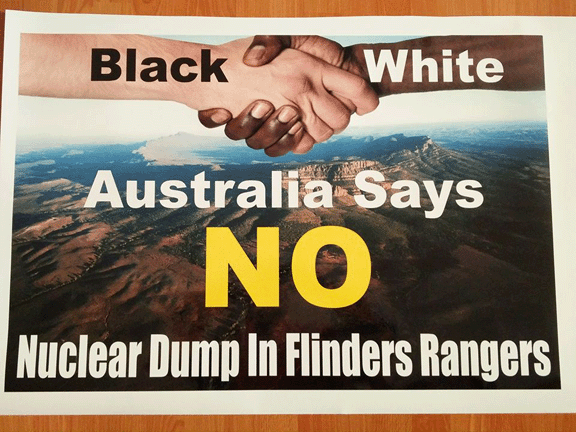 How the South Australians who dumped a nuclear dump may soon have another fight on their hands http://www.theecologist.org/News/news_analysis/2989048/how_the_south_australians_who_dumped_a_nuclear_dump_may_soon_have_another_fight_on_their_hands.html 15th June, 2017 The rejection of a plan to import vast amounts of high-level nuclear waste from around the world for profit was a significant result for campaigners but that threat is still far from over, writes JIM GREEN
Last November, two-thirds of the 350 members of a South Australian-government initiated Citizens’ Jury rejected “under any circumstances” the plan to import vast amounts of high-level nuclear waste from around the world as a money-making venture.
The following week, SA Liberal Party Opposition leader Steven Marshall said that “[Premier] Jay Weatherill’s dream of turning South Australia into a nuclear waste dump is now dead.” Business SA chief Nigel McBride said: “Between the Liberals and the citizens’ jury, the thing is dead.”
And after months of uncertainty, Premier Weatherill has said in the past fortnight that the plan is “dead”, there is “no foreseeable opportunity for this”, and it is “not something that will be progressed by the Labor Party in Government”.
So is the plan dead? The Premier left himself some wriggle room, but the plan is as dead as it ever can be. If there was some life in the plan, it would be loudly proclaimed by SA’s Murdoch tabloid, The Advertiser. But The Advertiser responded to the Premier’s recent comments, to the death of the dump, with a deafening, deathly silence.
Royal Commission
It has been quite a ride to get to this point. Continue reading
Ukraine uranium sales plan: Unreasonable, unstable and unsafe
In a statement tabled in the Senate last night, the Turnbull government has confirmed it will seek to proceed with selling Uranium to Ukraine despite significant safety and security concerns raised by the Joint Standing Committee on Treaties.
Uranium exports to Ukraine
“Australia, the nation that fuelled Fukushima should not sell uranium to the country that gave us Chernobyl,” said the Australian Conservation Foundation’s Dave Sweeney.
In February a JSCOT investigation found that existing safeguards were ‘not sufficient’ and there was a risk Australian nuclear material would disappear off the radar in Ukraine.
The government has ignored JSCOT’s recommended pre-conditions around risk assessment and recovery of nuclear materials and is looking to advance the deal despite the risks of war, civil unrest and nuclear insecurity in the eastern European country, which is involved in hostilities with Russia.
“The treaties committee’s report found ‘Australian nuclear material should never be placed in a situation where there is a risk that regulatory control of the material will be lost’, yet this is exactly what could happen under the deeply inadequate checks and balances that apply to exported Australian uranium,” said Mr Sweeney.
“JSCOT recommended the Australian government undertake a detailed and proper risk assessment and develop an effective contingency plan for the removal of ‘at risk’ Australian nuclear material prior to any sales deal.
“Unreasonably and irresponsibly the government response fails to credibly address this. Australia should be very cautious about providing nuclear fuel to an already tense geo-political situation in eastern Europe.
“Ukraine’s nuclear sector is plagued by serious and unresolved safety, security and governance issues.
“Two-thirds of Ukraine’s aging fleet of 15 nuclear reactors will be past its design lifetime use-by date in just four years.
“This is an insecure and unsafe industrial sector in a highly uncertain part of the world. Australian uranium directly fuelled Fukushima and this deeply inadequate response shows the government has learnt little and cares less”.
Senator Scott Ludlam probes the Australian government’s plan to dump Lucas Heights’ nuclear waste on rural South Australia
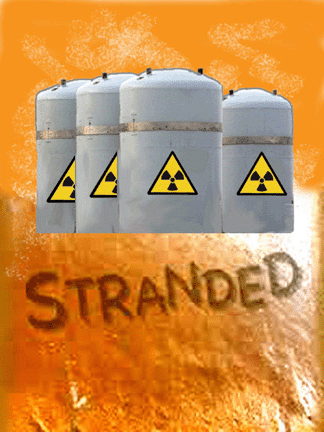 Assuming that the long-lived intermediate-level stuff does go to the sites that you are busy characterising at the moment, how long is it envisaged that it actually stays there before it gets taken somewhere else?
Mr B Wilson: We cannot give a definitive answer on that because we have not commenced a process to identify a permanent disposal solution for the long-lived intermediate-level waste—
Senator LUDLAM: Ouch!
if the really dangerous intermediate-level stuff is to be stored there you cannot tell them how long it is meant to be there for
so we kind of do not really know what is going on there or how long it is meant to be there for.
 ECONOMICS LEGISLATION COMMITTEE, Department of Industry – RADIOACTIVE WASTE 1st June 2017
Full Transcript here: http://parlinfo.aph.gov.au/parlInfo/download/committees/estimate/e3ddf88b-3e9c-4546-9d90-8f646689a98c/toc_pdf/Economics%20Legislation%20Committee_2017_06_01_5134.pdf;fileType=application%2Fpdf
Senator Canavan: I have been to Hawker and I am going there again tomorrow, and I would like to put on record my thanks to many in the Hawker community who engage in this process. Some have certainly changed their mind as they have come to have more understanding of it. I think you have probably been to Lucas Heights, and it I think it makes a big difference to people when they see it. There is a lot of misinformation spread about this, and we are trying to engage with people in a genuine way in good faith to give them the information to make informed decisions.
Senator LUDLAM: Who is spreading this information, Senator Canavan?
Senator Canavan: I hear it from time to time. I do not have any particular allegations to make about individual groups here, but you do hear lots of information from time to time about the potential danger of this material. But, of course, as you would probably know, much of the low-level waste is stored safely at Lucas Heights, a place where people go to and from work every day.
Senator LUDLAM: That begs the question of why it needs to move. ……
Senator LUDLAM: Staying in South Australia: has there been any consideration at all—this is for the department or the minister, whoever wants to take this one on—of the tension between the proposed national radioactive waste facility and the existing South Australian legislation, which would be the Nuclear Waste Storage Facility (Prohibition) Act 2000? The tension between the fact that your entire project is presently illegal under South Australian law: what is being done about that?
Mr B Wilson: We are certainly aware of the South Australian prohibition under their law. However, the National Radioactive Waste Management Act that we operate under overrides South Australian law.
Senator LUDLAM: And that is it? You are just going to squash them? Or are there discussions progressing with the South Australian government?….
Senator LUDLAM: Is the department, or you, Senator Canavan, or any of the federal agencies or other actors in communication with the South Australian government environment or heritage departments, or representatives of any body, actually, in relation to the tension between the two acts?
Senator Canavan: I have raised it with the South Australian government. They have indicated that they may seek to make changes. I am not aware of the status of that at the moment. Obviously, they have their own process, which is a separate to ours, on radioactive waste. Certainly, the issue has been raised. Mr Wilson is also right that we are confident that is not a barrier to this project. But Mr Wilson will be giving you that.
Mr B Wilson: We engage—I would have to characterise it as infrequently—with the South Australian government. It is more in the line of updating where we are. We have not had any recent engagements. They are certainly very well aware of the prohibitions under their law about what the South Australian government and its officials can do in this space….
When I said that the National Radioactive Waste Management Act overrides South Australian law, that is the fact. But what we are trying to do in the development of this project is to develop it and act in a way that is consistent with requirements under other South Australian legislation. For instance, in terms of Indigenous heritage protection and other aspects. While we are not necessarily bound by those laws we want to act in a way that is consistent with them.
Senator LUDLAM: With waste that is as dangerous as this, I am very glad to hear it! Is the department still accepting site nominations?
Senator Canavan: The government remains open to further nominations, as we announced on selecting the Hawker site last year. But the ones we have announced are those that we are proceeding with at this stage.
Senator LUDLAM: Wallerberdina and two at Kimba. Continue reading
ANSTO’s Dr Adi Paterson signed Australia up to New Nuclear club with NO Parliamentary discussion!
(Parliament Hansard) ECONOMICS LEGISLATION COMMITTEE http://parlinfo.aph.gov.au/parlInfo/download/committees/estimate/0493150c-8738-423c-a856-9cb37d9e9073/toc_pdf/Economics%20Legislation%20Committee_2017_05_31_5131.pdf;fileType=application/pdf 31st May 2017,
ANSTO ……….
Senator LUDLAM: ……. Dr Paterson, we have become aware through the JSCOT process that in June 2016 you signed the 2005 Framework Agreement for International Collaboration on Research and Development of Generation IV Nuclear Energy Systems. I have a couple of quick questions on this. Nuclear power reactors are actually prohibited in Australia under national law, so under what authority did you sign an agreement to promote research and development on nuclear reactors?
 Dr Paterson: In signing that agreement, we had been through a process of discussion with the department and with the relevant ministers, indicating that, in order to retain appropriate knowledge about the future of nuclear power globally, it would be a virtuous outcome to join the Generation IV International Forum…….
It is the job of ANSTO not to provide advocacy for nuclear power in Australia but to provide knowledge that protects us from poor decisions and provides us with a seat at the table at the International Atomic Energy Agency, because we are—
Senator LUDLAM: We already have that. With great respect, we already have that seat.
Dr Paterson: Yes.
Senator LUDLAM: We did not have to sign the gen IV agreement to retain our seat at the IAEA.
Dr Paterson: It was one of my proudest moments as the CEO of ANSTO to sign that agreement, and we are now going through the treaty process. I think it is the right thing to do for Australia.
Senator LUDLAM: Were there any additional costs over and above participation? Dr Paterson: The cost of membership will be of the order of $100,000. We are drawing on the knowledge base and the work that we already do as ANSTO, so we will not be developing significant new program capabilities to do this. We have not asked government to fund that $100,000; we are absorbing it in our appropriation.
Senator LUDLAM: That is absorbed? Okay.
NO PUBLIC DISCUSSION! Australia’s Generation IV Nuclear Energy Accession
 Submission to: Inquiry: The Generation IV Nuclear Energy – Accession. by Noel Wauchope, 24 April 2017
First of all, I find it very strange that this agreement has been signed up to in advance, not by any elected representative of the Australian Parliament, but by Dr Adi Patterson CEO of the Australia Nuclear Science and Technology Organisation, apparently pre-empting the results of this Inquiry!
I find it disturbing that this Inquiry is being held without any public information or discussion. Are we to assume that the decision to join this “Charter” is being taken without prior public knowledge?
It is a pretty momentous decision. According to the World Nuclear Association the 2005 Framework agreement “formally commits them (signatories) to participate in the development of one or more Generation IV systems selected by GIF for further R&D.”
The Environment Protection and Biodiversity Conservation Act 1999 currently prohibits the development of nuclear power in Australia. Nuclear power cannot be approved under either the EPBC Act or the Australian Radiation Protection and Nuclear Safety Act 1998. These prohibitions are, as I understand it, supported by all major parties in Australia?
This would be an extraordinary step for Australia to take, especially in the light of the recent South Australian Nuclear Fuel Cycle Royal Commission (NFCRC) pro-nuclear Royal Commission, which, while recommending South Australia for an international nuclear waste dump, nevertheless stated that
“The recent conclusion of the Generation IV International Forum (GIF), which issued updated projections for fast reactor and innovative systems in January 2014, suggests the most advanced system will start a demonstration phase (which involves completing the detailed design of a prototype system and undertaking its licensing, construction and operation) in about 2021. The demonstration phase is expected to last at least 10 years and each system demonstrated will require funding of several billion US dollars. As a result, the earliest possible date for the commercial operation of fast reactor and other innovative reactor designs is 2031. This timeframe is subject to significant project, technical and funding risk. It extends by six years a similar assessment undertaken by GIF in 2002. This means that such designs could not realistically be ready for commercial deployment in South Australia or elsewhere before the late 2030s, and possibly later.”
This was hardly a ringing endorsement of Generation IV nuclear reactors.
The South Australian Citizens Jury, Community Consultations, numerous economists, and the S.A. Liberal Party all rejected that nuclear waste plan, as not economically viable. A huge amount of preparation was done by the NFCRC in investigating the phases of the nuclear Fuel Cycle (more accurately Chain) to arrive at their rather negative view of Generation IV nuclear reactors.
That makes it all the more extraordinary that the Australian government would be willing to sign up so quickly to ANSTO’s request that Australia put resources into these untested, and so far, non-existent nuclear technologies.
I hope that the Committee is aware of the present financial troubles of the giant nuclear corporations, such as AREVA, Toshiba, and Westinghouse Electric. Nuclear power is turning out to be a financial liability wherever it is not funded by the tax-payer, (as in China and Russia). (1)
The World Nuclear Association describes the Generation IV International Forum (GIF) as countries for whom nuclear energy is significant now or seen as vital in the future. Australia’s situation in no way fits these criteria.
Nuclear energy is not significant now in Australia, and even the NRCRC nuclear proponents do not see it as vital for Australia’s future. It is almost laughable, that right now, renewable energy systems are taking off in Australia – both as large solar and wind farms, and as a huge increase in small decentralised systems such as home and business solar panel installations.
That’s where Australia should be putting its resources of human energy, talent, and funding.
The claims made by the nuclear lobby, ANSTO and some politicians, notably Christopher Pyne and Julie Bishop, about Generation Iv nuclear reactors, do not stand up to scrutiny:
Non proliferation “- Furthering Australia’s non-proliferation and nuclear safety objectives.” The well-known claim that a “conventional” nuclear bomb cannot be made from these new types of reactor, might be true, to a certain extent. However, IFRs and other plutonium-based nuclear power concepts fail the WMD proliferation test, i.e. they can too easily be used to produce fissile material for nuclear weapons. The use of thorium as a nuclear fuel doesn’t solve the WMD proliferation problem. Irradiation of thorium (indirectly) produces uranium-233, a fissile material which can be used in nuclear weapons. These materials can be used to make a “dirty bomb” – irradiating a city or other target. They would require the same expensive security measures that apply with conventional nuclear reactors.
If the purpose in joining the GIF is to strengthen non-proliferation and safety – why is ANSTO the implementing agent not the Australia Safeguards and Non-Proliferation Office?
Solving nuclear waste problem? Claims that these new nuclear reactors will solve the problem of nuclear wastes are turning out to be spurious. For example, Nuclear energy startup Transatomic Power has backed away from bold claims for its advanced reactor technology after an informal review by MIT professors highlighted serious errors in the company’s calculations. (2) Even at the best of times, the “new nuclear” lobby admits that their Gen IV reactors will produce highly toxic radioactive wastes, requiring security for up to 300 years.
The Integral Fast Reactor is called “integral” because it would process used reactor fuel on-site, separating plutonium (a weapons explosive) and other long-lived radioactive isotopes from the used fuel, to be fed back into the reactor. It essentially converts long-lived waste into shorter lived waste. This waste would still remain dangerous for a minimum of 200 years (provided it is not contaminated with high level waste products), so we are still left with a waste problem that spans generations. (3)
Climate change. The claim that new nuclear power will solve climate change is spurious. This ignores life-cycle CO2 emissions
Nuclear energy is not zero carbon.
Emissions from nuclear will increase significantly over the next few decades as high grade ore is depleted, and increasing amounts of fossil fuels are required to access, mine and mill low-grade ore.
To stay below the 2 degrees of global warming that climate scientists widely agree is necessary to avert catastrophic consequences for humans and physical systems, we need to significantly reduce our emissions by 2050, and to do this we need to start this decade. Nuclear is a slow technology:
The “Generation IV” demonstration plants projected for 2030-2040 will be too late, and there is no guarantee the pilots will be successful.
Nuclear Economics. For “a time when significant expansion in nuclear power production is underway” – this is a laughable falsehood. In reality, nuclear power economics are in a state of crisis, most notably in America, but it is a world-wide slowdown. (4)
The vagueness of the Generation IV International Forum (GIF) agreement is a worry. Australia is to formally commit to participate in the development of one or more Generation IV systems selected by GIF for further R&D. Surely Australia is not going to sign up to this, without any detail on what kind of research, what kind of reactor, what amount of funding we would be committing to the GIF.
And all this without any public discussion!
- https://www.theguardian.com/business/2017/apr/11/toshiba-losses-uk-moorside-nuclear-plant-westinghouse
- https://www.technologyreview.com/s/603731/nuclear-energy- startup-transatomic-backtracks-on-key-promises/
- https://skeptoid.com/episodes/4555
- http://reneweconomy.com.au/nuclear-industry-crisis-29735/
ANSTO must be transparent on costs of its nuclear research: Generation IV nuclear reactors – high cost for little benefit
 Here’s another fine submission to Australia’s Parliamentary Inquiry into Australia joining the Framework Agreement for Generation IV Nuclear Energy Systems . This one blows out of the water any idea that these so far non existent reactors could solve any nuclear waste problem, or be in any way economically viable. It also throws the spotlight on The Australian Nuclear Science and Technology Organisation (ANSTO). Just how much of tax-payers’ money is going to this secretive organisation?
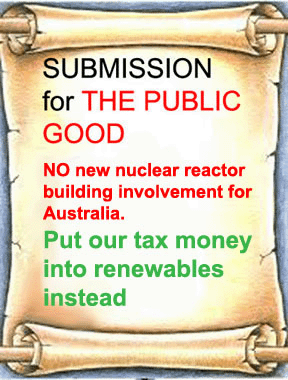 The latest reason for generation IV reactors centres on the unsolved problem of how to safely dispose of spent nuclear fuel. The proposition is that plutonium and other long lived transuranics in reactor fuel (that like plutonium also create a disposal problem) could be used up in so called “burner” reactors.
Analysis by the US National Academy of Sciences found this proposal to have such very high cost and so little benefit that it would take hundreds of years of recycling to reduce most of the global inventory.
Should ANSTO propose collaboration can occur without further cost to the taxpayer, then a funding review should be conducted to establish what research is already being done by ANSTO, at what cost, for what purpose and at whose behest. With an average loss of A$200 million annually, ANSTO should be able to provide disaggregated accounts for both transparency and accountability.
Generation IV Nuclear Energy – Accession Submission Medical Association for Prevention of War (MAPW) PO Box 1379, Carlton VIC 3053 Australia (03) 9023 195 m. 0431 475 465 e. eo@mapw.org.au w. http://www.mapw.org.au
Executive Summary
MAPW recommends strongly against Australia becoming a party to this agreement. There is no proposal for Australia to get a nuclear power program.
This framework agreement applies to technologies that are economically, socially, environmentally, and from a nuclear security perspective, very dubious. Generation IV reactors are an assortment of proposed technologies that have been put forward over the last 70 years, tried and failed.
ANSTO is already very heavily subsidised by the Australian government, and extending its operations into this research sphere will require further scientific effort, expertise and funding. This is highly inappropriate given the current major constraints on government spending, and the urgent need to focus research energies on realistic, financially viable and proven measures to contain emissions from electricity generation.
Collaboration would mean taxpayer subsidies would go to an industry which has already wasted many billions in public funds and resulted in major adverse legacies. No private industry is prepared to invest in this research without large government subsidies because none are prepared to lose so much money.
It is also clear that Australia has no policy to use these long promised and never commercially delivered reactors. Therefore any involvement just subsidises those who hope to use them. If Australia wishes to expand its nuclear expertise, then research into “non nuclear waste” generating technologies (such as those to produce medical isotopes) would be much more productive and also be of positive benefit to the Australian population.
Background
Objectives of GIF Framework Agreement Continue reading
Compelling argument against Australia joining the Framework Agreement for Generation IV Nuclear Energy Systems.
Today, I am taking the unusual step of publishing an entire submission. That’s because it is so good. The nuclear lobby pulled a swifty on Australians, by having government and media very quietly do what is sure to be a “rubber stamp” job on Australia joining up to the Framework Agreement for Generation IV Nuclear Energy Systems.
They allowed a very short time for submissions to the Parliamentary Inquiry. The nuke lobby must have been in the know, as they put in 11, whereas there were only 3, (one mine) critical of the plan.
Fortunately the critical ones contain compelling information. So, here, in full, is the:
 Submission from Friends of the Earth Australia and the Australian Conservation Foundation .
Contacts:
• Jim Green (Friends of the Earth, Australia) jim.green@foe.org.au, 0417 318 368
• Dave Sweeney (Australian Conservation Foundation) dave.sweeney@acf.org.au, 0408 317 812
Contents
1. Introduction and Response to National Interest Analysis
2. Generation IV Reactor Concepts ‒ Introduction
3. Decades Away
4. Purported Benefits
5. French Government’s IRSN Report
6. US Government Accountability Office Report
7. The Slow Death of Fast Reactors
8. Integral Fast Reactors
9. Thorium 10. Small Modular Reactors 11. Fusion Scientist Debunks Fusion
- INTRODUCTION AND RESPONSE TO NATIONAL INTEREST ANALYSIS Friends of the Earth Australia and the Australian Conservation Foundation welcome the opportunity to make a submission to this inquiry and would welcome the opportunity to appear before a hearing of the Committee.
The Committee will likely receive submissions promoting the construction of Generation IV reactors in Australia and it is therefore worth noting comments by the SA Nuclear Fuel Cycle Royal Commission in its May 2016 Final Report: “[A]dvanced fast reactors and other innovative reactor designs are unlikely to be feasible or viable in the foreseeable future. The development of such a first-of-a-kind project in South Australia would have high commercial and technical risk. Although prototype and demonstration reactors are operating, there is no licensed, commercially proven design. Development to that point would require substantial capital investment. Moreover, electricity generated from such reactors has not been demonstrated to be cost competitive with current light water reactor designs.”1
Here we provide brief responses to a number of comments in the National Interest Analysis (NIA).2
The NIA asserts that participation in the Generation IV International Forum (GIF) will further Australia’s non-proliferation and nuclear safety objectives. No evidence is supplied to justify the tenuous assertion. There is much else that Australia could do ‒ but is not doing ‒ that would demonstrably further non-proliferation objectives, e.g. a ban on reprocessing Australian Obligated Nuclear Materials (AONM); a reversal of the decision to permit uranium sales to countries that have not signed or ratified the NPT; or refusing uranium sales to countries that refuse to sign or ratify the Comprehensive Test Ban Treaty. There is much else that Australia could do ‒ but is not doing ‒ that would demonstrably further safety objectives, e.g. revisiting the decision to sell uranium to Ukraine in light of the ongoing conflict in that country, refusing to supply uranium to nuclear weapon states that are not fulfilling their NPT obligations, insisting that uranium customer countries establish a strong, independent regulatory regime (as opposed to the inadequate regulation in a number of customer countries, e.g. China, India, Russia, Ukraine and others).
Nuclear non-proliferation would also be far better realised by active Australian engagement in the current UN process around the development of a nuclear weapons ban treaty. Instead Australia has spurned this pivotally important initiative and is refusing to participate. If Australia is serious about its international standing, our representatives would be at the table in New York.
The NIA states that ongoing participation in GIF will help Australia maintain its permanent position on the IAEA’s 35-member Board of Governors. ANSTO routinely makes such arguments ‒ in support of the construction of the OPAL reactor, in support of the development of nuclear power in Australia, and now in support of Australian participation in GIF. Australia has held a permanent position on the IAEA’s Board of Governors for decades and there is no reason to believe that participation or non-participation in GIF will change that situation.
The NIA asserts that accession to the Agreement and participation in GIF will have important economic benefits. No evidence is supplied to justify that tenuous assertion. There are no demonstrated economic benefits from participation in GIF ‒ however there are clear costs.
The NIA states that the “costs of participation in the System Arrangements will be borne by ANSTO from existing funds.” ANSTO should be required to provide a detailed account of past expenditure relating to this Agreement and anticipated future expenditure.
The NIA states that ongoing participation in GIF “will improve the Australian Government’s awareness and understanding of nuclear energy developments throughout the region and around the world, and contribute to the ability of the Australian Nuclear Science and Technology Organisation (ANSTO) to continue to provide timely and comprehensive advice on nuclear issues.” Those arguments are tenuous, especially given that little about GIF is secret.
The NIA states that “Generation IV designs will use fuel more efficiently, reduce waste production, be economically competitive, and meet stringent standards of safety and proliferation resistance.” Those false claims are rebuked in later sections of this submission.
The NIA states that the success of Australia’s bid for membership of GIF was based in part on ANSTO’s “world-class capabilities and expertise” in the “development of nuclear safety cases.” ANSTO should be asked to justify that assertion. ANSTO could also be asked whether, based on its “world-class” expertise in nuclear safety, whether it considers it is appropriate for Australia to sell uranium to countries with demonstrably inadequate nuclear regulatory regimes, e.g. China, India, Russia, Ukraine and others.
The NIA asserts that “a significant expansion in nuclear power production is underway or under consideration by a number of countries, including several in the Asia Pacific region.” In fact:
- Globally, nuclear power has been stagnant for the past 20 years.
- For the foreseeable future, there is zero likelihood of a “significant” nuclear expansion of nuclear power and there will be an overall decline unless growth in China matches the decline elsewhere. Declines can be predicted with great confidence in North America, across all EU countries combined, in Japan, and in numerous other countries and regions ‒ and a very large majority of the world’s countries (about five out of six) are nuclear-free and plan to stay that way.
- No country in the Asia Pacific or South East Asia is seriously planning to introduce nuclear power. The only country that was seriously planning to introduce nuclear power in the region ‒ Vietnam ‒ abandoned those plans last year.
The NIA states that Australia’s participation in GIF falls within the existing functions of ANSTO under Section 5 of the Australian Nuclear Science and Technology Organisation Act 1987. The Joint Standing Committee on Treaties should assess whether Australia’s participation in GIF is consistent with legislation banning nuclear power in Australia (the EPBC and ARPANS Acts). 2.
2. GENERATION IV REACTOR CONCEPTS ‒ INTRODUCTION Continue reading
The Global Uranium Industry and Cameco’s Troubled History
 The Global Uranium Industry & Cameco’s Troubled History, May 2017, Jim Green − Friends of the Earth, Australia http://tinyurl.com/cameco-may-2017
Table of Contents
- INTRODUCTION
- THE GLOBAL URANIUM INDUSTRY
Australia’s Uranium Volume and Exports – 2006-2015
Australia’s top export revenue industries – Compared to uranium
“It has never been a worse time for uranium miners”
If there is a recovery, it will be a long time coming
Explaining the uranium market’s malaise
- CAMECO BATTLING URANIUM DOWNTURN, TAX OFFICE, TEPCO
- CAMECO’S URANIUM DEPOSITS IN WESTERN AUSTRALIA ‒ A BRIEF SUMMARY
- CAMECO’S INCIDENTS AND ACCIDENTS: 1981‒2016
 Firstly: the miserable state of the global uranium industry. For several years, the uranium prices (the spot price and long-term contract price) has been well below the level that would incentivise new mines. There is no end in sight to the industry’s current malaise ‒ as acknowledged by numerous industry insiders and market analysts.
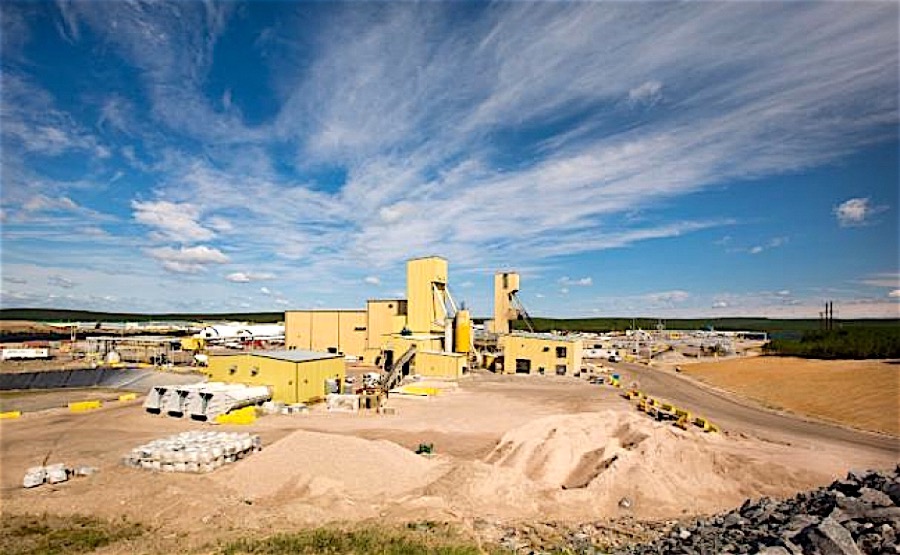 has two uranium projects in Western Australia ‒ Kintyre (70% Cameco / 30% Mitsubishi) and Yeelirrie (100% Cameco).
CAMECO’S URANIUM DEPOSITS IN WESTERN AUSTRALIA ‒ A BRIEF SUMMARY
The Global Uranium Industry & Cameco’s Troubled History May 2017 Jim Green − Friends of the Earth, Australia http://tinyurl.com/cameco-may-2017
 “…….. Kintyre (70% Cameco / 30% Mitsubishi) The Martu Aboriginal people have fought against this proposed uranium mine since the 1980s. The deposit sits between two branches of a creek called Yantikutji which is connected to a complex network of surface and groundwater systems. It is also in an area that was cut out of the Karlamilyi National Park, WA’s biggest National Park. Kintyre is home to 28 rare, endangered and threatened species. The project would include an open pit 1.5 km long, 1.5 km wide, it would use 3.5 million litres of water a day and leave behind 7.2 million tonnes of radioactive mine waste over the life of the project.
In June 2016, Martu Traditional Owners led a 140 km, week-long walk to protest against Cameco’s proposed uranium mine at Kintyre. Aboriginal Traditional Owners are concerned the project will affect their water supplies as well as 28 threatened species in the Karlamilyi National Park.
Joining the protest walk was Anohni, the Academy Award-nominated musician from Antony and the Johnsons. She said: “It’s a huge landscape – it’s a really majestic place. It’s really hard to put a finger on it but there’s a sense of presence and integrity and patience, dignity and perseverance and intense intuitive wisdom that this particular community of people have. There is almost an unbroken connection to the land – they haven’t been radically disrupted. They are very impressive people – it’s humbling to be around these women. In many regards, I think the guys who run Cameco are desolate souls, desolate souls with no home, with no connection to land, with no connection to country.” www.ccwa.org.au/kintyre
Yeelirrie (100% Cameco) Yeelirrie in the local Wongutha Aboriginal language means ‘place of death’. The local community has fought against mining at Yeelirrie for over 40 years. There was a trial mine in the 1970s which was poorly managed: the site was abandoned, unfenced and unsigned with a shallow open pit and tailings left behind. The project would include a 9 km long, 1 km wide open pit, it would use 8.7 million litres of water a day and leave behind 36 million tonnes of radioactive mine waste over the life of the mine. There are many cultural heritage sites under threat from this proposal. The project was rejected by the Western Australian Environmental Protection Agency in 2016 because of the threat that 11 species of underground microfauna would become extinct. The WA Environment Minister ignored the EPA advice and approved the project anyway. www.ccwa.org.au/yeelirrie
How Prime Minister Robert Menzies, and Sir Ernest Titterton sold us all out for British nuclear testing
Australian tolerance of the British and their obsessive secrecy may be explained by the deference and loyalty to the ‘motherland’. Prime Minister Menzies identified so strongly with Britain that he considered British national interest as Australia’s national interest.
Another factor which underlay Australian deference during the course of the testing program was the role of Sir Ernest Titterton.
The full legal and political implications of the testing program would take decades to emerge. The secrecy which surrounded the British testing program and the remoteness of the tests from major population centres meant that public opposition to the tests and awareness of the risks involved grew very slowly.
 Wayward governance : illegality and its control in the public sector / P N Grabosky
Canberra : Australian Institute of Criminology, 1989
“…..Admittedly, in the 1950s knowledge of radiation hazards was not as advanced as it is today. At the time it was not generally recognised that small doses of low level radiation might increase the risk of cancer years later. But even in the light of knowledge of the time, the information on which Menzies based his decisions was seriously deficient.
There seems little doubt that the secrecy in which the entire testing program was cloaked served British rather than Australian interests. Continue reading
A toxic legacy : British nuclear weapons testing in Australia
 Australia’s hospitality, largesse and loyalty to Britain were not without their costs. Moreover, the sacrifices made by Australians on behalf of the ‘motherland’ were not equally borne. Whilst low population density and remoteness from major population centres were among the criteria for the selection of the testing sites, the Emu and Maralinga sites in particular were not uninhabited. Indeed, they had been familiar to generations of Aboriginal Australians for thousands of years and had a great spiritual significance for the Pitjantjatjara and Yankunytjatjara people.
A variety of factors underlay the harm to public health, Aboriginal culture and the natural environment which the British tests entailed. Perhaps most significant was the secrecy surrounding the testing program.
During the entire course of the testing program, public debate on the costs and risks borne by the Australian public was discouraged through official secrecy, censorship, misinformation, and attempts to denigrate critics
Wayward governance : illegality and its control in the public sector / P N Grabosky
Canberra : Australian Institute of Criminology, 1989 “……. In 1950, Labor Prime Minister Clement Atlee sent a top secret personal message to Australian Prime Minister Menzies asking if the Australian government might agree to the testing of a British nuclear weapon at the Monte Bello Islands off Western Australia. Menzies agreed in principle, immediately; there is no record of his having consulted any of his Cabinet colleagues on the matter.
The Monte Bello site was deemed suitable by British authorities, and in a message to Menzies dated 26 March 1951 Atlee sought formal agreement to conduct the test. Atlee’s letter did not discuss the nature of the proposed test in minute detail. He did, however, see fit to mention the risk of radiation hazards:
6. There is one further aspect which I should mention. The effect of exploding an atomic weapon in the Monte Bello Islands will be to contaminate with radio activity the north-east group and this contamination may spread to others of the islands. The area is not likely to be entirely free from contamination for about three years and we would hope for continuing Australian help in investigating the decay of contamination. During this time the area will be unsafe for human occupation or even for visits by e.g. pearl fishermen who, we understand, at present go there from time to time and suitable measures will need to be taken to keep them away. We should not like the Australian Government to take a decision on the matter without having this aspect of it in their minds (quoted in Australia 1985, p. 13).
Menzies was only too pleased to assist the ‘motherland’, but deferred a response until after the 195 1 federal elections. With the return of his government, preparations for the test, code-named ‘Hurricane’, proceeded. Yet it was not until 19 February 1952 that the Australian public was informed that atomic weapons were to be tested on Australian soil. On 3 October 1952 the British successfully detonated a nuclear device of about 25 kilotons in the Monte Bello Islands. Continue reading
1 This month

of the week – Australians for War Powers Reform (AWPR)
To see nuclear-related stories in greater depth and intensity
 Antinuclear