Water is under pressure in the Great Artesian Basin.
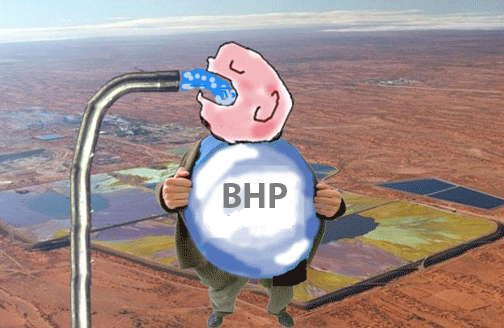
The Great Artesian Basin covers a fifth of Australia and contains water that has been there for millions of years. Now, decades of extraction are taking their toll and traditional owners are fighting a mining giant for compensation.
ABC News, Words by Leah MacLennan & images by Lincoln Rothall, 23 Nov 25
“Each spring carries a story that connects it to the traditional owners — the Arabana people. But they say the environment — and their cultural connection to it — is under threat. Some of the springs have dried up, and the health of others has deteriorated.
“The Arabana people are now fighting mining giant BHP for compensation over what they say is damage to their cultural heritage and the loss of kuta, the Arabana word for water.”
“The federal government estimates business activity in the basin — including agriculture and mining — contributed $33.2 billion to the economy last year.
“Just a few kilometres away from the springs on Arabana Country is a BHP-owned wellfield — known as Wellfield A — that, according to the company, pumps more than four million litres of water per day to its Olympic Dam mine
“The company takes another 29 million litres per day from another area — Wellfield B — further to the west.
“There’s plenty of monitoring data that shows that the extraction that BHP have engaged in supporting the Olympic Dam project has caused draw down and significant reductions in the pressure of the GAB aquifer or aquifers near their site,”
“The company says over the past 15 years it’s reduced its reliance on Wellfield A, and will stop taking from it in the mid 2030s — when there are plans for a government-built desalination plant to service the region.” https://www.abc.net.au/news/2025-11-23/water-is-under-pressure-in-the-great-artesian-basin/106002448
As Dutton champions nuclear power, Indigenous artists recall the profound loss of land and life that came from it
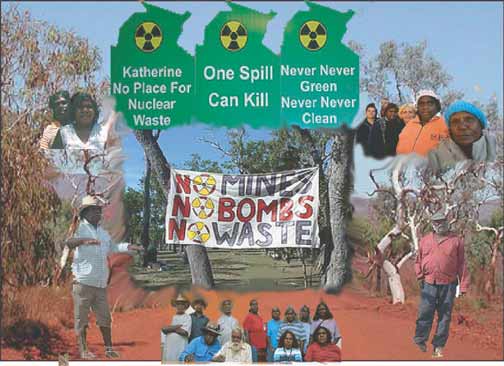
Josephine Goldman, Sessional Academic, School of Languages and Cultures, Discipline of French and Francophone Studies, University of Sydney May 2, 2025 https://theconversation.com/as-dutton-champions-nuclear-power-indigenous-artists-recall-the-profound-loss-of-land-and-life-that-came-from-it-249371
Opposition Leader Peter Dutton’s promise to power Australia with nuclear energy has been described by experts as a costly “mirage” that risks postponing the clean energy transition.
Beyond this, however, the Coalition’s nuclear policy has, for many First Nations peoples, raised the spectre of the last time the atomic industry came to Australia.
Indigenous peoples across Oceania share memories of violent histories of nuclear bomb testing, uranium mining and waste dumping – all of which disproportionately affected them and/or their ancestors.
Two sides of the same coin
While it may be tempting to separate them, the links between military and civilian nuclear industries – that is, between nuclear weapons and nuclear energy plants – are well established. According to a 2021 paper by energy economists Lars Sorge and Anne Neumann: “In part, the global civilian nuclear industry was established to legitimatise the development of nuclear weapons.”
The causative links between military and civilian uses of nuclear power flow in both directions.
As Sorge and Neumann write, many technologies and skills developed for use in nuclear bombs and submarines end up being used in nuclear power generation. Another expert analysis suggests countries that receive peaceful nuclear assistance, in the form of nuclear technology, materials or skills, are more likely to initiate nuclear weapons programs.
Since the first atomic bombing of Hiroshima in 1945, Indigenous peoples across the Pacific have been singing, writing and talking about nuclear colonialism. Some were told the sacrifice of their lands and lifeways was “for the good of mankind”.
Today, they continue to use their bodies and voices to push back against the promise of a benevolent nuclear future – a vision that has often been used justify their and their ancestors’ suffering and displacement.
Black mist and brittle landscapes
In 2023, Bangarra Dance Company produced Yuldea. This performance centres on the Yooldil Kapi, a permanent desert waterhole.
For millennia, this water source sustained the Aṉangu and Nunga peoples and a multitude of other plant and animal life across the Great Victorian Desert and far-west South Australia.
In 1933, Yuldea became the site of the Ooldea Mission. Then, in 1953, when the British began testing nuclear bombs at nearby Emu Field (1953) and Maralinga (1956–57), the local Aṉangu Pila Nguru were displaced from their land to the mission.
Directed by Wirangu and Mirning woman Frances Rings, Yuldea tells the story of this Country in four acts: act one, Supernova; act two, Kapi (Water); act three, Empire; and act four, Ooldea Spirit.
The impacts of nuclear testing are directly confronted in a section titled Black Mist (in act three, Empire). Dancers’ bodies twist and spasm as a black mist falls from the sky, representing the fog of radioactive particles that resulted from weapons testing. In reality, this fog could cause lifelong injuries when inhaled or ingested, including blindness.
But Yuldea is more than just a story of destruction. By exploring Aṉangu and Nunga relationships with Country before and after nuclear testing, it affirms their enduring presence in the region. This is captured in the opening prose:
We are memory.
Glimpsed through shimmering light on water.
A story place where black oaks stand watch.
Carved into trees and painted on rocks.
North – South – East – West.
A brittle landscape of life and loss.
To acknowledge is to remember
The podcast Nu/clear Stories (2023-), created by Mā’ohi (Tahitian) women Mililani Ganivet and Marie-Hélène Villierme, uses storytelling to grapple with the consequences of colonial nuclear testing.
Ganivet and Villierme address the memories of French nuclear testing on the islands of Moruroa and Fangataufa in Mā’ohi Nui (French Polynesia) from 1963 to 1996.
Rather than using a linear understanding of time, which keeps the past in the past and idealises a future of “progress”, Nu/clear Stories draws on Indigenous philosophies of cyclical or spiral time to insist that by turning to the past, we can understand how history shapes the present and future.
As Ganivet says when introducing the first episode, Silences and Questions:
We are part of a long genealogy of people who found the courage to speak before us. […] To acknowledge them here is to remember that without them we would not be able to speak today. And so today, we stand on their shoulders, with the face firmly turned towards the past, but with our eyes gazing deep into the future.
Stories in the Tomb
In her 2018 poem video Anointed, Part III of the series Dome, Marshall Islander woman Kathy Jetn̄il-Kijiner pays homage to Runit Island. This island in the Enewetak Atoll was transformed into a dumping site for waste from US nuclear bomb tests between 1946 and 1958.
A huge concrete dome was built on Runit Island in the 1970s to cover about 85,000 cubic metres of radioactive waste. The island became known as “the Tomb” to the Enewetak people – a tomb that still leaks nuclear radiation into the ocean today.
However, like the creators behind Yuldea and Nu/clear Stories, Jetn̄il-Kijiner refuses to remember Runit Island as only a nuclear graveyard. Instead, she approaches it like a long-lost family member or ancestor who she hopes will be full of stories.
Jetn̄il-Kijiner speaks to the island through her poem, drawing a devastating contrast between what it once was and what it is now:
You were a whole island, once. You were breadfruit trees heavy with green globes of fruit whispering promises of massive canoes. Crabs dusted with white sand scuttled through pandanus roots. Beneath looming coconut trees beds of ripe watermelon slept still, swollen with juice. And you were protected by powerful irooj, chiefs birthed from women who could swim pregnant for miles beneath a full moon.
Then you became testing ground. Nine nuclear weapons consumed you, one by one by one, engulfed in an inferno of blazing heat. You became crater, an empty belly. Plutonium ground into a concrete slurry filled your hollow cavern. You became tomb. You became concrete shell. You became solidified history, immoveable, unforgettable.
While Jetn̄il-Kijiner describes herself as “a crater empty of stories”, she continues to find stories in the Tomb: namely, the legend of Letao, the son of a turtle goddess who turned himself into fire and, in the hands of a small boy, nearly burned a village to the ground.
Juxtaposing this fire with the US’s nuclear bombs, she ends her poem with “questions, hard as concrete”:
Who gave them this power?
Who anointed them with the power to burn?The link between past and future
In their book Living in a nuclear world: From Fukushima to Hiroshima (2022), Bernadette Bensaude-Vincent and others explore how “nuclear actors” frame nuclear technology as “indispensable”, “mundane” and “safe” by neatly severing nuclear energy from nuclear history.
This framing helps nuclear actors avoid answering concrete questions. It also helps to hides the colonial history of nuclear technologies – histories which leak into the present. But not everyone accepts this framing.
Indigenous artists remind us the nuclear past must be front-of-mind as we look to shape the future.
Traditional owner says “over my dead body” to the Coalition’s nuclear policy
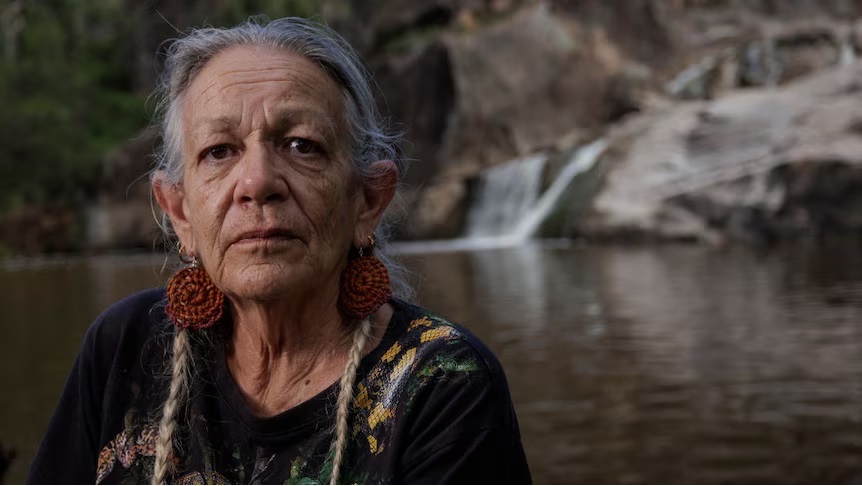
The scars of Australia’s nuclear past stain Coalition proposal for First Nations voters
The Age, By the Indigenous affairs team’s Kirstie Wellauer, Mon 28 Apr 25
In the 70s, Aunty Janine Smith protested against nuclear power on foreign shores.
“The contamination and the consequences of the bombings in Hiroshima, and then the Vietnam War and chemical warfare. There were always meltdowns somewhere,” she said.
“You know, it just reaffirmed my opinion of the safety of [nuclear] and the effectiveness of it.”
Today she is prepared to once again fight that battle, but now it’s at home on her own traditional lands — the site of one of the Coalition’s proposed nuclear power plants.
The Bujiebara traditional owner is worried the proposed plant at Tarong, north-west of Brisbane, could impact on culturally significant sites that lie only 4 kilometres away.
“Bujiebara were makers of stone axes and there is a large sandstone rock in the Tarong precinct that was used to grind the edge of these axes, that is our culturally significant site.”
She also holds concerns about the lack of water resources in the town given nuclear plants require more water than any other power source aside from hydropower.
“Because of the water limitations here, we just can’t. We haven’t got access to that kind of water,” she said.
“There is not enough water in the South Burnett to even supply all the towns with water.”
At the recent leaders’ debate hosted by the ABC, Peter Dutton insisted there was enough water for all seven of the proposed nuclear plants.
This claim was contradicted by one of his own senior frontbenchers, Nationals MP Darren Chester, who said the question of water requirements needed further scientific assessment that could take up to two and a half years.
Queensland Premier David Crisafulli is opposed to the Coalition’s nuclear policy. Mr Dutton will also need to overturn a federal parliament ban on nuclear power if he wins the election.
Aunty Janine Smith said she won’t ever give consent for nuclear power on her country.
“They want to try nuclear, then they’ll have to go over my dead body.”
The scars of Maralinga
For many First Nations people, anti-nuclear sentiment runs deep.
Passed down generation to generation, the enduring impacts of nuclear testing in the South Australian outback are front of mind for second-generation survivor Karina Lester this election.
Her late father, Yami Lester, was just 10 years old when he watched the British government drop an atomic bomb on his traditional country in 1953.
“Dad’s witness account [was] of the black mist rolling, and the ground shaking over his Walyatjatjara country,” said the Yankunytjatjara-Anangu woman.
“Four years after that test, my late father’s own world turned into complete darkness.”
Just a teenager, he went blind.
But loss of eyesight wasn’t the only impact worn by the Anangu people after the radioactive dust settled.
“Anangu died after those tests. Anangu still feel the effects of it through autoimmune diseases, through health issues, respiratory skin rashes, eye infections. The list goes on,” she said.
The Anangu people were not adequately warned about the test’s dangers.
It has taken decades and millions of dollars to clean up the radioactive fallout from the nuclear bombs, and tests show the contamination of the land remains highly active.
Ms Lester is now an ambassador for the International Campaign to Abolish Nuclear Weapons.
As the proposed rollout of nuclear power stations remains a cornerstone of the Coalition’s energy policy this election, she wants Australians to remember the lived experiences of her people when they head to the polls.
“We have the heavy burden of having to remind fellow Australians that this is not the way to go for nuclear power. We are standing up for our people and country.”
Proposed nuclear sites on Aboriginal land
The Coalition’s proposal has identified seven locations around the country for nuclear plants, all on the sites of current or former coal-fired power plants……………………………………………………………………………
Concerns for storage of nuclear waste
For both Karina Lester and Janine Smith, the issue of where the nuclear waste from these seven sites would be stored is also of major concern.
Under the Coalition’s plan, the radioactive waste generated by the power plants would be stored on site. At the end of each plant’s life the waste would be moved to a permanent home, yet to be established.
Over the decades, successive governments have attempted to establish a national nuclear waste repository — all have failed.
And part of that failing has been over a lack of consultation with relevant traditional owners.
Nuclear fallout: why Karina Lester is calling on Australia to sign the treaty banning atomic weapons

The late Yami Lester was blinded due to fallout from British nuclear testing at Emu Field. His daughter Karina addressed the UN in New York this week.
In the 1950s the British Government conducted a series of nuclear weapons tests at Maralinga and Emu Fields in South Australia.
Yankunytjatjara-Anangu woman Karina Lester, whose father the late Yami Lester went blind due to effects from the tests, wants to ensure no-one forgets.
On Thursday she spoke at the United Nations in New York as part of an International Campaign to Abolish Nuclear weapons (ICAN) delegation at the Third Meeting of States Parties to the Treaty on the Prohibition of Nuclear Weapons.
“Australia hasn’t signed and ratified the treaty on the prohibition of nuclear weapons,” Ms Lester told NITV from New York.
“It’s really important to voice our concerns, and in particular as victims or affected communities of the British nuclear testing, so as a second generation survivor.”
On October 15, 1953, the British Army, with the support of the Australian Menzies Government, detonated a 9 kiloton nuclear bomb, called Totem 1, at Emu Field, 480km north-west of Woomera in South Australia, without warning any of the Anangu communities living nearby.
“Totem 1 was the first mainland test in Australia. The radiation fallout drifted over Dad’s community, Walyatjatjara community, where Anangu and Yankunytjatjara people were living and working on their traditional lands none the wiser of what was being conducted under 160km south,” Karina said.
“But they did witness the black mist rolling over their traditional lands, and there was huge impact for our people.
“For Dad, four years after those tests, his world turned into complete darkness.
“People on that day became really ill. Many of the older, weaker generation passed.”
Karina says there were ripples that are still felt today, more than 70 years later.
“Because we had the fallout fall onto our environment, our trees, animals, our sand dunes, our grasses, our food that we eat as well.
“So it’s been a long, generational story for my family, where the onus is always on the victim to be continuing to speak about these things and to speak about nuclear injustice.”
As part of the Aukus security treaty between Australia, the United Kingdom and the US, Australia has signed up to acquire nuclear-powered attack submarines and will be responsible for radioactive waste generated through operations, maintenance and decommissioning.
“Us South Australians are very concerned because we often are pressured to be the nuclear waste dump of the nation,” Karina said.
“There’s been many struggles in that area where Indigenous peoples and Aboriginal people of South Australia have needed to fight against government pressure looking for a nuclear waste dump and nuclear powered submarines will produce this waste.”
Karina also has concerns about Opposition Leader Peter Dutton’s plan for nuclear power.
“These power plants are on traditional lands of Indigenous peoples across our nation and while there are seven locations that have been identified, yet the Coalition has not come to address and talk to Aboriginal people of those communities,” she said.
“There’s a strong message coming from South Australia that we certainly do not want nuclear power in our state, when we have been struggling and fighting against nuclear mining, nuclear waste dumps and nuclear testing.”
The nuclear industry has impacts on Indigenous peoples across the world, Karina pointed out.
“In our very own state of South Australia, they mine uranium, they tested in the 50s and 60s, they put pressure on the Aboriginal community to be the waste dump of the nuclear waste that is produced by industry,” she said.
“And now coming up with a bright idea of nuclear power.
“Aboriginal voices of South Australia have been strong to say ‘no nuclear power plants in our state’.
“So our strong message is, ‘no, we don’t want nuclear power’.”
Karina is disappointed that Prime Minister Anthony Albanese has not yet ratified the treaty against nuclear weapons.
“For us affected communities in very remote South Australia who carry the scars and carry this burden and this trauma of this lived experience through generations, now our government has failed us,” she said.
“We are out of sight and out of mind.”
Nuclear radiation took her father’s eyesight. Now Karina’s fighting Dutton’s nuclear reactors
TV Channel 9 Jan 11, 2025, The Morning Edition podcast
When opposition leader Peter Dutton proposed nuclear energy reactors on almost every mainland state in June last year, he reignited divisive public debate. It’s a debate Indigenous Australians are unwillingly at the heart of. A story that starts in the 1950s, when radioactive fallout from bomb tests caused illness among Aboriginal communities that were not adequately protected by the government of the day. Today, audio producer Julia Carr-Catzel brings us a special edition of The Morning Edition on the resistance in Aboriginal communities to a potential nuclear energy industry in Australia. Aboriginal and Torres Strait Islander listeners are advised that this podcast contains names of people who have died.
Jabiluka’s priceless heritage permanently protected.

“This day will go down in history.”
Gundjeihmi Aboriginal Corporation, representing the Mirarr Traditional Owners of Jabiluka, has today welcomed the decision of Northern Territory Mines Minister Mark Monaghan to refuse mining company Energy Resources of Australia’s application to extend the Jabiluka mining lease. This decision ensures that no mining will happen at Jabiluka, ending a decades-long fight by Mirarr and their supporters.
Mirarr Senior Traditional Owner Yvonne Margarula (pictured above) said:
“We have always said no to this mine, government and mining companies told us they would mine it but we stayed strong and said no. Today I feel very happy that Jabiluka will be safe forever. Protecting country is very important for my family and for me”
The Special Reservation (under the NT Mines Act) will protect Jabiluka from the threat of any mining and takes effect from August 11th when the current lease expires. The next steps for Government will be to seek inclusion in the World Heritage estate and to work with Mirarr to establish a new set of arrangements to incorporate the area into Kakadu National Park.
Gundjeihmi Aboriginal Corporation CEO Thalia van den Boogaard said:
“This news has been a long time coming. It’s a hugely significant day for the Mirarr and for all Australians. Jabiluka will never be mined and the internationally significant natural and cultural value of the site is finally being recognised and will now be protected. The Mirarr and their supporters have been steadfast in their opposition to this mining project for over four decades. Now the job starts of caring for Jabiluka as the heritage of all Australians.

“Mirarr are very concerned that ERA has been in serious financial decline for the past 18 months. Focus now needs to be put on the rehabilitation of the nearby former Ranger uranium mine. It is up to the mining company and the Commonwealth Government to ensure that site is fully rehabilitated so it can be safely returned to the Mirarr and included in the national park.”
Mirarr Traditional Owner Corben Mudjandi welcomed the news:
“This day will go down in history as the day the Mirarr finally stopped Jabiluka. It is great day for the Mirarr people, for Kakadu, the Northern Territory and for Australia. This proves that people standing strong for Country can win. We look forward to welcoming all Australians to share our cultural heritage for decades to come.”
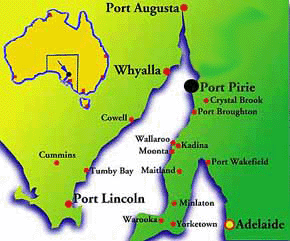
Indigenous group considers legal battle over proposed Port Augusta nuclear power plant
ABC Stateline / By Arj Ganesan and James Wakelin 21 July 24
In short:
Earmarking Port Augusta for the opposition’s nuclear plan has proved wildly unpopular with Indigenous leaders, who say mining and dumping nuclear material is akin to “killing your mother”.
Others say they believe Australia is lagging behind and needs to embrace nuclear energy.
What’s next?
Questions remain, with voters saying they are still in the dark about how much the plan will cost and how the privately owned land would be acquired.
Earmarking Port Augusta for Peter Dutton’s nuclear plan has proved wildly unpopular with an Indigenous leader, who says he feels so strongly about the issue that he is willing to go to court to fight the proposal.
Nukunu elder Lindsay Thomas said his community was against mining fissionable elements, such as uranium as a whole.
“Our people don’t believe in this, we don’t believe it should have even been dug out of the ground anywhere in Australia,” he said.
“We believe it’s poison.”
Mr Thomas said First Nations people had a spiritual connection to the land and he was proud of the work the Barngarla people had done in stopping the federal government’s attempt to dump nuclear medical waste in Kimba.
“You put that stuff in the ground, that kills that earth forever, we can’t do that, we cannot do that,” he said.
“That’s like killing your mother.”
Some locals concerned nuclear is too risky
Citizen scientist and master diver Jeff Bowey is also opposed to Port Augusta as a location for nuclear energy.
Mr Bowey said it was too risky as the water around the Upper Spencer Gulf took “three to five years” to move through.
“You get a spill or some impact into the Gulf itself, you literally destroy what we’ve got,” he said.
“The Gulf is on a knife’s edge, all we need is like one little bit more impact and we’ll probably lose the Gulf and all of the positives that it has.
“We have species here — animals, fish life, plant life, marine life — that’s found nowhere else on earth…………………………………………………………………………………..
Many questions regarding the proposed plant remain.
Voters are still in the dark about how much the plan will cost or how the government will acquire the privately owned land…………………….. https://www.abc.net.au/news/2024-07-21/port-augusta-nuclear-power-plant-legal-battle/104105048
BARNGARLA COURT WIN OVER NUCLEAR DUMP.

Jim Green, 18 July 23
Today, in a history making moment, The Federal Court of Australia through Her Honour Justice Charlesworth, handed down a decision which was favourable to the applicant the Barngarla Determination Aboriginal Corporation. This has resulted in the quashing of the decision to place the waste dump site at Napandee near Kimba.
“I am so happy for the women’s sites and dreaming on our country that are not in the firing line of a waste dump. I fought for all this time for my grandparents and for my future generations as well.” – Aunty Dawn Taylor, Barngarla Elder.
“This result today is about truth telling. The Barngarla fought for 21 years for Native Title rights over our lands, including Kimba and we weren’t going to stop fighting for this. We have always opposed a nuclear waste dump on our country and today is a big win for our community and elders.” – Jason Bilney, Chairperson Barngarla Determination Aboriginal Corporation.
“Every Australian, whether First Australians or more recent Australians have the right to independent scrutiny of Government. Today the Federal Court has set aside the declaration for the nuclear waste facility reinforcing how important these rights of independent review are. It has been a significant dispute which has created much pressure on Barngarla and their legal team they should be proud of their efforts to hold the government to account.” – Nick Llewellyn-Jones lawyer for Barngarla.
“The Barngarla have opposed the radioactive waste dump at Kimba since it was first suggested. We have fought for 7 years, to be heard, to be seen and to be respected. We welcome this decision and expect that this will be the end of this threat to our country, heritage and culture. We, the Barngarla have always stood strong and believe that this decision is reflective of staying steadfast; it shows that if you have a voice and want it to be heard, never give up. Continue to be loud. Continue to use your voice. Don’t rely on others to speak for you. Speak up for what’s right. Truth telling is what led us today. We are proud.” – The Barngarla People.
Aboriginal supporter of right-wing racism, Warren Mundine’s interests in mining uranium -not doing too well.
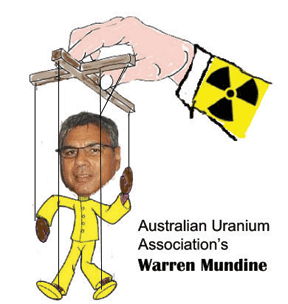
Mundine was one of the two main faces of the “No” campaign against last year’s Indigenous Voice to parliament referendum, campaigning against so-called “elites”.
The Voice “No” campaign was run by far-right lobby group Advance which ran a campaign of aggressively attacking so-called “elites” who it said were behind the Voice.
In fact, as previously reported, the No campaign was bankrolled by a handful of mega wealthy individuals, many with deep ties to the mining and fossil fuels sector.
The struggles facing Aura Energy coincide with a fierce political debate over the future of nuclear energy in Australia, with the federal Opposition calling for a nuclear rollout despite it being vastly more expensive than renewables.
Mundine uranium company shares collapse
ANTHONY KLAN, 9 July 24 https://theklaxon.com.au/mundine-uranium-company-shares-collapse/
A uranium exploration company overseen by businessman Warren Mundine has seen its share price crash after its auditor warned it was in danger of collapse.
Over $60 million has been wiped from the value of ASX-listed Aura Energy since its auditor waived the red flag — and a subsequent emergency capital raising has seen new investors left heavily in the red.
Company document show that on March 15 the auditor of Aura Energy — which states it has “major uranium projects” in “Africa and Europe” — warned there was a “material uncertainty” that it would be able to remain solvent.
Aura Energy had made losses of $9.79m in the 18 months to December 31 and had a remaining cash balance of just $5.86m.
Shares in the company — which is not covered by any analysts or stockbrokers — immediately crashed 33%, to 16.5c.
Aura Energy conducted a capital raising to help it stave off insolvency, but shares it sold under the offer only six weeks ago at 18c yesterday closed at just 13.5c.
Since January — while Australia has been engaged in a fierce debate over nuclear energy — the share price of Aura Energy has halved.
Mundine, who was appointed a director of Aura Energy in December 2021, is a major public advocate of nuclear energy was previously a director of Australian Uranium Association.
The woes facing Aura Energy follow the collapse of the planned $10m IPO of Mundine’s “minerals exploration” company Fuse Minerals in April.
That company, chaired by Mundine, was forced to scrap its plans to float on the ASX after failing to raise enough funds, despite it extending its capital raising period by more than eight-fold, from two weeks to more than four months.
Fuse Minerals had never earned a cent in revenue or conducted a single drill.
Mundine was one of the two main faces of the “No” campaign against last year’s Indigenous Voice to parliament referendum, campaigning against so-called “elites”.
He has repeatedly refused to comment when contacted by The Klaxon.
Company filings show Aura Energy entered a trading halt on March 15 and three days published its accounts for the six months to December 31.
In the six months it lost $2.99m, on the back of $6.80m in losses in the year to June 30, 2023.
In the half-year report, Aura Energy’s auditors Hall Chadwick state there is a “material uncertainty that may cast significant doubt” over the company’s “ability to continue as a going concern”.
In the report Aura Energy’s directors state the company is “dependent on further capital raises or external financing” to stay afloat.
“As the Group is in the exploration stage and does not generate operating cash inflows, the Group is dependent on further capital raises or external financing to maintain operations which results in a material uncertainty which may cast significant doubt on whether the Group can continue as a going concern,” the directors state.
On March 18 — the same day it published those half-year accounts — Aura Energy announced it had conducted a “successful placement” to raise $16.2m from “professional and sophisticated investors” by issuing 90.2m shares at 18c a share.
It would also raise $2m from the public, also at 18c a share, with those shares listed on the ASX on May 30.
Under both raisings, for every four shares bought there were also three “free” attached options, with an exercise price of 30c and a two year expiry. (Meaning they would have value if Aura Energy’s share price goes above 30c in the next two years).
In advertising the public raising, Fuse Minerals said the price of 18c a share was at an “18.2% discount” to the 22c a share they were trading at on the day the offer was announced.
Further, 18c a share was a “23.5% discount” to the average price the shares had been trading at over the five days before the offer was announced.
On the day the public offer shares were listed on the ASX, May 30, the company’s shared were trading at 16.5c.
Yesterday they closed at 13.5c.
At January 1 the company had 623m shares on issue and a share price of 26.5c, giving it a “market capitalisation” of $165.1m.
Yesterday its market capitalisation was $103m, down $62.1m.
The struggles facing Aura Energy coincide with a fierce political debate over the future of nuclear energy in Australia, with the federal Opposition calling for a nuclear rollout despite it being vastly more expensive than renewables.
Mundine and Senator Jacinta Price were the most prominent faces of the “No” campaign against the Indigenous Voice to parliament, which was voted down in October.
Two weeks later Mundine announced he was chair of Fuse Minerals — and that the company was seeking to raise up to $10m and list on the ASX.
The Klaxon subsequently revealed Fuse Minerals owned only one of the nine exploration licences listed in its prospectus — and that its own “independent expert” had warned it was in danger of collapse.
By January Fuse Minerals had raised just $1.86m, well short of the $6m-$10m sought and was legally required to refund money to investors seeking to exit.
On March 28 Fuse Minerals was forced to scrap the offer entirely.
The Voice “No” campaign was run by far-right lobby group Advance which ran a campaign of aggressively attacking so-called “elites” who it said were behind the Voice.
In fact, as previously reported, the No campaign was bankrolled by a handful of mega wealthy individuals, many with deep ties to the mining and fossil fuels sector.
Coalition nuclear policy leaves traditional owners of Kakadu uranium mine worried
ABC News, By Jane Bardon, 3 July 24
In short:
Kakadu traditional owners are worried the Coalition’s nuclear policy will drive demand for uranium mining on their land at Jabiluka.
Energy Resources of Australia (ERA) and traditional owners have asked the NT and federal governments to decide whether to extend the Jabiluka uranium mining lease.
What’s next?
ERA’s majority shareholder Rio Tinto is worried the Jabiluka lease stoush could drive up the costs of rehabilitating its closed Ranger Uranium Mine.
Mirarr traditional owner Corben Mudjandi is desperate for his spectacular land at Jabiluka to be incorporated into Kakadu National Park, which surrounds it, rather than mined for its uranium.
“Its sacred to us, and it’s a piece of human history, 65,000 years, we want Jabiluka not mined; we want to show people the beauty of nature, and what we call home,” he said.
Mr Mudjandi is worried the federal Coalition’s plan to open nuclear plants if it wins government could drive demand for Jabiluka’s uranium.
The Mirarr are also concerned that almost a year after Energy Resources of Australia (ERA) applied to extend its uranium mining lease over Jabiluka for another decade, the Northern Territory and federal governments have not yet decided whether to reject or approve it.
ERA’s current lease expires on August 11.
“The government are following process, but of course we hope they don’t support the application extension,” Mr Mudjandi said.
Senior Mirarr traditional owner Yvonne Margarula said she was worried that although ERA’s Jabiluka lease agreement enabled traditional owners to veto mining, they felt under constant pressure to change their minds.
“The mining companies might come back asking again and again, it’s annoying them asking more, enough is enough, so I hope the government is going to help us,” she said………………………………..
……………………….Professor of Archaeology at Griffith University Lynley Wallis said the Mirarr had a strong case for Jabiluka to be incorporated into Kakadu instead of mined, because of its 65,000 year-old-evidence of occupation.
“Archaeologically the escarpment that’s encapsulated within the Jabiluka mineral lease is unparalleled,” she said.
“There are hundreds of rock shelter sites, almost all of which have paintings in them, of which are incredibly well preserved, and then there are amazing objects that have been cached in those rock shelters, ceremonial wooden objects, grinding stones, spear points and scrapers.
………. the lease agreement includes a traditional owner right to veto mining……………
Lynley Wallis said the Jabiluka mining lease did not provide adequate protection.
“While a company holds a mineral lease over Jabiluka it is possible for them to apply to develop the resources in that land, and any development would pose imminent threat to the cultural sites that are within the lease,” she said.
While some of ERA’s minority shareholders want to keep the Jabiluka lease, which they estimate is worth $50 billion, its majority shareholder Rio Tinto does not.
Jabiluka is ERA’s only potentially valuable asset, but Rio Tinto estimates the rehabilitation costs would be much more than potential profits.
The cost of ERA’s rehabilitation of its neighbouring closed Ranger Uranium Mine on the Mirarr’s land has now blown out to more than $2.5 billion.
ERA is expected to run out of funds by September, and Rio Tinto has promised to fund Ranger’s rehabilitation.
But the ABC understands Rio Tinto is concerned ERA’s application to extend the Jabiluka lease is worrying Mirarr traditional owners so much, that they could delay further agreements needed on how the Ranger mine rehabilitation continues, adding to the project’s soaring costs.
Dave Sweeney, the Australian Conversation Foundation’s nuclear policy spokesman, has called on both governments to end the prospect of mining at Jabiluka.
“ERA are not making any money,” he said.
“They should be focused on getting the assured financial capacity on delivering on their legal obligations rather than appeasing minority shareholders in a fanciful push for a project that will never happen, but increases pressure on traditional owners who’ve had too much for too long.”
A spokesman for the federal Resources Minister Madeleine King said it was up to the NT government whether to renew ERA’s lease.
The spokesman said when Ms King provides her advice to NT government, she would “consider information about Jabiluka in good faith and with appropriate consultation”.
The NT Mining Minister Mark Monaghan would not explain why his government had not made a decision on the lease.
“We’re not delaying the decision, the decision is going through what is a process,” he said.
NT Opposition leader Lia Finocchiaro has backed ERA’s argument on why the lease should continue.
“Importantly that maintains the veto rights for the Mirarr people which we believe continues to be a very important right for them to have,” she said. worried
How a British nuclear testing program ‘forced poison’ onto Maralinga Traditional Owners
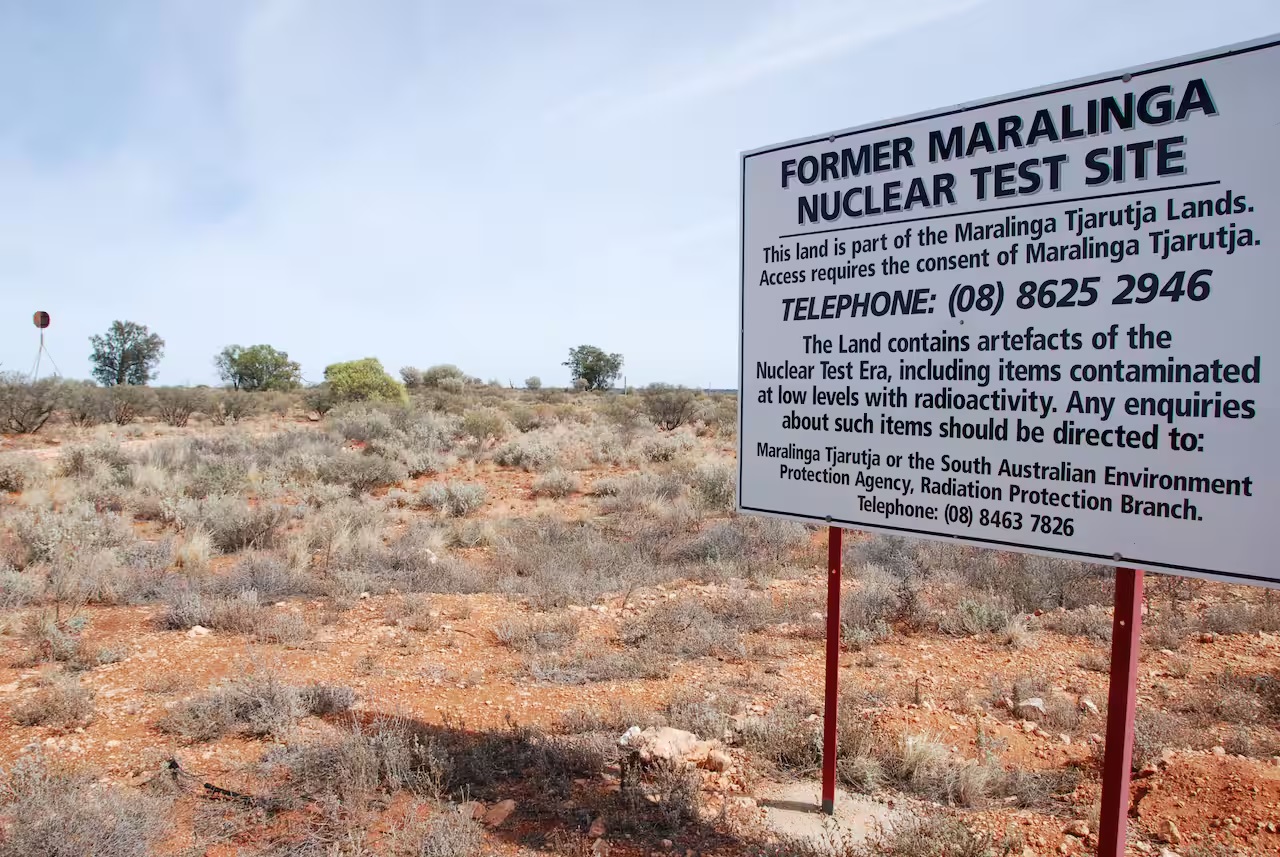
Indigenous Elders say they are once again being threatened by nuclear technology on their lands
SBS Sydney Lang, 20 June 24
Indigenous Elders are warning that their communities’ connections to sacred sites may be severed by nuclear power plants proposed by the Opposition.
Opposition leader Peter Dutton revealed earlier this week seven sites where the Coalition would seek to build nuclear power plants if elected.
One of the proposed sites is on Indigenous elder Aunty Janine Smith’s Country in Tarong, Queensland.
According to Smith, the proposal is a “death sentence to the land”.
Also responding to Dutton’s proposal, the Queensland Conservation Council’s Paul Spearim said: “White Australia has a shortsighted approach to Country”.
“You have forced poison onto the lands of Traditional Owners, and now Peter Dutton is proposing to create poisons that would last [hundreds of thousands] of years,” Spearim said.
First Nations and nuclear: A troubled history
Indigenous Australians’ fears about nuclear technology threatening their land and livelihoods are not occurring in a vacuum.
During the 1950s and 1960s,
the British government used the South Australian outback as a site for atomic bomb testing.
Keen to develop nuclear weapons of its own during the Cold War, the British government decided the remoteness of Maralinga and Emu Field made them ideal sites for nuclear weapon testing.
With agreement from the Australian government, the people living on Maralinga Tjarutja lands were relocated and told they could not return to their land. Many were rounded up and relocated to the Lutheran mission in Yalata, around 200km away.
The nuclear tests saw the wide-scale dispersion of radioactive material into the local environment.
Indigenous people living in and around the area, as well as British and Australian soldiers, were all exposed to radiation.
In the wake of the tests, there were many reports of cancer, blood diseases, eye problems, skin rashes, blindness, and vomiting — all of which are symptoms of radioactive poisoning.
It was not until 2009 that the land used for weapons testing was handed back to Traditional Owners…………………………………………………………………………………………………. more https://www.sbs.com.au/news/article/maralinga-how-australias-nuclear-testing-program-forced-poison-onto-the-lands-of-traditional-owners/zcuxce8o6
Lidia Thorpe warns new laws will turn Australia into “the world’s nuclear waste dump”

Giovanni Torre – May 13, 2024, https://nit.com.au/13-05-2024/11377/lidia-thorpe-warns-new-laws-will-turn-australia-into-the-worlds-nuclear-waste-dump?mc_cid=a41a81cd8c&mc_eid=261607298d
Senator Lidia Thorpe has warned new legislation to regulate nuclear safety of activities relating to AUKUS submarines has left Australia open to becoming “the world’s nuclear waste dump”.
Under the AUKUS deal, the federal government agreed to manage nuclear waste from Australian submarines, but under legislation to be introduced in June, Australia could be set to take nuclear waste from UK and US submarines also, Senator Thorpe warned.
The Gunnai, Gunditjmara and Djab Wurrung independent senator for Victoria called on the government to urgently amend the bill to prohibit high-level nuclear waste from being stored in Australia, a call she said is backed by experts in the field and addresses one of the major concerns raised during the inquiry into the bill.
“This legislation should be setting off alarm bells, it could mean that Australia becomes the world’s nuclear waste dump,” Senator Thorpe said on Monday.
“The government claims it has no intention to take AUKUS nuclear waste beyond that of Australian submarines, so they should have no reason not to close this loophole.
“Unless they amend this bill, how can we know they’re being honest? They also need to stop future governments from deciding otherwise. We can’t risk our future generations with this.”
In March, Senator Thorpe questioned Foreign Affairs Minister Penny Wong about the long-term cost from storage of nuclear waste, and whether Australia would take on foreign nuclear waste under the AUKUS deal. The minister responded that this cost is not included in the current $368 billion estimated for AUKUS, and she could not confirm that foreign waste would not be stored in Australia.
Senator Thorpe noted that the US Environmental Protection Agency warns high-level nuclear waste remains dangerous for at least 10,000 years; managing the risk posed by the decommissioned fuel rods from the AUKUS submarines would require storage and management that is future-proof, something that has proven challenging even in countries with advanced nuclear industries.
She also pointed out on Monday that the bill has also been criticised for lack of transparency and accountability; and allows the Minister of Defense to bypass public consultation and override federal and state laws to determine sites for the construction and operation of nuclear submarines, and the disposal of submarine nuclear waste.
Senator Thorpe said there are serious concerns about a lack of community consultation and the risk of violating First Peoples right to Free, Prior and Informed Consent.
Historically, governments have tried to push the storage of radioactive waste on remote First Nations communities, with successful campaigns in Coober Pedy, Woomera, Muckaty, Yappala in the Flinders Ranges and Kimba fighting off these attempts.
“We’ve seen how far the major parties will go to ingratiate themselves with the US. Labor must amend this bill to prove they’re putting the interests of our country first,” Senator Thorpe said.
“And they need to change the powers that allow the Minister and the Department to choose any place they like for nuclear waste facilities with no oversight or community consultation.
“That’s complete overreach and will undermine First Peoples rights for Free, Prior and Informed Consent under the United Declaration on the Rights of Indigenous Peoples.”
The senator said “time and again” governments have attempted to turn remote communities into nuclear waste dumps, with the risks from nuclear waste always being put on First Peoples.
“I’m concerned that this time it will be no different,” she said.
“The Bill allows the government to contract out liability for nuclear safety compliance, includes no emergency preparedness or response mechanisms, no consideration of nuclear safety guidelines from the Australian Radiation Protection and Nuclear Safety Agency and leaves many other questions on nuclear safety unanswered.”
“This Bill fails to set out a nuclear safety framework for the AUKUS submarines and instead focuses on defence objectives, while sidestepping safety, transparency and accountability. It’s a negligent and reckless bill that should not pass the Senate.”
Koonibba looks to the future as a rocket launch site, but one elder is concerned about impact on sacred sites
ABC Eyre Peninsula / By Jodie Hamilton and Amelia Costigan, Sat 11 May 2024
When an 11.5 metre German rocket was launched from the tiny South Australian former mission town of Koonibba last Friday, it lit the candle for self-determination and the future of local Indigenous youth.
But one elder says the project risks damaging sacred women’s sites and the next generation’s connection to country.
Kokotha elder Sue Coleman-Haseldine was camped out in the firing line on the rocket range with a handful of supporters to protest the space venture.
However, the majority of the 125 residents of Koonibba — down from a population of 145 in 2016 — supported the launch.
The community negotiated and developed the venture in partnership with Adelaide company Southern Launch over six years.
The partnership is already delivering educational benefits for town’s small school and nearby Ceduna schools, with plans for a space observatory to attract tourists.
Connection to country
But Ms Coleman-Haseldine has vowed to continue protesting against the site.
She is worried it could help develop weapons technology, the scars of which still plague the lands to the north of Koonibba at Maralinga and Emu Fields, where the Australian and British governments tested nuclear weapons from 1952 to 1963.
Ms Coleman Haseldine was born at the Koonibba Mission in 1951 and said she was no stranger to battles, having addressed the United Nations in 2017 about the impact of those weapons tests at Maralinga.
Walking across a large granite rock outcrop, she points out symbols and talks about the stories of the land.
With family and friends, she has been maintaining and cleaning sacred deep waterholes and clearing dirt and soil washed into shallow surface rock pools, to provide safer drinking holes for emus, kangaroos, birds and reptiles.
She set up camp in the Yumbarra Conservation Park, part of the 41,000 square kilometre rocket launch range, which allows for rocket re-entry and retrievals.
The Yellabinna Wilderness Protection Area to the north is also in the rocket launch range
“That rocket launching, I think it could start fires, it could just hit one of these rocks and smash it, starting to break the storylines,” Ms Coleman-Haseldine said.
A Department for Environment and Water spokesperson said the department ensured Southern Launch had consulted appropriately with the Far West Coast Aboriginal Corporation and the Yumbarra Conservation Park Co-management Board…………………………..
Ms Coleman-Haseldine said she had been going to the area from childhood and had a custodial role to protect the land, animals and stories.
“This area is all part of the Seven Sisters dreaming,” she said.
“Country gives us bush med, food, teaches the kids out here how to survive.
“And it teaches them respect for the country and each other, and the animals………………………………………….. https://www.abc.net.au/news/2024-05-11/koonibba-rocket-launch-aboriginal-community-protest-kokotha-sa/103808598
ERA applies to extend lease on Jabiluka uranium mine against traditional owners’ wishes
ABC Rural / By Daniel Fitzgerald, Thu 21 Mar 2024
- In short: Mining company ERA has applied to extend its lease on the Jabiluka uranium deposit for another 10 years.
- Mirarr traditional owners are fiercely opposed to the lease extension and any mining at Jabiluka.
- What’s next? ERA’s lease application will be assessed by the NT government and the company needs to spend at least $2.4 billion to rehabilitate the former Ranger uranium mine.
A mining company has lodged an application to renew its lease on a uranium deposit surrounded by Kakadu National Park, against the wishes of Indigenous traditional owners.
Energy Resources Australia (ERA) operated the Ranger uranium mine, 250 kilometres east of Darwin, from 1981 to 2021, and is now rehabilitating the mine, at a cost of over $2.4 billion.
Since 1991, the company has also had a the lease on the nearby Jabiluka site — which is one of the world’s largest and richest uranium deposits.
ERA had approval to mine Jabiluka but faced significant opposition from Mirarr traditional owners, which led to a blockade of the mine site by 5,000 people in 1998 and the company’s eventual decision to stop the mine’s development. …………………………………………….
Traditional owners oppose plans
Mirarr traditional owners rejected ERA’s claims that it was in their best interests for the Jabiluka lease to be extended.
Corben Mudjandi said his people were opposed to ERA renewing its lease and had no confidence in the company.
“ERA has a very big problem at Ranger, and this application isn’t helping with that,” Mr Mudjandi said.
“ERA says it wants to protect our cultural heritage at Jabiluka. The best way of doing that is to include it in the World Heritage listed Kakadu National Park where it belongs.”
In 2022, the Mirarr said they were “appalled” an independent report commissioned by ERA suggested traditional owners might reverse their opposition to mining Jabiluka.
ERA to raise funds for Ranger clean-up
Last week, ERA reported a net loss after tax of $1.38 billion in 2023, which included an increase to its rehabilitation provision for Ranger.
ERA had total cash resources of $726 million at the end of 2023 and flagged an equity raise later this year to fund further rehabilitation at Ranger.
“What guarantee is there that this company will be operating in 12 months’ time?” Mr Mudjandi said.
“[Applying to extend Jabiluka] is big talk from a company that is $2 billion short of rehabilitation at Ranger.”
Gundjeihmi Aboriginal Corporation, which represents the Mirarr, said it would seek formal protection of Jabiluka’s cultural heritage through the NT Sacred Sites Act and the Commonwealth Aboriginal and Torres Strait Islander Heritage Protection Act.
“We’ve heard very encouraging words from this company when they assured us Ranger would be cleaned up by January 2026 and look how wrong that turned out to be,” Gundjeihmi chief executive Thalia van den Boogaard said. …………. https://www.abc.net.au/news/2024-03-21/era-lodges-application-to-extend-jabiluka-uranium-lease-nt/103613966
Karina Lester addresses the Second Meeting of States Parties to the TPNW
Karina Lester, second-generation nuclear test survivor and ICAN Ambassador addresses the delegates at the UN Second Meeting of States Parties to the Treaty on the Prohibition of Nuclear Weapons in NYC, November 28th, 2023.
She said “People still suffer to this day. We know our lands are poisoned. We know the fallout contaminated our country and our families, our people who move through those traditional lands…
We want recognition by governments of the day of the harms and what they’ve imposed on our people and on our traditional lands… We want respect and we want to start the conversations on repair. How do we work together to fix the damages that are there?”
She called on states parties to get to work on Articles 6 & 7 and for observers to double their efforts to sign and ratify the #nuclearban. She called on Australia, in particular, to make joining the treaty a top priority.
1 This month

of the week – Australians for War Powers Reform (AWPR)
To see nuclear-related stories in greater depth and intensity
 Antinuclear
