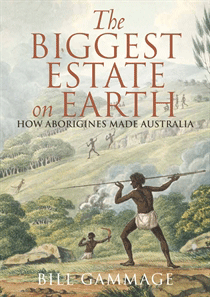
 Burning country not only maintains its health but makes a statement that country is being cared for. The “biggest estate on earth” didn’t happen by chance, rather, through good fire management practises, the land was kept in good order, a bit like housekeeping.
It’s time to invest in Indigenous carbon farming on Aboriginal lands, Guardian, Rowan Foley. 16 Nov 16
Australian businesses can take action on climate change by supporting Indigenous carbon farming while contributing to sustainable development goals.
Here’s a touch of irony in the fact the Australian government has invested $200m in the international Green Climate Fund, a United Nations fund to assist developing countries in adapting to and mitigating the effects of climate change.
There is, however, no equivalent investment fund by the government, or corporate Australia, towards developing sustainable economies on Aboriginal lands through one of those mitigation practices, namely carbon farming.
Investment in a sustainable Aboriginal carbon industry would directly impact climate change, Indigenous poverty and the management of traditional lands and waters. These are all key parts of meeting Australia’s commitment to the sustainable development goals (SDGs), specifically SDG13 (climate action), as well as SDG8 (decent work and economic growth), SDG11 (sustainable cities and communities), SDG14 (life below water) and SDG15 (life on land). Continue reading →
November 18, 2016
Posted by Christina Macpherson |
aboriginal issues, AUSTRALIA - NATIONAL, climate change - global warming |
Leave a comment
‘First Nations Peoples must demand our participation in the planning of Australia’s climate change strategies, which they have agreed to, at the Paris conference.’http://www.sovereignunion.mobi/content/feedback-cop22-climate-summit-marrakesh
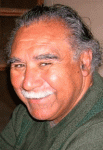 Ghillar Michael Anderson | Sovereign Union 8 November 2016: “First it’s important to know that the delay in countries signing the Paris Agreement was caused by both Australia and the USA threatening to walk away if other parties refused to permit various out clauses.
“Notable and critical examiners of the Paris Agreement all agree that the symbolism was great for the world facing catastrophies because of climate change, especially those of the small Pacific Islands and low coast lands.
“In reality the Paris Agreement leaks like a sieve and permits too many escape clauses for the major polluters and countries promoting extractive industries, despite the overall great objectives of the Paris Agreement.
“As Aboriginal Peoples of the world the Paris Agreement acknowledges us in the preamble where it states:
“The Paris Agreement affirms the importance of traditional knowledge of Indigenous Peoples as well as local knowledge systems in adaptation to climate change.
Indigenous Peoples’ traditional knowledge related to their food sources and subsistence practices, flora and fauna and relationships with their traditional lands, waters and other natural resources are the basis of their traditional economics as well as their cultures, identity and spirituality. Indigenous Peoples’ inherent rights to their lands, cultural heritage, traditional knowledge, land, resources and subsistence practices are affirmed and recognised in the UN Declaration on the Rights of Indigenous Peoples.
“The Paris Agreement specifically recognises the importance of Indigenous Peoples’ traditional knowledge in adaption actions and in recognition of the need to strengthen such knowledge, technologies, and practices it establishes a platform for the exchange of experience and sharing of best practices on mitigation and adaptation in a holistic integrated manner.” … “
November 16, 2016
Posted by Christina Macpherson |
aboriginal issues, AUSTRALIA - NATIONAL, climate change - global warming |
Leave a comment
Miner contemplates NT town’s future http://www.news.com.au/national/breaking-news/miner-contemplates-nt-towns-future/news-story/ebc248cbfd26edd555465ae79964e8ad NOVEMBER 15, 2016
Discussions over the future of a community near the Northern Territory’s Kakadu National Park have begun as a mining company prepares to pull out.
Jabiru town was built for a uranium mine which has been operating for more than three decades.
It was always intended to be temporary and its head lease will expire in about four years.
ERA operates the Ranger mine and has started a social impact assessment (SIA) to determine a transition and rehabilitation strategy for the township.
ERA says it’s not developing a plan for the future of Jabiru beyond the lease expiration in 2021 when production stops, which is expected to cost 350 jobs.
“It is important to note that a separate process involving the commonwealth government, Northern Territory government and traditional owner representatives has commenced to develop and agree a future plan for Jabiru,” ERA said.
“The outcome of those discussions will also have a significant influence on ERA’s plans.”
Traditional owners warn that if the NT government doesn’t commit to the town’s future it will effectively be demolished.
Justin O’Brien, chief executive of the Gundjeihmi Aboriginal Corporation which represents traditional owners, says Jabiru is the gateway to Kakadu and should continue to function without the mine.
“It’s about maintaining this town and maintaining essential services,” he told ABC local radio.
Jabiru residents and local business owners have been invited to attend 30 information sessions in November and Deccember, while more will take place early next year.
November 16, 2016
Posted by Christina Macpherson |
aboriginal issues, Northern Territory, uranium |
1 Comment
Traditional Owners and members of the Aboriginal-led Australian Nuclear Free Alliance (ANFA) have welcomed the Citizen’s Jury’s recommendation to reject an international high level radioactive waste dump for South Australia.
Throughout both the Royal Commission and Citizens Jury processes concerns of potential bias have been raised. The consultancy firm hired by the Royal Commission, Jacobs MCM, has clear links to the nuclear industry. The economic report was written by Charles McCombie and Neil Chapman, the president and vice president of the Association for Regional and International Underground Storage (ARIUS). A further example of bias was that the Citizen Jurors were asked to nominate ‘witnesses’ they wished to speak to, but DemocracyCo added three people to the witness list ‒ all of them pro-nuclear ‒ without the Jurors’ knowledge or consent.
ANFA members are concerned by SA premier Jay Weatherill’s suggestion that he may not heed the jury’s recommendations: “This jury doesn’t believe the present proposal should be taken forward but we need to take into account a whole range of other broad community views[1]“.
Kokatha-Mula woman Sue Coleman-Haseldine is a co-chair of the Australian Nuclear Free Alliance, in response to Premier Weatherill’s comments she said “The jury has listened to us, it’s time for the premier to listen to the jury. We don’t want this waste in South Australia. Not here, not anywhere”.
Aboriginal people travelled to Adelaide from across the state to share their concerns with the 350 jurors at the Indigenous session held on Saturday 5th November. Many others who would have liked to have been there were unable to attend but those present were able to convey their heartfelt concerns for protecting country and culture.
Vivienne McKenzie, Adnyamantha elder who has been campaigning to protect her traditional lands from radioactive waste told the jury “If you make the decision to let a waste dump be in this state, you will go down in history and have this on your conscience. What are you going to tell your children? ‘I was a juror, I gave the decision to have a waste dump.’ We will be history in the making. Really think about it, think from your heart, don’t think about money, there is no money in this. They are tricking everybody.”
In its recommendation, the jury stated “There is a lack of Aboriginal consent. We believe that the government should accept that the Elders have said no and stop ignoring their opinions. The Aboriginal people of South Australia (and Australia) continue to be neglected and ignored by all levels of government instead of being respected and treated as equals.”
Sue Coleman-Haseldine concluded:” ANFA members are pleased that the Jurors listened to the voices heard at the Indigenous session. Now it’s time for the Premier to listen too.”
Today’s statement is also on the ANFA website http://www.anfa.org.au/time-for-premier-weatherill-to-listen-to-jury-on-radioactive-waste
November 12, 2016
Posted by Christina Macpherson |
aboriginal issues, Nuclear Citizens Jury, South Australia |
Leave a comment
 Nuclear citizens’ jury: five surprising things INDaily , 7 Nov 16 “……The State Government is today pondering what to make of the report of the second citizens’ jury which looked at whether South Australia should pursue the establishment of a facility to accept the world’s high level nuclear waste.
Two thirds of the 350 jurors rejected the proposition – under any circumstances.
The report shows not only a lack of faith in the concept outlined in the state’s nuclear industry royal commission, but along the way, the 50-odd pages of the citizen’s jury report has offered an indictment of a whole generation of South Australian politicians.
You wouldn’t know it from much of the media coverage since the report was handed down yesterday, but a key factor in the jury’s decision was the overwhelming Aboriginal opposition to a nuclear waste dump. Continue reading →
November 7, 2016
Posted by Christina Macpherson |
aboriginal issues, Nuclear Citizens Jury |
Leave a comment
 The aggressive neo-liberal land grab is dividing Aboriginal communities and even brothers. As one Traditional Owner in the
Northern Territory told me recently, “these mining deals can give one or two families a big pay but generally they don’t improve the
community. Money goes on a few new cars and more grog comes in. We never see things get better but someone is getting very rich on our land.”
In the Kimberley and Pilbara in Western Australia, across the Northern Territory, on Cape York and in parts of NSW and South Australia, it is disturbing to see the divide and conquer tactics of mining companies and governments………..
Privatisation of land is the neo-liberal spearhead hurled deep into the heart of the traditional Aboriginal way of life……..
The Intervention’s extraordinary damage to the Aboriginal sense of control and wellbeing makes it the gravest policy disaster in
Australia since the removal of Aboriginal children in the Stolen Generations.
 THE WAY AHEAD: The new land grab Tracker, BY JEFF MCMULLEN, JUNE 21, 2013 NATIONAL: Neo-liberalism is a
hungry beast and this 21st Century strain of capitalism is shaping the agenda for control of Aboriginal lands, writes JEFF MCMULLEN.
You only have to listen to Professor Marcia Langton’s Boyer Lectures on ABC Radio or read Noel Pearson’s sermons on acquisition to see how this virulent form of free-market fundamentalism has gathered influential adherents, including policy makers in both political
parties.
Australian Government policy is heavily influenced by neo-liberalism through its extraordinary emphasis on managing access for mining
companies to resources on Aboriginal lands. This involves controlling what is still perceived as ‘the Aboriginal problem’ and forcing a
social transition from traditional values and Cultural practice to ‘mainstream’ modernism of a particular brand. It also involves
displacing many Aboriginal people from their traditional lands and concentrating them in ‘growth towns’. Continue reading →
November 5, 2016
Posted by Christina Macpherson |
aboriginal issues, AUSTRALIA - NATIONAL, reference, uranium |
Leave a comment
By Jeff McMullen https://newmatilda.com/2016/10/27/the-road-to-a-treaty/
 27 October 2016: “Our nation’s future lies in settling the demons of our past.
A Treaty with Australia’s First Peoples is the best path to get us there,
writes Jeff McMullen. …
“This leads me to my major proposal.
To end the continuing tragedy of the poverty and widespread inequality endured by our First People in their own land,
a national Treaty should recognise Indigenous law and custom,
immediately settle the remaining Native Title claims stuck in the courts and
also guarantee Aboriginal and Torres Strait Islander people the sub-surface mineral rights to the wealth of their lands.
“My logic is that the depths of poverty, welfare dependence, chronic illness, housing shortages, unemployment, over-incarceration and suicide
impacting so many of Australia’s 750,000 Indigenous people, can only be overcome through
a transformational shift of some of the bounty of this land that is rightfully theirs. … “
October 31, 2016
Posted by Christina Macpherson |
aboriginal issues, AUSTRALIA - NATIONAL |
Leave a comment
Kimberley representatives head to Morocco to share traditional fire management techniques ABC Kimberley By Leah McLennan, Matt Bamford and Fi Poole, Representatives from the Kimberley region of Western Australia will travel to climate talks in Morocco to discuss their strategic burning methods.
Traditional fire management techniques have generated more than $85 million for Indigenous groups across northern Australia.
Kimberley Land Council chief executive Nolan Hunter will deliver a presentation on Indigenous fire management in Australia at the UNESCO Indigenous Knowledge and Climate Change conference in Marrakech next month.
“We have been invited to go over there to present the work we have been doing with traditional owner groups in the north Kimberley on fire abatement and the role of Indigenous people in climate change and biodiversity,” Mr Hunter said……http://www.abc.net.au/news/2016-10-28/indigenous-fire-management-delegation-climate-change-conference/7972486
October 29, 2016
Posted by Christina Macpherson |
aboriginal issues, climate change - global warming, Western Australia |
Leave a comment
http://wanganjagalingou.com.au/canavan-doing-foreign-miner-adanis-bidding/
~ Wangan & Jagalingou http://wanganjagalingou.com.au/
23 October 2016:
“Rockhampton-based Minister for Resources and Northern Australia, Senator Matt Canavan
“is feigning concern for Aboriginal people while relying on misleading media stories this weekend
which attempt to discredit the Wangan and Jagalingou (W&J) Traditional Owners counciland
our rejection of the proposed Adani Carmichael mine”,
said Adrian Burragubba, senior Traditional Owner and spokesperson for the W&J council.
“Mr Adrian Burragubba said,
“We are self-determined and stand independently
– and we have said ‘no’ to Adani and their Government backers more times than we should have to
and Canavan is using us to serve his own self-interest.
““Hiding behind one W&J applicant, who is named as one of seven who received funds from Adani in a deal to attempt to overturn our decisions,
shows nothing but contempt for our concerns.
We have taken our concerns to the courts in a series of current cases, to the public, and to the United Nations. … “
October 27, 2016
Posted by Christina Macpherson |
aboriginal issues, Queensland |
Leave a comment
One wonders if the interests of a ‘handful of natives’ might on some future occasion again be deemed subordinate to those of the dominant culture.
Each of these explosions generated considerable radioactivity, by means of the initial nuclear reaction and the through dispersion of radioactive particulate colloquially known as ‘fallout’. In addition to British scientific and military personnel, thousands of Australians were exposed to radiation produced by the tests. These included not only those involved in supporting the British testing program, but also Aboriginal people living downwind of the test sites, and other Australians more distant who came into contact with airborne radioactivity.
While less spectacular than the major detonations, the minor trials were more numerous. They also contributed to the lasting contamination of the Maralinga area. As a result of the nearly 600 minor trials, some 830 tons of debris contaminated by about 20 kg of plutonium were deposited in pits which graced the South Australian landscape. An additional 2 kg of plutonium was dispersed over the area. Such an outcome was unfortunate indeed, as plutonium is one of the most toxic substances known; it dissipates more slowly than most radioactive elements. The half-life of plutonium is 24,000 years. At this rate of decay, the Maralinga lands would be contaminated for the next half-million years.
Perhaps most significant was the secrecy surrounding the testing program. The decision to make the Monte Bello Islands available to the British for their first nuclear test appears to have been made by the Prime Minister alone, without reference to Cabinet, much less Parliament or the Australian public.
 Chapter 16: A toxic legacy : British nuclear weapons testing in Australia Published in: Wayward governance : illegality and its control in the public sector / P N Grabosky Canberra : Australian Institute of Criminology, 1989 ISBN 0 642 14605 5(Australian studies in law, crime and justice series); pp. 235-253 “……..In 1950, Labor Prime Minister Clement Atlee sent a top secret personal message to Australian Prime Minister Menzies asking if the Australian government might agree to the testing of a British nuclear weapon at the Monte Bello Islands off Western Australia. Menzies agreed in principle, immediately; there is no record of his having consulted any of his Cabinet colleagues on the matter. A preliminary assessment of the suitability of the proposed test site was conducted in October-November 1950.
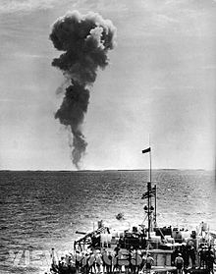 The Monte Bello site was deemed suitable by British authorities, and in a message to Menzies dated 26 March 1951 Atlee sought formal agreement to conduct the test. Atlee’s letter did not discuss the nature of the proposed test in minute detail. He did, however, see fit to mention the risk of radiation hazards:
6. There is one further aspect which I should mention. The effect of exploding an atomic weapon in the Monte Bello Islands will be to contaminate with radio activity the north-east group and this contamination may spread to others of the islands. The area is not likely to be entirely free from contamination for about three years and we would hope for continuing Australian help in investigating the decay of contamination. During this time the area will be unsafe for human occupation or even for visits by e.g. pearl fishermen who, we understand, at present go there from time to time and suitable measures will need to be taken to keep them away. We should not like the Australian Government to take a decision on the matter without having this aspect of it in their minds (quoted in Australia 1985, p. 13).
Menzies was only too pleased to assist the ‘motherland’, but deferred a response until after the 195 1 federal elections. With the return of his government, preparations for the test, code-named ‘Hurricane’, proceeded. Yet it was not until 19 February 1952 that the Australian public was informed that atomic weapons were to be tested on Australian soil.
Continue reading →
October 24, 2016
Posted by Christina Macpherson |
aboriginal issues, AUSTRALIA - NATIONAL, history, reference, South Australia, weapons and war |
Leave a comment
 Chapter 16: A toxic legacy : British nuclear weapons testing in Australia Published in: Wayward governance : illegality and its control in the public sector / P N Grabosky Canberra : Australian Institute of Criminology, 1989 ISBN 0 642 14605 5(Australian studies in law, crime and justice series); pp. 235-253 “…….The security measures taken to restrict access to the testing site were not without flaws. One morning in May 1957, four Aboriginal people, the Milpuddie family, were found by range authorities near the crater formed by the ‘Buffalo 2’ explosion the previous October. ‘Me man, woman, two children and two dogs had set out on foot from the Everard Ranges in the northwest of South Australia, and were unaware that the Aboriginal inhabitants of the Maralinga area had been removed. When authorities discovered them, the family was immediately taken to a decontamination centre at the site, and were required to shower. After this experience, which must have been frightening enough, the family was driven to Yalata.
As one of the site personnel described the experience:
It was a shocking trip down as they had never ridden in a vehicle before and vomited everywhere (Australia 1985, p. 320).
On instructions from the Secretary of the Commonwealth Department of Supply, the dogs were shot. ‘ne woman was pregnant at the time the family was taken into custody; subsequently, her baby was born dead. Australian authorities went to great lengths to keep the incident secret, but they appear to have been less concerned with the family’s subsequent health. Commenting upon the fact that no-one appears to have taken the time to explain the experience to which the hapless Aborigines were subjected, a team of anthropologists was to comment:
[T]he three remaining members of the family have been subjected to a high degree of stress and unhappiness about the events of twenty-eight years ago (Australia 1985, p. 323)…….http://aic.gov.au/publications/previous%20series/lcj/1-20/wayward/ch16.html
October 24, 2016
Posted by Christina Macpherson |
aboriginal issues, history, personal stories, South Australia, weapons and war |
Leave a comment
~ Wangan & Jagalingou Family Council http://wanganjagalingou.com.au/ http://wanganjagalingou.com.au/traditional-owners-fighting-adani-mine-meet-un-rapporteur/ 13 October 2016
“Traditional owners fighting Adani mine meet UN Rapporteur today:
“Raise ‘egregious failure’ of Qld Mines Minister & Coordinator General to respect Indigenous rights
“The declaration of Adani’s Carmichael coal project as “critical infrastructure” by Qld Government Mines Minister, Anthony Lynham,
is “a political absurdity, and continues the egregious failure of the Queensland Government to respect our rights”,
said Wangan and Jagalingou (W&J) Traditional Owners Council senior spokesperson, Adrian Burragubba today,
before a meeting with the UN Special Rapporteur on the Situation of Human Rights Defenders.
“Mr. Burragubba confirmed he would today raise this new development with Mr. Michel Forst,
who is currently conducting an official visit to Australia.
More detail about his visit is provided below.
“Mr Burragubba said, “Minister Lynham’s declaration is like calling a state of emergency for coal mining. Giving Adani this advantage provides cover for the abuse of the rights of Traditional Owners
who have stood firm in the face of the destruction that would befall their lands, waters and culture
if this massive, inappropriate project were to ever proceed.
““Adani and the Queensland government have used coercive powers under Native Title and State Development legislation, and the threat of compulsory acquisition of our land rights, to drive the development of the mine forward, over our vehement objections.
The Coordinator General, Mr Barry Broe, has been instrumental in making this happen and
this week Minister Lynham handed him even more power to override our legitimate concerns
about the destruction of our environment and the disregard of our rights”, Mr Burragubba said.
“Mr. Burragubba, and W&J youth spokesperson, Ms. Murrawah Johnson, said the meeting today will build on a previous submission W&J made to the UN Special Rapporteur on the Rights of Indigenous Peoples in which they sought assistance to deal with the failure of both State and Federal Governments to properly respect the human rights of W&J Traditional Owners, as both Governments fell over themselves in obscene haste to get Adani’s coal mine approvals out the door. … “
October 13, 2016
Posted by Christina Macpherson |
aboriginal issues, Queensland |
Leave a comment
 We Need To Talk Much Less About Andrew Bolt And Much More About Treaty Liam McLoughlin @situtheatre
https://newmatilda.com/2016/10/08/we-need-to-talk-much-less-about-andrew-bolt-and-much-more-about-treaty/
“A Yolngu man’s extraordinary win at the Northern Territory election is a significant milestone for the Treaty movement.
Yet all the media can talk about is the ‘Indigenous’ Andrew Bolt.
“In recent weeks it was declared that Yolngu man Yingiya Mark Guyula had won a stunning victory
over Labor’s Lynne Walker at the Northern Territory election, running proudly on a Treaty platform. …
“Held by the ALP since 1980, the seat was categorised as “Very Safe Labor” with a margin of 13.7 per cent.
While Labor’s Lynne Walker won the majority non-Indigenous mining town of Nhulunbuy,
Guyula won the vote in every single Yolngu community and was declared the overall winner by eight votes. … “
October 10, 2016
Posted by Christina Macpherson |
aboriginal issues, Northern Territory, politics |
Leave a comment
Aboriginal man’s story of Maralinga nuclear bomb survival told with virtual reality By Alex Mann ABC News, 7 Oct 16 In an unlikely collision of cultures, state-of-the-art 3D film technology is bringing an Aboriginal man’s unique tale of nuclear bomb survival to audiences across Australia.
In the 1950s Nyarri Morgan was a young man, walking and hunting in South Australia’s northern deserts. His dramatic first contact with whites came when he witnessed a nuclear bomb explosion at the British testing site at Maralinga.
Now, as an old man, and with the help of director Lynette Wallworth and some technology, he is sharing his story in a film called Collisions that is screening in selected venues around Australia.
“It happened in a desert where people assumed there were very few people [and] there was not much life and not much to be lost,” Wallworth said.
“Every one of those assumptions was wrong.”
‘People still have that poison today’ As the radioactive dust fell, Mr Morgan walked an ancient trade route at the edge of the test site. He had no idea of what he was witnessing.
In making the film, Wallworth asked Mr Morgan what he thought he was seeing. “He said, ‘We thought it was the spirit of our gods rising up to speak with us’,” she said. “[He said] ‘then we saw the spirit had made all the kangaroos fall down on the ground as a gift to us of easy hunting so we took those kangaroos and we ate them and people were sick and then the spirit left’.”
Mr Morgan is sharing his story, in his words, so it won’t ever be forgotten. “After the explosion the fallout went north,” Mr Morgan said. “Powder, white powder killed a lot of kangaroos [and] spinifex [grass]. Water was on fire, that’s what we saw.”
Mr Morgan said water “died” but that he and the two men he was with drank the water, even though it was still hot. “The smoke went into our noses, and other people still have that poison today,” he said.
“We all poisoned, in the heart, in the blood and other people that were much closer they didn’t live very long, they died, a whole lot of them.” ‘In virtual reality everything becomes personal’………..http://www.abc.net.au/news/2016-10-07/aboriginal-mans-story-of-nuclear-bomb-survival-told-in-vr/7913874
October 8, 2016
Posted by Christina Macpherson |
aboriginal issues, culture, history, South Australia |
Leave a comment


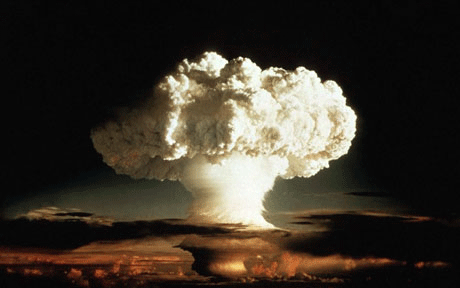
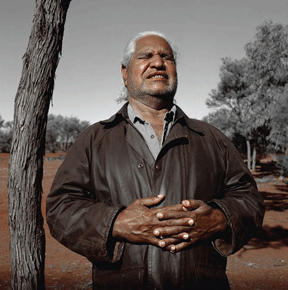 Black Mist Burnt Country review – exhibition covers devastation of nuclear war, Guardian, Clarissa Sebag-Montefiore, 12 Oct 16 With works by Sidney Nolan, Arthur Boyd and Jessie Boylan, Black Mist Burnt Country homes in on the 1956 British atomic tests in the Great Victoria Desert.

 Antinuclear