Traditional Aboriginal owners re-affirm their opposition to uranium mining at Yeelirrie
 Traditional Owners welcome Yeelirrie decision and re-affirm anti uranium mining position https://nuclearfree.wordpress.com/media/ 4th August 2016
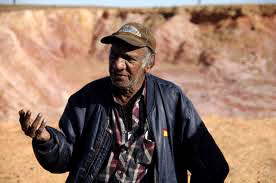
“Traditional Owners at Yeelirrie have fought against uranium mining for over 40 years.
The decision from the EPA comes as welcome relief but Traditional Owners remain wary.
“Richard Evans Koara elder and co-founder of the West Australian Nuclear Free Alliance has said “The EPA decision to protect subterranean fauna is a good decision and the right decision and we are happy with the outcome.
But we believe the EPA has underestimated the risk to bush foods, public health and water and most importantly our cultural heritage and our community’s opposition to the mine.”
“I invite the Minister (who has never spoken to us before) to come and meet with us the Traditional Owners of Yeelirrie before making a decision about our country. No Minister has come to talk to us about that country.
Yeelirrie is an important place in our culture, it is a dreaming site it important to us and other tribes around us.
In the short time since WA was colonised there have been drastic changes to the ecosystem and the country.” …
“It’s not just about protecting this country for us – but uranium threatens communities and country from the cradle to the grave, at home and overseas.
This is our responsibility and we take that responsibility seriously. We have to leave this poison where it is.” … “
To the ‘Minister for Adani’ — Matthew Canavan — “No Still Means No”
~ Wangan & Jagalingou People http://wanganjagalingou.com.au/qa-correction-to-the-minister-for-adani-matthew-canavan-no-still-means-no/ 2 August 2016
“On ABC’s Q&A last night, National Party Senator, Matthew Canavan – the ‘Minister for Adani’– made a vague reference to “native title” groups’ near unanimous support for the proposed Carmichael mine.
He complained that the media doesn’t cover such supposed ‘good news’, as though his Government’s interests are not constantly boosted in the press. …
“What the Minister failed to mention, or referred to only obliquely, is that we have several legal cases running to demonstrate that Adani does not have our free, prior, informed consent, they have engaged in conduct ‘analogous to fraud’ and that, along with the State and some statutory representatives,manipulated the native title process to override our rights and interests and divide our people. … “
Garma festival: Indigenous leaders call for land ownership settlement, slam land rights ‘failures’
http://www.abc.net.au/news/2016-07-31/garma-festival:-indigenous-leaders-call-for-land/7675658
Indigenous leaders at the Garma festival in northeast Arnhem Land have called for land ownership settlement, slamming the ‘failures’ of the Land Rights Act and Native Title Act that have allowed mining companies access to indigenous land.
WALKATJURRA WALKABOUT continue the fight to stop uranium mining
Walkatjurra Walkabout – Walking for Country https://walkingforcountry.com/walkatjurra-walkabout/walkatjurra-walkabout-about-us-2/
will be lead by the
Walkatjurra Rangers https://walkatjurra.com/rangers/
in partnership with
Footprints for Peace https://www.facebook.com/FootPrintsforPeace
Western Australian Nuclear Free Alliance (WANFA) https://nuclearfree.wordpress.com/
the Anti Nuclear Alliance of Western Australia (ANAWA) http://www.anawa.org.au/ and
the Conservation Council of Western Australia (CCWA) http://www.ccwa.org.au/
Wiluna to Leonora from August 7th – September 7th 2016
https://walkingforcountry.com/walkatjurra-walkabout/
 ‘WALKATJURRA WALKABOUT is a celebration of Wangkatja country, a testament to the
strength of the community who have fought to stop uranium mining at Yeelirrie for over forty years, and a chance to come together to continue share our commitment to a sustainable future without nuclear.
It is a chance to reconnect with the land, and to revive the tradition of walking for country.’
‘We invite all people, from all places, to come together to walk with us, to send a clear message
that we want the environment here, and our sacred places left alone.’ Kado Muir, Traditional Owner, Yeelirrie
Wakaya Traditional Aboriginal Owners steadfast against fracked gas pipeline
 NT Traditional Owners walk out on fracked gas pipeline deal Lock The Gate Alliance, July 28, 2016 Northern Territory Traditional Owners whose land is being targeted for the proposed new gas pipeline between Tennant Creek and Mt Isa have yesterday afternoon walked out of a joint Central and Northern Land Council meeting, pushing against a planned access route deal for Jemena’s Northern Gas Pipeline, due to concerns about the impacts of fracking gasfields.
A Land Council notice for the meeting asked, ‘are you ready to say yes or no to the pipeline?’ (see here). But the concerns and objections raised by Traditional Owners about the rushed consultation process and the proposed pipeline’s reliance on fracked gas has now meant the decision meeting is postponed until late September……
A final investment decision on the pipeline is due in December 2016 but Wakaya Traditional Owners say they will not back down and allow the project to proceed on their land. Continue reading
The critically important work of Australia’s indigenous rangers
Indigenous rangers play a silent and undervalued role as leaders and educators in their communities, role models for how to progress in both worlds. It’s important to provide local, challenging, culturally relevant, real jobs to keep these leaders embedded within the fabric of their families and communities.
They need a commitment beyond 2018 that their real jobs will still exist.
[The video below does not apply to The Numbulwar ranger group, but still gives an example of the kind of work that they do]
Queensland Indigenous Land and Sea Ranger Program
As well as protecting the land, Indigenous rangers play an undervalued role as leaders in their communities. It’s never been more important to protect these jobs. Many conservative politicians and commentators argue Indigenous ranger jobs are not “real jobs”. This is perfectly illustrated by the recentleaking to Crikey of a secret federal Coalition government plan to radically change this successful Indigenous ranger program in order to “get participants into employment”. While the minister for Indigenous affairs, Nigel Scullion has denied he is planning an overhaul of the program, his government has not made a commitment to fund the program beyond 2018.
This question of whether ranger jobs are “real jobs” can easily be put to rest.
The Numbulwar ranger group in Arnhem Land was re-established in November 2015, Continue reading
Will Australia’s new Resources Minister Matt Canavan really listen to Aboriginal people?
 Matt Canavan has now the opportunity to correct these mistakes and engage in a truly inclusive and transparent process which actually listens to the concerns of the community and other stakeholders. Although a nuclear proponent, he should ensure that this process is not dealt with light-heartedly and pays attention to all aspects involved.
This would best be achieved through an independent inquiry into Australia’s nuclear waste and options for managing it.
Aboriginal communities all across Australia have sustainably managed the land for thousands of years, longer than any other group of people can claim. Their knowledge and concerns are valuable. Let’s hope they will be listened to.
3rd Minister in two years to handle Australia’s nuclear waste dump http://www.onlineopinion.com.au/view.asp?article=18394&page=0 Anica Niepraschk – , 22 July 2016 The recent federal election has once more seen a bit of a reshuffle in PM Turnbull’s cabinet and thereby thrown the portfolio for Australia’s national radioactive waste dump in the hands of another Minister for the third time in less than two years.
After 20 years of failed siting processes for the proposed dump, then Industry and Science Minister Ian MacFarlane only announced a new attempt in November 2014. The first half of last year saw a voluntary nomination process happen where landowners across Australia could propose their property to host Australia’s low and intermediate level nuclear waste. Out of the 28 sites nominated, six were shortlisted for further consultation and investigation last November. All six site nominations were highly contested by the local communities.
Although the government, with its new ‘voluntary’ approach promised to not impose a nuclear waste dump on any community and therefore rely on voluntary nominations and community consultation, one of these six sites, Wallerbidina/ Barndioota in the Flinders Ranges, SA, made it to the next stage of the process, despite the strong opposition of the local Adnyamathanha community at Yappala station, just kilometres away from the site.
Not only chose the government to once again, after pursuing Coober Pedy from 1998 to 2004 and Muckaty in the NT from 2005 to 2014, to target an Aboginial community but it also chose a culturally highly significant site. The proposed property, nominated by former Liberal Senator Grant Chapman, is part of a songline and hosts many cultural sites, including the beautiful Hookina springs, a sacred women’s site for the Adnyamathanha. The local community remains actively connected to the maintenance and preservation of the land and is documenting and preserving their culture and history through recording traditional heritage sites and artefacts and mapping storylines in the area. Continue reading
Coalition govt’s secret plan to take over community-run indigenous rangers scheme
 Leaked docs reveal secret Coalition plans for indigenous rangers Although the Indigenous Rangers — Working on Country program is a huge success, Nigel Scullion wants to overhaul it from a community-run to a top-down structure. Crikey, Josh Taylor , 15 July 16 A secret document, leaked to Crikey, reveals significant changes being considered for the federal government’s wildly successful indigenous rangers program — that is, if Indigenous Affairs Minister Nigel Scullion keeps his job and is around to implement them.
The “Indigenous Rangers — Working on Country” program was started in 2007 under the Howard government as a means to provide employment and training for indigenous Australians into work applying their knowledge of the local land to care for it. It currently employs 777 indigenous rangers in full-time roles in 107 different groups, and more than 2500 indigenous people overall in full-time, part-time or casual positions…… (subscribers only) https://www.crikey.com.au/2016/07/15/leaked-docs-reveal-coalition-plans-indigenous-rangers/
Indigenous opposition to the international waste dump plan
Nuclear waste dump case unravels, World News Report, 13 July 16 , Green Left By Renfrey Clarke “……..Yankunytjatjara Native Title Aboriginal Corporation chairperson Karina Lester told a packed venue at a June 16 meeting: “The overwhelming majority of traditional owners … continue to speak out against establishing an international waste dump.”
Indigenous spokespeople have condemned the project since it was first mooted. In May last year, soon after the royal commission on South Australian involvement in the nuclear cycle began its work, representatives of 12 Aboriginal peoples met in Port Augusta.
 The gathering issued a statement that said: “South Australian Traditional Owners say NO! We oppose plans for uranium mining, nuclear reactors and nuclear waste dumps on our lands.
“We call on the Australian population to support us in our campaign to prevent dirty and dangerous nuclear projects being imposed on our lands and our lives and future generations.”
The prime site for the long-term waste repository is on the lands of the Kokatha people, near the towns of Woomera and Roxby Downs.
The Transcontinental Railway crosses the region and, as the Australian explained on June 27, the ancient rocks of the underlying Stuart Shelf are “considered by experts to have the best geological conditions for a nuclear dump”.
Early this year Dr Tim Johnson of the nuclear industry consulting firm Jacobs MCM told the royal commission his company envisaged a new port being built on the South Australian coastline to service the project. An interim storage facility nearby would hold newly-arrived wastes above ground for some decades, until they had cooled sufficiently to be transported by rail to the permanent dumpsite.
The only practical location for the port and above-ground repository would be on the western shore of Spencer Gulf, south of the city of Whyalla. Spencer Gulf is a shallow, confined inlet whose waters mix only slowly with those of the Southern Ocean. Any accident that released substantial quantities of radioactive material into the gulf would be catastrophic for the marine environment. Profitable fishing, fish-farming and oyster-growing industries would be wiped out, and the recreational fishing that is a favourite pastime of local residents would become impossible.
To connect the above-ground repository to the rail network, a new line would need to be built from the present railhead at Whyalla. Taking wastes north for permanent storage, trains would pass by the outskirts of Whyalla and Port Augusta.
Initially, the materials transported would be large quantities of low and intermediate-level waste, also planned for importation and burial. But after several decades, transport of high-level wastes would begin and would continue for another 70 years.
Awareness is growing in the Spencer Gulf region of the dangers posed by the nuclear industry. On June 24 in Port Augusta about 80 people took part in a protest against the federal plans to site a separate dump, for Australian-derived low-level radioactive wastes, near the Flinders Ranges’ tourist area………..https://world.einnews.com/article/334731841/OM4SBscz5Dp42697
Indigenous rangers partner with scientists in researching coral bleaching
 Indigenous rangers on the frontline of coral bleaching in remote Australia, ABC News By the National Reporting Team’s Kate Wild, 12 July 16 [Excellent pictures and video] In April this year Indigenous rangers from the Crocodile Islands received an alarming photograph of a coral reef off the coast of Arnhem Land. Leonard Bowaynu, who has fished the same reef since he was teenager, had seen small scattered patches of white coral before — but never anything this extensive.
“We used to go out, catch fish from the reefs. I never seen coral turning to white, like around the island or reef,” he said. Concerned by the image, rangers travelled to the area with a drone and GoPro camera to collect further evidence.
Michael Mungula said it was the first time Yolgnu people had seen the coral bleached white at that reef.
“At Murrangga [Island] we never seen white coral there before, during the 50s, 60s and 70s. But we seen it now, 2016.” “We need scientists to come here and do research in the Crocodile Islands,” Mr Mungula said. Meanwhile, 300 kilometres south-east, in waters around Groote Eylandt, Indigenous Rangers were watching giant clams turn white as well.
Anindilyakwa Rangers on Groote Eylandt began trialling the cultivation of giant blue-lipped clams (Tridacna squamosa) five years ago.
But in April the rangers noticed a number of the clams had turned white. Rick Taylor, the ranger manager, sent underwater footage of the clams to the ABC. He said it was first time he had seen the clams bleach since the trial was established in 2011.
With the two ranger groups’ permission, the ABC sent images of the Crocodile Islands coral and clams from Groote Eylandt to marine scientist Andrew Heyward at the Australian Institute of Marine Science.
Dr Heyward said the aerial photograph from the Crocodile Islands provided the first confirmation of a bleaching event in Arnhem Land. “It appears that in those areas checked it was severe,” he said. He said the photograph Crocodile Islands Rangers had received was confirmation of a massive bleaching event over the reef.
“The comments by the local rangers that they have never seen it [like this] before in their country is particularly telling that things are unprecedented, at least in human generational time frames,” Dr Heyward told the ABC……..
Skilled observers a precious commodity Dr Heyward said Indigenous rangers were able monitor environmental shifts in parts of the country most people cannot reach, and said he was keen for scientists and rangers to work together……Ranger groups have expressed enthusiasm for equal partnerships with scientists. http://www.abc.net.au/news/2016-07-11/indigenous-rangers-on-the-frontline-of-coral-bleaching/7557646
Enice Marsh at the Nuclear Citizens’ Jury – about the Federal nuclear waste dump
“……..JUROR: Enice, you are representing all of the Adnyamathanha people.
Australian Catholic Aboriginal leaders call for a TREATY NOW
 Australia is the only country in the English-speaking world that does not have a Treaty with its First Peoples. The USA, Canada, New Zealand and many other countries have treaties with their First Peoples, recognising their rights and prior occupation of their lands. We can be part of this.
It was made clear during community consultations that many Victorian Aboriginal peoples do not want to be recognised in the Constitution, as it will be more of the same lip service we have endured for decades, like many of the promises made to us in the past that changed nothing.
Catholic Aboriginal leaders in Victoria call for a Treaty http://melbournecatholic.org.au/News/catholic-aboriginal-leaders-in-victoria-call-for-a-treaty 28 June 2016 Sherry Balcombe, Coordinator, Aboriginal Catholic Ministry
In 1986 in Alice Springs Pope St John Paul II gave the most dramatic recognition by the Church in Australia to Aboriginal people. He challenged the Aboriginal people to find their rightful place in the Australian Church. Following that speech, the Aboriginal Catholic people around Australia felt new life and inspiration.
We at the Aboriginal Catholic Ministry Victoria have been greatly supported by the Archdiocese of Melbourne and we acknowledge this support and are grateful for helping us make our voice heard. It takes courage to step across the cultural abyss, so many thanks to the Archdiocese.
I feel that it was a personal challenge to me, and continues to be, to find our rightful place; we are constantly challenged to justify ourselves.
For far too long governments, authorities and the Church have tried to do things for Aboriginal people. Our wish is to do things for ourselves. With your support, encouragement and collaboration we can make this a brighter, prouder and more inclusive chapter in Australia’s shared history.
Although dominant cultures in Australia see us as the victims and problems, we know and see our great warriors: people running organisations, bringing up families and educating the wider communities on the deep, meaningful contributions that we can make to the life of this great country.
We have the chance right now to move forward the right and proper way by working with Aboriginal people towards the common goal of a Treaty. Our people have struggled on the fringes of society for far too long. Continue reading
The Nuclear Industry and Indigenous People -theme for July 16
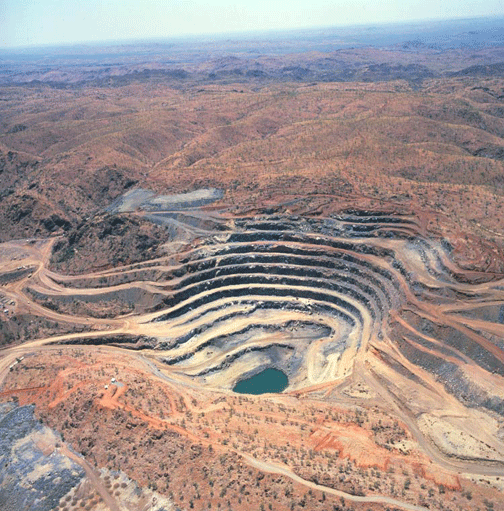 Indigenous people continue to bear the brunt of nuclear toxicity. It started with uranium mining – of course, on indigenous land in rural areas, in USA, Canada, Bulgaria, Australia, Germany , India, and of course to provide nuclear weapons material.
Then came the nuclear bomb tests – on remote rural indigenous lands and islands
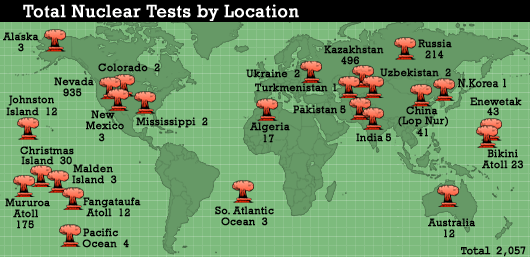
Indigenous peoples either stayed on their polluted lands, as uranium mining continued, or were removed from bomb tests sites, unable to return.
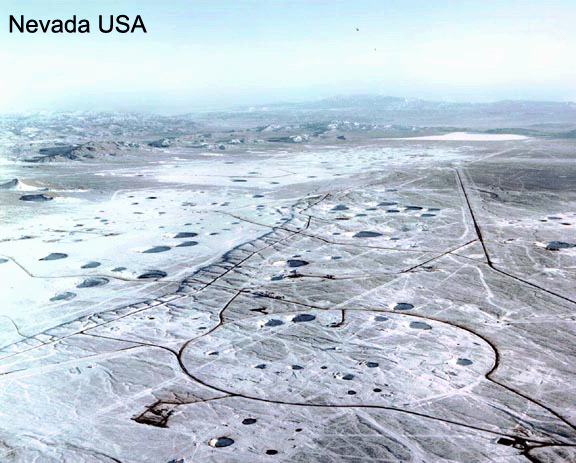
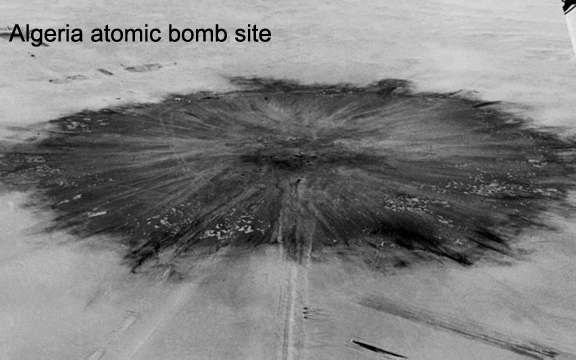
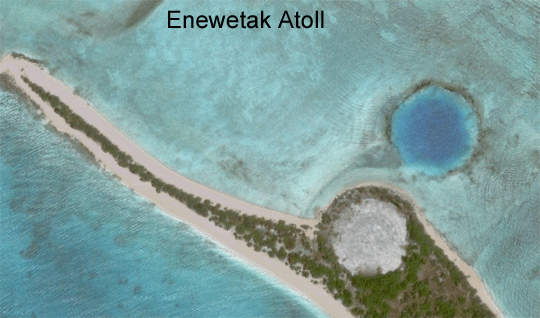
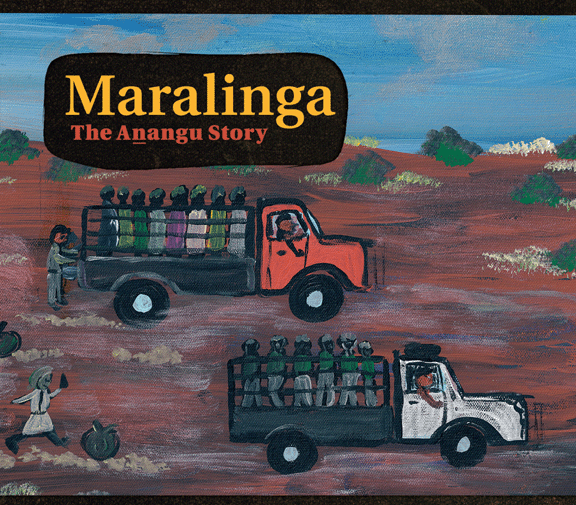
This Radioactive pollution remains today, from uranium mining in many countries – but always on or close to indigenous lands. The nuclear bomb test sites remain too radioactive for the indigenous people to return home.
Uranium mining and milling, nuclear bomb tests and radioactive wastes ... Russia is 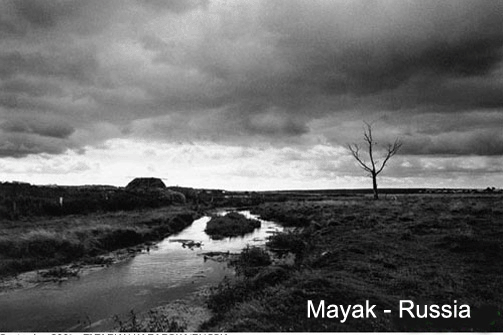 secretive about its nuclear wastes. They used to dump it in oceans, as did the French and others. Russia is notorious for its extremely polluted remote area at Mayak, where the rural people suffer the health legacy to this day
The “developed” world realises that something must be done with the growing amounts of radioactive trash.
Where to dump it? That’s a “developed society” no brainer 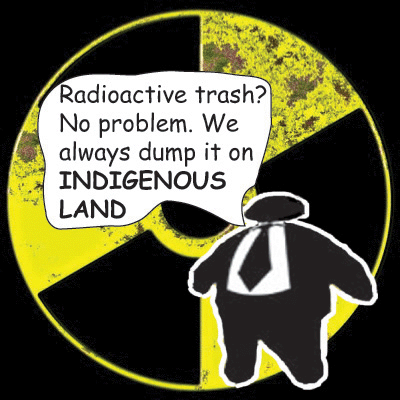
– ON INDIGENOUS LAND, of course. There’s now a movement to export radioactive trash to remote rural areas, such as the Aboriginal lands of Australia
Next week we will look at the indigenous fight against the nuclear industry
Tarlka Matuwa Piarku Aboriginal Corporation signs agreement with uranium company Toro
Toro signs native title deal for Wiluna, Yahoo News Jarrod Lucas, Kalgoorlie – The West Australian on July 7, 2016 Uranium hopeful Toro Energy has signed a native title agreement with the traditional owners of its proposed Wiluna mine.
It comes as Toro waits on the Environmental Protection Authority’s verdict on Wiluna after a three-month public review process was completed in February.
Wiluna is one of three Goldfields uranium projects — alongside Vimy Resources’ Mulga Rock project and WA’s biggest deposit, the Cameco- owned Yeelirrie — which are awaiting EPA approval.
The agreement with the Tarlka Matuwa Piarku Aboriginal Corporation, the native title holding body of the Wiluna people, recognises opportunities for a range of business and employment initiatives.
Toro’s managing director Vanessa Guthrie said the agreement was reached after more than seven years of relationship building with the Wiluna people……….
In July 2013 the Federal Court determined their native claim over almost 48,000sqkm, including the Millipede, Centipede and Lake Way uranium deposits which Toro plans to mine. The Wiluna project also takes in the Lake Maitland deposit, where mining would begin six years into the 20-year project life.There is currently no native title claim over Lake Maitland, but Toro has been engaging with the Barwidgee people who claim an interest.
The Liberal Government overturned a ban on uranium mining in 2008, but WA has not produced a single pound of yellowcake, with prices depressed since the 2011 Japanese tsunami sent the Fukushima plant into multiple meltdowns.
Wiluna became the first mine in WA to win State Government environmental approvals in October 2012 and Toro added Federal approval six months later. But the $35 million acquisition of the Lake Maitland deposit from Mega Uranium in mid-2013 meant Toro went back to the drawing board to win further approvals to add new deposits to the mine plan.
The situation is now delicately poised with Toro, Vimy and Cameco striving to win environmental approval before next year’s State election.
WA Labor remains opposed to the mining and export of uranium, but shadow mines minister Bill Johnston says the party would not over-turn approvals if it wins next year’s State election……….https://au.news.yahoo.com/thewest/wa/a/32003739/toro-signs-native-title-deal-for-wiluna/
The Lizard Bites Back goes North
 Nectaria Calan 6 July Arabunna elder Uncle Kevin Buzzacott has invited participants at the Lizard Bites Back to visit his country today, to witness firsthand the impacts of BHP Billiton’s Olympic Dam mine on the mound springs in the Lake Eyre region. The mound springs are integral to the desert ecosystem and sacred to the Arabunna people, and are threatened by the 37 million litres of water per day that the mine uses from the Great Artesian Basin, which feeds the mound springs.
The Lizard Bites Back has attracted over 300 people from around the country, converging near the mine gates for a weekend of direct action, workshops on nuclear issues, and music. After two days of workshops and marches to the gates of the mine, the last day of the convergence saw nearly one hundred activists block the main road to the mine for eighteen hours. Riot police were sent in at midnight. On their way, riot police approached base camp, in what appeared to be a simulated raid.
“They approached camp in formation at midnight, shouting at people to get out of their tents,” said Nectaria Calan, co-organiser of the Lizard Bites Back. “Then, for no apparent reason, they retreated. Trying to terrorise people at a non-violent protest camp was a low move, but in line with the police’s behaviour all weekend,” continued Ms Calan. “They have spent the weekend defecting cars and trying to deter people from attending the event by telling them that the public land we are camped on is owned by BHP Billiton. They have also prevented mine workers from visiting the camp. Although they have been lodged for the weekend by the company’s accommodation, they should remember that they do not actually work for BHP.”
“Despite the petty dishonesty of the police and the ongoing abuse of their powers, hundreds of people had the opportunity to sit on country and learn about the risks and impact of the nuclear industry, and disrupt the normal operations of a mine that will leave millions of tonnes of tailings that will remain radioactive for several hundred thousand years.”
“With South Australia facing two proposals for nuclear waste dumps, The Lizard Bites back has also aimed to raise awareness about the connections between uranium mining and nuclear waste,” said Ms Calan. “A responsible approach to managing nuclear waste would begin with stopping its production.”
Co-organiser Izzy Brown said, “Until we stop mining this metal that we have no idea how to dispose of safely, we will keep returning to remind BHP Billiton and the government that the intergenerational health and environmental impacts of this industry are more important than money.”
Many participants have called for another convergence next year.
“After this weekend, this is the most optimistic I’ve ever felt since Western Mining Corporation started digging up the old country. This industry is a house of cards,” said Uncle Kevin.
“This place has a long history of struggle, and we will continue to struggle to honour the sacrifices made by the elders that struggled before us, that may still be with us if this mine was not established. We need to say sorry to the old country and begin healing this land.”
1 This month

of the week – Australians for War Powers Reform (AWPR)
To see nuclear-related stories in greater depth and intensity
 Antinuclear
