Northern Territory Remote Aborigines – “We were not adequately consulted on fracking permits”
Northern Territory Indigenous community says it was not adequately consulted over fracking permits By Nadia Daly Yaho 7 News, March 29, 2015, The granting of fracking permits on Aboriginal freehold land in the Northern Territory is stoking tensions among some residents of a remote Aboriginal community who say they were not adequately consulted.
Last week, the NT Government announced it had granted the first two petroleum exploration permits on Aboriginal land managed by the Northern Land Council (NLC).
Jilkminggan community, 140 kilometres south-east of Katherine, with a population of about 300, sits in a zone that excludes fracking, according to the NLC.
However, fracking has been permitted over nearby swathes of land. News that gas companies could now drill exploratory wells on their land came as a shock to many in the community. Continue reading
Judge overturns West Australian Government’s decision to deregister Port Hedland Aboriginal sacred site
 WA court overturns decision to deregister Port Hedland Aboriginal heritage site http://www.abc.net.au/news/2015-04-01/aboriginal-heritage-test-case-port-hedland/6366250/?site=indigenous&topic=latest By Nicolas Perpitch and Laura Gartry April 01, 2015 The Supreme Court has quashed a decision by a West Australian Government committee to deregister a Port Hedland Aboriginal sacred site, in a test case that opens the door to a class action by traditional owners.
In his judgement, Justice John Chaney referred the case back to the Aboriginal Cultural Materials Committee (ACMC).
The committee had recommended to State Indigenous Affairs Minister Peter Collier that land and waters around parts of Port Hedland port should no longer be considered an Aboriginal sacred site because it had not been used for religious purposes.
“I conclude that the committee did not give consideration to the question of whether or not the Marapikurrinya Yintha was a place of importance or special significance because the question did not arise for consideration in light of the conclusion that it was not a sacred site,” Justice Chaney said in his judgement.
“The ACMC asked itself the wrong questions and identified the wrong issues, thereby falling into jurisdictional error.” Continue reading
Unprecedented Aboriginal stand to stop $16bn Carmichael coalmine, Australia’s largest
Queensland lawyer Stephen Keim, who is not acting in the case, said the complete rejection of the mine was the first of its kind and sets up a “significant event in the history of native title”.
“This is the first case with such a strong impasse, where the native title party has said ‘well we don’t want to negotiate compensation, we don’t want the action to go ahead,’” he said. “The native title act doesn’t give the right of veto, you’ve just got to keep working until you get an agreement.
“This situation does allow the arbitration process to say no, so perhaps for the first time we’ll see that happen. The impression has been that the arbiter has always seen mining as very important, but maybe this is the one.
 Aboriginal group fights to stop $16bn Carmichael coalmine, Australia’s largest Indian firm Adani has appealed to the native title tribunal to bypass the traditional owners’ rejection of the Queensland mine. Guardian, Oliver Milman, 26 Mar 15 An Aboriginal group in central Queensland is attempting to prevent Australia’s largest mine from being established on its ancestral land, in what is shaping up to be an unprecedented test of the country’s native title laws.
Representatives for the Wangan and Jagalingou people have formally rejected an Indigenous land use agreement that would see Indian mining firm Adani develop its huge $16bn Carmichael mine in the coal-rich Galilee basin region.
However, Adani has turned to the national native title tribunal to override this objection, which would allow the state government to issue a lease for the mine.
Wangan and Jagalingou elder Adrian Burragubba has written to the Queensland premier, Annastacia Palaszczuk, to uphold what he sees as the clan’s native title rights, warning that the mine would “tear the heart out of our country”. Continue reading
Remote Aboriginal communities in distress over W.A. moves to get them off their land
“And those remote communities stand there waiting for their verdict but don’t know what they’ve done to appear before the Liberal Government’s jury.”
Remote community residents frightened they will be forced off their land: Aboriginal elder ABC News 26 Mar 15 By Lucy Martin People in remote Indigenous communities are panicking about their future, say an Aboriginal elder and MP, as the Western Australian Government maintains no community will close without consultation.
Pintupi elder Bobby West said life was good in the isolated community of Kiwirrkurra in Western Australia’s Gibson Desert.
“It’s a friendly and safe community, much better than close by in the town area. We’re not planting marijuana or selling drugs in small communities. Yeah, we got a good life out here,” he said.
It has remained that way for decades, but Mr West said residents were growing increasingly frightened they would soon be forced off their land. Continue reading
Getting Aboriginals off their land, to facilitate mining industries
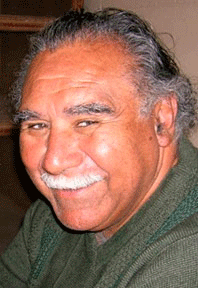 Ghillar Michael Anderson, leader of the Euahlayi people and ambassador of the Aboriginal Tent Embassy in Canberra, wrote an open letter to the United Nations on March 3, in which he states that the proposed closures of remote communities are to open up the land for mining.
“For the Western Australian government to now dispossess and displace the peoples of these homelands is designed to facilitate an expeditious expansion of mining interests and other developments,” he wrote.
The announcement of the closures coincides with the introduction of the Aboriginal Heritage Amendment Bill by the Barnett government last November. The bill, which is about to be debated in state parliament, proposes changes to the Aboriginal Heritage Act 1972. These simplify the process of gaining permission to develop Aboriginal sites, as the chief executive of the DAA will have sole discretion over whether to deem heritage protection. This would continue a DAA trend over recent years of site assessment which is beneficial to industry.
Are Mining Interests Behind Western Australian Remote Aboriginal Community Closures? http://www.vice.com/en_au/read/are-mining-interests-behind-western-australian-remote-aboriginal-community-closures March 20, 2015 by Paul Gregoir Yesterday, 18,000 people turned out at rallies across Australia in protest of the Western Australian government’s proposal to close up to 150 remote Aboriginal communities.
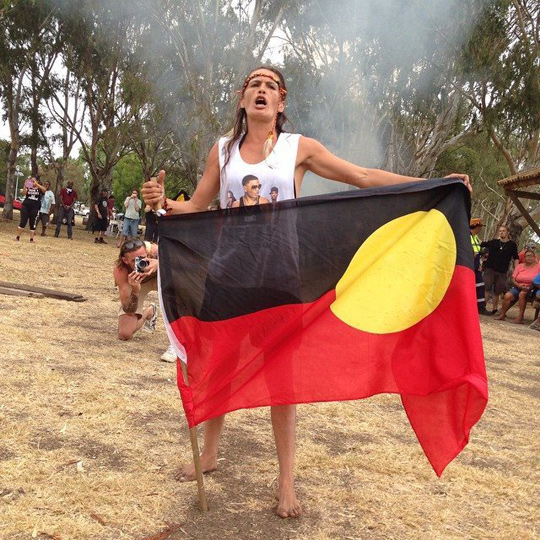
The importance of connection to country – the danger of Terra Vacua

Do we want Australia to become Terra Vacua, a site of vast quarries visited only by a fly in and fly out workforce?
Without connection to country, Australia is a shallow nation. That’s what Abbott doesn’t understand Guardian Chris Sarra 25 Mar 15 The best way to unite all Australians is to encourage the ancient Indigenous connection to the land, not destroy it or label it a “lifestyle choice” any official functions throughout Australia are opened with an acknowledgement to the traditional custodians of the land. Unfortunately, it is not unusual to observe some people rolling their eyes at this. If only they knew and understood the value of such a gesture. An acknowledgment of country may not seem like much, but its value is enhanced if one can understand that this very gesture has been occurring on this land withIndigenous Australians for many thousands of years. It is an ancient and serious gesture, which was traditionally executed to enable passage on another person’s country, as well as to signal good manners.
Today Indigenous Australians offer a gift to non-Indigenous Australians by enabling them to participate in this ancient gesture. As we execute this ritual together, our history becomes shared and non-Indigenous Australians can become more in tune with the rhythm of this land we both now live on. When we understand the depth of this gesture, we are better able respect and stand alongside each other.
Last week on his visit to Kalgoorlie, Tony Abbott – who likes to be seen as one who walks alongside Aboriginal Australians – set himself apart from us when he described many of those in remote communities as making “lifestyle choices”. Even his hand-picked Aboriginal advisers denounced him.
It is clear that Abbott wants to be regarded a prominent leader in this space but such comments signal he has a long way to go. It is also clear that neither he, nor any other politician, can develop the level of understanding required and respect that comes with it, from a few carefully choreographed appearances at remote Indigenous communities. On these visits, everything is done to ensure the VIPs hear what they want to, rather than what they need to.
It is worth understanding that Aboriginal people in many remote communities are there by anything but a process of “choice”. They are there because historically their people were rounded up and detained in such places under apartheid-like policies. Nonetheless, such communities have evolved over time. It is also clear that as a nation we have left them to dwindle at the end of the societal vine rather than enabled them to evolve into communities of quality and substance that can nurture a sense of hope and strength……. Continue reading
Greens call to reinstate Municipal and Essential Services funding for remote Aboriginal communities
Consultation to begin with Aboriginal communities slated for closure in WA, Guardian Calla Wahlquist 17 Mar 15 “………Greens senator Rachel Siewert was due to move a motion on Tuesday calling for the prime minister to apologise for the “insensitive” remark.
Abbott has so far refused to apologise for the comments or concede it was a poor choice of words.
The motion will also call on the federal government to reinstate the Municipal and Essential Services funding, which will run out next year under a deal that gave states responsibility for providing for remote communities, and urge the WA government to abandon plans to close Aboriginal communities.
“Many organisations, including the National Aboriginal Community Controlled Health Organisation, have noted that these remote communities are important to cultural, emotional and social wellbeing and should not be shut down for the sake of short-sighted budgetary measures,” Siewert said.
“We need to be working with communities to deliver essential services and support, not closing and abandoning them.”…..
Dodson, known as “the father of reconciliation”, said on Sunday the avenue for dialogue between Indigenous people and the federal government had closed and urged Abbott to reconsider his approach.
“Does Australia want to have a relationship with Aboriginal people, or does it not?” Dodson said. “Or does it simply want to improve the management and control systems over the lives of Aboriginal people? That’s the seminal issue.”……http://www.theguardian.com/australia-news/2015/mar/17/consultation-to-begin-with-aboriginal-communities-slated-for-closure-in-wa
National protests against plans to close remote Aboriginal communities
#SOSBlakAustralia call goes out across the land to save remote Indigenous communities, Crikey MARIE MCINERNEY | MAR 19, 2015 A day of action to protest plans to close remote Indigenous communities in Western Australia ended up not only trending nationally on Twitter but hit the streets in real-life, with rallies across Australia, from Derby and Roebourne to Townsville and Tasmania.
The largest protest was, understandably, in Perth, fuelled by Prime Minister Tony Abbott’s “lifestyle choice” comments last week. They also prompted this call today by Close the Gap campaign co-chairs Mick Gooda and Kirstie Parker for the governments to re-engage with Aboriginal and Torres Strait Islanders, saying the decisions being made about remote communities are “highly damaging and a breach of inherent rights”.
Such was the growing momentum on the issue that Premier Colin Barnett addressed the rally in Perth – see The West Australian’s report and other media coverage of the protest (and 2015 Close the Gap day events):……
Below is a selection of the #SOSBlakAustralia tweets that captured virtual and real-life protest through the day, from organisations and individuals, including high profile sports and arts figures. Not even a pending cyclone was going to stop them: [tweets reproduced here] http://blogs.crikey.com.au/croakey/2015/03/19/sosblakaustralia-call-goes-out-across-the-land-to-save-remote-indigenous-communities/
Kakadu Traditional Owners pay their respects to Malcolm Fraser
Kakadu Traditional Owners pay their respects to Malcolm Fraser The Mirarr people, whose lands include parts of Kakadu National Park as well as the Ranger and Jabiluka uranium deposits, are saddened by the news of Mr Malcolm Fraser’s passing. More than thirty years ago, as Prime Minister, Mr Fraser declared the first stage of Kakadu National Park and oversaw the enactment of the Aboriginal Land Rights (Northern Territory) Act.
These visionary decisions continue to have significant impacts on the lives of many Aboriginal people across the Northern Territory. While the passage of the Land Rights Act imposed the Ranger Uranium Mine on Mirarr country it also delivered real property rights to Mirarr and other Aboriginal people across the Northern Territory and remains the high water mark of Aboriginal Land Rights in Australia.
In more recent times, Mr Fraser has been an advocate for justice and decency for Aboriginal communities from within the conservative side of politics. Yvonne Margarula, Mirarr Senior Traditional Owner said: “I want to pay respect to Mr Fraser, who was an important leader. With Mr Gough Whitlam, Mr Fraser ensured that our land rights were acknowledged and granted to us and other Bininj (Aboriginal) people in the Territory.
“He has been a friend to Aboriginal people over a long period. “We also respect that he became Ambassador for Children’s Ground, one of our important partnerships in Kakadu and West Arnhem, to change the future for our people. We are thinking of his family at this time,” Ms Margarula concluded.
Australia’s land needs the cultural knowledge of Aboriginal communities
Evidence for the sustainability of Aboriginal settlements on their lands exists where Aboriginal people are moving increasingly into collaborations with scientists and other researchers to maintain the viability of fragile ecosystems on their lands.
Their role in mapping biodiversity, crucial to maintaining sustainable country in remote places, is unique and without parallel. This activity has important spin-offs in education and employment.
Eighty five percent of the population lives within 50 kilometres of the coastline. This is the voting block that is driving government policies. Thus it is this area of Australia that our present governance system overwhelmingly addresses.
In September 2012 the national organisation Desert Knowledge Australia released a report, Fixing the Hole in Australia’s Heartland, that identifies the defining features of remote Australia. Importantly, it sets out the challenges of governance faced by all nations with similar remote lands.
The project team and the reference group comprise an impressive array of people with considerable knowledge and experience of remote Australia. Notable are the former Minster for Aboriginal Affairs, the Hon Fred Chaney AO and Dr Peter Shergold AC who was at that time the most senior public servant in Australia.
Above all this report moved away from defining the issues to do with remote Australia as an “Aboriginal problem”. To quote from the report:
The governance of remote Australia should not be cast as an “Aboriginal issue” – it is about ineffective government arrangements, disengagement and national indifference.
These problems are too often perceived only in the context of the dysfunction of remote Aboriginal settlements and seen therefore as purely “Aboriginal” issues rather than issues of government capability. That is a mistake. Many non-Aboriginal Australians face similar issues as a result of their remote location.
I recently interviewed the project coordinator and lead author of the report, Dr Bruce Walker. He admitted the government response to this report has been negligible and disappointing. He is adamant that the need for an Outback Commission recommended in the report is now urgent and critical to address the needs of the people who live in remote Australia……
The Outback’s global significance as we move into the Anthropocene Continue reading
Australia’s remote ecosystems need the care of Aboriginal communities
Remote indigenous communities are vital for our fragile ecosystems – The Conversation http://bsllibrary.org.au/equity-and-climate-change/remote-indigenous-communities-are-vital-for-our-fragile-ecosystems-the-conversation-52920/ MARCH 13TH, 2015 Extract from an article by Craig Moritz, Emilie-Jane Ens and Jon Altman
Amid the questioning of government support for remote Aboriginal communities and what Prime Minister Tony Abbott called the “lifestyle choices” of those who live there, the growing role of Aboriginal management of large areas of remote Australia has been overlooked.
There are 1,200 small, discrete Indigenous communities in regional and remote Australia with various sources of income, including federal government “Working on Country” funding, as well as meagre and tightly regulated welfare payments. They fulfil a key role in populating large areas of outback Australia …
Outback Australia has high biodiversity and would otherwise be unoccupied – and so open to a host of threats including intense and widespread wildfires and invasive species. There is also a long-standing recognition of outstations as important to maintaining the connection of remote-living Aboriginal people to their culture and customary responsibilities.
More than a third of Australia is recognised as Aboriginal owned and managed land, mainly in very remote regions. Given ancestral connections and Aboriginal people’s customary obligations to Country (the land with its inherent natural, cultural and spiritual meaning), they are the best placed to look after it, it is a practice that can be very important to them.
SOURCE: Moritz, Craig; Ens, Emilie-Jane and Altman, Jon. “Remote indigenous communities are vital for our fragile ecosystems.” The Conversation 13th March 2015
Mounted police, canine squad & dozens of police move Aboriginal protestors at Perth’s Heirisson Island
 Heirisson Island Aboriginal protest: Police move in to clear campers, ABC News 13 Mar 15 By Rebecca Trigger Angry scenes erupted at Perth’s Heirisson Island today as police and the city moved to dismantle an Aboriginal camp, set up in response to the State Government’s plan to close remote communities.
Dozens of officers, including mounted police and the canine squad moved in on the island at about 3:00pm, Continue reading
Melbourne rally in protest at plan to close remote Aboriginal communities
Aboriginal rally brings Melbourne CBD to standstil SAMANTHA LANDY HERALD SUN MARCH 13, 2015 HUNDREDS of Aboriginal rights activists have shut down Melbourne’s CBD in a protest against the planned closure of remote indigenous communities in Western Australia. The demonstrators brought Swanston St to a standstill during the evening peak, disrupting traffic and almost a dozen tram routes for about an hour and a half from 6pm…….
Ms Onus said Mr Abbott’s comments that living in remote communities was a “lifestyle choice” were “blatantly racist”. “These people live where their ancestors have been for tens of thousands of years,” she said.
“There will be (thousands of) Aboriginal refugees if these communities close. “We know what happens to homeless Aboriginal people — they’re often criminalised. “They’re gonna end up in prisons and hospitals and homeless shelters.”
Ms Onus said protests were also being held in other capital cities.
Victoria Police spokesman Adam West said there were no incidents during the protest.samantha.landy@news.com.au http://www.heraldsun.com.au/news/victoria/aboriginal-rally-brings-melbourne-cbd-to-standstill/story-fni0fit3-1227261910970
Timeline for the struggle for Aboriginal land rights
Aboriginal people have a responsibility to live on Country
Closing the divide between all Australians, The Age, March 13, 2015 Justin Mohamed
Aboriginal organisations and communities have raised strong concerns about the impact community closures will have.It is not purely an economic equation. Continue reading
1 This month

of the week – Australians for War Powers Reform (AWPR)
To see nuclear-related stories in greater depth and intensity
 Antinuclear