Gurindji Indigenous group travels across Australia to pay repects to Gough Whitlam
Indigenous people pay respects to Whitlam, the prime minister who cared about them November 5, 2014, SMH, Dan Harrison Health and Indigenous Affairs Correspondent “……..this week, some of the Gurindji men and women involved in that fight and their families travelled across the country to Sydney to pay their respects to that jangkarni marlaka (“big important man”), former Prime Minister Gough Whitlam. The group have travelled from Kalkaringi, 800 km south of Darwin, to honour the man who, in August 1975, poured desert soil through the hand of Gurindji stockman Vincent Lingiari to signify the return of more than 3000 square kilometres of Gurindji ancestral land.
“We are mates now,” Lingiari replied.
When news of Whitlam’s death reached Kalkaringi two weeks ago, the community gathered at the spot where the ceremony took place, sharing stories in honour of the man they now refer to respectfully as kulum Whitlam…… http://www.smh.com.au/federal-politics/political-news/indigenous-people-pay-respects-to-whitlam-the-prime-minister-who-cared-about-them-20141104-11guaz.html#ixzz3IJiWV4RE
Plan to smash Aboriginal land rights , from Tony Abbott and Andrew Forrest
 Abbott and Forrest’s assault on Indigenous land rights Independent Australia Land Rights News – Northern Edition 31 October 2014, The iconic 1976 Land Rights Act is under attack like never before under the Abbott Government, writes former Fraser Liberal Government Minister for Aboriginal Affairs Ian Viner AO QC (via Northern Land Council – Northern Edition).
WITH the Commonwealth Government’s push for 99-year leases, the Forrest Review’s call for Aboriginal land to be privatised so as to be bought and sold, and attacks upon the Northern Land Council in particular over their defence of traditional ownership and their responsibilities under the Land Rights Act, the iconic 1976 Land Rights Act is under threat like never before.
The whole framework and security of traditional Aboriginal land, protected by theLand Rights Act, is in danger of being subverted by Governments, bureaucracies and people who have no real understanding or sympathy for traditional communal land ownership.
99-year town leases turn traditional ownership upside down.
In reality, they put the Commonwealth back into ownership and control of traditional Aboriginal land like it was before the Land Rights Act was passed as if Aboriginal land had returned to reserve status under Commonwealth control………..
The Forrest Review recommendations make it plain that the objective of Commonwealth land tenure reform policies in the Northern Territory should be to smash traditional ownership by making Aboriginal land “tradeable and fungible” as it says in Chapter 8. History tells us that land grabberswill quickly move in and Aboriginal land will be traded away forever and Aboriginal people left on the fringe once again.
The real objective of Commonwealth policy should be to put the Aboriginal people in control of their own destiny for the next 99 years. Keeping Aboriginal land firmly under Aboriginal control is the only way for that to happen.
Northern Territory Aboriginal people should learn from Maori history in New Zealand………http://www.independentaustralia.net/australia/australia-display/abbott-and-forrests-assault-on-indigenous-land-rights,7052
Nova Peris would be the strong good voice for Labor’s Aboriginal Affairs
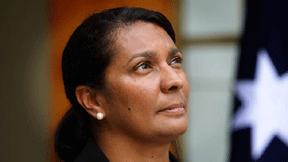
the Senator is the most qualified to represent through the ALP for this nation’s First Peoples. The Andrew Forrest and Professor Marcia Langton authored ‘Creating Parity’ report has been heavily criticised by Senator Peris. The real journey to ‘creating parity’ would have Senator Peris as the Opposition spokesperson on ‘Aboriginal Affairs’.
Nova Peris should be spokesperson for ‘Aboriginal Affairs’ The Stringer by Gerry Georgatos October 26th, 2014 White Australia still grips tightly its control over the nation’s agendas and cultural content despite a multicultural population that it continues to deride and where possible shun. The demography of this nation is not reflected in the parliaments and institutions of the nation. First People are under-represented, multicultural Australia is under-represented. White Australia – Anglo-Celtic-Saxon Australians – populate Government Cabinets, Shadow Cabinets, the party rooms of every political party. The Australian Labor Party had the opportunity to lead the way, but instead choose to let powerbrokers and the influence peddling stand in the way of the big picture message that should have been. Senator Nova Peris, not the Member for Blair’s Shayne Neumann, should be the Shadow Minister for Aboriginal Affairs.
Senator Peris has been effectively a lone voice on First People issues for the Australian Labor Party since she was handpicked by former Prime Minister Julia Gillard as a lead candidate for the Senate from the Northern Territory for the 2013 federal elections. Senator Peris became the first Aboriginal woman into parliament – a double coup for the ALP, but more importantly for the national consciousness, and even more importantly for the continent’s First Peoples.
Mr Neumann has barely uttered a word on the myriad issues affecting First Peoples since he was handed the portfolio by Bill Shorten late last year. Continue reading
Aboriginal and Torres Strait Islander Communities at risk from mining
“Our current Government is putting out a Green Paper called ‘The New Frontier’which includes Western Australia, Northern Territory and Northern Queensland, and they’re talking about the economic viability of the new frontier,” Lee said.
“What that translates to, is mining, taking of land, and when you start removing people from their land, then you can’t close the gap because you’re once again denying people their human rights.”
Aunty Pat, said communities need home bases, where a sense of belonging can be achieved, and children educated in the old ways to provide a path to the future where the loss their ancestor’s suffered can be replaced with traditional culture.
“We need to have a place where we can deal with a holistic approach of taking a family on a property and do the healing process,” Aunty Pat said.
“It will not take three months or six months, it could take a whole year and on this property we should have trained qualified people who will deal with the children and have some form of a mini school for the children to learn how to read and write the old way.”
Ms Vanessa Lee, said it’s crucial for our government and our country to try to understand how the land is important to Aboriginal and Torres Strait Islanders.
“I don’t think people understand the whole importance of land to Aboriginal and Torres Strait Islander people, it’s not just land rights, it’s a sense of spirituality,” Lee said.
“Everything comes from the earth and goes back to the earth, and that’s where you’ve got the Dreaming happening.”
Mr James said there’s evidence that what these organizations are doing out there is helping and making a difference, but they need continual support……..http://thestringer.com.au/forgotten-children-of-the-promised-land-the-fight-to-save-rural-aboriginal-and-torres-strait-islander-communities-8944#.VE6TiiLF8nk
Price fixing allegation involving indigenous “blow-ins” and mining companies
ACCC investigates claims of Aboriginal and mining ‘cartels’ October 24, 2014 SMH, Nicole Hasham
State Politics reporter Mining companies and Aboriginal groups allegedly engaged in “cartel conduct”, including price fixing for work involving ancient indigenous heritage sites, according to claims investigated by the competition watchdog……..Critics say Aboriginal cultural knowledge has been “commodified” and important artefacts and sites are being destroyed to make way for mining developments……..
Mining companies can pay groups known as “registered Aboriginal parties” to conduct field surveys and manage or salvage artefacts affected by mining development.
The ACCC investigated claims involving Rio Tinto Coal, Ashton Coal and NuCoal Resources,………
Aboriginal cultural heritage expert Maria Cotter claimed that decision-making on important sites was “being driven by dollar reimbursement and not by informed Aboriginal people making decisions about their heritage”.
“Aboriginality has been commodified in the process so that [people] are being bought to be Aboriginal, whether they have clear connections and understanding of the heritage of a particular place or not,” Dr Cotter said.
Scott Franks, who works with Ms Cotter and is a registered native title claimant for about 10,000 square kilometres of the Hunter Valley, claimed indigenous “blow-ins” from outside the area were engaged by mining companies, regardless of their knowledge or qualifications. Another local indigenous source close to the assessment process supported the claim……..http://www.smh.com.au/nsw/accc-investigates-claims-of-aboriginal-and-mining-cartels-20141026-119gab.html
Aboriginal landowners not consulted, not happy, on release of Ranger uranium mine report
for the traditional owners to have any confidence in the capacity of ERA and the regulators to manage Ranger the recommendations of the report must be acted on “swiftly and completely”.
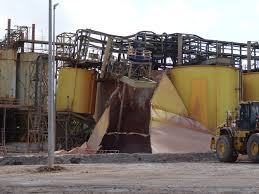 photo – uranium tank collapse at Ranger December 2013
Uranium miner ERA ‘did not meet expected standards’, new report over Kakadu acid spill says By James Dunlevie ABC News 24 Oct 14 A report has criticised standards at a Kakadu uranium mine, but local Aboriginal people say the investigation process had broken down and they had not been told the report was being released.
The investigation looked into the circumstances surrounding the incident at the Energy Resources of Australia (ERA) Ranger uranium mine in the national park, where 1,400 cubic metres of acidic slurry was spilt out of a collapsed tank about 1:00am on December 7, 2013.
The report found “at the time of the tank failure ERA’s management of process safety and its corporate governance did not meet expected standards”. In a joint statement announcing the release of the report, Federal Resources Minister Ian Macfarlane and his Territory counterpart, Willem Westra Van Holte, thanked the members of the Ranger Incident Taskforce for their efforts “in particular, the contributions by the Gundjeihmi Aboriginal Corporation and the Northern Land Council”.
It’s just absurd that you would establish a taskforce to investigate … over a nearly 12-month period and then release the report and not have any dialogue with any taskforce members.
Justin O’Brien, CEO Gundjeihmi Aboriginal Corporation
Gough Whitlam honoured as father of Aboriginal land rights in Australia
 Gough Whitlam: former PM was father of Aboriginal land rights in Australia http://www.news.com.au/national/gough-whitlam-former-pm-was-father-of-aboriginal-land-rights-in-australia/story-fncynjr2-1227097636875 OCTOBER 21, 2014 GOUGH Whitlam left the political scene decades ago, but Aborigines still — and always will — acknowledge him as the father of land rights in Australia.
The Rirratjingu clan of northeast Arnhem Land today held a small smoking ceremony, led by Yothu Yindi founder Wityana Marika, and grieved for the man who forced white law to recognise our first people.
- At the time Whitlam came to power in 1972, Aborigines in northeast Arnhem Land were reeling from the 1971 Milirrpum v Nabalco case in the Northern Territory Supreme Court, which found that they had no sovereign rights to their land.
- The government of Robert Menzies had in the 1960s granted Nabalco total rights to mine bauxite on the tribal lands of the Yolngu people, without the consent of the traditional owners, whom the court later deemed did not exist in Australian law.
Whitlam, alert to the injustice, ordered the Woodward Royal Commission in 1973, which recommended the recognition of land rights in the Territory.
- Prior to this, a group of Aborigines led by Vincent Lingiari walked off Wave Hill station, in the west of the Territory, demanding equal wages and conditions and stockmen.
Their struggled morphed into a campaign for land rights, strengthened by the findings of the Woodward commission.
In 1975, Whitlam handed back the Wave Hill lease to Aborigines, famously running sand through the hand of Lingiari. He told him: “Vincent Lingiari, I solemnly hand to you these deeds as proof in Australian law that these lands belong to the Gurindji people, and I put into your hands part of the earth as a sign that this land will be the possession of you and your children forever.”
Whitlam had by then drafted the Aboriginal Land Rights Act, though would be overthrown before it became law. His successor, Malcolm Fraser, passed the legislation almost unchanged, knowing that the time for recognition had come.
- All this was possible in the Territory, because it didn’t have full state rights; and state governments were by then eyeing the land rights’ developments nervously.
They fought against land rights, fearing they would surrender huge tracts of land to traditional owners.
In 1992, national recognition finally came when the High Court heard the Mabo case and found the doctrine of terra nullius — of Australia as an empty land prior to white arrival — to be a myth.
This led to the creation of Native Title law, which gave Aborigines cultural and economic rights to their land. All of this tied directly back to Milirrpum v Nabalco.
The son of Milirrpum, Wanyubi Marika, described Whitlam as “a very important man. Before him there was no land rights. “My father lost the case because of terra nullius. Mabo picked up the land rights issue from Arnhem Land and made it clear about the recognition of Aboriginal and Torres Strait ownership of the country.
“(Whitlam) was very helpful to our people, to our fathers. We want to think about his work and we will let his spirit be with us, going forward.”
Gough Whitlam’s exceptional legacy for Indigenous Australians
Gough Whitlam remembered: a true leader for Indigenous Australians, Guardian, 21 Oct 14
Gough Whitlam was the first prime minister to campaign so openly for Indigenous people and to listen to their concerns For Aboriginal people across the country, Gough Whitlam was our giant among former prime ministers. He was the first leader to campaign so openly for us. During his short term in office he and his government made momentous decisions to include Aboriginal people within the fabric of the nation. Continue reading
An Aboriginal call for true leaders, not government stooges
Ngiyani-ga nganbinganbi baluwaal miinba-y nginu-ngay, giirr wangaarrama-li! (We are in this together, never allow yourself to be beaten).
Enough is enough – It’s time to act by supporting the call for our true leaders The Stringer by Dr Woolombi Waters October 19th, 2014 The national call by community leaders Tauto Sansbury, Geoff Clark and Michael Mansell among others for a National Summit of legitimate First Nations leaders has the potential to change a generation. We are talking of the same influence of the Freedom Marches back in the ’60’s, the establishment of the Tent Embassy in ’72 and the Bark Petition in 1963.
But it will only change a generation if we embrace this movement as our own and realise the time for change has come. We can all be a part of history or we can continue to be victims of history. By calling for a National Gathering we are not excluding any people who share in the very real concerns of our mob, our identity and our Culture.
Very few will be given the opportunity to change history during their lives but by each and every one of us standing together we can start a movement to overcome … as together we work towards change.
We have all been called to the same stomping ground and it has come time to act. Continue reading
Aboriginal land was taken, but returning Aboriginal soldiers not entitled to soldier settlement blocks.
Racial issues were forgotten on the battlefield as allied troops united against the common enemy.
Initiatives such as the Soldier Settlement Scheme, which granted land to ex-servicemen was not extended to indigenous servicemen, despite the fact that much of the best farming land in Aboriginal reserves had been confiscated for soldier settlement blocks.
Aborigines Equal On The WWI Front, But Not At Home Central Western Daily 13 Oct 14 IT is estimated that up to 800 indigenous servicemen served in the First World War. The exact number will never be known since ethnicity was not recorded on enlistment papers.
When war broke out in 1914, many indigenous Australians who attempted to enlist were rejected on the grounds of race, their attestation papers marked ‘Unsuitable physique – Aboriginal’ or ‘Unsuitable physique – Colour’. This was in accordance with the Commonwealth Defence Act 1909 which prevented those who were not of ‘substantially European descent’ from enlisting in the armed forces. Many indigenous men enlisted under false names and/or places of birth in an attempt to evade these conditions…..
After Prime Minister Billy Hughes’ conscription referendum was defeated in October 1916 and enlistment numbers were falling, legislation was introduced allowing “half-castes” to enlist.
A Military Order stated: “Half-castes may be enlisted in the Australian Imperial Force provided that the examining medical officers are satisfied that one of the parents is of European origin.”
Indigenous Australians were present in almost every Australian campaign of World War I. At least 34 Aboriginal men fought at Gallipoli, 12 of whom were killed. They also served in trenches on the Western Front and on horseback with the Light Horse in the Middle East. Continue reading
Tony Abbott a very false friend to Australia’s Aborigines
John Pilger: War, circus and injustice down under, Green Left, Saturday, October 11, 2014 By John Pilger There are times when farce and living caricature almost consume the cynicism and mendacity in the daily life of Australia’s rulers.
Across the front pages is a photograph of a resolute Tony Abbott with Aboriginal children in Arnhem Land, in Australia’s remote north. “Domestic policy one day,” says the caption, “focus on war the next.”
Reminiscent of a vintage anthropologist, the prime minister grasps the head of an Aboriginal child trying to shake his hand. He beams, as if incredulous at the success of his twin stunts: “running the nation” from a bushland tent on the Gove Peninsula while “taking the nation to war”. Like any “reality” show, he is surrounded by cameras and manic attendants, who alert the nation to his principled and decisive acts.
But wait; the leader of all Australians must fly south to farewell the SAS, off on its latest heroic mission since its triumph in the civilian bloodfest of Afghanistan. “Pursuing sheer evil” sounds familiar; of course, an historic mercenary role is unmentionable, this time backing the latest US-installed sectarian regime in Baghdad and re-branded ex-Kurdish “terrorists”, now guarding Chevron, Exxon Mobil, Marathon Oil and Hunt Oil.
No parliamentary debate is allowed; no fabricated invitation from foreigners in distress is necessary, as it was in Vietnam. Speed is the essence. What with US intelligence insisting there is no threat from Islamic State to America and presumably Australia, truth may deter the mission if time is lost. If the police and media show of “anti-terror” arrests in “the plot against Sydney” fails to arouse the suspicions of the nation, nothing will………
Far from being a “friend”, Abbott’s government is continuing the theft of Aboriginal land with a confidence trick called “99-year leases”. In return for surrendering their country — the essence of Aboriginality — communities will receive morsels of rent, which the government will take from Aboriginal mining royalties. Perhaps only in Australia can such deceit masquerade as policy.
Similarly, Abbott appears to be supporting constitutional reform that will “recognise” Aboriginal people in a proposed referendum. The “Recognise” campaign consists of familiar gestures and tokenism, promoted by a PR campaign “around which the nation can rally”, according to the Sydney Morning Herald — meaning the majority, or those who care, can feel they are doing something while doing nothing.
During all the years I have been reporting and filming Aboriginal Australia, one “need” has struck me as paramount. A treaty. By that I mean an effective bill of rights: land rights, resources rights, health rights, education rights, housing rights and more. None of the “advances” of recent years, such as Native Title, has delivered the rights and services most Australians take for granted.
As Arrente/Amatjere leader Rosalie Kunoth-Monks says: “We never ceded ownership of this land. This remains our land, and we need to negotiate a lawful treaty with those who seized our land.”
A great many if not most Aboriginal Australians agree with her; and a campaign for a treaty — all but ignored by the media — is growing fast, especially among the savvy Aboriginal young unrepresented by co-opted “leaders” who tell White society what it wants to hear.
That Australia has a prime minister who described this country as “unsettled” until the British came indicates the urgency of true reform — the end of paternalism and the enactment of a treaty negotiated between equals. For until we, who came later, give back to the first Australians their nationhood, we can never claim our own. https://www.greenleft.org.au/node/57493
Leaders of States plot to facilitate mining on Aboriginal land?
COAG puts focus on land rights THE AUSTRALIAN 11 Oct 14 NORTHERN Territory indigenous land rights legislation will be reviewed in Tony Abbott’s northern Australia white paper after a meeting of state and national leaders was told it was holding back development.The Prime Minister announced the review at the Council of Australian Governments meeting in Canberra………Northern Territory Chief Minister Adam Giles called for changes to indigenous land administration and land use to enable traditional owners to attract private-sector investment and finance for development.
He said all the operating mines in the Northern Territory had been approved before the current land rights laws were implemented in the 1970s. “The protracted and complicated processes for approving development projects on Aboriginal land are prohibiting indigenous Territorians from pulling themselves out of poverty through economic development,” Mr Giles said……..http://www.theaustralian.com.au/national-affairs/state-politics/coag-puts-focus-on-land-rights-to-get-territory-moving-on-jobs/story-e6frgczx-1227086931999
A vision for a modern outback in Australia
Another imagined future is to treat the Outback as a land ripe for unfettered development. It would divide the landscape into exploited and conserved (or neglected) sectors, and would seek to transform the areas by creating an economy highly reliant on intensive agriculture and mining.
It would seek to overcome logistical and environmental constraints of such industrialisation through government subsidies. This may create brief economic growth in a few districts. However, in the long term this approach would cause irredeemable loss to those values that make the Outback so distinctive and important.
 There is a different future that instead recognises the extraordinary existing inherent value in the Outback, and supports development that adapts to and works within the environmental and other constraints of remote and dry lands
A Modern Outback — nature, people and the future of remote Australia BARRY TRAILL THE AUSTRALIAN OCTOBER 11, 2014 “…… The Outback stands out as one of the great natural places globally, a place where nature remains in abundance; a landscape where the bush still stands, where the rivers still flow and where wildlife still moves as it always has to find food and shelter in a tough environment……..
There are especially magical, mysterious, spectacular places in the Outback — Kakadu, Uluru, the Kimberley — icons that draw visitors from the nation and beyond.
But these are parts of a whole, places embedded within a vast natural landscape, and dependent on the greater landscape for their ecological health. It’s essential that we think about the Outback as an entire and modern whole because its varied landscapes now face similar problems…….
The Outback is at a crossroads economically and environmentally. Social and economic development is highly dependent on maintaining the natural health of the Outback. The condition of many landscapes and wildlife species in the Outback is dependent on active human management.
It is possible, and Australia now faces the challenge and the opportunity, to create a modern Outback that depends on nature, which in turn supports people, jobs and regional economies…….. Continue reading
Aboriginal poverty increased through self-serving corporations and highly paid executives
according to the Office of the Registrar of Indigenous Corporations, mining is returning millions to Aboriginal owned corporations. Western Australia’s Pilbara is the engine room of the nation’s mining boom. But the two billion years old 400,000 square kilometres Pilbara is home to some pretty sad poverty, all of it First Peoples – Roebourne and Wickham for starters, and any of the cluster of communities around Marble Bar, Tom Price, Nullogine, Port Hedland.
Port Hedland is Australia’s busiest port, with ships leaving daily filled with iron ore extracted from Aboriginal land but with the profits returned to multinationals – next-to-nothing for the communities where many of the native title claimants live . Native title owners? A fool’s gold many say.
But if not billions of dollars there are millions of dollars going the way of Aboriginal corporations. Continue reading
After 86 years, traditional owners get back land where 100 Aboriginals were massacred
Coniston massacre: Nigel Scullion returns site to traditional owners 86 years after killings 7 News, ANTHONY STEWART October 9, 2014, The site of Australia’s last recorded massacre of Aboriginal people has been returned to its traditional owners.
Indigenous Affairs Minister Nigel Scullion travelled to Yurrkuru 274 kilometres north-west of Alice Springs to present native title deeds to traditional owners.
Here, in 1928, up to 100 Aboriginal people were killed near the Coniston cattle station in reprisal for the death of a white man. The murders later became known as the Coniston massacre.
Warlpiri and Anmatyerr people welcomed Senator Nigel Scullion on to their land with traditional song and dance.
Senior Anmatyerr man Teddy Long said generations of his family had been fighting to have the massacre acknowledged and the land returned. “My old man, my father been explaining to me what happened to me, the shooting days,” he said.
“In the massacre days many people were killed here and that’s why [I’ve] been fighting real hard for this land”
Land returned decades after Land Rights claim Traditional owners initially lodged a claim under the Aboriginal Land Rights Act for the land in 1985………
In 1928 The prime minister at the time, Stanley Bruce, launched an a board of inquiry into the actions of police and pastoralists.
It ruled the police had “acted in self-defence”……https://au.news.yahoo.com/a/25219778/coniston-massacre-nigel-scullion-returns-site-to-traditional-owners-86-years-after-killings/
1 This month
17 October, Free Public Talk on Nuclear Issues in South Australia
David Noonan will speak on public interest concerns over the new Roxby Downs Indenture Act 2026 on BHP copper-uranium mining and ore processing in SA, and on how AUKUS may face SA with a High-Level nuclear waste agenda.
Dr Jim Green will discuss international developments in the field of nuclear power including ‘small modular reactors’ and Generation 4 ‘advanced’ nuclear reactor concepts.


Help Aunty Sue Protect Her Land and Sacred Sites From Destructive Rocket Testing.
.

Australians deserve the truth
about
AUKUS – https://aukuspublicinquiry.com/

PETITION – To: Prime Minister Anthony Albanese and the Australian Labor Government

of the week – Australians for War Powers Reform (AWPR)
To see nuclear-related stories in greater depth and intensity

