Aboriginals wait to see if Cape York Peninsula can be protected from mining
 Lateral Love, 6 Feb 14 Traditional Owners in the Cape York Peninsula are still waiting on the State Government to submit information that would see parts of the Cape listed as UNESCO World Heritage.
Desmond Tayley is speaking for his traditional land in the Laura area, a cultural site with world-renowned rock art that is also a major tourist attraction.
Mr. Tayley says there has been no feedback by the Government and world heritage status would not just protect the site from mining……http://lateralloveaustralia.com/2014/02/05/aboriginal-news-aboriginal-way-national-indigenous-radio-service-nirs-19/
History of Aboriginal Land Rights in Australia
The story of Mabo, SMH January 31, 2014 Colleen Keane Before 1967, Aboriginal people in Australia – the first Australians – were not included in the national census. The referendum altered their status in the constitution, but afterwards it no longer contained any reference to indigenous people. The doctrine of terra nullius also meant that Aboriginal people were not recognised as traditional owners of their land. Continue reading
Is ignorance bliss? The date for Australia Day should be changed
Most people just want a day to celebrate the place that they call home, to be part of a community, and to guide Australia into the future. I am one of these people, so why can’t we celebrate this on a day that includes all Australians? Surely there must be another historically significant date that can be trumped up to include every person in this country. But ignorance is bliss, right?
Australia Day is a time for mourning, not celebration, The Guardian 26 Jan 14 The refusal to celebrate Australia Day is part of an ongoing fight for the recognition of the abuse of Indigenous people’s rights. If we give up on protesting, we might soon no longer remember the past Nakkiah Lui
This is why, for us, Australia Day is a day of mourning. It is not a day to go over to my friends’ to sit in a blow up pool and get drunk, and it’s definitely not a day to wear red, white and blue while waving a flag with a Union Jack and a Southern Cross on it. Continue reading
Australian government spied on Aboriginal activists: photographic exhibition
THROUGH THE LOOKING GLASS Exhibition dates: Wed 22 January to Sat 1 February 2014 View the artworks http://damienmintongallery.com.au/artists/asio-through-the-looking-glass
Australia spy photos: Australia stalked Aboriginal activists ‘Persons of Interest’ Australia stalked Aboriginals By Brenda Norrel Censored News, 23 Jan 14, Australian Aboriginals were secretly photographed under surveillance by the government of Australia. Now, the spy photos of Aboriginal land rights activists, authors, playrights and artists are the subject of a photo exhibit.
“The 70 photos of people such as author Frank Hardy, Aboriginal activists Eddie Mabo and Gary Foley, film critic David Stratton and actor Bob Maza, among a range of Australians who went on to become prominent in public life,” Business Insider reports.
The director of the documentary series, Haydn Keenan, said the photos are “… images with no author, created by the State, of those who threatened it. They are secret political images, stolen to gain power over the subject. Here is a machine aesthetic. No artful frame or composition proposed, but uncannily appears.”
The gallery said the photographs were created as documents and records of surveillance by secret ASIO operatives going about their work monitoring the activities and meetings of people who the state considered to be ‘a person of interest’……(PHOTOS below in the original article) http://bsnorrell.blogspot.com.au/2014/01/australia-spy-photos-australia-stalked.html
Aboriginal religions and the land
‘Dreamtime’ and ‘The Dreaming’ – an introduction The Conversation, Christine Nicholls Senior Lecturer at Flinders University 23 January 2014, In 2002, Jeannie Herbert Nungarrayi, formerly a Warlpiri teacher at the Lajamanu School in the Tanami Desert of the Northern Territory, where I worked for many years first as a linguist and then as school principal, explained the central Warlpiri concept of the Jukurrpa in the following terms:
To get an insight into us – [the Warlpiri people of the Tanami Desert] – it is necessary to understand something about our major religious belief, the Jukurrpa. The Jukurrpa is an all-embracing concept that provides rules for living, a moral code, as well as rules for interacting with the natural environment.
The philosophy behind it is holistic – the Jukurrpa provides for a total, integrated way of life. It is important to understand that, for Warlpiri and other Aboriginal people living in remote Aboriginal settlements, The Dreaming isn’t something that has been consigned to the past but is a lived daily reality. We, the Warlpiri people, believe in the Jukurrpa to this day.
In this succinct statement Nungarrayi touched on the subtlety, complexity and all-encompassing, non-finite nature of the Jukurrpa.
The concept is mostly known in grossly inadequate English translation as “The Dreamtime” or “The Dreaming”. The Jukurrpa can be mapped onto micro-environments in specific tracts of land that Aboriginal people call “country”.
As a religion grounded in the land itself, it incorporates creation and other land-based narratives, social processes including kinship regulations, morality and ethics. This complex concept informs people’s economic, cognitive, affective and spiritual lives…….. Continue reading
Australia voted with USA against Declaration for Rights of Indigenous Peoples
 TPPA Environment Chapter & Chair’s Commentary Posted by WikiLeaks Issues for NZ 1Professor Jane Kelsey 16 January 2014 (NZDT) The consolidated draft text of the Environment chapter of the Trans-Pacific partnership Agreement and the accompanying chair’s commentary have been posted in Wikileaks (http://wikileaks.org/tpp-enviro). The documents are dated 24 November 2013, the final day of the
  Salt Lake City round in November…..
The most egregious threat to the environment is the investment chapter, in particular the prior consent by all countries except Australia to investor-state dispute settlement (ISDS). The vast majority of investment arbitrations under similar agreements involve natural resources, especially mining, and have resulted in billions of dollars of damages against governments for measures designed to protect the environment from harm caused by foreign corporations. The US is also demanding that contracts between investors and states that involve natural resources also have access to ISDS.
Chapters that may impact on environmental measures, with some examples, include:…..
It is time for a TREATY with Aboriginal people
 It is time for a Treaty.
Aborigines have never ceded sovereignty to the colonial invaders. There must be a treaty recognising prior ownership and all the legal, social and financial responsibilities that flow from that.
None of this will be won by petitions, or electing Aboriginal people to Parliament, or relying on Labor.
En Passant. John Passant 10 Jan 14 If Wikileaks and Edward Snowden teach us anything it is that our leaders lie. And lie. And lie.
Australia Day is no different. It is Invasion Day but we will never hear that truth. Bourgeois clichés about the lucky country (what irony!) and our great nation compete with bullshit about our brave soldiers overseas and how we all in this together.
It’s time for some truth about our genocidal and racist history. As George Orwell said telling the truth is a revolutionary act.
Australia has a black history.
For 65000 years Aboriginal people lived here in harmony with themselves and the environment. Australia Day does not recognise that proud history and prior stewardship. It whitewashes this history by celebrating the arrival of a bunch of neocolonialists and their convicts and guards a mere 225 years ago. Continue reading
Treaty with Aborigines needed – Pilger’s new film “Utopia”
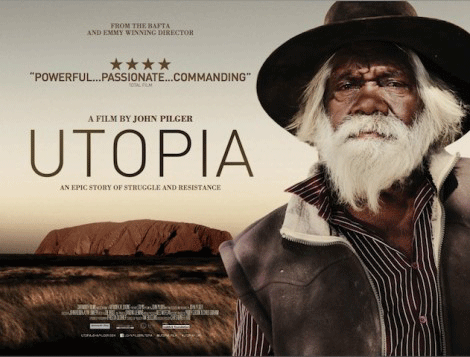 John Pilger’s damning new film about indigenous Australia SMH, Julian Drape, December 31, 2013 “……London-based Pilger returns to outback Australia for this documentary film to find little has changed since his 1985 work The Secret Country.The Utopia of the title refers to the Northern Territory region north of Alice Springs…….
Pilger, 74, sees a treaty and genuine land rights as the key to improving the position of the original owners of Australia. Anything less, including the current talk of constitutional recognition, is simply a “distraction”, he says.
The film opened in the United Kingdom in mid-November and screens in Sydney on January 17. Subsequent limited dates include Melbourne, Brisbane, Perth and Alice Springs. Pilger would have been delighted to show Utopia in Australia first but no local distributor offered a cinema run.
“One Australian distributor refused to take the film because he said it was ‘too dark’ and ‘it might upset people with its myth-busting’,” the veteran journalist says.The film was commissioned by ITV in Britain and funded entirely in the UK…..
Pilger doesn’t apologise for taking such an uncompromising view.”Unlike the US, Canada and New Zealand, no treaty was ever negotiated between the lawful owners of Australia and those who took their land,” he says. “International law is clear – there has to be a treaty.
“If the Australian political establishment believes it can continue to look the other way and deny the first Australians their basic rights they are seriously mistaken.”……
Pilger reminds the viewer that Bob Hawke in the 1980s walked away from genuine land rights in the face of a racist scare campaign from the mining industry. He draws parallels with Julia Gillard’s decision to fold on Labor’s mining tax in 2010.
“The revenue lost is estimated at $60 billion,” the director says in the film. “Enough to fund land rights and to end Aboriginal poverty.”……
Child abuse is one of the rationales for taking children away, yet the NT has one of the lowest rates of reported child abuse in Australia, Pilger says. He argues Australians shouldn’t still need educating about the plight of indigenous Australia, but if they do he hopes Utopia helps.
“Utopia tells them the truth,” he says. “If people choose to ignore the research and evidence in this film then their prejudice is unshakeable.”….. Utopia is on limited released in Australia from January 17. Details at utopiajohnpilger.co.uk http://www.smh.com.au/entertainment/movies/john-pilgers-damning-new-film-about-indigenous-australia-20131231-303tf.html#ixzz2povi3A9Z
Constitutional Preamble is irrelevant: Aborigines need a Treaty!
 Forget the Preamble, what Australia needs is a Treaty Woollydays, Derek Barry January 3, 2014 The new Coalition Government has been making noises on a referendum to change the constitution to recognise First Australians. The wording of the change has yet to be announced but Prime Minister Tony Abbott is saying the change would “complete our constitution rather than change it.”
What exactly Abbott means by completion rather than change is not clear from the article but I assume it means the change will have purely ornamental rather than legal force. According to his deputy Julie Bishop, the government wants to have a “deep discussion” with the Australian people before agreeing to the wording but here’s a free tip from me if the changes are purely for show: Forget it.
I say forget it, not because Australian constitutional referendums have a habit of failing, but because there are genuine things constitutional change could do to improve the situation of First Australians. The most profound change would be to turn the preamble into a Treaty, common enough in other settler countries, but the first ever in 225 years of European occupation of Australia. Unlike a flowery but pointless preamble, a treaty would genuinely acknowledge past failures and injustices and show sincere desire for a better future and more just relationship……. Continue reading
Why successive Australian governments rejected a Treaty with Aborigines
Forget the Preamble, what Australia needs is a Treaty Woollydays, Derek Barry January 3, 2014“………..A Treaty is a political document between sovereign people and it was this difficulty that saw John Howard reject the idea  as far back as 1988 as an absurd proposition that “a nation should make a treaty with some of its own citizens.” Yet the idea is far from absurd to the many Indigenous people who see this as the first step in the recognition of the wars and dispossession of their country and the genocide that followed. It was Howard’s assimilatory ideas in the face of historical evidence that were blatantly contradictory and hence absurd. Howard’s culture of forgetting was shared by his later immigration Minister Phillip Ruddock who told ABC in October 1998 there couldn’t be a treaty because there never had been a war in this country.
Ruddock’s idea of war was flawed as was his view of a Treaty. A Treaty (also known by its Yolgnu name Makarrata meaning thigh) was long established as an appropriate way by which whites could acknowledge Aboriginal equality and prior ownership. In 1979 an Aboriginal treaty committee was formed by prominent whites almost all came from political and intellectual left. Then Prime Minister Malcolm Fraser offered to discuss treaty conditions with Aborigines while 8 years later his successor Bob Hawke spoke of ‘a compact of understanding’. But this whitefella idea of a treaty was rejected by the Federation of Aboriginal Land Councils because of insufficient consultation with Aborigines, doubts of its significance and consequences and because it would legalise occupation and use of sovereign Aboriginal lands by the Australian settler state…… https://woollydays.wordpress.com/2014/01/03/forget-the-preamble-what-australia-needs-is-a-treaty/
The Aboriginal Tent Embassy, and the struggle against mining takeover of the land
the establishing in Canberra, 1972, of the Tent Embassy, to protest against a court decision over mining operations on Aboriginal land.
To many it came as a shock when in April 1971 the Northern Territory Supreme Court decided against Aboriginal people and in favour of a mining company to have access to Aboriginal land. Australian common law, the justice concluded, did not recognise Aboriginal land rights (Reconciliation Australia, 2012).
on January 26th, 2012, the Tent Embassy held its 40th anniversary, making it the longest site of political agitation. The Embassy helped in the struggle for land rights and to end racial discrimination, sadly this is still an ongoing struggle (Korffs, J., 2012).
The Rights For Freedom Of Aboriginal Australians History Essay UK Essays.com 3 Jan 14 This essay focuses on the rights for freedom for the Aboriginal Australians who have lived in Australia for at least 40,000 years. The arrival of the Europeans in 1788 resulted in the significant change to traditional Aboriginal customs and way of life. Up until 1901 colonial governments and communities formally and informally discriminated against Aboriginal people (Rights and freedoms, 1945- the present, n.d.).
How Australia caved in to Britain, in not properly cleaning up Maralinga bomb sites
Why cabinet sought only a partial clean-up of British nuclear test site Archives give new insight into Hawke government’s response to royal commission on weapons testing in Maralinga region Paul Chadwick theguardian.com, Wednesday 1 January 2014
 Gareth Evans, the energy minister at the time, said ‘a non-confrontational approach’ had been adopted in dealing with the Thatcher government.
The complete rehabilitation of areas of Australia used to test British nuclear weapons may not be possible, the Hawke cabinet was advised in 1986.
Cabinet was warned that a full clean-up may have been more expensive than the British government would be willing to contemplate, according to documents released this week by theNational Archives.
They provide new insights into the Hawke government’s response to the recommendations of the McClelland royal commission into British nuclear tests in Australia. Continue reading

Australia’s inadequate decontamination of radioactive nuclear test sites
 Cabinet Papers 1986-87: The struggle for indigenous land rights, SMH, Damien Murphy, 28 Dec 13, “……….. Decontaminating radioactive sites The McClelland royal commission on British nuclear tests in Australia had recommended that the Maralinga and Emu test sites should be decontaminated to a standard suitable for unrestricted habitation by the traditional owners.
But a technical assessment group found that even the expenditure of hundreds of millions of dollars would not achieve complete decontamination.
The Resources and Energy Minister, Senator Gareth Evans, recommended that Cabinet consider the lesser option of decontamination sufficient to allow casual access to a larger area than was currently permissible. This option might cost between $20 and $30 million, “much more within the ball park that the UK Government is likely, on present indications, to be prepared to contemplate”.
Cabinet also decided that compensation claims for diseases that might have been caused by radiation would be resisted if the Commonwealth did not believe that a liability existed……….
Traditional owners had been dispersed to Yalata and the Pitjantjatjara lands in South Australia and Coonana in Western Australia. Cabinet allocated an initial $500,000 for projects of lasting and general community benefit…….. http://www.smh.com.au/federal-politics/political-news/cabinet-papers-198687-the-struggle-for-indigenous-land-rights-20131228-3017r.html
Australian government didn’t want to know about Aborigines affected by atomic tests
Cabinet rejected the royal commission’s recommendation for the creation of a new register of persons who may have been exposed to “black mist” or radiation at the tests.
The actions of previous Australian government [sic] in shepherding Aboriginal people from their traditional lands for the purpose of conducting atomic tests were both immoral and appallingly executed.
Why cabinet sought only a partial clean-up of British nuclear test site Paul Chadwick theguardian.com, Wednesday 1 January 2014 “…………An aerial survey of radioactivity around the test sites would be followed by a more detailed ground survey. Five studies would “define the areas – hopefully quite small – which must remain surrounded by fences, and further outer areas in which activities such as food gathering and excavation should not occur”.
A report by technical experts attached to the cabinet submission states: “Aboriginals living and gathering food on the Maralinga lands may be exposed [to contaminants] … in three major ways – by inhalation, by ingestion and by entry of contaminated material through open flesh wounds and abrasions.”
The experts considered options for burial of contaminated soil. They noted that since one of the contaminants had a half life of 24,000 years it was a prerequisite to make a prediction about the sort of changes in the earth expected to occur in the Maralinga area in the timeframe. Continue reading
Australia’s tortuous political struggle over Aboriginal Land Rights
Cabinet Papers 1986-87: The struggle for indigenous land rights, SMH, Damien Murphy, 28 Dec 13, The Hawke Government continued to grapple with the sensitive issue of indigenous land rights. In March 1986 Aboriginal Affairs Minister Clyde Holding told Cabinet that NSW, Queensland and South Australia had enacted legislation and Victoria was preparing to do so, but that Tasmania and Western Australia rejected the concept of land rights legislation in principle…….
Cabinet again endorsed its 1985 Preferred National Land Rights Model, but agreed to negotiate with Western Australia on non-legislative measures such as community funding and the granting of long leases to Aboriginal reserves.
The Tasmanian and Victorian governments presented the Commonwealth with conflicting challenges. In December 1986 Mr Holding told Cabinet that Tasmania refused to recognise that Aboriginal people had any legitimate claim to land.
……….The government was concerned that the parlous state of the Aboriginal community might become an issue of moral and political embarrassment during the 1988 bicentennial celebrations……….http://www.smh.com.au/federal-politics/political-news/cabinet-papers-198687-the-struggle-for-indigenous-land-rights-20131228-3017r.html
1 This month

of the week – Australians for War Powers Reform (AWPR)
To see nuclear-related stories in greater depth and intensity
 Antinuclear