BHP’s legal privileges overOlympic Dam copper-uranium mine have had devastating consequences for traditional Aboriginal owners
David Noonan Nuclear Fuel Cycle Watch, 20 Oct 21
· “A Way Forward” Juukan Caves Inquiry Final Report https://www.aph.gov.au/…/Nort…/CavesatJuukanGorge/Report Inquiry Report conveys a striking critique of BHP legal privileges over Olympic Dam copper-uranium mine, see Legislative exemptions from cultural heritage protections p.147-148:
“Acts such as these have had devastating consequences for traditional owners as rights to protect cultural heritage are intentionally disrupted and prevented … these Acts remain in force and even when they are repealed their associated histories of injustices will remain … States and territories as well as companies involved in such acts should seek to fast-track transitions and recompense traditional owners for injustices that have occurred.”
‘It makes us sick’: remote NT community wants answers about uranium in its water supply
‘It makes us sick’: remote NT community wants answers about uranium in its water supply, Laramba’s Indigenous residents fear they are at risk of long-term illness and say they need to know who is responsible for fixing the problem, Guardian, by Royce Kurmelovs and Isabella Moore, Mon 18 Oct 2021,
Jack Cool is looking to hitch a lift out of town.
The 71-year-old former stockman has lived in Laramba, a remote Indigenous community in the Northern Territory, for most of his life
Since his partner, Jennifer, 57, and his youngest daughter, Petrina, 35, started kidney dialysis at the end of last year, he has been trying to make the two-and-a-half hour trip south into Alice Springs whenever he can.
Cool, who also takes medication for kidney issues, says he doesn’t know why this has happened to his family but he thinks it has something to do with the water.
“When we drink the water it makes us sick,” he says.
Problems with Laramba’s water supply have been known since at least 2008 but the scale of the issue was not revealed until 2018, when testing by the government-owned utility company Power and Water Corporation (PWC) found drinking water in the community of 350 people was contaminated with concentrations of uranium at 0.046mg/L.
That is nearly three times the limit of 0.017mg/L recommended in the Australian drinking water guidelines published by the National Health and Medical Research Council.
Follow-up testing in 2020 found the problem was getting worse as uranium concentrations – which occur naturally in the area – had risen to 0.052mg/L, and the water also contained contaminants such as nitrate and silica.
A stream of conflicting advice
Prof Paul Lawton, a kidney specialist with the Menzies School of Health Research who has been working in the Territory since 1999, says there is no good evidence to say for sure whether the water at Laramba is safe to drink…….
Assoc Prof Tilman Ruff from the Nossal Institute for Global Health at the University of Melbourne says uranium contamination also delivers “relatively low but relatively frequent doses” of radiation
“The overall consequences from a radioactive point of view is that this will widely dispose in the body and organs, and will contribute to a long-term risk of cancer,” Ruff says.
Because children are particularly vulnerable, with girls 40% more likely than boys to be affected over their lifetime, Ruff says there is “no good amount of radiation”.
Though there are still many unknowns, authorities elsewhere have addressed similar situations by acting with caution. In Eton, Queensland, a bore supplying the community was turned off when concerning concentrations of uranium were found in the water supply……….
A permanent holding pattern’
Laramba is just one of many among the 72 remote Indigenous communities in the Territory whose water is contaminated with bacteria or heavy metals.
This year the NT government promised $28m over four years to find “tailored” solutions for 10 towns, including Laramba, after a campaign by four land councils for laws to guarantee safe drinking water across the territory.
Asked what was being done to fix the problem, a spokesperson for PWC directed Guardian Australia to sections of the company’s latest drinking water quality report that discuss pilot programs for “new and emerging” technologies to “potentially” clean water of uranium and other heavy metals……….
What little information that is available has filtered through in the media or highly technical language that many people, for whom English is a second language, can’t understand.
In the meantime both men say several people, including some in their own families, have been diagnosed with kidney problems or cancer.
“We have to drink, so we are drinking it,” Hagan says. “We don’t know anything about $28m. We’re still here drinking the same water. Nothing’s changed.”
The co-director of the Environment Centre NT, Kirsty Howey, says communities such as Laramba have been left in a “permanent holding pattern” and the lack of engagement is a “feature of a flawed system”.
Boiling point
Andy Attack, a non-Indigenous man who runs the Laramba general store, says in the three years he has lived there he has noticed a change in the community.
“People here are just so respectful and polite and calm,” he says. “The water is something that makes them really angry, and they don’t like being angry. It’s not nice seeing them like that.”
Attack says the first thing he was told when he moved to Laramba was not to drink the water. He installed reverse osmosis filters normally used in hospitals, which cost $130 a year to maintain, on the taps in his house.
Those who can’t afford such sums must either rely on rainwater or buy expensive 10L casks. ……….https://www.theguardian.com/australia-news/2021/oct/18/uranium-in-the-water-remote-nt-community-wants-answers-about-safety
Uranium mining and high cancer rates in Aboriginals around Ranger mine
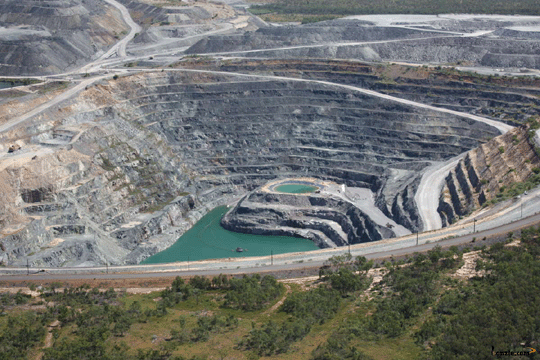
Kakadu mining and radiation, The Saturday Paper 14 Aug 21, Max Opray Carved out of the pristine surroundings of Kakadu National Park in the Northern Territory, the Ranger uranium mine has long been a site of deep controversy.
The mine may have been decommissioned in January, but concerns remain about its legacy, as the Mirarr traditional owners suffer through a mysterious health crisis.
The stillbirth rate among Aboriginal people living near the mine is more than twice as high as among Indigenous Australians elsewhere in the Top End, and rates of cancer are almost 50 per cent higher.
A six-year Northern Territory investigation into the issue failed to identify the cause, noting only that risk factors relating to diet, smoking and alcohol consumption were higher in the local population than in other Aboriginal populations.
The investigation was conducted by staff at the Population and Digital Health Branch of the Northern Territory Department of Health and overseen by an independent reviewer in cancer, epidemiologist professor Bruce Armstrong.
The report, published in November 2020, concluded ionising radiation from uranium mining was unlikely to be linked but did not categorically rule it out.
However, a Flinders University Centre for Remote Health analysis of the government investigation, published in the Medical Journal of Australia this month, found that the parameters of the inquiry were too narrow.
“Cancer is a complex condition,” Dr Rosalie Schultz, author of the analysis, tells The Saturday Paper. “A study like this can’t find a definitive cause.”
The Alice Springs GP was concerned that the main outtake of the report was that Aboriginal people should smoke and drink less.
“Statistically, it didn’t look like smoking and drinking caused the excess cancer rate,” she says. “It’s almost like blaming people rather than looking into the reasons – why is it people are smoking and drinking more in that area in particular, for instance?”
With more than 200 documented leaks, spills and other incidents associated with the mine, Schultz argues the impact of Ranger was multifaceted, including social consequences not considered by the investigation. “Things like destruction of waterbirds and creeks, the worry of that when you get your food and livelihood from the land,” she says.
A senate estimates committee heard in 2009 that 100,000 litres of contaminated water a day was leaking from the mine’s tailings dam into rock fissures beneath Kakadu.
In another breach in 2004, dozens of mine employees were found to have showered in and consumed water containing 400 times the legal limit of uranium.
In response to the release of the Territory government report, Reuben Cooper, chair of the Red Lily Health Board Aboriginal Corporation, welcomed messages “to encourage reduction in smoking and alcohol consumption” but said the findings offered an incomplete picture.
“This investigation does not discuss the reasons for higher rates of smoking and alcohol consumption in the Gunbalanya–Kakadu region,” he said, “which could include factors such as cultural dislocation, stress and royalty payments. Nor does it discuss the potential social impacts that the uranium mining industry has had on the population in the region.”
Schultz’s analysis expands further on these points, noting how unevenly distributed royalty money can increase inequality and the ways in which locals were deprived of a sense of agency and authority.
“The inquiry didn’t look at other knowledge, such as the Dreaming stories about sickness country,” Schultz says.
Centuries before Western science understood the dangers of radioactive substances, Aboriginal people were avoiding the uranium-rich sites near Kakadu, which were considered inappropriate places to camp.
The Dreaming stories of the Jawoyn people warn against disturbing stones or drinking water in what they called “sickness country” south of Ranger, beneath which Bula the creator is said to lie dormant.
In and around the Ranger site itself, the Dreaming stories of the Mirarr warn of sacred sites that are dangerous to disturb……………..
With no data available about individual exposure to ionising radiation, the report authors concluded this was unlikely to have been a contributing factor based on measurement of environmental radiation levels, consumption of bush tucker, and airborne exposure to radon gas.
Justin O’Brien, chief executive of the Gundjeihmi Aboriginal Corporation, which represents the Mirarr people, says the “shocking paucity of data” extends to all aspects of the health and social impacts of the mine. “It’s a very limited data set, so no wonder the findings are inconclusive,” he says………..
With the mine decommissioned in January this year, O’Brien is concerned about whether operators Energy Resources of Australia, a subsidiary of Rio Tinto, will properly rehabilitate the Ranger site, warning that radioactive waste from uranium mining can remain hazardous for tens of thousands of years.
“This is just the first chapter of the legacy of this mine, and the world is watching Rio Tinto,” he says. “The mining company has been given five years to complete all the rehabilitation work – this is patently insufficient.”…………
For Schultz’s part, the monitoring of Ranger failed even in the context of Western science. “They didn’t do what was recommended to consider local perspectives and concerns,” she says. “It was a top-down epidemiological approach, where if you can exclude ionising radiation, the mine is off the hook. It feels like the science is taking a narrower approach now – we used to have researchers embedded in communities. Forty years later … we just look at five data points and that’s it.” https://www.thesaturdaypaper.com.au/life/health/2021/08/14/kakadu-mining-and-radiation/162886320012251#mtr
Barngarla native title owners were excluded from decision-making on Kimba nuclear waste plan.
Barngarla people say their votes weren’t counted in Kimba nuclear dump census, The Advertiser 22 July 21
As SA awaits confirmation on a location of a national nuclear waste dump near Kimba, traditional owners say they weren’t included in a vote on the contentious project.
A First Nations people say their voice wasn’t heard in the proposal to create a permanent, national nuclear waste storage facility, despite a census of the nearest township.
The plan cleared a major hurdle in June, with a shortlist of sites passing the Senate on June 21.
Federal Resources Minister Keith Pitt expected to name Napandee farm, near Kimba on the Eyre Peninsula as the likely choice in the coming weeks.
The debate about the facility centres on a 2019 census by the Australian Electoral Commission, which found more than 60 per cent of Kimba residents were in favour of the facility.
However, the body for the local Indigenous community, the Barngarla Determination Aboriginal Corporation said their voices on the proposal were not heard.
Group chair Jason Bilney said the Kimba ballot did not account for the First Nations people, who have a significant stake in the land, and in the Dreaming stories associated with it.
“The simple fact remains that even though the Barngarla hold native title land closer to the proposed facility than the town of Kimba, the First Peoples’ for the area were not allowed to vote,” he said.
“It’s a cop out to say we weren’t on the electoral roll, we had to do a separate vote, but how do we guarantee our votes are combined,” he said.
The bill allowing construction of the facility only passed the senate last month, after a clause was introduced which allows judicial review for those opposed to any decision.
“They tried to take the umpire out in the fourth quarter, so we’re glad to have had that amendment included, it‘s a win for democracy,” Mr Bilney said………….
Mr Bilney said if a proper heritage assessment and consultation with the Barngarla people had occurred, the dialogue could have been less combative.
“It’s about being open and transparent, it should have been put to us and all South Australians affected, what about all the towns who will now have nuclear waste trucked through, where was their say,” he said.
If we’d been consulted and a part of the process from the beginning, it could have been a different story.
“A lot of our people remember the impacts up in Maralinga, my grandfather was from up there and we remember some of the impacts and cancers that came about in the years after.
“They didn’t have a right back then, so we’re fighting for our say now.”
South Australia has a chequered nuclear history, with long term effects of radiation at the Maralinga bomb site and dumping at the Arkaroola mine in the Flinders Ranges marring public confidence in anything nuclear.
Barngarla Determination Aboriginal Corporation (BDAC) will take legal action against nuclear dump plan if Resources Minister Keith Pitt names Napandee as the site
Barngarla will pursue judicial review if Napandee site named. https://www.portlincolntimes.com.au/story/7330119/barngarla-may-seek-legal-review/?fbclid=IwAR28Hj_22In6jE2Vd3s7ZrWBtOe0nHJxbyqdKk_xXF6hXv8Z-TNbEtBu5CEMembers of the Barngarla Determination Aboriginal Corporation (BDAC) have said the outcome of the nuclear waste amendment bill was the result they were hoping for.
The National Radioactive Waste Management Amendment (Site Specification, Community Fund and Other Measures) Bill 2020 was passed by the Australian Parliament on June 22.
The BDAC had previously raised concerns about the absence of a judicial review process by naming the Napandee site in the proposed legislation.
“The government sought to change the law to remove our democratic right to judicial review of their actions so that no court could ever assess what had been done,” they said in a previous statement.
However BDAC chair Jason Bilney said the bi-partisan support the bill received in parliament was what they were looking for, as changes were made to the bill to reinstate the ability to pursue a judicial review of the site selection process.
The bill was initially tabled in parliament in February 2020 with the intention to name the Napandee site near Kimba within the legislation.
Now federal resources minister Keith Pitt will be required to name the host site through ministerial decision, which will allow for a potential judicial review of the site selection process in future.
Mr Pitt is also not bound to name one of the three sites currently shortlisted.
Mr Bilney said it had been a “long, hard battle” for 15 months, and that he and others were in Canberra that week as the bill went through.
“It’s a good outcome for the Barngarla people, but also all Australians because it affects all Australians,” he said.
The BDAC have stated since the passing of the bill that if there is a declaration of the Napandee site, the BDAC will seek a judicial review.
“The Barngarla and farmers worked together and the senate did not agree to pass any bill which removed judicial review,” they said.
“We had certain demands, which amounted to removing site specification in the bill and removing Schedule 1.
“The government gave in to these demands and effectively amended their own bill to reflect what Barngarla, Labor and the cross bench had said we required.
“So, we have no issues with the new bill, as it is the bill that we demanded occur.
“Namely, it preserves judicial review.
“In simple terms, we won this battle in parliament and we are very grateful for Labor and the cross bench, including senator Hanson’s One Nation, the Greens, and senator Patrick.”
We even had the Explanatory Memorandum further amended to make it clear that the Minister was not limited to just the three sites in the Table and that the Table was purely a historical record.
Maralinga nuclear bomb tests – British and Australian governments’ callous cruelty to First Nations people.

Australia’s Chernobyl: The British carried out nuclear tests on Indigenous land. It will never heal. https://www.mamamia.com.au/maralinga-nuclear-testing/ CHELSEA MCLAUGHLIN, JULY 5, 2021 For tens of thousands of years, the Aṉangu people lived on the warm, red earth of their country.
The land provided them with food, water and shelter as they travelled around an area we now know as outback Far North South Australia.
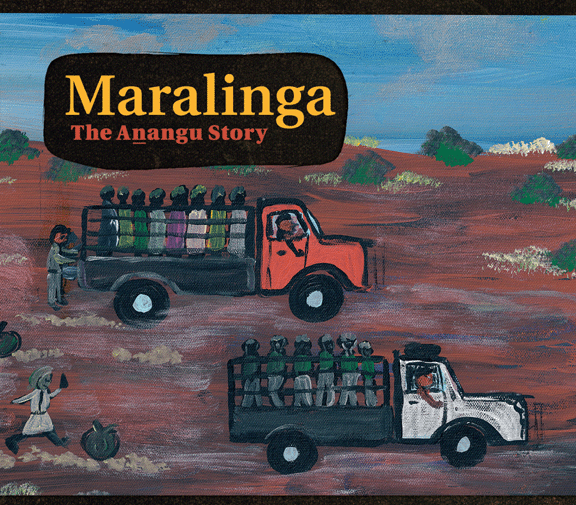
But after colonisation, they were moved off their land: forcibly removed, sent into missions across the region and displaced by train lines linking Australia’s east and west that impacted their water supply.
Much of the information around the tests was highly classified, and some information remains so.
For tens of thousands of years, the Aṉangu people lived on the warm, red earth of their country.
The land provided them with food, water and shelter as they travelled around an area we now know as outback Far North South Australia.
But after colonisation, they were moved off their land: forcibly removed, sent into missions across the region and displaced by train lines linking Australia’s east and west that impacted their water supply.
Much of the information around the tests was highly classified, and some information remains so.
Thirty per cent of the British and Australian servicemen who were exposed during these tests died of cancer, though a Royal Commission in 1984 was not able to reach a conclusion linking their health issues directly to the blasts.
Similarly, many locals died prematurely, went blind and suffered from illness that may have been linked to radiation.
British nuclear scientists, wanting to determine the long-term effects of the tests on Australia and its citizens, ordered the testing of dead Australian infants and children for radiation contamination.
Between 1957 and 1978 in hospitals around Australia, bones were secretly removed from 21,830 bodies. They were reduced to ash and sent away to be analysed for the presence of Strontium 90, a radioactive isotope produced by nuclear fission.
Unsurprisingly, none of the First Nations people of the region were told about the tests and many of the bones were taken without permission.
Associate professor Liz Tynan, the author of Atomic Thunder: The Maralinga Story, told Mamamia‘s The Quicky First Nations people were still in the area during the periods of testing, and this led to disastrous consequences.
Tynan said the Milpuddie family – Charlie, Edie, two kids and their dogs – were found by British service personnel in 1957, camped on the crater left by the bomb Marcoo soon after it had been detonated.
They were rounded up and most of the family, not Edie, but most of them, were given showers. Edie didn’t wish to have a shower,” Tynan explained.
“They were tested for radioactivity and the geiger counters did detect radioactivity, particularly on the young boy Henry. Anyway, there were rather insensitively treated I suppose, given showers, had clothes put on them and then take off down south to a mission.”
Their dogs were shot in front of them. Edie was pregnant at the time, and she later lost her child.
“It was a tragic story and indicative of the callous approach to Indigenous people that was displayed by both the British government and their officials that were conducting the tests, and by the Australian government as well,” Tynan said.
Following the testing, many Aṉangu people returned to the area, but the lands that had previously sustained and protected them were now poison.
We still don’t know the truth impact of the bombs at Maralinga, as well as nearby Emu Fields and the Montebello Islands off the coast of Western Australia.
“The South Australian Department of Health commissioned a fairly extensive study, [but] that study was hampered by the fact there was no base-line data from which to understand the general health of the population before the tests,” Tynan said.
The study did show an increase in various cancers, but most of the findings were inconclusive due to a lack of information. Indigenous Australians were not counted in the census at the time and there was very little known about the health of the populations.
In 1964, a limited cleanup of the Maralinga site, named ‘Operation Hercules’, took place.
A year after a 1966 survey into the level of contamination at the site, a second clean-up titled ‘Operation Brumby’ filled 21 pits with contaminated equipment and covered them with 650 tonnes of concrete.
Tynan said it was later found the survey data was drastically wrong, and the contamination was 10 times worse than thought.
It wasn’t until decades later, with the help whistleblowers and scientists, that the government began to realise the true, horrifying extent of the damage done to the land at Maralinga.
Under an agreement between the governments of the United Kingdom and Australia in 1995, another clean-up took place. And while this was more thorough than the previous, it still came with issues.
Whistleblower Alan Parkinson, who wrote the 2007 book Maralinga: Australia’s Nuclear Waste Cover-up, exposed the unsatisfactory methods.
The plan had been to treat several thousand tonnes of debris contaminated with plutonium by a process called situ vitrification. Against the advice of Parkinson, the government extended the contract of the project manager, even though that company had no knowledge of the complex process of vitrification.
Parkinson was let go from the project.
The government and the project manager then embarked on a hybrid scheme in which some pits would be exhumed and others treated by vitrification. After successfully treating 12 pits, the 13th exploded and severely damaged the equipment. The government then cancelled the vitrification and simply exhumed the remaining pits, placed the debris in a shallow pit and covered it with clean soil.
Parkinson told The Quicky another, complete clean-up of Maralinga could take place, but it was unlikely because of the cost and the courage it would take to admit the previous attempts were insufficient.
Around the same time as the 90s clean up was the Australian government push for a nuclear waste dump to be located nearby.
Fearing even further poisoning of their country, First Nations woman Eileen Wani Wingfield co-founded the Coober Pedy Women’s Council to campaign against the proposal.
The plan was eventually abandoned, but has popped up again in many forms over the decades. Currently, the Coalition is amending a bill that could see a site set up near Kimba.
Glen Wingfield, Eileen’s son, has spent his life working and learning from his parents’ tireless campaign for protection of their country.
The theme of NAIDOC Week 2021 is Heal Country! but as Wingfield told The Quicky, much of the Aṉangu lands in and around Maralinga are beyond healing.
“A lot of the Aboriginal communities that live in and around that area, they just will not and do not go back near that country. I think that’s a word, healing, that we can’t use in the same sentence with that area.”
Tynan agreed, saying there are parts of the area that will be uninhabitable for a quarter of a million years.
“There are parts of the site that you can’t go to, that are still very dangerous,” she said.
“The real problem at Maralinga was the plutonium which was detonated in a series of trials… The particular type of plutonium they used, plutonium 239, has a half-life of 21,400 years which takes hundreds of thousands of years for that radioactivity to diminish.”
Wingfield said the broken connection between these people and their lands is “just downright disgraceful and horrible”.
“No amount of conversation will ever cover what’s been done for people in and around. The lasting effects of health issues on people have been passed through people who were there to generational abnormalities… I think when you talk compensation and stuff, I don’t think we’ll ever get close.”
First Nations and Farmers condemn the federal government’s selection process for nuclear waste dump
Barngarla criticise Kimba waste site process, Port Lincoln Times, Louis Mayfield JUNE 24 2021 Members of the Barngarla Determination Aboriginal Corporation (BDAC) have launched a scathing attack on the federal government’s process of selecting a site near Kimba to establish a radioactive waste dump.
A joint statement released by the First Nations corporation and the No Radioactive Waste on Agricultural Land in Kimba or SA group outline several issues with the government’s consultation process.
In the media release the two bodies claim that the government has “completely and utterly miscarried” the site selection process by not allowing First Nations people to vote in the community ballot.
“The simple fact remains that even though the Barngarla hold native title land closer to the proposed facility than the town of Kimba, the First Peoples for the area were not allowed to vote,” they said.
“They prevented Barngarla persons from voting, because native title land is not rateable. They did not allow many farmers to vote, even though they were within 50km of the proposed facility, because they were not in the Council area.
“They targeted us, because they knew that if they had a fair vote which included us, then the vote would return a “no” from the community.”
The results of the Kimba community ballot demonstrated a “majority support” for the federal government’s proposed nuclear facility, with 61 per cent voting in favor of the dump.
Further criticism was directed at a lack of consultation with communities that will be affected by the transport of nuclear waste to the facility.
“Those communities, where the waste will be transported through, have had no right to have a say. South Australians more broadly have had any rights to have a say,” they said………..
Minister Pitt said the specific transport routes from radioactive waste storage locations around Australia would be determined once a decision has been made on a site for the facility.
The National Radioactive Waste Management Amendment (Site Specification, Community Fund and Other Measures) Bill 2020 was passed by the Australian Parliament on Tuesday……….
After a 60-day period period, the Minister can then declare a site and acquisition of a site by the government for the purpose of hosting the National Radioactive Waste Management Facility.
This story Scathing attack on radioactive waste process first appeared on Whyalla News. https://www.portlincolntimes.com.au/story/7312689/scathing-attack-on-radioactive-waste-process/?fbclid=IwAR0bdbcqMq8QRGHYeBnwFNFlKHydpL-QEX8AfcaRdvjRxdJvOl2xOxDnDCs
Historic handback of Kakadu town to Mirarr traditional owners,
Historic handback of Kakadu town to Mirarr traditional owners, The Age By Miki PerkinJune 26, 2021, For four decades the Mirarr people, led by senior traditional owner Yvonne Margarula, have been calling for the town of Jabiru, inside World Heritage-listed Kakadu National Park, to be returned to its rightful custodians.
At a handback ceremony on Saturday, their decades-long fight for recognition of their traditional ownership over Jabiru culminated in the grant of freehold title over the town, the first of its kind in Australia.
At a handback ceremony on Saturday, their decades-long fight for recognition of their traditional ownership over Jabiru culminated in the grant of freehold title over the town, the first of its kind in Australia.
The fight for land rights in the region began in 1978, when Jabiru was built on Crown Land without the involvement of traditional owners to service the controversial Ranger uranium mine.
Ranger began operations in 1980, and was run by Energy Resources Australia, which is majority-owned by Rio Tinto.
Initially, there were plans to bulldoze the Jabiru town once the mining lease expired, but the Northern Territory government and the Gundjeihmi Aboriginal Corporation, which represents Mirarr people, have developed an ambitious plan to transform it into a tourism hub for Kakadu, and a regional centre.
The Commonwealth has promised $276 million towards the revitalisation of the town, which includes a new international airport, a five-star eco-tourism lodge, and better access to Kakadu’s natural attractions, but there have been criticisms at the speed of progress.
Justin O’Brien, the chief executive of Gundjeihmi Aboriginal Corporation said the lease handover was a historic milestone in the transition from a mining economy to tourism but the town’s future challenges should not be underestimated.
Energy Resources Australia had failed to engage in a timely way on the town’s transition, Mr O’Brien said, with former mining employee houses not ready for use, and at least 70 ERA houses vacant…….
Processing of ore at the uranium mine finished in January and the mine’s vast pits will be filled in over the next five years, but there are concerns about the rehabilitation process.
Australian Conservation Foundation nuclear campaigner Dave Sweeney welcomed the tenure change but said there were profound challenges ahead for the costly and complex mine rehabilitation, which is set to be completed by 2026.
“There has been 40 years of industrial activity involving heavy metals and radioactive materials in a wet-dry tropical place, surrounded by a World-Heritage listed area,” Mr Sweeney said. “To bring that up to a standard where it could be reincorporated into the surrounding area is a very, very high bar.”
In a statement, Energy Resources Australia extended its congratulations to Mirarr traditional owners and said that after 40 years of production its priority was to successfully rehabilitate Ranger to a standard that could be incorporated into Kakadu National Park.
In the mid-1990s, Ms Margarula and other Mirarr people mounted a high-profile campaign to oppose the Jabiluka uranium mine. Elders also lodged the Jabiru native title claim which was decided by the Federal Court in 2016 after one of Australia’s longest-running native title matters. The court granted native title to the Mirarr.
In 2017, researchers published their findings about a wealth of artefacts on Mirarr country which indicated humans reached Australia at least 65,000 years ago — up to 18,000 years earlier than archaeologists previously thought. https://www.theage.com.au/environment/sustainability/historic-handback-of-kakadu-town-to-mirarr-traditional-owners-20210625-p584c7.html
Barngarla people hold Native Title land close to planned nuclear waste dump, but were denied a vote on this.
The nuclear waste site is planned for Barngarla Country, but the amendments will allow Traditional Owners to take the matter to court, https://www.sbs.com.au/nitv/article/2021/06/23/traditional-owners-can-challenge-nuclear-waste-dump-country-1?fbclid=IwAR0ZYwZRYOUQn58LdV3A0X4L1AeERiDi8ylqkVFcjReI5KQj7_fl6VTXcaABy Keira Jenkins
Source: NITV News, 23 JUN 2021 The Senate has passed legislation that would allow nuclear waste to be stored at a remote site in South Australia, replacing current city facilities.
The Morrison government was forced to abandon key features of the bill to gain opposition support, including a provision that would have locked in Kimba as the new storage location.
Instead, Minister for Resources Keith Pitt can issue an ‘intention to declare’ a preferred location.
The amended bill, which passed through the Senate this week, also allows for a judicial review of the location if there is a dispute.
Barngarla Determination Aboriginal Corporation welcomed the reinstatement of the right to a judicial review on the process.
“This is a great moment for democracy, and for those who appreciate the independent scrutiny of government action,” they said in a statement.
In 2019, the Australian Electoral Commission conducted a month-long community ballot, asking the question ‘Do you support the proposed National Radioactive Waste Management Facility being located at one of the nominated sites in the community of Kimba?’
The ballot returned a 61.58 per cent ‘yes’ vote.
Barngarla conducted their own poll, saying they had been excluded from the AEC’s postal ballot.
100 per cent of the votes returned from Native Title holders said ‘no’ to the proposed nuclear facility.
Barngarla said the site selection process had been “completely and utterly miscarried”.
“No proper heritage assessment of the site was ever undertaken,” read the statement.
“… the most obvious and appalling example of this failed process was when the Government allowed the gerrymandering of the Kimba ‘community ballot’ in order to manipulate the vote.
“The simple fact remains that even though the Barngarla hold Native Title land closer to the proposed facility than the town of Kimba, the First Peoples for the area were not allowed to vote.
“…Mistakes have been made and the process needs to start again.”
Barngarla Aboriginals and Kimba farmers join forces to fight nuclear waste dump plan
Barngarla Determination Aboriginal Corporation and No Radioactive Waste on Agricultural Land in Kimba or SA group 24 June 21, The issue of the nuclear waste facility is something which provokes significant emotion, and community opposition. However, no one else is as affected by it like we are. We issue this joint press release as the First Peoples for the Kimba area, and the farming communities who make their livelihood from the land because we are having our home, our land and our heritage threatened. We are the groups of people whose lives will be permanently damaged,if a waste facility is placed on our home.
We have fought hard and will continue to fight against a nuclear waste facility being placed on our home. We do not want it, and we will never support it. Our voices and views have been ignored by the Government. Local member Rowan Ramsey has been one of the main influences in pushing the Government to place a nuclear waste facility at Kimba. If you do not want this facility in SA orin the Eyre Peninsula or the Mid-North, then you must vote out Rowan Ramsey. We will never end this issue, whilst he is a local member.
The Government has completely and utterly miscarried the site selection process. There are many examples of this. No proper heritage assessment of the site was ever undertaken, andthey have marginalised the voices of the farming community throughout the entire process. However, the most obvious and appalling example of this failed process was when the Government allowed the gerrymandering of the Kimba “community ballot”, in order to manipulate the vote. The simple fact remains that even though the Barngarla hold native title land closer to the proposed facility than the town of Kimba, the First Peoples for the areawere not allowed to vote. They prevented Barngarla persons from voting, because native title land is not rateable. Further, they did not allow many farmers to vote, even though they were within 50km of the proposed facility, because they were not in the Council area. They targeted us, because they knew that if they had a fair vote which included us, then the vote would return a “no” from the community.
The process also ignores the fact that the Government never sought the views of the communities which will be affected by the transport of nuclear waste. Those communities, where the waste will be transported through, have had no right to have a say. SouthAustralians more broadly have had any rights to have a say.
Mistakes have been made and the process needs to start again. Instead, the Government sought to change the law to remove our democratic right to judicial review of their actions so that no Court could ever assess what had been done. We find this staggering, as checks and balances are needed for a functioning democracy. The removal of independent scrutiny is, for all Australians, frightening, Protecting judicial review was the issue before the Federal Senate on Monday. It is important to understand that this is what the Senate was debating. We have won our right to have judicial review restored in this process. The broader failures are matters which will have to be dealt with in the future.
The Government have been forced by the Senate to preserve judicial review. The table in Schedule 1 of the Government’s revised Bill, is merely a face-saving exercise, and has no legal impact or effect. Even the Government Explanatory Memorandum makes this clear. Their own document states: “Recognition of the three shortlisted sites confirms the sites as being nominated and approved under the Act, but does not limit the Minister from approving new nominations. The Minister may declare any approved nomination as a site, and is not bound to declare one of the three shortlisted sites”
The Government’s attempt to remove judicial review was so egregious and careless, that it provoked almost unanimous opposition across the political spectrum. This is a great moment for democracy, and for those who appreciate the importance ofindependent scrutiny of Government action, this is a day that the Barngarla people and the farmers at Kimba have saved one of the fundamental rights in a Democratic Country. Because the Government were opposed by everyone from very different political backgrounds, such as: Labor, Pauline Hanson’s One Nation, the Greens and Senator Patrick, we consider it appropriate to express our thanks to all of these groups. This reflects the fact that judicial review is a pivotal right no matter a person’s political background. We thank everyone in no particular order, as it remains the fact that had they not stood together, the Government would have removed the democratic rights of judicial review from us, and set a precedent which would have weakened democracy for all Australians:
Labor: The Australian Labor Party deserves congratulations from all Australians for its actions. Without of the support of the Opposition, the Government would have gotten away with removing a fundamental democratic right from us and set aprecedent to remove that right every other time they did not get their way.
Labor listened to all of us, but in particular they lived up to their commitment to listening to the First Peoples for the Kimba area. The Barngarla worked extensively with Labor, and in particular the Shadow Minister Ms Madeliene King ensured that the Barngarla were entitled to review any further amendments before they wereintroduced. We intend to write to other members of Labor, such as Senator Wong who has fought for all South Australians to express our thanks. As a party, however, they have been outstanding.
More broadly, there is the issue of what to do if Labor win Government. Many in Labor do not support a process where Aboriginal people were denied the right to vote. We believe Labor will continue to fight for us. But that is tomorrow’s issue. Monday was about judicial review, and Labor protected us and by extension all Australians, by preserving our right to judicial review. •
Pauline Hanson’s One Nation & State Leader of One Nation in SA Ms Jennifer Game: It remains a simple statement of fact that without PHON and Ms Jennifer Game, there would be a nuclear waste facility on prime farming land, in circumstances where Aboriginal people were denied the right to vote, and Aboriginals and farmers would have no right to independent legal review.
For those of you out there who might relate to this side of politics, particularly the farmers in the Eyre Peninsula, who do not want a waste dump then we strongly suggest you look at what One Nation and their representative Ms Jennifer Game have done to save South Australia from nuclear waste. They said “no” and listened to the local farming community when the Local member ignored us.
The Barngarla also recognise the great work of PHON and Ms Jennifer Game. It is a testimony of our work together that we have prevented the Government from removing fundamental basic rights for all Australians.
The Greens: Special recognition must be given to the Greens. This is an issue that is central to the Greens, they have stood up and through their tireless and passionate advocacy have helped us immensely.
All Green supporters should be proud of their party’s efforts. In particular, Senator Hanson-Young has been a tireless advocate for South Australia. She was one of the first Senators to help us, and we imagine she will be with us to the end of this fight.
We would also like to acknowledge the strong words of Senator Thorpe. We agree that the Government has been tokenistic in its approach to the Barngarla people. What could be more tokenistic than saying they want to hear Barngarla views, but then deny the Barngarla the right to vote. It is our hope that with advocates likeSenator Thorpe, no other Aboriginal group will ever have to be treated in such a despicable way.•
Senator Patrick: Senator Patrick deserves great credit for his commitment to South Australia. He deserves the recognition of everyone committed to our State. He has been actively engaged on this issue from the very beginning. He has tirelessly fought to access Government documents under FOI so that South Australian’s can have access to the information which shows how badly this process has been miscarried.
We would like to thank Senator Patrick for his regular commitment and support to us in fighting to ensure our access to judicial review. Senator Patrick has also sought to find other solutions by trying to assess additional site options, whether Woomera or Leanora or others. We hope that this work by Senator Patrick will one day paydividends, and the Government will abandon its terrible plan to place this facility on prime agricultural land, which is significant also to the Barngarla People. •
The remaining cross bench: We would also like to thank the efforts of the remaining cross bench. Although we did not ultimately need to rely on their votes, we understand that they would likely have ensured our rights to judicial review. Theyspoke to us and engaged and should be acknowledged for their efforts.
Further information contact: Barngarla: barngarlamedia@gmail.com Peter Woolford: 0447 001 493
Indigenous rights issues in Kimba nuclear waste dump proposal
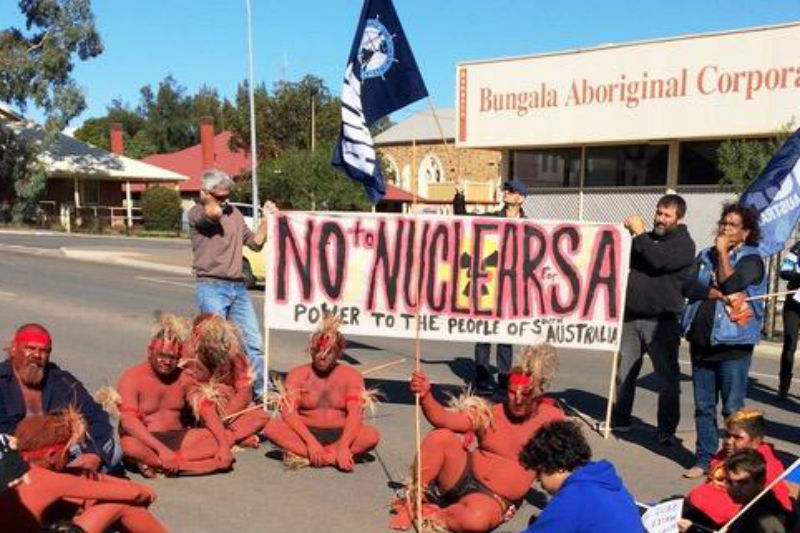
Looking back to the 2016 shonky South Australian Nuclear Fuel Cycle Royal Commission, – the same problems apply to the present Federal Government plan . Friends of the Earth Australia examined these- in Arguments against turning SA into the world’s nuclear waste dump.
”Aboriginal Traditional Owners
Our organisations hold serious concerns over past and continuing nuclear industry practices and impacts and the following comments highlight the often poor treatment of Aboriginal people by the nuclear/uranium industries in Australia and by governments pursuing or facilitating nuclear/uranium projects.
”The SA Government’s handling of the Royal Commission process systematically disenfranchised Aboriginal people. The truncated timeline for providing feedback on draft Terms of Reference disadvantaged people in remote regions, people with little or no access to email and internet and people for whom English is a second language. This was compounded when the Commission was formulated as there was no translation of the draft Terms of Reference, and a regional communications and engagement strategy was not developed or implemented. Subsequent efforts by the Royal Commission to provide translators and to translate written material were highly selective, partial and simply inadequate. Aboriginal people repeatedly expressed frustrations with the Royal Commission process.
The federal government tried but failed to impose a national nuclear waste dump on Aboriginal land in SA from 1998‒2004, then tried but failed to impose a dump on Aboriginal land in the NT from 2005‒14, and now the federal government appears to again be seeking to impose a dump on Aboriginal land in SA against the near-unanimous opposition of Traditional Owners.
At the federal level Labor and the Coalition both supported the National Radioactive Waste Management Act, which permits the imposition of a dump on Aboriginal land without any consultation with or consent from Aboriginal Traditional Owners (to be precise, the nomination of a site is not invalidated by a failure to consult or secure consent).
In SA, there is bipartisan support for the South Australian Roxby Downs Indenture Act. The Act was amended in 2011 but it retains indefensible exemptions from the SA Aboriginal Heritage Act. Traditional Owners were not even consulted about the amendments. The SA government’s spokesperson in Parliament said: “BHP were satisfied with the current arrangements and insisted on the continuation of these arrangements, and the government did not consult further than that.” Arguments against turning SA into the world’s nuclear waste dump https://nuclear.foe.org.au/waste-import-arguments/?fbclid=IwAR1yajKABFYLvMp3gFjM_DuYJFFMu4nnuc3LXxLFEBLpI7Da9-OjSv0IHrk#_ftnref4
It’s not acceptable to ignore Aboriginal land owners, in order to impose high level nuclear waste on their land.
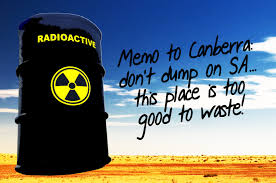
Kim Mavromatis,No nuclear waste dump anywhere in South Australia, 18 May 21, In 2020 it’s not acceptable to completely ignore the traditional owners of country and not acceptable to deliberately remove Independent Scrutiny or Rights of Appeal from the Legislation process. But these bullies don’t care what South Australia thinks.
The world classifies Spent Nuclear Fuel (10,000 times more radioactive than uranium ore) and Nuclear Waste from reprocessed SNF (still contains 95% of the radioactivity of SNF) as High Level Nuclear Waste but Aust and ANSTO classify it as Intermediate level – and that’s what the Fed Govt want to dump on SA farmland. https://www.facebook.com/groups/1314655315214929
Need for ‘consent laws’, as Australian mining companies trample on Aboriginal rights
“The Australian government needs to amend native title and land rights legislation to include a requirement for companies to gain free, prior and informed consent from traditional landowners before proceeding with projects, as well as mandatory human rights due diligence assessments.”
The report also recommends governments at all levels work to remove financial and other barriers to Indigenous people accessing the courts to ensure they can effectively challenge decisions that affect them.
Close the gap in consent laws for major resource projects: report. A new report highlights accountability shortfalls in major resource projects and calls for legislative reform to protect Indigenous people’s rights. https://www.rmit.edu.au/news/all-news/2021/mar/mining-first-nations Michael Quin, 21 Mar 21,
The First Peoples and Land Justice Issues in Australia report by researchers at RMIT University’s Business and Human Rights Centre (BHRIGHT), reveals the human rights impacts of companies operating on Aboriginal and Torres Strait Islander land.
BHRIGHT Director, Associate Professor Shelley Marshall, said the case studies revealed a pattern of companies failing to meet international business and human rights norms, as well as a lack of respect for the fundamental principle of obtaining free, prior and informed consent from landholders on projects impacting them.
“Our research reveals a legal framework and corporate behaviour that refuses to acknowledge lack of consent,” Marshall said.
“The fact that companies can operate within Australian law while failing to respect and uphold their international human rights obligations underlines the urgent need for legislative reform at state, territory, and federal levels.”
“These companies also need to step up and take their obligations under human rights frameworks much more seriously.” Continue reading
The remediation of Ranger uranium mine: will it really restore the environment?
Traditional owners were given land rights in return for their support for the Ranger mine, and Kakadu National Park was born. ……. the land will finally be returned to the traditional owners… the question is, in what state? ……… we could find the site an eroding heap of substandard scrub.
As part of cleaning up the mine site, contaminated buildings and equipment will be buried in one of the mine’s enormous pits.
We’ve been told that burying the equipment and the contaminated material in the mine site is out of step with global best practice in the mining industry.
|
Kakadu in crisis, ABC 22 Feb 2021, Crisis in Kakadu: The turmoil threatening Australia’s biggest national park
“It’s gone downhill. No one basically trusts anybody, no one respects each other anymore. That’s how bad it is here.” Traditional owner Kakadu is one of the great natural wonders of the world. The stunning landscape, teeming with wildlife, is a major tourist destination with scores of Instagram friendly sites. For tourism operators it is an iconic symbol of what Australia has to offer. “It’s one of the most special places in Australia. It’s for so long been one of the reasons why people visit Australia and for Australians, one of their must do life experiences.” Tourism industry representative Despite its beauty, there is trouble inside Australia’s biggest national park. This World Heritage listed site is in crisis. “It’s an absolute mess because the institutions responsible for fixing it up aren’t doing their job.” Traditional owner On Monday Four Corners investigates accusations of mismanagement and neglect which have fuelled a bitter dispute between the park’s traditional owners and the authority that runs the park. |
Clean-up plan for Ranger uranium mine is ”woefully inadequate”
Gundjeihmi and ERA enter negotiations to extend Ranger Uranium Mine rehabilitation
By https://www.abc.net.au/news/2021-01-09/gundjeihmi-era-negotiate-ranger-uranium-mine-rehabilitation/13043076 Matt Garrick
An Aboriginal group in Kakadu National Park says the rehabilitation plan for a decommissioned uranium mine is “woefully inadequate”, and is calling for a 26-year extension to the process.
Key points:
- Mining at the Ranger Uranium Mine wound up yesterday after more than 40 years
- Traditional owners in Kakadu are now calling for an extension of the project’s rehabilitation phase
- The company that runs the mine has signalled its support for the move
Production at the Ranger Uranium Mine, on the outskirts of the national park, drew to a close yesterday after more than 40 years of operation.
Gundjeihmi Aboriginal Corporation, which represents Mirarr traditional owners, has used the closure to demand owner Energy Resources Australia (ERA) rehabilitate the site beyond its current lease expiry in 2026.
Within that timeframe, the company is required to restore the site to its previous pristine state.
“That’s not long enough,” the corporation’s CEO, Justin O’Brien, said.
“We are now awaiting a drafting from the Commonwealth Government for amendments to the Atomic Energy Act such that you can actually put in place an extension to the rehabilitation period.”
Mr O’Brien said traditional owners were pushing for the rehabilitation period to be extended by an additional 26 years, which would carry the process through until 2052.
He said ERA and its parent company, Rio Tinto, had signalled their support for an extended term of rehabilitation — but the timeframe and details of that extension are still being negotiated.
In a statement, the company said it was committed to “achieving all documented rehabilitation outcomes in its Mine Closure Plan (MCP) by January 2026”.
It confirmed negotiations were underway with traditional owners to “determine an appropriate mechanism” to extend the company’s tenure at the Ranger site, which would allow it to continue rehabilitation beyond 2026.
Environmental group the Australian Conservation Foundation yesterday welcomed the end of production at the site, the last active uranium mine in the Northern Territory.
The foundation’s Dave Sweeney, who is an anti-nuclear campaigner, said he was supportive of the push to extend the rehabilitation period.
“The company should not be approaching clean-up asking itself what it can do in five years,” he said.
“It should be approaching clean-up asking ‘What is the best possible way to reduce and address the damage that has happened?’
“What’s the best outcome — not the best outcome we can do in five years.”
The wind-down of production at the mine is expected to prompt an exodus from the nearby town of Jabiru, where ERA holds the lease for about 300 houses.
One hundred and twenty-five ERA staff were made redundant this week.
1 This month

of the week – Australians for War Powers Reform (AWPR)
To see nuclear-related stories in greater depth and intensity
 Antinuclear