Film “Utopia” to be shown in Australia on 26 January
..You have been documenting this struggle for decades. What change would you most like to see next?
One word: treaty. That’s the beginning.
John Pilger, Utopia 5 November, 2013 | By Andreas Wiseman Veteran journalist and BAFTA-winning filmmaker John Pilger returns to the screen with new documentary Utopia, about the plight of indigenous Australians. Pilger, who has reported discrimination against Australia’s first people since the 1970s, describes his new film as “a journey into a secret country” describing “not only the uniqueness of the first Australians, but their trail of tears and betrayal and resistance – from one utopia to another.”
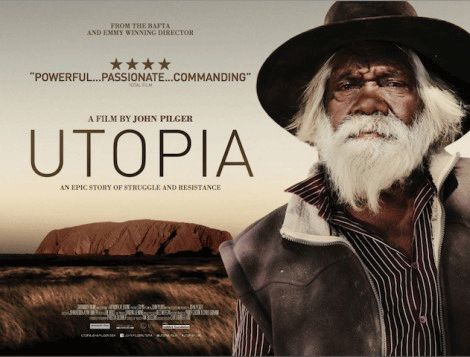
Interviewees include Aboriginal leaders, human-rights campaigners, academics and politicians, among them former prime minister John Howard.
Never one to shy away from controversy, the film will be released in Australia on Australia Day (or ‘invasion day’, as Pilger also calls it) and will play at indigenous festivals including Sydney’s Yabun Festival. Continue reading
Indigenous self-determination is needed, not Abbott’s hand-picked board
 The case for Indigenous self-determination ABC Indigenous, Sol Bellear October 21, 2013 If we want to shift Aboriginal disadvantage, then self-determination is the only way, writes Sol Bellear……..
The point that seems to have been lost on many readers – despite it appearing in the article several times – is that the High Court declined to make a finding on the basis of race. White people are just as entitled to have their background considered as people of colour. It was not a victory for Aboriginal people, it was a victory for ALL people … and common sense.
However, I argued that while I respected the High Court decision, the case I’ll celebrate is the one in which the High Court determines it has no jurisdiction over Aboriginal people. If we want to shift Aboriginal disadvantage, then self-determination is the only way to achieve that……. Continue reading
Australia, especially indigenous Australia, vulnerable to climate change extremes
Australia shouldn’t be waiting for more evidence of climate change impacts,such as floods, fires and cyclones.
She says while adaptions can be made by future governments, there should be recognition now of the magnitude of the challenge and of the need to act.
 AUDIO: New climate change warnings for Australia http://www.sbs.com.au/news/article/2013/10/15/new-climate-change-warnings-australia A leaked draft report by the IPCC outlines a sobering set of climate change challenges faced by Australia. By Ildi Amon (Transcript from World News Australia Radio)
In a report last month, the Intergovernmental Panel on Climate Change concluded it was more certain than ever that humans were responsible for global warming.That report focused mainly on the science of climate change, rather than on what to do about it.
Now, the Panel is working on a report on climate change impacts, vulnerabilities and adaptation, due for release in March.
And, as Ildi Amon reports, a leaked draft of that report by the Panel outlines a sobering set of challenges faced by Australia.According to the leaked draft report, climate change will present Australia with significant heat stress, extreme weather events, and a higher rate of disease in the coming decades.
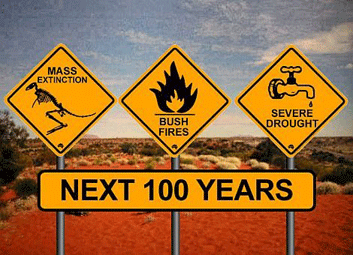
It says there is high agreement among scientists that Indigenous Australians will face disproportionate harm from climate change. Continue reading
Influential Aboriginal leaders have doubts about Warren Mundine and the new Indigenous Advisory Council (IAC)
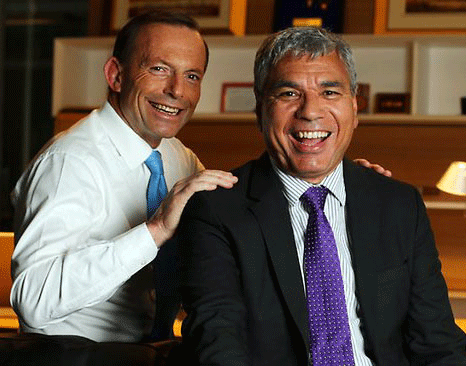
The establishment of the IAC, two thirds of which is directly aligned with the uranium industry, does not bode well for advancing a mature conversation around and action on the problems of Aboriginal disadvantage. At the very least there should be a diversity of communities and a diversity of views represented.
A lode of real action http://www.onlineopinion.com.au/view.asp?article=15551 By Kado Muir, Mitch . and Peter Watts – 7 October 2013 This article was first published in the Koori Mail As the dust starts to settle and Australia reflects on the outcomes of the recent federal election, many Aboriginal people have growing concerns over Tony Abbott’s new Indigenous Advisory Council (IAC) and the agenda behind its plans for real action for Indigenous Australians. Continue reading
South Australian Govt’s plan to keep ‘unsuitable’ people out of body governng Aborignal lands.
New APY rules to vet ‘unsuitable people ‘http://www.theaustralian.com.au/national-affairs/politics-news/new-apy-rules-to-vet-unsuitable-people/story-fn59nqld-1226733838565 SARAH MARTIN OCTOBER 07, 2013 NEW rules for the executive body that governs South Australia’s troubled northern Aboriginal Lands are being considered by the state Labor government, as it embarks on a review of the APY Land Rights Act.
The terms of reference for the review, obtained by The Australian, show that the government wants to prevent unsuitable people being appointed to the Anangu Pitjantjatjara Yankunytjatjara Lands executive through a new “fit and proper person” test.
“The criteria would cover, but would not be limited to, demonstration of competency, experience, skills and ability, personal integrity, reputation, diligence, independence of mind, fairness and absence of convictions or civil liabilities,” the terms of reference say.
“To give confidence the nominees for election to the APY executive have the necessary skills, experience, ability and commitment to carry out the role, it is considered only fair and reasonable for some form of ‘fit and proper’ criteria to be applied.”………
Uniting Communities indigenous policy spokesman Jonathan Nicholls said he was concerned about the scope of the review.
“It is unlikely this review will do much to address the governance and capacity problems that have plagued the APY executive for a number of years.” http://www.theaustralian.com.au/national-affairs/politics-news/new-apy-rules-to-vet-unsuitable-people/story-fn59nqld-1226733838565#sthash.WAfwHGWH.dpuf
Western Australian Aboriginal call for voices other than Warren Mundine’s
NACCHO health political update week 4: National and WA peak bodies express concerns about Indigenous voice NACCHO Aboriginal Health News Alerts 2 Oct 13
As we enter week 4 of the new Abbott led Government , the future of Aboriginal affairs and specifically Aboriginal health is still uncertain. Last week in Western Australia a number of Aboriginal organisations including NACCHO affiliate Aboriginal Health Council of Western Australia (AHCWA), the Kimberly Land Council and the National Congress of Australia’s First Peoples expressed concerns about “Indigenous voices”. Aboriginal Health Council of Western Australia (AHCWA)
Western Australia’s peak Aboriginal health body says they agree wholeheartedly with recent statements by the Kimberly Land Council that 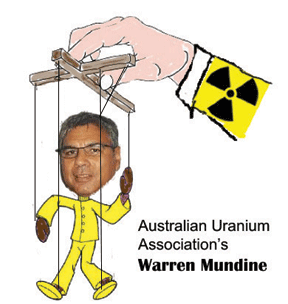 Warren Mundine is not the only Indigenous voice but urges the government to remember that land isn’t the only Indigenous issue.
‘Tony Abbott’s Indigenous Advisory Council needs a strong voice from Western Australia, but that voice needs to represent all the interests and needs of Aboriginal people and their communities,’ says Des Martin, Aboriginal Health Council of Western Australia (AHCWA)
While Mr Martin acknowledges land rights are an important issue, the health and wellbeing of Aboriginal people cannot be forgotten, he says.
‘I agree wholeheartedly with Kirstie Parker’s statement that Warren Mundine isn’t the only voice for Indigenous people and I support what the Kimberley Land Council does, it is extremely important for all Aboriginal people to have their country and care for it to secure their future but if their health is still suffering then that isn’t a good thing for them or future generations,’ Mr Martin says.
‘We need broad representation on the Indigenous Advisory Council, not just land or business interests. Tony Abbott does need to take advice from more than one source when it comes to Aboriginal people. Continue reading
Tony Abbott’s Aboriginal stooge Warren Mundine wastes no time in pushing Abbott’s agenda
Aboriginal adviser Warren Mundines hits out at green campaigner Geoffrey Cousins October 4, 2013 Dan HarrisonHealth and Indigenous Affairs Correspondent Tony Abbott’s chief adviser on indigenous affairs has taken a swipe at businessman and environmentalist Geoffrey Cousins over his campaign against a gas hub at James Price Point in the Kimberley, suggesting he ”pull a bit of money out of his own pocket” to compensate Aboriginal people who will miss out on a $1.5 billion benefits package…….In an interview with Fairfax Media, Warren Mundine, the chairman of Mr Abbott’s advisory council on indigenous affairs, lashed Mr Cousins for his role in opposing the James Price Point development……
Mr Cousins said Mr Mundine was misguided, and he had not opposed the gas project but had argued James Price Point was the wrong location. He said processing the gas offshore would make the project even more profitable for Woodside and there was no reason why the company should not pay the promised benefits. http://www.smh.com.au/federal-politics/political-news/aboriginal-adviser-warren-mundines-hits-out-at-green-campaigner-geoffrey-cousins-20131003-2uxg1.html#ixzz2gmwfZi94
Coverup of the brutal history of the taking of Aboriginal land
Frontier atrocities against Australian Indigenous people were appalling. Frontier conflict is not pleasant at the best of times, but what happened in Australia has been covered up for too long. I leave you with the words of Henry Reynolds (2006) when summing up attitudes towards frontier conflict – and conflict it was – real, bloodthirsty, brutal – a battlefield and a war, waged almost silently, and with little record of it.
It can be found in almost every type of document – official reports both public and confidential, newspapers, letters, reminiscences. Settlers often counted black bodies either in anger or in anguish; members of punitive expeditions confessed to their participation in a spirit of bravado or contrition. Later observers came across bones and skulls; burnt, buried or hidden and occasionally collected and put proudly on display (Reynolds 2006: 127).
Battlefield Australia : Frontier Conflict in Early Australian Settlement by Sue Carter : HeritageDaily , September 28, 2013 It has been estimated that the first people arrived in Australia possibly around 45,000 years ago and from that time, until the settlement of Europeans on the eastern coast, the Australian Aborigines had been turning space into place for much of that time.
It is equally quite easily demonstrated that Indigenous
people were frequently massacred indiscriminately
and with impunity in Colonial Queensland and
that their remains were treated with disrespect,
if not outright contempt (Ørsted-Jensen 2011: 169)
They viewed their lives as being part of an overall design where everything had a right to live, they carved their position nestled in the landscape, and viewed their lives within it as part of a design in which Country was seen as place. Everything within the Indigenous cultural paradigm was multidimensional and people were attached emotionally, psychologically and metaphysically to the land they inhabited (Bird 1996). They sang songs regarding the history and birth of their part of Country, painted and recited stories which were passed down through generation after generation. ……..
The settlement of the continent included invisible boundaries that were known by the various tribes. Each had their own district where they belonged through spiritual and ancestral bonds and there was interaction between neighbouring tribes where their boundaries overlapped in many complex ways, through spirituality, kinship ties and interaction. A major aspect of the inter-tribal and family relationships was that of sharing; no one owned anything – it belonged to all within the group (Reynolds 2006). They lived with and on the land – protecting, nurturing and preserving – for thousands of years. Continue reading
Australia’s anthropologists under fire, because of their support for Aboriginal Land Rights
Throughout the two centuries of colonisation, Aboriginal people, though vastly outnumbered, have done their best to resist European dominance: they fought to defend their land and, even under the enforced control of settlers, missionaries and the state, continued to lead subversive ‘double lives’ in which they tried to maintain their own cultural practices. They have struggled for greater social, economic and political equality, and they have tried desperately to reclaim their land.
Australia is one part of the world in which anthropologists have been able to make themselves genuinely useful to indigenous groups. For many decades now, they have been instrumental in assisting Aboriginal people in recording cultural knowledge and using this to support their claims to land and resources and their efforts to regain self-determination.
The latest development in Australia is for those opposed to land claims to spend very large sums of money suing anthropologists for millions of dollars,
Snippet #40: AUSTRALIA’S ABORIGINAL MINORITY – DISPOSSESSION AND LAND RIGHTS http://snippetysnippet.wordpress.com/2013/09/26/aboriginal-minority-snippet/ 26 Sept 13, “The Aboriginal minority in Australia represents about 2 per cent of the population as a whole. Colonisation of the country by Europeans has taken place over 200 years, with the major dispossession of the indigenous people occurring primarily in the first century of colonisation, but with some areas not fully ‘settled’ until early in the twentieth century. In some regions well into that century, the colonisation of land was accompanied by considerable violence and sometimes by outright genocide. Continue reading
Imagine how it feels – the dispossession of Aboriginal land
 MY LIFE: THIS LAND IS MINE / THIS LAND IS ME QAGOMA BRUCE MCLEAN 26 SEPTEMBER 2013 “………One of the most important social movements toward positive change in recent decades has been the Reconciliation Movement, which gained momentum in the wake of then prime minister Paul Keating’s 1992 ‘Redfern Address’, perhaps the most significant and stirring oration concerning Indigenous people and issues by any Australian politician. In the address he asked Australians to imagine themselves in the shoes of Aboriginal and Torres Strait Islander peoples in a particularly poignant passage:
. . . it might help us if we non-Aboriginal Australians imagined ourselves dispossessed of land we have lived on for 50 000 years — and then imagined ourselves told that it had never been ours . . . Imagine if ours was the oldest culture in the world and we were told that it was worthless. Imagine if we had resisted this settlement, suffered and died in the defence of our land, and then were told in history books that we had given up without a fight . . . Imagine if we had suffered the injustice and then were blamed for it . . . It seems to me that if we can imagine the injustice then we can imagine its opposite. And we can have justice.13…….http://blog.qag.qld.gov.au/my-life-this-land-is-mine-this-land-is-me/
Tony Abbott recruiting his new unelected Indigenous Council
Abbott recruiting for indigenous council http://www.sbs.com.au/news/article/2013/09/25/abbott-recruiting-indigenous-council LISA MARTIN -September 25, 2013, Prime Minister Tony Abbott’s new indigenous advisory council will complete a review of indigenous spending by early next year.
Mr Abbott has begun recruiting people for the council, which will oversee a shake up of indigenous affairs.Warren Mundine on Wednesday officially signed on to be the council’s chairman. He said his preference was for the council to have seven or eight members.
The membership will be finalised before the end of October.
“It’s not a representative committee … it’s a council of experts, indigenous and non-indigenous, who will be working in this space to get the socio-economic outcomes for indigenous people,” Mr Mundine told AAP.
“It will be based on expertise, but the majority will be indigenous people on the council.” Continue reading
Queensland govt talks the talk on Aboriginal rights, but does it walk the walk?
Queensland government using the right language on mining on aboriginal land http://fredleftwich.com/2013/09/18/queensland-government-using-the-right-language-on-mining-on-aboriginal-land/
http://statements.qld.gov.au/Statement/2013/9/18/aurukun-proposals-submitted
The Queensland Government has received two proposals to develop the Aurukun bauxite deposit in western Cape York. The government says it will evaluate the proposals based on their environmental merits as well as how they maximised benefits and returns to the native title holders, the Aurukun community and the state.
At least the government is using the right language in trying to maximised benefits and returns to aboriginal communities but to make sure, the government must release the details of the final contract showing that aboriginal groups are in deed receiving their fair share of profits. As I mentioned in my previous post, A treaty would help this process to achieve the best possible outcomes for all parties.
30 years of the New South Wales Aboriginal Land Rights Act – still a long way to go
 Australia: Spotlight on indigenous affairs today: 20 September 2013 by Charles Harrison, Josephine Heesh, Patricia Monemvasitis, Peter Punch and Janine Smith Carroll & O’Dea ABORIGINAL LAND RIGHTS ACT 1983 (NSW)2013 marks the 30th anniversary of the passing of the New South Wales Aboriginal Land Rights Act 1983 (‘the Act‘), recently celebrated as part of NAIDOC week.
The 1983 Act, passed by the Wran Labor Government, was New South Wales’ first piece of land rights legislation. The Act followed a two year consultation period, facilitated by a Legislative Assembly Select Committee chaired by Maurice Keane, which involved 4,000 individuals across the State and received 262 submissions.
The Act significantly acknowledged prior ownership and occupancy, made unused Crown Land available to claim and established mechanisms to facilitate Aboriginal self-determination. While some Aboriginal activists at the time felt that the Act did not go far enough, the High Court’s previous Justice Kirby once characterised the Act as “little short of revolutionary”, considering its pre-Mabo context.
To mark the anniversary the History Council of NSW organised a seminar during NAIDOC week titled “ Daring ideas: Is Land Rights Enough?“. A panel of lawyers, lecturers, activists and those involved with the administration of the Act discussed and debated the Act’s current operation. There seemed to be consensus amongst the participants, and members of the audience, that while the Act represented a significant step forward, there is still a way to go to deliver meaningful land rights to Aboriginal Australians…….. http://www.mondaq.com/australia/x/263784/indigenous+peoples/Spotlight+on+indigenous+affairs+today
Traditional owners’ court case against plan for Muckaty radioactive trash dump
 Spurious excuses The rationale for the dump is spurious. There is no compelling scientific or public safety necessity for one to be built.It has been repeatedly claimed that a specialised waste dump is required to safely store low level waste (LLW) and long lived intermediate level waste (LLIW).
Most of the LLW is derived from medical isotopes used in hospitals and clinics, while the LLIW comes almost exclusively from the nuclear reactor at Lucas Heights in Sydney. It is this latter type of waste that is of most concern because it is highly toxic and radioactive for a lengthy period
No Northern Territory nuclear waste dump!, En Passant Posted by John, September 19th, 2013 Despite clear opposition  from the Aboriginal traditional owners, the push for a nuclear waste dump at Muckaty Station, 120 kilometres north of Tennant Creek in the Northern Territory, continues, write Jon Lamb and Cathy Lawless in Red Flag.
The campaign led by traditional owners to stop the waste dump is gearing up for the next stage in the fight.
On 26 August, the Federal Court set June 2014 for a case to be heard on whether the nomination of the site for the waste dump followed due process. The nuclear free campaigner for the Australian Conservation Foundation, Dave Sweeney, told Red Flag: Continue reading
Traditional land owners want troubled ERA uranium mining to shut down by 2021 (or earlier)
traditional owners of the land want ERA to stick to the 2021 deadline.
“It’s never crossed our mind that they would mine beyond 2021,”
Rio Tinto may decide to walk away from the project at its mandated deadline. “They will be acutely aware that they will be judged long into the future on how they exit Kakadu,” Sweeney says.
Debate warming up over Ranger mine future, The West Neda Vanovac, AAPSeptember 19, 2013, The operators of the Ranger uranium mine in the Northern Territory have unveiled a new water processing machine they say will give it a future beyond 2021.
But not everyone’s happy……. Traditional owners and environmental groups want to see ERA exit in 2021. Continue reading
1 This month
17 October, Free Public Talk on Nuclear Issues in South Australia
David Noonan will speak on public interest concerns over the new Roxby Downs Indenture Act 2026 on BHP copper-uranium mining and ore processing in SA, and on how AUKUS may face SA with a High-Level nuclear waste agenda.
Dr Jim Green will discuss international developments in the field of nuclear power including ‘small modular reactors’ and Generation 4 ‘advanced’ nuclear reactor concepts.


Help Aunty Sue Protect Her Land and Sacred Sites From Destructive Rocket Testing.
.

Australians deserve the truth
about
AUKUS – https://aukuspublicinquiry.com/

PETITION – To: Prime Minister Anthony Albanese and the Australian Labor Government

of the week – Australians for War Powers Reform (AWPR)
To see nuclear-related stories in greater depth and intensity

