Ancient Aboriginal art treasures threatened by uranium mining
After years of drilling, Canadian-based mining company Cameco has reported the find in the Wellington Range, where the thousands of Aboriginal artworks adorning cliffs and caves include a painting of the extinct dog-like creature, the thylacine, made in a style that is at least 15,000 years old.
“The importance of this art site is that it’s like a library,” Ronald Lamilami, a traditional Aboriginal landowner in western Arnhem Land and a custodian for the art, told The Global Mail, which on Friday published a detailed feature and map of the rock-art sites at risk nationwide. Lamilami said he fears if mining goes ahead, the works of his ancestors will be damaged…….
The rainbow serpent, fish, kangaroos and other creatures are painted in traditional “X-ray” style and the world’s only known indigenous rock-art stencils depicting whole birds are silhouetted on a cave wall, ……http://www.guardian.co.uk/environment/2013/mar/08/australian-uranium-discovery-art
Marcia Langton’s pro mining lectures raise questions about corporate funding of university lecturers
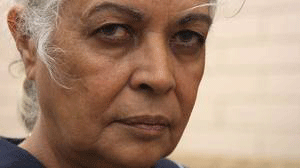 Langton failed to disclose mining company funding The Age, Gina McColl 2 March 13, LEADING environmentalists have criticised the ABC and Professor Marcia Langton after revelations her recent ABC Boyer Lectures, in which she praised the mining industry’s role in the emergence of an Aboriginal middle class and delivered a broadside against the green movement, drew on research partially funded by big mining companies.
Santos contributed $45,000, Woodside $30,000, and the federal government’s Indigenous Affairs Department $300,000 to a four-year research project led by Professor Langton into economic empowerment in indigenous communities.
Rio Tinto contributed an undisclosed sum to the $480,000 project, while Marnda Mia, a company that represents local indigenous communities in deals with Rio, offered non-cash support.
Scientist and former Australian of the year Tim Flannery, whom Professor Langton accused in one lecture of racism, said the lectures ”take on a different light” since the big resource companies’ contribution was highlighted by website Crikey. Professor Flannery said the views expressed were consistent with those of the mining industry in their criticism of environmentalists and advocacy of indigenous development and mining expansion going hand in hand.
”This goes to the heart of the credibility of the Boyer Lecture series,” he said. ”There should be requirements for disclosure of this sort of thing and they should be abided by.”
While detailed on the University of Melbourne website, where Professor Langton is foundation chair of Australian indigenous studies, the industry funding was not disclosed to listeners when the lectures were delivered in the ABC’s Brisbane studios late last year, broadcast on Radio National or extracted in Fairfax Media……. an academic with experience researching the Western Australian mining regions said the commercialisation of research did raise questions about independence.
Dr Sarah Holcombe, at the Australian National University, said access to staff and mine sites are controlled by the companies, and that accommodation outside of their mining camps is often non-existent.
Native title laws should shift the onus of proof away from Aboriginal claimants
 PM missed native title chance: Keating, BY:BRIDGET CORMACK The Australian February 25, 2013
 PAUL Keating says the Gillard government has lost an opportunity to make a vital amendment to Native Title laws that would shift the onus of proof away from indigenous claimants.
The former prime minister, who ushered in Australia’s first Native Title laws two decades ago, said the government should have seized the chance to change the laws to make it easier for Aborigines to win rights to their traditional lands. Mr Keating gave a rousing speech yesterday on North Stradbroke Island, 30km south east from Brisbane, where he urged the Quandamooka people to make the most of their hard won land rights, recognised after 16 years of negotiations in an agreement endorsed by the Federal Court in 2011.
While theirs was a victory, he said, the Native Title process was still “far too slow” and the law desperately needed to be given the long-mooted amendment so Aboriginal claimants no longer have to prove a continuous association with their land. “I think the current government has lost the opportunity now to make the amendment,” Mr Keating said. “It would pass the Senate with the Greens and the Independents.”
Mr Keating said the test for proving continuity relied on “written traditions” and was at odds with the “oral traditions” of Aboriginal people.
On the 20th anniversary of the Mabo decision last year the government proposed landmark changes to Native Title laws, including a definition for “good faith” negotiations and allowing historical extinguishment of native title in national parks to be disregarded.
The bill did not reverse the onus of proof. Continue reading
Corporate mining giants funded Aboriginal leader, Marcia Langton’s pro mining lectures
 Marcia Langton defends non-disclosure on mining cash before Boyers, Crikey.com, ANDREW CROOK | FEB 22, 2013
The academic background to last year’s Boyer Lectures was funded by global miners Rio Tinto and Woodside. But the audience was none the wiser. Should she and the ABC have disclosed?
Indigenous leader Marcia Langton and the ABC have defended a lack of disclosure over last year’s Boyer Lectures, despite tens of thousands of dollars in cash for Langton’s academic research being sourced from resources giants Rio Tinto, Woodside and Santos.
The series of five Boyers, titled “The Quiet Revolution: Indigenous People and the Resources Boom”, were delivered late last year by Langton at the ABC’s Brisbane studios and beamed around the country on Radio National.
They argued the boom had substantively benefited indigenous communities, with Langton lauding the work of a number of corporate behemoths — notably Rio — in providing job opportunities and friendly chop-outs. One lecture featured a full frontal attack on the “conceit” of anti-mining greenies.
But what listeners weren’t aware of was that two of the companies Langton praised were also bankrolling her. Continue reading
Arnhem Land traditional owner opposes fracking on his land
“In many ways, it’s an uncontrolled experiment on the Australian environment”
The meeting was told that about 80 per cent of Territory land and 90 per cent of its coastline are subject to mining exploration applications of some kind.
Shale gas ‘fracking’ fractures views in Top END By Andrew Thompson | ABC , 22 Feb 13, The head of an anti-fracking community group based in the eastern states has warned against the development of the shale gas industry in the Northern Territory.Farming, fishing, pastoral and environmental groups were among those represented at a Darwin meeting to discuss the controversial underground mining technique known as hydraulic fracturing, or fracking. Continue reading
Aboriginal community leaders refute Marcia Langton’s claim that minng is the solution to Aboriginal progress
As Aboriginal community based leaders we take issue with Professor Langton’s suggestion that
embracing mining is a positive option for Aboriginal people if they are to engage with the modern
economy. In her lectures Professor Langton paints a rosy picture of the services and employment
which some mining companies offer Aboriginal people as part of Native Title ‘agreements’. There
is only passing reference to the fact that Native Title does not allow Aboriginal people to say no
to mining.
Mining is inherently short term but the problems it brings to country last well beyond the life of
any mine.
 Peter Watts (Arabana)
Mitch (Aranda/Luritja)
Kado Muir (Wongutha) 4 Feb 13, We write as co-chairs of the Australian Nuclear Free Alliance (ANFA) in response to recent
comments by Professor Marcia Langton in her Boyer Lecture series “Indigenous People and the
Resources Boom”. ANFA brings together Aboriginal people, environment, health groups and trade
union representatives to discuss the impacts of the nuclear industry on land and communities.
ANFA opposes uranium mining, exploration and the dumping of radioactive waste on Aboriginal
land.
Uranium mining, exploration and the dumping of radioactive waste on Aboriginal land is
detrimental to the health of Aboriginal people, Aboriginal lands and our collective environments.
Mining generally is an extractive industry that by its very nature destroys land often at the
expense of spiritual and cultural connections of Aboriginal people. Income generated from mining
comes at a cost and often ignores the possibility of creating alternative sustainable economic
opportunities that need not rely on extraction as its primary economic base. Continue reading
Aboriginal people need a Sovereign Treaty not an Act of Recognition
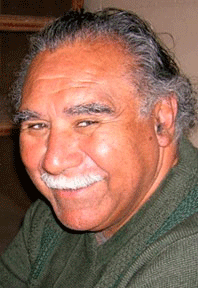 Michael Anderson, 14 Feb 13, Sovereign Union serves the Crown with formal objection to the Act of Recognition
Aboriginal Sovereign Union diplomat Graham Merritt, speaking today from Parliament House Canberra said:
“Today is an historic moment, when on behalf of the Sovereign Union I am serving the Crown via the Governor
General Quentin Bryce and the Commonwealth Government of Australia with our formal objection to the Act of
Recognition. “
“This Act of Recognition is a sleight of hand, as the Crown and Government continue to bypass proper recognition of our continuing Sovereignty. The Commonwealth Government is using the reform process to attempt to bring Sovereign Aboriginal Nations and Peoples into the Constitution of a foreign illegal occupying force.”
“Now that the Crown and Commonwealth Government have the Sovereign Union’s written objections they cannot claim ignorance of the significance of our Sovereign position, nor do they have the free, prior and informed consent of Aboriginal Nations and Peoples to usurp our sovereignty.”
“Even more insulting to me as a member of the Stolen Generations is that the Federal Government is doing this on the fifth anniversary of the Apology. Since the Apology the Commonwealth Government has further stripped back our human rights. Now they want to use the Act of Recognition to achieve the legislative equivalent of Constitutional Reform, usurping our Sovereignty in a way that attempts to undermine our inalienable connection to country and our true ownership of the Land and Waterways that are so significant to us: the rocks, the hills, the rivers that will always be a part of our culture and traditions.
Sovereignty is the most important issue today in this country they now call Australia. The Gillard Government may be educated but we as an Aboriginal Sovereign peoples are smarter and are here to stay. Our proposed solution is the negotiation of Sovereign Treaties, or other instruments under international supervision such as a Peace Accord.
Timing: Presenting to Senator Rachel Siewert at 2pm, Parliament House, Canberra. Meet in Parliament House foyer at 1.45pm followed by a presentation to the Governor-General at Government House, Yarralumla
Something Australia can be proud of – beautiful Koongarra preserved from uranium mining
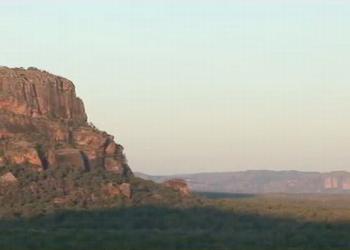 Australia Places Aboriginal Land in Park to Bar Uranium Mining http://ens-newswire.com/2013/02/07/australia-places-aboriginal-land-in-park-to-bar-uranium-mining/ CANBERRA, Australia, February 7, 2013 – After 34 years of campaigning to keep uranium mining out of his ancestral land of Koongarra, Djok Senior Traditional Owner Jeffrey Lee sat in the House of Representatives Wednesday to watch this land be protected forever.
Environment Minister Tony Burke introduced a bill to repeal the Koongarra Project Area Act – a 1979 law excluding Koongarra from the original boundaries of Kakadu National Park because of its potential to be the site for a uranium mine.
“In 2010, the Government promised Mr. Lee that we would incorporate Koongarra into Kakadu National Park, to ensure that the threat of mining was banished forever,” Burke said. Koongarra is an area of native woodland of great environmental and cultural significance, now incorporated within the boundaries of Kakadu National Park. Kakadu is located within the Alligator Rivers Region of the Northern Territory of Australia, 171 kilometers southeast of the territorial capital, Darwin.
The Koongarra uranium deposit is estimated at about 14,000 tonnes. Mining companies, most recently the French company AREVA, have been trying to mine the deposit for decades despite the opposition of traditional owners. Continue reading
26 January – for Aboriginal people a day to mourn huge losses
Australia Day or Invasion Day: A Day of Contrasts Feb 7, 2013 “……..Invasion Day – A Day to Mourn Huge Losses”………As a strong contrast, 26 January is also marked and observed as the Invasion Day by the aborigines of country who live a traditional life. It represents the invasion of their land. Why should they celebrate this day or what calls for the celebration, is a pertinent question every aborigine has in his/her mind. Unanswered, it is a cause of dissatisfaction and unhappiness even today.
Aborigines of Australia call this day by different names. They are: ‘Day of Mourning’, ‘Invasion Day’, and ‘Survival Day’. As an effort to unite all aboriginals in their fight for sovereignty this day is also celebrated by many as the ‘Aboriginal Sovereignty Day’ by many people who believe in fighting back for their rights.
Why do they call it the Day of Mourning?
When the First Fleet landed in the Sydney Cove, it altered the lives of aborigines of the nation for all times to come. It was the day that saw the abduction of people, killing of local resistance and forceful eviction. They consider it as a day when they lost their land to the invaders. The darkest things of the day are the death in custody and loss of family. Basically the aborigines were stripped of all their rights. As this day represents the massacres that took place, it is a day of deep sorrow to them.
What has caused this Dissatisfaction?
Aborigines feel that:
- They were driven out of their lands
- The struggle led to killing of aboriginals
- They were not allowed to follow their customs and culture
- They were not allowed to teach their language
- They were disrespected.
The deprivation of rights and the deaths caused by this invasion is etched on the minds of the aboriginals not to view the day as a day of celebrations. The attack on their culture and lifestyle has given them the cause to display their dissatisfaction or unhappiness through various activities like re-enactments of Phillip’s landing which was accepted as part of the ceremonies for the Australia Day celebrations. The aborigine’s stage protests on this day to show their dissatisfaction staging protests to show their loss.
This day being a day of great contrasts, is both celebrated and mourned by two different groups of people of Australia. While the day represents achievements, joy and fun, it also marks the sorrow of people who were unable to exercise their rights. http://actco-australia.org/2013/02/australia-day-or-invasion-day-a-day-of-contrasts/
Koongarra permanently protected from uranium mining
GUNDJEIHMI ABORIGINAL CORPORATION 7 Feb 13 Mirarr Traditional Aboriginal Owners today welcomed Environment Minister Tony Burke’s introduction of a bill which clears the way for the incorporation of the Koongarra area into Kakadu National Park. This move recognises the long held Aboriginal aspiration to protect this unique area from the threat of uranium mining.
The introduction of the Completion of Kakadu National Park (Koongarra Project Area Repeal) Bill was also welcomed by the Djok Senior Traditional Owner of the Koongarra area, Jeffrey Lee AM. Mr Lee was in the Federal Parliament to witness the introduction of the bill, accompanied by a delegation representing the Mirarr. Jeffrey Lee was awarded the Order of Australia in 2012 in recognition of his work to protect his country and gift it to the nation. He has firmly opposed uranium mining on his country on the grounds of the deep cultural significance of Koongarra to its Traditional Owners and concerns about the dangers of uranium.
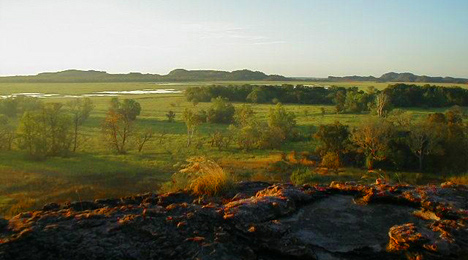
In his long struggle to protect his country Mr Lee has drawn inspiration from Yvonne Margarula, the Senior Traditional Owner of the neighbouring Mirarr people. Since the 1990s Yvonne Margarula has led the Mirarr opposition to the proposed Jabiluka mine, north of Koongarra and the existing Ranger uranium mine also on Mirarr land. Ms Margarula spearheaded the international campaign against mining at Jabiluka. Her resolve and leadership guided the campaign and prompted a special UNESCO mission, resolutions in the European Parliament and US Congress and several Australian parliamentary inquiries. In the late 1990s Ms Margarula won several prestigious international awards in recognition of her work to protect her country.
In 2001, the Rio Tinto majority owned mining company Energy Resources of Australia acknowledged the opposition of the Mirarr traditional owners and agreed to halt work at Jabiluka.
Ms Margarula said, “Traditional Owners must be allowed to make their own decisions about development on their country. Jeffrey has been speaking out to protect his country and we support him. He has always said no to mining at Koongarra and we support him when he says he wants to see that country put into the National Park. We want to see the same protection for Mirarr country.”
The Mirarr people have this month executed a renegotiated agreement for the existing Ranger mine, which was imposed on them in 1978. This agreement, along with provisions of the federal Atomic Energy Act, provides for the Ranger area to also be included into Kakadu National Park as the mine is rehabilitated.
The executive officer of Gundjeihmi Aboriginal Corporation, Justin O’Brien, said, “This action by the government is to be applauded, although the name of the bill incorrectly implies that this completes the national park. There is further work to be done and we still look forward to the day when all of Kakadu is included in the National Park and adequately protected from unwanted industrial development.”
A WRITTEN STATEMENT FROM MR LEE IS ATTACHED TO THIS STATEMENT Continue reading
Jeffrey Lee – Aboriginal elder who put his country before $millions – saving Koongarra from uranium mining
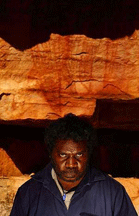 Aboriginal elder spurns million dollar offer from uranium minershttp://www.mining.com/aboriginal-elder-spurns-millions-of-dollars-from-uranium-miners-58963/Marc Howe | February 6, 2013 An elder from the Djok aboriginal community has hailed a move by the federal government to prevent the mining of uranium on his ancestral lands.
On Wednesday the federal government introduced a bill to incorporate 1228 hectares of the Koongarra, the traditional land of the Djok people, into the Kakadu National Park, thus preventing efforts by uranium mines to develop the area’s resources.
Jeffrey Lee, an elder of the Djok people, welcomed the decision after fighting for over three decades to prevent uranium extraction in the area, as well as spurning million dollar offers from miners.
“I have said no to uranium mining at Koongarra because I believe that the land and my cultural beliefs are more important than mining and money,” said Mr. Lee.
A French company reportedly offered Mr. Lee $5 million to withdrawn his opposition to uranium development plans.
Although Koongarra lies within the Kakadu area, a ruling in 1979 prevented its inclusion in the park, in order to leave open the possibility of development of its uranium resources, estimated to stand at around 14,000 tonnes.
Former Prime Minister Bob Hawke as well as Federal Environment Minister Tony Burke joined Mr. Lee to make the announcement as well as hail the government’s decision.
As New Zealand did, Australia should reserve Parliamentary seats for indigenous people
if history has taught us anything, it is that treating our most
vulnerable members like we treat everybody else can be the very source
of their disadvantage.
The pursuit of equality often requires that we
treat people differently because it is by attending to the specific
needs and histories of diverse populations that they gain the ability
to participate in society on a par with everybody else. That is why
breaking glass ceilings requires that we treat women not like men, but
as a group encountering unique social barriers to promotion…..
 A better voice for indigenous Australians, SMH, February 4, 2013
George Vasilev Reserving parliamentary seats for indigenous citizens
is about equality. The vexed issue of indigenous representation has
surfaced again with Julia Gillard’s controversial endorsement of Nova
Peris as a Labor Senate candidate for the September 14 election.
Australia has an abysmal record on indigenous representation. Only
three indigenous people have ever been elected to federal Parliament.
Of those, the Liberals’ Ken Wyatt is the only candidate to ever win a
seat in the House of Representatives.
In a country where indigenous people comprise 2.5 per cent of the
population and with a federal Parliament with 226 seats, we fall way
short of the most basic standard of representative fairness that
demands legislatures reflect the societies they govern. Continue reading
Local Area Land Councils throughout New South Wales protest against (NSWALC) mining decisions
Ryan’s defence of mining plan dismissed by angry protesters National Indigenous Times, 1 Feb 13, An angry mob of First Nations people representing Local Area Land Councils throughout New South Wales delivered the New South Wales Aboriginal Land Council (NSWALC) a blunt message at a protest rally last Friday – “Consult us before mining in our Country”.
And New South Wales Aboriginal Land Council Chairman, Stephen Ryan was delivered a warning by Gomeroi leader Alf...(subscription only) http://www.nit.com.au/news/2426-ryans-defence-of-mining-plan-dismissed-by-angry-protesters.html
ERA’s uranium plan: Ranger 3 Deeps deposit beneath Pit 3 – could they diddle the Aborigines?
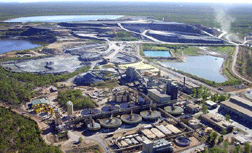 Christina Macpherson 25 Jan 13, It all looks good, that the Mirrar Aboriginal people people have at last got a fairer deal with ERA concerning their long struggle, first against, uranium mining at the Ranger site, and then to get a better deal.
The senior traditional owner of the Mirarr clan, the very highly respected Ms Yvonne Margarula, has welcomed the agreements.
These agreements do not include ERA’s new project , underground mining at Ranger 3 Deeps deposit beneath Pit 3.
This situation needs careful watching. Is the new agreement part of a softening up process by the uranium mining company, as they plan to get acquiescence from the Aboriginal people for the this next project.
It has been done before – that uranium miners have chosen to mine underground, in order to avoid the responsibility of native title issues on the surface. When they do a big shaft entry, they expand underground without involving the native title holders. a big shaft entry, they expand underground without involving the native title holders. They have been able to convince the Aboriginal owners that “the crown owns the minerals”.
ERA has recently been dealing with 30 years accumulation of radioactive waste water, at Ranger.
ERA could be a bit desperate – as recent economic history has not been kind to them In 2012 “From a share price of $18.22 in May 2009, the stock lost more than 90 per cent of its value to be languishing at $1.15 earlier this year, with the company’s future being seriously questioned. …. The goal of turning ERA into an underground miner won’t come to fruition before late 2015, and there will be myriad environmental, indigenous, government and company approvals to satisfy before then. ” http://www.smh.com.au/business/kakadus-miner-for-all-seasons-20120427-1xqg2.html#ixzz1tNGNVJGh
Mirrar Aboriginal agreement on Ranger uranium mine does not include new underground mine
Ranger uranium mine agreement updated, Gundjeihmi Aboriginal Corporation, 25 Jan 13,
The Mirarr traditional Aboriginal owners of the Ranger uranium mine area welcome the
settlement today of the long-running renegotiation of the 1978 Ranger mining agreement.
The execution today of a number of agreements and associated correspondence between
the Gundjeihmi Aboriginal Corporation (GAC), the Australian Government, miner Energy
Resources of Australia (ERA) and the Northern Land Council signals the formal conclusion of
a 14-year process of renegotiation.
Importantly, the agreements cover existing operations on the Ranger Project Area. They do
not deal with future mining beyond the existing Ranger Authority or underground mining at
the so-called Ranger 3 Deeps deposit beneath Pit 3.
The senior traditional owner of the Mirarr clan, Ms Yvonne Margarula, welcomed the end of
negotiations about the original Ranger mine. “We Mirarr are happy that today, after so long,
we have a fairer agreement for mining at Ranger,” she said. “My father never agreed to
Ranger. Our right to stop the mine was taken away by the government. It is good that after all
these years we have a better agreement for Mirarr. This will help all Bininj [Aboriginal people]
in the region.” Continue reading
1 This month
17 October, Free Public Talk on Nuclear Issues in South Australia
David Noonan will speak on public interest concerns over the new Roxby Downs Indenture Act 2026 on BHP copper-uranium mining and ore processing in SA, and on how AUKUS may face SA with a High-Level nuclear waste agenda.
Dr Jim Green will discuss international developments in the field of nuclear power including ‘small modular reactors’ and Generation 4 ‘advanced’ nuclear reactor concepts.


Help Aunty Sue Protect Her Land and Sacred Sites From Destructive Rocket Testing.
.

Australians deserve the truth
about
AUKUS – https://aukuspublicinquiry.com/

PETITION – To: Prime Minister Anthony Albanese and the Australian Labor Government

of the week – Australians for War Powers Reform (AWPR)
To see nuclear-related stories in greater depth and intensity

