Historic Native title win for Western Australian Aboriginals over mining company
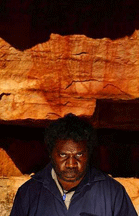
 Native title blocks Weld Range mine project, PAUL CLEARY , The Australian, September 24, 2011 THE Wajarri Yamatji people of Western Australia’s Weld Range have long believed that their land was special. Now, the National Native Title Tribunal has decided the rock art, ochre mines and ancient ceremonial grounds are more valuable than $7 billion of minerals in the ground.
A ruling this week by tribunal deputy president Chris Sumner marked just the second time that it has rejected a mining application. Weld Range contains the Wilgie Mia Aboriginal site, given national heritage listing this year by the federal government.
Mr Sumner said it was an area of “outstanding importance”. It includes an ochre mine that has been worked for 30,000 years.
Traditional owner Colin Hamlet said he was “feeling really proud that we’re actually getting some notice”. He said the region offered great tourism potential because it had “a wealth of stuff”. Simon Hawkins, the chief executive of the Yamatji Marlpa Aboriginal Corporation, which represented the Wajarri Yamatji people, said the success reflected the “consistent approach” of the traditional owners in outlining the heritage value of the land……http://www.theaustralian.com.au/national-affairs/state-politics/native-title-blocks-weld-range-mine-project/story-e6frgczx-1226144919702
Traditional Aboriginal landowners excluded from Rio Tinto land agreement
The Bark Petition: An expression of legal ownership, Green Left, September 18, 2011, By Emma Murphy Yirrkala, in north-east Arnhem land, is home to the famous 1963 “Bark Petition”. This was a protest action by the Yolngu people that led to the first native title litigation in Australia’s history. Continue reading
Jeff McMullen’s passionate call against a second Aboriginal Intervention
 the fight for the homelands is the new frontline.
Federal, Northern Territory and state government policy is now in collusion — and it’s across both sides of the political spectrum.
Assimilation is the essence of this government approach and what they are trying to do is, ever so slowly, prise Aborginal people up from their settlements on the homelands and move them for economic rationalisation and to clear the way for the the various kinds of development that have always taken the wealth out of Aboriginal land…..the contest with the miners, and that appetite, that greed for the wealth on Aboriginal lands, is bringing Aboriginal society once more to the crossroads……
This intervention started with a vicious lie: the one that said all of these communities had pedophile rings.
The Australian Crime Commission has now erased that lie, saying there were, and there are, no pedophile rings…….
 Jeff McMullen: Don’t buy the NT intervention lie, Green Left, September 17, 2011, Outside prescribed Aboriginal communities in the NT ‘those shameful signs still exist’. Jeff McMullen, a prominent journalist and Aboriginal rights advocate, gave the address below at the Sydney launch of Walk With Us: Aboriginal Elders Call Out to Australian People to Walk with them in their Quest for Justice at Gleebooks, Sydney, on September 1. Continue reading
Senator Scott Ludlam speaks on ANFA, uranium, Aboriginals, and Navajo
 In 2008, a five-year cleanup plan of the Navajo lands was proposed and implemented by the US EPA, which estimated that 30 per cent of all Navajo still lack uncontaminated drinking water. It is an experience that is familiar to Aboriginal people here in Australia
Adjournment speech – Fukushima 6 months on – Australia’s Nuclear Free Alliance Spokesperson Scott Ludlam 14th September 2011“…….I had the enormous good fortune before I departed for Canberra to spend Sunday, 11 September at Seven Mile Camp on the outskirts of Alice Springs at a meeting of the Australian Nuclear Free Alliance-ANFA ……. I spent my time there in the company of a number of people: Uncle Kevin Buzzacott, who has spent the latter part of his life fighting nuclear dispossession of the land of his people by the Olympic Dam uranium mine at Roxby Downs in central South Australia; Mitch, whose sense of humour and fierce wit and passion for her people leave an indelible trace on the memory of anybody who spends time with her; the indestructible Barb Shaw, who has unfortunately spent far too much of her time having to fight the negative impacts of the Northern Territory intervention that was so unwisely carried forward by this government; and Aunty Isabel and Bunny Naparrula, who travelled down from Tennant Creek to speak to that group of people about this Commonwealth government’s shameful proposal to continue the Howard government’s radioactive dispossession of their people with the proposed imposition of a radioactive waste dump which would collect the Commonwealth obligated nuclear material which principally resides at the moment at Lucas Heights in central South Australia-though there is also a certain amount at overseas reprocessing sites in France. They do not want that material there, and they have led an extraordinary campaign, which I have been privileged to be a part of, to prevent that material being dumped in a shed on a cattle station on their traditional land so that the Commonwealth government can wash its hands of it and walk away.
 ANFA has been going since 1997. It was formed in Alice Springs in response to the Howard government’s unleashing of the uranium sector to vastly more disappointing results than I imagine they were anticipating and in particular in response to the challenge of the proposed Jabiluka mine in Kakadu National Park in the Northern Territory. ANFA, which was formed as the Alliance Against Uranium, has stayed very strong since then. That ANFA meeting was an amazing gathering of people whom you might consider some of the most marginalised and disadvantaged in the country. Aboriginal communities, activists, elders and some of the new leaders coming through gather once a year-this is the fourth one that I have had the extreme good fortune to attend-to share their stories of dispossession and of that e campaigns that they have waged and in many cases won against foreign and domestic uranium mining companies and against the extraordinarily misguided ambitions of successive Commonwealth governments in seeking to leave this toxic time capsule of radioactive waste on their country. Continue reading
Local anger at Australian govt plan for nuclear waste dump in Northern Territory
But on the ground, in communities near the site, many people are angry at the NLC. They say they haven’t been consulted, and can’t understand why.
What’s interesting is that Tennant Creek itself, where much opposition is focused, is just inside the jurisdiction of the Central Land Council, not the NLC: Muckaty, bang in the middle of Australia, lies just on the NLC side. So people in Tennant Creek can complain about the site all they like, but the NLC is not compelled to listen to them.
LAND COUNCIL COPS DUMP FALLOUT, SBS World News, Living Black,08 September 2011 Video journalist Bill Code on the controversial proposal to store nuclear waste on Aboriginal land in the Northern Territory. Continue reading
Social Impact Bonds – a way for Aboriginals to remain on their land
Indigenous Australians deserve an opportunity to help themselves. Some might want a mining job, most do not. Some welcome the ongoing industrialisation of their country, but many think there must be a better way. An impact bond is one way to offer more control to indigenous people over investments in their future. There is risk, of course, but the greater risk is that we continue down the same sorry path we have been on for decades.
A Bran Nue Way ahead, SMH Patrick Read ,Michael Dodson/ IanGill, August 17, 2011“………….The reality is that many indigenous Australians want to remain on their land. They want to lead productive lives caring for their country, not digging it up. To its credit, the Commonwealth already invests in programs – such as indigenous protected areas (IPAs) and Caring for Our Country – that employ indigenous rangers in recognition of their unique knowledge of the land and its cultural and natural resources. Continue reading
Australian government policy drives Aboriginals off their homelands Amnesty report
Aborigines being driven off homelands: Amnesty, Google News, 9 Aug 11, SYDNEY — Australia’s Aborigines are being forced off their traditional land because of government policy, despite the fact they would live longer if they stayed put, Amnesty International claimed Tuesday.The human rights organisation studied small groups in the central desert region and found those choosing to live on their ancestral lands were effectively denied services such as public housing due to a government emphasis on bigger towns.
“There’s a grave risk that these policies will mean that one-third of the Aboriginal population in the Northern Territory will be abandoned,” said Amnesty International Australia director Claire Mallinson. “The report highlights the really unique and special relationship that Aboriginal people have with the land and then how government policies are putting that relationship at risk, and as a result, people and culture at risk.”
Mallinson said that research showed Aborigines lived healthier and longer lives in the small, homeland communities and that these tended to have fewer social problems such as domestic violence and substance abuse. “The stripping away of essential services will effectively force families to abandon their traditional lands and move into larger towns and cities,” she told AFP.
Australia has committed to improving the lives of its indigenous people but is directing the majority of resources in the Northern Territory to so-called growth towns, Amnesty argues. It said this means that outside these towns, many Aborigines live in overcrowded and dilapidated housing, often without electricity, running water or sanitation…..http://www.google.com/hostednews/afp/article/ALeqM5hk-Qm-M0PbPOcmJN4TeShRpGgnjA?docId=CNG.acce424d93fc8a31839fc35f83f0dae3.5d1
Australian govt policy grabs Aboriginal homelands, (suits uranium miners)
In its report to be released today, Amnesty International slams the federal and NT Government’s Closing the Gap policy ….More than one-third of the NT’s Aboriginal population lives in 500 remote homeland communities….
the federal government’s NT Intervention had been a “traumatising” land grab.
During the 2007 NT Intervention the federal government took over homelands under a five-year lease which is due to expire next year.
NT Aborigines driven out of homelands, Herald Sun, AAP , August 09, 2011 NORTHERN Territory Aborigines are being driven off their traditional homelands and herded into “hub towns” Continue reading
In Western Australia, the system and the media benefit miners, not Aboriginals
the reality is that once an Aboriginal community commits to the Native Title process they are locked into a process which guarantees that mining will take place on their land whether they want the mining or not..
..In WA the mining interests are also assisted in an almost blanket (corporate) media message that mining is good for Aboriginal and non-Aboriginal people alike. This is nowhere more evident than in the sole WA daily newspaper, The West Australian which fawns over local magnates Andrew Forrest and Gina Rinehart in weekly articles and opinion pieces,
Yindjibarndi Aboriginal people take on WA FMG mining magnate, CPA The Guardian, 4 Aug 11 On one side are the proud Yindjibarndi people, who wish to preserve their culture, customs, language, way of life and country which embodies their spirit. On the other side is Australia’s second richest person, Andrew Forrest (another Western Australian mining magnate, Gina Rinehart being the richest) with a net worth of $6.9 billion who is chairman of the corporation he founded, Fortescue Metals Group (and currently appealing a ruling by the Federal Court that bars him from running FMG), which mines and exports iron ore. Continue reading
A second Australian govt Aboriginal Intervention to provide land for uranium industry
Labor’s next phase seeks to go further in closing “unviable” remote communities, opening up Aboriginal land for exploitation and creating a “work-ready” cheap labour force….. Long-term leases are also being established over Aboriginal land to give open access to mining
Australian government deepens Northern Territory “intervention”, World Socialist website, By Susan Allan , 21 July 2011, The Gillard government last month marked the fourth anniversary of the Northern Territory Emergency Response Intervention by announcing a further intensification of its regressive measures against Aboriginal people. A “second stage” of the intervention will commence next year, when the emergency legislation was due to expire. Continue reading
How the Northern Territory Intervention gets Aboriginals off their land, and uranium miners on to it
It is worth noting that the majority of Australia’s extensive supply of uranium (almost half of the world’s supply) is currently found under Aboriginal land in the Northern Territory, making these lands extremely valuable to the Australian government and mining companies…
Some communities have found themselves forced to travel extreme distances to access a store where the Basic Card is accepted…..This last factor is taking a lot of people off their lands, as they are driven to larger towns in order to buy food and small and remote local shops are going out of business.
On the Northern Territory Intervention, FEMINISTE, by HEXY on 16 July 11 “……..Compulsory acquisition of townships currently held under the title provisions of the Native Title Act 1993 through five year leases, with no appeal process and exclusive rights over all buildings and properties. Continue reading
Australian govt debates nuclear waste dump, as Aboriginal opposition continues
Six years of ‘long, hard struggle’: Communities call for a new approach on radioactive waste management, Beyond Nuclear, 15 July 11, Today marks six years since the Howard federal government announced plans for a radioactive waste dump in the Northern Territory. There was immediate and resolute opposition from the Northern Territory Government and Traditional Owners and communities near all of the targeted sites.
 Three Department of Defence sites were initially announced, with a site in the Muckaty Land Trust added to the short list after a controversial nomination by the Northern Land Council.
New legislation tabled by Resources Minister Martin Ferguson names the contentious Muckaty site as the only area to be further assessed, even though a federal court case by Traditional Owners is underway to challenge the nomination. Continue reading
Australia’s second Invasion, Aboriginal land for uranium industry
In the Northern Territory, the Gillard government is in effect driving Aboriginal communities into apartheid areas where they will be “economically viable”. The unspoken reason is that the Northern Territory is the only part of Australia where Aborigines have comprehensive land rights; and here lie some of the world’s biggest deposits of uranium..
……The most powerful political force in Australia is the multibillion-dollar mining industry. Canberra wants to mine and sell, and those bloody blackfellas are in the way again. But this time they are organised, articulate, militant. They know it is a second invasion. Having finally uttered the forbidden word, white Australians should stand with them…..
The invasion of Australia Australia’s forbidden word has been uttered at last. And with it is comes a new Aboriginal articulacy, John Pilger, guardian.co.uk, 1 July 2011 The City of Sydney council has voted to replace the words “European arrival” in the official record with “invasion”. Continue reading
Koongarra’s Aboriginal owner to Paris to save his land
 French uranium challenge to Kakadu heritage listing, Lindsay Murdoch, Darwin,The Age, June 20, 2011 ,”………..Jeffrey Lee, the sole member of the Djok clan and senior custodian of the land that includes the 12.5 square kilometre Koongarra project area, has also travelled to Paris hoping to speak at the meeting.Mr Lee, 40, who would be one of Australia’s richest people if he allowed the mine to go ahead, told The Age he wanted to tell the story of his country, which he wanted to see protected forever in the park.”I’ve waited too long for this to happen,” said Mr Lee, who works as a ranger in Kakadu.Koongarra is an ecologically sensitive area three kilometres from Nourlangie Rock, one of Kakadu’s most visited sites.According to Aboriginal beliefs, the land has places where the rainbow serpent entered the ground and a giant blue tongue lizard still lurks.The area also has rock art dating back thousands of years…..French uranium challenge to Kakadu heritage listing
Australia’s uranium mining: continued record of racism
Uranium mining Socialist Party Australia 17 June 11 Rural Indigenous populations have long been victims of the nuclear industry. The Ranger uranium mine in the Northern Territory has been in operation since 1981. During the ‘negotiating process’ the Mirarr Traditional Owners were told their opposition “shall not be allowed to prevail”. Continue reading
1 This month
17 October, Free Public Talk on Nuclear Issues in South Australia
David Noonan will speak on public interest concerns over the new Roxby Downs Indenture Act 2026 on BHP copper-uranium mining and ore processing in SA, and on how AUKUS may face SA with a High-Level nuclear waste agenda.
Dr Jim Green will discuss international developments in the field of nuclear power including ‘small modular reactors’ and Generation 4 ‘advanced’ nuclear reactor concepts.


Help Aunty Sue Protect Her Land and Sacred Sites From Destructive Rocket Testing.
.

Australians deserve the truth
about
AUKUS – https://aukuspublicinquiry.com/

PETITION – To: Prime Minister Anthony Albanese and the Australian Labor Government

of the week – Australians for War Powers Reform (AWPR)
To see nuclear-related stories in greater depth and intensity

