*&^%$#@! / * Day
The obvious, principled compromise is this – keep 26 January, but stop pretending it should be the main day of national celebration. Turn it into a national day of truth-telling and reckoning, a day that acknowledges what the date is and what it has meant, a day that faces the history rather than trying to drown it in noise.
But if 26 January becomes a day of truth and reckoning, then the country also needs a day of celebration that can plausibly belong to everyone without requiring First Nations people to swallow the insult of being asked to celebrate invasion………… Australia needs a date that can be carried by a civic idea fit for a plural democracy – belonging as commitment, not conquest
The cleanest candidate is already embedded in civic practice – 17 September, Australian Citizenship Day.
25 January 2026 Roger Chao, https://theaimn.net/day/
In late January the country performs a small miracle of selective attention. We turn up the music, we pull a plastic chair into the shade, we talk about how lucky we are; we feel, many of us, an untroubled affection for the ordinary decent life we’ve built here. And then, almost as background noise, we ask a First Nations person to do the impossible – to stand inside that affection, to smile at the same symbols, to treat the same date as a benign birthday, while knowing that the date’s elevation to national holiness is inseparable from a beginning that did not ask permission. It is a demand that some Australians pay for other Australians’ comfort with the currency of their own history.
The most stubborn fault in the Australia Day debate is the insistence that it is a debate about taste – about whether people should be allowed to “celebrate Australia,” about whether “both sides” could calm down, about whether we might add a solemn acknowledgement before the fireworks and call it a balanced approach. But public holidays are instruments of civic formation. A national day is a day on which the state teaches the nation who it is, and what it owes itself. The calendar is one of the quietest and most effective political technologies we possess. It organises memory. It distributes honour. It creates a rhythm in which some facts become normal and others become “controversial.” And because it is repeated, it becomes hard to see. It slides under argument and into atmosphere. That is why it matters.
If we want to see what is really happening, we should begin where the argument always tries not to begin – with time itself, with the scale of this continent’s human story. Aboriginal and Torres Strait Islander peoples have lived here for at least 65,000 years. Say the number out loud and feel its resistance to the way settler culture narrates “Australia.” Sixty-five thousand years is a civilisational fact so enormous that it makes the colonising period look like a thin scratch on a very old surface. Yet the national myth insists, quietly but relentlessly, that the country begins when the British arrive. We are trained to speak as though history starts with documentation, as though law begins with British ink, as though the continent becomes real when it becomes legible to empire. This is an epistemic conquest. It is the first act of taking – taking time from other people, taking their prior sovereignty and turning it into a kind of “before,” a prelude, a cultural mood-board.
Long before 1788, there were laws here. There were ways of holding people accountable, ways of defining responsibility to land and kin, ways of adjudicating disputes, ways of regulating access to water, food, ceremony, marriage, obligation. “Country” in this sense is an ethical and juridical concept; it names a relationship. But colonial narration works by flattening these realities into sentiment – beautiful, spiritual, tragic, but not binding. That flattening is convenient. If First Nations law is treated as culture rather than jurisdiction, then sovereignty can be spoken as though it arrived on ships. The great trick of settler modernity is to recognise Indigenous people as human beings and still deny their political standing. That denial lives, very comfortably, inside our festivals.
Even within the British story, the “beginning” is not as simple as the calendar pretends. In 1770, James Cook claimed the east coast for Britain and named it New South Wales. Whatever one thinks of Cook as a person, the moral structure of the act is plain – a claim made over people who were not consulted, carried out through the imperial confidence that sovereignty is something you can announce into existence. The claim is a template for everything that follows – the conversion of inhabited land into a legal abstraction available for administration, the treatment of existing law as irrelevant noise, the invention of a vacant continent in the imperial imagination. If the later phrase “terra nullius” has become shorthand for a legal fiction, it is worth remembering that the fiction was never confined to courtrooms. It was cultural. It was the moral permission slip for a society that wanted the benefits of possession without the discomfort of acknowledging what possession required.
Then, in January 1788, the First Fleet arrived and the colonial project began in the place we now call Sydney Cove, Warrane, on Gadigal Country. The landing is saturated with symbolism – the ships, the shore, the flag, the impression of a world being “founded.” It has the dramatic clarity that modern nation-states crave. Yet the state did not have to choose that moment as the centre of our civic joy. It chose it. The government of the colony was formally proclaimed on 7 February 1788, when official instruments were read out in the early settlement. If we were simply looking for a date that marked the establishment of colonial governance, 7 February would be the cleaner candidate. But 7 February is not as cinematic. It is administration, not arrival. The landing gives the nation a theatre of beginnings that is all motion and confidence, a beginning scene in which the coloniser’s presence is framed as history itself. The choice of 26 January tells us what kind of story the country wants to tell about itself – not the story of legal formality, but the story of arrival as entitlement.
From that chosen scene, the continent is remade. This is where Australian public memory becomes evasive. We like to say “settlement” because it is gentle. We like to say “pioneers” because it is brave. We like to say “development” because it sounds inevitable. But the record is not gentle, brave, or inevitable. The frontier was not a misunderstanding. It was a contest over land, law, life. Across the continent, there were killings, reprisals, punitive expeditions, and massacres, there is now a substantial body of public historical work documenting colonial frontier violence, including massacre research projects and museum resources that treat these events as constitutive to colonisation rather than as aberrations. Our duty now is to ask contemporary people not to sanctify the initiating moment of a project that required such violence, and not to treat the consequences as mere “complexity” that can be tidily balanced by a respectful acknowledgement.
Violence, however, is only one strand of the colonial apparatus. Another strand is control, exercised under the language of care. The nineteenth-century “protection” regimes are a case study in moral camouflage. In Victoria, the Aboriginal Protection Act 1869 established a Board for the Protection of Aborigines, formalising state authority to intervene in Aboriginal lives. Protection, when enacted by a colonising state, often means the opposite of what it claims. It means the regulation of movement, labour, residence, relationships. It means the conversion of a people into a managed population. It means the state reserving to itself the right to decide what kinds of lives Indigenous people are permitted to live. It is the bureaucratic face of domination – domination that smiles, domination that keeps records, domination that insists it is for your own good.
The forced removal of children, and the long grief gathered under the name “Stolen Generations,” belongs to this history of control. The Bringing Them Home report, tabled in Parliament in 1997, documented the laws and practices that produced removals and made recommendations for acknowledgement and repair. The Apology delivered in 2008 acknowledged the harm of those policies at the highest level of the state. The important thing to notice is not that Australia has apologised. The important thing to notice is that we have learned, at least momentarily, to name some parts of our history as wrong. If we can do that in Parliament, we can do it in the calendar. If we can say, publicly, that certain policies were grievous and unjust, we can also say that it is ethically incoherent to locate the nation’s principal celebration on a date that has become, for many, a yearly reminder of dispossession’s beginning.
The defenders of 26 January often respond with a kind of sentimental absolutism. They speak as if the date were sacred, unchangeable, embedded in the soil. Yet the history of the date as “Australia Day” is itself a history of invention and consolidation. Governor Macquarie marked the 30th anniversary of the landing in 1818, an early official commemoration of the event that later becomes linked to the national day. The day’s meaning and observance shifted across time and place, its modern, national uniformity is not ancient. The public holiday’s standardisation on the actual date across the country is tied to late twentieth-century decisions, including moves in the 1990s to align observance nationally. In other words, the thing presented as immovable tradition is policy, repeated until it feels like destiny.
And even more importantly, the date has never belonged to only one tradition. The country likes to describe protest as a new intrusion into an old party. History says the opposite. On 26 January 1938, Aboriginal activists held a Day of Mourning at Australia Hall in Sydney in response to sesquicentenary celebrations, protesting the treatment of Aboriginal people and demanding political rights. This was a declaration that the date’s public meaning was already morally contested, that celebration on that day required a kind of willed deafness, that the nation’s joy was being built on an instruction to Indigenous people – be quiet, be grateful, be invisible.
In 1972, on 26 January, the Aboriginal Tent Embassy was established opposite Parliament House, making the claim of unceded sovereignty visible in the most direct possible way – by occupying the symbolic space of the state with the presence the state’s story wanted to manage. The Embassy is often spoken of as if it were merely an activist landmark. But it is also an ethical critique in physical form. It says – the nation you celebrate is unfinished, the legitimacy you assume is contested, the land you treat as settled is not settled. That it began on 26 January is not incidental. It is a deliberate counter-ritual. It interrupts the state’s annual performance of innocence.
This brings us to what I take to be the most revealing, and the most indefensible, element of contemporary Australia Day practice – the staging of citizenship ceremonies on 26 January. Citizenship ceremonies are the moment in which the state makes membership visible, in which new citizens make the pledge and are welcomed into the political community. The Australian Citizenship Ceremonies Code states that ceremonies should be held on “days of significance,” explicitly including Australia Day (26 January) and Australian Citizenship Day (17 September). So the state actively encourages this pairing.
What does it mean, ethically, to welcome new Australians into citizenship on a day that many First Nations people rightly experience as invasion? It means we are inducting new citizens into a civic identity whose origin story is still settler-centred. We are asking them, often without their informed consent, to participate in a ritual that treats colonisation’s initiating moment as a suitable setting for national inclusion. We are doing inclusion as theatre while leaving the moral architecture of exclusion untouched. That is why it feels so hollow when public officials describe the day as “for everyone.” Inclusion is not merely a matter of inviting everyone to the party. Inclusion is a matter of whether the party’s theme requires some of the invited guests to pretend their history is not what it is.
The historical irony deepens, because citizenship itself was formally tied to 26 January. On 26 January 1949, the Nationality and Citizenship Act came into effect, creating the legal concept of Australian citizenship where previously Australians were treated as British subjects in law. The state deliberately braided the birth of “citizenship” into the anniversary of colonial beginning. The symbolic message is not subtle – membership is grounded in arrival. The nation becomes itself when the ships come, and citizenship becomes itself on the anniversary of that arrival. It is a neat narrative, neat enough to conceal the moral violence it depends on.
When a society ties its membership ritual to a colonisation anniversary, it is making a claim about legitimacy. It is saying – our belonging flows from this origin. It is saying – our political community begins here. It is saying – the story you join is this story. And if you want to see why the argument about Australia Day will not go away, look at that claim, it is a matter of whose sovereignty counts as foundational.
At this point the conversation often becomes psychologically revealing. Many non-Indigenous Australians respond as though critique of 26 January were critique of themselves. They hear, “you are personally guilty,” when what is actually being said is, “your nation’s ritual life is ethically incoherent.” They hear, “you cannot love your country,” when what is being asked is, “can you love your country truthfully?” They hear, “you must feel ashamed,” when what is being required is a willingness to rearrange public meaning so that the state’s joy is not built on someone else’s humiliation.
This is where the phrase “we can’t change history” appears, as if it were a serious argument. It is not. Changing the date does not change the historical facts. It changes what we honour. It changes what we ask one another to affirm. The defenders of the date want the state to keep awarding the nation’s highest public joy to a settler beginning scene, and they want Indigenous protest to remain a regrettable but manageable interruption. That is why they are so committed to “keeping politics out of it.” What they mean is – keep Indigenous politics out of it. The state’s politics, the politics of choosing 26 January as the nation’s day, must remain invisible, because if it becomes visible it can be judged.
Judged by what standard? By the standard a democracy claims to hold – that its citizens have equal standing, that their histories count, that their grief is not an inconvenience, that their political testimony is not a nuisance. The problem with 26 January is that we have chosen, with determination, to celebrate ourselves on a date whose mixedness is not incidental but constitutive – a date that signifies, in its national elevation, the triumph of a colonising project over Indigenous jurisdiction.
And because the nation is not merely a story but an institution, the harm is not only symbolic. Symbolic harm is real harm in political communities. It is one of the ways unequal standing is maintained. When the state insists that the national day must be 26 January, it is saying, each year, with the force of ritual, that Indigenous pain can be acknowledged but not allowed to reorganise public life. It is saying that truth can be spoken but must not displace celebration. It is saying that the most morally significant fact about the date, that it marks the onset of colonisation, is something we can sideline as “divisive” in order to preserve the mood of unity.
The way out of this is to design public time more honestly. Australia has been trapped in the childish idea that unity requires one day, one mood, one story. It is a strangely thin conception of a nation, especially a nation that tells itself it is mature, multicultural, confident. Adults do not need to force celebration and reckoning into a single afternoon. Adults can hold more than one kind of day.
The obvious, principled compromise is this – keep 26 January, but stop pretending it should be the main day of national celebration. Turn it into a national day of truth-telling and reckoning, a day that acknowledges what the date is and what it has meant, a day that faces the history rather than trying to drown it in noise. It treats truth as a civic obligation rather than a personal hobby. It accepts that the date already carries a counter-tradition of mourning and protest, 1938, 1972, and the many Invasion Day marches since, and it stops treating that tradition as an irritation to be policed. It gives the nation an authorised space to say, publicly, that colonisation was not benign, that its consequences persist, that sovereignty was never ceded, that the modern state exists on contested ground.
A truth-telling day should be the kind of day that makes the nation’s moral accounting concrete – the kind of day on which the country’s institutions do more than perform acknowledgement, they report, they measure, they confront continuing injustice without euphemism. We already have the administrative capacity to do this. We publish budgets. We publish economic statements. We publish national security briefings. The refusal to publish a yearly moral account of colonisation’s ongoing consequences is not a capacity problem. It is a will problem. If the state can choreograph citizenship ceremonies, it can choreograph public truth. If the state can choreograph fireworks, it can choreograph accountability.
But if 26 January becomes a day of truth and reckoning, then the country also needs a day of celebration that can plausibly belong to everyone without requiring First Nations people to swallow the insult of being asked to celebrate invasion. This is where many proposals become either thin or contentious. You can choose Federation and end up celebrating a constitutional arrangement that did not include First Nations people as equal partners. You can choose a court decision and end up collapsing legal recognition into national belonging. You can choose a referendum and end up mythologising it into a substitute for structural change. Australia needs a date that can be carried by a civic idea fit for a plural democracy – belonging as commitment, not belonging as conquest.
The cleanest candidate is already embedded in civic practice – 17 September, Australian Citizenship Day. The government already treats it as a day on which Australians reflect on citizenship and welcome new citizens, and the ceremonies code already names it as a day of significance for ceremonies. In other words, the date already has a civic purpose that aligns with the moral work we want a national day to perform. It is about the present, not the conquest. It is about chosen membership, not imposed sovereignty. It is about a democratic “we” that can be expanded through consent and commitment rather than through arrival and assertion.
Make 17 September the principal national day of celebration, and make citizenship ceremonies the centrepiece of that celebration. Do not treat citizenship as a decorative extra attached to 26 January. Put it where it belongs – at the heart of the day that the nation uses to describe itself. It changes the story the state tells. It says – our pride is not in the landing; our pride is in the ongoing practice of democratic belonging. It says – you can love Australia without needing to sanctify colonisation as the foundation of your joy. It says – new citizens are welcomed into a nation that is honest about its history and serious about its future, not into a nation that asks them to lend their smiling faces to the management of a moral wound.
Some will say changing the national day does not fix material injustice. True. But the defenders of the status quo cannot have it both ways. They cannot say the date is too trivial to change and too sacred to move. They cannot say symbolism does not matter while insisting that the nation’s identity collapses if the party is moved. The truth is that symbolism matters precisely because it shapes what a nation thinks it owes. A country that insists on celebrating itself on 26 January trains itself to experience colonisation as settled history. A country that consecrates 26 January to truth-telling trains itself to experience colonisation as unfinished business. That difference matters for policy, for education, for the public’s tolerance of reform. It matters for whether the country can even imagine treaty and truth as normal rather than as extremist demands. It matters for whether the public treats Indigenous claims as reasonable moral testimony or as an endless complaint.
Others will say that a truth-telling day sounds like self-hatred. This is another psychological confession masquerading as an argument – the idea that the only alternative to self-congratulation is self-loathing. It is a strangely adolescent view of national character. The better alternative is moral adulthood. Adult love is not blind. Adult love can face wrongdoing without collapsing into nihilism. Adult love can say, “this was done in our name, and we will not pretend it was fine.”
The most revealing objection will be the one that says, quietly or loudly, that Indigenous people should simply accept the date because “it happened so long ago.” In this objection, time is treated as absolution. But time absolves nothing when institutions keep renewing the wound. The annual insistence that 26 January is the nation’s birthday is itself an ongoing act. It is an act done now, not then. And it is done against a background of continuing inequity – disproportionate incarceration, health gaps, child removals, the everyday realities of racism, and the deeper constitutional reality that sovereignty remains unresolved. A nation that continues to disadvantage Indigenous people materially while asking them to smile through a celebratory commemoration of is ethically grotesque.
It is also, frankly, politically foolish. The country spends enormous energy every January re-litigating the same question, burning civic trust, splitting communities, forcing local councils into culture-war battles, turning what could be a season of civic generosity into a season of resentment. If the point of a national day is unity, then the current arrangement fails on its own stated terms. But I do not want to make the argument on utilitarian grounds, only justice.
Justice begins, in a settler democracy, with the refusal to make Indigenous people do the emotional work required to preserve settler innocence. It begins with the refusal to treat Indigenous protest as an inconvenience. It begins with the recognition that “acknowledgement” is not reconciliation when the calendar remains untouched. It begins with a willingness to redistribute public honour so that the country’s joy is not performed over someone else’s injury.
The truth-telling day on 26 January would not be an exercise in moral theatre for its own sake. It would be a national commitment to remember properly – to remember the continent’s deep time, to remember the imperial claiming, to remember the arrival at Warrane and the formal establishment of governance, to remember frontier violence and protection regimes, to remember the forced removals and the long struggle for recognition, to remember the Day of Mourning and the Embassy and the continuing refusal to let colonisation be rebranded as benign. It would be, in the best sense, an interruption of the national habit of taking comfort as a civic right. It would say – you do not get to be innocent just because you would like to feel innocent.
The celebratory day on 17 September would then have room to be what a national day should be in a plural democracy – a day on which the state does not ask anyone to deny their history in order to belong. It would allow the country to celebrate what is genuinely worth celebrating, its capacity for inclusion, its ordinary decencies, its democratic aspirations, without building those celebrations on a foundation that many citizens experience as a yearly insult. And it would allow citizenship ceremonies to be what they claim to be – a welcome into an ethical community, not a welcome into a sanitised myth.
There is a particular obscenity in the current practice of using citizenship ceremonies on 26 January as evidence that the day is “inclusive.” It is a kind of moral laundering – proof-by-photo-op. Look, we say, at the new citizens smiling, therefore the date cannot be unjust. But the smile of the welcomed is not a moral permission slip to ignore the dispossessed. It is precisely the opposite. The fact that people from all over the world can become Australians should sharpen our ethical imagination, not narrow it. If we can build a community of shared citizenship across difference, then surely we can build a calendar that does not demand Indigenous people accept a celebratory commemoration of invasion as the price of membership.
The most honest response to this proposal is to ask whether it aligns the nation’s ritual life with its professed values. We claim to value fairness. We claim to value respect. We claim to value democratic equality. We claim to value truth. If we mean those claims, then the current arrangement is untenable. A society that keeps its party on 26 January is a society that has chosen, repeatedly, to privilege settler comfort over Indigenous standing. And a society that welcomes new citizens on that same day is a society that uses inclusion as a mask for unresolved injustice.
The country does not need a perfect date. It needs an honest one. It needs a civic architecture that can hold both truth and celebration without forcing them into a single moral confusion. It needs, above all, to stop asking First Nations people to accommodate the nation’s denial. Keeping 26 January as a day of truth and reckoning and moving the national celebration, with citizenship ceremonies, to 17 September is an act of institutional decency. It is a refusal of the annual humiliation built into the current ritual. It is a step toward a nation that can bear the weight of its own story without flinching.
If Australia wants to be a mature democracy, it must become capable of a simple act – placing joy where it can be shared, and placing truth where it can be faced. It is what adulthood looks like when a nation has the courage to stop confusing comfort with virtue.
Michael West Media scoops the prize pool in the 2025 Walkey Awards
Editor’s Note: this is satire. The Walkleys is on tomorrow night.
MWM publisher and journalist Kim Wingerei took out the Walkey Award for Public Interest Journalism for his expose Peter Dutton’s Nuclear Plant to cost $4.3 trillion (not $600 billion). We thank the sponsors NotNewsCorp.
by Michael West | Nov 26, 2025 |
Journalists from Michael West Media have scooped the pool in this year’s Walkey Awards for Excellence in Journalism taking home no less than 28 Walkeys*.
This year’s Gold Walkey (not sponsored by Woodside) was a hard-fought affair with Rex Patrick taking out the gong for his body of work on government transparency and Australia’s 60-year campaign to steal Timor’s oil and gas.
Rex Patrick with his Gold Walkey
Veteran journalist, Wendy Bacon, joins the giants of Australia’s media landscape as an inductee of the prestigious Walkey Hall of Fame. Bacon also won the award for Outstanding Contribution to Journalism with Yaakov Aharon for their body of work as MWM Special Envoys for Combatting Antisemitism Scams (not sponsored by the Tel Aviv litigation budget of the Zionist Federation of Australia).
Bacon and Patrick led the charge in a humongous year for independent outfit Michael West Media at Australia’s most venerable and glamorous awards night. Other winners included Josh Barnett, Stephanie Tran, Michael Pascoe, Kim Wingerei, Sarah Russell, Yaakov Aharon, Harry Chemay, Stuart McCarthy, Zach Szumer.
Wendy Bacon also took home the Walkey Award for Investigative Journalism (not sponsored by the Victor Chang Institute) for her intrepid coverage of the St Vincent’s Hospital debacle and was runner-up for coverage of foreign lobbyists and fossil fuel lobbyists interfering in Australian governments.
Truly a watershed
Commenting on the watershed moment in world journalistic history, MWM founder Michael West thanked the community, politicians and business leaders, and particularly the Walkey judges for their debonaire taste.
“We couldn’t have done it without the judges,” said West in a teary acceptance speech. “Me and the judges, we’re mates,” he told the large audience which was clearly moved by the occasion. “But we also owe a debt of gratitude to Australia’s politicians and business leaders for providing such good material to work with – and of course to our platinum sponsors NotSantos and NotPwC”.
“We couldn’t have done it without the judges,” said West in a teary acceptance speech. “Me and the judges, we’re mates,” he told the large audience which was clearly moved by the occasion. “But we also owe a debt of gratitude to Australia’s politicians and business leaders for providing such good material to work with – and of course to our platinum sponsors NotSantos and NotPwC”.
Stephanie Tran has won Young Journalist of the Year (sponsor Not Accenture) and was runner-up in the Walkey Scoop segment for uncovering the billion-dollar coal scam on workers with her entry Private Tax Collectors (sponsor Not BHP).…………………………………………………………..https://michaelwest.com.au/michael-west-media-scoops-the-prize-pool-in-the-2025-walkey-awards/
Dutton nuclear scheming depiction wins 2025 Bald Archy Prize
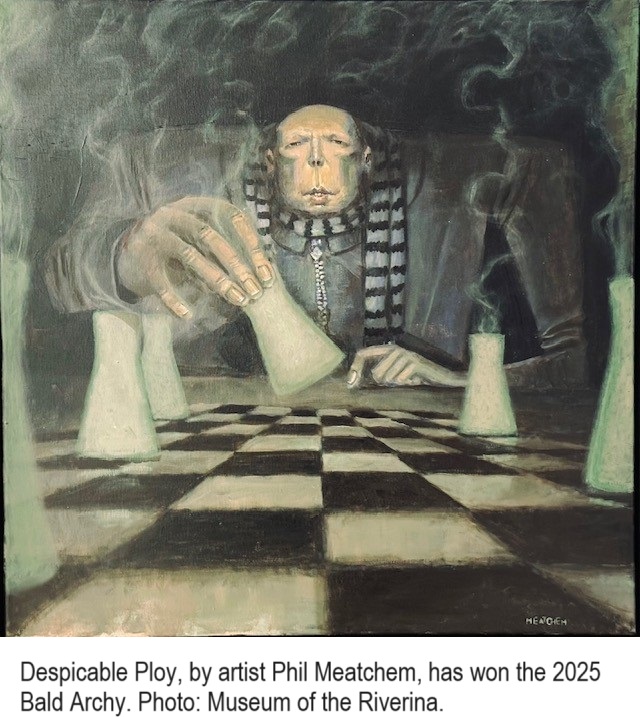
Region Riverina 29 March 2025 | Marguerite McKinnon
Despicable Ploy, by artist Phil Meatchem, has won the nation’s premier satirical art prize in Canberra. A Gru-inspired image of Opposition Leader Peter Dutton playing chess with some nuclear reactor pieces has taken out the 2025 Bald Archy Prize.
Mr Meatchem won the $10,000 prize for his painting after it was announced at the Canberra Potters and Watson Arts Centre.
Despicable Ploy is a satirical take on Opposition Leader Peter Dutton’s proposed nuclear power infrastructure plan.
“I’m not an artist with a strong political view. It was a simple idea of what looked like a pretty scary dude, to me at least, and these ominous looking nuclear monoliths,” Mr Meatchem said.
“It had been quite a while since I’d entered an art prize, and winning was a great surprise and a bit of lesson for me that, sometimes, you just have to have a crack.”………………………………………….. more https://regionriverina.com.au/dutton-nuclear-scheming-depiction-wins-2025-bald-archy-prize/87234/
One Horrible Year on from October 7 2023, a Bleak Reflection.

larryjhs September 27, 2024, https://webstylus.net/2024/09/27/a-bleak-year/?fbclid=IwY2xjawF1TM9leHRuA2FlbQIxMAABHesplRcX1423JwSpof6CAkT303FkdzIX_bEcTdRO5SkXXOkPsj9hdRcULg_aem_XDLROjlruTcdEBP9ZqlzlQ—
The past year since Hamas’ attack has been traumatic for the Australian Jewish community locally and internationally. The fate of hostages appears to in the hands of Netanyahu, his generals, and extremists, who despite public outrage, has continued to prosecute an unwinnable war. It is now clear that that Hamas has made numerous offers for a prisoner exchange and ceasefire, but these have been deliberately refused with a preference for war at all costs by the Israeli government. Israeli Jews who protest are now arrested and beaten up. This includes hostage members’ families and protesting members of the Israeli establishment. The forces of anti-democratic extreme nationalism and militarism have taken over the country, unimpeded. Sadly, this mentality appears to be held by some Jews locally.
This war against the Palestinian people has now been extended to the West Bank and into Lebanon against Hezbollah for firing rockets. For liberal Zionists, the sum total of such a military strategy is a betrayal of what they thought was possible, to negotiate a peaceful political settlement for two peoples, in two states. Zionism as an ideal now appears bereft of a moral foundation and liberal Zionists are flailing. For non-Zionists and anti-Zionist Jews, it is confirmation of their worst fears about the seemingly inevitable drift of Zionism to extremism of the worst sort.
Some now call what is going on genocide, others reject the term as offensive, and in fact, it is up to the Internal Court of Justice to make the final ruling. But with the ongoing evidence of incitement to genocide in the Israeli media, we should call a spade a spade. This is a situation where some Israeli Jews are calling for, or taking part in war crimes.
The violence in real time – aided by an almost unimpeded flow of American arms is like nothing we have seen before, and we have rapidly entered into the world of science fiction with remote explosions of pagers and other devices.
There is always the same excuse for such violence and its “collateral” damage – Hamas or Hezbollah are our eternal enemies and the fight is existential. The only solution is military eradication. Sadly, this is the script that has been in use for decades, but it has worn thin. This violence is an attempt to permanently destroy anything that amounts to independent Palestinian life. The Israel State rejects the existence of an independent Palestine. But people’s wars – which is what the revolt in Gaza is about – are not won by military force, as learned in Algeria and Vietnam.
Israel has committed war crimes in Gaza, far beyond Hamas’ own act on October 7. Israeli soldiers have been filmed rejoicing in destruction and using Palestinians as human shields. Hospitals and schools and universities have been destroyed and journalists killed. Aljazeerah is closed down. Thousands are arrested for unspecified crimes. Starvation is taking place. This is not an ordinary war for legitimate defence. It is something far, far worse. For Palestinians and their supporters, this is considered to be a continuation of what went on in 1948 and thereafter, but this time, the world sees the brutality on its screens.
This brutality helps to explain why the atrocity against Jews and foreign workers on October 7 is now considered by many on the left as of secondary importance, when it has become an obsession among Jews, used to reinforce the sense of eternal victimhood. It also helps to explain the simplistic identification by some with Hamas’ actions and its war machine as a justified form of resistance “by any means possible”, when the result has been the superior and brutal murder conducted by Israel. It also helps to explain why so many have doubted accounts of sex crimes and atrocities by Hamas, when Israel manipulated unclear information from the very beginning. In war, truth is the first casualty.
Israel/Palestine brings together issues of war and peace, identity, and great power politics as a social media event. It has become a focus for culture and political wars that particularly affect the thinking of alienated young people in a world that appears to be falling apart under the pressure of climate change, political corruption, and technological abuse.
The brutality of Israel’s assault also helps to explain how the uncritical acceptance of formerly specialist academic theories about colonialism, imperialism, and racism, have found root in many corners of the left internationally, angered by the lack of action by the US and others to stop the carnage. Palestine has become the cause celebre even a surrogate for all international injustice even though other brutal regional wars and massacres also call for attention. The difference is of course, that Israel has claimed to be acting as a democracy and in the interests of the West. At times of course, this anger over Israel has at times segued into explicitly conspiratorial antisemitism, though this is abhorrent to responsible pro-Palestine advocates.
In fact, the idea that only the colonized, not the colonialist has any rights is totally ahistorical. Theories should not be set in stone and exclude other insights. In this case, the current take on Israel as a colony reflects theoretical narrowness and the absence of deep knowledge or particular empathy for the peculiar and awful historical circumstances that brought about migration of so many Jews to historical Palestine, as Zionists of one sort or other, or desperate refugees. Once a colony, damned as a colony for ever, including its children. This is determinism. It has got to a point that the idea of a “conflict” is rejected, since the situation is seen as a pure invasion. The Jews of modernity are thus regarded as wholly outside interlopers to an imagined Palestine, when in fact Palestine was always multicultural, subject to migration forces and domination by great powers. I’ve thus got a real concern that Palestinian nationalism, for all its talk of future equality, shares a similar thread of intolerance of difference as the Zionist project. In fact, as the great Palestinian historian and activity Rashid Khalidi said in his The Hundred Years War on Palestine “[T]here are now two peoples in Palestine, irrespective of how they came into being, and the conflict between them cannot be resolved as long as the national existence of each is denied by the other.”
But such subtlety now appears to be rejected by many on the left in Australia with dogmatic calls for particular forms of future arrangements that smack of an antidemocratic form of thought and political control, and are devoid of any understanding of the reality of peacemaking in conflict zones, whatever the cause. The result, as we all know, has even been a political nightmare even in Australia as accusations are made about the direct complicity of any number of institutions for any connection to Israel and politicians are accused of heinous crimes well out of their direct control. Many Jews feel unsafe whether or not the threat is real. But as a number of commentators have said, there should be no confusion between the perception of unsafety because of political criticism that upsets a privileged comfort zone and blindness or indifference to the plight of others (as distinct from real antisemitism), and the truly and physically unsafe position of Palestinians in Gaza or the West Bank.
Of course, the intolerance shown by elements of the left to anything identified as “Zionist” deserves condemnation because it leads to stereotypes and oversimplification. Consequently, I have greatly regretted the lack of support on the left in Australia for the activist Israeli Jewish left which while a minority in the Israel, has taken on the hard task of standing up for Palestine. This criticism extends to elements of the anti-Zionist Jewish left who appear bereft of any empathy for 50% of the world’s Jews. This lack of support may be due to position that this amounts to “legitimatization” of Jewish -Israeli domination over that of oppressed of Palestinians. I think this is a wrong position to take. Conflict resolution needs people of goodwill from all sides, whatever the shape of final political arrangements, which I hope are based on principles of full and equal rights for all, the end to the occupation and the apartheid system and restorative justice for Palestinians. Huge political & psychological concessions are required by both sides, something hardliners refuse to admit at both ends.
Of course, actions of major Australian Jewish organisations, aligned to dominant political interests in acting as echoes for hasbarah and attacking Israel’s critics has been destructive. Their and others’ attack on universities for alleged and widespread antisemitism is also flawed, exaggerated, highly partisan, and a threat to academic freedom. Crying wolf over antisemitism is destructive to the interests of free political speech. Likewise, uninformed sloganeering, exaggerations and barbs on both sides, and attacks by Zionist or leftist thugs do nothing to progress social cohesion. They detract from political efforts to alter Australian foreign policy to take a strong stand against the Israeli state.
Sadly, I may be wrong in all this and we will be stuck with unceasing violence by the military state, a largely compliant population, continuing repression of Palestians and violent blowback while the world stands by. The US will be constrained by internal weakness to do any thing, and there will be an increased fracture between Israel and a fair proportion of world Jewry, while an unrepentant and fanatical faction pours in money and support and exerts political pressure. Bleak Bleak Bleak.
(edited a bit for clarification)
[The image is “Exterminating the cockroach” Yosi Even Kama came up with these posters about the fascist state in 2010 as part of an art project about how things would be in 2023]
Nuclear power exits Australia’s energy debate, enters culture wars

Jim Green, Jun 13, 2019, https://reneweconomy.com.au/nuclear-power-exits-australias-energy-debate-enters-culture-wars-47702/
What do these politicians and ex-politicians have in common: Clive Palmer, Tony Abbott, Cory Bernardi, Barnaby Joyce, Mark Latham, Jim Molan, Craig Kelly, Eric Abetz, and David Leyonhjelm?
Yes, they’re all men, and all so far to the right of the political spectrum that right-wing ideologues think they are right-wing ideologues.
And they all support nuclear power.
To the far-right, pro-nuclear luminaries listed above we could add the right-wing of the right-wing National Party (pretty much all of them), the Minerals Council of Australia (who lobby furiously for clean nuclear and clean coal), the Business Council of Australia ,media shock-jocks Alan Jones and Peta Credlin (and others), the Murdoch media (especially The Australian newspaper), the Citizens Electoral Council, and the Institute of Public Affairs and its front group the Australian Environment Foundation.
It’s no surprise that the far-right supports nuclear power (if only because the ‘green left’ opposes it).
But in Australia, support for nuclear power is increasingly marginalised to the far-right. Indeed support for nuclear power has become a sign of tribal loyalty: you support nuclear power (and coal) or you’re a cultural Marxist, and you oppose renewables and climate change action or you’re a cultural Marxist.
Support for nuclear power in Australia has ebbed in the aftermath of the Fukushima disaster, catastrophic costs overruns on reactor projects, and the falling costs of renewables.
Dr Ziggy Switkowski used to be nuclear power’s head cheerleader in Australia and he led the Howard government’s review of nuclear power in 2006. But he said last year that “the window for gigawatt-scale nuclear has closed” and that nuclear power is no longer cheaper than renewables with costs rapidly shifting in favour of renewables.
Peter Farley, a fellow of the Australian Institution of Engineers, wrote in RenewEconomy earlier this year:
“As for nuclear the 2,200 MW Plant Vogtle [in the US] is costing US$25 billion plus financing costs, insurance and long term waste storage. … For the full cost of US$30 billion, we could build 7,000 MW of wind, 7,000 MW of tracking solar, 10,000 MW of rooftop solar, 5,000MW of pumped hydro and 5,000 MW of batteries. … That is why nuclear is irrelevant in Australia. It has nothing to do with greenies, it’s just about cost and reliability.”
In January, the Climate Council ‒ comprising Australia’s leading climate scientists and other policy experts ‒ issued a policy statement concluding that nuclear power plants “are not appropriate for Australia – and probably never will be”.
The statement continued: “Nuclear power stations are highly controversial, can’t be built under existing law in any Australian state or territory, are a more expensive source of power than renewable energy, and present significant challenges in terms of the storage and transport of nuclear waste, and use of water”.
NUCLEAR COSTS INCREASE FOUR-FOLD, SEVEN-FOLD, TEN-FOLD
The 2006 Switkowski report estimated the cost of electricity from new reactors at A$40–65 per megawatt-hour (MWh). That’s roughly one-quarter of current estimates. Lazard’s November 2018 report on levelized costs of electricity gives these figures:
- New nuclear: A$161‒271 / MWh(US$112‒189)
- Wind: A$42‒80 / MWh(US$29‒56)
- Utility-scale solar: A$52‒66 / MWh(US$36‒46)
- Natural-gas combined-cycle: A$59‒106 / MWh(US$41‒74)
In 2009, Switkowski said that the construction cost of a 1,000 MW power reactor Australia would be A$4‒6 billion.
Again, that’s about one-quarter of all the real-world experience over the past decade in western Europe (and Scandinavia) and north America, with cost estimates of reactors under construction ranging from A$14‒24 billion.
The V.C. Summer project in South Carolina (two AP1000 reactors) was abandoned after expenditure of at least A$12.9 billion. The project was initially estimated to cost A$14.1 billion; when it was abandoned, the estimate was around A$36 billion. Largely as a result of the V.C.
Summer disaster, Westinghouse filed for bankruptcy and its parent company Toshiba almost went bankrupt as well.
The cost estimate for the Vogtle project in US state of Georgia (two AP1000 reactors) has doubled to A$38.8‒43.2+ billion and will increase further, and the project only survives because of multi-billion-dollar government bailouts.
In 2006, Westinghouse said it could build an AP1000 reactor for as little as A$2.0 billion ‒ that’s 10 times lower than the current estimate for Vogtle.
In the UK, three of six proposed reactor projects have been abandoned (Moorside, Wylfa, Oldbury), two remain in limbo (Sizewell and Bradwell) and Hinkley Point C is at the early stages of construction.
The estimated combined cost of the two EPR reactors at Hinkley Point, including finance costs, is A$48.7 billion (£26.7 billion ‒the EU’s 2014 estimate of £24.5 billion plus a £2.2 billion increase announced in July 2017).
A decade ago, the estimated construction cost for one EPR reactor in the UK was almost seven times lower at A$3.7 billion.
The UK National Audit Office estimates that taxpayer subsidies for Hinkley Point ‒ primarily in the form of a guaranteed payment of A$169 / MWh, indexed for inflation, for 35 years ‒ will amount to A$55 billion, while other credible estimates put the figure as high as A$91 billion.
Hitachi abandoned the Wylfa project in Wales after the estimated cost of the twin-reactor project had risen from A$26.4 billion to A$39.7 billion.
Hitachi abandoned the project despite offers from theUK government to take a one third equity stake in the project; to consider providing all of the required debt financing; and to consider providing a guarantee of a minimum payment per unit of electricity (expected to be about A$137 / MWh).
In France, one EPR reactor is under construction at Flamanville. It is seven years behind schedule (and counting) and the estimated cost of A$17.7 billion is more than three times the original estimate of A$5.4 billion.
In Finland, one EPR reactor is under construction. It is 10 years behind schedule (and counting) and the estimated cost of A$13.8 billion is nearly three times the original A$4.9 billion estimate.The A$13.8 billion figure was Areva’s estimate in 2012; true costs have likely increased
NUCLEAR EXITS AUSTRALIA’S ENERGY DEBATE, ENTERS CULTURE WARS
The far-right won’t let facts get in the way of their promotion of nuclear power. NSW Deputy Premier John Barilaro claims that nuclear power would probably be the cheapest power source for the average Australian household and is “guaranteed” to lower power bills.
The claim by the Institute of Public Affairs that 10 power reactors could be built for A$60 billion is out by A$100 billion or so. Jim Molan claims nuclear power is cheap and the cost is comparable to coal.
Clive Palmer claims that nuclear power is cheap and that the federal government should fund the construction of a nuclear power plant.
The far-right repeatedly claim that ‘small modular reactors’ (SMRs) will come to the nuclear industry’s rescue. But real-world experience with SMRs under construction suggests they will be hideously expensive.
According to a December 2018 report by the CSIRO and the Australian Energy Market Operator, the cost of power from SMRs would need to more than halve to be competitive with wind and solar PV even with some storage costs included (two hours of battery storage or six hours of pumped hydro storage).
Tony Abbott’s rationale for supporting nuclear power ‒ and repealing Howard-era legislation banning nuclear power plants ‒ is to “create a contest” with the unions, GetUp, the Greens and the Labor Party. Likewise, he said last year that promoting nuclear power “would generate another fight with Labor and the green left.”
Abbott ‒ and some others on the far-right ‒ would undoubtedly oppose nuclear power if Labor and the ‘green left’ supported it and they would be pointing to the A$14‒24 billion price-tags for new reactors in western Europe and north America.
Abbott seems to have forgotten the experience in John Howard’s last term as Prime Minister. Howard became a nuclear power enthusiast in 2005 and the issue was alive in the 2007 election contest.
Howard’s nuclear promotion did nothing to divide the Labor Party. On the contrary, it divided the Coalition, with at least 22 Coalition candidates publicly distancing themselves from the government’s policy during the election campaign.
The policy of promoting nuclear power was seen to be a liability and it was ditched immediately after the election.
LUNATICS IN CHARGE OF THE ASYLUM
Those of us opposed to nuclear power can take some comfort in its increasing marginalisation to the far-right. But there are far-right-wingers highly placed in the federal government and a number of state governments.
Right-wing National Party MPs are lobbying for a Senate inquiry and for a repeal of the legislation banning nuclear power. According to Greens Senator Sarah Hanson-Young:
“Talk of overturning the ban on nuclear power in Australia is crackpot stuff. Aside from being a dangerous technology, nuclear power is wildly expensive and would take a decade or more to build. It would be a funny joke if it wasn’t so embarrassing to have the Nationals, who are in government and who sit around the cabinet table, pushing for this. These people are meant to be in charge, and they’re running around like a bunch of lunatic cowboys.”
Senator James McGrath claims that many Nationals support nuclear power, hence the push for a Senate inquiry “to make informed decisions rather than allow the loons of Twitter to shout down this important discussion.”
On the subject of “loons”, as he describes them, McGrath’s pown erformance on ABC’s Q&A program in April was likened to a “one way trip to crazy town“.
It has the sense of a political set-piece: the far-right wins control of the numbers on a Senate inquiry and the government agrees with its pro-nuclear findings and repeals the legislation banning nuclear power.
But would Prime Minister Scott Morrison agree to repeal the ban given that there is no prospect of nuclear power being a viable option for Australia in the foreseeable future? Surely that would be an own goal, providing ammunition to political opponents and opening up divisions within the Coalition.
If Morrison agreed to repeal the ban ‒ and he says the government has no plans to do so ‒ it would presumably only be because he felt constrained to do so by far-right Coalition MPs and by non-government far-right Senators such as Pauline Hanson. (He is also dealing with the far-right push for government funding for a new coal-fired power plant.)
NSW Premier Gladys Berejiklian has the same calculation to make in response to the nuclear power push driven by right-wing Nationals (including Deputy Premier John Barilaro) and by One Nation’s Mark Latham (who introduced the Uranium Mining and Nuclear Facilities (Prohibitions) Repeal Bill 2019 to the NSW Parliament in May 2019).
ECOMODERNISTS
Of course, support for nuclear power in Australia isn’t exclusively limited to the far-right, although it is heading that way.
A tiny number of self-styled ‘pro-nuclear environmentalists’ or ‘ecomodernists’ continue to bang the drum. Ben Heard, for example, continues to voice his support for nuclear power ‒ his advocacy lubricated by donations and amplified by the right-wing media and by invitations to any number of nuclear-industry talk-fests.
Heard continues undeterred by the South Australian Nuclear Fuel Cycle Royal Commission’s clear acknowledgement that nuclear power is not economically viable in Australia or by its complete rejection of his ‘next generation’ nuclear fantasies.
But what impact could Heard’s nuclear advocacy possibly have in the current context, with fossil fuel interests fighting to protest their patch and to curb the growth of renewables, and with nuclear power being so exorbitantly expensive that isn’t part of any serious debate about Australia’s energy options?
Surely the only effect of nuclear advocacy in the current context is to muddy the debate about transitioning from fossil fuels to renewables and thus to shore up incumbent fossil fuel interests.
Australian economist John Quiggin discussed these issues last year:
“The problem is that nuclear fans like Ben Heard are, in effect, advocates for coal. Their line of argument runs as follows:
(1) A power source with the characteristics of coal-fired electricity (always on) is essential if we are to decarbonise the electricity supply
(2) Renewables can’t meet this need
(3) Nuclear power can
“Hence, we must find a way to support nuclear. The problem is that, on any realistic analysis, there’s no chance of getting a nuclear plant going in Australia before about 2040.
So, the nuclear fans end up supporting the Abbott crew saying that we will have to rely on coal until then. And to make this case, it is necessary to ignore or denounce the many options for an all-renewable electricity supply, including concentrated solar power, large-scale battery storage and vehicle-to-grid options.
As a result, would-be green advocates of nuclear power end up reinforcing the arguments of the coal lobby. … In practice, support for nuclear power in Australia is support for coal. Tony Abbott understands this. It’s a pity that Ben Heard and others don’t.”
Dr Jim Green is the editor of the Nuclear Monitor newsletter and national nuclear campaigner with Friends of the Earth Australia
‘Like a radioactive cloud’: elegance and horror combine in powerful Yhonnie Scarce exhibition
Australia’s forgotten nuclear history and its dehumanisation of Aboriginal people come together in First Nations glass artist’s fiercely intellectual work.
Guardian, by Rosamund Brennan, 2 Apr 24
Yhonnie Scarce grew up in the grim aftermath of nuclear weapons testing in South Australia in the 50s and 60s, not far from her birthplace of Woomera. From the tender age of ten, she heard stories from elders about a cataclysmic roar, the sky turning red and a poisonous black mist hovering over the desert, like an apparition.
Born in 1973, the Kothakha and Nukunu glass artist has spent much of her career researching the British government’s testing of nuclear weapons in Maralinga and Emu Field, which she says “lit a fire in my heart that hasn’t been extinguished”.
The blasts wreaked havoc on generations of Aboriginal people, as well as military personnel and non-Aboriginal civilians – sending radioactive clouds thousands of kilometres, causing burns, blindness, birth defects and premature death.
When the toxic plumes reached Ceduna, where Scarce’s family lived, radioactive slag rained down from the sky, singeing their skin. Their concerns about the burns were rebuffed by doctors, who spuriously claimed there was a measles outbreak. But today, according to Scarce, cancer is prevalent in the town.
“I call this a mass genocide,” Scarce says. “I don’t know if we’ll ever find out how many Aboriginal people died over that 10-year period. But I can imagine it’s thousands.”………………………………………………………………………………………………..
The series is revelatory of Scarce’s practice: at once fiercely intellectual, deeply felt and elegant in its materiality. As a glass-blower, Scarce quite literally breathes life into her work, animating its delicate, molten surface, giving form to invisible pain and loss.
Glass holds special significance for Scarce: crafted from silica, or sand, it emerges from the very essence of the landscape. As Australia’s only professional Indigenous glass-blower, she veered away from working with traditional forms like decorative vases or bowls, instead drawing from what she calls the “bush supermarket”: depicting yams, plums and bush bananas to convey the history of her people.
Conceived by Wardandi and Badimaya curator Clothilde Bullen, the career-spanning exhibition at AGWA also features works which examine the dehumanisation and exploitation of Aboriginal people through displacement, indentured labour and institutionalised racism. One such work is In The Dead House, which features glass bush bananas laid out on a mortuary trolley, their bodies split wide open.
……………………………………………………………………………………………… In a seemingly fated moment, when those monstrous atomic bombs exploded at Maralinga almost 70 years ago, the red desert sand melted into thousands of green shards of glass that still litter the site today. Across Scarce’s 20-year career, it’s as if she’s been slowly collecting the disaster’s shattered remains and, piece by piece, crystallising a dark, hidden chapter of Australia’s history. Like a radioactive cloud, her astonishing body of work engulfs you in its sheer power and potency.
https://www.theguardian.com/artanddesign/2024/apr/02/yhonnie-scarce-light-of-day-art-gallery-western-australia
- Yhonnie Scarce: Light of Day is showing at the Art Gallery of Western Australia until 19 May 2024
The prospect of omnicide – whose fault?

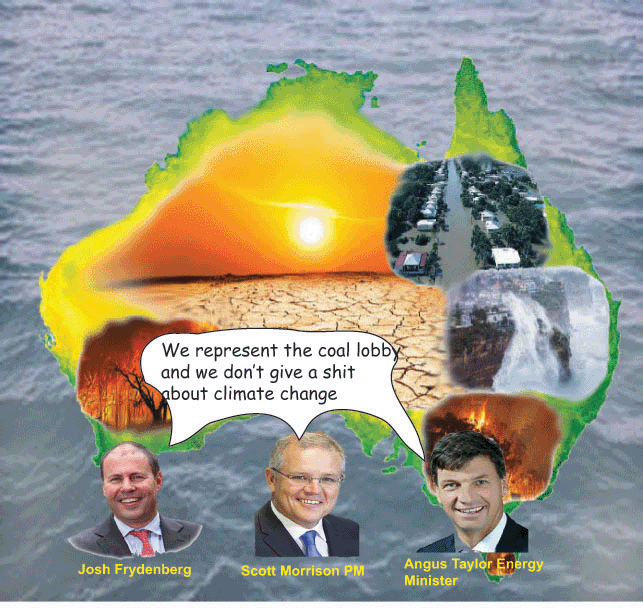 disaster. The same political representatives who approved and continue to approve new coalmines in the face of scientific consensus on the effect that continuing to burn fossil fuels will have on climate in general, and drought and temperatures in particular. The same political representatives who approve water being diverted to support resource extraction, when living beings are dying for want of water and drying to the point of conflagration.
|
Omnicide: Who is responsible for the gravest of all crimes? https://www.abc.net.au/religion/danielle-celermajer-omnicide-gravest-of-all-crimes/11838534?fbclid=IwAR0kOl8bovqqaBMq9XVaiUKq8HUElnk1s13dCWnEOh5p88lxtxb_UyLTj4w Danielle Celermajer 3 Jan 2020,
As the full extent of the devastation of the Holocaust became apparent, a Polish Jew whose entire family had been killed, Raphael Lemkin, came to realise that there was no word for the distinctive crime that had been committed: the murder of a people. His life work became finding a word to name the crime and then convincing the world to use it and condemn it: genocide. Today, not only has genocide become a dreadful part of our lexicon. We recognise it as perhaps the gravest of all crimes. During these first days of the third decade of the twenty-first century, as we watch humans, animals, trees, insects, fungi, ecosystems, forests, rivers (and on and on) being killed, we find ourselves without a word to name what is happening. True, in recent years, environmentalists have coined the term ecocide, the killing of ecosystems — but this is something more. This is the killing of everything. Omnicide. Continue reading |
Nuclear Groundhog Day in Australia
it is right-wing ideologues who continually resurrect nuclear power
historically-informed judgments matter, as energy policy specialists like Benjamin Sovacool realize, writing that SMRs are almost entirely rhetorical fantasies built upon utopian expectations.
Do you ever get the feeling that the continual resuscitation of the nuclear power option is just one more continual delay in meaningful reform of our energy portfolio? One more continual delay in meaningful reduction of CO2 emissions and the shifting of the electricity grid toward significant incorporation of renewables?
 Australia’s nuclear fantasies: the technological creationism of nuclear power, Nuclear Monitor, December 2019, Dr. Darrin Durant ‒ Lecturer in Science and Technology Studies at the University of Melbourne Australia’s nuclear fantasies: the technological creationism of nuclear power, Nuclear Monitor, December 2019, Dr. Darrin Durant ‒ Lecturer in Science and Technology Studies at the University of MelbourneIt is just a little past Nuclear Groundhog Day in Australia. A 2019 parliamentary inquiry 1 into the conditions under which future Governments might consider nuclear power in Australia recently concluded that emerging nuclear technologies were a clean energy pathway for Australia.2 This recommendation was immediately opposed by Labor and the Greens, and even opened up divisions within the Coalition, while also failing to resolve how partially lifting Australia’s nuclear ban (for one type of nuclear generating technology) could practically work. Much ink and even more pixels have been and will continue to be splayed everywhere on this polarized issue, but the untold story of the nuclear option is that it is in fact a technological form of Creationism. Let me explain. Nuclear power is like a wild goose chase where the goose is a zombie that cannot be killed. The nuclear option in Australia has been buried at least three times previously, only to be brought back from the dead. Nuclear power was originally prohibited by legislation. Section 10 of the Australian Radiation Protection and Nuclear Safety Act 1998 prohibits fuel fabrication, enrichment or processing, and nuclear reactors.3 Section 140A of the Environmental Protection and Biodiversity Conservation Act 1999 prohibits the federal Minister from approving an action leading to such installations.4 Yet a federal Government review of 2006 (the Switkowski Report) considered the potential to establish such installations, although it concluded nuclear power in Australia was uneconomic.5 A 2016 South Australian royal commission to investigate the potential for SA to participate in the nuclear fuel cycle similarly concluded nuclear power in Australia was not commercially viable.6 Nuclear power does not affect its own resurrection by virtue of its own divine power. Instead, like Lazarus was said to have been resurrected by Jesus four days after retirement, nuclear power has divine ideologues on its side. Obviously not the Labor Party, which thinks resurrecting the nuclear option signals the indulging of political fantasies7 , nor the Greens, who think resurrecting the nuclear option is the stuff of crackpot lunatic cowboys.8 Instead, as Friends of the Earth wrote, it is right-wing ideologues who continually resurrect nuclear power, in a culture war trying to wedge the political Left.9 Or as the economist John Quiggin wrote, support for nuclear power is de facto support for coal.10 Given the decades of lead time required for nuclear power to feed into the electricity grid and, assuming publics and politicians swallow the argument that renewables cannot satisfy base-load power requirements, coal is advertised as the only viable option until nuclear comes online. The technological creationism of nuclear power But the nuclear option has more than the business-as-usual commitments of right-wing ideologues on its side. The nuclear option has inherited an argumentative strategy from American Creationists, which the evolutionary biologist Eugenie Carol Scott coined the Gish Gallop.11 Named after the Creationist Duane Gish12, Scott wrote that the strategy involves making “a simple declarative sentence, and you have to deal with not an easily-grasped factual error, but a logical error and a methodological error, which will take you far longer to explain… [Creationists present] half-truth non-sequiturs that the audience misunderstands as relevant points. These can be very difficult to counter in a debate situation, unless you have a lot of time. And you never have enough time to deal with even a fraction of the halftruths or plain erroneous statements”.13 We can miss the Gish Gallop at the heart of pro-nuclear advocacy if we chase the controversy. We know nuclear power is politically polarizing and it is easy to report on clashing protagonists making seemingly alternate-reality claims. Thus the Australia Institute’s submission to the parliamentary inquiry dismissed nuclear power as uneconomic, climate unfriendly because of high water use in an already drought-prone Australia, and as lacking a social license.14 In black mirror fashion, the Minerals Council of Australia strongly supported nuclear power as affordable, climate friendly because of zero-emissions, and as enjoying rising public support.15 Like chasing Creationists down the rabbit holes of their homespun Gish Gallops, opponents of nuclear power can spend a fruitless amount of intellectual and emotional energy rebutting half-truths and methodological sleights of hand. The fruitlessness stems from earnestly interpreting the opponents’ claims ‘straight’ and tackling them head on. The Minerals Council of Australia For instance, the Minerals Council of Australia (MCA) argues that nuclear power is affordable and that Small Modular Reactors (SMR) represent a cheap and feasible option for Australia.15 By contrast, the (independent) World Nuclear Industry Status Report found that nuclear power costs 5-10 times more per kWh than renewables, and that there is no sign of a technological or commercial breakthrough that would render SMRs viable.16 Similarly, the MCA argues that climate change is real, and that nuclear power is the only way Australia can meet our Paris Agreement goals without sacrificing jobs and prosperity. But are the MCA really climate defenders? The thinktank InfluenceMap – which tracks climate policy opponents – ranks the MCA -59 (or 8th worst Trade Group) in its carbon policy footprint scores (-100 is highly and negatively influencing climate policy; +100 highly and positively influencing climate policy).17 Unfortunately, straight rebuttals matter little to technological creationists. Anything can be cheap, depending upon how you trim the costs. Everything can be feasible, depending upon your tolerance for fantasy. Anyone can be green, depending upon your degree of gullibility Gish Gallop The difficulty presented by the Gish Gallop argumentative strategy is that only on the surface is the critic confronted by factual claims open to empirical challenge. Deeper down, we have pregnant misdirection, diversionary reframing, and strategic incompleteness. The strategy does not even have to be deliberate gaslighting18, where the aim is to disorient and destabilize the audience in a quest to leave the speaker the beneficiary of the disenchantment of truth. Instead, the Gish Gallop simply entices the audience to run off in multiple directions at once, earnestly looking for the grounding of a claim that is in fact a groundless fog. For instance, are nuclear reactors zero emissions, as the MCA claims? There is a grain of truth there, if the nuclear life cycle is restricted to reactor operation. But as the energy analyst and environmentalist Mark Diesendorf has shown, to calculate the emissions from nuclear power one must account for fossil fuel use in every other aspect of the nuclear life cycle (mining, milling, fuel fabrication, enrichment, reactor construction, decommissioning and waste management). Moreover, the lower the grade of uranium ore, the higher the resulting emissions, so that nuclear power will emit more CO2 over time as highergrade ores are used up.19 Some analysts try to be fair, concluding that emissions from nuclear power are neither zero nor high and made complex by multiple uncertainties20, or that unstated assumptions about the carbon footprints of energy supplied in the non-operational phases of the nuclear fuel cycle strongly determine the ultimate carbon footprint.21 But notice how it is the audience that must supply the context for assessing pro-nuclear technological creationist claims? The necessary context for assessing claims – zero emissions, etc. – is willfully deleted from the message itself. SMRs Similarly, the MCA writes that SMRs ‘are simply an evolution of a proven mature technology’.15 Specific claims about an unproven technology (SMR) are then treated as general warrants for a technology which possesses an actual track record (where the track record is not supplied). Again, straight responses are possible. The anti-nuclear activist Noel Wauchope lists seven reasons why SMRs are unwise 22, and Quiggin questions whether the plant that is supposedly going to manufacture the technology even exists.23 But it is the context deleted by the MCA that is of most relevance, so we must ask about the track record of this ‘mature’ technology and whether SMRs are just an unproblematic next step. The maturity claim typically means nuclear technology has benefited from economies of scale and social learning, so that construction times and costs would go down over time. But as the World Nuclear Industry Status Report (and previous versions) shows, nuclear power lacks an upward learning curve.16 Reactor cost blowouts in time and money have been the norm since the technology’s inception. SMRs have inherited that legacy, with a survey of eight countries showing SMRs are even less economically competitive than large nuclear plants. The Gish Gallop strategy here is simply to delete history from the evaluative criterion. But historically-informed judgments matter, as energy policy specialists like Benjamin Sovacool realize, writing that SMRs are almost entirely rhetorical fantasies built upon utopian expectations.24 Indeed, the broader case for nuclear power in Australia is similarly built upon a Gish Gallop strategy of strategic deletion perversely coupled with proliferating half-truths. For instance, the MCA claims that surveys indicate increasing public support for nuclear power. But closer analysis shows that support varies if nuclear power is framed as a solution to climate change, indicating the support may reflect desired action on climate change itself.25 Moreover, most have no desire to live near a reactor. Climate wedges But this entire argument about a technology-neutral approach being premised on the need to pursue all elements in an energy portfolio at once rests on willfully deleting the context for assessing energy choices. The climate wedge idea derives from a 2004 paper by Stephen Pacala and Robert Socolow.27 A wedge represents an activity that reduces emissions to the atmosphere starting at zero today and increases linearly until it accounts for one billion metric tonnes of reduced carbon emissions in 50 years. But as Pacala and Socolow noted, “although no element is a credible candidate for doing the entire job (or even half the job) by itself, the portfolio as a whole is large enough that not every element has to be used”.27 Not every element! The technology-neutral, all-of-the-above approach is both bad energy economics and deceptive politics, because passive and complacent business-as-usual masquerades as active and concerned political choice. Was democratic debate really meant to be this way? When we say democratic debate is about letting each side have its say, is the kind of argumentative sleight of hand practiced by pro-nuclear technological creationists really what we were imagining? To anticipate a reply that might be offered as complementary but is a mistake: no, truth is not the answer. Truth can be despotic, as the political philosopher Hannah Arendt argued in 1967, peremptorily demanding to be recognized and precluding debate by relying on the coercive force of self-evidence.28 Or put differently, truth is great when you have it on your side, until everyone claims it is on their side, and politics reduces to who coerces last But nor is the abandonment of truth to opinion the answer either. In the phrase of another political philosopher, Nadia Urbinati, to be unpolitical is to remove an issue in need of deciding from the open arena of competing political visions, political groups, and partisan views.29 Urbinati advises we defend the merits of political deliberation, because it allows for contestation and revision, and be wary of forensic decisions by experts. But is a little more of the unpolitical – a little less political deliberation – sometimes a wise move? Do you ever get the feeling that the continual resuscitation of the nuclear power option is just one more continual delay in meaningful reform of our energy portfolio? One more continual delay in meaningful reduction of CO2 emissions and the shifting of the electricity grid toward significant incorporation of renewables? The nuclear power option has had its day but lives to tell another day because we tell ourselves that debating all the options is always good, even if we should really be saying some option needs to be retired. The context at work making this continual resuscitation possible is not just the persistence of business-as-usual elites, but the political ecology in which those elites reside. Political populism radically polarizes public forums and delegitimates the independent advice-giving institutions of democracy. Media and cultural partisans have turned political deliberation into a spectator sport. The business-as-usual ethos exploits that weakened ground of consensus-formation to suggest old options are better than new options. A crisis of truth, authority and legitimacy As the historian of science Steven Shapin has suggested, we are facing a crisis of truth not because facts are being routinely contested or even because facts are being routinely made up, but because our institutions are suffering a crisis of authority and legitimacy.30 We have lost track of who knows and does not know, which is a dearth of social knowledge about reputation and integrity. Keeping the spectre of nuclear power at bay will require rethinking our institutions and how they can assist in making the objects of our political deliberation worthy objects. We can neither give up on experts nor citizens, but we do need to revisit how we think about each. As myself and some fellow sociologists of science have argued, experts at the service of business-as-usual will never escape institutional delegitimisation effects, so we must look to expertise playing the role of a check and balance within our pluralist democracies.31 Similarly, citizens do need to engage with public claims to test their contextual merits and coherency. But as analysts of public participation like Matthew Kearnes and Jason Chilvers have warned, until organizations and institutions are more transparent and candid about their assumptions, values and interests, the burden of proof will fall unevenly on the less powerful.32 In each case, experts and citizens, what we need from them is interrogation of context. Not simply can they be our fact checkers, but can they be our redeemers of context, our arbiters of whether half-truths are masquerading as full claims, and our unmaskers of the pretenders at coherence? Dr. Darrin Durant’s research focuses on how experts and citizens interact in democratic debate, especially in debates about energy politics. Recent books include Experts and the Will of the People (2019) and previous work on the nuclear fuel cycle including Nuclear Waste Management in Canada (2009). Reprinted from New Matilda, 17 Dec 2019, ‘Nuclear fantasies down under: the political and economic problems with old money power’, https://newmatilda. com/2019/12/17/nuclear-fantasies-down-under-thepolitical-and-economic-problems-with-old-money-power/
|
|
Australian film-makers to join in 10th Uranium Film Festival in Rio de Janeiro May 2020
 Marcia Gomes de Oliveira shared a link. 2 Nov 19
These filmmakers and producers have already agreed to come to Rio 2020: Peter Kaufmann (Australia), Kim Mavromatis (Australia), Laura Pires (Brazil), Angelo Lima (Brazil), Miguel Silveira (USA/Brazil), Cris Uberman (France), Marcus Schwenzel (Germany), Rainer Ludwigs (Germany), Michael von Hohenberg (Germany), Peter Anthony (Denmark), Michael Madson (Denmark), Lise Autogena (Denmark), Masako Sakata (Japan), Maurizio Torrealta (Italy), Alessandro Tesei (Italy), Amudhan R.P. (India), Tamotsu Matsubara (Japan), Tamiyoshi Tachibana (Japan), Tineke Van Veen (Netherlands), Mafalda Gameiro (Portugal), James Ramsay Cameron (Scotland), José Herrera Plaza (Spain), Marko Kattilakoski (Sweden), Edgar Hagen (Switzerland),Tetyana Chernyavska (Ukraine), Brittany Prater (USA), Ian Thomas Ash (Japan/USA).
Rio’s 10th International Uranium Film Festival is scheduled for May 21st to 31st. Do not miss it!
What the planet needs from men
We’ve just endured a series of 40-plus days across much of the country, last month was the hottest on record. We joke. Thirty-six is the new normal, haha. I gaze with cold-envy at Antarctica, minus 29. But see this for what it is. This is the will-to-dominance: fragile masculinity in action.
Yet we continue to beat nature into submission, as if striving to make the world hotter and weather events more extreme. Other countries reduce emissions. Germany pledges to close its remaining coal-fired power plants in 30 years. Australia could match that. Both UNSW and the CSIRO with Energy Networks Australia argue that renewables could easily supply most or all of our future energy needs. Instead, we become the developed world’s only deforestation hotspot, expected to clear-fell a further 3 million hectares in 15 years.
The Darling Basin Royal Commission finds “gross maladministration” and “negligence” in our governments’ wilful ignorance of climate change. Even the courts, bless them, have started to disallow coal mines for their climate impact. Yet the government response is, well, nothing, actually. Minister Littleproud mentions “learnings” from the Darling but still our noble leaders favour irrigators, build motorways, approve new mines, deny climate science and ease the path to public subsidies for one the biggest coal mines on earth as though it’s all fine.
It’s not fine. This is domestic violence. This planet is our home and they thrash around in it yelling, intimidating, wrecking the joint. Like violent husbands they get all remorseful and beg forgiveness only to do it all again. Why? Because we’ve always thrashed nature, and nature has always coped. As a bloke once said to me: “You don’t want me to shout and get possessive? But I’ve always treated women like this.”
Stoically, the planet has housed and nourished us, tolerated us. But it can’t last. A dominance relationship is never sustainable, human-to-human or human-to-nature. Winning? To win this battle is to lose. The era of collaboration is here………….
It’s when people “stitch their self-worth to being all-powerful” that things go bad. An equal-status relationship – with a partner or with nature – requires listening, empathy, the antidote to shame.
We talk as though “traditional masculinity” were the enemy, as though we want men to evolve into something more like women. But that’s wrong.
What we need is not faux-women but nobler, more confident men. The man-heroes of the future, if we’re to have one, won’t be the brutes and sociopaths. They won’t be the cruel and the thoughtless, the boat-stoppers and coal-brandishers. They’ll be those who hold power but refuse to exploit it, renowned as much for their kindness as their exploits. Literally, gentlemen.
Male anger is leading us over a cliff. If men can find the strength to be truly vulnerable, they deserve to lead. If not, if they persist in this fragile rage, it’ll be up to Rosie the Riveter to save the day. Why? Because there is no spare room to sleep in. https://www.brisbanetimes.com.au/national/what-the-planet-needs-from-men-20190214-p50xrq.html
The Royal Nuclear Show — exhibition on in Victoria
Public works: Royal Nuclear Show, THE AUSTRALIAN, By BRONWYN WATSON, DECEMBER 7, 2018
“……….Screen-printing workshops across the country, such as Redback Graphix, Earthworks Poster Collective and the Tin Sheds, created posters that adorned cafes, telephone poles, university campuses, libraries and virtually any public space. They had slogans such as No Nukes No Tests, No More Hiroshimas, and End Uranium Mining. At the time, perception of a nuclear future was seen as progressive and positive, with governments and industry trying to promote nuclear experimentation as necessary to the nation’s security and beneficial to humanity.
One artist who emphasised these issues in her poster prints was Toni Robertson, whose work, The Royal Nuclear Show — 3, is on show at the Burrinja Dandenong Ranges Cultural Centre in Upwey, Victoria. Produced while Robertson was an artist-in-residence at the Experimental Art Foundation in Adelaide in 1981, it depicts a dystopian post-nuclear carnival where crowds wander past a billboard with a baby sleeping and sucking a bottle. On the baby’s pillow is written Bomblet. The billboard reads: “Meet the nuclear family, Bomblet the baby nuke. He’s so like his dad! This little boy was conceived as a low yield, tactical weapon for use in limited theatre war.” “Little boy” was the name given to the bomb dropped on Hiroshima.
……. Gallery and exhibition curator JD Mittmann says this work “really resonates quite strongly with me. It is really a statement of the time, but I think not much has changed in some ways. We are still sold nuclear technology, especially as a solution to climate change problems. Certainly, it is important to remember how dangerous these things are, and so I think this print might have been from 1981 but if you had 2011 underneath it, it would work in just the same way.” https://www.theaustralian.com.au/arts/review/public-works-royal-nuclear-show/news-story/aa2b2b7a2a0dd38f6f6efcc61d15d081
Striking school students are more likely to have successful careers
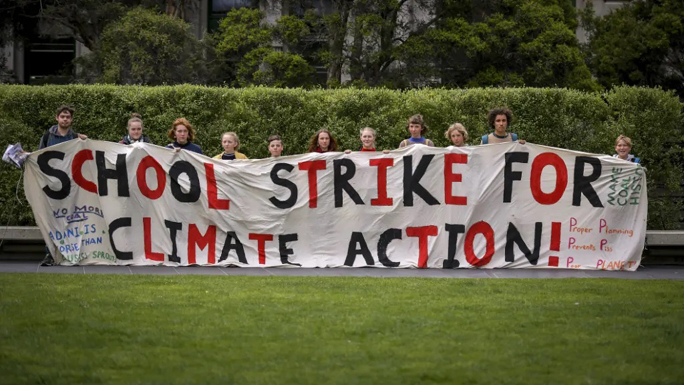 School strikers are going places but the dole queue isn’t one of them, https://www.brisbanetimes.com.au/environment/climate-change/school-strikers-are-going-places-but-the-dole-queue-isn-t-one-of-them-20181202-p50jog.html, By Clive Hamilton 2 December 2018 The resources minister, Matt Canavan, last week told students that the only thing they’d learn by skipping school to protest over inaction on climate change would be how to join the dole queue.
The history of protest in Australia shows the opposite. The protest leaders of the 1960s and 1970s, including many high school students, were denounced by conservatives as long-haired layabouts who would never amount to anything. In fact, they became the next generation of leaders in politics, universities, media, the public service, NGOs and even business.
Take the 1965 Freedom Ride, for instance. “Look at em,” said one RSL stalwart when students turned up to protest against the ban on black diggers. “The brains of Australia! God help you if you ever end up under em.” That’s exactly what happened. The Freedom Ride’s leaders included Jim Spigelman, who would go on to become Chief Justice of NSW and chair of the ABC, Ann Curthoys, later an eminent professor, and Charles Perkins, who became an Aboriginal leader, leading public servant and one of Australia’s Living National Treasures.
Student protesters have become newspaper editors, cabinet ministers, prize-winning poets, much-loved cartoonists, publishers, world-famous authors and Supreme Court judges.
There’s a reason they develop into leaders. It’s those young people who throw themselves into civic engagement who become the best citizens and most productive members of our society. They are the passionate ones willing to stand up. They are not content to “work, consume, die” but commit themselves to making a better Australia.
When we hear Canavan tell 2GB the protesters are “not actually taking charge of their lives” and they should get a real job, he’s telling them they should not be active, motivated citizens but docile consumers who leave politics to the politicians.
The protesting school kids, tired of watching the sacrifice of their future by a government dominated by climate science deniers, had some sharp answers to that, waving placards reading “Why should we go to school if you won’t listen to the educated?” and “I’ve seen smarter cabinets in Ikea”.
The students are carrying on a noble tradition. The great social movements that defined modern Australia—the movements for women’s liberation, gay rights, Indigenous rights, and environmental protection—all inspired school students to get out on the streets, wave banners and chant slogans.
Clive Hamilton is the author of What Do We Want? The Story of Protest in Australia and professor of public ethics at Charles Sturt University in Canberra.
Burrup peninsula rock art: Western Australia to seek World Heritage Listing
‘A Senate report warning of damage to the 50,000-year-old treasures
has persuaded the state government to act’ Calla Wahlquist
@callapilla,27 Aug 2018
‘The Western Australian government has formally committed to
pursuing world heritage status for the Burrup peninsula,
one of the oldest and richest examples of rock art in the world.
‘It comes five months after a Senate inquiry report into managing the site warned that the cumulative emissions from heavy industry on the peninsula, centred around the north-west shelf gas project, could be damaging
the surface of the rock art and causing it to degrade.
‘The step towards nomination has been welcomed by rock art experts,
who say it is one of the most significant archeological sites in the southern hemisphere.
‘“The thing that is unique about this is that it covers almost the entire origin of the north-west coast of Australia, and it is hunter-gatherers from the bottom to the top,”
director of the University of Western Australia’s centre for rock art
research and management, Jo McDonald, said.
“Nowhere else has it covered 50,000 years of hunter-gatherer human history.” … ‘ Read more of Calla Wahlquist‘s ground-breaking & comprehensive & well-researchedarticle:
www.theguardian.com/australia-news/2018/aug/27/burrup-peninsula-rock-art-western-australia-to-seek-world-heritage-listing
Black Mist Burnt Country: art under the nuclear cloud of Maralinga
https://www.smh.com.au/entertainment/art-and-design/black-mist-burnt-country-art-under-the-nuclear-cloud-of-maralinga-20180823-p4zz7i.html, By Karen Hardy 24 August 2018 On September 27, 1956, the British exploded an atomic bomb on Pitjantjatjara land in South Australia. The place would become known as Maralinga, which means “thunder” in the now-extinct Garik Aboriginal language.
Black Mist Burnt Country tells the stories of the atomic tests in Australia in the 1950s and ’60s, revisiting the events and locations through the artworks of Indigenous and non-Indigenous contemporary artists across the mediums of painting, print-making, sculpture, photography, video and new media.
Now showing at the National Museum of Australia, it has been touring with great success since September 2016, opening then to commemorate the 60th anniversary of the first test at Maralinga.
Curator JD Mittman, from the Burrinja Dandenong Ranges Cultural Centre, grew up “under the nuclear cloud” in Germany during the 1980s and when he came to Australia he was surprised to learn there had been atomic tests here.
In the collection of the small community arts centre he found a large canvas work by Jonathan Kumintjarra Brown entitled Maralinga Before the Atomic Test.
The question for me was what did ‘after’ look like?”
When he began his research he was surprised to find so many works concerning Australia’s place in the nuclear race.
Artist Arthur Boyd participated in anti-nuclear demonstrations in the 1960s and his Jonah on the Shoalhaven – Outside the City (1976), features a tiny mushroom cloud, blending biblical imagery with contemporary landscape and personal symbolism.
Sidney Nolan’s Central Desert: Atomic Test (1952-57) is part of a classic series of desert landscapes Nolan began in the late 1940s. He added a mushroom cloud on the horizon at a later date.
“Every generation has taken a different approach.”
There are large canvases by Kumintjarra Brown, one Frogmen, shows three men in masks and protective suits, another Black Rain tells the tragic story of a group of Anangu people who were found huddled together, dead, in a crater near the bomb site.
Mittman says it’s important for Australians, particularly generations who may not have even heard of the testing, let alone those of us to whom Maralinga is a familiar word but were unaware of such details as then prime minister Robert Menzies did not even consult cabinet when he gave permission to begin the testing.
“There is great concern among the indigenous community, and I don’t want to speak on their behalf, about the ongoing repercussions of the testing on country.
“And it’s even more than that, the multi-media work from Linda Dement and Jessie Boylan builds a bridge between the past and the present. “There are 15,000 warheads in the world at present, many of them on planes, in submarines, ready to strike within minutes.
He says it’s somewhat fitting that the exhibition opens in Canberra in the same week the International Campaign to Abolish Nuclear Weapons protest arrives in Canberra heading to parliament to urge politicians to ratify the nuclear weapon ban treaty.
Black Mist Burnt Country at the National Museum of Australia until November 18.
Data ethics heavily influenced by the biases of well-off white males
If the recent Cambridge Analytica data scandal has taught us anything, it’s that the ethical cultures of our largest tech firms need tougher scrutiny.
But moral questions about what data should be collected and how it should be used are only the beginning. They raise broader questions about who gets to make those decisions in the first place.
We currently have a system in which power over the judicious and ethical use of data is overwhelmingly concentrated among white men. Research shows that the unconscious biases that emerge from a person’s upbringing and experiences can be baked into technology, resulting in negative consequences for minority groups.
These biases are difficult to shed, which makes workplace diversity a powerful and necessary tool for catching unsuspected bias before it has a chance to cause damage. As the impact of data-driven algorithms and decisions grows more profound, we need to ask: how is this going to change in the future?
Unfortunately, the indicators suggest the answer is: not much.
What consequences are we talking about?
Algorithmic bias is now a widely studied problem that refers to how human biases creep into the decisions made by computers.
The problem has led to gendered language translations, biased criminal sentencing recommendations, and racially skewed facial recognition systems.
For example, when an automated translation tool such as Google Translate is required to translate a gender-neutral language (such as Turkish) into a gender-specific one (such as English) it makes a guess as to which gender to assign to the translated text.
1 This month

of the week – Australians for War Powers Reform (AWPR)
To see nuclear-related stories in greater depth and intensity
 Antinuclear