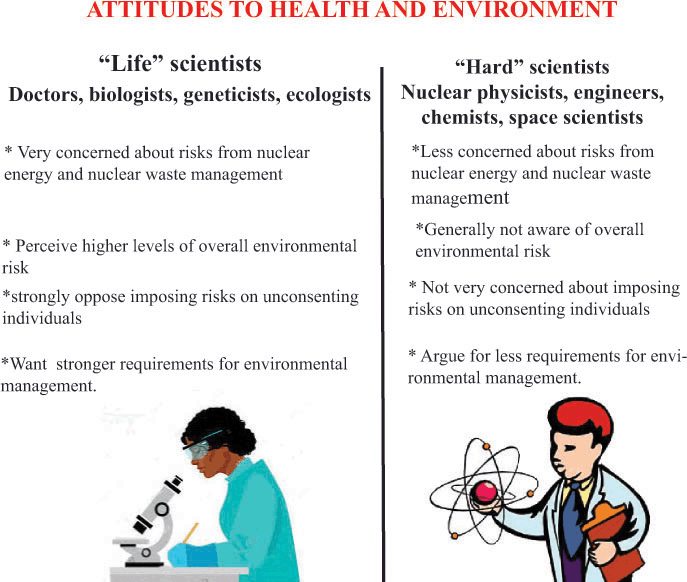
Research has found disturbing differences in the attitudes of scientists in different areas, to health and environmental risks of the nuclear industry.
It is even more disturbing that policy-makers and politicians prefer to support and value the opinions and work of the very scientists who are least informed and least interested in those risks.
Politics and Scientific Expertise: Scientists, Risk Perception, and Nuclear Waste Policy, Richard P. BarkeHank C. Jenkins‐Smith. – To study the homogeneity and influences on scientists’perspectives of environmental risks, we have examined similarities and differences in risk perceptions, particularly regarding nuclear wastes, and policy preferences among 1011 scientists and engineers. We found significant differences (p0.05)in the patterns of beliefs among scientists from different fields of research. In contrast to physicists, chemists, and engineers, life scientists tend to: (a)perceive the greatest risks from nuclear energy and nuclear waste management; (b)perceive higher levels of overall environmental risk; (c)strongly oppose imposing risks on unconsenting individuals; and (d)prefer stronger requirements for environmental management.
On some issues related to priorities among public problems and calls for government action, there are significant variations among life scientists or physical scientists. We also found that–independently of field of research–perceptions of risk and its correlates are significantly associated with the type of institution in which the scientist is employed. Scientists in universities or state and local governments tend to see the risks of nuclear energy and wastes as greater than scientists who work as business consultants, for federal organizations, or for private research laboratories. Significant differences also are found in priority given to environmental risks, the perceived proximity of environmental disaster, willingness to impose risks on an unconsenting population, and the necessity of accepting risks and sacrifices. more https://onlinelibrary.wiley.com/doi/abs/10.1111/j.1539-6924.1993.tb00743.x
No real gift in giving: culture of Christmas must change Brisbane Times 19 Dec 17 Christmas, we’re assured, brings out our best selves. We’re full of goodwill to all men (and women). We get together with family and friends – even those we don’t get on with – eat and drink and give each other presents.
We make an effort for the kiddies. Some of us even get a good feeling out of helping ensure the homeless get a decent feed on the day………
there’s a darker, less charitable, more Scrooge-like interpretation of what Christmas has become since A Christmas Carol.
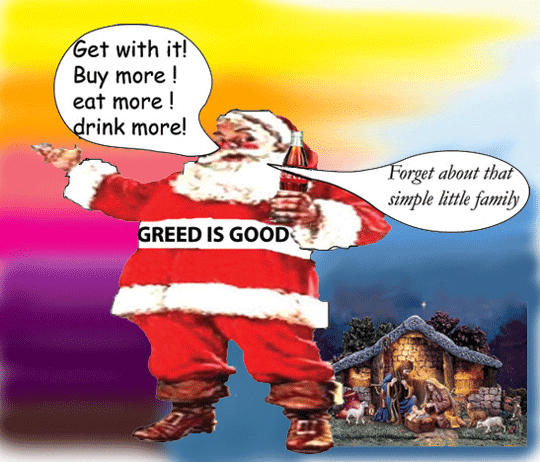
Under the influence of more than a century of relentless advertising and commercialisation – including the soft-drink-company-created Santa – its original significance as a religious holy-day has been submerged beneath an orgy of consumerism, materialism and over-indulgence.
We rush from shop to shop, silently cursing those of our rellos who are hard to buy for. We attend party after party, stuffing ourselves with food and drinking more than we should.
All those children who can’t wait to get up early on Christmas morning and tear open their small mountain of presents are being groomed as the next generation of consumerists. Next, try the joys of retail therapy, sonny.
But the survey also reveals a (growing?) minority of respondents who don’t enjoy the indulgence and wastefulness of Christmas.
A fifth of respondents – more males than females – don’t like buying gifts for people at Christmas. Almost a third expect to get gifts they won’t use and 42 per cent – far more males and females – would prefer others not to buy them gifts…….
Rich people like us need to reduce our demands on the environment to make room for the poorer people of the world to lift their material standard of living without our joint efforts wrecking the planet.
This doesn’t require us to accept a significantly lower standard of living, just move to an economy where our energy comes from renewable sources and our use of natural resources – renewable and non-renewable – is much less profligate.
This is the thinking behind the book Curing Affluenza, by the Australia Institute’s chief economist – and instigator of the survey – Dr Richard Denniss……
Planet Ark have declared a festive war on waste, as Australians get set to buy, eat and party more than ever this Christmas.
Introducing their 12 DOs of Christmas, Planet Ark are calling on people to consider some simple actions to help reduce the amount of waste produced.
The Christmas and New Years period see a significant increase in the amount of kerbside material sent for recycling.
Higher consumption rates also see increases in a number of non-recyclables items, with common Christmas gifts like computers, printers, iPads, mobile phones, clothing and fashion accessories leading to older items and packaging being discarded.
Planet Ark’s Recycling Programs Manager, Ryan Collins, said he is hoping Australia’s approach to the festive season will have been influenced by the success of the ABC documentary series War on Waste.
“2017 has been a landmark year for Australia’s waste and recycling discussion, and this Christmas is a great time to look at the best and worst parts of our habits,” he said.
“Over the festive period councils report a steep spike in the amount of waste they collect, but with 12 DOs every Australian can fight a festive war on waste.”
Research commissioned by Planet Ark looking at the most popular methods for reducing waste at Christmas found that over half of Australians save food for Boxing Day, while 40 per cent reuse their old wrapping paper.
The report also found 39 per cent write and stick to a shopping list and 37 per cent find out what recipients want before buying gifts.
‘This is my first post in my ‘Real Life Ideas’ area and I wanted to share this as an idea because what I experienced on over the last month really made me think about different types of activism, what the word really means and how we can connect to the planet in a spiritual way while involving ourselves in activism and campaigning.
‘I also truly hope that the idea of a nuclear free world is one that will spread throughout
the world before more beautiful beings are harmed by its dangers. …
‘As the global nuclear free movement grows, so too will the attention given to this land.
It is in for a turbulent next few years, but no matter what any corporations, or selfish politicians say,
there is no denying the dangers and outright absurdities of uranium.
‘Too many people have been and will be hurt by nuclear weapons and nuclear power failures
and many more in the future will be effected by radioactive waste that we are accumulating.
‘Here’s an idea to say no to uranium, leave it in the ground.
‘Here’s an idea to say no to colonialism and exploitative western powers.
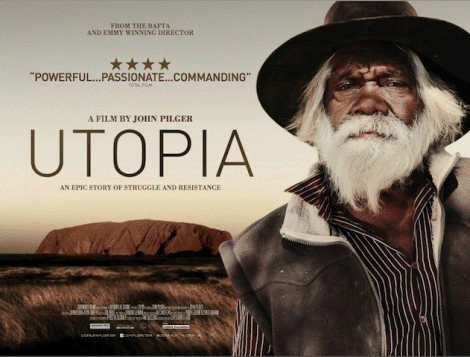
If you’ve ever wondered whether the federal government might be trustworthy, whether our first nation peoples have been treated fairly and whether they have the right to have a whinge, then this film might make wake you up, if you’re like most Australians and asleep at the wheel … my biggest surprise was the integrity of ABC’s Lateline … oh … and Dave Sweeney who spoke at Hawker at our latest gathering? He appears briefly too!
Do we believe what the Feds say? It’s propaganda +++ and poor Kimba, about to have a three-month intensive ‘community consultation’ roadshow …
‘It will be your artists: the poets, painters, actors, dancers, musicians, orators — they will be the ones to lead the changes.’ It was one of the many international invited guests, a Maori woman speaker, who made this prediction to the huge 40,000 strong crowd; to the 30,000 First Nations people from across the nation and 10,000 of us non-Aboriginal supporters who had joined them enroute to Hyde Park, Sydney, on 26 January 1988.
In South Australia almost 30 years later, this prophecy continues to unfold in the ongoing high-stakes battle for country that surrounds the proposed nuclear waste dump.
The orators have been long leading the way. ‘We can’t sell that country — we can’t sell it. Just like selling your own kid, own grandmother, own grandfather,’ said Arabunna Elder Kevin Buzzacott at the 1998 Global Survival and Indigenous Rights Conference in Melbourne 1998.
Tjunmutja Myra Watson told the Olympic Games international media, Botany Bay, 2000: ‘We already lost everything at Maralinga’ — the site of the 1950s and 1960s British nuclear tests.
‘We thought that Maralinga would be the last one … We love our land … We got the Dreaming, we got the songs and we got the culture. We’re going to fight to keep it. Let’s keep it, let’s keep the country, not this man coming in and digging up our spirit and our land and all our songs. They’re spoiling it when they put the poison in. They’re taking everything and they did it before.’
They are joined in the struggle by other artists: painters Eileen Wani Wingfield and Eileen Unkari Crombie; dancers Eileen Kampakuta Brown, Edie Nyimpula King and other Kupa Piti Kungka Tjuta, dancing for protection of country in the bush; singers like Ivy Makinti Stewart, whose astonishing voice filled the Adelaide Town Hall with the lament of the Seven Sisters: Irati Wanti — the poison — leave it!Continue reading →
Black Mist Burnt Country review – exhibition covers devastation of nuclear war, Guardian, Clarissa Sebag-Montefiore, 12 Oct 16 With works by Sidney Nolan, Arthur Boyd and Jessie Boylan, Black Mist Burnt Country homes in on the 1956 British atomic tests in the Great Victoria Desert.
In the new exhibition Black Mist Burnt Country, one photograph by Jessie Boylan sticks out. Yankunytjatjara man Yami Lester stands on the deep red earth next to a single skinny tree. His brown jacket reflects the muted landscape. His hands are clasped on his chest as if in pain, and his eyes, tilted to the sky, are scrunched shut. Yami Lester, you see, is blind.
Lester was just a child when the British tested the atomic bomb near his home in the Australian outback, in what came to be known as Maralinga. “It was coming from the south – black, like smoke,” he later recalled. “I was thinking it might be a dust storm, but it was quiet, just moving through the trees.”
Elders thought it was an evil spirit and tried to use woomera (spear-throwers) to disperse it. But the damage was done. Lester’s family soon fell sick. He lost his sight. The trees, too, shrank, shrivelled and died.
The national touring exhibition, which runs until 2019, commemorates the 60th anniversary of the Maralinga atomic tests through painting, sculpture, printmaking and installations. Spanning 70 years, from Hiroshima to today, it covers artistic reactions to nuclear warfare from more than 30 artists, Indigenous and non-Indigenous.
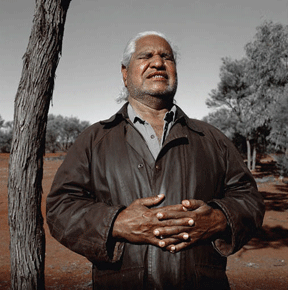 Black Mist Burnt Country review – exhibition covers devastation of nuclear war, Guardian, Clarissa Sebag-Montefiore, 12 Oct 16 With works by Sidney Nolan, Arthur Boyd and Jessie Boylan, Black Mist Burnt Country homes in on the 1956 British atomic tests in the Great Victoria Desert.

 Antinuclear