Why The Economics of War in Australia Matter
14 February 2026 AIMN Editorial, By Denis Hay
Australia’s defence spending is rising at a time when housing stress, health system pressure, and energy transition demands are also intensifying.
Public debate often treats defence and social investment as separate conversations. They are not. Both draw on the same public money, skilled labour, industrial capacity, and political attention.
This article examines how the war economy functions, how Australia’s major defence commitments shape long-term fiscal settings, and what opportunity cost means in practical terms. It does not argue for ending defence. It does not dismiss strategic risk.
Instead, it asks a structured economic question: when public funds are allocated to long-duration military programs, which alternatives are delayed or constrained?
Unlike earlier articles on Monetary Sovereignty that focus on financial capacity, this piece concentrates on real resource allocation and political incentives within defence policy.
The Problem: The Economics of War and Locked-in Spending
Rising Global Military Spending
The Stockholm International Peace Research Institute reports that global military spending reached US 2.7 trillion in 2024. Australia is part of this global expansion…………………….
Australia’s Major Defence Commitments
Under the Department of Defence strategy and the AUKUS submarine pathway, Australia has committed to multi-decade procurement and sustainment programs………………………………………………………
Systemic Causes
- Alliance integration priorities
- Strategic deterrence doctrine
- Industrial policy embedded within defence
- Long-term contracting frameworks
Political Incentives
- Regional job creation promises
- Perception of strength and security
- Limited scrutiny of lifecycle costing
- Concentrated contractor influence
Beneficiaries of the Status Quo
- Large defence primes
- Specialist subcontractors
- Regions hosting major facilities
- Political actors are able to signal security leadership
This does not imply corruption. It shows structural incentives.
The Economics of War in Australia and Opportunity Cost
Opportunity cost is not abstract. For example, if $10 billion in defence procurement employs engineers and advanced manufacturers, those same skilled workers are not simultaneously available to expand public housing construction…………………………………………………………………………………………………………………………………………………………………………………………
Conclusion
The economics of war in Australia are about allocation, not ideology.
Defence commitments such as AUKUS are long-term and capital-intensive. Housing shortages, healthcare strain, and energy transition pressures are immediate and socially destabilising.
Public money reflects political priorities. The central question is whether more military capability delivers greater marginal security than investment in social resilience.
Australia has the institutional capacity to pursue both strategic security and domestic stability. Outcomes depend on policy choice, not inevitability.
The economics of war in Australia are not just about defence budgets or alliance commitments. It is about choices. Every dollar committed to long-term military expansion is a dollar not invested in housing, healthcare, education, and productive industry. A balanced approach to the economics of war in Australia requires transparent costing, clear strategic purpose, and a serious national discussion about opportunity cost. https://theaimn.net/why-the-economics-of-war-in-australia-matter/
“Make Iran like Gaza”: Chilling insider view from Israel weapons expo
by Michael West and Stephanie Tran | Dec 23, 2025 , https://michaelwest.com.au/make-iran-like-gaza-chilling-insider-view-from-israel-weapons-expo/
How to make ‘Iran like Gaza’ and describing the genocide in Palestine as a weapons testing laboratory. Michael West and Stephanie Tran with the inside story of a weapons expo.
Inside a conference hall at Tel Aviv University, executives, generals and venture capitalists took turns boasting about “combat-proven” Israeli weapons and surveillance systems.
At Defense Tech Week 2025, senior figures from Israel’s defence establishment openly described how the genocide in Gaza has accelerated weapons development, unlocked new export markets and reshaped Israel’s global identity as a defence powerhouse.
Less than 70 kilometres from where the conference was held, Gaza has been reduced to rubble. More than two years of genocide, indiscriminate bombardment and mass displacement have left at least 70,000 Palestinians dead and 90% of the Strip destroyed.
Gaza weapons lab
Defense Tech Week advertises itself as a forum connecting startups, investors, defence primes and policymakers. According to its organisers, the event showcases “practical lessons from Israel’s cutting-edge solutions that are addressing global security challenges”.
MWM has obtained the footage with Drop Site News in the US.
The speakers resembled a roll call of Israel’s military-industrial complex with senior Israeli military leadership, officials from the Ministry of Defense, and executives from Israel’s largest arms manufacturers, including Israel Aerospace Industries, Elbit Systems and Rafael Advanced Defense Systems.
Speaker after speaker framed the war as a lucrative opportunity for weapons development and sales.
“These are not lab projects or PowerPoint concepts,” said Amir Baram, Director General of Israel’s Ministry of Defense.
“They are combat-proven systems.”
Gili Drob-Heistein, Executive Director at the Blavatnik ICRC and Yuval Ne’eman Workshop for Science, Technology and Security, described defence technology as Israel’s “next big economic engine”.
Israel is known for being the startup nation,” she said. “We all believe that defence tech has the potential to become the next big economic engine for Israel.”
She credited what she called Israel’s “technological leadership” and “out of the box thinking” for results “we’ve seen recently on the battlefield.”
For Boaz Levy, President and CEO of Israel Aerospace Industries, the war has presented an opportunity to showcase the company’s wares with IAI’s weapons being deployed in Gaza, Iran and Yemen.
“The war that we faced in the last two years enabled most of our products to become valid for the rest of the world,” he said.
“Starting with Gaza and moving on to Iran and to Yemen, I would say that many, many products of IAI were there.”
Real-time combat data
Elbit Systems CTO Yehoshua (Shuki) Yehuda spoke about deploying autonomous systems and mass data collection in real-time combat. He showed a video demonstrating how an AI-powered system developed by Elbit is used to select and track targets “less than a pixel.”
“All of it is done by collecting the data,” he said, describing the ability to track “small targets in a very tough background… less than a pixel.”
He explained that these systems were developed in collaboration with the IDF and refined through continuous data collection during military operations.
Profiting from genocide
The speakers were candid about the scale of the financial opportunity presented by genocide.
According to Amir Baram, more than 300 startups are now working with Israel’s military research directorate, MAFAT, with 130 joining during the current war alone. In 2024, he said, the ministry invested 1.2 billion shekels in defence startups.
Baram oriented Israel’s surge within the global boom in defence spending.
“Global defence spending reached $2.7 trillion in 2024,” he said, pointing to the increase in expenditure from NATO countries and US defence spending exceeding $1 trillion.
“By partnering with Israel, you gain access to our advanced technologies as well as the valuable insights and experience that make our system truly effective. The world has chosen to partner with Israel because trust in defence must be built on credibility, performance, and shared strategic purposes.”
In 2024 alone, Baram said, Israel signed 21 government-to-government defence agreements worth billions, positioning Tel Aviv as the world’s third largest defence tech hub.
At Israel Aerospace Industries, Levy said 80% of the company’s activity is export-oriented.
“IAI as of now has $27 billion of new orders,” he said, with annual sales of around $7 billion.
Elbit Systems reported $8 billion in annual revenue and a $25 billion backlog, with more than 20,000 employees worldwide.
‘Make Iran like Gaza’
The speakers were explicit about how techniques developed and used in Gaza could be deployed in future conflicts.
Dr Daniel Gold, head of Israel’s Directorate of Defense Research and Development, described scenarios in which Israel would replicate Gaza style control in Iran.
“Once we have operational freedom in the air,” he said, “we inject inside… our UAV fleet controlling Tehran and controlling Iran – which means we make Iran like Gaza.”
Gold highlighted the practicality of “dual use” technology which have both civilian and military applications.
“A swarm of drones that control the traffic in Tel Aviv can be the same swarm of drones that control in Gaza,” he said.
During his presentation, video footage was shown of a semi-autonomous drone targeting an individual inside an apartment building, imagery that bears striking resemblance to documented Israeli strikes that have killed civilians in residential homes, including the attack that killed Dr Marwan al-Sultan and his family.
“It is very simple to operate,” Gold explained. “Semi-autonomous.”
Mounting pressure
In her report on the “Economy of Genocide”, UN Special Rapporteur for Palestine, Francesca Albanese stated that “for Israeli companies such as Elbit Systems and Israel Aerospace Industries, the ongoing genocide has been a profitable venture.”
the report found.
Two years into Israel’s livestreamed genocide in Gaza, execs appear to be acutely aware of the mounting international pressure.
Shlomo Toaff, an executive at RAFAEL Advanced Defense Systems, lamented that “Israel is experiencing a boycott.”
“I think Israel is experiencing a boycott,” he said, citing the company’s exclusion from the Paris Air Show last year. “This is something that we have to take into account when we’re talking about what we’re doing here in the industry.”
‘Inadequate’: Audit call on $368bn AUKUS cost estimate.

COMMENT. Even the Australian is being critical of AUKUS.
They don’t mention that the $368 billion doesn’t cover a high level nuclear waste dump and associated transport, or upgrades needed for the LeFevre peninsula to host a sub building facility at Osborne.
Some of Australia’s top naval experts have cast doubt on the government’s $368bn AUKUS price tag, warning that the cost will be ‘significantly more’.
Ben Packham The Australian 17.11.25
Some of Australia’s top naval experts have cast doubt on the government’s $368bn AUKUS price tag, saying the program to acquire two classes of nuclear-powered submarines will cost “significantly more” than originally thought, with higher upfront outlays.
UNSW Canberra’s naval studies group has called for an urgent and comprehensive audit of AUKUS costs “to provide a realistic financial baseline” for the program, which is already cannibalising the wider defence budget.
Labor argues it can fund the program without a major increase in defence funding beyond its currently planned outlays, which are set to rise from about 2 per cent of GDP to 2.33 per cent by 2033-34.
UNSW Canberra’s new Maritime Strategy for Australia warns the proposed expenditure “will likely be inadequate” to deliver on the government’s naval ambitions. “This is already evidenced by cuts to lower priority projects and sustainment,” the strategy says.
It argues the AUKUS ‘Pillar I’ submarine program “was not comprehensively costed at the outset and its full demand on the Defence budget is still to be fully quantified”.
The paper says a substantial increase to defence funding will be needed, urging the government to “conduct a comprehensive, independently verified costing of AUKUS Pillar I as a matter of urgency to allow for re-baselining of Defence financial requirements and recalculation of required overall Defence funding”.
The strategy also sounds the alarm over the navy’s “long-neglected” mine countermeasures and undersea mapping capabilities, saying they pose “a critical gap that must be regenerated to guarantee maritime access to ports and littoral (coastal) waters”.
It comes amid a Defence-wide cost-cutting drive, revealed by The Australian, that has forced service chiefs to slash sustainment budgets, reduce “rates of effort”, and look at axing some capabilities.
Former RSL president Greg Melick took aim at the funding issue last week, using his Remembrance Day speech to warn hat the nation’s military preparedness was being undermined. The speech earned him a rebuke from Paul Keating, who branded him a “dope” and accused him of seeking a war with China.
But retired Vice-Admiral Peter Jones endorsed Major General Melick’s warning, saying the stretched defence budget was “the elephant in the room at the moment”.
Admiral Jones, the lead author of the maritime strategy and head of the Australian Naval Institute, told The Australian: “It appears the cost (of AUKUS) is significantly more than what was originally thought, including greater upfront costs before submarine construction.”
The paper comes as the government finalises its updated defence strategy and capability investment program, both of which will be released ahead of next year’s federal budget.
Labor announced a $12bn upgrade to Western Australia’s shipbuilding precinct in recent weeks as a downpayment on AUKUS infrastructure in the state, which is likely to cost more than twice that figure.
Workforce costs are also soaring as hundreds of Australian sailors take up training places on US and British submarines, and Australian tradespeople are deployed to shipyards in both countries to gain experience building nuclear boats.
Defence Minister Richard Marles revealed the government’s $368bn AUKUS cost estimate two years ago when he announced the program’s “optimal pathway” to obtain three to five Virginia-class submarines from the US and a new class of AUKUS submarines to be built in Adelaide. He said this was equivalent to about “0.15 per cent of GDP for the life of the program”.
The Australian asked the minister’s office how the figure was arrived at, whether it had any statistical measure of its likely accuracy, and whether it would seek an independent assessment of the program’s cost. It declined to respond to all three questions.
A spokeswoman for Mr Marles instead issued a boilerplate statement repeating the government’s case for acquiring nuclear submarines.
“The acquisition of conventionally armed, nuclear-powered submarines for the Australian Defence Force is a multi-decade opportunity, representing the single biggest capability acquisition in our nation’s history and creating around 20,000 direct jobs over the next 30 years,” she said.
“Working with our AUKUS partners, Australia is not just acquiring world-leading submarine technology but building a new sovereign production line, supply chain and sustainment capability here in Australia. This includes growing the capabilities, capacity and resilience of business – particularly small and medium-sized enterprises.
Unlocking Asia: CPA Australia urges bold action to boost national capability.

12 November 2025 AIMN Editorial, https://theaimn.net/unlocking-asia-cpa-australia-urges-bold-action-to-boost-national-capability/
Australian businesses are missing significant investment and innovation opportunities in Asia.- Education, business and professional exchange programs must be expanded.
- Speaking from experience – CPA Australia has nearly 50,000 members in the region.
One of the world’s leading accounting bodies, CPA Australia, is urging the Federal government to take bold steps to strengthen Australia’s Asia capability, warning that Australian businesses are missing out on significant opportunities in the region.
In a submission to the government’s inquiry into building Australia’s Asia capability, CPA Australia provides four key recommendations aimed at deepening Australia’s engagement with Asia through education, business and cultural exchange.
Rebecca Keppel-Jones, Chief Member Operations Officer at CPA Australia, says many Australian businesses, particularly SMEs, remain domestically focused and are not capitalising on opportunities in Asia.
“Asia is central to Australia’s future prosperity. To remain competitive, we must build Asia capability from the classroom to the boardroom,” Ms Keppel Jones said.
“With Asia home to some of the world’s fastest-growing economies, Australia risks falling behind unless it invests in Asia capability now. We need more investment into existing programs, such as the New Colombo Plan, to improve Australians’ understanding of Asia.”
CPA Australia is proud to have maintained a strong presence in Asia for more than 70 years. It now represents nearly 50,000 members in mainland China, Hong Kong, Malaysia, Singapore, Indonesia, Vietnam and the UAE.
“Australia must better leverage its people-to-people connections and professional networks to unlock economic potential,” Ms Keppel-Jones said.
CPA Australia’s four key recommendations:
- Expanding Asia-focused training for SMEs to improve business readiness and regional engagement.
- Showcasing Australian success stories in Asia through a government-supported case study library to inspire and educate.
- Increasing scholarships and professional placements for young Australians to study and work in Asia.
- Revitalising Asian language and cultural education in schools and universities to reverse declining enrolments and build long-term regional literacy.
“As global dynamics shift, our ability to engage with Asia is more critical than ever. We need to ensure Australia’s workforce is globally competitive,” Ms Keppel-Jones said. “We are ready to work with government, educators and industry to turn these recommendations into action.”
The submission highlights CPA Australia’s active contributions to regional policy development, education and professional exchange, including a reciprocal work placement exchange program with Malaysia.
Eligible CPA Australia members can enjoy temporary work placements in Malaysia as part of a broader Young Professionals Exchange Program organised by the Department of Foreign Affairs and Trade. The exchange program is designed to enhance business engagement between Australia and its Southeast Asia partners and is available in Malaysia first, before being rolled out to other Southeast Asian markets.
CPA Australia’s thought leadership initiatives across Asian nations include its annual Asia-Pacific Small Business Survey and Business Technology Report.
Cheaper, greener power is on the way.

Cheaper, greener power is on the way. As long as anti-net zero populists
don’t throttle it in the cradle. Not that long ago, Mark Purcell, a retired
rear admiral in the Australian navy, was paying about A$250 a month for
electricity in his roomy family home on the Queensland coast.
Today, he says he makes as much as A$300 a month, or nearly $200, from the
electricity he makes, stores and sells with his solar panels and batteries.
“This is the future,” he told me. “This is what the energy transition
could look like for a lot of folks.” Purcell is one of the 58,000-plus
customers of Amber Electric, an eight-year-old Melbourne business that
gives householders access to real-time wholesale power prices so they can
use power when it’s cheap and sell what is stored in their batteries when
it’s expensive.
The company is adding 5,000 customers a month, putting it
among a new generation of fast-growing energy tech start-ups aiming to make
electricity cheaper and greener, and not just in Australia. Amber’s dynamic
pricing technology is due to launch soon in the UK, where the company has
done licensing deals with the energy suppliers Ecotricity and E.On.
Norway’s Tibber offers similar services to the 1mn customers it has gained
since launching in 2016 and expanding to Germany, Sweden and the
Netherlands. In Germany, the market share of companies including Tibber,
Octopus Energy and Rabot Charge has grown from 0.1 per cent in 2023 to 2.4
per cent in 2025, says the Kreutzer Consulting group. Between them they
have more than 1mn customers, 77 per cent of whom are particularly or very
happy with their provider, far more than the industry-wide figure of 57 per
cent.
Remember those figures the next time you hear a rightwing populist
condemn allegedly unaffordable net zero policies. In fact, this new class
of energy tech entrepreneurs is showing how electricity can become more
affordable precisely because of the renewables, batteries and electric cars
that net zero efforts drive.
It is no accident Amber Electric began in
Australia, long a world leader in rooftop solar systems that sit atop more
than 4mn of its homes and small businesses. Its population of 28mn is now
undergoing a home battery boom, following the July launch of a A$2.3bn
government subsidy scheme. Industry estimates show rooftop solar can save
households up to A$1,500 a year on energy bills, a figure that nearly
doubles if you add a battery, and rises further with dynamic pricing. Is
there a catch?
Right now, the upfront costs of green tech can be
considerable. Queensland’s Purcell is a superuser who has spent tens of
thousands of dollars on solar panels, batteries and a home energy
management system that makes everything from his pool heater to his air
conditioners price-responsive. His family also has two Teslas with even
bigger batteries.
This is clearly unaffordable for many, but maybe not for
long. Big home hardware retailers have begun to launch financing plans that
let people pay monthly fees of less than A$150 for solar and battery
packages rather than a big initial outlay.
FT 29th Oct 2025, https://www.ft.com/content/8bf14af2-8c22-4731-ad06-4a36277dff74
Coalition’s nuclear gambit will cost Australia trillions – and permanently gut its industry
The modelling cited extensively by the federal Coalition to defend its
nuclear power fantasies is predicated on a massive hollowing out of
Australian industry.
Climate Energy Finance (CEF) published a report on
Thursday examining the economic implications of the nuclear pathway
modelled by Frontier Economics for Australia’s energy transition.
Frontier concludes its $A331 billion costed nuclear scenario is somehow
better than the Australian Energy Market Operator’s Integrated System
Plan’s (ISP) Step Change scenario cost, which they calculate at $594
billion by bizarrely ignoring the massive cost of the resulting cumulative
$3.5 trillion reduction in Australian gross domestic product (GDP) by 2050.
Renew Economy 24th April 2025 https://reneweconomy.com.au/coalitions-nuclear-gambit-will-cost-australia-trillions-and-permanently-gut-its-industry/
New report: Coalition’s nuclear folly would cost Australian economy at least $4.3 trillion by 2050
Climate Energy Finance Media April 24, 2025, https://theaimn.net/new-report-coalitions-nuclear-folly-would-cost-australian-economy-at-least-4-3-trillion-by-2050/
New analysis by independent public interest think tank Climate Energy Finance (CEF) looks at the economic implications of the nuclear pathway modelled by Frontier Economics for Australia’s energy transition – cited extensively by the Federal Coalition to defend its nuclear plan. The analysis reveals a massive hollowing out of Australian industry, permanently higher total energy costs, uncosted and unabated carbon pollution, and trillions of dollars in lost GDP.
The CEF analysis exposes damaging flow-on costs to the economy for which the Frontier modelling fails to account.
Combined with Frontier’s extreme underestimation of the capital costs of building nuclear reactors, these costs accumulate to $4.3 – 5.2 trillion by 2050, 13-16 times the $331bn price tag for a nuclear Australia assumed by Frontier Economics.
These costs include an estimated:
- $3.5 trillion in cumulative undiscounted lost GDP through to 2050;
- An $111-332bn in nuclear capex costs, which the Frontier modelling erases all but $13.5bn of by failing to both amortise nuclear’s capital investment costs incurred after 2050 and account for inevitable expensive retrofits;
- $234bn in higher fuel costs due to slower electrification meaning consumers and businesses are forced to rely on higher cost fossil fuels for longer;
- $72-720bn in economic damage from up to 2.0bn of additional tonnes of CO2 emissions;
- $100bn in lost export revenue from the aluminium industry alone, likely to collapse under the drastically reduced industrial electricity demand in the nuclear scenario.
Report author Tim Buckley, CEF Director and a former Managing Director of global investment bank Citigroup, said:
“It strains credulity that the Frontier Economics nuclear report is riddled with shortcomings which completely undermine its credibility as a work of serious energy transition analysis, given this is the central modelling being relied upon by the Opposition for its key energy and climate policy offering of the 2025 Federal election.
“The largest share of the Frontier-modelled ‘savings’ in energy transition investment comes at the cost of delivering much weaker outcomes for Australia, including an assumption the Australian economy’s GDP is $300bn lower annually by 2051. This represents an astonishing $3.5 trillion in cumulative GDP forgone.
“This is as weak as the Opposition Leader recently declining to accept the settled climate science because he is ‘not a scientist’.
It beggars belief that this is the best the party representing itself as alternative federal government can come up with, as the nation stands on the brink of an immense generational opportunity to remake itself as a global renewables superpower and green energy trade and export leader in a rapidly decarbonising world.”
Federal election 2025: Economists send open letter opposing Coalition nuclear plan

The economists said all the outlined [clean renewable energy] benefits would be delivered much faster and at a fraction of the cost of nuclear energy.
economists said the $330 billion price tag for the nuclear plan was likely to go much higher and was based on questionable modelling for the coalition.
“Major Australian firms are increasingly signing agreements to purchase electricity from solar and wind farms – recent examples include Rio Tinto, BHP Mitsubishi, Telstra, Woolworths, Coles.”
Lloyd Jones, 20 Apr 2025, https://thenightly.com.au/politics/federal-election-2025/federal-election-2025-economists-send-open-letter-opposing-coalition-nuclear-plan-c-18427749
An open letter from 60 Australian economists has rejected the coalition’s nuclear energy plan, promoting instead the subsidising of household clean energy policies, including incentives for home battery storage.
The organiser of the letter, Gareth Bryant, an associate professor in political economy at the University of Sydney, says the letter is intended as an intervention in the election campaign.
“As economists, energy analysts and policy specialists we strongly support government investment in household clean energy and industrial electrification and not in nuclear energy,” the letter says.
It says simple household clean energy upgrades can deliver immediate cost-of-living benefits and reductions in carbon emissions, and electrification can safeguard the future of industrial jobs and the communities that rely on them.
The economists, from a range of Australian universities and other tertiary institutions, said the construction of nuclear power plants would take at least 15 years at a cost of at least $330 billion.
“It would result in higher household energy costs, drain investment away from renewable energy and energy-intensive manufacturing, and leave the Australian economy precariously over-dependent on increasingly automated mineral extraction,” the letter says.
The economists said they support a nationwide program to upgrade homes and industry with clean renewable energy.
They said the technologies to fund should include large-scale home electrification with smart appliances to deliver bill savings, energy-efficiency upgrades and battery storage, which can save surplus solar for night-time use, and hot water retrofits for more efficient water heating.
“An extensive number of studies have found household electrification and energy upgrades would generate immediate household savings, helping to address cost-of-living pressures,” the letter says.
It says modelling for ACOSS found that with energy efficiency upgrades the average household would save almost $3500 a year.
The economists said their pathway would be anti-inflationary, due to less reliance on volatile international gas markets and it would benefit Australian manufacturing which requires low-cost, secure electricity.
“Major Australian firms are increasingly signing agreements to purchase electricity from solar and wind farms – recent examples include Rio Tinto, BHP Mitsubishi, Telstra, Woolworths, Coles.”
The economists said all the outlined benefits would be delivered much faster and at a fraction of the cost of nuclear energy.
The coalition’s nuclear plan proposes to build seven nuclear reactors with the first of these not operational until 2035.
The coalition plan had a number of flaws, the economists said, including higher household energy costs.
“Independent modelling by the Institute of Energy Economics and Finance found it would increase the electricity bill of an average household by $665 per year.”
The coalition nuclear plan would have detrimental impacts on the Australian economy, the economists said.
It would decrease bank and investor certainty, which will in turn increase the cost of renewable energy.
Opposition Leader Peter Dutton has defended his nuclear plan, saying it would help reduce carbon emissions and deliver lower cost electricity and gas, and reliable energy.
But the open letter economists said the $330 billion price tag for the plan was likely to go much higher and was based on questionable modelling for the coalition.
Investing in nuclear power would take away money that could be invested in more cost-effective household clean energy, they said.
“Today, with rising geopolitical tensions, trade wars, and accelerating climate breakdown, sovereign capability is even more critical,” the economists said.
“Renewables enable Australia to maintain this capability – nuclear does not.”
Dutton’s nuclear push will cost renewable jobs
by Charlie Joyce, https://australiainstitute.org.au/post/duttons-nuclear-push-will-cost-renewable-jobs/
As Australia’s federal election campaign has finally begun, opposition leader Peter Dutton’s proposal to spend hundreds of billions in public money to build seven nuclear power plants across the country has been carefully scrutinized.
The technological unfeasibility, staggering cost, and scant detail of the Coalition’s nuclear proposal have brought criticism from federal and state governments, the CSIRO, the Climate Council, the Electrical Trade Union (ETU), the Climate Change Authority, the Australia Institute, and independent energy experts.
The CSIRO, among others, has refuted the Coalition’s claim that nuclear will be cheaper than renewables; instead, they have shown the energy produced by Australian reactors would cost approximately eight times more than the same amount of energy produced by renewables. If this cost is passed on to consumers, the average household would pay $590 per year more on their power bill. Unsurprisingly, Australia Institute polling has found that fewer than one in twenty Australians (4%) are prepared to pay this nuclear premium.
The cost alone should be enough to bury this nuclear proposal. But it is also important to recognise how the Coalition’s plan will impact – and fail – workers.
False promises
The Coalition has proposed that large nuclear reactors would be built on the sites of five operational or recently decommissioned coal fired power stations: Liddell and Mount Piper in New South Wales, Tarong and Callide in Queensland, and Loy Yang in Victoria. In doing so, the Coalition has promised that nuclear energy would be a source of stable and plentiful work for the communities where coal-fired power plants are phasing down.
This is a false promise. Six coal fired power stations have already closed in the past decade, with 90% of Australia’s remaining coal-fired power stations set to close in the next decade. These communities are already undergoing structural adjustment, and they need new sources of employment now. But this is not what the Coalition’s plan delivers. The Coalition outlines that the first two nuclear reactors would not come online until the mid-2030s – more than a decade from now – while the remainder would be completed by 2050.
And energy and technology experts agree that even this timeline is impossible. On average, a nuclear reactor takes 9.4 years just to build in countries with established and capable nuclear industries. Former Australian Chief Scientist Alan Finkel has estimated that it would take until the mid-2040s at the earliest for Australia to build an operational nuclear reactor. Moreover, analysis from the Institute for Energy, Economic & Financial Analysis (IEEFA) has found that, in economies comparable to Australia’s, every single nuclear reactor project experienced multi-year delays and cost blowouts of up to three and a half times over budget. It is hard to see how Australia, which lacks the experienced workforce, training and research base, or regulatory framework, would buck this trend.
Lost jobs
While the Coalition’s nuclear plan would not bring jobs to the communities that need them, it might have the real effect of depressing investment in renewables.
Renewable energy already generates approximately 40% of Australia’s energy and is by far the cheapest form of electricity. Renewable energy industries already account for the employment of tens of thousands of workers, and Jobs and Skills Australia estimates that approximately 240,000 new workers will be required in industries associated with clean energy by 2030.
But this requires ongoing and expanding investment in renewables, which the Coalition’s nuclear policy is likely to derail. The Clean Energy Council has estimated that by capping renewable energy to 54% of total use (as the Coalition’s modelling has assumed), 29GW of renewable energy generation projects would not be built – squandering an expected 37,700 full-time-equivalent construction jobs and 5,000 ongoing jobs in operations and maintenance. By limiting renewables investment, prolonging fossil fuel usage, and diverting investment towards nuclear energy, the full employment opportunities of the renewable energy transition are lost.
Scarce and dangerous work
If the Coalition’s nuclear plan does come to fruition it will hardly create any ongoing jobs for the communities that have undergone structural readjustment. According to analysis from the Nuclear Energy Agency, while the peak period of construction of the average 1GW nuclear power plant can demand up to 3,500 workers, ongoing operations and maintenance will only require about 400 workers – with only a quarter of these being onsite blue-collar jobs that might provide work for the people who will have lost jobs with the closure of coal-fired power stations. Most jobs will be in administration, regulatory compliance, energy, marketing, sales, science and emergency personnel – and many of them are likely to be located away from the nuclear facility itself.
Disturbingly, any jobs on-site may put the health of workers at risk. Recent analysis of multiple studies of the health impacts of nuclear power plant employment across multiple countries found that workers have a significantly higher risk of mesothelioma and circulatory disease due to exposure to radiation. Nearby residents also exhibit a significantly higher risks of cancer, with children under the age of five at particular risk. And this does not even factor in the risk of sudden plant failure and reactor meltdown on workers and communities – a risk sharpened by the Coalition’s plan for these reactors to be built on geological fault lines with heightened earthquake risk.
Australian workers have much to gain from the renewable energy transition, including cheaper power, new clean technology industries, and hundreds of thousands of new jobs. The Coalition’s nuclear plan only brings false promises, lost jobs, and – if the plan comes to fruition – few jobs and potentially dangerous work.
Going nuclear will decimate jobs in regions first, stop billions in new investment.
Cancelling new transmission projects will decimate opportunities for electrical workers and apprentices in exactly the regional areas where opportunities are needed, says ETU national secretary Michael Wright
Rachel Williamson, Apr 10, 2025 https://reneweconomy.com.au/going-nuclear-will-decimate-jobs-in-regions-first-stop-billions-in-new-investment/
Regional areas will suffer the most from job and investment losses stemming from the Coalition’s energy promises, according to analyses from alarmed energy sector stakeholders.
The Coalition’s push for nuclear, a policy that was announced with much fanfare in December but has largely disappeared from the election hustings, will result in the loss of $58 billion in direct investment in renewable and storage, and cause the loss of 42,000 full time jobs, the Clean Energy Council says.
Opposition leader Peter Dutton’s Budget reply promised to abolish the $19 billion Rewiring the Nation fund will also cause the immediate loss of jobs, the Electrical Trades Union (ETU) says.
The ETU analysis suggests 2000 electrical worker jobs will disappear this year if work stops on major network projects, rising to 7000 job losses in 2029 when building work on new transmission is expected to peak.
The costs are the direct impact from the Coalition’s promise to build seven nuclear reactors across Australia.
In December, it outlined a vision of small modular reactors becoming operational by a hugely ambitious timeline 2035 – notwithstanding the fact that these do not exist as commercial technology yet – and predicted the first large reactor operational by 2037.
But that vision requires renewable generation taking up no more than54 per cent of the total energy supply in 2050 – compared to Labor’s target of 82 per cent by 2030 – and cutting funding for new transmission by 79 per cent to allow room both in the grid and budget, according to modelling by think tank Frontier Economics.
At what cost?
The overall cost of abruptly changing the country’s energy course will be high, according to numbers crunched in a Clean Energy Council analysis.
Their data shows the size of the loss in the years before 2030 alone, and the size and longevity of the damage to investment decision making.
“The energy sector doesn’t plan based on three-to-four-year election cycles. These are 30–40-year investment decisions and investors need to see continued confidence in the sector through stable, long-term policy settings to keep investing in Australia,” says CEC CEO Kane Thornton.
“We need the right policy settings in place and both government and industry working together to accelerate the delivery of cheap, reliable and modern clean energy that works for Australia.”
Renewable generation is set to reach 54 per cent of the National Energy Market (NEM) by 2028 from projects that are being built or have financial backing today.
Preventing renewable energy generation from growing past that level would mean cancelling almost 29 gigawatts (GW) of large scale solar and wind currently proposed or in planning and the $58 billion of capital investment they will need.
Some 37,7000 construction jobs per annum won’t happen, nor will 5000 jobs annually in operations and maintenance, just between 2026 and 2030.
Regional areas will miss out on $68 billion of economic activity and landholders will miss out on $2.7-3.4 billion in payments over a 25-year project life cycle.
Communities will lose a further $696 million in direct contributions from renewable energy projects.
And to top it off, household bills will be $449 higher, according to the Clean Energy Council NEM bill analysis in March of the impact of going nuclear.
Regions will hurt the most
While the nuclear proposal is seen by many analysts as a smokescreen for keeping decrepit coal plants running longer, the immediate ramifications will hit hardest and immediately in the regions.
Renewable energy projects are delivering jobs and financial investment in country areas long neglected by national and state budgets, says Renew Economy‘s David Leitch.
“This is the greatest economic opportunity the regions will ever face in Australia, at least in the last 100 years, and probably in the next 100 years,” he said during a Smart Energy Conference talk on Wednesday.
Cancelling new transmission projects will decimate opportunities for electrical workers and apprentices in exactly the regional areas where opportunities are needed, says ETU national secretary Michael Wright.
“Peter Dutton is planning a jobs bloodbath for the electrical industry,” he said in a statement.
“Cancelling new transmission construction] deprives nearly 12,000 electrical workers, their communities and their families of a living across the country.”
Its analysis suggests that staying the course under the Australian Energy Market Operator’s (AEMO) Step Change plan would lead to almost 43,000 new jobs by 2050. Dutton’s energy plan would lead to an aggregate of almost 25,000 job cuts.
Other jobs that will disappear include construction workers and truck drivers, due to halting new renewable projects in order to meet the 54 per cent cap, says Thornton.
Capping renewables at 54 per cent would not only see Australia miss out on billions of dollars of capital investment and economic growth, but thousands of jobs… and billions of dollars in community benefits would be left on the table,” he said in a statement.
“We need all sides of politics to embrace this private-sector investment into regional Australia and the thousands of well-paid jobs this industry generates every year.
“These are real dollars for farmers, real dollars for country towns and real blue-collar jobs that pay Australians’ bills.”
Littleproud’s great pretence on nuclear insurance, as sparkies attack Coalition nuke proposals
Ketan Joshi, Apr 2, 2025, https://reneweconomy.com.au/littleprouds-great-pretence-on-nuclear-insurance-as-sparkies-attack-coalition-nuke-proposals/
Just prior to the election being called, Nationals leader David Littleproud was pressed on ABC’s Radio National breakfast on whether insurance costs were included in the modelling exercise putting a dollar figure on the Coalition’s nuclear plans.
It has been tough for the Coalition: nuclear power is notoriously expensive, and so trying to present a narrative of it being cheap has been tricky. Littleproud had a confident answer in response to being challenged about insuring nukes:
“Well, as many countries around the world do that is actually factored in and in fact, self insurance is normally what they undertake. So it’s not a significant amount of anything that goes into the running cost”.
The majority of the Coalition’s claims regarding nuclear power come from a December 2024 report published by Frontier Economics, which itself has been widely criticised by experts.
It pulls off the trick of presenting an expensive approach to energy transition as cheap by a variety of accounting tricks, previously covered at RenewEconomy. But what it doesn’t seem to do is actually incorporate the costs of insurance, as claimed by Littleproud.
In fact, the Frontier Economics modelling does not mention insurance at all. Not in any context, or even in passing, or in footnotes (nor is it mentioned in the Coalition’s ‘blueprint‘). The Frontier report simply declares an assumption about the capital costs of nuclear power ($10,000 per kilowatt). RenewEconomy emailed Frontier asking for more details, but received no response.
The 2024-25 CSIRO GenCost consultation draft does contain an assumption around the insurance costs of nuclear, and ultimately concludes that “nuclear power does not currently provide the most cost competitive solution for low emission electricity in Australia”, and that “while nuclear technologies have a long operational life, this factor provides no unique cost advantage over shorter-lived technologies”. Notably, GenCost actually assumes a problematically low cost for nuclear power, as discussed here recently.
It is bad enough that Littleproud seems to be making a false claim about it being ‘factored in’ to the modelling, but insuring extremely risky technologies prone to massive cost blowouts and very vulnerable to worsening climate disasters is not going to be cheap.
Campaign against nuclear heats up with attack ads aiming at hip pocket
Rachel Williamson, Mar 27, 2025 https://reneweconomy.com.au/campaign-against-nuclear-heats-up-with-attack-ads-aiming-at-hip-pocket/
The 2025 federal election will be all about cost of living pressures, and that is exactly where the Smart Energy Council is aiming with a $1 million spend to tell Australians how much their power bills will go up if Dutton’s nuclear dreams come to fruition.
If the Coalition’s price tag of $600 billion for seven reactors is correct – and there are plenty who dispute it – then in today’s money that comes to $30,000 per Australian taxpayer, Smart Energy Council CEO John Grimes said in a statement.
That figure doesn’t take into account the higher power bills Australians will need to pay in order to fund the reactor rollout, he says.
Their accounting suggests that households without rooftop solar will see a potential power bill increase of an average of $665 a year, while households with rooftop solar can expect a bill increase as high as $1400 a year.
Last year, the Smart Energy Council estimated rooftop solar would need to be off for about 67 per cent of the year to make room for the proposed 14 gigawatts (GW) of nuclear power, a fact the nuclear lobby has already accepted.
In June last year Robert Barr, a member of the lobby group Nuclear for Climate, told the ABC that rooftop solar would need to make way for nuclear.
“I think what will happen is that nuclear will just tend to push out solar,” he said.
“I think it wouldn’t be that difficult to build control systems to stop export of power at the domestic level. It’d be difficult for all the existing ones but for new ones, it just might require a little bit of smarts in them to achieve that particular end — it can be managed.”
Given the “white hot rage” of consumers faced with the introduction of emergency stop buttons in South Australia, Victoria, Queensland and now New South Wales (NSW), it’s fair to say the nuclear lobby has underestimated how attached Australians are to their rooftop solar systems.
To give an idea of what they’re up against, the nuclear lobby is today pitting itself against the little over a third of Australia households who already have rooftop solar.
Slightly more than half of houses in Queensland have rooftop solar, the highest penetration in Australia. In South Australia it’s almost half, Western Australia has 45 per cent of homes topped by solar and in NSW it’s 35 per cent, according to a Climate Council report last year.
“Australians will be outraged to know that despite investing thousands of dollars to increase their energy independence and slash power bills, they’ll be forced to pay for their panels to be switched through nuclear power,” Grimes says.
This election is a sliding door moment for millions of Australians that have invested in renewable energy.”
Grimes points out that under the Coalition’s proposal nuclear power plants would be commercially protected, while there is no such law for Australians who’ve invested in rooftop solar systems.
Dutton’s nuclear plan would see large scale renewables capped at 54 per cent of the grid, compared to the minimum-82 per cent target currently in place under the Labor government.
But that would do harm to all Australians, regardless of whether they have been able to install their own solar system, says a report today from the Clean Energy Investor Group.
It found that in 2024, without wind, solar and battery storage, Australian households and businesses would have faced wholesale electricity prices up to between $30/MWh and $80/MWh higher than they actually were in 2024, and paid an estimated $155 – $417 more for household electricity bills.
But it also found that without rooftop solar the 2024 cost of electricity would have increased by a whopping $400-$3,000/MWh.
Investors take aim at Coalition as nuclear debate hits boiling point
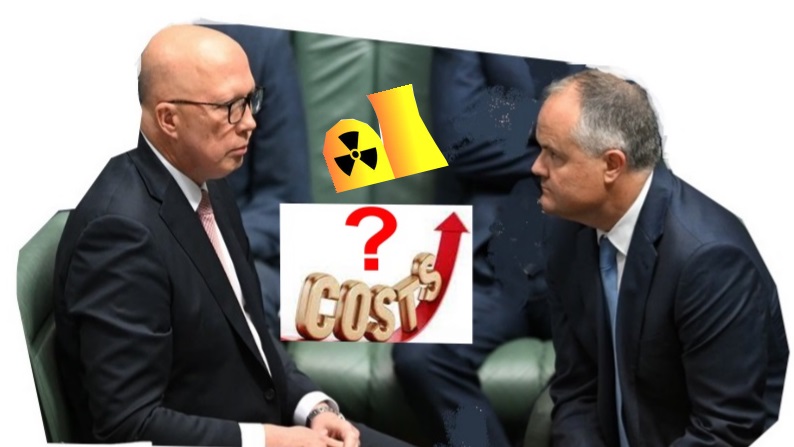
The Age, By Nick Toscano, March 19, 2025
Major investors have clashed with the Coalition ahead of the federal election, warning that slowing the rollout of renewable energy will push up electricity bills by increasing the need to call on failure-prone coal plants and expensive gas-fired generators.
Debate about Australia’s clean energy shift has been thrust to centre stage as Opposition Leader Peter Dutton campaigns to limit renewables to 54 per cent of the electricity grid and build a fleet of government-owned nuclear generators across the mainland.
If it wins the election, the Coalition would roll back Labor’s 2030 climate commitments, including its target for renewables to make up 82 per cent of the grid by 2030, which experts believe is unlikely to be met.
However, in a significant intervention, a group of large investors including US asset giant BlackRock, France’s Neoen, Australia’s Macquarie Bank and the Andrew Forrest-backed Squadron Energy has ramped up its push against policies that would restrict the expansion of wind and solar and keep the grid heavily tied to fossil fuels for longer.
“Australia needs more renewables, not less, to achieve sustained power price reductions,” said the Clean Energy Investor Group, which represents 18 global and local investors with a portfolio value of $38 billion across Australian renewable projects.
Households have been hit with double-digit power bill increases since 2022, the year that Russia’s invasion of Ukraine unleashed a global energy crunch. Another power price rise, partly due to recent stretches of low wind and rain limiting renewables’ output, is set to take effect in Queensland, NSW and South Australia from July this year.
But bills would be up to $417 a year higher if not for renewable energy and batteries, the investor group’s analysis shows, as utilities would be forced to more frequently fire up their gas-powered generators, which are among the most expensive suppliers to the grid.
Separate industry modelling released last week by the Clean Energy Council suggests the Coalition’s push to limit renewables would require at least a three-fold increase in gas-powered electricity costs by 2030.
Investors have also expressed concern at the Coalition’s proposal to extend the lives of ageing coal-fired power stations beyond their closure dates in the 2030s and 2040s until nuclear plants were ready to replace them, which could raise risks of sudden breakdowns, power shortages and price spikes.
“Running a grid using fossil fuels rather than renewables would increase total system costs, weaken energy security, and place greater strain on ageing coal and gas infrastructure,” the investor group said………………………………..more https://www.theage.com.au/business/companies/investors-take-aim-at-coalition-as-nuclear-debate-hits-boiling-point-20250318-p5lkg8.html
Coalition’s nuclear plan most expensive option for Australia, former US climate official says
Dr Jonathan Pershing, a former US special envoy for climate change and climate negotiator under Democratic presidents, says few countries building nuclear power plants
Adam Morton Climate and environment editor, Tue 11 Mar 2025 , https://www.theguardian.com/australia-news/2025/mar/11/coalitions-nuclear-plan-most-expensive-option-for-australia-former-us-climate-official-says
A longtime senior US climate official has weighed in on Australia’s energy debate, saying “very, very few people” internationally are building new nuclear power plants and, in most cases, the combination of solar and batteries delivers “higher reliability than gas”.
Dr Jonathan Pershing, a former US special envoy for climate change and climate negotiator under Democratic presidents, was in Sydney on Monday to speak at the city’s climate action week. Asked whether nuclear power as proposed by the Coalition was a viable option for Australia, he said “almost all the numbers that I have seen suggest that that’s a more expensive option than other choices”.
“What’s really interesting is the global community’s progress on nuclear with, frankly, a bigger head start than Australia’s had, because the ban here has been in place for a long time,” he told Guardian Australia.
“Very, very few people are building new nuclear.”
Pershing, who is program director at the William and Flora Hewlett Foundation, said even if Australia was able to overcome two immediate hurdles to nuclear energy – the legislated ban and an historical lack of public support for the technology – it then faced asking taxpayers to pay “holding costs” for 10 to 20 years when it could be building the same amount of generating capacity sooner.
“The cheapest one still globally, and I think here as well, is probably a combination of solar plus batteries – and that’s firm capacity, by the way,” he said. “If we look at the way that’s been analysed, the combination of the two [solar and batteries] gets you higher reliability than you get from gas.
He cited the example of the 40-year-old Diablo Canyon nuclear plant, in California. He said it was not likely to be replaced with a new nuclear generator once it reached the end of its life because of the cost. “They’ll do some life extensions, but they don’t think it is even plausible to imagine building new capacity there,” he said. “It’s just too expensive.”
The Coalition has claimed that its proposal to slow the rollout of renewable energy, extend the life of ageing coal plants, rely more on gas-fired power and later build publicly funded nuclear plants at seven sites, mostly after 2040, would be cheaper and more reliable than Labor’s promise of sourcing 82% of Australia’s electricity from renewable energy by 2030.
Peter Dutton has said the Coalition’s claim is supported by a report by consultants at Frontier Economics. But several other independent energy experts have argued the Coalition’s plan would, in relative terms, be likely to be more expensive for consumers over the next decade, at least, and less reliable and lead to substantially higher greenhouse gas emissions.
Pershing said a another problem for Australia would be training personnel for a nuclear power industry. Technical experts would have to be brought from overseas, which isn’t the case for other types of energy generation, he said.
That expertise could come from Canada, China, France or Russia, adding that in the case of Russia, “I’m not so convinced that that’s where you’d want to go”.
Pershing said the Trump administration’s anti-climate action stance would have an effect “but, I think, less than people might imagine”. He said the change in the US was an opportunity for Australia, “depending on how it chooses to engage”.
“The thing that’s most salient is that the rest of the world has decided that the least-cost solution to provide for more energy, particularly for electricity, is through some combination of renewables technologies plus batteries,” he said, citing International Energy Agency data showing it was the cheapest and faster solution “for about 80% of the world”.
“In much of the world, demand [for energy] is rising and you’re going to have to supply that demand from something. That means transition minerals, and that means technology, and that means investment. Those are places that the Australian economy is well positioned to deliver.”
Based on Trump’s language and early actions, the US was likely to slow the construction of wind and solar power and electric vehicles while increasing its demand for critical minerals, he said. But the US was “not the primary place where things are happening”.
“The place where things are happening is across Asia, broadly, with enormous continued demand from China, demand from India, demand from Indonesia and then actually others around the world who are building on that capacity,” he said.
Regarding fossil fuel exports, Pershing said the question for Australia was how it replaced the economic value of the coal and gas it sells with other exports, and what commitments it has made that were consistent with keeping global heating to less than 2C.
Australia could, for example, build a new mutually beneficial trade relationship with Japan where Australia produced and sold zero carbon steel and other metals. Pershing said Australia would also have to deal with the future of communities, such as in the Hunter Valley and its nearby port of Newcastle, that rely heavily on coal mining and coal exports.
“I think these are difficult questions, and they’re legitimate ones for the whole society to take up,” he said. “[A change] is coming. It’s not that it won’t come, but if we don’t manage it, it’ll have enormously negative consequences for communities, and I think that’s on the collective government, civil society and thought leadership to resolve and to address”.
Higher household bills by 2030 under nuclear: report

by News Of The Area – Modern Media – , https://www.newsofthearea.com.au/higher-household-bills-by-2030-under-nuclear-report
HOUSEHOLDS could fork out an extra $450 a year for power by 2030 if policymakers pursue nuclear and a slower renewable rollout, modelling suggests.
An analysis commissioned by the Clean Energy Council found the additional pricey gas needed under a nuclear pathway would drive bills higher by 2030 than if the renewables-led grid transition continues.
The modelling mirrors the energy policies on offer from the major federal parties – the Labor government is vying for 82 per cent of renewable energy in the grid by 2030, while the coalition is promising to build nuclear power plants.
Renewable energy would make up about half the energy grid by 2050 and nuclear power 38 per cent under the opposition plan.
Opposition leader Peter Dutton has promised cheaper electricity long-term based on calculations it commissioned from consultancy Frontier Economics.
Using AEMO’s “progressive change” scenario for the nation’s energy mix, Frontier found including nuclear energy would reduce costs from $437 billion to $331 billion – or slash costs by 44 per cent compared to the “step change” scenario.
Yet numbers crunched by professional services firm Jacobs on the clean energy industry body’s behalf found households could expect a 30 percent average increase by 2030 under the nuclear pathway.
This would amount to an $449 annual increase for the typical consumer ser
viced by the main energy grid.
Small businesses could expect a $877 increase in their bills by 2030 if the clean energy rollout slows down while waiting for nuclear to be built.
Even bigger price jumps were possible were a coal generator to unexpectedly fail – something that becomes more likely as they age – as more gas would be needed to make up the shortfall.
Voters are set to go to the polls May 17, at the latest, and cost of living will be front of mind following a prolonged stint of high interest rates aimed at taming inflation.
Clean Energy Council chief executive officer Kane Thornton said halting renewable energy deployment and relying on coal and gas before nuclear comes online would be a “disaster” for power prices.
“Australia would have to increase its reliance on increasingly expensive and unreliable old coal generation, as well as significantly increase gas generation, which is a much more expensive energy source,” he said.
“Getting more renewables into our system, such as solar and wind and backed by pumped hydro, batteries and small amounts of gas, is the cheapest and most reliable way to keep energy bills as low as possible for Australians.
The analysis considered the influence of wholesale electricity prices on power bills for households and small businesses under each scenario.
Network costs and other components of electricity bills were not included in the modelling.
Tuesday’s power bill numbers follow the Climate Change Authority’s report highlighting the nuclear power plan could push Australia’s 2030 climate target out until 2042 and add two billion tonnes of carbon emissions to the environment by 2050.
1 This month

of the week – Australians for War Powers Reform (AWPR)
To see nuclear-related stories in greater depth and intensity
 Antinuclear