 Troubled ANSTO raises nuclear medicine prices, THE AUSTRALIAN, SEAN PARNELL, HEALTH EDITOR,JULY 26, 2019 Australia’s nuclear medicine sector has been hit with price hikes of up to 9 per cent from the government manufacturer despite months of supply problems, safety concerns and breakdowns.
The Australian Nuclear Science and Technology Organisation provides the domestic supply of nuclear medicine, likely to be needed by one in two Australians during their lifetime, and also wants to ramp up its exports.
But amid calls for Australia to also embrace nuclear energy, ANSTO’s reputation has been tarnished by problems at its Lucas Heights facilities that have even required it to rely on imports.
Most recently, after heaters for hydrogen converters failed, ANSTO was forced to bring its new $200 million plant into service before it had all the approvals. Two workers were then exposed to excess radiation, forcing its closure, and yet another investigation by the regulator, the Australian Radiation Protection and Nuclear Safety Agency.
An ANSTO spokesman yesterday confirmed the nuclear medicine sector had been asked to pay more than 3-9 per cent more for products…….
Some customers have been lobbying federal Industry, Science and Technology Minister Karen Andrews to intervene. https://www.theaustralian.com.au/nation/troubled-ansto-raises-nuclear-medicine-prices/news-story/208ee20abacac04f304e45960bd963b4
July 27, 2019
Posted by Christina Macpherson |
AUSTRALIA - NATIONAL, business, safety |
Leave a comment
 Wake up and smell the radiation. Nuclear is not the answer https://www.dailytelegraph.com.au/rendezview/wake-up-and-smell-the-radiation-nuclear-is-not-the-answer/news-story/dc3ea481d9d6083a9c6b391268f6d078m Allen Hicks, 24 July 19
Senior Coalition figures are demanding nuclear power stations across Australia, which would represent a massive growth opportunity for the union I lead.
If dozens of power plants were to pop up on the fringes of Australian cities it would create thousands of well-paid jobs for Electrical Trade Union members.
But here’s the thing: the members I represent — electrical workers who understand power generation — could not be more staunchly against an Australian nuclear industry.
This is why the ETU, despite the obvious direct benefits on the table, is against the nuclear push.
So what are our reasons?
Firstly, there’s the economics.
A few months ago, the giant global financial advisory Lazard calculated the ‘levelised’ cost of various means of electricity production.
Natural gas was $A59 per megawatt hour, solar was $A52, and wind $A42.
Nuclear was $A161, according to the findings.
Little wonder that Exelon senior vice president William Von Hoene noted last year: “I don’t think we’re building any more nuclear plants in the United States. I don’t think it’s ever going to happen. They are too expensive to construct.”
Mr Von Hoene’s negativity about nuclear’s prospects is shared by the governments of South Korea, Switzerland, Taiwan, and Belgium — all of whom are now committed to phasing out their nuclear power industries. By 2022, Germany has committed to closing all seven of its nuclear reactors.
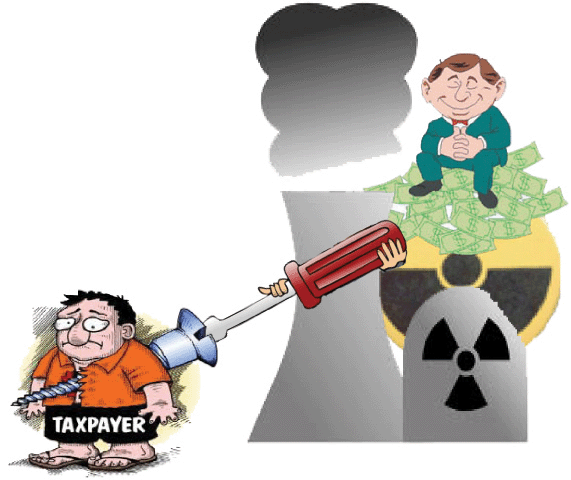
Every single recent report, including an in-depth study by our own CSIRO, shows nuclear is uneconomical unless massively subsidised by taxpayers.
And an Australian nuclear industry would face far greater challenges than most.
In established nuclear generation countries the best case scenario is about five years to build a new plant. That’s with established regulatory bodies, procedures, and an existing skilled workforce.
This means you would be looking at a decade at least to build a nuclear power station in Australia, when the same size power generation completed in a combination of solar, wind, and battery storage could be done in under two years.
Basically anyone who tells you an Australian nuclear industry is an economic win is either lying or has been lied to.
Yet even if the numbers could balance on an Australian nuclear power industry, our union would still oppose it.
And that is our second reason for taking a stand — it’s far too dangerous.
The inescapable point is that when you split the nucleus of a uranium molecule, the radiation released damages living cells.
Yes, you can create safeguards, but they will never be failsafe.
And those on the frontline of the danger won’t be the loudmouths in parliament or talkback radio pushing for a nuclear industry. It will be the working people — the miners who dig up radioactive material and the power station workers.
And it’s not just the hazardous material that poses dangers, there is also the immense security risk.
I visited a nuclear power station in Texas, USA, to better inform myself about the processes from the generation through to radioactive waste disposal.
The drive to the plant was zigzagged — a necessary precaution to stop any would-be ram-raids building momentum. Armed response teams with automatic weapons closely monitored the perimeter.
After they handed back our passports and checked our phones and cameras to delete any pictures they didn’t like, I thought of my home near New South Wales; Lucas Heights facility and the nights I see dozens of police motorbikes and cruisers helping to transport a tiny amount of medical grade nuclear material.
The idea of amplifying this risk is horrifying.
As a union, we simply can’t justify putting our members in that line of fire. And we don’t need to.
In Australia’s transition away from high-emission fuel sources, we don’t have to turn to one with such a high margin for error.
Zero-emission, renewable sources of energy and storage abound and the technology is improving at breakneck speed. All we need is for government and investors to lock in behind it and not be distracted by nuclear pipe dreams.
There has been a legal prohibition against the construction of nuclear power reactors in Australia since 1999. Maybe conservative politicians need to be reminded of that.
Because at the moment it seems the only thing with a longer half-life than radioactive waste is the misguided patience of those spruiking an Australian nuclear industry.
Allen Hicks is the Electrical Trades Union national secretary.
July 25, 2019
Posted by Christina Macpherson |
AUSTRALIA - NATIONAL, business, employment, safety |
Leave a comment
 The nuclear cycle of destruction , RedFlag, James Plested, 12 July 2019 ” ……..Another downside to nuclear power is the cost and time involved in constructing new reactors. As Peter Farley of Engineers Australia wrote in RenewEconomy earlier this year, “The 2,200 MW Plant Vogtle [a new nuclear plant in the US] is costing US$25 billion plus financing costs, insurance and long term waste storage … For the full cost of US$30 billion, we could build 7,000 MW of wind, 7,000 MW of tracking solar, 10,000 MW of rooftop solar, 5,000 MW of pumped hydro and 5,000 MW of batteries”.
International financial advisory firm Lazard’s 2018 Levelized Cost of Energy Analysis found that nuclear power was significantly more expensive than gas, coal, or renewable energy sources like solar and wind. For new nuclear, it estimated the cost at US$112-189 per megawatt hour. The cost of power generation from coal was US$60-143. Wind and utility-scale solar were significantly cheaper, at US$29-56 and US$36-46 respectively.
The world’s 450 or so operative nuclear reactors produce only around 11 percent of the electricity supply. Any significant increase in this proportion would require a massive program of construction – on the order of 1,000 new plants over the next decade.
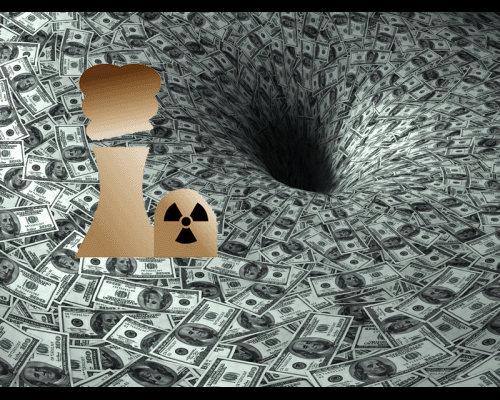
According to the most generous estimates, the cost of constructing a single new nuclear reactor is between US$5 and $10 billion (and the necessary decommissioning of the average reactor now costs an estimated US$500 million). So for the construction of 1,000, we would be looking at up to US$10 trillion. In addition, there is related infrastructure such as new uranium mines, enrichment and transportation facilities, waste storage facilities and so on. But if there are trillions of dollars available for nuclear, why not use that money to fund a global shift to a combination of wind, solar, tidal and other renewable sources that could much more cheaply and sustainably provide for the world’s energy needs? ….” . http://www.onlineopinion.com.au/view.asp?article=20398
July 13, 2019
Posted by Christina Macpherson |
AUSTRALIA - NATIONAL, business |
Leave a comment
 Nuclear war between super funds Online Opinion, Jim Green – , 11 July 2019 Industry Super Australia (ISA) – a research and advocacy body for Industry SuperFunds – has published a report promoting nuclear power, prompting a sceptical response from Industry Super Holdings, which is controlled by super funds including AustralianSuper, Cbus, Hostplus and HESTA. Most of those super funds are also involved in ISA, so the sector is at war with itself – or perhaps the sceptical response can be read as the sector’s response to the authors of the pro-nuclear report.
The context for this debate is welcome – super funds urging governments to speed up climate action, and considering using some part of their own vast wealth to make needed investments for climate change abatement.
But the ISA report – ‘Modernising Electricity Sectors: A guide to long-run investment decisions’, written by ISA Chief Economist Stephen Anthony and Emeritus Professor Alex Coram from the University of WA – misses the mark on nuclear power.
ISA gives itself some wriggle-room by noting that the views expressed in the report do not necessarily reflect those of ISA. And the authors give themselves some wriggle-room: for all their nuclear boosterism, they note that it ‘is unlikely that nuclear offers opportunities for investment in the short term’ and that it should be placed on a ‘watching brief’.
On the other hand, the authors argue that Australia’s lack of experience managing a nuclear power plant ‘pre-empts the ability to make decisions between all major options for emission reduction.’ So Australia should introduce nuclear power in order to make a decision as to whether or not to develop nuclear power? Insofar as there is any logic to that argument, it is dizzyingly circular.
The authors fret that Australia has no capacity to build or operate a nuclear facility and thus lags geographical neighbours such as Indonesia and Vietnam. That’s nonsense. All three countries are in the same position: operating research reactors, no capacity to build power reactors and no serious plans to acquire them from overseas vendors (Vietnam abandoned its quest for nuclear power in 2016, citing excessive costs).
The authors aim to ‘to provide the best analysis possible’ but there isn’t even passing mention of salient issues such as the proliferation and security issues associated with nuclear power, or the industry’s sickening record of mistreating indigenous peoples, or the nuclear waste legacy, or the occasional catastrophic accident costing hundreds of billions of dollars in addition to the human and environmental costs.
 Nuclear economics
The authors state that levelised costs of energy are not a good basis for long-term investment or policy decisions, and they prefer grid-level cost estimates (which make allowance for such things as the cost of back-up power). Fine – but the inputs they choose undermine their work. Rubbish in, rubbish out……..
The report ignores the Hinkley Point construction project in the UK (two EPR reactors) as it ‘seems to be an outlier in terms of technology and financial arrangements’. So the authors use the ridiculous EIRP cost estimates for non-existent Generation IV reactors but ignore cost estimates for reactors that are actually under construction … go figure. Hinkley weighs in at a hefty US$10.5 billion per GW. And the ISA report ignores the Vogtle twin-AP1000 project in the US state of Georgia, which is even worse at US$12.3+ billion per GW.
There’s no mention of the V.C. Summer project in South Carolina (two AP1000 reactors), abandoned after the expenditure of at least A$12.9 billion, There’s no mention of the bankruptcy of industry giants Westinghouse and Areva.
The nuclear industry is in crisis – but you wouldn’t know it reading the ISA report. Nuclear lobbyists have themselves repeatedly acknowledged nuclear power’s ‘rapidly accelerating crisis‘, a ‘crisis that threatens the death of nuclear energy in the West‘, ‘the crisis that the nuclear industry is presently facing in developed countries‘, while noting that ‘the industry is on life support in the United States and other developed economies‘ and engaging each other in heated argumentsabout what if anything can be salvaged from the ‘ashes of today’s dying industry’.
Generation IV concepts
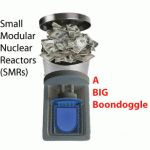 If the ISA report authors are entranced by Generation IV nuclear concepts, as their uncritical use of the EIRP report suggests, why not consider the estimated cost of prototypes under construction rather than ridiculous guestimates offered by nuclear companies? Argentina claims to be a world leader in the development of small modular reactors, but the estimated cost of the one SMR under construction in Argentina has ballooned to an absurd US$21.9 billion / GW. Likewise, estimated construction costs for Russia’s floating nuclear power plant increased more than four-fold and now amount to over US$10 billion / GW.
ISA’s chief economist and report co-author Stephen Anthony told the ABC that nuclear power ‘looks awfully good’. But the only figures in the ISA report that make nuclear look good are the ridiculous guestimates provided by companies involved in Generation IV R&D. Nuclear doesn’t look awfully good to the growing number of countries phasing out nuclear power ‒ a list that now includes Germany, Switzerland, Spain, Belgium, Taiwan and South Korea. And it doesn’t look awfully good to the nuclear lobbyists pondering what if anything can be salvaged from the ‘ashes of today’s dying industry’ … it looks awful, not awfully good.
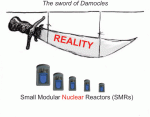 A 2015 report by the International Energy Agency and the OECD’s Nuclear Energy Agency said that ‘generation IV technologies aim to be at least as competitive as generation III technologies … though the additional complexity of these designs, the need to develop a specific supply chain for these reactors and the development of the associated fuel cycles will make this a challenging task.’
The late Michael Mariotte commented on the IEA/OECD report: ‘So, at best the Generation IV reactors are aiming to be as competitive as the current − and economically failing − Generation III reactors. And even realizing that inadequate goal will be ‘challenging.’ The report might as well have recommended to Generation IV developers not to bother.’
Technological neutrality?
A single reactor would be a ‘relatively small investment’, the ISA report states. But cost estimates for all reactors under construction in north America and western Europe range from A$14-24 billion………..
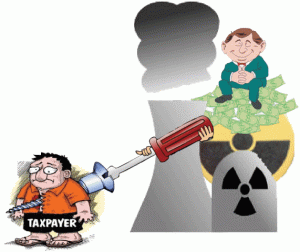 The report discusses the plan for a twin-reactor nuclear plant at Wylfa in Wales, abandoned after the cost estimate increased from A$26.4 billion to A$39.7 billion. The project was abandoned by Hitachi, the ISA authors state, ‘because it was required to carry too much risk relative to the size of the company.’ But staggering British taxpayer subsidies were on offer for Hitachi to proceed with Wylfa. Business and Energy Secretary Greg Clark saidthe UK government offered a ‘significant and generous package of potential support that goes beyond what any government has been willing to consider in the past’ … which is really saying something since taxpayer subsidies for Hinkley Point are estimated at A$55–91 billion.
Evidently the ISA report authors believe that the subsidies on offer for Wylfa needed to be increased again and again until Hitachi finally agreed to go ahead with the project.
Sceptical responses
The New Daily, a publication of Industry Super Holdings, didn’t buy the ISA’s nuclear Kool-Aid. The New Daily article quotes Dr Ziggy Switkowski saying last year that ‘the window for gigawatt-scale nuclear has closed’ and that nuclear power is no longer cheaper than renewables, with costs rapidly shifting in favour of renewables.
The New Daily also quotes Andrew Richards, CEO of the Energy Users Association of Australia. Richards noted that it would take at least a decade to get a nuclear power plant up and running (20+ years according to economist Prof. John Quiggin) and that governments would need to support insurance, dismantling and disposal costs as the private sector won’t take on those risks.
The Electrical Trades Union condemned the ISA report. ETU National Secretary Allen Hicks said: ‘The ETU has very strong concerns about this ISA report that broadly spruiks nuclear power while using flawed assumptions and poor modelling to write down the capacity of renewables and battery technology.’
Hicks called on partners in the superannuation industry to join in the condemnation of the ISA report ‘that is not only full of holes but would put at risk the very people who industry super represents – union members.’
Hicks continued: ‘This report has been developed without consulting key industry stakeholders or actual members of Industry Super Australia that we have been in contact with. … With the Federal Liberal Government totally incapable of leading on energy policy, we think ISA should take a leading role in energy investment, but it must not try to put our members retirement savings into a deadly industry that does not exist in Australia and is fading around the globe and consistently leads to spiralling costs.’
ETU National Industry Coordinator Matthew Murphy accusedI SA of ‘fluffing up the benefits of nuclear power’ and said many of the report’s findings were based on assumptions or numbers with no basis in reality. ‘This report is biased toward nuclear power and against renewables and that clearly bares out in shoddy maths and assumptions like ‘a battery will only run for one hour’ or that the island nation of Australia is not suitable for off-shore wind and tidal power,’ Murphy said. http://www.onlineopinion.com.au/view.asp?article=20399&page=1
July 13, 2019
Posted by Christina Macpherson |
AUSTRALIA - NATIONAL, business, Opposition to nuclear |
Leave a comment
 The nuclear cycle of destruction, Red Flag, James Plested, 12 July 2019 “……..Another downside to nuclear power is the cost and time involved in constructing new reactors. As Peter Farley of Engineers Australia wrote in RenewEconomy earlier this year, “The 2,200 MW Plant Vogtle [a new nuclear plant in the US] is costing US$25 billion plus financing costs, insurance and long term waste storage … For the full cost of US$30 billion, we could build 7,000 MW of wind, 7,000 MW of tracking solar, 10,000 MW of rooftop solar, 5,000 MW of pumped hydro and 5,000 MW of batteries”.
International financial advisory firm Lazard’s 2018 Levelized Cost of Energy Analysis found that nuclear power was significantly more expensive than gas, coal, or renewable energy sources like solar and wind. For new nuclear, it estimated the cost at US$112-189 per megawatt hour. The cost of power generation from coal was US$60-143. Wind and utility-scale solar were significantly cheaper, at US$29-56 and US$36-46 respectively.
The world’s 450 or so operative nuclear reactors produce only around 11 percent of the electricity supply. Any significant increase in this proportion would require a massive program of construction – on the order of 1,000 new plants over the next decade.
According to the most generous estimates, the cost of constructing a single new nuclear reactor is between US$5 and $10 billion (and the necessary decommissioning of the average reactor now costs an estimated US$500 million). So for the construction of 1,000, we would be looking at up to US$10 trillion. In addition, there is related infrastructure such as new uranium mines, enrichment and transportation facilities, waste storage facilities and so on. But if there are trillions of dollars available for nuclear, why not use that money to fund a global shift to a combination of wind, solar, tidal and other renewable sources that could much more cheaply and sustainably provide for the world’s energy needs? …… https://redflag.org.au/node/6835
July 13, 2019
Posted by Christina Macpherson |
AUSTRALIA - NATIONAL, business |
Leave a comment
ETU pushes union trustees to block nuclear AFR, 10 July 19 The Electrical Trades Union is leading a push for union trustees to formally commit to excluding nuclear energy from industry super investments in favour of bolstering renewables. ETU national secretary Allen Hicks will propose an anti-nuclear investment motion at the Australian Council of Trade Union’s national executive later this year and use the ACTU’s Super Trustees Forum to “build and leverage support among my union director colleagues on this”.
“I want to pass a motion committing union directors in the industry super sector to focus on backing investment in renewable tech,” he will tell the union’s national conference on Wednesday afternoon.
“To focus on backing that investment instead of propping up the misguided imaginings of those who long for an Australian nuclear sector.”
The motion follows the ETU’s attack last week on an energy paper released by industry fund peak body Industry Super Australia (ISA), chaired by former ACTU secretary Greg Combet…….
Mr Hicks will attack the paper as a “disgrace” in his speech and question industry funds diverting money to ISA to produce it.
“It’s a disgrace that this body – this body that unions created – could be used as part of a push to expose workers and their communities to the catastrophic dangers that nuclear power plants present,” the speech says.
He will advocate industry super funds commit to a “war-like mobilisation” to battle climate change and “become the ultimate weapon in Australia’s fight for a clean, renewable energy sector”.
“The retirement savings of Australian workers could be deployed to invest in smart, new, renewable technology – including battery tech – that could set us on the path to zero carbon emissions.”
The ETU’s anti-nuclear position is supported by the $50 billion building industry super fund Cbus, which includes the CFMEU on its board of trustees………
Mr Hicks will argue the economics around nuclear power don’t stack up due to the costs and time taken for construction.
“But even if they did, our union would oppose it,” he will say, arguing nuclear puts workers in unsafe conditions.
“No responsible Australian trade union … no organisation that claims to represent the interests of Australian workers … could possibly endorse putting Australians into that line of potential fire.”…..
Energy Super, whose board includes ETU representatives, stressed it was “focused on maximising members’ hard-earned retirement savings”.
“We have a transparent investment process which considers many factors including environmental, social and governance criteria to ensure the sustainability of the fund over the longer term,” chief executive Robyn Petrou said.
“We are increasing our investments in renewables, such as wind farms and solar energy.” https://www.afr.com/leadership/workplace/etu-pushes-union-trustees-to-block-nuclear-20190710-p525sj
July 11, 2019
Posted by Christina Macpherson |
AUSTRALIA - NATIONAL, employment, opposition to nuclear |
Leave a comment
Unions revolt over Industry Super’s nuclear backing, Financial Review, David Marin-Guzman 3 July 19 The Electrical Trades Union has condemned a report from Industry Super Australia that backed nuclear energy as an option to confront the energy crisis, sparking a split between unions and industry funds’ own peak body.
ETU national secretary Allen Hicks said industry fund participants were not consulted on the ISA energy paper released last week and called on unions to condemn the paper’s recommendations, which he said promoted a “highly risky investment with deadly consequences”.
While the paper titled Modernising Electricty Sectors stressed it was not “pro nuclear” it said nuclear must be considered as part of the energy investment mix and questioned the capabilities of battery and renewable options.
“The ETU has very strong concerns about this ISA report that broadly spruiks nuclear power while using flawed assumptions and poor modelling to write down the capacity of renewables and battery technology,” Mr Hicks said.
“This report has been developed without consulting key industry stakeholders or actual members of ISA that we have been in contact with.”
The comments mark a significant push-back against the industry fund peak body, which is chaired by former Australian Council of Trade Unions chief Greg Combet.
The ETU has representatives on industry funds Cbus and Energy Super and its anti-nuclear position is shared by the maritime union, which opposes shipping nuclear material into ports.
Cbus, whose board members include building unions such as the CFMEU, joined the ETU in disagreeing with the ISA paper’s position.
“The ISA paper raises a number of interesting points for discussion. However, from an investment perspective Cbus doesn’t see nuclear as a part of Australia’s energy mix and we are actively pursuing other energy opportunities,” a spokesman for the fund said.
Mr Hicks said he supported ISA taking the lead on energy investment due to government inaction. But he argued it should focus on maximising returns, not promoting an industry that “would put at risk the very people who industry super represents – union members”.
The ETU has opposed nuclear power and uranium mining since the Second World War due to perceived risks to workers and the public.
Mr Hicks said members had “witnessed first-hand the death and destruction that comes with this form of power” and “more recent disasters in Fukushima and Chernobyl only reinforce this view”.
“That’s why it’s so vexing that industry funds our members pay their retirement savings into would offer any support to a report giving the nod to nuclear.”
………. ETU national industry co-ordinator Matthew Murphy claimed the ISA report “fluffed up” the benefits of nuclear power while including flawed assumptions on renewables “that had no basis in reality”.
“This report is biased toward nuclear power and against renewables and that clearly bears out in shoddy maths and assumptions like ‘a battery will only run for one hour’ or that the island nation of Australia is not suitable for offshore wind and tidal power,” he said.
Mr Murphy said the “most glaring” statement in the paper was that 100 to 150 nuclear power plants was enough to power half the country.
“Unlike the numbers in the report, we can’t pluck nuclear reactors out of thin air. And there is likely to be huge public opposition from the 150 towns where these deadly power plants would be built.” https://www.afr.com/leadership/workplace/unions-revolt-over-industry-super-s-nuclear-backing-20190702-p5239a
July 4, 2019
Posted by Christina Macpherson |
AUSTRALIA - NATIONAL, employment |
Leave a comment

Industry super urges Australia to consider the nuclear power option https://www.abc.net.au/news/2019-06-26/industry-super-funds-consider-the-nuclear-option/11248202, The World Today By senior business correspondent Peter Ryan 26 June 19
Nuclear reactors should be considered as a realistic option to confront Australia’s deepening energy crisis, according to a study from industry superannuation’s chief lobby group.
Key points:
- Industry Super says Australia should “build some capacity to operate a nuclear facility”
- The report says nuclear is often dismissed as “even more immoral than burning coal”
- It suggests a future energy mix including solar, wind, gas, coal and carbon capture
In a report that raises concerns about the ability of battery technology to maintain the baseload power, Industry Super Australia (ISA) argued that investment in nuclear energy should not be sidelined simply because of its controversial nature.
“If you look at the output of the nuclear industry, and if you consider its future relative to other technologies, it looks awfully good relative to some of the other potential technologies and therefore it shouldn’t be excluded from consideration,” ISA’s chief economist Stephen Anthony told The World Today.
Nuclear power the ‘ugly duckling’, batteries too costly
In addition to nuclear, the report argued technologies such as solar, wind, coal, gas generation and carbon capture and storage need to be considered.
The study also raised concerns about battery schemes, finding that using Tesla batteries to achieve 1.5 days power backup would cost $6.5 trillion, or the cost of building around 1,000 nuclear reactors.
It warned that generating power for a renewable energy system in the same period would require 100 Snowy Hyrdo 2.0 schemes at a cost of $700 billion.
In a discussion paper released today, Industry Super Australia acknowledged that investing in the nuclear option would raise concerns among environmental groups, particularly because of accidents in recent decades such as Chernobyl, Three Mile Island and Fukushima.
The report refers to research saying “nuclear power is now the ugly duckling of the power generation industry. People somehow dismiss it as immoral, even more immoral than burning coal”.
‘Something has got to give’
ISA chief economist Stephen Anthony told The World Today there was a case for industry fund intervention given the energy policy stalemate from Canberra.
“While the climate debate rages on, Australia’s ageing infrastructure continues to fall further and further behind the rest of the world,” Mr Anthony said.
“If this policy inertia continues, regulatory uncertainty will continue to rise, allowing some investors to capitalise on price movements and maximise public subsidies to game the market.
“Something has to give and this is where industry super funds come in.”
The study found that cashed-up industry super funds are ready to invest in energy infrastructure but are waiting on policy direction from the Federal Government.
“The lack of a genuine, long-term, technology neutral energy policy is a major factor undermining fund investment,” the report concluded.
In the normal course, portfolio investors would be lining up to fund long-term solutions in this changing industry for Australia. But so far, the silence from investors is deafening.
“Right now, it seems the only politically acceptable investments appear to be relatively small scale, quickly deployed renewable wind or solar projects.”
The Australian Energy Market Operator estimates that about 60 per cent of current coal-fired generation capacity will be retired by 2040.
“The reality is that, even without climate change, the existing fleet of base load generators needs replacing,” the report noted.
The report excludes a range of technologies from the mix of energy options, including biomass because of its high emissions intensity, and it dismisses tidal and wave power as unrealistic because of the cost and scale required.
June 27, 2019
Posted by Christina Macpherson |
AUSTRALIA - NATIONAL, business |
Leave a comment
 Pay Day: Christopher Pyne’s Defence bonanza a fee fillip for EY https://www.michaelwest.com.au/pay-day-christopher-pynes-defence-bonanza-a-fee-fillip-for-ey/, Jun 27, 2019 It dwarfs all other government spending. It is secretive. A huge chunk of it does not even go out to tender. The lion’s share goes to foreign multinationals who pay no tax in Australia. It is defence spending. Michael West reports on the explosion in defence spending which has tripled to more than $60 billion in one year since the Coalition took office, and since Christopher Pyne became Minister for Defence Industry on July 19, 2016.
Christopher Pyne switched up portfolios from Defence Industry to Minister for Defence on August 28 last year, a role in which he remained until April this year.
Just two months out of Cabinet, and with well over $100 million a year in Defence fees already going to global consulting firm EY, Christopher Pyne and EY announced yesterday the former minister was signing on with the firm to “ramp up its defence capabilities”.
The response on social media was immediate and rabid, forcing EY straight into defence mode, insisting just three hours later that Pyne would not be lobbying the government on behalf of EY and its clients. Centre Alliance Senator Rex Patrick called on Prime Minister Scott Morrison to censure Pyne for breaching the code of ministerial standards, tweeting:
“Mr Pyne has current knowledge of the broadest affairs of Government and intimate details of every significant matter in respect of the Defence portfolio. He cannot un-know what he knows when forming up advice for EY. Inappropriate and a new test for Scott Morrison”.
When Christopher Pyne headed up Defence Industry in 2016, this was the first year in which government spending on defence surpassed all other agencies combined at 57 per cent of all contract fees. It was even higher the next year at almost 60 per cent.
What sort of contracts are we talking about here? Advice. EY billed the government $17.2 million in one contract for “change management services” for the Department of Defence.
The chart below [on original]shows the Big Four global accounting firms fees over the two years 2016-17.
Defence is by far the biggest item of public spending, yet it attracts almost no media attention, partially because of the secrecy, also because both major parties are loathe to be wedged on national security and so never make a fuss about it – even as billions are being squandered on questionable projects with very little visibility or accountability.
The ABC attempted to shed some light on it two weeks ago, obtaining documents which showed the Government was keeping its “projects of concern” hidden from the public. The documents it found using Freedom of Information, were heavily redacted on “national security” grounds.
Apparently, taxpayers who fund this mountain of government expenditure do not deserve to know how their money is being spent.
Since 2004, and up to 2015, the Department of Defence spent (according to contracts in AusTender) $5 billion to $21 billion. Then, in 2016, it tripled to almost $60 billion and has continued at two to three times pre-2016 spending rates for the last three full years. According to data analyst, Greg Bean, running this year at $16.5 billion for 5.5 months, it will end up at around $36 billion by year’s end.
“That’s at this rate,” says Bean. “It’s just a simple projection of current trend so it’s primitive, but still not trivial.”
June 27, 2019
Posted by Christina Macpherson |
AUSTRALIA - NATIONAL, business, politics, secrets and lies |
Leave a comment
 Brisbane Times, By Jeff Angel, June 11, 2019 — ……… In a little publicised study released this year, the NSW Innovation and Productivity Council assessed the environmental goods and services sector. The activities involved include delivering waste, water and energy management; and biodiversity, landscape and climate services. It found the number of jobs generated as 152,000 larger than the total number of jobs in agriculture and mining combined. Importantly a significant number were in regional areas and the vast majority of businesses, small to medium size. With a 6 per cent growth rate, the environmental goods and services sector was already contributing $43.9 billion a year across the economy.
Notably the study did not include tourism jobs, many of which are based on our magnificent natural assets found in national parks. There are more than 50 million visits a year, with Destination NSW finding more than $20 billion is spent on nature based tourism generating tens of thousands of jobs.
So, protecting the environment is not a job destroyer. It’s the opposite. But what has caused this positive situation?
To the chagrin of some on the “let the market run free” side of the political debate – a major influence has been government regulation stimulating investment and innovation. Mandatory renewable energy targets are one example.
Another is the NSW Energy Savings Scheme, where electricity retailers are required to meet escalating targets helping business, industry and households save energy (and have lower bills). The Council notes the government law created a competitive market to deliver energy savings at least cost, resulting in NSW now leading the world in the wide-scale adoption of efficient lighting.
A more recent development has been “return and earn” providing refunds on drink bottles and cans. Originally decried by major beverage companies as a tax on consumers that would cost jobs – the evidence is that more than 500 new jobs have been created. None have been reported lost. The state’s Pricing Regulator has also found minimal cost impact; and when you return your drink container for the 10 cent refund, you are saving on the purchase price.
This does not mean that these jobs are replacing employment in the extractive industries, but rather at a macro level there is a social and economic benefit. The issue confronting policy makers is transition as one industry declines and another grows. Some skills are transferable but more deliberate assistance programs are needed. …..
It’s not a choice between jobs and the environment, but how to transition in a way that manages inevitable dislocation and also prevents ongoing, damaging and serious environmental impacts on present and future generations. This is the challenge for the new federal and NSW ministers for the environment and industry.
We know there are many jobs in the green economy – NSW has shown this. Income and job creating services that protect the climate will grow if government allows it. Establishing a local reprocessing industry for our recycling is also essential. Asia has rejected our kerbside recyclate and we can’t just dump or incinerate it here. On the optimistic side, we have a new federal Minister for Waste Reduction in the environment portfolio, the first in Australia’s history; and state ministers are grappling with how to embrace the circular economy where resources are not wasted. Let’s dispense with the slogan of jobs v the environment and get on with doing both.
Jeff Angel is the director of the Total Environment Centre. https://www.brisbanetimes.com.au/national/ditch-the-jobs-v-environment-slogan-and-get-on-with-doing-both-20190610-p51w8n.html
June 11, 2019
Posted by Christina Macpherson |
AUSTRALIA - NATIONAL, climate change - global warming, employment |
Leave a comment
 Vimy Resources eyes US uranium fix, Stuart McKinnon, The West Australian 1 June 2019 Vimy Resources managing director Mike Young refers to himself as a “silver-lining guy” and jokingly admits “you have to be … in uranium”.
The Andrew Forrest-backed Vimy has a completed definitive study for its $493 million Mulga Rock uranium project 200km east of Kalgoorlie, has two granted mining leases and other key approvals in place. It just needs the price of yellowcake to roughly treble so it can push the button.
The spot price of uranium has been in the doldrums since the 2011 Fukushima nuclear disaster in Japan, which prompted a phasing out of nuclear power in western countries, particularly in Europe.
Despite several false dawns, sentiment for the commodity has remained stubbornly low for the past eight years.
But the forthright Mr Young and Vimy’s chief nuclear officer Julian Tapp are hopeful the market might be approaching an inflection point.
They see a looming decision of the US Government as a potential catalyst to move uranium prices higher.
President Donald Trump is expected to decide next month whether to introduce trade restrictions to protect US-based uranium producers……..
If a quota is introduced, the company is hopeful Australia’s close relations with the US could win the country key concessions as it has done with aluminium and steel.
But whatever the outcome, Vimy believes a decision will provide clarity to a market starved of certainty for the past 18 months. US utilities, representing nearly a third of the global uranium demand, have effectively been on a buying strike since the start of last year.
…… “Politically, people are now thinking of nuclear as an avenue to emissions-free, dispatchable power 24/7 in all weather conditions,” Young said. “There’s still an anti-nuclear lobby, but by and large mainstream environmental scientists are getting on board nuclear power.” ….. https://thewest.com.au/business/spinifex/vimy-resources-eyes-us-uranium-fix-ng-b881212458z
June 3, 2019
Posted by Christina Macpherson |
business, uranium, Western Australia |
Leave a comment
 Uranium Week: Buyers’ Market. https://www.fnarena.com/index.php/2019/05/28/uranium-week-buyers-market/ By Greg Peel, May 28 2019
Sellers continue to chase down ever more empowered buyers in an ongoing weak uranium market.
-Uranium spot price continues to fall
-Rio Tinto may shut down Rossing
-US production falls dramatically
It was Groundhog Week last week in the uranium market. With utilities largely out of the market pending a section 232 decision, sellers continue to lower prices in order to flush out buying interest.
And the buyers are not making it easy. Having the upper hand, they are not simply insisting on lower prices, industry consultant TradeTech reports, but on specific origins, delivery locations and other restrictive terms and conditions.
Four transactions totalling 500,000lbs U3O8 equivalent were recorded in the spot market last week. TradeTech’s weekly spot price indicator has fallen -US20c to US$24.30/lb.
The spot price has now fallen -16% in 2019, whittling a 12-month gain down to 6%.
There were no transactions reported in uranium term markets. TradeTech’s term price indicators remain at US$28.50/lb (mid) and US$32.00/lb (long).
Supply Response
Australian-listed diversified miner Rio Tinto ((RIO)) has announced it will advance the closure of its 69% owned Rossing uranium mine in Namibia to June 2020 if the Namibian competition regulator blocks the US$104m sale of the mine to China National Uranium Corp.
Rio cannot continue to operate the loss-making business and would rather cease operations ahead of a forecast 2025 mine life if the sale is rejected.
The Namibian government owns a 3% stake in Rossing but 51% of the voting rights. The Iranian Foreign Investment Co holds 15% and the Industrial Development Corp of South Africa owns 10%.
Persistently low uranium prices continue to impact on global supply. Last week the US Energy Information Agency reported US uranium mines produced 700,000lbs U3O8 in 2018, down -37% from 2017.
Total shipment of uranium concentrate from US mills fell -35%. US producers sold 1.5mlbs of concentrate at an average price of US$32.51/lb.
May 30, 2019
Posted by Christina Macpherson |
AUSTRALIA - NATIONAL, business, uranium |
Leave a comment
|
  Brace for impact – climate change litigation is fast approaching https://www.canberratimes.com.au/story/6184421/brace-for-impact-climate-change-litigation-is-fast-approaching/?cs=14246, Arthur Marusevich , 30 May,19 Brace for impact – climate change litigation is fast approaching https://www.canberratimes.com.au/story/6184421/brace-for-impact-climate-change-litigation-is-fast-approaching/?cs=14246, Arthur Marusevich , 30 May,19
Since the late 1990s, Australian politics on climate change has been divisive. Although Australia signed the Kyoto Protocol in 1998, it did not ratify it until 2007. Then, in 2011, the Clean Energy Act purporting to reduce greenhouse emissions was passed, only to be repealed in 2014.
In 2016, Australia ratified the Paris Agreement and the Doha Amendment to the Kyoto Protocol; however, any serious action on climate change remains to be seen.
At the same time, some states and territories also have emissions reduction targets. The uncoordinated approach is a problem for at least two important reasons.
First, climate change is an ever-increasing phenomenon, with tremendous impact on corporate, social and political discourse. Any meaningful legal framework to govern climate change requires the development of a legal consensus at the federal level, in line with international commitments.
Second, there is a rising wave of climate change-related litigation globally which is headed for Australia. Climate change litigation 2.0 (targeting companies) and climate change litigation 3.0 (targeting governments) will sink Australia, unless drastic measures are implemented.
Under the current legal regime, company directors may only be liable if found to be in breach of their duty of care or for failing to address a foreseeable risk. However, guidance from case law suggests that it is difficult to establish that the actions or omissions of a particular entity or director caused or contributed harm to be suffered by another. With the arrival of climate change litigation 2.0, this will all change.
For one, litigation 2.0 will force companies to assess and report on the risks of climate change and potentially set out plans for mitigating those risks. The recent tide of comments from the Australian Securities and Investments Commission, the Australian Prudential Regulatory Authority and the Reserve Bank of Australia are a testament to this.
Companies and their directors could soon face liability (including personal liability) if they fail to assess and address risks relating to climate change. Investors, shareholders and even communities will be able to recover losses and seek damages from companies and their directors, auditors and advisors, for failing to assess and mitigate risks.
As major climate change attribution studies emerge to assist in tracing particular weather events with greenhouse gasses, causation will be easier to establish. It is likely that in the future, courts will rely on such studies to conclude that a particular entity has contributed, at least in some proportion, to a particular harm.
It would be interesting to see how companies and directors brace for impact as climate change litigation 2.0 approaches.
Although unprecedented and unheard of in Australia, climate change litigation 3.0 will be the next phase. It will allow Australians to bring action against the government for failing to mitigate risks.
Claims of this nature around the world are already proving to be quite successful. The Urgenda litigation in the Netherlands is the leading example. In that case, a Dutch NGO argued that the Netherlands Government had breached its duty of care to the Dutch people by failing to mitigate the risks of climate change and reducing greenhouse gases. The remedy ordered by the court was that the Netherlands Government reduce emissions by at least 25 per cent by the end of 2020.
Similarly, the Juliana case brought against the US government argued that current policies fail to satisfy their obligations to hold certain essential resources on trust for all US citizens. The case is currently awaiting a determination as to whether it will go to trial.
We can only ignore it for so long – in the coming years, we are destined to see a rise in climate change litigation in Australia. While this may be welcome news for practitioners, it is not so much for companies and governments, who need to re-examine their approach to assessing and mitigating climate change risks now. If not, litigation 2.0 and 3.0 will do it for them.
- Arthur Marusevich is a lawyer and writer. He is an advocate for legal reform and social justice.
|
|
May 30, 2019
Posted by Christina Macpherson |
AUSTRALIA - NATIONAL, business, climate change - global warming, legal |
Leave a comment
It’s not worth wiping out a species for the Yeelirrie uranium mine, SBS, BY GAVIN MUDD “……. So are the economic benefits worth wiping out a species?
Short answer: no. But let’s, for a moment, ignore these subterranean animals and look at whether the mine would be beneficial.
Yeelirrie is one of Australia’s largest uranium deposits – and yet it has a low grade of 0.15 per cent (as uranium oxide). This refers to the amount of uranium found in rock. For comparison, the average grade of uranium mines globally is normally 0.1 to 0.4 per cent of uranium oxide (with some higher and others lower).
And Cameco’s Cigar Lake and McArthur River mines in Canada have typically been 15-20 per cent of uranium oxide. Despite such rich ore, McArthur River was uneconomic and closed indefinitely in early 2018.
What’s more, the future of nuclear power is not bright. According to the World Nuclear Industry Status Report, the number of nuclear reactors under construction around the world is at its lowest point in a decade, as renewable energy increases. The amount of nuclear electricity produced each year is flat. And nuclear’s share of global electricity is constantly falling behind renewables……..https://www.sbs.com.au/news/it-s-not-worth-wiping-out-a-species-for-the-yeelirrie-uranium-mine
April 27, 2019
Posted by Christina Macpherson |
business, uranium, Western Australia |
Leave a comment
 Record result but still no breathing space for Lynas, The Age, Colin Kruger, April 20, 2019
It should have been a great week for Lynas Corp….. Despite soft prices in the rare earths market – and a forced shutdown of its operations in Decemberdue to a local Malaysian government cap on its production limits – Lynas reported a 27 per cent jump in revenue to $101.3 million in the March quarter……
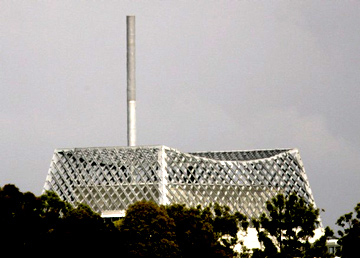
Unfortunately, Lacaze could provide no information on the glaring issue outside the company’s control that imperils its future: the regulatory cloud around the 450,000 tonnes of radioactive waste produced by its Malaysian operations since 2013, which is jeopardising the renewal of its licence to operate in the country. …..
the company was still “seeking clarification” on comments earlier this month by Malaysian Prime Minister Mahathir Mohamad, which appeared to solve the problem of the licence pre-condition that Lynas says it cannot meet – removal of the radioactive waste by September 2.
Mahathir said Lynas – or any potential acquirer (without explicitly naming Lynas’ estranged suitor, Wesfarmers, whose $1.5 billion indicative offer for the group was rebuffed in March) – would be able to continue to operate in Malaysia if it agreed to extract the radioactive residue from its ore before it reached the country.
Despite two cabinet meetings since that announcement, Mahathir has failed to clarify his comments, or confirm whether it means Lynas might not need to move the existing mountain of radioactive waste that has been accumulating at its $1 billion, 100-hectare processing facility in Kuantan province.
Continue reading →
April 22, 2019
Posted by Christina Macpherson |
AUSTRALIA - NATIONAL, business, politics international, rare earths, wastes |
Leave a comment







 Antinuclear