Australian Mining touts Honeymoon uranium mine, but only IF URANIUM PRICE IMPROVES
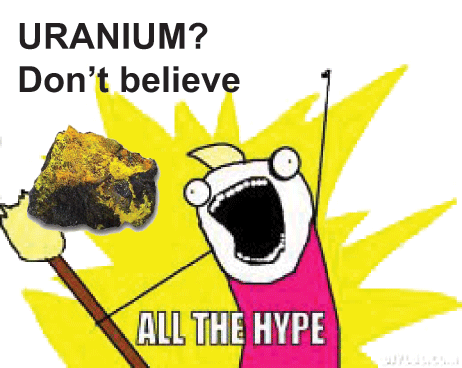 They headed the article “Boss discovers ‘major breakthrough‘ for Honeymoon uranium expansion ” and went on to detail how the Honeymoon uranium mine project restart in South Australia will ramp up production. But even in its enthusiasm, , Australian mining gave a hint about the low prospects for the uranium industry. It will all happen – “ assuming a favourable global uranium price for shareholders is achieved” https://www.australianmining.com.au/news/boss-resources-discovers-major-breakthrough-for-honeymoon-expansion/
Climate crisis – heating oceans affecting Tasman Sea marine life, and seafood industries
 ‘Not very happy’: Tasman Sea warmth puts the heat on key fisheries, Brisbane Times, By Peter Hannam, March 2, 2019 Back-to-back summer heatwaves in the Tasman Sea that have affected marine life and seafood industries in Australia and New Zealand could be another sign of the warming climate, scientists say.
Australia has just had its warmest summer by far, with the role of so-called blocking highs in the Tasman seen by meteorologists as key to the build-up of record-breaking heat over the country’s south-east.
The still conditions brought by those highs have the effect of limiting ocean mixing, while the relatively cloudless skies allowed solar radiation to warm the waters of the Tasman to a greater-than-usual depth.
By the Bureau of Meteorology’s definition, a marine heatwave occurs when temperatures in the top 10 per cent of readings for that time of year exist for at least five days. The Tasman Sea has met the definition for months on end, two years in a row………
The effect on marine ecosystems, fishing and aquaculture industries “can be devastating, including killing off kelp forests and corals”……… https://www.brisbanetimes.com.au/environment/weather/not-very-happy-tasman-sea-warmth-puts-the-heat-on-key-fisheries-20190302-p511cr.html
Extreme weather in Australia – the economic effects : why we need to prepare for this
 Storm-o-nomics: Why Australia should be more prepared for extreme weather, The Conversation, By Matt Wade
February 9, 2019 Another Australian summer has been marked by disasters triggered by extreme weather. Some came out of the blue, like the Townsville floods. Others unfolded gradually, like the droughtafflicting much of eastern Australia.
But there’s one characteristic our natural disasters have in common: their high price tag when compared with the rest of the world.
The World Disasters Report 2018, prepared by the Red Cross, found Australia was ranked 10th in the world for the cost of damage caused by disasters between 2008 and 2017. It estimated our disaster damage bill over that decade to be a hefty $US27 billion ($38 billion).
A separate study by London-based charity Christian Aid rated Australia’s lingering drought as the world’s seventh most costly weather-related disaster of 2018 (between US$5.8 and $9 billion).
We’re also located in world’s most disaster-prone region. The Asia Pacific was hit by two out of every five of the 335 disasters recorded worldwide in 2017 and suffered 58 per cent of disaster-related deaths, according to the Red Cross.
The headlines typically focus on the insurance losses caused by property damage following a calamity like the Townsville floods.
A recent report by consultancy SGS Economics and Planning for insurance company IAG tallied the insurance losses in Australia due to natural perils between 1970 and 2013.
During those decades storms caused the greatest losses (27 per cent of the total) followed by hail damage (21 per cent), floods (18 per cent), tropical cyclones (18 per cent) and bushfires (10 per cent).
But there’s a difference between insurance losses due to extreme weather and the broader economic cost. Insurance losses following natural disasters only capture the losses accruing to insured assets such as homes, motor vehicles and business premises. That’s only part of the story.
The disruption caused by disasters changes the way businesses and consumers behave, sometimes for an extended period, causing losses to production that never show up in insurance claims. ……….
Professor Frank Jotzo, director of the Centre for Climate Economics and Policy at the Australian National University, says climate science shows Australians should expect more frequent, and more intense, extreme weather events due to climate change. He warns the effects of climate change will drag on the economy in two ways.
First, the destruction caused by more frequent extreme weather events, especially to public infrastructure, will require capital and labour to be diverted to rebuilding things we already have rather than creating new productive assets.
“It means we have to invest resources in things that don’t give us an additional economic output,” says Professor Jotzo.
Second, climate change will take a toll on productivity. One obvious example is the impact higher average temperatures and shifting rainfall patterns will have on agricultural production.
The health of employees, especially in cities, will be affected by more frequent and long-lasting heatwaves and that means more work days lost to illness.
“Heatwaves mean people are under greater stress and more prone to ill-health,” says Jotzo. “That’s a direct hit on the economy.”………..
So what can be done?
Rawnsley’s analysis shows governments have focused too much on post-disaster reconstruction while investing too little in mitigation.
“Out of ever $100 spent on disasters about $97 is spent post the disaster,” he says.
The upshot? A disaster-prone nation like Australia should be doing more to mitigate the effects of extreme weather. https://www.brisbanetimes.com.au/business/the-economy/storm-o-nomics-why-australia-should-be-more-prepared-for-extreme-weather-20190208-p50wln.html
Cost of insurance becoming unmanageable in Australia, due to climate change?
 Could climate change make it harder to get insurance in Australia? ABC News The Signal , By Ange Lavoipierre and Stephen Smiley for The Signal, 6 Feb 19, At the moment, Townsville is more or less underwater and large parts of Tasmania are on fire.
Key points:
- There were anecdotal reports of premiums reaching $30,000 after the 2017 Lismore floods
- There is a serious risk some places could become too disaster-prone to insure, according to an expert
- Taxpayers could end up footing the bill
Summer in Australia has always been extreme, but some corners of the country are experiencing climate-driven disasters that are worse than ever — and more of them every year.
Those stories are told in extraordinary detail as they unfold, but once the world looks away, there’s the question of who’ll pay the bill.
So with fires, floods and crazy weather becoming more frequent and severe, is Australia on its way to being uninsurable?
The clean-up can take years and cost millions…….
Could we become too disaster-prone to insure?
The director of the Climate and Energy Program at the Australia Institute, Richie Merzian, says it’s a very real risk.
“We will get to a certain point, somewhere between say 3 degrees or 4 degrees above pre-industrial levels, and a world like that will see situations where cities, entire coastlines, do become uninsurable,” he said.
Mr Merzian said in that case “the basic safety net that’s provided by the private sector just becomes too prohibitively expensive”.
He said in that instance, the burden will fall back on the taxpayer.
“The Government is always the insurer of last resort and then you see these odd situations where everyone will have to pay to keep these towns operating,” Mr Merzian said.
“And we saw that with the Queensland flood levy, where the damages were so big the insurance industry couldn’t possibly cover it.”.
So can it be avoided?
Mr Merzian said it was possible, in the immediate future, to manage the risks to insurers in flood and fire-prone areas.
“Some insurers have basically decided to leave certain markets,” he said.
“Ideally the insurance [companies] that do want to stay in there need to work with the governments to make that happen.
“And that’s where you see more money and effort put into mapping the risks, improving zoning, building better codes and better safety measures.”
Mr Merzian warned that the difficult discussion about whether or not it was even appropriate to rebuild in some disaster-prone areas was not happening in enough places.
“There’s $88 billion at risk in terms of damage from coastal erosion in Australia … but no local council wants to go and tell people who have million-dollar beach houses, ‘you shouldn’t have built here’,” he said. https://www.abc.net.au/news/2019-02-06/could-climate-change-make-australia-uninsurable/10783490
|
|
Cost of rehabilitating Ranger uranium mine
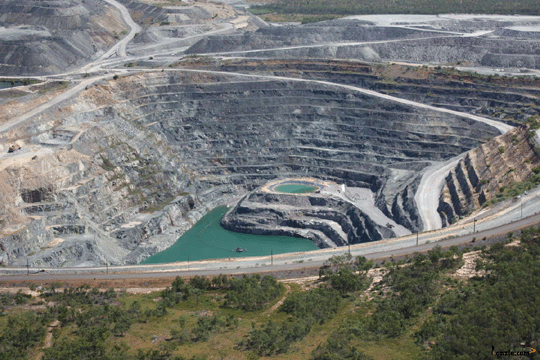 World Nuclear News 7th Dec 2018 The estimated rehabilitation costs for the Ranger Project Area inAustralia’s Northern Territory have increased from AUD512 million (USD370
million) to AUD808 million, Energy Resources of Australia (ERA) has
announced. The estimate is based on preliminary findings from a feasibility
study which will be finalised in early 2019.
http://www.world-nuclear-news.org/Articles/ERA-updates-Ranger-rehabilitation-costs
REPORT CASTS DOUBT OVER THE VIABILITY OF THE MULGA ROCK URANIUM PROJECT
|
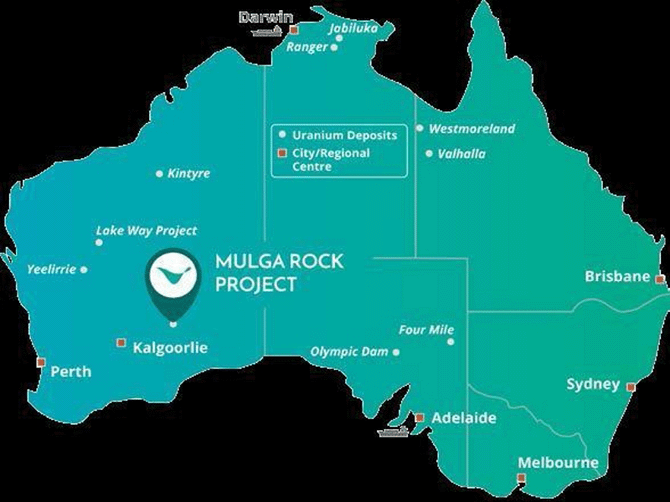
Vimy Resources has relied on heroic assumptions about prices, unfounded optimism about a booming nuclear industry, and has ignored regulatory risks and mine closure costs in its Definitive Feasibility Study (DFS) for the proposed Mulga Rock uranium mine to the east of Kalgoorlie, a new report by the Australia Institute has found. The report, commissioned by the Australian Conservation Foundation (ACF) and the Conservation Council of WA (CCWA), will be released tomorrow as shareholders gather at Vimy Resources AGM in Perth. Dr Cameron Murray of The Australia Institute said, “The report clearly shows that, based on plausible assumptions about exchange rates and uranium prices, the proposed Mulga Rock uranium mine is unprofitable. “The Mulga Rock DFS is ambitious to the point of heroic. The projections for the future role of nuclear power are extremely optimistic, and the economic assessment of the project’s position in the global uranium marketplace fails to accurately reflect the international situation,” Dr Murray said. CCWA Nuclear Free Campaigner Mia Pepper said, “This report is a reality check for shareholders making investment decisions that would not only adversely affect their back pocket, but also impact a unique part of WA’s backyard.” “Vimy Resources is putting a brave face on a speculative roll of the dice,” said ACF Nuclear Free Campaigner Dave Sweeney. “The company lacks finance, full approvals, social licence, and a market. Having a gamble is hardly news in the mining sector, but gambling with the product that fuelled Fukushima and always generates long lived radioactive waste is not acceptable, and will be actively contested.” For the full report go to http://www.ccwa.org.au/nuclearfreewa scroll down to Reports. |
|
Striking school students are more likely to have successful careers
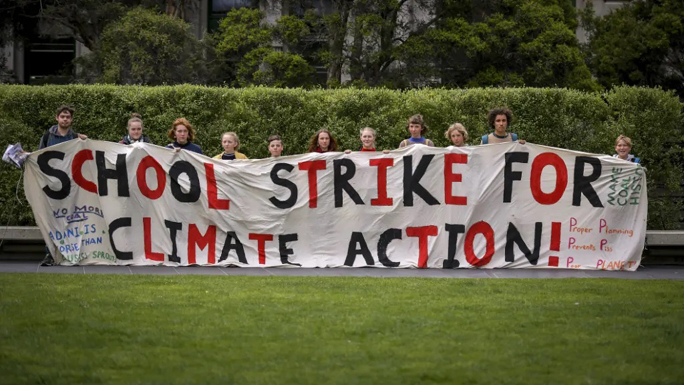 School strikers are going places but the dole queue isn’t one of them, https://www.brisbanetimes.com.au/environment/climate-change/school-strikers-are-going-places-but-the-dole-queue-isn-t-one-of-them-20181202-p50jog.html, By Clive Hamilton 2 December 2018 The resources minister, Matt Canavan, last week told students that the only thing they’d learn by skipping school to protest over inaction on climate change would be how to join the dole queue.
The history of protest in Australia shows the opposite. The protest leaders of the 1960s and 1970s, including many high school students, were denounced by conservatives as long-haired layabouts who would never amount to anything. In fact, they became the next generation of leaders in politics, universities, media, the public service, NGOs and even business.
Take the 1965 Freedom Ride, for instance. “Look at em,” said one RSL stalwart when students turned up to protest against the ban on black diggers. “The brains of Australia! God help you if you ever end up under em.” That’s exactly what happened. The Freedom Ride’s leaders included Jim Spigelman, who would go on to become Chief Justice of NSW and chair of the ABC, Ann Curthoys, later an eminent professor, and Charles Perkins, who became an Aboriginal leader, leading public servant and one of Australia’s Living National Treasures.
Student protesters have become newspaper editors, cabinet ministers, prize-winning poets, much-loved cartoonists, publishers, world-famous authors and Supreme Court judges.
There’s a reason they develop into leaders. It’s those young people who throw themselves into civic engagement who become the best citizens and most productive members of our society. They are the passionate ones willing to stand up. They are not content to “work, consume, die” but commit themselves to making a better Australia.
When we hear Canavan tell 2GB the protesters are “not actually taking charge of their lives” and they should get a real job, he’s telling them they should not be active, motivated citizens but docile consumers who leave politics to the politicians.
The protesting school kids, tired of watching the sacrifice of their future by a government dominated by climate science deniers, had some sharp answers to that, waving placards reading “Why should we go to school if you won’t listen to the educated?” and “I’ve seen smarter cabinets in Ikea”.
The students are carrying on a noble tradition. The great social movements that defined modern Australia—the movements for women’s liberation, gay rights, Indigenous rights, and environmental protection—all inspired school students to get out on the streets, wave banners and chant slogans.
Clive Hamilton is the author of What Do We Want? The Story of Protest in Australia and professor of public ethics at Charles Sturt University in Canberra.
Western Australia’s uranium promise: 10 years later it’s a complete flop
|
10 years ago this week the Barnett government lifted thpr The reality has been far more like morose miners on methadone. After a decade that has seen sustained Aboriginal and wider community resistance to mining plans, the uranium price plummet in the wake of Fukushima and a surge in renewable energy production, there is not a single operating uranium mine in WA. Uranium exploration companies were a dime a dozen but just four projects surfaced as having potential in WA. Three of them raced through the environmental assessment process under the Barnett government and emerged with environmental, but not final, approvals just weeks before the state election in a clear move to wedge the incoming Labor government. The McGowan government felt the wedge and let the four mines with partial approvals continue ‒a clear breach of Labor’s pre-election promise not to allow mines to proceed unless they had full approvals. But the sustained low uranium price and community opposition has thwarted plans to develop any of the four mines. Cameco has written off the entire value of the Kintyre project, Toro Energy has shelved its uranium plans and is now trying to strike lucky with gold, Cameco’s Yeelirrie project is the subject of a legal challenge by the Conservation Council of WA and three traditional owners and then there is Vimy’s Mulga Rock project. Vimy released its Definitive Feasibility Study for Mulga Rock earlier this year and the company is reportedto be “confident of securing contract prices of about $US60/lb this year or next for delivery in 2021 when it hopes to be in production with Mulga Rock.” There was supposed to be an investment decision by July but instead Vimy was handing out pay cuts and scaling back or bunkering down for the sustained lull in the uranium price (currently around $US30/lb). And while Toro is looking for gold ‒and other uranium companies have diversifiedinto medicinal marijuana production or property development ‒Vimy is hedging its bets by setting up a subsidiary to explore for base metals. Globally there are 115 nuclear reactors undergoing decommissioning‒double the number under construction. The International Energy Agency is warning about the lack of preparation and funding for a “wave of retirements of ageing nuclear reactors” and an “unprecedented rate of decommissioning”. A growing number of countries are phasing out nuclear power, including Germany, South Korea, Switzerland, Belgium and Taiwan. The world’s most experienced reactor builder, Westinghouse, went bankrupt last year and the debts it incurred on reactor projects almost bankrupted its parent company, Toshiba. After the expenditure of at least $A12.4 billion, construction of two partially-built reactors in the US was abandoned last year, and the only other reactor construction project in the US was almost abandoned this year after cost overruns of $A14 billion. No wonder that nuclear lobbyists are themselves acknowledging a “crisis that threatens the death of nuclear energy in the West” and are already writing eulogies about the “ashes of today’s dying industry”. Globally there are 115 nuclear reactors undergoing decommissioning‒double the number under construction. The International Energy Agency is warning about the lack of preparation and funding for a “wave of retirements of ageing nuclear reactors” and an “unprecedented rate of decommissioning”. A growing number of countries are phasing out nuclear power, including Germany, South Korea, Switzerland, Belgium and Taiwan. The world’s most experienced reactor builder, Westinghouse, went bankrupt last year and the debts it incurred on reactor projects almost bankrupted its parent company, Toshiba. After the expenditure of at least $A12.4 billion, construction of two partially-built reactors in the US was abandoned last year, and the only other reactor construction project in the US was almost abandoned this year after cost overruns of $A14 billion. No wonder that nuclear lobbyists are themselves acknowledging a “crisis that threatens the death of nuclear energy in the West” and are already writing eulogies about the “ashes of today’s dying industry”. |
|
Rio Tinto offloads Northern Territory uranium resources to Canadian company
Rio Tinto offloads NT uranium asset to Laramide, Australian Mining Ewen Hosie
The Murphy uranium tenements, located near the Queensland-NT border, were responsible for the production of high-grade uranium in the 1950s but have not seen much exploration since the 1970s. The tenements are contiguous to Laramide’s Westmoreland project in northwest Queensland.
The acquisition comprises the EL 9319 and EL 9414 exploration licences and several other applications across 683 square kilometres.
Laramide has paid Rio the first of three $150,000 cash payments to Rio Tinto as laid out in the terms of the agreement announced in July this year…….https://www.australianmining.com.au/news/laramide-completes-acquisition-rio-tinto-uranium-tenements-nt/
Lucas Heights nuclear reactor in disarray – costs and safety problems
Delays hold back nuclear medicine – SEAN PARNELL, OCTOBER 26, 2018 https://www.theaustralian.com.au/national-affairs/health/delays-hold-back-nuclear-medicine/news-story/16d8606ac2f0e5c1d8e9010ea316aa74
Australia’s production of nuclear medicine is in disarray, with a promised world-class manufacturing plant running two years behind schedule, unresolved questions over waste management, and broader concerns over ageing facilities and safety issues at Lucas Heights.
A conveyor breakdown in June at building 23 — where a series of safety incidents prompted a damning independent review — has caused ongoing supply issues throughout Australia and overseas.
The Weekend Australian has learned the existing plant will not be able to resume full domestic production of generators until next year. Amid the disruptions, the Australian Nuclear Science and Technology Organisation has been forced to import generators and trade local ingredients with an American producer. It is refusing to detail how much the inefficient workaround is costing.
One of the safety incidents that prompted a rare intervention by the regulator was caused by a wheel falling off a trolley. It has now emerged the conveyor breakdown was caused by damage to the guide rails that other trolleys use and the conveyor chain guides themselves.
With nuclear medicine stakeholders expressing frustration at the ongoing delays, and a perceived lack of transparency by ANSTO, Industry, Science and Technology Minister Karen Andrews has asked the agency to respond to the internal review as a priority.
“I’ve also sought assurance from ANSTO that they are supplying the market at normal levels,” Ms Andrews said.
Stakeholders had raised concerns with the minister’s predecessor without response and point to continuing practice restrictions.
A new $168.8 million plant, to be known as ANSTO Nuclear Medicine, was meant to be operational in 2016 and as much as triple the production of generators, making Australia a major global player. However, it will not be operational before early next year — ANSTO will not say if the budget has blown out — and license conditions set by the Australian Radiation Protection and Nuclear Safety Agency add to the challenges.
ARPANSA will not allow any overall increase in production until the existing plant is decommissioned, adding to delays, and is demanding more information on plans for a new waste-management facility — including contingency plans should it, too, be delayed.
The ANM would also rely on building 23 which, like the existing plant, was built in the 1950s and is past its use-by date. The independent review revealed ANSTO wanted to replace the building “but federal government budget restrictions have meant that this has not been progressed”.
“A number of additions and modifications have been made to the facility, but these cannot possibly resolve all of the issues associated with a facility not designed for its current use,” the review concluded.
Ms Andrews would not be drawn on the issue, saying it was a matter for ANSTO to respond to the independent review, which also raised concerns over culture.
ARPANSA is overseeing the independent review and has given ANSTO more time to respond to the recommendations.
Britain’s exit from European Union- a cause for rejoicement to Australia’s uranium industry?
|
Australia is working on a new deal for selling uranium to the United Kingdom once it leaves the European Union. Australia is working on a new nuclear deal with the United Kingdom once it leaves the European Union.One fifth of Australia’s uranium goes to the UK, but it cannot be used for military purposes, or sold to other countries who use it for their militaries. Dr John Kalish, acting director general of the Australian Safeguards and Non-proliferation Office, says a new deal will have to be done with the UK to mirror the old one with the EU. Under the old deal and the proposed one, the UK can only sell the uranium on to certain countries. “Retransfers can only be made to third parties that have a nuclear cooperation agreement with Australia,” Dr Kalish told a parliamentary committee on Monday. But Dr Kalish could not reveal which countries Australian uranium ends up in, citing “commercial in confidence”. Liberal MP Andrew Wallace can’t understand why. “I’m just trying to work out why the Australian people can’t be informed what third party countries the UK might reassign or retransfer uranium that comes out of this country?” he asked. Dr Kalish said he could give the committee the names of the countries, but they would have to remain secret. Meanwhile, Labor’s foreign affairs spokeswoman Penny Wong gave a speech to the Australian Institute of International Affairs on Monday, in which she called for Australia to take a greater role in banning nuclear weapons. “A Shorten Labor government will seek to muster wide international support, including from the states that possess nuclear weapons, for a ‘No First Use’ declaration,” she said. “For states with nuclear weapons to adopt a ‘No First Use’ policy would constitute a major step forward in reducing tensions and risks of accidental or mistaken use.” Senator Wong says Labor will also use Australia’s strong relationships with nuclear weapons states to push for a reduction in their nuclear stockpiles. “Dismantling 15,000 nuclear warheads and the security arrangements that rest upon them is not going to happen overnight,” she said. |
|

Australian government’s absurdly inflated claim of 45 jobs for proposed nuclear waste dump
Jobs not sustainable JIM GREEN Friends of the Earth Australia, Eyre Peninsula Tribune, 10 Oct 18
The federal government claims that 45 jobs will be created at its proposed national radioactive waste facility in Kimba or the Flinders Ranges.
The government further claims that its jobs estimate has been “tested” against comparable overseas facilities.
But such comparisons prove that the government’s jobs estimate is grossly inflated. The CSA radioactive waste facility in France processes 73 cubic metres (m3) per employee per year. The El Cabril radioactive waste facility in Spain processes 10 cubic metres (m3) per employee per year.
Yet the Australian government estimates productivity of just 1 m3 per employee per year. The government evidently has a dim view of the productivity of Australian workers, or, more likely, its jobs estimate is grossly inflated.
If we assume that Australia matched the lowest of the figures given above ‒ 10 m3 per employee per year at El Cabril in Spain ‒ then the staff at an Australian facility would be processing waste for just one month each year.
The government might be willing to pay 45 staff to do nothing for 11 months each year, but it’s not a sustainable situation. The Department of Finance wouldn’t tolerate it. Staffing would be dramatically culled.
Almost certainly, a future government would revert to the plan pursued by previous governments: keeping the waste facility closed most of the time, and opening it occasionally for waste disposal and storage. https://www.eyretribune.com.au/story/5693747/letters-to-the-editor/
Victoria’s renewable energy boom set to create thousands of jobs

 Green Energy Markets predicts more than 6,000 annual jobs will be created but urges federal policy intervention, Guardian, Calla Wahlquist @callapilla 2 Oct 2018 The renewable energy construction boom in Victoria is on track to create more than 6,000 annual jobs, according to a new analysis.
As of August 2018, large-scale wind and solar projects under construction in Victoria had created 5,169 job years of employment – meaning one person working full time for one year – overtaking Queensland with 5,156, according to an analysis by Green Energy Markets released by GetUp on Tuesday.
When the remainder of the projects greenlit under Victoria’s renewable energy auction come online, job years of employment will increase to 6,072.
Victoria has 26 operational large-scale wind and solar projects, 12 under construction and 28 with planning approval.
But the Green Energy Markets director of analysis, Tristan Edis, said that without federal policy intervention the construction boom would being tapering off in 2020, because the large-scale generation certificates scheme would be over-supplied.
Renewable energy made up 25.5% of the electricity fed into the major east and west coast power grids in August, enough to power 12.1m homes, the report said.
As of August there were another 6,184MW of new large-scale renewable energy projects under construction, creating 15,511 jobs, the bulk of which were in Queensland and Victoria. Wind generation accounted for 54% of the new projects and the remainder were large-scale solar……..
Victoria and Queensland also on track to meet their state-based renewable energy generations targets of 40% and 50% respectively by 2030.
Victorian environment minister Lily D’Ambrosio said the construction jobs were the product of a record investment in renewable energy and that investment would be under threat if the Coalition won the state election next month.
NSW currently leads the number of jobs in the rooftop solar installation industry, followed by Queensland, Victoria and WA, although jobs in rooftop solar in Victoria are forecast to increase due to its $2250 solar panel rebate.https://www.theguardian.com/australia-news/2018/oct/01/victorias-renewable-energy-boom-set-to-create-thousands-of-jobs
The value of Australia’s coal exports is forecast to decline sharply
Thermal coal prices forecast to drop 25% and metallurgical coal prices 23% as value of iron ore exports also falls, Guardian, Gareth Hutchens@grhutchens, 2 Oct 2018 The value of Australia’s coal exports is forecast to decline sharply over the next 18 months as thermal coal prices drop 25% and metallurgical coal prices fall 23%.
Jobs for South Australians at nuclear morgue? That is a shaky promise.
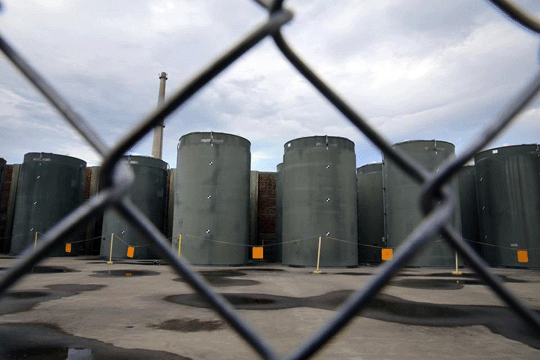
A nuclear waste jobs bonanza for regional South Australia? http://www.onlineopinion.com.au/view.asp?article=19959, – Jim Green, 27 Sept 19
The federal government is trying to persuade regional communities in South Australia to host a national radioactive waste facility – an underground burial repository for lower-level radioactive wastes and an above-ground ‘interim’ store for long-lived intermediate-level waste. One site under consideration is near Hawker in the Flinders Ranges, and two other sites under consideration are on farming land near Kimba at the top of the Eyre Peninsula.
The government is promising 45 jobs, three times its earlier claim that there would be 15 jobs at the proposed facility. The compensation package on offer has also tripled and now stands at $31 million.
Forty-five jobs would be welcome in small regional communities. But is it plausible that 45 jobs would be created? When the Howard government was attempting to establish a radioactive waste repository in SA from 1998 – 2004, the government said there would be zero jobs – not even any security guards. The government-commissioned PR company Michels Warren said: “The National Repository could never be sold as “good news” to South Australians. There are few, if any, tangible benefits such as jobs, investment or improved infrastructure.”
From 2005 to 2014, Coalition and Labor governments targeted sites in the Northern Territory for a radioactive waste repository and said there would be just six jobs, all of them security guards.
Last year, with SA once again in the firing line, the government said: “At least 15 full-time equivalent jobs will be needed to operate the facility. These will be in site management, administration, security, environmental monitoring, site and building maintenance as well as receiving and packaging waste materials.”
Recently, the jobs estimate was upped to 45, with the government saying: “In addition to the 15 operational jobs already confirmed, the structure now includes roles for community liaison, management, tourism, environmental monitoring, security, health and safety: a total of 45 staff.”
This is the breakdownof the 45 jobs:
14 – security and safeguards
13 – waste operations and technicians
8 – site management and community outreach
5 – environmental protection and quality control
5 – safety and radiation protection
That estimate comes with caveats: “the final workforce design and structure will be based on a number of factors including advice from security agencies, the views of the independent regulator and the details of the final business case, with inputs from across government.”
Overseas comparisons
The Centre de Stockage de l’Aube (CSA) radioactive waste facility in France handles over 200 times more waste per yearcompared to the proposed facility in SA yet it employs only four times as many staff as the proposed facility in SA. CSA processes 73 cubic metres (m3) per employee per year (13,164 m3 / 180 staff).
Is the estimate of 45 jobs credible? Not if overseas radioactive waste facilities are any guide.
The El Cabril radioactive waste facility in Spain has a staff of 137 people and processed an average of 1,395 m3 per year from 1993 to 2016. That equates to 10.2 m3 per employee per year.
Yet the Australian government estimates a workforce of 45 people to process 45 m3 per year: 1 m3 per employee per year compared to 10.2 in Spain and 73 in France. The government evidently has a dim view of the productivity of Australian workers, or, more likely, its jobs estimate is grossly inflated.
Will the government pay staff to do nothing?
Measuring jobs-per-employee doesn’t account for some jobs required whether a facility processes 1 m3 or 1 million m3 per year: administration, security and so on. As a government official stated: “There are a base number of jobs related to the management of the waste which are not linear with volume and a number of jobs that would scale with larger volumes.”
Nevertheless, productivity at the proposed Australian facility would be dramatically lower than comparable facilities overseas.
If we assume that Australia matched the lowest of the figures given above – 10.2 m3 per employee per year at El Cabril in Spain – then the staff at an Australian facility would be processing waste for just one month each year and they’d have 11 months to play ping-pong.
The current government might be willing to pay 45 staff to play ping-pong for 11 months each year, but it’s not a sustainable situation. The Department of Finance wouldn’t tolerate it. If staff at the waste facility are paid by the federal government to do nothing for most of the time, what sort of a precedent does that set, and why shouldn’t the rest of us be paid to do nothing for 11 months out of 12 at a cost to taxpayers of several million dollars each year?
Almost certainly, staffing would be dramatically culled. Almost certainly, a future government would revert to the plan pursued by previous governments: keeping the waste facility closed most of the time, and opening it occasionally for waste disposal and storage. In the jargon, this is called a campaign-based approach with occasional waste disposal ‘campaigns’.
Previous governments said that waste would be sent to the facility just once every 3 – 5 years. For example, the government said in 2003 that waste would be transferred to the facility just once every five years: “It is considered for planning purposes that an average period of 5 years between campaigns will be appropriate” (Volume III of DEST application to ARPANSA, Ch.9, ‘Waste – Transfer and Documentation’, p.5).
In a recent attack on me for questioning its estimate of 45 jobs, the Department of Industry, Innovation and Science said it was unable to locate any previous government documents regarding periodic, campaign-based plans. The federal government can’t find federal government documents? Seriously?
The government says that it wants continuous operation of the repository (for reasons unexplained) rather than a periodic, campaign-based approach. But even so, the government only plans to shift waste to the facility once or twice each yearaccording to a 2016 document. A July 2018 government document states: “This facility will be an operational facility and not as some have suggested, a minimally crewed warehouse to be opened once or twice a year.” But it is the government itself which says that waste will only be transported to the facility once or twice each year!
Broader economic impacts Continue reading
1 This month
6 March -Online – Reversing nuclearization:
From nuclear weapons in Belarus and NATO host countries to a European-Nuclear-Weapon Free Zone
Mar 6, 2026 03:00 AM in Canberra, Melbourne, Sydney

of the week – Australians for War Powers Reform (AWPR)
To see nuclear-related stories in greater depth and intensity
 Antinuclear