 What Australia’s corporate leaders really think about renewable energy https://arena.gov.au/blog/company-directors/ @DanielSilkstone 6 Nov 17, Renewable energy is so hot right now.
That’s the key message that emerges from a new study of corporate Australia, undertaken by the Australian Institute of Company Directors.
The Director Sentiment Index, released twice each year, maps the thoughts and priorities of the nation’s company directors. It provides an excellent window into the issues and concerns that are cropping up in boardrooms around the country.
There has been plenty of speculation in recent times about whether the political disagreement that has sometimes accompanied debates around the nation’s energy needs was acting as a handbrake on investment.
But the survey makes clear that the nation’s corporate leaders both want and expect the growth of renewable energy to continue. Continue reading →
November 6, 2017
Posted by Christina Macpherson |
AUSTRALIA - NATIONAL, business, energy |
Leave a comment
What the National Energy Guarantee lacks though is a formal clean energy target, which, in the absence of a carbon pricing scheme, would at least be a market-based mechanism that provides incentives for low emissions and renewable generation.
the report concludes that advocates of coal-fired generating capacity who oppose carbon pricing are doing themselves a disservice, as investors are unlikely to commit to the investment needed, given future regulatory risks.
 Report throws book at ‘energy mess’ saying governments must get serious on carbon emissions http://www.couriermail.com.au/news/opinion/opinion-report-throws-book-at-energy-mess-saying-governments-must-get-serious-on-carbon-emissions/news-story/b121d3e13e10d74cfce74b8816de2e88, Paul Syvret, The Courier-Mail, October 28, 2017
THE Australian Productivity Commission – the Federal Government’s economic advisory body that recommended cuts to weekend penalty rates – is not renowned as a hotbed of left-wing activism.
On Tuesday Treasurer Scott Morrison released the first of the commission’s five-year reviews, using the document as a platform to mount a case for continuing economic reforms to lift Australia’s productivity rate.
The ideas in the 1200-page document – ranging across the full spectrum of the Australian economy – should have dominated debate at a time when the Government is trying to wrest back control of the political agenda.
The Michaelia Cash trainwreck put paid to that, despite Morrison’s best efforts to warn that “the price of a generation of Australians growing up without ever having known a recession is that reform comes more stubbornly and incrementally”.
What Morrison didn’t highlight though was Chapter 5 of the Productivity Commission report, titled “Fixing the energy mess”.
In this section, the commission says Australian governments “must stop the piecemeal and stop-start approach to emission reduction and adopt a proper vehicle for reducing carbon emissions that puts a single effective price on carbon”. Continue reading →
October 27, 2017
Posted by Christina Macpherson |
AUSTRALIA - NATIONAL, business, climate change - global warming, politics |
Leave a comment
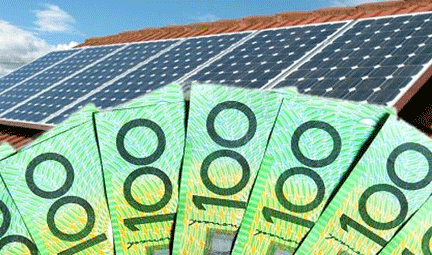
 Our Future | Business solar projects pay for themselves from day one http://www.examiner.com.au/story/4999405/business-solar-projects-pay-for-themselves-from-day-one/?cs=97,Nathan Henkes 22 Oct 17 Right now, you’re paying more money than you need to be for energy. Why? Because of the widely-held misconception that traditional energy is still cheaper than solar.
It’s not!
This misunderstanding is costing everyone – from individual shop owners to giant shopping centres – significant money through bloated electricity bills. The political argy bargy on energy has distracted from the fact that the price of solar has experienced a historic drop that even the smartest energy experts failed to predict.
The result? Today, virtually every business in regional Australia can save money with solar. It’s actually cheaper to borrow money and invest in a solar installation than it is to pay your current energy bills. In many instances, the business case for solar today is 50 to100 per cent stronger than it was just 12 months ago.
Typically, the return on investment is around three years and reputable commercial installers guarantee the system for five years – so there’s zero risk. Right now, you’re paying more money than you need to be for energy. Why? Because of the widely-held misconception that traditional energy is still cheaper than solar.
October 23, 2017
Posted by Christina Macpherson |
AUSTRALIA - NATIONAL, business, solar |
1 Comment
http://www.theage.com.au/business/energy/smallscale-solar-cutting-billions-from-electricity-bills-20171012-gyzf2c.html, Cole Latimer, 14 Oct 17,
Small-scale solar systems have cut wholesale electricity costs by up to half in the past 12 months, a study has shown.
The report by consulting firm Energy Synapse, commissioned by a community-based organisation Solar Citizens Australia, found solar photovoltaic (PV) installations in NSW had saved consumers up to $2.2 billion from May 2016 to April 2017
During this period, small solar PV systems are estimated to have generated 1540 gigawatt hours of power within the state.
The report says the volume-weighted average price of wholesale electricity would have been between $29 and $44 per megawatt hour higher than the actual average price for the period of $88 per megawatt hour.
The study found that small-scale solar had the largest impact during February, when record heatwaves were experienced, reducing the volume-weighted average price of wholesale electricity by between $119 and $258 per megawatt hour.
There has been a massive increase in renewable energy investment and construction this year. New solar energy generation has grown by 50 per cent globally, according to a report by the International Energy Agency. The IEA’s Renewables 2017 report says 165 gigawatts of new energy came online from renewables as a whole – including solar, wind and hydro power.
“We see renewables growing by about 1000 GW by 2022, which equals about half of the current global capacity in coal power, which took 80 years to build,” IEA executive director Fatih Birol said.
“What we are witnessing is the birth of a new era in solar PV. We expect that solar PV capacity growth will be higher than any other renewable technology through 2022.”
In Australia, there are more than 40 large-scale renewable energy projects that have either started, or will start, construction this year.
Clean Energy Council chief executive Kane Thorton said this represented an investment of more than $8 billion.
“These 41 projects will deliver over 4330MW of new capacity, which is crucial to increasing supply in the energy market, replacing old coal-fired generation that continues to close, and ensuring downward pressure on power prices,” Mr Thornton said.
There are 26 projects being built, and another 14 projects that have secured finance with the expectation that construction will start before the end of the year.
“We have already seen six times the investment value in 2017 of what we saw in 2016, and the new capacity will also help with energy security,” Mr Thornton said.
“In 2016, the combined capacity from all projects completed stood at 264.1 MW. This year 2210.2 MW of projects have been committed and 1881.2 MW are in construction with a whole financial quarter still to go.”
October 14, 2017
Posted by Christina Macpherson |
AUSTRALIA - NATIONAL, business, solar |
Leave a comment
 Adani Australia: Investigation uncovers tax haven ties to British Virgin Islands, Four Corners ,By Stephen Long, Wayne Harley and Mary Fallon , ABC News, 3 Oct 17 An investigation by the ABC’s Four Corners program has uncovered previously unknown tax haven ties for Adani Group’s Australian operations, with key assets ultimately owned in the British Virgin Islands.
Key points:
- Adani Group’s filings with ASIC fail to mention a company registered in the British Virgin Islands
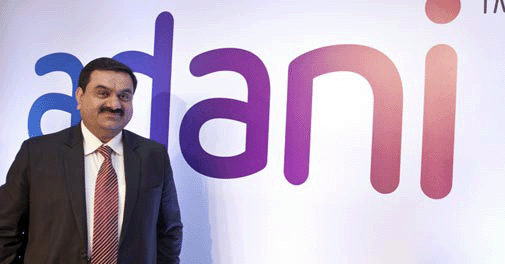
- Vinod Adani, older brother of Adani Group chairman Gautam Adani, has been under investigation in India
- Vinod Adani also a substantial shareholder in Adani Enterprises Limited
Adani Group has promised a $22 billion windfall in taxes and mining royalty payments for Australia over the life of the giant Carmichael coal mine it has been given approval to build in outback Queensland.
But experts say an opaque web of companies and trusts behind its Australian assets gives it ample opportunity to minimise the tax it pays.
Adani Group’s assets in Australia include the Abbot Point Coal Terminal near Mackay in Queensland, a terminal expansion project it has approval to undertake at Abbot Point, and a planned railway line of nearly 400 kilometres from the port to the giant mine it wants to build in the Galilee Basin — aided by a subsidised loan of up to a $1 billion it is seeking from the Federal Government’s Northern Australia Infrastructure Facility.
It was previously thought that Atulya Resources, a Cayman Islands domiciled company controlled by members of the Adani family, was the ultimate holding company for Abbot Point, the expansion project, and the railway.
However, filings in Singapore by privately-owned Adani companies show that a company registered in another notorious tax haven, the British Virgin Islands, sits behind Atulya Resources.
Vinod Adani investigated over alleged scam
It is variously described in the offshore company filings as ARFT Holding Limited, AFRT Holding Limited and Atulya Resources Family Trust.
Adani Group’s filings with Australia’s corporate watchdog, ASIC, fail to mention this company, instead continuing to list Atulya Resources as the owner.
The British Virgin Islands’ company’s apparent position at the apex of the structure is disclosed in the financial reports of a series of Adani companies controlled by Vinod Adani, also known as Vinod Shantilal Adani or Vinod Shah.
Vinod Adani, the older brother of Adani Group chairman Gautam Adani, has been under investigation in India over an alleged scam designed to shift money offshore…….http://www.abc.net.au/news/2017-10-02/adanis-tax-haven-ties-to-british-virgin-islands-revealed/9007714
October 4, 2017
Posted by Christina Macpherson |
AUSTRALIA - NATIONAL, business, climate change - global warming, secrets and lies |
Leave a comment
THE ADANI LIST: COMPANIES THAT COULD MAKE OR BREAK THE CARMICHAEL COAL PROJECT Adani’s plans to dig up hundreds of millions of tonnes of dirty Galilee Basin coal are gargantuan, requiring input from a range of project partners. And every company that helps this nightmare become a reality would be partly responsible for the environmental and climate devastation the Carmichael project stands to inflict.
Who We Are
‘Market Forcesbelieves that the banks, superannuation funds and governments
that have custody of our money should use it to protect not damage our environment.
‘Our work exposes the institutions that are financing environmentally destructive projects
and help Australians hold these institutions accountable.
‘We work with the community to prevent investment in projects
that would harm the environment and drive global warming.’
www.marketforces.org.au/about-us/
How We Work
‘Market Forces is proud to be an affiliate project of Friends of the Earth Australia
and a member of the BankTrack international network,
connecting us with passionate campaigners, environmental issue experts
and advocates of environmentally sustainable behaviour from the finance sector.’
Our Vision
‘Our vision is a future where institutions invest with a high degree of respect for the environment,
utilising our money to deliver solutions to major environmental issues, and
where the community holds to account the custodians of their money
to ensure it is used to benefit the environment.’
October 4, 2017
Posted by Christina Macpherson |
AUSTRALIA - NATIONAL, business, climate change - global warming, Queensland |
Leave a comment
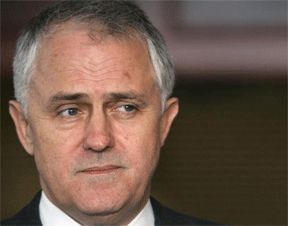 No commercial demand for nuclear power: PM http://www.news.com.au/national/breaking-news/no-commercial-demand-for-nuclear-power-pm/news-story/fda3ef8ef990ebe9899cc8f31a605845
The prime minister says with electricity demand flat and even falling in Australia, he doesn’t see there being a commercial demand for expensive nuclear power. Roje Adaimy, 21 Sept 17, Malcolm Turnbull doesn’t see there being the commercial demand for nuclear power in Australia to warrant pushing its development.
The prime minister says that while the country has among the biggest uranium reserves in the world, building nuclear power stations takes a very long time.
China has a number of plants under construction but there is no “cookie cutter” design to help efficiently roll out the technology.
There also needed to be bipartisanship, which right now “is not even remotely there”, he told a ‘politics in the pub’ event on Queensland’s Sunshine Coast.
“The projects take so long to build that they would be very likely to span the lifetime of several governments,” Mr Turnbull said on Thursday night. “They’re all bespoke, so it takes a very long time to construct them and very expensive.”
On top of that, demand for electricity in Australia was flat or declining. “I don’t see there being the commercial demand for nuclear power,” he said. “That’s putting my businessman’s hat on rather than my politicians’ hat on.”
It comes just a few weeks after the Minerals Council released a paper setting out the case for nuclear power.
Nuclear power has relatively strong support among coalition MPs, but it remains a political hot potato and has been repeatedly ruled out by governments because of its cost.
September 21, 2017
Posted by Christina Macpherson |
AUSTRALIA - NATIONAL, business, politics |
Leave a comment
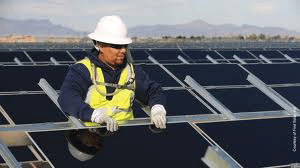 http://www.examiner.com.au/story/4876719/australia-eclipsed-in-commercial-solar-uptake/?cs=97 Reece Turner, 27 Aug 2017, Australia is seeing a new boom in solar energy generation powered by nose-bleeding electricity and gas price rises. In fact, Australian households are approaching 25 per cent solar uptake, which is the highest in the world by a large margin.
In Illawarra, there are 11,259 households powered by the sun and, according to advocacy group Solar Citizens, this saves residents $5.4 million every year. This is great for job creation and the environment.
However, when it comes to businesses installing solar power, Australia’s doing far worse. Estimates are we’re not even in the top 20 countries for commercial solar.
Community energy group Repower and solar engineering company Planet Ark Power hope to change that by helping more companies in Illawarra to take up solar.
This month, at the Wollongong Tennis Club, we’ll be launching “Repower Wollongong”. This follows successful launches of Repower Shoalhaven and Repower Southern Highlands. Indeed, this model of community energy group is one of the most successful in the country, assisting 17 businesses save thousands on their bills.
Many businesses are interested in going solar, but there are some hurdles. One of them can be the upfront costs. A commercial solar system generates free energy for 25 or 30 years, but the initial investment can be anything from $20,000 upwards.
The Repower community energy model removes this hurdle by collecting community investment that pays for the system upfront and then sells the clean energy back to the business at a rate cheaper than grid electricity and with a degree of certainty against rising energy hikes.
It’s a brilliant model delivering returns to the community, helping save on business costs and supporting local jobs. Find out more at www.repower.net.au
Reece Turner is business development manager at Planet Ark Power.
August 28, 2017
Posted by Christina Macpherson |
AUSTRALIA - NATIONAL, business, solar |
Leave a comment
Australia now exports about 200m tonnes. Adani project is, by any measure, a massive expansion that could push the world measurably closer to breaching the goals of the Paris climate agreement……
“The [Adani Carmichael coal] project is not on the radar, not expected to happen, immaterial for India’s energy plans given the progressive move away from imported thermal coal and just unbankable for Indian banks given excessive Adani group debt.”
Coal in decline: Adani in question and Australia out of step Special report: India and China are shifting away from coal imports and coal-fired power while a mega-mine is planned for Queensland. Where does this leave coal in Australia?
Coal in decline: an industry on life support, Guardian, by Adam Morton , 24 Aug 17, The Paris-based International Energy Agency ……suggested investment in new coal power across the globe has peaked and is on the verge of a steep decline. In a coinciding media briefing, the IEA chief economist, Laszlo Varro, declared the “century of coal” that started in 2000 – evident in the extraordinary wave of investment by emerging Asian nations – may already be over.
It is becoming clear that Chinese coal demand has peaked,” he went on. “The outlook for imports [to] India and other countries is uncertain.”
What does this mean for Australia, producer of about 30% of the world’s coal, as it plans a vast expansion in production in outback Queensland?……
Market analysts at Citi Research last month warned investors that the outlook for coal stocks was pessimistic: major banks were financing fewer projects; Donald Trump’s much-vaunted pro-coal and anti-climate change stance was having little impact in the US…..
In a report for the Australian Conservation Foundation, consultants ACIL Allenagreed. “At present, there is considerable pessimism regarding the long-term outlook for prices of thermal coal in international markets,” it said. “This is reflected in forecasts by credible Australian and international agencies.” Continue reading →
August 25, 2017
Posted by Christina Macpherson |
business, climate change - global warming, Queensland |
Leave a comment
Carmichael coalmine: Commonwealth Bank indicates it will not lend to Adani
Controversial Queensland coalmine project is now without financing from any of Australia’s big four banks, Guardian, Michael Slezak, 11 Aug 17, The Commonwealth Bank has indicated it will not lend money to Adani’s proposed Carmichael coalmine, leaving the project without financing from any of Australia’s big four banks.
A spokesman from Commonwealth Bank said the bank is “not among the banks who have been, or will be, asked to consider this financing”……
The statement follows a significant public campaign pressuring the bank to rule-out funding the project.
Until today, it was the last of Australia’s big-four banks to not rule out lending to the project. Commonwealth Bank remains a lender to Adani’s Abbot Point coal export terminal, through which coal from the proposed Carmichael mine will be shipped through the Great Barrier Reef to India……
Blair Palese, chief executive of 350.org Australia said the announcement was a win for the public campaign.
“It’s a huge win for the two and a half years of campaigning from the public across Australia to put pressure on the bank,” Pelase said.“Literally there were thousands of protests at Commbank branches around the country,” she said. It would be really great if they would come out openly and clearly (to rule out the project) but we’ll take it,” she said. “It’s a clear statement that it’s a toxic project.”
Julien Vincent, chief executive of Market Forces, a financial campaign group, said not having any of Australia’s big-four banks on board would be a problem for Adani.
“They provide not just debt but credibility,” he said. “Losing Commonwealth Bank from the pool of prospective lenders is a huge blow, given that CBA is already a lender to Adani’s Abbot Point coal export terminal.”
Jonathan Moylan, a campaigner at Greenpeace said the announcement from CBA is a win for the public, but that pressure on the bank to release a stronger climate policy would continue…….https://www.theguardian.com/business/2017/aug/11/carmichael-coalmine-commonwealth-bank-indicates-it-will-not-lend-to-adani
August 12, 2017
Posted by Christina Macpherson |
AUSTRALIA - NATIONAL, business |
Leave a comment
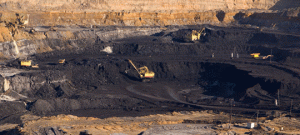 Adani loan too much of a risk for taxpayers according to independent study, The Age, Mark Kenny, 31 July 17,
A $1 billion concessional loan to the controversial Adani Carmichael mine project in Queensland’s Galilee Basin could expose taxpayers to a high risk of losing their money, according to an independent business analysis.
The economic assessment of the troubled project’s outlook found the collapsing coal price, the uncertain global picture for thermal coal, and the $21.7 billion project’s heavy reliance on external financing contributed to a high risk for taxpayers.
Among the problems was Adani’s hope of using the Northern Australia Infrastructure Facility to fund a key part of the project – a rail link to Abbot Point – while relying extensively for security on the availability of other, as yet unsecured, debt and equity financing.
The assessment was done by the business consulting firm, ACIL Allen, and commissioned by the Australian Conservation Foundation. The study was fully independent of both the ACF and Adani, and forms the basis of a submission from the environmental group to a Senate Economics References Committee currently examining the “Governance and Operation of the Northern Australia Infrastructure Facility”.
Noting that a number of unknown commercial factors made definitive third-party assessment problematic, ACIL Allen found there were multiple reasons why a public loan from the Northern Australia Infrastructure Facility appeared risky……..
ACIL Allen also highlighted a contradiction between the Infrastructure Facility’s rationale, which is to provide finance to economy enhancing infrastructure projects that are unable to secure private capital funding, while also relying on the project principals’ assurances that adequate private investment will become available for the mine to go ahead.
“It is not clear how the Northern Australia Infrastructure Facility could meet the direction from government that there be an expectation of full repayment of the loan with interest, while providing support only if commercial financiers do not provide sufficient finance for the project to proceed. It seems that the expectation could not be high if sufficient private sector finance is not forthcoming.”….
ACIL Allen said amid the uncertainties, “one thing is clear” about the project. “The substantial decline of thermal coal prices since 2011 has stripped in excess of $A40 per tonne from profit (after adjusting much larger US$ price declines for depreciation of the $A). This has raised doubts about the likelihood of any significant surplus of revenue over full costs (including a reasonable risk-adjusted rate of return on investment) in medium- and long-term timeframes.”http://www.theage.com.au/federal-politics/political-news/adani-loan-too-much-of-a-risk-for-taxpayers-according-to-independent-study-20170731-gxmarj.html
August 2, 2017
Posted by Christina Macpherson |
AUSTRALIA - NATIONAL, business, politics |
Leave a comment
Big four banks slash lending to coal miners, The Age, Clancy Yeates, 25 July 17, Australia’s big banks have slammed the brakes on project finance lending to expand the coal industry since late 2015, but are still lending billions for other fossil fuel developments, environmental finance group Market Forces says.
ANZ and Commonwealth Bank, previously named as the largest lenders to fossil fuels, both signalled they were actively reducing loans to some carbon-intensive sectors including the coal industry,
- Westpac and National Australia Bank have also toughened their stance on lending to coal mining recently, as all four banks are targeted by environmental groups.
Even so, critics of all four banks maintain much more action is needed in order to meet the climate change targets that banks say they support.
- Market Forces conducted a detailed survey of the big four banks’ project finance – lending to a specific mine or project, rather than a corporation – since the big four supported the Paris agreement to limit global warming to no more than 2 degrees.
Its analysis, to be released on Monday, did not find a single new project finance loan that went towards expanding coal mining since late 2015. This has partly reflected weak conditions in coal mining, but banks signalled it was also partly because of a toughening in coal lending……..
- Despite the decline in coal lending, Market Forces found new lending for gas, oil and liquefied natural gas in Australia and overseas was far greater, with more than $17 billion lent to fossil fuel since the Paris commitments. This was more than three times the new lending to renewables, it said…….
- Market Forces, an affiliate of Friends of the Earth Australia, obtains its data from company filings and specialist news services that monitor bank lending.
Banks do not disclose directly comparable figures on their carbon exposure, but the banks’ own figures on carbon exposure have also shown a decline in coal mine lending. http://www.theage.com.au/business/banking-and-finance/big-four-banks-slash-lending-to-coal-miners-20170720-gxf9u8.html
July 26, 2017
Posted by Christina Macpherson |
AUSTRALIA - NATIONAL, business |
Leave a comment
Smaller businesses are installing rooftop solar at unprecedented rates (which explains why solar is by far the most popular technology choice)
Business slowly wakes up to reality that renewables are cheap http://reneweconomy.com.au/business-slowly-wakes-reality-renewables-cheap-32040/, By Giles Parkinson on 19 July 2017 One Step Off The Grid Consider these two propositions: The top reason cited by Australian business for using more renewables it that it costs less. The top reason cited by Australian business for not using renewables it that it costs more.
As Ivor Frischknecht, the head of the Australian Renewable Energy Agency observes, both propositions cannot be right. It is pretty obvious now that the right answer is that renewables cost less, but ignorance is hurting business, as well as Australia’s policy debate.
Less than half of Australian businesses – according to a new ARENA report – actually source any renewable energy at all, and when they do it assumes only a minor role (less than 10 per cent of the needs of the user).
The lack of knowledge is perhaps understandable – the arrival of cheap renewables is not something that gathers much mainstream media attention, despite the soaring cost of grid power to its current ridiculously high levels.
Two of the biggest corporate investments in renewable energy have received little or no mainstream media coverage.
These include the Sun Metals investment in a 116MW solar farm to underpin the expansion of its zinc refinery in north Queensland; and the commitment by Nectar Farms to power the country’s largest glasshouse for vegetable crops with just wind and battery storage, preventing a project from heading overseas due to high energy costs in Australia.
Telstra got a lot of publicity for its recent commitment to a 70MW solar farm in Queensland, but as Nada Kalam, an electrical engineer for Telstra Energy says, it was no easy job.
“The economics for a solar PPA speaks for itself,” Kalam said. “Financially it totally makes sense.” But, Kalam added, it was hard work to get it through the system.
“It took a while but it set a precedent,” she said at the Clean Energy Summit on Tuesday. “We showed it is very doable and we built trust about the process. This is something we can do more of and at a faster pace.” Continue reading →
July 21, 2017
Posted by Christina Macpherson |
AUSTRALIA - NATIONAL, business, energy |
Leave a comment
 Paladin Energy enters administration, WNN, 03 July 2017 Paladin Energy Ltd has today appointed administrators after it was unable to agree a delay to the repayment of $277 million it owes Electricité de France (EDF). The administrators will continue to operate the company on a business-as-usual basis until further
Western Australia-based Paladin in February announced plans for a balance sheet restructuring to enable it to meet debts due in April, after plans to sell a 24% stake in the Langer Heinrich uranium mine in Namibia to China’s CNNC Overseas Uranium Holdings failed to progress. The sale of a 30% stake in the Manyingee project in Western Australia to Avira Energy Ltd (formerly MGT Resources), announced at the same time as the CNNC sale in July 2016, also failed to complete.
CNNC, which already owns a 25% joint venture equity stake in the Namibian project, subsequently began a process that could lead to it exercising an option to acquire all of Paladin’s share of Langer Heinrich. This led to the proposal in May of an alternative restructuring plan by Paladin, as the original plan had assumed the company would retain an ongoing interest in its Namibian flagship project.
Paladin is due to pay EDF $277 million by 10 July under a long-term supply agreement signed in 2012. The company said it had approached EDF to grant a “standstill” agreement, which would allow time for the alternative restructure proposal to be implemented. Although terms had been negotiated they had not been signed.
“EDF has now informed Paladin that it is not prepared to enter into a standstill agreement and requires payment of the amount when due on 10 July 2017,” Paladin said today……. http://www.world-nuclear-news.org/UF-Paladin-Energy-enters-administration-0307177.html
July 5, 2017
Posted by Christina Macpherson |
AUSTRALIA - NATIONAL, business, uranium |
Leave a comment
Great Barrier Reef ‘too big to fail’ at $56b, Deloitte Access Economics report says http://www.abc.net.au/news/2017-06-26/great-barrier-reef-valued-56b-deloitte/8649936, By Louisa Rebgetz The Great Barrier Reef has a total asset value of $56 billion and is “too big to fail”, according to a new report.
Key points:
- Deloitte Access Economics says GBR has calculated economic, social and iconic value of $56 billion
- Tourism is the biggest contributor to the total asset value making up $29 billion
- But tourist figures are down 50 per cent in the Whitsundays — operators say “this is as bad as it was during the GFC”
Deloitte Access Economics has calculated the economic, social and iconic value of the world heritage site in a report commissioned by the Great Barrier Reef Foundation.
Tourism is the biggest contributor to the total asset value making up $29 billion.
The Great Barrier Reef generates 64,000 jobs in Australia and contributes $6.4 billion dollars to the national economy, the report said.
It states the brand value, or Australians that have not yet visited the Reef but value knowing it exists, as $24 billion.
Recreational users including divers and boaters make up $3 billion.
The report does not include quantified estimates of the value traditional owners place on the Great Barrier Reef and it said governments should consider doing more to protect it.
Climate change remains biggest threat
It also references the back to back coral bleaching events which have devastated the reef and says climate change remains the most serious threat to the entire structure.
“We have already lost around 50 per cent of the corals on the GBR in the last 30 years. Severe changes in the ocean will see a continued decline ahead of us,” the report states.
“Today, our Reef is under threat like never before. Two consecutive years of global coral bleaching are unprecedented, while increasingly frequent extreme weather events and water quality issues continue to affect reef health,” said Dr John Schubert AO, Chair of the Great Barrier Reef Foundation.
Association of Marine Park Tourism Operators executive director Col McKenzie said the reef is crucial to the industry.
“We don’t have an industry without the Barrier Reef being in good condition.”
He said the negative coverage of the reef relating to the destruction caused by Cyclone Debbie earlier this year and the bleaching event is having an impact on visitor numbers.
Mr McKenzie said tourist figures are down 50 per cent in the Whitsundays and it is being felt along the Queensland coast.
June 26, 2017
Posted by Christina Macpherson |
business, climate change - global warming, Queensland |
Leave a comment





 Antinuclear