Adani coal mine just does not make economic sense
 Coal glut, cheaper renewables, Adani makes no sense at all, MichaelWest.com.au April 19, 2017 As public angst over the prospective A$1 billion subsidy to coal magnate Guatam Adani hits fever pitch, a small company is modestly beavering away on another – more worthy – energy project in Far North Queensland.
Genex Power has turned the abandoned Kidston gold mine into a solar farm and pumped-hydro power storage project. Kidston will deliver 145MWh of renewable energy per year. This is enough to power 26,484 homes. In terms of reducing emissions, this is equivalent to taking 33,000 cars off Australian roads.
Like Adani, the Kidston project also got a leg-up from government. It won a grant of nearly A$9 million from ARENA, the Australian Renewable Energy Agency, and struck a deal with the state of Queensland to sell electricity for 20 years.
Unlike Adani’s Carmichael coal mine, however, the Kidston solar project has bankers and investors. Unlike Adani, whose labyrinthine corporate structure wends its way to the Cayman Islands, Genex is listed on the Australian Stock Exchange, has a market value of A$70 million and is owned by small investors. When it delivers its first power in the next three months, it’s likely to pay tax on its profits.
The furore over Adani has so far centred on the putative subsidy for the rail line to cart the coal from the Galilee Basin to the coast. There is no rail line without a mine, however, and so the bigger question is: who is going to tip in the A$10 billion in project finance to build the mine?
Adani’s bankers have long fled the scene – not just for environmental reasons, but because the business case for building this, the world’s biggest new thermal coal mine, is sketchy.
The global seaborne coal market is in structural decline. There is a glut. Thermal coal futures prices are well below the spot price – and even at present spot prices, this is hardly a viable financial proposition…….http://www.michaelwest.com.au/coal-glut-cheaper-renewables-adani-makes-no-sense-at-all/
Adani coal project – a foolish useof tax-payers’ money
 The Adani coal mine would be a poor use of our taxes, SMH, 15 Apr 17, The Adani coal mine in the Galilee Basin of Central Queensland looks like the Trump presidency did around this time last year: a bad idea with foreseeable bad consequences that may yet prove unstoppable.
The project will create “tens of thousands of jobs” and generate “an enormous amount” in taxes and in royalties, revenues for federal and state government”, the Prime Minister enthused. Meanwhile Barnaby Joyce has been banging the drum about how the coal will light up hundreds of thousands of poor households. In other words, lending our taxes to the billionaire proprietor would do India’s poor people a favour.
For now, new native title legislation that would remove one obstacle is blocked in the Senate, but the government is determined to fix that…….
It would be a very bad look indeed if the project goes ahead with the help of funds from the Australian public. It not only goes against this government’s belief in the wisdom of the free market, but would be yet another piece of embarrassing climate change denialism that sets us apart from more forward-thinking nations – including China and India – that are walking away from coal in favour of renewables.
The pivotal question for now is whether the project meets the eligibility criteria for a loan. The fact that the loan would only be available if the project couldn’t proceed otherwise (or would be seriously delayed) creates the bizarre situation that taxpayers are left footing the bill when commercial lenders baulk.
But it’s not up to politicians to decide whether Adani Mining gets the loan, although resources minister Matt Canavan, a strong supporter of the Carmichael mine, has the ultimate sign-off on disbursement of the loan funds. It’s up to the board of the Northern Australia Infrastructure Fund to make a fully independent assessment on commercial grounds. Taxpayers are entitled to expect the board to be scrupulously diligent in its decision.
To date more than a dozen banks and other funding sources have declared they won’t back the project or have pulled out of existing funding arrangements. The project’s opponents say it’s no longer financially viable, if it ever was. It augurs badly that India’s coal and power minister Piyush Goyal has repeatedly stated a goal to stop importing coal, even specifying a time frame of between two and three years, so Adani coal imports would be up against the tide.
Add to that ongoing Indian government investigations into Adani group companies, including for alleged profiteering on coal imported from Indonesia and for international tax arrangements, it’s clear the NAIF board has a lot to consider…….http://www.smh.com.au/comment/smh-editorial/the-adani-coal-mine-would-be-a-poor-use-of-our-taxes-20170413-gvkac0.html
Telecommunications company joins Click energy to challenge coal electricity utilities
 Telco, online energy retailer merge to take on coal-laden utilities, REneweconomy, By Giles Parkinson on 10 April 2017
The potential merger of telecommunications and energy offerings has long been mooted. But, despite Telstra snapping up PowerShop’s Ben Burge last year to head the newly created Telstra Energy and promising its own line of solar and storage, little has happened to date, although combined offerings have become common in the US and Europe.
“I think it will be standard here in the next few years time,” says Dominic Drenen, who will continue his role as CEO of Click Energy. “We think we can put together a bundled product that is quite compelling. For consumers, they will be dealing with one platform, so it’s just one less hassle.”
The two companies think there are significant opportunities for an “asset-light” retailer that is not burdened by legacy assets such as ageing coal-fired power stations.
“Retailing industry players are burdened with complex legacy systems and pricing structures, with most major providers also owning ageing coal-fired generating assets,” amaysim CEO Julian Ogrin said in a presentation. “Customers face large confusing bills, bill shock, no real online engagement or DIY experience and poor customer service is common.”
Ogrin sees a “once-in-a-generation” opportunity in the forced migration of around 8 million Australian homes changing their broadband service by 2020. He says the telco and energy sectors are typically “inert”, so the opportunity to increase market share in the forced migration of NBN is a unique opportunity.
It expects to have its first combined offers available in 2018, and sees major savings in “back-end” IT platforms and other synergies of around $5 million a year…….http://reneweconomy.com.au/telco-online-energy-retailer-merge-to-take-on-coal-laden-utilities-99299/
Insurance companies want big increase in govt disaster mitigation spending
Australia’s biggest insurers want the government to revisit the plans to dramatically increase natural disaster prevention spending, which the commission believes will save billions in post-catastrophe clean-ups.
As the damage wrought by Cyclone Debbie continues to mount, Insurance Australia Group and Suncorp have hit back at politicians’ accusations companies are “stingy” with claims, and have called on the government to adopt the recommendation it commit to an annual $200 million spend on mitigation. The proposal, part of the Productivity Commission Inquiry into Natural Disaster Funding Arrangements, was rejected by the government two days before Christmas last year, after it sat on the report for two years.
“There is overwhelming evidence that shows the economic and social impact savings which upfront mitigation funding could achieve and this is being ignored,” IAG chief executive Peter Harmer told The Weekend Australian.
“The government response in late December …. was disappointing and did not go far enough, particularly in the area of funding for disaster resilience and mitigation.
“We have been advocating for some time that there needs to be a different approach to natural disaster funding, with more focus on mitigation, to avoid some of the impacts we are seeing.”
As of yesterday, insurers had received nearly 47,000 claims from Queensland and NSW policyholders for insured losses stretching to $413m. It is estimated losses will break $1 billion.
The federal government invests about $50m a year on adaptation funding but spends more than $500m on average on post-disaster relief and recovery.
The Australian Business Roundtable for Disaster Resilience said spending $250m a year on preventive infrastructure, such as flood levees, would slash recovery costs in half and generate savings of more than $12bn by 2050.
“The recommendations of the review included significantly reducing recovery funding provided to states, while increasing mitigation funding over time,” a government spokeswoman said……. http://www.theaustralian.com.au/business/news/insurers-call-for-disaster-mitigation-increase/news-story/acf1ecfd783c1422864a4c7ad21908a3

ESG investors turn to green bonds
Green is the new black: ESG investors turn to green bonds to meet mandates, SMH, Myriam Robin, 9 Apr 17
As the billions of dollars in ethical and environmental funds swell, Australian corporates and governments are issuing increasing amounts of “green bonds” to access the cash.
Green bonds function just like normal corporate or government bonds, but the issuer has to promise to use the funds to fund some type of environmentally beneficial development. This investment doesn’t have to sustain a commercial rate of return itself – if the bond is instead underwritten by the total balance sheet of the issuer, it shares the issuers’ credit rating. Because of this, green bonds typically have identical yields to equivalent regular bonds.
Between 2014 and 2016, the total amount of money put in funds with some social or green investment principles grew from $US148 billion to $US516 billion across Australia and New Zealand, according to the Global Sustainable Investment Review, released in March.
Most of this growth, the report stated, came from professionally managed funds choosing to incorporate such principles into their main funds. Funds specifically targeting green or social impact investors amount to 3.8 per cent of Australia’s total professional managed assets market, up from 2.5 per cent in 2014.
The style of investments by such funds is changing in a way that shows increasing demand for green bonds. In Canada and Europe, the only two regions for which asset allocations were available to the Global Sustainable Investment Review report, a majority (64.4 per cent) of such funds were invested into green bonds – a rapid reversal of the dominant trend in 2014 when equities dominated.
The surging investment in green bonds, the review suggested, could reflect rising environmental concerns. According to Bank of America Merrill Lynch, $US90 billion of green bonds were issued in 2016, taking the total market past $US200 billion in early 2017. $US19 billion in green bonds were issued globally in the first two months of this year. At the end of February, $US2.3 billion in green bonds had been issued so far in Australia.
Australian governments and banks have led the way in green bond investments – their issuances have been oversubscribed, showing heavy local demand for the products. In a $300 million NAB green bond raising in December 2014, 54 per cent of the bond distribution went to fund managers, with another 30 per cent being purchased by institutions and pension funds.
HSBC’s Violeta Jovanoska, director of debt capital markets in its Sydney office, was involved in the first corporate green bond issue in Australia, a Euro-donominated bond issued by Stockland Trust Management in November 2014, as well as the NAB bond, which HSBC was a joint bookrunner on.
She said corporates were turning to green bonds as a way to access this swelling pool of money placed in funds with an environmental, social or governance mandate. As many investment managers have signed up to responsible investment or climate change agreements, green bonds are a way to meet that commitment………..
The lack of regulation around green bonds has meant some critics dismiss the area as “greenwash” marketing – an environmental sheen on what is essentially a regular corporate bond. It’s hard to say whether green bonds allow new green projects to be completed or if organisations are using them just to easily fund the more environmentally friendly parts of their investment agenda, with the green bond money going towards projects they would have funded anyway. Companies don’t have to turn green in any significant way to issue a green bond……http://www.smh.com.au/business/markets/green-is-the-new-black-esg-investors-turn-to-green-bonds-to-meet-mandates-20170404-gvd2v6.html
While the Australian government slumbers on, business takes lead on climate disasters
With actuaries warning that some properties could become uninsurable in future, land values in some areas would likely plummet.
“The possibility of legal liability heightens risks for companies that aren’t responding”
While the financial sector is now seriously factoring the practical impact of climate change into their plans, many within it fear government is not.
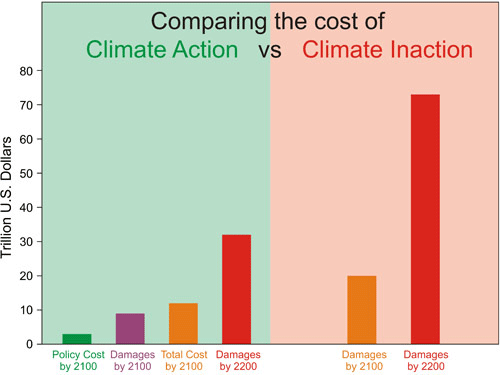 Business takes lead on climate disasters, In the wake of cyclone Debbie, the insurance and banking industries are pushing for better mitigation measures, while the federal government lags behind. By Karen Middleton, Saturday Paper 8 Apr 17, “……..The Cannons and their neighbours join the residents of Murwillumbah, Lismore and other affected areas of NSW and Queensland in surveying the damage from cyclone Debbie, and the storms and flash flooding of its aftermath, and asking what can be done to help communities protect themselves in future.
The same questions are being asked in the boardrooms of corporate Australia – especially but not only in the finance sector – with an increasing emphasis on planning for and guarding against such events, rather than just cleaning up afterwards.
…….The Insurance Council of Australia wants the federal government to focus on mitigation as a priority in the upcoming federal budget.
“Cyclone Debbie and the floods that followed it should be a starting point for state and federal governments to address mitigation,” council spokesman Campbell Fuller said.
In the insurance and superannuation industries, work is being done on the likely longer-term impact of climate change on the frequency and ferocity of these major disasters and how they and other investors – and ultimately governments – should respond.
The big banks have also begun studying the implications of climate change on their risk exposure through mortgages reaching back 30 years. Continue reading
Australia’s big banks scrutinising business customers for exposure to climate change risks
Climate change: three of Australia’s big four banks reviewing exposure to fossil fuels https://www.theguardian.com/australia-news/2017/apr/07/climate-change-three-of-australias-big-four-banks-reviewing-exposure-to-fossil-fuels
Commonwealth, NAB and ANZ are each analysing the financial position of business customers in sectors exposed to climate change, Guardian, Gareth Hutchens, 7 Apr 17, Three of Australia’s big four banks are reviewing their exposure to fossil fuels, including their lending practices to households and farmers, in response to climate change.
The Commonwealth Bank is conducting a “detailed climate policy review” that will be released publicly pending board approval, and NAB has a working group reviewing the risks from global temperatures rising two degrees.
ANZ is conducting portfolio analysis to identify changes in the financial position of business customers in sectors “most exposed” to climate change. It is also working with the Bureau of Meteorology to understand variability in average annual rainfall over recent decades to understand how climate change is affecting Australia’s traditional farming areas.
Executives from the three banks shared this information with the House of Representatives’ standing committee on economics, as part of a review of the four major banks. The revelations, written in response to questions on notice from the committee, were published on the federal parliamentary website on Friday afternoon.
It comes two months after the banking regulator warned climate change posed a material risk to Australia’s financial system, and urged companies to start adapting.
He pointed to the Paris Climate Agreement, ratified by Australia in November, as a significant policy moment for all governments, including Australia’s.
Summerhayes said the Paris Agreement provided an “unmistakable signal” about the future direction of policy and adjustments that companies, markets and economies “will need to make”.
The revelations from CBA and NAB come after ANZ’s chief executive, Shayne Elliott, said last month he was examining the impact of sea level rise and other climate impacts on housing mortgage risk.
Adam Bandt, the Greens’ climate and energy spokesman, has welcomed the revelations. He also questioned why Westpac has not ruled out funding Adani’s giant Carmichael coalmine in Queensland given its competitors’ concerns about climate change.
“Following ANZ’s revelation that sea-level rises might make it tougher to grant a mortgage, CBA and NAB seem to be examining whether to follow suit,” Bandt said. “The penny doesn’t seem to have fully dropped, because banks like Westpac still think they can commit to a two degree target but leave the door open to expanding coal mines.
“Westpac’s refusal to rule out funding Adani is especially concerning; as the bank seems to think it can have its climate cake and eat it too. But the days of dealing with climate change simply by putting a polar bear in your ad are long gone.”
Last year, financial activists Market Forces said Australia’s big four banks could act on their stated ambition to help achieve a 2C warming target simply by giving no new loans to coal projects.
While coal mining contributes to climate change, climate change is wiping out coal mining revenue!
Cyclone Debbie could wipe $200m of coal revenue, John McCarthy, The Courier-Mail, April 5, 2017 THE State Government could lose up to $200 million from coal royalty revenue after Cyclone Debbie knocked out crucial rail links to the coast.
Adani’s Carmichael coal mine is environmentally reckless and contrary to today’s energy markets
http://www.smh.com.au/business/mining-and-resources/adanis-carmichael-coal-mine-is-environmentally-reckless-and-contrary-to-todays-energy-markets-20170404-gvdkgh.html
~ Julien Vincent executive director of Market Forces 6 April 2017:
“If at first you don’t stack up economically, make the public pay for it.”
“This could be the mantra that delivers Adani’s Carmichael mega coal mine in the Galilee Basin
at the expense of the environment, culture, our prospects of a stable climate and in defiance of sound economics. …
“Since buying the coal tenements from Linc Energy in 2010, Adani has failed to secure a single private backer for the Carmichael mine.
“In fact, since then, 17 banks have either publicly distanced themselves from Galilee Basin
coal export projects or introduced policies that prevent them lending to the Carmichael mine. …
“In an industry where sentiment and market signals have a huge impact, leadership from private banks like Westpac can do more than just prevent a project like Adani’s Carmichael coal mine, and its impacts on people, the environment and climate. It can help prevent Australians for having to pay for the privilege.”
Why Australia’s power companies block battery systems
The real reason our power companies block battery systems, http://www.theage.com.au/business/the-real-reason-our-power-companies-block-battery-systems-20170329-gv8ybe.html, Brian Robins, 29 Mar 17, If you’re wondering why battery storage is still on the fringe of the energy debate in Australia, and why power prices are high, just ask Dr Tony Marxsen, the head of the Australian Energy Market Operator (AEMO).
He made it plain earlier this week the big power companies have invested hundreds of millions of dollars on quick start power stations, so-called “gas peakers” and they aren’t going to be giving up their sway over the market any time soon: they want to make sure they get a return on their money.
Richard Turner, the founder of Zen Energy, a renewable energy outfit, asked Marxsen on Tuesday when the electricity market would shorten to five minutes from the present 30 minutes the settlement period. Sound technical? Sure, but that change would see a rapid rollout of battery storage with the potential to bring down power prices.
At the heart of the electricity market is a 30-minute settlement period. Power generators bid to supply electricity in five-minute blocks but the price they receive is averaged out over 30 minutes. Pressure is building for change, but the power generators don’t want to budge since the status quo gives the coal and gas generators a return over a longer period, while batteries which can be turned on, and off, quickly, are penalised.
“The fundamental challenge is it will affect adversely the business model of investors in gas peaking plants,” AEMO’s Marxsen said of any change. “They’ve entered into contracts based on existing arrangements therefore there is the need for transition.
“A five-minute [interval] is the long term future of Australian energy but it is a matter of transition – in a matter of years.”
The trouble is Australia’s thermal power generators are a powerful oligopoly and have been lobbying hard to keep storage out and to prevent the market operator from changing the rules. The overseer of the energy market, the Australian Energy Market Commission has just extended for the second time, now until mid-year, a review into the vexed issue.
“Transition can be painful,” Grattan Institute’s energy program head Tony Wood said of the roadblocks to changing the competitive landscape. “The losers will shout louder than the winners will.”
But the way Zen Energy’s Turner sees it the lack of access to the electricity market is forcing some states, like South Australia, to put $150 million on the table to back battery storage. He expects Victoria to follow suit with the closure this week of the giant Hazelwood power station.
“Governments are putting money on the table … to substitute for what should be available on the grid,” he said. “The rules have to change quickly.”
“Last Wednesday in Adelaide, we had four 30-minute periods when in the first five minutes the wholesale electricity price hit $14,000 a megawatt hour. When those events happen, the big generators power up to meet that demand. Even if the price is negative in the final few minutes of that 30-minute window, the generators receive the average price for that 30 -minute period of, say, $2500.
“Is that market manipulation? Maybe, but they get away with it. If there was five-minute pricing, the battery would come in, grab that demand and eliminate that pricing event. Batteries just help make the system more stable rather than wait for generators to fire up and get going. Even after averaging the price out over 30 minutes they’re making a ridiculous amount of money, protecting their investment – and preventing the introduction of new technology.”
Chaired by Ross Garnaut, who headed up the federal government’s climate change review, Zen has teamed up with Santos to use gas as a back-up for renewables. It is also working up plans for solar farms as it evolves towards becoming a power utility.
“What people don’t understand about renewables is the need for diversity of sources. You can’t just have wind,” he says. You also need solar for when the wind doesn’t blow and batteries to help smooth the energy flows to meet demand.”
So removing the half-hour average settlement rule and allowing payment in five-minute blocks would tilt the playing field towards batteries, which store output from wind and solar systems, and save energy users money.
The road blocks slowing the penetration of renewables in the energy sector comes as the Commonwealth Bank has raised $650 million through an issue of five-year green bonds, carrying an interest rate of 3.25 per cent on the fixed rate portion of the raising and 2.715 per cent on the floating rate portion of the raising. The funds are to be invested in renewable energy and low carbon assets.
Banks won’t back coal plants
The simple reason for this is that investments in such technologies are too risky for any self-interested bank credit officer to give any proposed clean-coal project the thumbs up…..
The Australian Prudential Regulation Authority’s Geoff Summerhayes effectively put banks and other financial institutions on notice that he now expects them to take into account “transition” climate risks……
offshore banks would face the same risk hurdles as local banks…
What other forms of funding might be available for a clean coal plant? Offshore banks are a possibility and they have backed syndicates investing in local infrastructure, particularly Chinese and Indian banks. The State Bank of India was slated as a potential provider of a $1bn loan for the Adani coalmine in Queensland, but prospects of that loan being approved dimmed when Reuters reported a bank source as saying “the credit guys are not comfortable with the project”.
This is a salient reminder that offshore banks would face the same risk hurdles as local banks.
Another possibility is that private sector superannuation funds or the federal government’s Future Fund could provide backing. But they need to confront the big stick from APRA or the Australian Securities & Investments Commission about the need to take into account climate change and associated sovereign risk.
That seems to leave only the government to finance any such projects and, hence, the idea of changing the Clean Energy Finance Corporation legislation to allow it to invest in clean coal.
But let’s take stock here: haven’t we just imposed a whole swag of new regulations on banks to stop them from getting involved in lending that is too risky? If the risks around clean coal are too daunting for those irritating banks to take on, why on earth would the taxpayer do so?
Taking into account all of these risks, coupled with the difficulty in offsetting them via the market or through portfolio diversification, and the multitude of uncertainties surrounding any proposals for a clean-coal generator, we should assume that no bank funding will be forthcoming for clean coal- fired power stations.
Rob Henderson is a policy and markets economist and formerly chief economist (markets) with National Australia Bank. http://www.theaustralian.com.au/opinion/this-energy-may-be-clean-but-banks-wont-back-coalfired-plants/news-story/dccef0d5bd68e26ae39ac1bbf0bcd8c6
Never mind the danger: economically nuclear power for Australia is a stupid idea
 Nuclear energy is still a stupid idea for Australia, SMH,
You don’t even need to monger any scares about radiation: nuclear energy isn’t remotely the solution to Australia’s self-created energy problem Andrew P Street, 16 Mar 17 As you are doubtlessly aware, our nation is currently gripped in an energy crisis that demands rapid – indeed, hasty and reckless – action to address.
Plenty of new solutions are being suggested – except for renewables, obviously, which could meet all of Australia’s energy needs right now if wind and solar energy wasn’t all a socialist leftist plot fermented by that notorious Safe Schools-loving Marxist feminist greenie, the Weather.
The Prime Minister has announced plans to expand the Snowy River Hydroelectric scheme, which will be a boon to employment via massive construction projects and generate enough energy to power half a million homes – an excellent plan that will benefit places that aren’t actually having any problem with their power supply.
And, predictably, a bunch of Coalition backbenchers have come out in favour of that old conservative favourite, nuclear energy. Which isn’t going to happen in Australia, obviously, because words like “Fukushima” and “Chernobyl” trigger the bit of people’s brains that don’t want to endure a slow, lingering death from radiation-induced cancer. …
The biggest problem is one that you might not be aware of, which is that electricity demand in Australia has been dropping for years – partially because of better efficiency, partially because of higher prices, partially because of government regulation, and partially because of the decline of heavy manufacturing in Australia.
This is one of the reasons our liquid natural gas manufacturers have been focusing on export rather than local generation: the demand in Australia just doesn’t exist to a suitably profitable extent….
as the SA storms showed us, the biggest liabilities relating to Australia’s energy security is the profiteering of the national electricity market, and the weakness of the grid itself.
If we’re seriously thinking about large scale investment devoted to shaking up the way we meet Australia’s energy needs, maybe having a handful of large, centralised generators with long spindly arms of distribution towers which get blown over isn’t the best model to maintain.
So you might conclude that right now might not be a great time to sink billions into making more large-scale electricity plants of any shade – but there are some extra costs that are unique to nuclear reactors.
- First up, nuclear reactors are very, very, VERY expensive to build……
- Depending on the level of regulation a plant takes between five and seven years to build and another year or more to get online – so, again, not a great short-term solution for power generation by a government eager to improve energy security.
And that’s assuming that a large-scale project of this type and complexity never runs into any snags.
- then you have the decommissioning costs, which are in the billions of dollars. ….
- the state is forced to pick up the tab for de-poisoning the site, which is what’s currently happening at Sellafield in the UK.
There’s also the cost of storing radioactive waste, which is a whole extra issue – but if the British experience is anything to go by, the public can expect to be paying for that too. …..
- any green credentials are more than offset by the carbon emission heavy process of mining the uranium to fuel it, which is an environmental nightmare. Right, Ranger Mine?…….
- So, to recap: nuclear energy costs a lot to set up, a lot to break down, creates extra new storage problems that are expensive to fix, and isn’t a long term solution in any case. Advocating for power plants to be built in Australia is just another excuse to subsidise the construction and mining industries – so at least it’s in line with the rest of the government’s existing policy priorities.
If only the sun hadn’t been built by Karl Marx and was therefore ideologically untenable. Then we’d all be fine. http://www.smh.com.au/comment/view-from-the-street/nuclear-energy-is-still-a-stupid-idea-for-australia-20170316-guzb68.html
Australian Prudential Regulation Authority (Apra) could require financial institutions to test climate risks
Finance sector could face climate-risk testing, says Australian watchdog
Regulator says it may add climate change to the list of scenarios it asks institutions to run to check economic resilience, Guardian, Gabrielle Chan, 9 Mar 17, Australia’s financial institutions could be required to test climate-risk scenarios as international regulators continue to warn of the economic dangers posed by climate change.
Geoff Summerhayes, executive board member of the Australian Prudential Regulation Authority (Apra), told a Senate committee that climate scenario testing could be added to the other common scenarios Apra requires financial institutions to face to ensure their systems are robust.
It’s been more than a year since the COP21 Paris climate change conference, when the former New York City mayor Michael Bloomberg was appointed to head a taskforce to provide investors, insurers, banks and consumers with more information. The move was part of plans for a voluntary industry-led code announced by the Financial Stability Board (FSB), the G20 body that monitors and makes recommendations about the financial system.
Last month Summerhayes warned climate change posed a material risk to the entire financial system and urged companies to start adapting. Apra is the regulator that oversees the $6tn industry made up of banks, building societies, superannuation, insurance companies and other financial institutions.
Summerhayes said Apra already sent out common scenarios for institutions to test. These scenarios have an economic factor, including an asset price shock and, in the case of the insurance industry, a potential liabilities scenario as well.
He acknowledged the Bank of England’s Prudential Regulatory Authority (PRA) had been very active on climate change. The bank’s governor, Mark Carney, has warned of financial crises and falling living standards unless corporations faced up to the risks. “Apra is not first prudential regulator to make statements about climate,” he said.
Emma Herd, the chief executive of Investor Group on Climate Change, told the committee the political debate in recent years had stopped companies speaking publicly about their strategic response to climate change…….
The Senate inquiry, initiated by Greens senator Peter Whish-Wilson and restarted after the federal election, is looking into carbon risk and disclosure in corporate Australia.https://www.theguardian.com/business/2017/mar/08/finance-sector-could-face-climate-risk-testing-says-australian-watchdog
ANZ, NAB, Commonwealth Bank and Westpac invest $7bn more in fossil fuels than in renewables
 Big Australian banks invest $7bn more in fossil fuels than renewables, says report https://www.theguardian.com/australia-news/2017/mar/06/big-australian-banks-invest-7bn-more-in-fossil-fuels-than-renewables-says-report ANZ, NAB, Commonwealth Bank and Westpac provided three times more for non-renewable than clean energy projects in 2016, says Market Forces, Guardian, Naaman Zhou, 6 Mar 17, Australia’s big four banks invested three times as much in global fossil fuels as they did in clean energy in 2016, despite pledging to help Australia transition to a low carbon economy.
The banks provided a combined $10bn to projects around the world that expanded non-renewable energy, according to finance group Market Forces.
ANZ and the Commonwealth Bank were the worst offenders, investing over $3bn each in fossil fuels. In the same period, ANZ only lent $225m to renewables, giving it a 14:1 ratio. Continue reading
Coal power now “univestable”, but Australian government keen to subsidise it
 Coalition’s “clean coal” plan to power Gina, Clive, Adani in Galilee basin, REneweconomy. By Giles Parkinson on 1 March 2017 The so-called “clean coal” power generator being promoted by the Coalition has been revealed to be a 2009 proposal from businessman Clive Palmer that would be used to help provide electricity to Galilee coal mines planned by Palmer himself, Gina Rinehart, and Indian group Adani.
Waratah Coal, the company owned by Palmer’s Mineralogy, confirmed to the ABC on Tuesday that it had made an application to the Clean Energy Finance Corporation last Friday to finance a proposed 900MW coal generator that proposes to use an unproven technology, carbon capture and storage.
The revived plan was originated in 2009, and the details can be found here. It proposed to bury the emissions from the coal plant under the very same coal province that the three mining groups propose to mine – except that it will be “sequestered” in an “un-mineable” area of coal seams some 1km underground.
The $1.25 billion figure comes from its 2009 estimates, but it is expected that this is well out of the ball-park now. It also does not, the application makes clear, include the cost of carbon capture and sequestration.
No plant in the world has come close to making this a commercially viable proposition and the owners of the most advanced project, Kemper in Georgia, now admit it would be impossible make money from coal generation and CCS.
But that hasn’t stopped the Coalition continuing to push “clean coal” over renewables, despite overwhelming consensus that it would cost at least twice as much – and possibly four times as much with CCS – than wind and solar alternatives.
Prime minister Malcolm Turnbull – who as recently as 2010 supported 100 per cent renewable energy scenarios – has now pitched the Coalition’s energy policy firmly behind the construction of new “ultra supercritical” coal plants.
Resources minister Matt Canavan has been particularly vocal in support of a new coal-fired power station in north Queensland. This proposal, from Palmer, is the only proposal in the pipeline. Most other energy investors in the area are instead looking to solar and wind farms.
This comes as new data shows that Australia’s greenhouse gas emissions continue to rise, jumping another 2.2 per cent in the last financial year and taking the growth since the repeal of the carbon price to more than 7 per cent.
Much of this growth has come from the electricity sector, due to increased coal-fired generation, and from the new LNG export facilities in Queensland, where more coal and gas is being burned to power the liquefaction of coal seam gas, so it can be shipped overseas.
New studies have again questioned whether coal seam gas is any “cleaner” than coal power, given evidence that “rogue methane emissions” which are not measured by the gas companies, are actually making CSG a dirtier power source than coal…..
The Minerals Council, it has been widely reported, supplied the lump of coal brought into Question Time last month by treasurer Scott Morrison, in the middle of a record-breaking heat wave. The coal was lacquered so Coalition ministers and MPs would not get their hands dirty.
The proposed coal-fired power station in the Galilee Basin reveals the farcical depths of Australia’s energy policy debate. Even the Energy Supply Council, which represents the country’s fossil fuel generators, admits that new coal power is now “un-investable”.
The Coalition wants such coal plants to be funded by the Clean Energy Finance Corporation, but this has been dismissed on several occasions by CEO Oliver Yates, who points out that co-financiers would be impossible to find, and any such investment would require billions of dollars in government guarantees and indemnities against a future carbon price.
The Minerals Council, though, is pushing the Galilee coal basin hard. It has previously fought against a carbon price and has launched numerous campaigns to promote coal as a commodity……http://reneweconomy.com.au/coalitions-clean-coal-plan-power-gina-clive-adani-galilee-basin-35115/
1 This month



Help Aunty Sue Protect Her Land and Sacred Sites From Destructive Rocket Testing.
.

Australians deserve the truth
about
AUKUS – https://aukuspublicinquiry.com/

PETITION – To: Prime Minister Anthony Albanese and the Australian Labor Government

of the week – Australians for War Powers Reform (AWPR)
To see nuclear-related stories in greater depth and intensity

