Toro Energy, uranium miner, CEO Vanessa Guthrie chucks away the poisoned uranium chalice
 Toro Energy rings in the changes at the top as Dr Vanessa Guthrie departs http://www.proactiveinvestors.com.au/companies/news/169921/toro-energy-rings-in-the-changes-at-the-top-as-dr-vanessa-guthrie-departs-169921.html
Australian solar power technology sold to China, by CSIRO
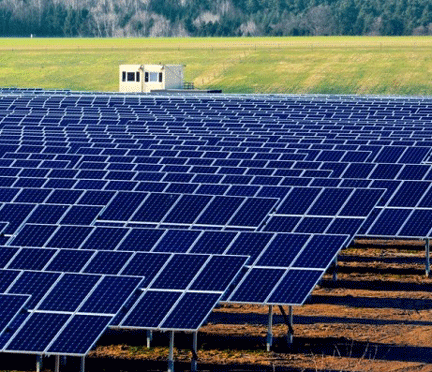 CSIRO sells concentrated solar power technology to China, The Age, Marcus Strom , 28 Nov 16 The CSIRO on Tuesday will sign a technology licensing agreement with a Chinese solar company that could reap millions of dollars in royalties for the national science and industry organisation. The deal with Beijing-based Thermal Focus will allow the company to bid for business in the burgeoning Chinese market for concentrated solar power using Australian-designed technology.
China aims to build infrastructure that produces 1.4 gigawatts of concentrated solar power by 2018, increasing this to 5GW by 2020.
“To put that into perspective, Australia has 50GW capacity in all its power stations,” said Wes Stein, CSIRO’s chief energy research scientist. John Grimes, of the Australian Solar Council, said: “This is a significant commercial opportunity, perhaps worth hundreds of millions.” CSIRO chief executive Larry Marshall said: “This partnership takes our climate mitigation focus to a global stage.”
Minister for Industry, Innovation and Science Greg Hunt said: “Australia is a leader in clean energy technology and this partnership is an important step in realising this advantage.”
The partnership will be signed at the Asia-Pacific Solar Research Conference at the Australian National University. Phil Hearne
Concentrated solar power, or solar thermal, uses mirrors to focus the sun’s energy into a collector. At collected temperatures of 560 degrees, that energy is then stored in molten nitrate salts in large thermal tanks. This can then generate superheated steam to drive turbines for electricity generation for weeks.
CSIRO’s patented technology uses smaller mirrors of about five square metres, known as heliostats, and field-control software to direct the solar energy. The technology was pioneered at the CSIRO’s energy centre in Newcastle. The solar thermal team has grown to more than 30 scientists and engineers.
Mr Stein said: “The big difference with photovoltaic cells is that our technology has storage embedded at a lower cost than batteries.”
A CSIRO spokesman said the licensing agreement covered a technology transfer payment with recurring royalties for the number of heliostats installed……
John Grimes at the Australian Solar Council said: “CSP with storage is the missing link in China’s renewable energy market.” Mr Grimes said what gave this deal credibility was that the Chinese had delivered on their plans in renewables. “Already China has installed 120GW of solar photovoltaic cells,” he said. “It really is a world leader in this field.” Its commitment was partly due to a combination of environmental concerns, cost effectiveness and air-quality pressures in cities, Mr Grimes said.
There are no commercial plants operating concentrated solar thermal technology in Australia. He said this was because government leadership in Australia had been lacking.
However, there are some companies working towards this: Vast Solar, SolarReserve and SolarStor, which is backed by former Liberal leader John Hewson.
SolarStor plans to build a concentrated thermal plant near Port Augusta, South Australia, as does US firm SolarReserve.
The solar deal comes a day after an interim report by a Senate committee recommended all Australian coal mines close by 2030.
The retirement of coal-fired power stations report committee is chaired by Greens senator Larissa Waters. Its final report will be handed down on February 1. http://www.theage.com.au/technology/sci-tech/csiro-sells-concentrated-solar-power-technology-to-china-20161128-gsz8gh.html
BHP Billiton living in la la land on uranium: mining giant faces difficult questions at its Annual General Meeting
 16th November 2016 Company Directors of BHP Billiton will face some difficult questions tomorrow at the mining giants Annual General Meeting in Brisbane. The operator of the Olympic Dam uranium mine in South Australia’s north has been receiving much attention over the past year after the tailings dam collapse at its jointly owned Samarco iron ore mine in Brazil in November 2015, causing what’s been described as the worst environmental disaster in Brazil’s history.
Anti-nuclear and social justice campaigner Adam Sharah is one of several delegates attending the meeting to challenge company directors on matters including the Samarco disaster and issues surrounding the Olympic Dam mine. Mr Sharah will question company directors about BHP Billiton’s position regarding nuclear regulation in Australia, new expansion plans for Olympic Dam, and plans to increase the height of the tailings dams at the mine.
In its submission to the recent South Australian Royal Commission into the Nuclear Fuel Cycle, BHP Billiton recommended that nuclear actions should not be regulated under the federal Environment Protection and Biodiversity Conservation Act, the key piece of legislation for environmental protection in Australia, on the basis that uranium is just like any other mineral. The company claims that “there is no scientific basis for uranium mining to be defined as a Matter of Environmental Significance…”[1]
“BHP Billiton is in la la land if they still believe that uranium is just like any other metal – no other metal has such an enormous range of international treaties – uranium is fundamentally risky, and BHP Billiton should act accordingly,” said leading Environmental Engineering academic, Dr Gavin Mudd.
“What would have been the impact of the tailings dam collapse in Brazil if the tailings were radioactive?” asks Adam Sharah. “Uranium and the tailings produced by uranium mining are unique both in their health and long term environmental impacts.”
“In the wake of the tailings dam collapse in Brazil, there are concerns here in Australia about reports that BHP Billiton are seeking approval to increase the height of their tailings dams at the Olympic Dam mine,” continued Mr Sharah. “It is important that the company clarify this for the Australian public, Aboriginal custodians of the area, and its shareholders.”
Mr Sharah will also seek clarification on the progress of the company’s plans for an on-site heap leach trial at Olympic Dam as part of a cheaper expansion plan, after it shelved it’s grand expansion plans in 2012.
“It is always a concern when corporations start seeking cheaper, cost-cutting alternatives,” said Nectaria Calan, of BHP Billiton Watch. “These concerns are magnified by the fact that federal approval of the heap leach trial did not require any environmental assessment even though heap leach mining is not a method currently used on-site at the Olympic Dam mine.”
“Yet despite by-passing environmental assessment for the trial, and despite the legal privileges and exemptions BHP Billiton enjoy under the Indenture Act, which only applies to the Olympic Dam mine, the company is still lobbying through forums such as the Nuclear Fuel Cycle Royal Commission to reduce regulation further. This type of regulatory race to the bottom, characteristic of third world nations competing for foreign capital, will only make disasters like Brazils more common.”
BHP Billiton’s AGM will be held on Thursday 17th November, 11 am, Brisbane Convention and Exhibition Centre
Jobs in a clean energy future
http://apo.org.au/resource/jobs-clean-energy-future
25 October 2016 Download file
By committing to the Paris Agreement, the world recognised the need to work together to keep global warming well below 2 degrees. Around the world, other governments are embracing the opportunities of transitioning to a clean energy future. But at home, Australia’s pollution continues to rise and Australia remains as one of the biggest per capita polluters in the world. There is still no coherent national plan to transition Australia to a net zero emissions economy.
Jobs in a clean energy future updates our 2010 collaboration Creating Jobs – Cutting Pollution and demonstrates, yet again, that creating a brighter future for the Australian community and our environment go hand in hand.
This report presents a clear choice. If Australia continues with business as usual, pollution will continue to rise and the health of the people and our natural world will continue to deteriorate. If the government acts now and implements policies under a strong action scenario we can create one million more jobs by 2040. People and nature will be better off and the places we love will thrive. If we increase public transport and clean energy Australia’s cities, towns and regions will be more liveable, smarter and healthier places to live. By embracing these opportunities Australia can be a world leader and create jobs and industries that are at the forefront of the transition.
‘reckless’ and ‘indefensible’ Carmichael coal mine approved by Queensland govt
 Queensland fast tracks ‘reckless’ and ‘indefensible’ Carmichael coal mine, Independent Australia Renew Economy 11 October 2016 Minus financial backing, reneging on the Paris Agreement and even ignoring Adani’s own loss of interest in the project, the Queensland Government is fast tracking the Carmichael coal mine, writesRenewEconomy‘s Sophie Vorrath.
IN A MOVE that has been labelled “indefensible” and “reckless” by green groups, the Queensland Government has declared the massive Carmichael coal mine and port proposed for the State’s Galilee Basin as “critical infrastructure”, in an effort to fast-track its development.
State development minister Anthony Lynhamsaid on Monday that the Labor PalaszczukGovernment had invoked special powers to help progress Adani’s $21 billion project, reinstating and expanding its “prescribed project” status to include its water infrastructure…….
while governments of all colours appear to be rolling out the red carpet for the coal project, there are other hurdles it has yet to clear – not least of all economic ones – as coal looks more and more like a high-risk investment.
As John Quiggan wrote last month, a long list of banks and other funding sources have announced they won’t touch the project, or have pulled out of existing finance arrangements.
The list includes the Commonwealth Bank of Australia (formerly a big lender to Adani), NAB, the Queensland Treasury and global banks including Standard Chartered (another former big lender), Citigroup, JP Morgan Chase, Goldman Sachs, Deutsche Bank, Royal Bank of Scotland, HSBC and Barclays, as well as BNP Paribas, Credit Agricole and Societe Generale. The U.S. and Korean Export-Import banks and the State Bank of India have been touted as possible sources, but appear to have backed away.
Even Adani Group, the Indian conglomerate behind the project, has appeared to lose interest in its coal plans. And just this week, the energy minister for India – the main market for the coal that would be dug up at Carmichael – called on the country’s power generators to cease coal imports if the nation was to come good on its “One Nation, One Grid, One Price” energy goal…..https://independentaustralia.net/politics/politics-display/queensland-fast-tracks-reckless-and-indefensible-carmichael-coal-mine,9578
Uranium mining companies desperate to survive, but no improved market in sight
 Desperate uranium miners switch to survival mode despite nuclear rebound, Reuters, 7 OCT 16 LONDON “……..BULGING INVENTORIES Mining executives partly blame the slump on their customers’ wait-and-see attitude, as utilities believe that the uranium market’s over-capacity will persist for years and see no need to rebuild their dwindling stockpiles.
Demand for uranium is determined by the number of nuclear plants in operation worldwide, but supply and demand are disjointed by huge stocks and uranium’s long production cycle……..
In the five years before Fukushima, utilities worldwide bought about 200 million pounds of uranium per year, he said. Although Japan’s consumption averaged only around 25 million pounds per year, when it closed its reactors demand was cut far further, falling by half. European and U.S. utilities saw that the market was over-supplied and reduced inventories, buying less.
Mining firm Energy Fuels estimates global uranium stocks held by utilities, miners and governments are now at around 1 billion pounds. That is down from a peak around 2.5 billion pounds in 1990, but still many years’ worth of consumption.
Despite the plunge in uranium prices after the 2008 financial crisis and again after Fukushima, uranium production has doubled from 80-90 million pounds in the mid-1990s to about 160 million pounds last year, according to Energy Fuels data……
DESPERATE TIMES
With so much new supply, and demand sliding, prices have fallen to a level where most uranium miners operate at a loss.
“At today’s spot prices, the primary uranium mining industry is not sustainable,” US uranium producer Energy Fuels COO Mark Chalmers told the World Nuclear Association’s London conference last month.
He added that many legacy long-term supply contracts will expire in 2017-18, which will force many mines to close or throttle back even further than they already have.
Miners like Canada’s Cameco, France’s Areva and the uranium arms of global mining companies have closed or mothballed several mines and deferred new projects in order to cut back supply.
Paladin – the world’s second-largest independent pure-play uranium miner after Cameco and the seventh or eighth-largest globally – has production capacity of 8 million pounds of yellowcake uranium but produced just 4.9 million pounds last year at its Langer Heinrich mine in Namibia.
Molyneux said the firm will produce about 4 million pounds this year and will cut output further to about 3.5 million pounds next year if prices do not recover.
Paladin suspended production at its 2.3 million pounds per year capacity Kayelekera mine in northern Malawi in 2014 but maintains equipment so it can resume when prices recover.
Meanwhile it is trying to further reduce its debt, which already fell from $1.2 billion five years ago to $362 million.
Paladin has agreed to sell 24 pct of Langer Heinrich to the China National Nuclear Company and plans to use the expected proceeds of 175 million dollars to further reduce debt.
Bigger peer Cameco in April suspended production at its Rabbit Lake, Canada mine while also curtailing output across its U.S. operations, saying market conditions could not support the operating and capital costs needed to sustain production.
Cameco marketing head Tim Gabruch told the WNA conference that “desperate times call for desperate measures”.
Supply adjustments and producer discipline had not yet been sufficient to counter the loss of demand, he said.”As difficult as those decisions have been, we recognize that those actions may not be enough.”(Reporting by Geert De Clercq; editing by Peter Graff) http://www.reuters.com/article/us-uranium-nuclearpower-idUSKCN1230EF
West Australian wave energy company in CETO wave farm deal with Sri Lankan company
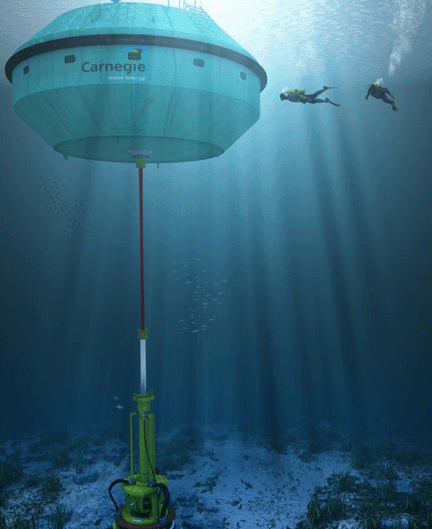 Carnegie Wave Energy up on Sri Lankan agreement https://au.news.yahoo.com/thewest/wa/a/32773367/carnegie-wave-energy-up-on-sri-lankan-agreement/#page1 – on September 30, 2016
The wave energy firm will work with Lanka Energy Conservation to identify opportunities and development pathways for its technology on the island nation.
Specifically the two companies will examine opportunities to enable CETO wave farms to be integrated into the existing or new power infrastructure to supply clean power and freshwater.
Carnegie’s chief operating officer Greg Allen said the company had made significant progress in its entry into the “small island” market this year.
“The signing of this MOU provides us with another opportunity to provide services to explore the possibility of incorporating CETO, along with microgrid solutions, to enable high penetration of renewable energy, displacing imported diesel,” he said.
Mr Allen said island nations were assessing clean, cost effective, alternative energy solutions to remove their reliance on electricity generated using imported fossil fuels.
“These imported fossil fuels come at a high cost, do not provide energy security and have a significant environmental footprint,” he said.
“Carnegie presents an effective clean energy alternative that can provide a solution for island and fringe of grid communities globally.” Lanka Energy Conservation chairman and managing director Dammica Wickramaratne said Sri Lanka showed good potential for wave, solar and wind energy power.
South Australia’s nuclear dump plan – fool’s gold? – senior Liberal MP
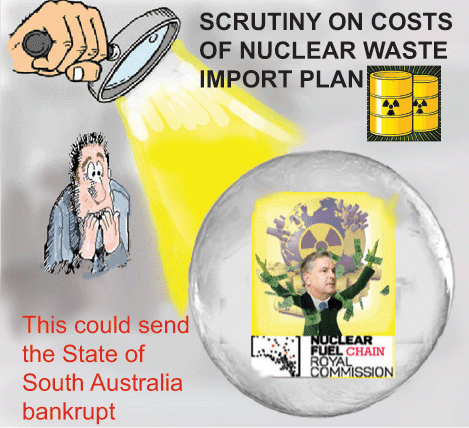 SA nuclear dump dreams just fool’s gold: senior Lib, The Australian, September 29, 2016, byMichael Owen http://www.theaustralian.com.au/national-affairs/state-politics/sa-nuclear-dump-dreams-just-fools-gold-senior-lib/news-story/a595649777c14703159a462c5d9cb34f
A senior Liberal has broken ranks in what had been a bipartisan approach to inquire into the potential for South Australia to host a repository for the world’s high-level nuclear waste, warning that taxpayers risked wasting money “on fool’s gold”.
Rob Lucas, a former state treasurer and the opposition’s Treasury spokesman, told parliament that intense political pressures would make it near impossible for there to be the required bipartisan support at both federal and state level for the necessary legislative changes to allow such a facility.
Mr Lucas, a member of parliament’s joint committee on the findings of the Nuclear Fuel Cycle Royal Commission, also cast doubt on the potential economic benefits, warning it was not possible to verify “some of the financial estimates in terms of what the state might earn from this facility”.
The Scarce royal commission’s final report, delivered in May, found that building a nuclear waste dump in South Australia could bring in an extra $100 billion over 120 years.
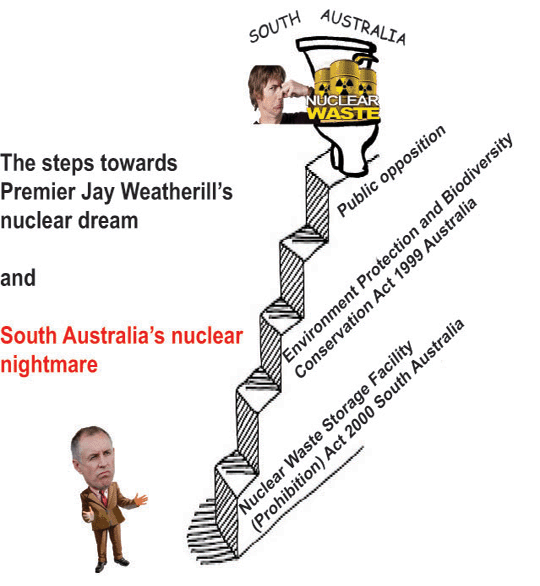
South Australian Premier Jay Weatherill — who faces resistance from federal Labor and his own Left faction — has said cabinet would make a decision in November as to whether to progress the proposal, after extensive community consultation. Latest opinion polls show South Australians almost equally divided on the issue.
Last night, Mr Weatherill, who returned this week from touring the world’s first permanent nuclear waste storage facility in Finland, told The Australian he understood the complexities. “I do agree that this issue poses challenges, not the least for my party, but I feel duty bound to act in South Australia’s and the national interest in progressing this debate,” he said.
Mr Lucas said it would be a “courageous Liberal candidate or member in a federal campaign who would be out there campaigning hard to support Premier Weatherill on a nuclear waste dump or facility’’ in his state.
“At an upcoming federal election … (there will be) federal Labor candidates campaigning in South Australia against a nuclear waste facility in South Australia and potentially candidates from the Greens and the Nick Xenophon Team campaigning against a nuclear waste dump or facility (there). If there is not going to be the support of the federal Labor Party, then we, the taxpayers of South Australia, will be spending tens and maybe hundreds of millions of dollars on fool’s gold — fool’s uranium, fool’s nuclear waste dumps.”
Long delay for money in for South Australia’s Temporary Nuclear Waste Storage facility
David Salomon, Nuclear Fuel Cycle Watch South Australia, 30 Sept 16
At any election during this time approval for the project could be overturned by either state or federal governments as happened with the Yucca Mountain Repository in the USA after being approved in 2002 and funding withdrawn in 2011. Were there to be another Chernobyl or Fukushima that leads to shut down of existing nuclear power stations the demand for the waste facility would be restricted to existing not projected waste. The business plan fall apart.
The fact that the only new reactors are planned by non market economy countries. Business seems not to be interested in building new power plants without massive public subsidy. In the UK this means guaranteeing double the market price for the power supplied. You need very deep pockets to be engaged in the nuclear industry. Could it be that South Australia is in danger of exhausting itself financially and politically on going for the one big prise on the horizon that is actually a mirage when you get closer. We do have a history of doing that in the past. Would it not make better business sense to invest in renewables and ride that wave for the next 25 years or so, or is it that we can see what is right in front of us. We are already at 40% renewables, a manufacturing workforce itching for something to do and in need of greater independence in power supply.
I know that there are people who think about renewables like Bill Gates did in the early days of the internet when he said, “the internet was a novelty that would give way to something better”, though I do believe this sentiment does apply to the waste dump proposal. (BTW I don’t know if Bill likes renewables or what his attitude to Nuclear fuel is, just that people of high status can say some dumb things.)
Check out the outgoings references in this report: https://antinuclear.net/2016/05/06/major-financial-risks-for-south-australia-are-ignored-by-nuclear-fuel-cycle-royal-commission/
I think you’ll find the financial analysis in the Royal Commission somewhat lacking. https://www.facebook.com/groups/1021186047913052/
Australia’s super funds are backing exploration for fossil fuels
 Digging Deeper: How energy company executives are remunerated to expand fossil fuel reserves, and how Australia’s major super funds support them, http://apo.org.au/resource/digging-deeper-how-energy-company-executives-are-remunerated-expand-fossil-fuel-reserves Market Forces 29 September 2016 Australian-listed fossil fuel companies are continuing to search for more unburnable carbon, with $12.69 billion spent on fossil fuel exploration by just fifteen companies since July 2012. Another $14.62 billion has been spent by just ten foreign companies on fossil fuel exploration in Australia between 2013-2015.
In many cases, exploration is encouraged through executive remuneration packages. Seven companies in the S&P ASX300 explicitly refer to reserve replacement or exploration targets in their executives’ bonus structures, as do six international companies with major Australian fossil fuel operations.
Senior executives at the seven Australian companies stand to make a combined $2.02 million in additional bonuses each year if their reserve targets are met.
Australia’s super funds are failing to effectively challenge this business model, despite their stated belief in engagement as a strategy for changing the behaviour of companies. In the last year, only three Australian energy companies incurred a significant vote against their remuneration packages, none of which were an explicit protest against reserves-based incentives.
Only eighteen of Australia’s 50 largest super funds disclose their complete proxy voting record, making it difficult to determine which funds are genuine ‘active owners.’ Our analysis of twelve funds’ voting records shows only three voted against any Australian-listed energy company’s remuneration package in the last year. Major funds including AustralianSuper, First State Super, MLC and ANZ OnePath supported the remuneration packages of every Australian energy company they held shares in.
Australia’s super funds must have effective engagement policies and practices, and demonstrate how these are being implemented to ensure companies they invest in are compatible with a low carbon future. An obvious step to demonstrate alignment with the goals agreed to in Paris is for funds to reject fossil fuel exploration incentives.
Business Investment in Renewable Energy hit by government cuts to Australian Renewable Energy Agency.
 ARENA Cuts Impact Renewable Energy Businesses
  Business investment in Australia’s renewable energy sector will take a direct hit, with up to $5 billion of private funding at risk, as a result of the federal government’s decision to cut half a billion dollars from the Australian Renewable Energy Agency. Pro Bono, Wednesday, 21st September 2016 Ellie Cooper, Journalist Future Business Council executive director Tom Quinn said the government’s decision to cut funding to ARENA in the budget savings bill could have run-on effects on matched private-sector funding for renewable energy.
ARENA was saved from a worse fate, with the Coalition originally planning to strip $1.3 billion from the agency. Negotiations with the opposition secured $800 million in funding over the next five years.
But Quinn said the damage to the renewable energy sector would still be significant.
“The cuts to ARENA are shaking business confidence even further in the renewable energy space. This is a boom sector of this century, Australia’s got natural advantages in this space,” Quinn told Pro Bono Australia News.
“But the one thing holding back the industry is policy uncertainty created by hostile government actions.”
He said demand for renewable energy technology was “enormous”, with $329 billion invested globally in the sector last year.
But he said the role of ARENA was critical in launching renewable startups, growing viable businesses, and attracting local and international investment.
“If we’re talking about innovation in any new technology then early stage investment is critical, and that’s really where government comes in. Government has the ability to invest where the private sector can’t, and all too often that’s where Australia has let down its innovators and entrepreneurs,” he said.
“We haven’t got a good track record of backing early-stage innovation, and this is where ARENA was critical…….https://probonoaustralia.com.au/news/2016/09/arena-cuts-impact-renewable-energy-businesses/
Finland companies keen to market their nuclear waste technology to South Australia
 Finland’s Onkalo nuclear waste disposal facility want to export the technology to South Australia, The Advertiser Daniel Wills, Helsinki, Finland, The Advertiser September 21, 2016 OPERATORS of the world’s most advanced nuclear disposal facility want to export the technology to South Australia and form an alliance to help the state develop its own commercial facility to take waste from around the world.
At a briefing with Premier Jay Weatherill at Finland’s Onkalo nuclear waste disposal facility, Posiva Solutions Oy managing director Mika Pohjonen said his company would be willing to licence intellectual property and engineering solutions to SA if it were to proceed with expanding the local nuclear industry.
Posiva is a joint venture owned by two of Finland’s biggest energy companies — Teollisuuden Voima Oyj and Fortum Power and Heat. It is set to become the first organisation in the world to bury a canister of spent nuclear fuel when they begin inserting them into the bedrock from 2020. Mr Pohjonen said SA could hope to move from site selection to burying canisters within about 15 years, less than half the time taken by Finland, because the Scandinavians had already undertaken the slow work of proving the technology………
The Onkalo disposal site is about 10 times smaller than that conceived by SA’s Nuclear Fuel Cycle Royal Commission.……
Mr Weatherill will by the end of the year declare a formal State Government position to Parliament on expansion of the industry………
“The next major step is a threshold question about whether we maintain our prohibition against a facility for spent fuel or whether we take a step to explore it further.”- Mr Weatherill said ….
Australian company exporting lithium
 Why mine lithium?
Lithium is essential for wind turbines, as well as for so many 21st Century  technologies. However, it is another potentially toxic extractive industry. There’s so much of it dumped in discarded devices. Design should be the answer, so that lithium can be recycled.
MinRes beats Galaxy in lithium export race Jarrod Lucas – The West Australian on September 16, 2016 The first shipment of spodumene concentrate from the Mt Marion mine, 40km south-west of Kalgoorlie-Boulder, is set to depart Fremantle next month bound for lithium processing plants in China.
The product, the equivalent of about 6 per cent lithium, will be delivered to Mt Marion co-owners Ganfeng Lithium (43.1 per cent), which builds batteries out of Jiangxi province and recently branched out into manufacturing electric cars.
Mt Marion, jointly owned by Chris Ellison’s Mineral Resources (43.1 per cent), and Neometals (13.8 per cent), will beat Galaxy Resources to market after its first shipment via Esperance from the revamped Mt Cattlin mine near Ravensthorpe was delayed until December.
It comes as Mt Marion’s neighbours Maximus Resources yesterday trumpeted a “new lithium discovery” on the doorstep of the mine……..https://au.news.yahoo.com/thewest/wa/a/32629967/lithium-set-for-export/#page1
Discord in nuclear submarine lobby
Businessmen lobby for nuclear subs, news.com.au SEPTEMBER 13, 2016 Australian Associated Press A group of Australian businessmen is lobbying for Australia’s next fleet of submarines to be nuclear-powered and supplied by another country, warning the current deal to build the vessels in Australia will “condemn our sailors to their graves”.
The group says it can’t understand the federal government’s decision to award a multi-billion deal to French supplier DCNS, which will be required to deliver 12 diesel-powered submarines for which there are no drawings and no plans…….
The businessmen, including Dick Smith, Gary Johnston of Jaycar Electronics and ad man John Singleton took out a full-page advertisement in The Australian slamming the move to go with French producer DCNS, suggesting buying off-the-shelf nuclear subs would be a better option……
It also questioned the economics of the decision, saying it would be cheaper to subsidise car industry jobs, if creating jobs was the desired outcome.
Mr Johnston said DCNS was being asked to build a diesel-powered version of what is essentially a nuclear-powered sub.
“They haven’t got a drawing, they haven’t got a plan. Their current nuclear submarine, the Barracuda, is sitting on a slipway…..http://www.news.com.au/national/breaking-news/sa-premier-hits-back-at-sub-criticism/news-story/b8dd63476f1a4552c6685d3533163cd1
Banks ready to back big solar projects: renewable energy jobs on the rise

 Banks looking even closer at backing big solar projects: Clean Energy Council, Brisbane Times, Tony Moore , 8 Sept 16, Australian banks will invest more heavily in solar energy projects within the next 12 months, Clean Energy Council chief executive Kane Thornton said after Thursday’s announcement that 12 new solar farms Australia-wide had been backed by $100 million from the federal government.
The federal government’s Australian Renewable Energy Agency on Thursday announced 12 large-scale solar projects – six in Queensland – had received federal support.
ARENA chief executive Ivor Frischknecht said improved efficiencies had meant solar energy producers were getting much more bang for their funding buck than they were even two years ago. “In 2014, the grant funding needed for large-scale solar projects was $1.60 a watt,” Mr Frischknecht said.”In 2015, this dropped to 43 cents at the EOI stage of ARENA’s $100 million large-scale solar funding round; and to an average of 28 cents in June 2016 when full applications were submitted,” he said.
“The average requirement of the projects we are taking forward today is an incredible 19 cents a watt.”
Mr Thornton said solar projects would soon begin to rely less on federal government for funding to begin operations. “We really at the threshold of saying that once we see another round of these of these projects we are going to see the costs decline to the point when they are built on their own, without the government support,” he said. “I think it is months, if not maybe a year or so, before we can expect them to go ahead without further funding.”
Mr Thornton said banks were now closely examining the viability of investing more heavily in solar and renewable energy projects in Australia.
The first major investment in solar energy by Australian banks came in 2013 when NAB and ANZ invested in a 20 megawatt solar plant in Canberra. More investment in solar plants followed, while banks have questioned some large new coal projects……….
Mr Thornton said scale of new solar farm plants was lowering production costs to the point where it was “cost comparative’ with coal and gas.
Mr Thornton said it was now time to begin training workforces that worked in traditional energy supply companies to work in renewable energy. http://www.brisbanetimes.com.au/queensland/banks-looking-even-closer-at-backing-big-solar-projects-clean-energy-council-20160908-grc5ol.html
1 This month.

Help Aunty Sue Protect Her Land and Sacred Sites From Destructive Rocket Testing.
.

Australians deserve the truth
about
AUKUS – https://aukuspublicinquiry.com/

PETITION – To: Prime Minister Anthony Albanese and the Australian Labor Government

of the week – Australians for War Powers Reform (AWPR)
To see nuclear-related stories in greater depth and intensity
 Antinuclear