Is there REALLY profit in nuclear waste importing industry?
Conservation Council South Australia 18 Mar 16 A high-level nuclear waste dump for SA
Should we do it for the money?
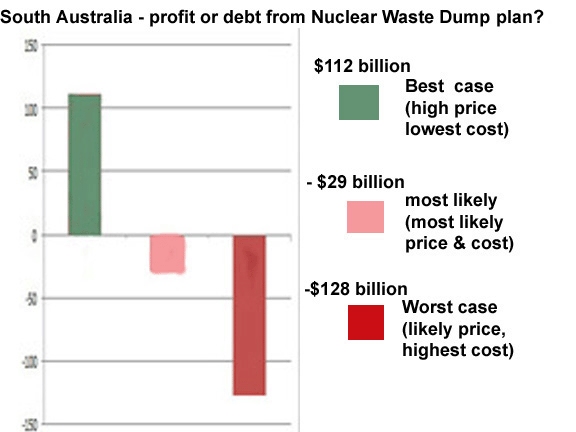
The Nuclear Royal Commission claims some eye-popping revenue figures to take the world’s high-level nuclear waste.
Australia’s uneconomic and declining uranium industry
 Fukushima five years on, and the lessons we failed to learn, Guardian, Dave Sweeney, 11 Mar 16 “…….As home to around 35% of the world’s uranium reserves, Australia has long been a significant player in the global nuclear trade.
Since the 1980s Australian uranium mining has been dominated by two major operations – Ranger in Kakadu and Olympic Dam in northern South Australia. Both operations and their heavyweight owners have been voting with their feet and their finances since 2011. Processing of stockpiled ore continues at Ranger but mining has ended and parent company Rio Tinto is now preparing to commence costly and complex rehabilitation work.
At Olympic Dam the world’s biggest mining company BHP Billiton stunned the South Australian government in 2012 when it shelved an approved and long planned multi-billion dollar mine expansion.
Smaller mines like Honeymoon in South Australia have been placed on extended care and maintenance, junior companies have abandoned the field and the sectors prevailing business model is to get the paperwork in order and wait in hope for better times.
Historically the sector has been constrained by political uncertainty, restrictions on the number of mines, a consistent lack of social license and strong Aboriginal and community resistance.
Recent years have seen fewer political constraints but a dramatic decline in the price of uranium and popularity of nuclear power following Fukushima.
Australia now accounts for approximately 11% of global uranium production, down from over 18% a decade earlier. Australia’s uranium production of 5,000 tonnes in 2014 was the lowest for 16 years.The industry generates less than 0.2% of national export revenue and accounts for less than 0.02% of jobs in Australia. Less than one thousand people are employed in Australia’s uranium industry.
In an attempt to jump start the flat-lining uranium trade, successive federal governments have preferred enthusiasm to evidence. They have failed to conduct the requested industry review and instead fast-tracked increasingly irresponsible uranium sales deals, most recently with India.
Approvals are fast-tracked, regulators are complacent, community concerns are air-brushed away and all for a sector that never really made sense and now doesn’t even make dollars.
In short, Australia’s uranium sector is high risk and low return. It leaves polluted mine sites and home and drives nuclear risk and insecurity abroad. And it fuelled Fukushima – a profound environmental, economic and human disaster that continues to negatively impact lives in Japan and far beyond.http://www.theguardian.com/commentisfree/2016/mar/11/fukushima-five-years-on-and-the-lessons-we-failed-to-learn
Australia’s uranium -nuclear sector – high risk, low return
Failed Uranium Promises Highlights Need For Caution On Radioactive Waste Plans New Matilda, By Dave Sweeney on March 3, 2016 There’s no market, there’s no expertise, and there’s no need for Australia to become the world’s nuclear waste dump.
Having failed to deliver on promises of national wealth from uranium mining – nuclear industry promoters are now talking up the prospect of ‘stupendous’ riches from Australia hosting the world’s high-level radioactive waste.
The South Australian Nuclear Fuel Cycle Royal Commission, headed by former Governor Rear Admiral  Kevin Scarce, has unleashed a frontier style enthusiasm that has seen SA’s Adelaide Advertiser newspaper trumpeting the “Scrooge McDuck levels of cash which the state would be swimming in”.
With the promised dollar signs shinier in the eyes of many politicians and commentators than the very real danger signs, it is time for some cool heads when it comes to plans to import hot wastes.
As home to around 35 per cent of the world’s uranium reserves, Australia has long been a significant player in the global nuclear trade and there are some useful lessons from this experience.
Since the 1980’s the ‘modern’ period of Australian uranium mining has been dominated by two major operations – Ranger in Kakadu and Olympic Dam in northern South Australia.
The sector has been constrained by political uncertainty, restrictions on the number of permissible mines, a consistent lack of social license and strong Aboriginal and community resistance.
Recent years have seen fewer political constraints but a dramatic decline in the price of uranium and popularity of nuclear power, following the Australian uranium fuelled Fukushima nuclear crisis – which  is fast approaching its five year anniversary, and whose radioactive fallout continues to negatively impact lives in Japan and beyond.
Australia now accounts for approximately 11 per cent of global uranium production, down from over 18 per cent a decade earlier.
Australia’s uranium production of 5,000 tonnes in 2014 was the lowest for 16 years.
The industry generates less than 0.2 per cent of national export revenue and accounts for less than 0.02 per cent of jobs in Australia. Less than one thousand people are employed in Australia’s uranium industry.
In short, the sector is high risk and low return………. https://newmatilda.com/2016/03/03/failed-uranium-promises-highlights-need-for-caution-on-radioactive-waste-plans/
Could renewable power be Port Augusta’s saviour?

THE “dominoes” are lined up for Port Augusta to switch from coal-fired to solar thermal power generation and advocates are urging governments to summon the “political will” to secure the project….(subscribers only)
http://www.adelaidenow.com.au/news/south-australia/solar-thermal-power-push-to-keep-jobs-in-port-augusta/news-story/dd0e42df6d28e5e0bb5959966ac676be
World’s most expensive and toxic “stranded asset” – Nuclear Waste Dump For South Australia
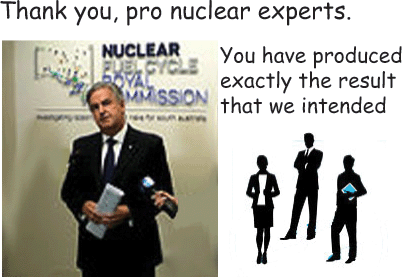 Nuclear Royal Commission: What’s Scarce in Kevin’s Report, Independent Australia
17 February 2016,The Scarce Report recommends South Australia being storing the world’s nuclear waste, opening the door for nuclear power generation in Australia in the future, writes Noel Wauchope.
Kevin Scarce’s Report on the “tentative findings” of the South Australian Nuclear Fuel Chain (I mean Cycle) Royal Commission runs to 42 pages. Still, he manages to leave a few questions unanswered and, indeed, a few questions not even asked, as well as leaving a few grey areas to be brushed over in a suitably vague manner.
MONEY
The major recommendation of the Report is for South Australia to make billions by importing, managing, storing and disposing of nuclear waste.
Who pays up first?
An interesting question – and grey area – is exactly who would be responsible for paying for the building of the nuclear waste facilities; for the construction of the dedicated port facility, airport and rail freight line; and the maintenance of all the infrastructure?
Well, that question is not answered clearly at all by the Report. However, as it states that ‘the facilities would need to be controlled and owned by government’, we can assume that the tax-payer will be responsible for the costs, now unto eternity, as eternity is about how long that high level radioactive wastes have to be contained and kept secure .
The Commission’s financial advice from Jacobs MCM makes this clear:
‘Capital and operating costs are assumed to be met from revenue. In the first few years of the model costs are assumed to be incurred before revenue is received.’
The payments for taking in spent fuel (high level wastes) from other countries would start only ‘at the moment of transfer from ship to shore in South Australia’, which would happen 15 years after the waste storage facility was built
Now how could they sell that idea to the public? Well, there’s the possibility of other countries paying for some of it, sort of:
‘…the potential to negotiate advance reservation fees with some prospective client countries to offset at least a portion of this cost.’
How much will it all cost?
Scarce reports the underground disposal facility as costing $33 billion. The Jacob report does not make all of the costs clear. It does not reveal the costs of the surface storage facilities and of maintaining high level wastes for many decades in dry storage casks.
The Jacobs MCM financial advisory report to the Commission has a tone of optimism and yet its 214 pages contain many “ifs” and “buts”.
Some of these include:
- Disposal of spent fuel (SF) will account for 93% of the costs. No country except UK has actually priced this cost, and estimates for these costs vary wildly from country to country.
- Countries with established nuclear experience – USA, UK, France, Sweden, Finland, Russia, China and India – will not be exporting nuclear waste to Australia, which leaves potential markets to a number of nuclear-inexperienced countries in Asia and Middle East — some with unstable regimes. Japan is committed to reprocessing its nuclear wastes, with no plan to export them……….
How come Australia is the only country to jump at this opportunity? Continue reading
Telstra to rollout solar and battery storage technologies
 Telstra takes on energy utilities with home solar and storage plan, Independent Australia Giles Parkinson 11 February 2016 Telstra’s rollout of solar and battery storage looks to be a game-changer in the home energy market. RenewEconomy‘sGiles Parkinson reports.
AUSTRALIA TELECOMMUNICATIONS giant Telstra plans to accelerate the rollout of solar and battery storage technologies, and is looking to offer home energy services to millions of consumers in the first sign it will take on the major energy utilities.
Telstra has established a dedicated project team to be led by Ben Burge, the feisty CEO of Powershop and Meridian Energy Australia,which has made major inroads into the Australian energy oligopoly, and which has been a keen proponent of wireless technology and smart-phone apps.
The arrival of a giant corporation such as Telstra into the home energy market signals massive change in the industry, as new technologies such as solar and battery storage, and the “internet of things” offer new avenues to the consumer market.
Telstra is flagging the possibility of offering home energy services – including solar and battery storage – as part of its bundled services that includes internet and telephone.
Telstra’s head of new business, Cynthia Whelan says in her corporate blog:
We see energy as relevant to our Connected Home strategy, where more and more machines are connected in what is called the Internet of Things.
We are looking at the opportunities to help customers monitor and manage many different aspects of the home, including energy……..
Analysts have predicted for several years now that the traditional energy industry would come under attack from new players such as telcos, and IT giants such as Google.
Mark Coughlin, the head of utilities at PwC, says electricity utilities, are facing their “Kodak moment” as the emergence of rooftop solar, in combination with battery storage and smart software, shift the power from the utility to the customer.
And, he says, telcos such as Telstra are better at consumer service than energy utilities, which will struggle to maintain their right to survive. …….https://independentaustralia.net/environment/environment-display/telstra-takes-on-energy-utilities-with-home-solar-and-storage-plan,8666
Companies like AGL waiting for government clarity on renewable energy policy
 AGL puts an each-way bet on renewable energy, The Age February 11,
  2016 Elizabeth Knight AGL:Environmental terrorist or evangelist? Take your pick but financial pragmatist is probably the best description.
The fact is that this company makes most of its earnings off the back of carbon producing coal-fired energy production and is using the proceeds to seed a $3 billion renewable energy fund that will invest in clean sources of power like solar and wind.
There is nothing new age environmentally conscious in this. Like any corporation that is looking to maximise returns, AGL (like several others) understands that the writing is on the wall for the the production of dirty energy – in the longer term. Thus it is making an each-way bet on the future.
Make no mistake, companies like AGL make investment decisions primarily with reference to investment returns rather than environmental outcomes – regardless of the rhetoric. This is the company that last week announced it was winding down its interest in the coal seam gas industry.
Once again it was influenced by community uproar and protests about fracking in their back yards but the decision was one centred on the the gas supply/demand equation and the capital costs of firming up an unreliable coal seam gas resource……..
Renewables tipped to pay off
Longer term it is clear that AGL is taking a punt that the balance will ultimately move between clean renewable energy and the dirty stuff which earns its healthy profits today – hence this week’s creations of the renewables fund.
One of its existing clean energy assets will be effectively vended into this new renewables fund…….
To really move the dial towards producing cleaner energy, companies like AGL need stronger support from the government which under the Abbott government gave them little certainty about how much support and financial incentive would be given to green policies.
And AGL is the first to admit that the changes in government policies over the past 4 -5 years has made investment decisions difficult.
Ultimately AGL, which is the country’s largest generator, its largest emitter of greenhouse gases and the largest builder and operator of renewable energy is a particularly important part of the conversation about Australia’s energy use and generation.
And as such the allocation of its investment should exert some influence on government policy. But it is limited in how fulsome any commitment to investment in clean energy can be until it can be secure with the level and the timing it will receive from legislators. : http://www.theage.com.au/business/comment-and-analysis/agl-puts-an-eachway-bet-on-renewable-energy-20160210-gmqh1t#ixzz3zu51N8JO
Big Electricity Company AGL launches $3b renewable energy fund
AGL Energy going greener with launch of $3b renewable energy fund, SMH February 10, 2016 Angela Macdonald-Smith Electricity major AGL Energy has taken its most decisive steps yet to reposition itself for a lower-carbon future, launching a $3 billion renewable energy project fund and investing $US20 million ($28.4 million) in a Californian solar and battery storage developer.
The latest moves come less than a week after the country’s largest emitter of greenhouse gases announced it would quit natural gas production and caps what chief executive Andy Vesey describes as a “very significant strategic pivot” during his first 12 months in the role.
The new unlisted fund will hold AGL’s recently completed solar power projects in western NSW and will be partly owned by AGL, which will contribute $200 million in equity, alongside partners which are likely to be local infrastructure funds.
AGL’s exit from gas production incurred a $640 million after-tax write-down, as flagged last week, which drove the company into the red in the first half……..
Mr Vesey said the strong performance of AGL’s core business “highlights that we are well positioned to capitalise on the evolution occurring in the energy sector”, leading to the launch of the Powering Australian Renewables Fund, which he had hinted at late last year.
The fund will aim to develop at least 1000 megawatts of large-scale renewables projects, about 20 per cent of capacity needed to meet the 2020 Renewable Energy Target, at a cost of $2 billion to $3 billion.
Feedback from “soft soundings” among potential co-investors has been positive, with the line-up of partners likely to be finalised towards the end of June, Mr Vesey said. Australia’s large banks are likely to contribute senior debt, while mezzanine financing could also be involved, said chief financial officer Brett Redman.
Green welcomeGreen groups welcomed news of the fund, with Clean Energy Council head Kane Thornton describing it as the sort of move that is “crucial to unlocking the many thousands of megawatts of renewable energy projects that are ready and waiting to be built around Australia.” http://www.smh.com.au/business/energy/agl-energy-going-greener-with-launch-of-3b-renewable-energy-fund-20160209-gmq2in.html#ixzz3zu38xisy
The Ugly Australian – Peninsula Energy uranium mining in South Africa
Already today, the environment around Beaufort West is contaminated close to the previous mine sites. First field studies by the author show unprotected nuclear wastes with 10 to 20 times the background radiation.
Dust and Radiation – Two Deadly Impacts…… a particular direct relationship between occupational exposure to uranium and its decay products and lung diseases.Mining uranium ore in the Karoo will invariably create huge plumes of contaminated dust. Dust clouds are unavoidable during drilling, blasting and transporting.
Dust suppression by spraying water is only partially effective and creates new problems with contaminated slimes, adding to the environmental cost of groundwater abstraction
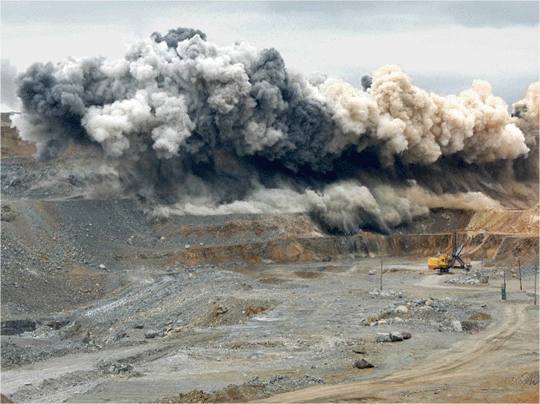
The Karoo has long been known to harbour substantial sedimentary uranium deposits. Now an Australian company [Peninsula Energy , through it’s wholly owned subsidiary Tasman Pacific Minerals Limited] with Russian funding is planning to get the radioactive mineral out of the ground on a major scale.
The company has quietly accumulated over 750 000 hectares of Karoo properties and concessions around Beaufort West and plans to set up a large Central Processing Plant just outside that town.
While the nation is still debating the pros and cons of fracking, the Environmental Impact Assessment (EIA) as the precursor to mining licences is nearing finalisation. During 2016 the Department of Mineral Resources will make a decision on the industry’s application……….
extensive studies on the risks of uranium mining over many decades are available today….yet so far there is no public debate, no strategic assessment process in place in the Karoo.No advocacy groups balance the glossy claims of the industry against sobering experiences on the ground….. Continue reading
ERA’s Ranger uranium mine – dead but ERA just won’t lie down
Did the Australian Labor Party get rid of Martin Ferguson as Minister For The Nuclear Lobby, only to replace 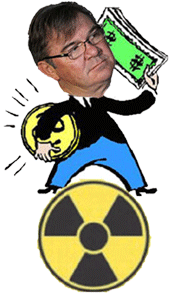 him with Gary Gray -a new Minister For The Nuclear Lobby?
Opposition resources minister Gary Gray has said that a closure of Ranger would have “massive implications” for the economy of Arnhem Land and would be unfortunate for the uranium industry in Australia.
Energy Resources of Australia nears decision on future of Ranger uranium mine, SMH, January 12, 2016 Angela Macdonald-Smith Energy Reporter The future of the Ranger uranium mine in the Northern Territory hangs in the balance as owner Energy Resources of Australia nears a decision on a strategic review.
Rio Tinto-controlled ERA said on Tuesday it would update the market this quarter on the strategic review, which it kicked off in October after being advised by traditional owners that they oppose an extension of production at the mine near Kakadu.
The Mirarr traditional owners refused to back the miner’s bid to extend its processing permits beyond the current expiry date of January 2021.
ERA, 68 per cent-owned by Rio, warned then that it may have to write down its assets as a result. Some analysts calculate the impairment could reach several hundred million dollars. ERA, for whom Ranger is its only producing asset, is due to report its 2015 earnings on January 28…………. Continue reading
Australian Ethical Superannuation finds the nuclear industry to be an unacceptable risk

Australian Ethical Super Dr Stuart Palmer, Head of Ethics Research at Australian Ethical. 6 Jan 16
We agree that the nuclear energy is a complex issue given the need to transition globally to low-emissions power. However, Australian Ethical has a strong negative screen on nuclear power for a range of reasons including:
· frequent association with nuclear weapons manufacture;
· radioactive pollution from uranium mines;
· the intractability of radioactive waste;
· the potential for catastrophic failure of nuclear power stations;
· security risks associated with the operation of nuclear power stations, and with the transport and storage of nuclear waste.
In our view these concerns outweigh the potential climate change benefits of nuclear power. Even with new generation nuclear plants we still consider the level of risk to be unacceptable, particularly given rapid advancements in renewable energy and storage technology.
I hope this information is helpful in explaining our approach.
–tinyurl.com/Nuclear-Uranium
New report rules out nuclear power for Australia, on economic grounds
 Nuclear priced out of Australia’s future energy equation in new report By Sophie Vorrath & Giles Parkinson on 26 November 2015 http://reneweconomy.com.au/2015/67465
Australia’s official economic forecaster has finally admitted that the cost of nuclear energy is more than double other clean energy alternatives, suggesting it would likely play no role in a decarbonised grid based around lowest costs.
The Australian Power Generation Technology Report – a 362-page collaborative effort from more than 40 organisations, including the CSIRO, ARENA, the federal government’s Department of Industry and Science and the Office of the Chief Economist – clearly shows that solar and wind will be the cheapest low carbon technologies in Australia.
It comes at a critical time, with the nuclear lobby, supported by existing coal generators, pushing nuclear generation heavily, on the basis of previous technology cost assessments that had unrealistically optimistic views of its costs.
But the APGT report has essentially ruled out nuclear power for the whole of Australia, revealing that the technology is becoming more and more prohibitively expensive, at around double the capital cost estimated three years ago – and double the cost of competing technologies. Continue reading
Paladin called on to close and rehabilitate Malawi uranium mine
 Conservation Council of Western Australia, 20 Nov 15 Shareholders at Perth based company Paladin’s AGM will call for the non-operational Kayelekera uranium mine in Malawi to be closed and rehabilitated. Calls for rehabilitation follow years of community opposition to the mine and failure to prevent the release of radioactive material into the environment.
The mine has been under ‘care and maintenance’ for several years due to the falling demand for uranium globally.
Charles Roche from the Mineral Policy Institute who will be attending the meeting said “With predicted operating costs almost double the long-term uranium price, there is a real danger that Kaylekera will be abandoned or sold off to reduce company debt. Instead of endless optimism Paladin should be honest about the possibility of re-commencing of mining in the next few years and begin rehabilitation works to protect communities, secure the site and end the cycle of financial losses”.
Mia Pepper, CCWA nuclear free campaigner who is in Africa at the Nuclearization of Africa conference this week said “We’ve been asking, along with French group CRIIRAD, for Paladin to release monitoring data from testing downstream from the mine. CRIIRAD have completed intermittent tests which indicate there is some radiological impact from the Kayelekera mine on the environment.”
“As the mine is about to go into a third year of being in Care and Maintenance we are concerned about the ongoing management of water on site and the structural integrity of the site. We would like to see this mine going into early rehabilitation, given the failures of Paladin to address community concerns, the clear local opposition to the project and the failure to contain radiological material onsite and an uncertain future. Rehabilitation should be done to the same standards expected in West Australia.”
Paladin has two uranium exploration projects in WA, also on hold given the stagnant uranium price and no mid term prospects of improvement. Paladin’s project in Qld is on hold indefinitely given that the Queensland Government reinstated the ban on uranium in Qld. Their JV proposal in the NT is also indefinitely on hold given strong opposition from the NT Government and Alice Springs residents.
Even Westinghouse gives cost of nuclear reactor as $17.5billion
Global energy giant Westinghouse says an Australian nuclear power plant would cost $17.5bn November 5, 2015 ……..Ms Bowser, Westinghouse’s vice president of new plant project advancement, said construction of the company’s AP1000 model would take four years but deciding a site and various necessary approvals would take longer.
Cameco’s uranium plans in Western Australia stalled indefinitely by low prices
Uranium miner Cameco to move in WA when demand lifts for nuclear energy, Perth Now
October 28, 2015 North American uranium miner Cameco plans to advance its WA projects when demand picks up.
The company says it is frustrated by roadblocks to uranium mining in WA, particularly from the WA Labor Party, which may stop new uranium mines from going ahead if elected.
Cameco Australia managing director Brian Reilly said uranium miners would need access to more Australian ports to export its products in the future……..http://www.perthnow.com.au/business/uranium-miner-cameco-to-move-in-wa-when-demand-lifts-for-nuclear-energy/news-story/cb93a50d83666159909dfa00d4b94c7c
1 This month.

Help Aunty Sue Protect Her Land and Sacred Sites From Destructive Rocket Testing.
.

Australians deserve the truth
about
AUKUS – https://aukuspublicinquiry.com/


PETITION – To: Prime Minister Anthony Albanese and the Australian Labor Government

of the week – Australians for War Powers Reform (AWPR)
To see nuclear-related stories in greater depth and intensity
 Antinuclear