Uranium mining experts have faith, despite the gloomy situation for the nuclear industry
One of the major risks for the uranium industry is the rapid advancement of the renewable power sector, particularly in battery technology.
“We have been waiting for the Japanese nuclear power fleet to be turned back on. We had an expectation for the past two summers that it would be turned back on and that hasn’t come to pass, and that remains the biggest question for uranium prices..”
Australia is well placed to cash in on uranium boom, say mining experts The Age, August 6, 2015 Peter Ker If uranium demand were to ever boom like iron ore, Australia would make a packet. But renewables and community attitudes threaten that. If uranium demand were ever to boom in the way iron ore has over the past decade, Australia would be well placed to cash in.
With the world’s largest known uranium resource and enough mining to be the world’s third biggest producer of the nuclear fuel, Australia is already a significant player in the global uranium industry.
But that industry remains relatively small compared with the likes of gold, copper and coal, and it has endured a severe downturn over the past four years………..
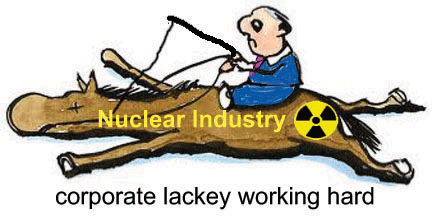
dramatically reduced demand for uranium and prices have been badly depressed ever since. The benchmark price has spent the past couple of years between $US25 a pound and $US40 a pound, and uranium was fetching $US35 a pound last week.
The weak prices have forced many marginal mines around the world to close which, combined with older mines reaching the end of their working lives, has reduced the number of operating uranium mines in Australian in recent years.
Uranium is now being produced at just three Australian sites: BHP Billiton’s Olympic Dam mine in South Australia, the Rio Tinto-dominated Ranger lease in the Northern Territory, and the Four Mile mine in South Australia, run by Quasar and Alliance Resources.
Mining at Ranger has stopped and the company is gradually working through the remaining stockpiles, while Olympic Dam is focused on copper and treats uranium as a byproduct.
Two others in South Australia (Russian miner Uranium One’s Honeymoon mine and US company General Atomics’ Beverley mine) closed down during 2013 and 2014 because weak uranium prices made them unviable.
But weak prices do not only hurt the mines that are already in production; they also deter companies from pushing ahead with the next generation of uranium mines, as at Ranger last month when plans for a underground expansion were abandoned.
Other Australian uranium deposits, such as the ones Toro Energy is developing in Western Australia, seem unlikely to be mined unless uranium prices significantly recover. Continue reading
Uranium miner ERA losses slump, yet again
 ERA’s loss widens to $255m, Yahoo 7 Finance, 1 Aug 15 Uranium miner Energy Resources of Australia has slumped to a $255 million half year loss after shelving a major mine expansion in challenging conditions.
The Rio Tinto-controlled miner will not pay a half year dividend and said the uranium market remained challenging as an oversupply kept prices week……Half of the company’s board quit last month after ERA decided its proposed new underground mine at Ranger the Northern Territory would not proceed to a final feasibility study due to a sluggish uranium market.
Controlling shareholder Rio Tinto then pulled its support for any expansion of the mine, despite ERA saying it would seek to extend its authority to operate Ranger in order to re-visit the expansion at some stage.
ERA’s net loss in the six months to June 30 is significantly larger than the $127 million loss incurred in the same period of 2014, due mainly to a $197 million writedown related to the mine decision……https://au.finance.yahoo.com/news/eras-loss-widens-255m-051004998.html
Australian uranium company Paladin desperate to stay alive – cuts salaries
 Paladin Energy cuts management salaries in break-even bid, THE AUSTRALIAN,BUSINESS SPECTATOR JULY 30, 2015 Michael RodMichael Roddan Troubled Australian uranium miner Paladin Energy has slashed the pay of its chief executive by 20 per cent as part of a string of cost cutting measures across the business designed to get the firm to a cash flow break-even point by the end of the year.
Paladin (PDN) said today it had materially lowered its break-even level for the 2016 financial year, on a cashflow basis, off the back of capital expenditure reductions, and cutting of corporate and debt costs….
Previous to this, the salary of the managing director had been reduced by 35 per cent and board fees cut by 10 per cent.
…Mr Borshoff also gave himself a 20 per cent pay cut as part of the restructure, along with a 10 per cent salary cut for management and staff and further 20 per cent reduction in fees payable to Paladin’s chairman and non-executive directors……..
Uranium is currently being traded at $US36 a pound, The market has been soft for some time, with the uranium spot price hovering around or under $US40 for the last two years, well below its peak of $US130 a pound in 2007.
Paladin shares have also taken a pounding since the commodity’s peak, falling from $10.44 in 2007 to their current level at 22.5c……..
Industry under attack, as Tony Abbott hacks into Clean Energy Finance Corporation
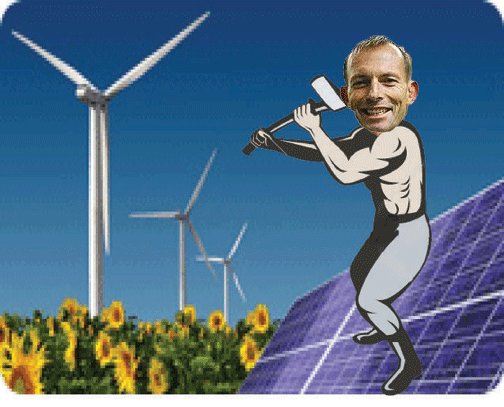 Australia Renewable Energy Gets Hacked & Attacked, Clean Technica July 21st, 2015 by Steve Hanley Originally published on Solar Love.
Australia is bathed in sunlight like few other places on earth. It, among all countries, has the highest potential to generate all the electricity it needs from renewable sources, principally the sun and wind.
But the prime minister doesn’t care about clean, renewable energy in Australia. All he cares about is doing the bidding of the wealthy coal owners who bought and paid for his election win in 2013. Since he took office, Australia’s investment in clean energy projects has fallen 70%, according to Bloomberg New Energy Finance.
Government Says No to Solar Investment
Now Abbott has issued instructions to the Clean Energy Finance Corporation (CEFC) prohibiting it from investing in wind farms or small-scale solar projects. Opposition leaders and solar energy supporters say the government directive prohibiting CEFC from investing in rooftop solar will cripple the industry and further diminish Australia’s chances of transitioning to a clean energy economy.
“I don’t agree with the prime minister that if you just don’t have any government support for the future of renewable energy, that the renewable energy will just miraculously grow and increase in Australia,” opposition leader Bill Shorten told the Australian Broadcasting Corporation. He said that striking wind farms and rooftop solar from the CEFC will mean that “the only thing the CEFC can invest in is flying saucers.”
The Role of the Clean Energy Finance Corporation
National Australia Bank to invest more in renewable energy
 NAB maintains its faith in renewable energy, SMH, July 19, 2015 James Eyers Senior Reporter The country’s largest financier of renewable energy projects, National Australia Bank, has said it plans to lend more to the sector despite it being thrown into turmoil last week when Prime Minster Tony Abbott ordered the Clean Energy Finance Corporation (CEFC) to stop putting funds into wind power.
NAB’s head of debt capital markets, Steve Lambert, said the domestic politics around wind power is “noise, but you have to try to look [past that]” and said in the absence of local deals, NAB will continue to back projects overseas, and intends to become one of the world’s leading banks in renewable energy financing. …….
“Is the renewable energy industry supported by long-term fundamentals? Both public opinion and demand suggest yes, it is. Is there money flowing into the industry? Yes, there is. So our thinking is: how do we help facilitate that? We want to stay there and at the same time try some new things.”
NAB has been working with the CEFC to provide Australian businesses with access to discounted funding for energy efficiency and renewable energy upgrades. It was also the first Australian bank to issue a “green bond”, where proceeds are used for an environmentally sustainable purpose. …….. http://www.smh.com.au/business/banking-and-finance/nab-maintains-its-faith-in-renewable-energy-20150719-gieq5g.html#ixzz3gZ5w596X
BHP under fire for artificial tax avoidance
McGeoch slams BHP over tax Glenda Korporaal – The Australian, 15 July 15 Sydney company director Rod McGeoch has hit out at BHP Billiton for using a Singapore company to structure its tax arrangements and called for major Australian companies to drop artificial tax avoidance structures.
In an interview with The Australian, Mr McGeoch, who is a director of Ramsay Health Care and led the Sydney bid for the 2000 Olympics, said directors on the boards of major companies should hold themselves to higher standards than just maximising profits for shareholders………
He said company directors who felt their main duty was just “wealth maximisation” for shareholders were “heading for trouble”.
Mining companies, including BHP Billiton, have recently come under focus for the use of so-called offshore marketing hubs.
“When you are taking minerals out of the ground and putting them on a ship and sending them to China, to suggest that there is a transaction going through Singapore, that is not artificial.
“I am sure they (BHP) do have an office in Singapore but the truth of the matter is that the ore is going from Australia to China. We can all create a series of transactions that Singapore buys the ore (from Australia) and Singapore sells it (to China), but, really, does any person in China really think this stuff comes from Singapore?” Mr McGeoch said……..
Mr McGeoch’s comments come in the wake of recent appearances by BHP and other mining executives before the Senate inquiry into corporate tax minimisation. During the inquiry, BHP confirmed it was in a dispute worth more than $500 million with the Australian Taxation Office relating to its Singapore marketing operations………http://www.businessspectator.com.au/news/2015/7/15/resources-and-energy/mcgeoch-slams-bhp-over-tax
World’s poorest country, Malawi, ripped off by Paladin in tax avoidance?
 Australian miner accused of dodging tax in world’s poorest country, The Age, July 11, 2015 –Heath Aston Political reporter
Tax avoidance tactics of multinational companies have angered Australians, but an Australian mining firm used such methods in Malawi. Tax avoidance tactics of multinational companies have angered the public and placed pressure on the Abbott government to prevent profits being exported offshore.
But an Australian uranium miner is defending the use of identical methods to reduce its tax bill in the world’s poorest country, Malawi.
Between 2009 and 2014, Paladin Energy moved $US183 million out of Malawi to a holding company in the Netherlands and then on to Australia.
A 15-page report by London-based ActionAid has found the Dutch transfers and a special royalties deal – in which Malawi’s mining minister agreed to drop the initial tax rate applied to the uranium mine from 5 per cent to 1.5 per cent – have cost the Malawi public $US43 million.
In Africa’s poorest nation, where per capita GDP is just $US226 a year and life expectancy 55, that money could provide the equivalent of 39,000 new teachers or 17,000 nurses, according to the aid group……..
Paladin’s tax-free transfers to the Netherlands were a combination of management fees and interest payments on loans initiated in Australia. The company loaded its African subsidiary up with huge debts, leaving the Kayelekera uranium mine in northern Malawi with an 80:20 debt to equity ratio – a financing structure known as “thin capitalisation”.
The Dutch structure allowed Paladin to avoid paying a 15 per cent withholding tax to the Malawi government due to a tax treaty between Malawi and the Netherlands which expired in 2014, saving the company $US7.3 million. Paladin closed the mine in February 2014, citing a “sustained low uranium price”.
ActionAid has accused the company of “treaty shopping” and shortchanging the Malawi people. The country’s nursing ranks have the equivalent of four nurses to every 100 in Australia, despite 10 per cent of Malawi’s population being infected with HIV/AIDS……..http://www.theage.com.au/federal-politics/political-news/australian-miner-accused-of-dodging-tax-in-worlds-poorest-country-20150710-gi6uzv.html
GDF SUEZ Australian Energy, coal mine owner, investing big into solar energy
“Solar is becoming totally competitive,” “Solar is an energy of the future. It is the energy with the biggest potential for development. It’s no longer a subsidized niche.”
the shift by Engie from centralised fossil fuel and nuclear capacity to one based around decentralised renewable energy generation is typical of the transformation going on around the world – with Europe’s E.ON, RWE and Vattenfall, and in the US, with generators such as NRG, and network operators in California, New York and elsewhere.
 Hazelwood owner makes big push into solar energy, REneweconomy, By Giles Parkinson on 10 July 2015 The owner of the Hazelwood coal-fired power station, the dirtiest generator in Australia, has announced a major push into renewable energy, snapping up the international solar farm developer SolaireDirect for about $A300 million.
GDF Suez, now known as Engie under a massive re-branding campaign that signals its shift from fossil 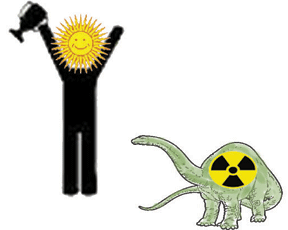 fuels and nuclear to renewable energy, will become the largest solar and wind developer in France after the purchase.
But its big focus is on the international scene. Gerard Mestrallet, the CEO of Engie, one of the biggest operators of nuclear plants in Europe, says new solar now beats new nuclear on price, with new solar parks costing between $US60 and $US90/MWh. Continue reading
Community renewable energy will get a boost from Frontier Energy’s financing toolkit
Financing toolkit in works for community renewables project http://www.businessspectator.com.au/news/2015/7/10/renewable-energy/financing-toolkit-works-community-renewables-project JOHN CONROY 10 JUL 15 Frontier Energy is creating a toolkit that is set to make community energy projects easier to develop, supported by $296,000 funding from the Australian Renewable Energy Agency (ARENA).
The $493,000 project aims to break down some of the barriers facing new community energy projects by increasing project developers’ understanding of how to secure finance.
“While the community renewable energy sector in Australia is growing, there remains a large gap in information on financing,” ARENA CEO Ivor Frischknecht said.
“The new financial toolkit will provide easily accessible information on financier requirements, financial models, checklists and case studies through a central website, along with a list of key contacts.
“Spending less money on external advice, particularly in the early stages of development, will make projects cheaper overall. Continue reading
Uranium investing – some stocks bad, others worse
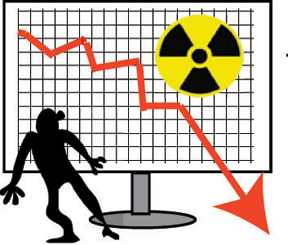 ERA also has a $290m cash stockpile but faces almost double that to close Ranger. Unlike Amy Winehouse, that’s one rehab to which ERA must go-go-go.
As for Paladin Energy (PDN, 25.5c), being the world’s only listed pure-play uranium miner with two operating mines (albeit on care and maintenance) hasn’t made for unfettered joy either……..
We rate ERA a sell and Alliance and Paladin as specbuys
Uranium stocks a mixed bad for investors THE AUSTRALIAN JULY 03, 2015 Tim Boreham Over the years the uranium caper has been much more fun for investors in the exploration chase, rather than the drudgery of actually mining the toxic substance. Continue reading
Taxpayers likely to cop the costs of Ranger uranium clean-up. if ERA goes bankrupt
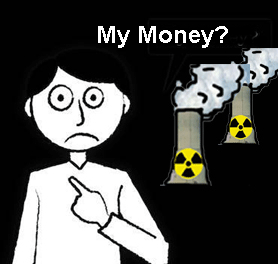 as Ranger was authorised by the Commonwealth Government under 1953 Atomic Energy Act which primarily allowed the uranium to be used for military purposes, the Commonwealth and, ultimately the taxpayers, could be liable for the clean up if ERA was bankrupted.
ERA faces closure after uranium miner’s expansion plans shelved by Rio Tinto, ABC News, 30 June 15 By business reporter Stephen Letts Sorry history, uncertain environmental legacy Apart from the discharge of a million litres of radioactive slurry in 2013, Ranger has a sorry history of accidents with more than 200 environmental incidents being reported to government agencies since 1979.
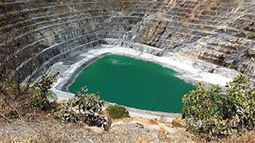 Just how much Ranger’s clean-up will cost is open to question. Under existing legislation, once the lease expires early in 2021, ERA has five years to complete the rehabilitation program.
Gavin Mudd, a senior lecturer in environmental engineering at Monash University with a long standing interest in Ranger, argues there are problems calculating the final cost as it depends on a number of choices, including how long is an adequate period of monitoring radioactivity levels.
The level of radioactivity around the site is unlikely to be safe any time soon given the half-life of uranium-238 is 4.5 billion years. The half-lives of other principal radioactive components of mill tailings, thorium-230 and radium-226, are shorter at about 75,000 years and 1,600 years respectively, but it’s a rather academic distinction.
Currently there is not a stipulated period for monitoring levels of radiation at the site once the rehabilitation is completed. However, Dr Mudd said a monitoring program should be run over decades rather than years.
“Fifty years would be a good start,” he said. Continue reading
The end of the line for uranium company Energy Resources of Australia
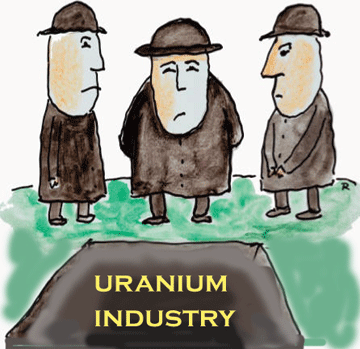 ERA faces closure after uranium miner’s expansion plans shelved by Rio Tinto, ABC News, 30 June 15 By business reporter Stephen Letts ERA was once one of the world biggest uranium producers, supplying about 10 per cent of the global market for ‘yellowcake’ and powering electricity utilities in Japan, Europe and North America.
It’s now pretty well friendless as its last three independent directors resigned, leaving the company in the hands of its majority shareholder Rio Tinto.
Rio for its part said there is no future for ERA’s only productive asset, the Ranger Mine, which operates in the middle of the World Heritage listed Kakadu National Park.
With its existing open mine resources exhausted, ERA has been labouring on, processing stockpiled ore since late 2012.
Ranger’s last hope lay in an ambitious and expensive underground mine – the Ranger 3 Deeps project – which could have extended the mine’s life by another decade. That hope was extinguished earlier this month when Rio, with its 68 per cent stake in ERA, said enough was enough. The market was blindsided by Rio’s decision, with ERA’s share price tumbling more than 70 per cent in the aftermath.
In hindsight it was probably inevitable.
ERA’s losses mount to $700 million since 2011 Continue reading
South Australia’s pro nuclear lobby upset about the State’s embrace of rooftop solar
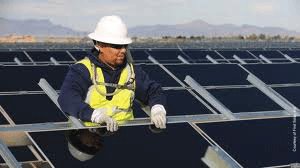 Dennis Matthews, 26 June 15, There is little doubt that South Australians have embraced rooftop solar electricity, with gusto. This is undoubtedly a worry to the pro-nuclear lobby ( a long time opponent of renewable energy) and to companies who stand to lose income from such independent electricity producers.
Thanks to the breakup and privatisation of the former publicly owned ETSA, what one part of the electricity industry gives, another part can just as easily take away. Or as the monopoly electricity network company SAPN has so coyly put (The Advertiser, 25/6/15) “it was ultimately up to the energy retailers as to how much of the reduction in SAPN charges were passed on to householders.”
Given that SAPN and the retailers do not compete for the electricity dollar, what’s the bet that prices will continue to go up, maybe not this year but almost certainly by the end of 2016, and that each segment of the privatised electricity industry will blame the other.
The game is up for uranium miners ERA and Paladin
After 10 years of no profit, and millions in shareholder value destroyed, very few have profited from Paladin’s ongoing existence. ERA, on the other hand, was profitable up until 2010, but has gone backwards since. Neither trend is unlikely to change in the future.
What’s next for Australia’s uranium miners? Motley Fool, 24 June 15 Energy Resources of Australia Limited (ASX: ERA) and Paladin Energy Limited (ASX: PDN)are two of Australia’s largest independent uranium producers, but have they lived out their useful half-lives?
Some might suggest yes, following the recent news stories surrounding ERA, which is majority owned (68%) by Rio Tinto Limited (ASX: RIO).
You may have already seen some of the news surrounding one of Australia’s largest uranium miners, ERA, when its shares plunged 47% in early trading two weeks ago. That reaction was due to the company’s decision to cancel its Ranger 3 Deeps project thanks to continued low uranium prices, and ongoing uncertainty over the uranium market’s direction in the immediate future.
ERA owned and operated the Ranger mine, which is surrounded by the Kakadu National Park in Australia’s Northern Territory. But the decision to not proceed with the Ranger 3 Deeps project means the mine holds very little value for ERA, Rio or anyone else wanting to mine uranium. Without Ranger 3 Deeps, ERA is processing stockpiled ore. What the company will do when that runs out is anybody’s guess. Continue reading
The end of big uranium mining projects in Australia
Mining exploration slump makes a new Olympic Dam unlikely, The Age, June 24, 2015 Tess Ingram Reporter One of the key geologists involved in the discovery of BHP Billiton’s highly-regarded Olympic Dam mine says the industry’s search for another deposit of a similar scale has all but ceased as major miners reject greenfield exploration and juniors struggle to secure financing.
Douglas Haynes was one of a small fleet of young geologists working in the 1970s for Western Mining Corporation, whose innovative approach to copper exploration aided in the discovery of one of the world’s largest economic mineral deposits.
Mr Haynes told The Australian Financial Review on the sidelines of the Association of Mining and Exploration Companies Convention the sustained lull in exploration activity suggested “there is no more exploration for Olympic Dams in Australia”.
“There are two things happening,” he said. “The idea of finding an ore body at 300 metres depth puts a lot of small companies off because of the starvation of capital for entrepreneurial types doing this kind of thing.” He added major miners such as BHP Billiton and Rio Tinto were unlikely to “indulge” in large exploration programs……….http://www.theage.com.au/business/mining-and-resources/mining-exploration-slump-makes-a-new-olympic-dam-unlikely-20150624-ghvjmh
1 This month.

Help Aunty Sue Protect Her Land and Sacred Sites From Destructive Rocket Testing.
.

Australians deserve the truth
about
AUKUS – https://aukuspublicinquiry.com/


PETITION – To: Prime Minister Anthony Albanese and the Australian Labor Government

of the week – Australians for War Powers Reform (AWPR)
To see nuclear-related stories in greater depth and intensity
 Antinuclear