Less power, more climate pollution: Four ways Dutton is cooking the books on nuclear
Climate Council , 13 Dec 24
“PETER DUTTON’S NUCLEAR numbers have more holes than Swiss cheese, leaving out big ticket items like the costs of dealing with radioactive waste,” says the Climate Council CEO Amanda McKenzie, slamming the Federal Coalition’s misleading modelling.
“Dutton must be honest with the Australian people. CSIRO tells us nuclear is double the cost of renewables, no amount of dodgy accounting can change the facts.”
Nicki Hutley, Climate Councillor and economist, said: “It’s shocking to see the Federal Coalition knowingly mislead Australians on the true costs of nuclear. If we’re going to debate the economics of energy it must be based. on real-world evidence – not dodgy modelling that obscures the real price tag.”
The Climate Council has identified four ways that the Federal Coalition appear to be cooking the books with their dodgy nuclear numbers:
1) Ignoring the costs of keeping our ageing coal-fired generators operating for longer, which would cost a bomb in constant maintenance and fault repairs, and produce far more climate pollution.
2) Failing to account for Australia’s growing electricity needs, producing up to 45% less power than our current plan by 2050. The Australian Electricity Market Operator expects power generation to double by 2050, and assuming any less is inaccurate.1
3) Underestimating the cost and timeline of building nuclear reactors, which international experience has shown cost on average 2.2 times more to build than their initial estimate, and take at least 15 years for construction alone.
-Advertisement-
4) Excluding significant and certain costs from their estimates, including the costs of managing highly radioactive nuclear waste.
Nicki Hutley, Climate Councillor and economist, said: “Nuclear doesn’t add up for Australia. The CSIRO tells us that nuclear energy will cost twice as much as renewables, and the risks of further budget and bill blowouts are simply not worth it. International experience has proven that nuclear is a financial black hole, with the average project costing more than double its original estimate, and projects like the UK’s Hinkley Point C costing triple. We’re already seeing renewables deliver power faster and at lower cost today.”
Amanda McKenzie, CEO of the Climate Council, said: “The Federal Coalition’s nuclear scheme would send our kids’ future up in smoke. Waiting up to 20 years for nuclear reactors means burning coal and fossil gas longer—adding 1.5 billion tonnes of climate pollution by 2050. That means more deadly bushfires, floods, and heatwaves.”
Greg Bourne, energy expert and Climate Councillor, said: “Australians can’t afford to wait 20 years for nuclear. All our coal-fired generators are due to close before even the first nuclear reactor could be built, and keeping our old coal clunkers running past their use-by-date presents a critical risk to our energy security. We need more renewables backed by storage now so it’s online before more coal is retired.”
Amanda McKenzie, CEO of the Climate Council, said: “Investing in renewable power backed by storage is the only way we can tackle climate change and replace our ageing coal fleet this decade. More than four million Australian households have already put solar panels on their roofs, saving $3 billion a year on electricity bills. Expanding access to rooftop solar will cut bills further, reduce climate pollution, and drive a cleaner, safer energy future. Let’s focus on what’s already working.”
1 Based on total generation implied by 14 GW of nuclear capacity, providing 38% of total generation at an 89% capacity factor.
Dutton says nuclear will cost $331 billion. Chalmers adds $4 trillion to that
The Age, By Shane Wright and Mike Foley, December 17, 2024
A nuclear Australia would grow 12 per cent slower every year until 2050, according to government analysis of Opposition Leader Peter Dutton’s power plan, with economists warning that less energy for the country will lead to a smaller economy.
The long-awaited economic costings of Dutton’s nuclear energy policy, released last week, revealed the opposition is banking on an electricity grid that ends up 40 per cent smaller by 2050 than the government’s plan, which predicts the country to be almost entirely powered by renewables.
Government figures revealed to this masthead project that under Labor’s energy plan the economy would grow at 2.12 per cent a year. But under the opposition’s plan for a smaller grid, the figures state the economy would grow at 1.89 per cent a year.
That equates to a 12 per cent difference in annual economic growth, compounding each year.
The government has not provided this masthead with the analysis used to produce these figures.
Treasurer Jim Chalmers, while not revealing his expectation of how large the economy will be, said the cost to Australia under the opposition’s proposal would equate to $4 trillion by 2050.
“What these characters are proposing is a recipe for less growth in a smaller economy, with less energy at higher prices,” Chalmers said, referring to CSIRO findings from earlier this month that nuclear energy is at least 50 per cent more expensive than renewables.
“It means an economy which is $294 billion smaller by 2050, and the lost output between now and then would be about $4 trillion.”
………………………………………………………..Treasurer Jim Chalmers, while not revealing his expectation of how large the economy will be, said the cost to Australia under the opposition’s proposal would equate to $4 trillion by 2050.
“What these characters are proposing is a recipe for less growth in a smaller economy, with less energy at higher prices,” Chalmers said, referring to CSIRO findings from earlier this month that nuclear energy is at least 50 per cent more expensive than renewables.
“It means an economy which is $294 billion smaller by 2050, and the lost output between now and then would be about $4 trillion.”
…………………………………………….One key reason the Coalition’s plan forecasts lower demand is it predicts fewer people will be driving electric vehicles.
The government’s ambitious renewable plan is based on a scenario identified by the Australian Energy Grid Operator that assumes the capacity of the country’s electricity grid will need to nearly quadruple in the next 25 years.
However, the opposition’s model assumes the grid will only grow just over half as much and also assumes some existing energy-intensive businesses will either reduce their power usage or disappear.
The opposition’s forecast for the energy grid, based on energy market operator modelling of a scenario where electricity grows more modestly than forecast by the government, assumes electricity demand from heavy industry drops about a third between 2027 and 2030.
That could spell bad news for aluminium smelters like those located in NSW’s Hunter Valley and Portland, in Victoria, which are the largest individual electricity customers in the grid and major regional employers.
Australian Aluminium Council chief executive Marghanita Johnson said smelters used about 10 per cent of all the electricity in the grid, and the industry may have to shut if power costs become internationally uncompetitive.
“The next five years are critical for Australia’s aluminium sector,” Johnson said. “High energy costs, regulatory uncertainty, and more attractive policies in competitor nations make the future of our industry far from certain.”
……………………………………………Grattan Institute energy and climate change deputy program director Alison Reeve said the issue of electricity grid planning hinged on assumptions about economic growth.
“If you choose to have a larger economy, you will need a larger electricity grid,” Reeve said.
Independent economist and member of the advocacy group Climate Council Nicki Hutley said it was illogical to argue that power supply can be reduced as much as the opposition plans to do without also reducing economic growth.
“You can’t curtail the supply side to the degree that the nuclear plan does while using the most expensive form of energy without it increasing energy costs,” Hutley said.
The Australian Industry Group, which represents big energy users like manufacturers and smelters, said its members depended on the delivery of reliable and affordable power.
“Energy-intensive industries like aluminium, steel and ammonia are vital and should be able to make an even bigger contribution to our national economy if Australia delivers on our potential for energy advantage,” said AIG principal national adviser Tennant Reed.
“But they could shrink or exit altogether if they can’t secure energy that is internationally competitive, sufficiently reliable and clean enough to meet expectations from investors, customers and policymakers.” https://www.theage.com.au/politics/federal/dutton-says-nuclear-will-cost-331-billion-chalmers-adds-4-trillion-to-that-20241216-p5kymd.html
Dutton’s promises billions for fossil fuels and a smaller economy for the rest of us.
John Howard once warned climate action would lead to a smaller economy. Now Peter Dutton promises a smaller economy with no action.
Bernard Keane, Crikey, Dec 16, 2024
Peter Dutton’s steady progress away from the traditions of his own party continued in Friday’s nuclear policy costings, one of the more disingenuous documents foisted on Australians by either party for quite some time.
While experts rapidly spotted the deep flaws, bizarre assumptions and inconsistencies in the freebie modelling performed by the Coalition’s longtime advisers at Frontier Economics — and the implications for Australia’s millions of solar rooftop owners — the problems were so apparent that mainstream media commentators spotted them. Even right-wing economists tore the numbers apart.
Given that the job of the Coalition and Frontier Economics was to invent a set of numbers to claim that a build-from-scratch nuclear power industry would be cheaper than renewables with storage — when the objective truth is the latter is far cheaper — it’s unsurprising the modelling was so shambolic…………………………….. (Subscribers only ) https://www.crikey.com.au/2024/12/16/peter-dutton-nuclear-plan-costing-fossil-fuels-coal-economy/
Peter Dutton’s nuclear fantasy equals soaring power bills
December 13, 2024, Solutions for Climate Australia, by: The AIM Network, https://www.thesaturdaypaper.com.au/news/politics/2024/08/17/advances-plan-destroy-the-greens
Solutions for Climate Australia today called out figures provided by Peter Dutton on the future cost of power from nuclear reactors as expensive and a failure to tackle climate pollution.
“While we are waiting decades for Mr Dutton’s nuclear reactors, the Coalition proposes to pour money into propping up expensive, ageing coal power stations that are already failing, and massively increasing climate pollution.
“CSIRO’s optimistic estimates of the costs of nuclear reactors last week show them as twice as expensive as the renewable energy pathway. Somehow Mr Dutton claims using the most expensive source of electricity will bring down consumer costs.
“Even more bizarrely, the federal Coalition’s plan relies on Australians using 45% less electricity than the independent electricity operator forecasts.
“What matters to consumers in the cost of living crisis we have here and now is the cost of electricity, and yet Mr Dutton is proposing a fantasy to build hugely expensive nuclear reactors on the taxpayer’s dime, decades from now.”
“Yesterday the Liberal Tasmanian Government made a joint announcement with the Labor Federal Government for an offshore wind zone that will produce 20 GW of electricity.”
“It’s time the federal Coalition gets serious about deploying the sun and wind power we have right here and now to bring down power prices and keep the lights on.”
CSIRO’s nuclear costings have recklessly ignored construction risk, and the taxpayer will pay
On Monday, the CSIRO released updated estimates for the cost of nuclear as
well as a range of other power generation technologies. According to the
CSIRO’s analysis, producing power from a conventional, large-scale
reactors would cost between one and half and two and half times more than
from a 90% renewables system backed up by batteries and gas.
Unfortunately, the CSIRO’s costing for nuclear power was not a particularly
comprehensive one. It doesn’t adequately take account of the complexity
involved in nuclear power plant construction and high risk of budget cost
blow-outs with this technology.
The CSIRO’s Gencost publication assumes
the cost of building a nuclear reactor in 2030 will be around $8.5 billion
for a one gigawatt unit. Yet the experience from real world projects across
Europe and the United States indicates the lower bound cost is $14.9
billion and the upper end is $27.5 billion.
Renew Economy 11th Dec 2024 https://reneweconomy.com.au/csiros-nuclear-costings-have-recklessly-ignored-construction-risk-and-the-taxpayer-will-pay/
Nuclear energy questioned again as new CSIRO report finds it will push up power prices

By Daniel Jeffrey Dec 9, 2024, https://www.9news.com.au/national/csiro-gen-cost-report-nuclear-twice-expensive-renewables/53b37f54-ad6e-4542-9ab0-35fdf48dec96
Experts have once again cast serious doubt on the viability of nuclear energy in Australia, with a new CSIRO report finding it would likely be more than twice as expensive than using renewables.
The latest version of the GenCost report, published this morning, concluded a mix of solar and wind power with firming is the cheapest form of energy production, and will remain so well into the future.
It found nuclear presents “no unique cost advantage over other technologies”.
[Excellent table here – on original]
“Similar cost savings can be achieved with shorter-lived technologies, including renewables, even when accounting for the need to build them twice,” CSIRO chief energy economist and report lead author Paul Graham said.
“The lack of an economic advantage is due to the substantial nuclear re-investment costs required to achieve long operational life.”
The report found renewables with firming produced power at a cost of $98-$150 per megawatt-hour (MWh) this year, and is set to drop to between $67-$137 in 2030.
Large-scale nuclear generation has a cost, on the other hand, of between $155-$252, which is set to only drop to $150-$245, while the respective figures for nuclear small modular reactors are more expensive again at $400-$663 and $285-$487.
The findings come as the federal opposition prepares to release the long-awaited costings for its proposal to build seven nuclear power plants.
Asked about the report, Opposition Leader Peter Dutton didn’t answer whether his party’s plan would push up power prices, instead questioning the methodology used by the CSIRO.
“The assumptions and the methodology have been disputed before… they were disputed before, and do you know what? They haven’t even seen our plan yet, and yet they’re out bagging it,” he said.
The national science agency has changed its methodology used to assess nuclear power costs, to the point it gives the technology “extremely generous” assumptions, emeritus professor Ian Lowe said.
“The study confirms the view of the electricity industry that solar and wind with storage are much cheaper than any nuclear power station would generate, even with extremely generous assumptions about the costs and operating life of nuclear reactors,” he said.
Western Sydney University’s Dr Thomas Longden said there are a number of issues facing nuclear power.
“For nuclear to achieve the lowest levelized cost of electricity, it needs to be built big and operate all the time and for a long time,” he said.
“Yet, the bigger it gets; the more upfront cost needs to be paid. And if it isn’t used as often or as long as expected, then it gets more costly.
“The true cost of nuclear will be revealed over a long time and is subject to construction costs, plus there’s also the issue of operational, fuel, and waste costs, which will be higher for nuclear.”
Energy expert Ken Baldwin noted the report showed the cost of solar and battery storage has significantly decreased, while wind, coal and particularly gas have increased.
“Solar and wind remain the cheapest form of electricity generation, even when taking into account the additional cost of firming with storage, and the additional transmission costs,” he said.
“This cost advantage over nuclear is projected to widen over the coming decades – especially by the earliest date that nuclear could foreseeably be expected to operate in Australia in the late 2030s, given the projected lead time of around 15 years.”
Dutton promised to unveil the Coalition’s nuclear costings later this week.
A sneak preview of Peter Dutton’s nuclear costings
Tristan Edis, Dec 2, 2024, , https://reneweconomy.com.au/a-sneak-preview-of-peter-duttons-nuclear-costings/
Any day now, we should be provided with an estimate from the Liberal-National Coalition and/or Frontier Economics on what Peter Dutton’s plan for nuclear power will cost us.
Keep in mind we already have plenty of sources of information for what nuclear power costs based on real-world experience.
The chart below,[ on original] based on analysis by myself and Johanna Bowyer, shows the power price required for nuclear power plants to be commercially viable compared to current wholesale energy costs passed on to residential power consumers.
These power prices are based on the cost of actual power plants which have either been committed to construction or which provided tender construction contract offers over the past 20 years across Europe and North America.
Our research indicates that conventional nuclear power stations cost anywhere between $14.9 to $27.5 million per megawatt to construct. They also accumulate significant finance interest costs over a lengthy construction period ranging between 9 to 18 years.
While yet to be commercialised small modular reactors are promised to achieve shorter build times, they don’t exist, except on the drawing board.
The only one that has progressed to a construction contract in the developed world would have cost $28.9 million per megawatt. These are the range of costs and build times that the Coalition and/or Frontier Economics should be using if they want to be realistic.
This would lead to the uncomfortable conclusion that household power bills would need to rise by around $665 per year for nuclear power plants to recover their costs from the electricity market.
Oddly, Ted O’Brien and Angus Taylor didn’t think real world experience with nuclear projects was a valid basis for assessing the cost of their plan. That, of course, makes one wonder what they might have in mind.
Here are four ways they might instead approach their costing:
1) Apply the shoulda, coulda, woulda approach to costing nuclear power plants also known as a “nth of a kind” costing;
2) Assume all transmission upgrade costs can be avoided with nuclear even though the prior Liberal-National Government approved and supported these transmission projects when in government;
3) Assume coal power plants never grow old;
4) Assume the damage from emissions released prior to 2050 don’t matter
We look at those claims in detail.
1) Look out for ‘NOAK’ or the shoulda, coulda, woulda approach to costing
Advocates for nuclear power aren’t terribly fond of using costs based on real-world experience. Instead they like to apply the shoulda, coulda, woulda approach to power plant costing.
This is where they assume away all the things that almost always go wrong with nuclear power plant construction, and imagine what should, could, or would happen if the real world would just stop being so damn unco-operative.
This typically requires that:
1. Construction companies and component suppliers stop making mistakes and stop seeking to claim contract variations;
2. Members of the community and politicians welcome nuclear projects with open arms and stop seeking to obstruct and delay them;
3. Nuclear plant designers get their designs perfect right from the start, avoiding the need to make adjustments on the fly as construction unfolds;
4. Financiers stop worrying about risk;
5. The community and politicians loosen-up about the small risk of radioactive meltdowns and apply less onerous safety requirements;
6. Construction staff aren’t tempted away to non-nuclear projects with offers of better pay or a more reliable stream of work;
7. Safety regulators work co-operatively and flexibly (compliantly?) with industry; and
8. Power companies en masse commit to ordering lots of reactors from a single supplier well in advance of when needed to enable the supply chain of nuclear equipment suppliers to achieve mass economies of scale and learning.
You generally know that these types of assumptions have been made in a nuclear costing because that costing will be described as a “nth of a kind” or NOAK cost.
The idea here is that incredibly high costs that were incurred in building all the prior nuclear power plants were an anomaly because they involved a whole bunch of mistakes and inefficiencies that the industry will learn from.
So, after they build several more and get progressively better, they’ll eventually reach the “Nth” number of plants, and all the problems that made prior plants so expensive will be ironed out.
At exactly what number plant do we reach N?
Well that’s usually a bit rubbery.
Under pressure from the nuclear lobby, you’ll find this NOAK costing approach is commonly adopted by the International Energy Agency, the US Department of Energy and even Australia’s CSIRO adopted a nuclear NOAK costing for its GenCost publication.
Unfortunately, while these agencies are generally good sources of information, the Nth power plant seems to always be a few more nuclear power plants away from being realised.
In reality the cost of building nuclear reactors has historically got worse rather than better over time in the western world.
The chart below [on original] illustrates the construction cost experience for pressurised water reactors in the US (in blue) and France (in red). Note this was based on a 2011 paper and omits the more recent and even worse cost experience detailed in the report by Bowyer and myself.
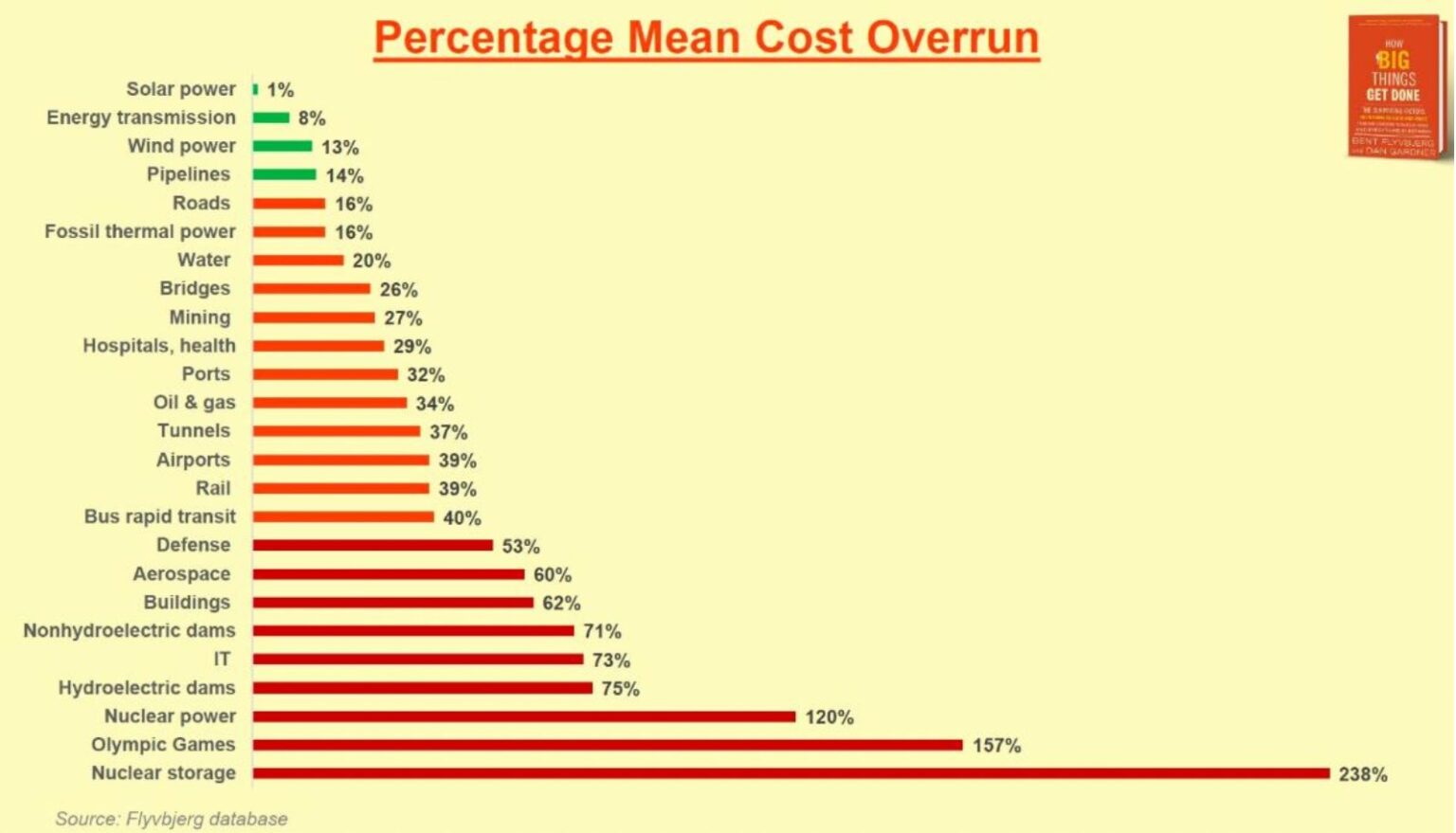
Bent Flyvberg – a professor in construction management at Oxford University and author of the bestselling book, How Big Things Get Done, has helpfully compiled a huge database of how major construction projects across the globe have performed against their original budgets.
This database reveals just how unreliable are the costings provided by the nuclear industry and its proponents. As the chart below published by Flyvberg reveals, the mean cost overrun of nuclear power projects stands at 120%, with only Olympic Games and Nuclear Waste Storage Facilities managing worse cost over-runs.
Meanwhile look at what types of projects perform well [graph at top of page]– notice anything?
For the journalists reading this article your task is simple – when the Coalition or Frontier Economics release their nuclear plan costing you need to ask them the following:
(1) Can you please provide us with a written assurance from the CEO of an experienced nuclear technology provider, like Westinghouse, EDF or Korea Hydro and Nuclear Power, confirming they are willing to enter into a fixed price contract to build a nuclear power plant in Australia for the cost and timeframe used in your costing?
If instead they cite to you the experience of the Barakah Plant in the United Arab Emirates let’s say, then you can always ask them:
So, like the United Arab Emirates, will you be:
– allowing the mass importation of construction labour from developing countries;
– removing the right of workers to collectively organise and bargain;
– exempting nuclear construction projects from paying Australian award wages; and
– banning the right to peacefully protest?
2) All transmission expansion costs are the fault of Labor and can be avoided with nuclear power
It should be acknowledged that transmission network expansion projects in this country are also being hit by large budget blow outs which involve multi-billion dollar costs. We need to do a far better and more judicious job in the roll out of transmission projects in this country.
It’s also true that several of these projects are critical to supporting ongoing expansion of wind and solar power. Ted O’Brien and David Littleproud have been highly critical of these new transmission projects and claimed extra transmission costs can be avoided by rolling out nuclear.
Given this, their forthcoming costing will probably suggest all of these new transmission costs can be sheeted home to Labor’s Renewable Energy Policies.
But this would also indicate that O’Brien and Littleproud suffer from amnesia. That’s because the major transmission expansions which are incurring the largest costs were actively pushed by the former Coalition Government which both of them served in.
Read more: A sneak preview of Peter Dutton’s nuclear costingsThe prior government “welcomed” and helped underwrite the new 900 kilometre transmission interconnector between SA and NSW.
In the lead up to the 2019 election, they vowed to build a second electricity interconnector between Tasmanian and the mainland.
In January 2020 the Federal Coalition entered into a funding deal with the NSW Government to upgrade transmission lines across north, central and southern NSW.
As part of the 2020 budget, Angus Taylor and a range of National Party MPs announced funding support for an 840km transmission line across inland Queensland which they declared was a “commitment to regional jobs, industry development and affordable reliable power.”
Then, leading into the 2022 election, they announced they would underwrite construction works on a major new transmission line between NSW and Victoria.
Then Energy Minister Angus Taylor’s press release at the time spoke glowingly about the benefits of new transmission, stating:
“Our investment in this project will support reliable electricity supply, deliver substantial cost savings and help keep the lights on for Australian families, businesses and industries.
This builds on the Morrison government’s record of judicious investment of over $800 million in priority transmission projects recommended by AEMO’s Integrated System Plan – projects that stack up for consumers.”
3) Relying on coal power plants that never grow old
It is almost guaranteed that the Coalition’s costing model will assume we can rely on the existing coal power stations to keep powering on for another decade or two with no deterioration in their reliability, before they then switch to nuclear power.
This is a very handy assumption to make because it allows you to avoid or delay significant costs involved in building the new, replacement power stations before the nuclear plants miraculously come to the rescue.
Yet while it might be a handy modelling assumption, it probably isn’t a realistic one.
To keep coal power plants reliable, especially when they are several decades old, requires ongoing significant expenditure on maintenance and replacement parts. Plus, even with this expenditure there can reach a point where a plant is so old it will continue to suffer serious reliability problems.
A good example of the risks and limitations of refurbishment is the case of the attempt to refurbish Western Australia’s Muja A and B coal generating units of 240 megawatts.
In 2007 these units, which were approaching 50 years of age, were mothballed. But by 2009 the WA Government announced they would be recommissioned due to a gas shortage that had afflicted the state. At the time the cost was estimated to be $100m.
The cost of refurbishment subsequently blew out to $290 million and in 2012 one of the units suffered an explosion due to corroded piping, injuring a worker.
A subsequent investigation highlighted a range of technical problems with the plant that made refurbishment challenging, but in 2013 the government chose to press on and sink a further $45 million into the project, claiming it would have a lifetime of 15 years and ultimately recover its costs.
However, even after refurbishment was completed it was reported by the West Australian newspaper the generating units were “plagued by operational and reliability problems, generating electricity just 20 per cent of the time. By 2018 the WA Government decided to cut their losses and shut Muja A and B permanently.
AGL’s Liddell Power Station is another case in point. AGL argued that a ten year life extension would cost $900m, and decided it wasn’t worth it. A government taskforce which sought to second guess AGL on the closure noted,
“a Liddell extension meets the maximum power output requirement.
This means it could provide sufficient capacity to maintain current levels of reliability in NSW as long as it is actually available during peak demand conditions. However, the increasing risk of outages as the plant ages gives rise to an increasing possibility those outages would lead to supply shortfalls.
Liddell already has a high outage rate compared with other NSW coal generators…. There is a risk that upgrades to make the plant compliant with safety and other regulation would not alter its upward trajectory of faults and unplanned outages.”
The other issue is that owners of power plants are likely to face considerable difficulty raising finance to undertake such refurbishment.
Delta Electricity, the owner of the Vales Point B coal power station, revealed in a rule change request to the AEMC that it was facing significant difficulty accessing bank finance stating, “A significant number of financial institutions…are no longer providing financing facilities to fossil fuel generators”.
The rule change request asked that Delta be able to provide cash, rather than a bank guarantee to AEMO to meet prudential requirements for trading purposes.
It explained that the bank providing its current guarantee was unwilling to continue with this arrangement because lending to a coal generator was in breach of environmental policies governing its financing practices.
In a search to find another lender Delta found, “during the refinancing process that 13 of the 15 lenders declined due to ESG [Environment, Social and Governance] constraints, which included the Big-4 Australian banks.
“Both of the remaining financial institutions were prepared to offer a bank guarantee facility to provide credit support related only to requirements for mining rehabilitation obligations and renewable Power Purchase Agreements.”
Some conservative politicians might like to pass this off as some short-term, woke fashion that will pass once they reach power. But it won’t pass, because bankers don’t like to lend money to risky commercial ventures.
Some conservative politicians might think global warming is an idea promoted by a mass conspiracy of meteorological science agencies across the globe to impose a socialist, world-wide government. However, most people think that’s a bit far-fetched.
Conservative politicians that think climate change is a hoax aren’t always in power, so bankers recognise there is a significant risk coal generators will be subject to emission control policies that will undermine their commercial viability.
This isn’t a distant risk, because such policies (which often are targeted towards supporting growth of renewable energy) have already been implemented.
4) The damage caused by power plant emissions in the years prior to 2050 don’t matter
Carbon dioxide and a range of other greenhouse gas emissions released by fossil fuel extraction and combustion last many decades once released into the atmosphere. Consequently, the extent of global warming is a function of the accumulated stock of greenhouse gas emissions in the atmosphere built up over time.
It isn’t a function solely of emissions in the single year of 2050. If we manage to achieve net zero emissions in 2050, but have polluted the hell out of the atmosphere in the preceding years then global warming will be very bad indeed.
A tonne of CO2 emitted this year and each of the years preceding 2050 will cause damage to society that is worth something to avoid. Any economist worthy of calling themselves an economist knows that the value of this avoided damage needs to be taken into account in any attempt to properly cost alternative options for our electricity system.
The Australian Energy Regulator provides one such option for valuing this in its paper – Valuing emissions reductions.
It should be noted the AER’s attaches significantly lower value to avoiding emissions than the United States Environmental Protection Agency recommends in the years prior to 2050, and very far below values used by the UK Government.
If the Liberal-National Party’s policy leads to slower emission reductions (even if they ultimately deliver net zero by 2050) this carries a serious penalty for our children and future children.
If it is ignored from their economic analysis, can we come to any other conclusion than the Liberal-National Party think climate change is so unimportant its impacts can be ignored?
Tristan Edis is director of analysis and advisory at Green Energy Markets. Green Energy Markets provides data and analysis on energy and carbon abatement certificate markets to assist clients make informed investment, trading and policy decisions.
Ontario’s huge nuclear debt and other things Dutton doesn’t understand about cost of electricity

Unfortunately for us, Dutton and O’Brien are also in a hurry. They think they can deliver nuclear power plants far faster than what many experts believe is sensible and what many countries with far more nuclear experience than ourselves have been able to achieve.
Dutton and O’Brien also want to do this via a government-owned utility, instead of via a competitive market.
ReNewEconomy, Tristan Edis, Oct 30, 2024
All of this has left taxpayers with a massive budget and timeframe blow-out. This is what happens when we leave it to politicians in a hurry to hand pick power projects.
It seems our alternative Prime Minister Peter Dutton’s favourite topic is your electricity bill. Given how much he talks about electricity prices, you’d think he might know a fair bit about what makes up your electricity bill, wouldn’t you?
According to Dutton and his Shadow Energy Minister Ted O’Brien, the problem is all about too much renewable energy in the mix. And their answer to the problem is nuclear power, as well as more gas.
According to Peter Dutton, “We can’t continue a situation that Labor has us on of a renewables only policy because, as we know, your power prices are just going to keep going up under this Prime Minister.”
Instead, according to Dutton, “we could be like Ontario, where they’ve got 60 or 70 per cent nuclear in the mix, and they’re paying about a quarter of the price for electricity that we are here in Australia.”
O’Brien, elaborated on this point by saying:
“We will have plenty of time in due course to talk about the costings [for their nuclear plan] once we release them here in the Australian context. But I point to Ontario in Canada, there you have up to 60 per cent of their energy mix in the grid, coming from zero emissions, nuclear energy. Their households pay around about 14 cents kilowatt hour. There are parts in Australia that will be paying up to 56 cents a kilowatt hour from July 1 this year.”
Once you actually delve into these numbers it becomes apparent that O’Brien and Dutton don’t seem know much about electricity costs and pricing.
But even worse, they don’t know how badly Ontario’s taxpayers and electricity consumers were burnt by their utility racking up huge debt building nuclear power plants equal to $70 billion in current day Australian dollars.
Do Dutton and O’Brien understand your electricity bill?
You can actually look up what Ontario households pay for electricity via the Ontario Energy Board’s bill calculator website.
This provides you with a break down on the charges a typical household faces depending on the utility you choose…………………………………………………
But notice there’s also other very significant items in this bill separate to the kilowatt-hour charge? There’s a “delivery” charge which is the cost of paying for the distribution and transmission poles and wires. There’s also regulatory charges and also their sales tax is known as “HST” rather than GST for us.
So the Ontario 14 cents per kilowatt-hour charge that O’Brien and Dutton are referring to covers only the wholesale energy portion of their bill.
In Australia, we pay a majority of the costs of distribution and transmission in our cents per kilowatt-hour charge, in addition to wholesale energy costs, and then we get GST added on top. O’Brien and Dutton don’t seem to have appreciated this important aspect of electricity pricing in this country, which is different to Ontario.
But it actually gets worse.
I went digging on the official government energy retailer comparison sites- www.energymadeeasy.gov.au and www.energycompare.vic.gov.au and I initially couldn’t find a single Australian retailer selling electricity at 56 cents per kilowatt-hour.
This was based on looking at offers based on a single rate tariff. Then I had a brainwave and looked at time-of-use rates. In Queensland and Victoria I still couldn’t find anyone wanting to charge me 56 cents for the peak period.
But eventually I succeeded. Right at the bottom of the EnergyMadeEasy list of retailer offers – which were ordered from best to worst – sat EnergyAustralia as the worst offer, charging 57 cents for the peak period in South Australia (although with a compensating high solar feed-in tariff of 8.5 cents)…………………………………
To help out O’Brien and Dutton, I’ve prepared the table below which provides a proper apples versus apples comparison (as opposed to apples vs peak rate bananas) –[on original ]
…………………………………………….. Ontario’s nuclear debt debacle
Yet this comparison between Ontario and Australia misses a far more important part of the story that O’Brien and Dutton seem to be blissfully ignorant of.
That is the history of the Ontario’s state owned utility – Ontario Hydro – and the unsustainable level of debt that it racked up over the 1980’s and 1990’s as a result of an ambitious nuclear plant construction program that went wrong.
While this cost is no longer apparent in current electricity prices, Ontario businesses and households were stuck with paying back CAD$38.1 billion in debt (over $70 billion in Australian current day dollars) for more than 35 years after their public utility committed its last nuclear reactor to construction in 1981.
So what went wrong?
In anticipation of large growth in electricity demand, over the 1970’s and 1980’s Ontario Hydro committed to construction 12 nuclear reactors with 9,000 MW of generating capacity. To fund the projects the public utility accessed commercial debt markets anticipating that it could comfortably repay this debt from the increased electricity demand it forecast. However, several things went wrong.
The nuclear power stations took far longer to build and were around twice as expensive to build than had been planned
– Interest rates on debt rose to very high levels by historical standards over the 1980’s in order to contain the high levels of inflation that unfolded over the 1970’s and early 1980’s. With the nuclear power stations taking longer than expected to build, interest was accumulating on this debt with far less output from the plants to offset it.
– Lastly, Ontario Hydro’s estimate of large growth in electricity demand didn’t eventuate. A 1977 forecast projected a system peak of 57,000 MW by 1997. Actual peak demand in 1997 was 22,000 MW. This meant that the very large cost and associated debt of the large nuclear expansion had to be recovered from a much smaller volume of electricity sales than it had anticipated, making it much harder to pay off the debt without substantial increases in electricity prices.
……………………………………………………………………………………………………………… “On April 1, 1999, the Ministry of Finance determined that Ontario Hydro’s total debt and other liabilities stood at $38.1 billion, which greatly exceeded the estimated $17.2-billion market value of the assets being transferred to the new entities. The resulting shortfall of $20.9 billion was determined to be “stranded debt,” representing the total debt and other liabilities of Ontario Hydro that could not be serviced in a competitive environment.”
So the CAD$38.1 billion in debt was transferred out of the electricity companies and into a special purpose government entity called the Ontario Electricity Financial Corporation (OEFC). This debt management corporation was given the following revenues to service the debt:
– Both residential and business consumers were required to pay a special “Debt Retirement Charge”. This charge was introduced in 2002 and lasted until 2016 for residential consumers and 2018 for business customers.
– The Ontario government would forgo any corporate income and other taxes owed by the offshoot electricity companies from Ontario Hydro so they could be diverted to the OEFC to pay down debt.
– If the cumulative profits of two of the new state power companies exceeded the $520m annual interest cost on their debts, then this would go towards paying stranded debt rather than dividends to the Ontario government.
None of this is apparent on current bills, but the burden of repaying the nuclear debt left the Ontario government and its taxpayers far poorer than Dutton and O’Brien seem to appreciate.
More things O’Brien doesn’t want to understand about Ontario’s nuclear power program
Dutton and O’Brien like to claim that nuclear power plants last a very long time and so therefore the large upfront cost of these plants isn’t something we should be too worried about………………………..
It’s not as simple as this. Nuclear power plants involve a range of components which are exposed to severe heat and mechanical stress. These all need to be replaced well before you get to 60 years, and such refurbishment comes at a cost.
Ontario’s experience is that refurbishment comes at a very significant cost. Less than 25 years after the Darlington Nuclear Power Plant construction was completed, it needed to commence refurbishment. The total cost? $12.8 billion in Canadian dollars or $14 billion Australian dollars.
This is partly why, even though the original nuclear construction cost debt had been largely paid down and nuclear operating costs are lower than coal or gas plant, Ontario still pays more for its electricity than we do.
This is because the current owner of the nuclear power plants – Ontario Power Generation – operates under regulated return model where the regulator grants them the right to recover these refurbishment costs from electricity consumers.
Are O’Brien and Dutton about to commit to another Snowy 2.0 budget blow-out, but on steroids?
………………………………The problem here is that when you don’t know very much and you’re spending other people’s money, ego can easily cloud your judgement. Don’t get me wrong, ego will often cloud business leaders’ judgement too. But their ability to spend money to feed their ego can only so far before either competitors or shareholders intervene.
Ontario taxpayers on the other hand realised far too late that their public utility, in cahoots with their politicians, were pursuing a nuclear vanity project built upon a poor understanding of the future, and without any competitor to discipline their ego.
Australian taxpayers have seen a similar mistake unfold with the Snowy 2.0 pumped hydro plant whose cost now stands at five times greater than the original expectation, and double what was meant to be a fixed price construction contract.
Snowy 2.0 is a parable of what goes wrong when:
– Politicians rush things leading to inadequate planning and preparation;
– Politicians fail to objectively and thoroughly evaluate alternatives; and
– Politicians fail to employ open and competitive markets to deliver end consumer outcomes.
All of this has left taxpayers with a massive budget and timeframe blow-out. This is what happens when we leave it to politicians in a hurry to hand pick power projects.
Unfortunately for us, Dutton and O’Brien are also in a hurry. They think they can deliver nuclear power plants far faster than what many experts believe is sensible and what many countries with far more nuclear experience than ourselves have been able to achieve. Dutton and O’Brien also want to do this via a government-owned utility, instead of via a competitive market.
While the budget blowout of Snowy 2.0 is bad enough, it pales into comparison with the kind of cost blow-outs that can unfold with nuclear power projects. As an example, the budget for completion of UK’s Hinkley Point C nuclear project now stands at $89.7 billion which is three times higher than what was originally budgeted.
We’ve all seen this movie before, including in Ontario, and it doesn’t end well……………………………………………………………………………………………………………….. more https://reneweconomy.com.au/ontarios-huge-nuclear-debt-and-other-things-dutton-doesnt-understand-about-cost-of-electricity/
Union slams “false hope” in nuclear push, warns energy jobs at risk

Marion Rae, Oct 23, 2024, https://reneweconomy.com.au/union-slams-false-hope-in-nuclear-push-warns-energy-jobs-at-risk/
Queensland’s sparkies have been warned of the “huge risk” to thousands of jobs in renewable energy posed by nuclear plans.
The Electrical Trades Union told electricians and apprentices in a mass mailout on Wednesday that nuclear energy was a “radioactive pipe dream” that could not replace coal-fired power stations.
National policy director Katie Hepworth says the “false hope” offered by the LNP on the premise that coal-powered stations can keep running is “letting down coal communities”.
“The ETU members, our maintenance workers, who work in these power stations know that they’re being held together by all the will in the world, but they know they can’t hold on forever,” Dr Hepworth told AAP.
“There is a huge risk that if what they’re being given is a fantasy of a nuclear power station without an entire industrial plan and a renewable plan, that they’re just going to be thrown on the scrap heap again.”
Apprentices are among those voting for the first time on Saturday when Queensland goes to the polls.
Dr Hepworth said the ETU was trying to give them a vision of the economy they were stepping into as the next generation of workers.
She said there was “huge excitement” among apprentices in the type of work they would be able to do, such as working on EVs, installing appliances and building clean energy generation.
“By calling into question that renewable transition, we’re really putting all of that at risk,” Dr Hepworth said.
The union’s Nuclear Energy Report for 2024 found nuclear reactors would be more expensive, could not be built before coal exits the electricity grid, and were “simply unnecessary” given abundant renewable energy sources.
The report authored by Dr Hepworth found nuclear power would be the most expensive form of energy for Australia, at 1.5 to three times the cost per kilowatt hour of coal-fired electricity and four to eight times of solar.
Small modular reactors, still unproven on a commercial scale, would be even more costly, the CSIRO has estimated.
The Smart Energy Council has calculated the federal opposition’s proposed fleet of seven nuclear reactors at up to $600 billion, for a mere four per cent of energy supply in the grid.
Nor can nuclear power be considered a clean source of energy because radioactive waste management was “costly, complex, contested and unresolved” in Australia and globally, Dr Hepworth said.
Even countries with existing nuclear capability are choosing renewables over nuclear, including China, because of the speed of deployment, and because the cost curve is low and continues to fall.
The federal opposition’s nationwide nuclear plan, includes two Queensland sites for nuclear generation – the Callide and Tarong coal-fired power stations.
“The Queensland LNP is committed to affordable, reliable and sustainable power,” an LNP spokeswoman told AAP.
“Keeping the lights on at Callide with our Electricity Maintenance Guarantee will ensure power bills are affordable, reliable and sustainable until alternatives are ready to power Queensland,” she said.
Union boss Peter Ong said massive changes to the energy system were already affecting workers and the union had been working hard to move them into well-paid, secure jobs.
“Peter Dutton’s nuclear fantasy will throw ETU members’ jobs in the gutter,” he said.
Electrical Trades Union questions Australia’s billion-dollar nuclear price tag
09 October, 2024, BY Aaliyah Rogan, https://mining.com.au/etu-questions-australias-billion-dollar-nuclear-price-tag/?fbclid=IwY2xjawF1SuRleHRuA2FlbQIxMQABHZuZOLhjX1n0h3g6EQL1ux1wMtrzMt09-VLVDSaM8enMFX4RZ8Fu8yOx0w_aem_1ulz0sgMMWof53yKtuqOUQ
The Electrical Trades Union (ETU) is pushing back against the Coalition’s proposal to build nuclear reactors in a new advertising campaign that queries the project’s price tag, and flags concerns it will destroy valuable job opportunities.
In mid-June 2024, Opposition leader Peter Dutton revealed the opposition’s plans to build several nuclear power plants that will begin rolling out in 2035 if the party wins the upcoming election.
Dutton’s plan involves reactors being built on the sites of end-of-life coal-fired power stations at locations including Gippsland in Victoria, Gladstone in Queensland, Port Augusta in South Australia, Collie in Western Australia, and the Hunter Valley in New South Wales.
Following Dutton’s proposal, the Smart Energy Council conducted a detailedanalysisusing CSIRO’s latest GenCost report and the Australian Energy Market Operator’s integrated system plan, which revealed the nuclear reactors will cost between $116 billion and $600 billion.
ETU National Secretary Michael Wright says the ad was prompted by electrical workers’ concerns that an abrupt shift towards nuclear energy will “rob the industry of a jobs and skills boom”.
“Renewables and batteries in Australia are producing so much low-cost energy we are on track to hit climate targets,” Wright says.
“This will create nearly 100,000 more jobs for electricians by 2050 — so many that we need to rewire our training system to skill up enough people.
“We are very concerned that a rapid change in direction to high-cost nuclear with decades-long timelines would derail this momentum and rob the next generation of electrical workers of renewable transition opportunities.”
Wright adds that people have the right to ask questions about Dutton’s nuclear plans, about the costs, the length of time, and why Australia needs nuclear energy when batteries and low-cost renewables are gathering momentum in a short period of time.
“People should get to form their views with the same information that electrical workers, energy investors, and businesses in the industry have access to,” he says.
“These insiders have reached a consensus view that nuclear is not right for Australia.
“People are questioning the financial cost of nuclear for relatively little output that won’t come online until the middle of the century. We think most people would prefer to see renewables and batteries bring down power bills and hit climate targets much sooner than that.”
ETU’s video advertisement will be launching initially for catch-up viewers across key areas of Queensland exposed to plans for nuclear energy, before being launched in other areas ahead of the 2025 federal election.
The ad will air on 7plus, 9Now, 10Play, SBS ON Demand, FoxtelGo, Kayo, Tubi, and Binge, as well as Youtube and Meta properties.
The Electrical Trades Union is an Australian trade union that is a division of the Communications, Electrical, and Plumbing Union. It is considered the largest of the three divisions.
What nuclear power in the United States tells us about the Coalition’s controversial energy policy

“If nuclear power were a person, it would be weeping with its head in its hands over the Vogtle story. Vogtle is clear proof that large nuclear construction is not an economic way to go.”
ABC News, By Eric Campbell, 7 Oct 24
“…………………………………It’s been touted as the start of a new era for the US’s flagging nuclear power industry. Vogtle’s newest reactors are among the first built in the US in decades.
“Thank you for your service to our nation in providing this arsenal of clean power,” Energy Department Secretary Jennifer Granholm said at the May opening ceremony for Vogtle’s latest reactor.
“Now let’s draw up some battle plans for new reactors. I don’t know about you but I for one am reporting for duty!” she said, saluting.
Peter Dutton is ready to enlist Australia. If he wins next year’s election, he plans to build seven nuclear power stations at retiring coal-fired plants.

Mr Dutton has flagged the AP1000 reactor used at Vogtle could be one of the models used to power homes and businesses in Australia.
“We don’t want to be the purchaser of the first in class or have an Australian-made technology, we want to rely on the Westinghouse AP1000,” he said in June. Beyond this, he’s given little detail about how exactly the plan would work.
Four Corners travelled around the US to examine the Coalition claims that developing nuclear power plants was the best way to replace coal power.
It has cited the US, which remains the world’s largest producer of nuclear energy, as one of the places to see the benefits it could bring Australia. Before launching the policy, Coalition MPs accompanied two groups of engineers and environmentalists around the US and to Ontario in Canada to see the potential first-hand.
In our experience, the reality was more complex.
Cost blowout
The Coalition’s pitch for nuclear is that it’s reliable, clean and cheap. And Vogtle certainly ticks two of those boxes. The plant almost never stops running and it produces no [greenhouse] emissions. But here’s the problem. It was expensive to build.
The giant AP1000 reactors designed by Westinghouse opened seven years late at more than twice the budgeted cost. The final bill of around $US35 billion ($50 billion) makes them among the most expensive nuclear generators ever built.
Now, Georgia residents are paying the price for Vogtle’s overruns in their electricity bills.
Community organiser Kimberley Scott said people have been struggling to keep up.
“Power bills have gone up hundreds of dollars for consumers including myself,” she said.
Georgia ratepayer Anna Hamer said she now has had to ration air conditioning in the Atlanta summer as her bills rise. In July she was hit with her highest power bill ever: $US618 for one month.
“They were telling us everything was going to be OK with this plant, that it would be on time and it would be on budget. It’s over budget and we are paying for that. That seems wrong to me.”
It’s very different to what the Coalition has been suggesting in media interviews and energy speeches since it launched its nuclear policy over three months ago.
At the nuclear policy launch in June, Mr Dutton said: “Electricity is cheaper where there is a presence of nuclear energy. That is a fact. So we can rely on that international experience.”
The Coalition often cites the Canadian province of Ontario as a model, saying its three nuclear plants contribute to much lower power bills than Australia. The plants are owned and subsidised by the provincial government…………….
Peter Bradford, a former member of the US Nuclear Regulatory Commission, which licences commercial reactors, told Four Corners building nuclear plants was always the most expensive option.
“It’s an unbroken string of economic disappointment,” he said.
“If nuclear power were a person, it would be weeping with its head in its hands over the Vogtle story. Vogtle is clear proof that large nuclear construction is not an economic way to go.”
………………………….Ted O’Brien said the Coalition’s policy has been shaped by the lessons learned by other countries.
“If you look at the Vogtle example, one of the lessons we need to learn in Australia is we should not be adopting first of a kind technology. We should only be adopting what’s referred to as next-of a kind proven technology.”
He said a Coalition government would spend two-and-a-half years studying the sites and consulting communities before an independent authority chooses the most appropriate reactor design.
The SMR conundrum
The other type of reactor the Coalition wants in its nuclear power arsenal has been promoted as a game changer for the industry…………………………
The Coalition wants SMRs operating in Australia from 2035. There’s just one problem.
They don’t exist yet, at least not commercially.
Billions of dollars are being spent to make them a reality. But so far, all attempts are years from completion or have already failed.
The only project that won approval from the US Nuclear Regulatory Commission was abandoned last November because of rising costs, even after the US Department of Energy pledged more than $US500 million in grants.
Four Corners went to the latest place where there’s a concerted attempt to break this conundrum. It’s a sleepy coal town in south-west Wyoming called Kemmerer, with a population of nearly 3,000.
……Enter Bill Gates. In June the billionaire climate change activist came to town and turned a sod on his project to construct a working SMR, declaring: “This is a big step towards safe, abundant, zero carbon energy.”
He’s putting $US1 billion of his own money into trying to make it a success, with the federal government pledging another $US2 billion.
…………………………………………….. Fortunately for the project, the town administration welcomes the prospect of anything that might bring work.
“Essentially, the town was going to lose a couple of hundred jobs or more,” Mayor Bill Thek said.
“We’re hoping that the people that work for the power plant, the current coal burning power plant will be able to transition, or at least some of them, into the nuclear plant.”
For now, all that’s being constructed are the bits around the reactor, while the project waits for approval from the Nuclear Regulatory Commission (NRC). Project spokesman Jeff Navin said they still hoped to finish construction by 2030………..
SMRs face a challenge. They’re small, producing far less power. Any power they produce would therefore be more expensive, unless the modules can be mass produced to make them cheaper to construct to offset the generation cost.
But nobody is going to mass produce anything until there is a working model that promises to produce power economically that attracts lots of eager customers. Which takes you back to square one.
Peter Bradford has seen promised breakthroughs like SMRs come and go.
“In this industry, vendor claims about cheaper nuclear costs have a long, well-documented and very sad history — they just don’t come true.
“There is no basis for believing that this utterly unproven technology is going to sweep in and make a success of a field that up to now has been an unmitigated economic failure.”
Even in the Gates-backed project’s most optimistic scenario, it’s unlikely SMRs would be mass produced to bring down costs before Australia plans to install them.
When asked about this, Ted O’Brien did not appear fazed…………..
Getting it done
The uncertainty around SMRs, and the cost blowout in Georgia, point to the practical difficulties Australia would face in trying to build reactors cheaper than countries with decades of experience, when we’ve never built a nuclear energy plant before.
The US is not the only nuclear country struggling to build new plants.
- France’s latest reactor opened 12 years behind schedule and around 10 billion euros over budget.
- Britain’s Hinkley Point plant is running six years late and facing a 20 billion British pound overrun.
- A South Korean consortium was able to build four reactors in the United Arab Emirates over 12 years. Even under an authoritarian regime, each reactor was connected to the grid around three years later than expected.
US journalist and nuclear historian Stephanie Cooke has been covering the industry since 1980.
“I have never seen a project come in on time or budget. They’ve come in way, way over budget and way over time. It amazes me that there’s so much hype about something that’s been such an abject failure in my opinion.
“I mean, yeah, it’s produced electricity, but at what cost? I don’t think that we should be wasting our money on it plain and simple.”
……………………………………………. The finer points of how the Coalition plans to overcome the challenges it will confront are still unclear.
It’s yet to reveal how much its plan will cost or how it will overturn federal state bans on nuclear energy.
It says SMR plants could be operating by 2035, or 2037 if it starts with larger reactors. But the timing beyond that is unclear…………………. more https://www.abc.net.au/news/2024-10-07/nuclear-power-us-coalition-energy-policy-australia-four-corners/104432870
Big Super is still investing in nuclear weapons: report

| Quit Nukes / The Australia Institute, 1 October 24 https://theaimn.com/big-super-is-still-investing-in-nuclear-weapons-report/ |
A new report has found that despite claiming not to invest in ‘controversial weapons’ 13 of the top 14 Australian super funds are still investing in nuclear weapons companies, in some cases even in an option described as ‘responsible’.
One of the 14, Hostplus, has excluded nuclear weapons companies across its portfolio since December 2021.
At least $3.4 billion of Australian retirement savings are invested by these funds in companies involved in making nuclear weapons, according to the new research conducted by Quit Nukes in collaboration with The Australia Institute.
The report analyses financial returns and finds that the exclusion of nuclear weapon companies from portfolios has an immaterial impact on returns.
Rosemary Kelly, Director, Quit Nukes:
“It’s frankly unconscionable to sell super fund members a responsible investment option and then use their money to invest in nuclear proliferation.
“The thing that makes this baffling is that investing in nuclear weapon companies is just completely unnecessary in the broader scheme of things..
“Superannuation funds should divest immediately from weapons manufacturers who produce nuclear weapons. If you’re a member of 13 of these 14 leading funds you can request that your fund divest or threaten to take your savings elsewhere.
“Super funds are being sneaky by boasting of policies to exclude “controversial weapons” but not counting nuclear weapons as “controversial.” That’s pretty hard to swallow when you consider that most ESG advisers now consider nuclear weapons as controversial weapons, given the UN Treaty on the Prohibition of Nuclear Weapons that came into force in 2021.
Alice Grundy, Research Manager, The Australia Institute
“The most frustrating thing about the lack of process in this area is that excluding nuclear weapon companies from super portfolios is so easy. Divesting has an immaterial impact on investment returns.
“Your super fund could divest your money from nuclear weapon companies without materially impacting your returns.
“So long as nuclear weapons exist, nuclear war is an ever-present risk. Its impacts would be catastrophic. Even a limited nuclear war, involving say 250 of the over 12,000 nuclear weapons in the world, would kill 120 million people outright and cause nuclear famine, putting 2 billion lives at risk. There would be massive impacts on global supply chains and manufacturing.
“The long-term financial implications should be factored into decisions about where to invest Australian super.”
The full report Media contacts: Anil Lambert 0416 426 722
AustralianSuper ESG option invested in nuclear weapons: report.

Hannah Wootton, 1 Oct 24 https://www.afr.com/wealth/superannuation/australiansuper-esg-option-invested-in-nuclear-weapons-report-20240926-p5kdpp .
Australia’s 14 biggest superannuation funds are investing about $3.4 billion of workers’ retirement savings in nuclear weapons despite many promising to avoid controversial arms, new research shows.
Industry fund gorilla AustralianSuper alone had $1.5 billion in nuclear weapons companies, while UniSuper, Aware Super and HESTA invested more than $200 million each.
Hostplus was the only major fund on the Australian market to exclude nuclear weapons, according to the study by Quit Nukes and the Australia Institute.
It comes as members ramp up engagement with super funds over concerns about unethical or environmental investments and regulators crack down on companies making false promises to consumers about their social good.
It also follows Treasurer Jim Chalmers saying there was an opportunity for super funds to “think more strategically” about how institutional capital flows into the defence industry as part of his push last year to tap $3.9 trillion for nation building investments, which funds and experts pushed back on.
Looking at funds’ default MySuper options, which account for the bulk of their members and funds under management, the report found Aware Super was the most exposed to nuclear weapons.
About 0.91 per cent of its total funds in the option were in nuclear weapons, outstripping AustralianSuper with 0.7 per cent and UniSuper and HESTA with just under 0.5 per cent.
Nuclear weapons ‘excluded’
Quit Nukes director and report co-author Rosemary Kelly said if funds wanted to keep pace with international law, global investment norms and members’ expectations and make the best risk-adjusted financial decisions, they would exclude atomic weapons.
“Super funds are being sneaky by boasting of policies to exclude ‘controversial weapons’ but not counting nuclear weapons as ‘controversial’,” she said.
“That’s pretty hard to swallow when you consider that the United Nations now considers nuclear weapons as controversial weapons.”
The report was based on portfolio holdings at December 31, 2023, and termed nuclear weapons companies as those which have a meaningful stake in the manufacture, maintenance, detonation or development of nuclear warheads and missiles or components exclusively used in them.
AustralianSuper and Spirit Super’s ESG options invested in them to the tune of $20.1 million and $400,000 respectively, despite targeting ethical investors and promising to exclude controversial (but not nuclear) weapons.
“That was a big surprise and it’s unacceptable. People read the headlines of funds’ websites and don’t have the tools to drill down into what’s actually happening – so if a fund says it excludes controversial weapons, a normal punter would think that includes nuclear,” Dr Kelly said.
Only Hostplus excluded nuclear weapons from its MySuper offering, while nine more funds ruled out controversial weapons but not atomic ones. AustralianSuper, Brighter Super, UniSuper and Care Super did not exclude any arms.
Financial sting
Dr Kelly, who is a former Aware Super director and headed its investment committee, said super funds needed to take the long-term economic implications of nuclear war seriously given their legal obligation to always act in the best financial interests of members.
“Any nuclear war, started intentionally or by accident, will be disastrous for global financial markets. This is clearly not in anyone’s best financial interest,” she said.
Even a “limited nuclear war”, which some conflict strategists view as a tactical alternative to full nuclear war should deterrence ever be deemed necessary, involving just 250 of the 12,000-plus atomic weapons in the world would kill 120 million people outright.
It would then risk a further 2 billion lives through a nuclear famine and have significant consequences for global supply chains and manufacturing.
Modelling included in the report showed there was no meaningful change in super fund returns when nuclear weapon companies were excluded from portfolios compared to when they were included.
An Aware Super spokeswoman said the fund’s investments in nuclear were only in companies where the weapons component was “a very small part of their overall business”, and its controversial weapons policy more broadly was under review.
A HESTA spokesman said only a small portion, 0.15 per cent, of the fund’s total assets were in nuclear weapons and that Quit Nukes’ data was outdated.
But the report acknowledged the fund had reduced its holdings since the data collection and sold out of four of the five companies it had previously held in breach of its own commitment to exclude companies earning more than 5 per cent of revenue from nuclear weapons.
An AustralianSuper spokesman said the fund’s members had “diverse values, preferences and attitudes when it comes to investing”, with any exclusions and screens communicated to them on its website.
Spirit Super planned to review its ESG and nuclear weapons positions after its current merger with Care Super completed.
Peter Dutton’s nuclear plan still has no costings, and no grid connection: It’s a political hoax

ReNewEconomy, Giles Parkinson, Sep 23, 2024
Outside, in Martin Place, the voices were clear – unions and environmental groups holding placards and denouncing Coalition leader Peter Dutton’s nuclear “fantasy:” A combination of denial and delay they said: “Dutton wants gas, Dutton wants coal, nuclear is just a troll,” they chorused.
Inside the Fullerton Hotel, in the basement where Ballroom B is located, it was expected to be the moment for the nuclear true believers, but the numbers just weren’t there.
Unusually for a CEDA event, there was only a scattering of corporate table sponsors – ANZ, KPMG, and Clayton Utz – and most of the ballroom was partitioned off. Among the 160 attending, quite small for a CEDA event, there was the usual Dutton entourage, including energy spokesman Ted O’Brien, Warren Mundine, and a lot of media.
Bizarrely, many of the rest were from the clean energy industry, curious to know what they might be dealing with should the Coalition return to power next year. Did they like what they heard? Not really. Did they learn anything? No.
This was supposed to be Dutton’s occasion to spell out his nuclear power plan: “A nuclear powered Australia – could it work” was the title of the event. But we left little the wiser. The question about how many nuclear power plants, how much would they cost, when they would be built, and which technology, were not answered.
Instead, the event got a re-run of the Coalition’s renewable scare campaign. Dutton’s thesis is that wind and solar won’t work, even with storage and dispatchable back-up. Renewables, says Dutton, are dangerous and will lead to blackouts and the destruction of industry.
We’ve heard this before. It’s the common refrain of the fossil fuel and nuclear industries. They’ve gone from attacking the climate science to ignoring it, and have focused their attacks on the technology solutions. The ones that threaten their legacy and vested interests.
The Coalition uses “baseload” as if it’s another word for “reliability”. It’s not, as AEMO boss Daniel Westerman explains in this week’s Energy Insiders podcast.
Dutton did at least concede that building nuclear power stations at the seven sites identified by the Coalition will cost a lot, even if he wouldn’t say how much, or how consumers are impacted. Somehow, he imagines, the cost will be amortised by their assumed 80 year timeline. Perhaps he hasn’t seen their maintenance and refurbishment bills.………………………….
We did learn a couple of new things. One was that Dutton admitted that Aukus – the controversial deal to sign up for half a dozen nuclear submarines at horrific cost and questionable use – was as much a Trojan horse for the nuclear debate as it is an allegory for his power plans…………………
There was indeed, an awful lot of fudging. Dutton pretends that his nuclear power plan can be rolled out without new transmission lines. But he’s kidding himself, and trying to fool the public.
Firstly, the seven sites he has targeted are already filling up with their owner’s own projects – mostly battery storage and renewables. There simply isn’t room on the grid…………….
There was indeed, an awful lot of fudging. Dutton pretends that his nuclear power plan can be rolled out without new transmission lines. But he’s kidding himself, and trying to fool the public.
Firstly, the seven sites he has targeted are already filling up with their owner’s own projects – mostly battery storage and renewables. There simply isn’t room on the grid.
Secondly, the sort of nuclear reactors Dutton is planning are nearly twice the size of most coal generators – which means – as a matter of course – that there has to be more infrastructure built to support them, in transmission lines, and back-up capacity in case of a trip or unexplained outage. That is grid management 101.
Thirdly, Dutton hasn’t explained what fills the gap as coal fired power plants exit the grid. Either he has to double, table, or even quadruple his nuclear power plans – at great cost and huge new transmission requirements, or he has to rely on renewables after all, and they will also require new transmission.
Fourthly, his complaints against new transmission is largely a furphy. AEMO’s Integrated System Plan – which is little changed for when it was produced for the Coalition government – doesn’t contemplate the 28,000 kms of new transmission as Dutton claims…………
Dutton did confirm that the Coalition’s plan was to extend the life of coal fired power stations as much as it could, and build a lot of new gas generators. Quite how he believes these investment will lower the price of power to consumers was not and has never been explained.
Like nuclear, they are the most expensive sources of power. He suggested they will all be government owned, which is inevitable as private finance won’t touch it, and Snowy Hydro is quite accustomed to projects that run well over time and budget. And that way, the true cost will already be hidden from homes and businesses……………………………….
He also confirmed he doesn’t understand batteries. They can’t store energy for more than four hours he said, which is news to the project developers of more than 3,000 megawatt hours of eight-hour batteries. Has he heard of demand management? Dutton refuses to see or admit the solutions that are right in front of him.
Meanwhile, the general public is being led a merry dance by folksy promises, a solution that sounds vaguely plausible, but in reality has no chance of delivering.
The protestors with the placards outside the hotel were closest to the truth: This is about denial and delay, the whole policy is an elaborate troll, a political hoax, and a refuge for the climate deniers and do-littles. Nothing more, nothing less. https://reneweconomy.com.au/peter-duttons-nuclear-plan-still-has-no-costings-and-no-grid-connection-its-a-political-hoax/—
Affordable nuclear? Dutton’s plan would add nearly $1,000 a year to the power bill of a family of four

Sophie Vorrath, Sep 20, 2024, https://reneweconomy.com.au/affordable-nuclear-duttons-plan-would-add-nearly-1000-a-year-to-the-power-bill-of-a-family-of-four/—
A family of four in living on the east coast of Australia would pay nearly $1000 more a year for electricity under the federal Coalition’s nuclear power plan, a new report has found, while the average Australian household would see bills rise by $665 a year.
In a major new report, the Institute for Energy Economics and Financial Analysis, IEEFA, has undertaken to calculate the cost to consumers of Peter Dutton’s plan to build seven nuclear power plants across Australia, including both large-scale reactors and small modular reactors (SMRs).
This has already been done, to a fashion, by Australia’s main scientific body, the CSIRO, whose GenCost report in May of this year found large-scale nuclear to be at least double the cost of integrated renewables, and impossible to deliver before 2040.
IEEFA has taken a different tack, seeking to measure the cost of nuclear to “mums and dads,” by calculating the electricity bill impact of a range of scenarios, based on the actual costs of six recent projects in countries comparable to Australia.
For large-scale reactors the first four scenarios are based on actual, recent nuclear power plant construction costs and timeframes for countries in liberal democracies where costs are transparent, IEEFA says.
This includes the real-life projects – Finland’s Olkiluoto Unit 3, France’s Flamanville Unit 3, the US’s Vogtle Units 3 and 4 and the UK’s Hinkley Point C.
For SMRs – where, as IEEFA notes, “no plants have been successfully completed in a democratic country” – costs are based on the one example of a binding contract offer to build such a plant in the US, the now-cancelled NuScale project.
It also used this approach to assess the costs to build South Korean APR technology (a design that the Coalition has cited for potential implementation in Australia) in a democratic country with laws protecting labour rights: the Czech Republic’s Dukovany proposed plant.
“In the international examples examined, the capital cost of nuclear power plants was very high – up to $90 billion,” says Johanna Bowyer, report coauthor and lead analyst for Australian electricity at IEEFA.
“Recent international large-scale nuclear projects have experienced construction challenges, delays and cost-blowouts. Capital costs, excluding financing costs, of recent nuclear power station builds we analysed had blown out by a factor of 1.7 to 3.4 times.”
When extrapolated to the Australian market, results vary – the more than 50-page report provides precise details on the differences in bill increases depending upon which nuclear power project cost experience you consider, which state (South Australia, Victoria, New South Wales or south-east Queensland) and the size of the household.
But the bottom line is that, in every scenario, bills increase by hundreds of dollars and in some cases by more than $1000.
At the bottom end, the bill increase for households consuming a median amount of electricity was as low as $260 a year based on the anticipated cost of a new nuclear plant in the Czech Republic – although given that is a pre-construction project IEEFA says it is highly likely to have underestimate final costs.
The lowest impact from a nuclear plant successfully completed (Vogtle) is $383-$461 per year for an average household. Meanwhile, the UK experience with the still under construction Hinkley Point C indicates electricity bill rises of up to $1,259 are possible.
Across all nuclear scenarios and regions, the report finds that for a four-person household the bill impact would average out at $972/year, and for a five-person household – like Peter Dutton’s – that figure would rise to an eye-watering $1,182/year.
Ultimately, it’s a finding that rather answers the question posed by next week’s CEDA luncheon discussion: “A nuclear powered Australia – could it work?”
“For nuclear power plants to be commercially viable without government subsidies and generating 24/7 – as the Coalition proposes – electricity prices would need to rise to these higher levels to allow the nuclear power plants to recover their costs,” says Bowyer.
“This would result in a large increase in wholesale market prices which would then flow through to household bills,” Bowyer says. “In a cost-of-living crisis, bill increases like this are a big deal.”
But what about those countries that use nuclear and have lower retail electricity prices than Australia? Aren’t they proof positive that nuclear power is affordable?
Nice try, but no, says IEEFA. “In almost all cases around the world, the cost of nuclear power plant construction and financing is not fully reflected in market prices for power,” the report says.
“This is because either nuclear power plants are very old and their costs are largely depreciated, or governments have acted to recover the costs either through taxpayers, or via levies which are independent of electricity markets – for example in France, the UK and Ontario, Canada.
“The Coalition has outlined something different, ruling out taxpayer subsidies and stating that any government investments in nuclear plants would receive a commercial return.”
Tristan Edis – a director at energy advisory firm Green Energy Markets and a contributor to the IEEFA report – says the mistaken perception that nuclear is a cost-effective technology is often based on the fact that it is in use across the globe.
But he says most of the plants built in the western world were committed based on projected costs and timeframes that turned out to be “horrible underestimates” that have cost governments dearly.
“They almost make Snowy 2.0 look good by comparison,” Edis says, referring to the federal government-owned 2.2GW pumped hydro project whose original price tag of $2 billion has ballooned to a massive $12 billion and is running seven years behind schedule.
“The end result has often been bankruptcy and taxpayer-funded bail-outs for many of the firms involved,” Edis adds, citing the examples of Ontario’s publicly owned utility, for Westinghouse with its AP1000 design, and for France’s AREVA and EDF.
“These cost blow-outs are sometimes not apparent in the electricity prices seen in other countries, but that’s just because it is the taxpayer picking up the tab instead,” he says.
In the case of Australia, the Coalition has repeatedly ruled out taxpayer subsidies for its nuclear plans, and repeatedly claimed that any government investments in nuclear plants would receive a commercial return.
Take shadow treasurer Angus Taylor’s comments to the National Press Club in May:
“The key for me as someone who really believes that we should make sure that we have affordable, reliable power, and I don’t want to commit subsidies that aren’t necessary, is to make sure that it’s [nuclear power] commercially viable, and we think it can be. … If it’s commercially viable, it’s not going to be
subsidies. It’s as simple as that.”
As the report notes, this line of logic implies that the Coalition expects wholesale electricity market prices will be sufficient for nuclear power plants in each state to recover their construction costs plus a commercial level of return.
Further, these nuclear power plants would be “always on,” which means power prices would need to average out at the level a nuclear plant needs to be commercially viable – to recover their costs – almost all of the time.
And the only way this can be achieved without substantial, taxpayer-funded government subsidies is for household power bills to rise significantly, says Bowyer.
“Our analysis indicates that the Coalition’s plan is unlikely to represent a realistic cost-effective energy solution for Australia,” she says.
“Any plan to introduce nuclear energy in Australia … should be examined thoroughly, with particular focus on the potential impact on electricity system costs and household bills, and with detailed analysis of alternative technologies such as renewables and firming.”
1 This month

of the week – Australians for War Powers Reform (AWPR)
To see nuclear-related stories in greater depth and intensity
 Antinuclear