Profits for EnergyAustralia, AGL, and Origin Energy if RET is cut
 Renewable Energy Target cut would hit budget: modelling, The Conversation, 18 Aug 14 Michelle Grattan Professorial Fellow at University of Canberra “……..The current arrangement (including the large-scale RET plus existing hydro and small-scale solar PV panels) would lead to about 28% of national electricity coming from renewables by 2020-21. The modelling looked at capping it at 20% (the “reduced” scenario) as well as abolishing the RET altogether.
Reduction of the large-scale RET as proposed by some power companies would bring $8 billion extra profit to coal and $2 billion to gas generators (net present value of future profits 2015-30).
Under current ownership arrangements, EnergyAustralia is the company that would stand to gain the most. Its potential extra profit would be about $1.9 billion if the RET were reduced (and $2.2 billion if it was abolished).
But “if AGL purchases Macquarie Generation, it would become by far the biggest beneficiary of reducing the RET”, with combined extra profits of $2.7 billion if the RET were reduced.
“Origin Energy’s total extra profit would be about $1.5 billion. Origin owns the power station that would emit the largest amount of additional pollution under a reduced RET.” ……..http://theconversation.com/renewable-energy-target-cut-would-hit-budget-modelling-30598
Australia’s Future Fund and Banks invest in nuclear weapons
 The Don’t Bank on the Bomb report in 2012 revealed that most Australian banks have provided loans to nuclear weapons companies at some stage since 2008. Disappointingly, none have shown a willingness to divest, but they draw the line at financing projects specifically for nuclear weapons work.
Australia: The Future Fund goes Ballistic, Tim Wright, http://www.dontbankonthebomb.com/2014/07/30/australia-the-future-fund-goes- ballistic/ Opinion polls show that Australians overwhelmingly oppose nuclear weapons. So when we learned in 2011 that our major federal government investment fund – the so-called Future Fund – has substantial investments in nuclear weapons companies, there was widespread public uproar.
Melbourne’s leading daily newspaper, The Age, ran a front-page story with the headline: “Australia investing in nuclear arms.” The following day, readers reacted angrily on the letters pages, and a cartoon depicted businessmen being hurled through the air by an exploding nuclear bomb. “The Future Fund goes ballistic,” read the caption.
We uncovered this controversial information using freedom-of-information laws, which allow any member of the public to gain access to documents held by Australian government agencies. There was no charge for this service.
When the news broke, the Future Fund stated that it had no plans to divest from companies involved in nuclear weapons production, even though it had earlier divested from cluster munitions and landmines. It claimed that countries such as the United States, Britain and France possess nuclear weapons legitimately.
Not satisfied with this response, we encouraged friendly senators to quiz the Future Fund leadership about their position in the parliament. This helped keep the issue on the political agenda. The minister overseeing the fund, Senator Penny Wong, was forced to defend the position.
We then commissioned legal advice from a team of top barristers, who found that the Future Fund had failed to comply with its own stated investment policies. Continue reading
Silex dumped solar for nuclear: now nuclear has dumped Silex
 Silex tumbles after solar-nuclear switch hits market roadblock, REneweconomy By Giles Parkinson on 28 July 2014 Silex Systems decided in June to dump its solar business to focus on nuclear. But now the nuclear industry has dumped Silex.
 Less than one month after Australia’s Silex Systems placed its solar technology assets up for sale to focus on uranium enrichments, it has been dealt a massive blow by the suspension of its nuclear ambitions.
In late June, Silex sought to arrest its slumping share price and preserve its cash reserves by deciding to seek buyers and co-investors in its Solar Systems and Transluscent businesses.
CEO Michael Goldsworthy said at the time he wanted to focus on its laser uranium enrichment process, confident that its partnership with GE and Hitachi (GLE) could mean that the world’s first commercial laser enrichment plant could be in operation later this decade.
But those dreams are now on hold – indefinitely – after GLE said it would cease funding laser development projects at Lucas Heights in Sydney and put the main project facility near Oak Ridge in Tennessee in “cold storage”. Most contractor-based work on the project will be suspended, with the project facility near Oak Ridge, Tennessee to be placed in a safe storage mode, and GLE-funded activities at the laser development facility at Lucas Heights, Sydney to cease.
Silex appears to to have been shocked by the announcement, saying it was “unexpected” and GLE had already invested “hundreds of millions of dollars” in the project.
The share slump cames just days after “stock pickers” in Fairfax and News Ltd business pages rated Silex as the “best speculative stock” on the ASX. A day after a Fairfax collumnist called Silex “one of the best intelligent speculations on the ASX, the stock plunged rom 94c to a low of 49c. The stock has fallen from a 2009 high of $7.97 a share, and a year ago it was trading at more than $3.
Those brazen calls – and the optimism of its mostly retail shareholders – were based on the optimistic belief that the nuclear industry is about to rebound. But this is mostly based on hope – and an arrogant distrust of renewables – than any actual evidence.
GE CEO Jeff Immelt, who made the call to bring the research to a halt despite investing hundreds of millions, has said privately that nuclear is “too difficult” . (GE was one of the biggest suppliers of nuclear technology in the world.”
Goldsworthy says it is clear that the global nuclear industry is “still suffering the impacts of the Fukushima event” and the shutdown of the entire Japanese nuclear power plant fleet in 2011.
Demand for uranium has been slower to recover than expected and enrichment services are in significant oversupply, and the market could take “several years” to rebalance………..http://reneweconomy.com.au/2014/silex-tumbles-after-solar-nuclear-switch-hits-market-roadblock-51041
Queensland uranium plan fails the nuclear test
1 Aug 14 State government plans released today and promoting a fast tracked uranium industry in Queensland have been described by ACF as fanciful and irresponsible.
“The LNP’s promotion of uranium mining has the logic of a problem gambler,” said ACF nuclear free campaigner Dave Sweeney. “It is a bad policy based on a broken promise and is driven by enthusiasm rather than evidence”.
Ahead of the 2012 state election Campbell Newman declared it was ‘very, very clear that we have no plans to develop any sort of uranium mines in Queensland’. After the election and without any independent assessment or public consultation the LNP back-flipped on uranium and today Mines Minister Cripps is championing the sector.
His industry promotion is deeply flawed, including in relation to:
(i) Economic benefits – these have never independently tested by LNP and the Australian uranium industry has been  seriously hurt and constrained by market fallout from Fukushima with the uranium price hovering around nine-year lows amid weak demand.
The Ministers spruiking of uranium as an economic bonanza has been released as Australia’s longest operating uranium mine – Energy Resources of Australia’s Ranger mine in Kakadu – announced a further half year operating loss of $127 million.
“Queenslanders would do well to look at the facts before signing on to the fiction. This is an absurd time to be giving a green light to yellowcake,” said Mr Sweeney.
(ii) Royalty payments: the Minister’s talk of “royalties to fund school and health services, roads and public infrastructure” fails to acknowledge that the Queensland Resources Council is currently involved in closed door talks with the LNP seeking to negotiate reduced or suspended royalties for any future state uranium mine.
(iii) Uranium transport: Minister Cripps dismissal of community concerns over the possible future movement of uranium through a Queensland port lacks credibility. The LNP government has not ruled out any such movements, the Port of Townsville has formally expressed interest in facilitating such movements, the federal government and uranium industry lobbyists are pushing for a new export site on the east coast and the proposed Ben Lomond deposit is just up the road.
In today’s media when asked whether it was possible for a Queensland port to be granted permission to be used as an export point, Mr Cripps would not rule it out: “Well if an application comes forward to assess a port for the export of uranium oxide, I mean, we’ll take it and we’ll assess it.”
“The Queensland community and environment deserve better than backflips, backroom deals and backward thinking,” said Mr Sweeney.
“If Minister Cripps thinks this industry adds up he should have no problem with an independent public Inquiry into the cost and consequences of the LNP’s plan for uranium mining. This industry is contested and contaminating and demands scrutiny and rigour, not wishful thinking and lame assurances,” said Mr Sweeney.
Further context or comment: Dave Sweeney 0408 317 812
Energy Resources of Australia (ERA) reports a loss – AGAIN!
 ERA posts $127m loss in tough conditions, Trading Room, PERTH, July 31 AAP Energy Resources of Australia (ERA) has reported a first half net loss as the uranium price hovers around nine year lows amid weak demand.
The uranium miner reported a $127 million loss in the six months to June 30 after posting a $53.5 million loss a year earlier.
The company did not produce any uranium oxide during the period…………..ERA said in the short term, the uranium oxide market remained challenging for producers.
“All Japanese reactors remain offline three years after the Fukushima accident and the market continues to be oversupplied,” the company said in its half year results.
“The spot price for uranium oxide has now fallen below $US30 per pound, the lowest level since 2005.”
ERA only restarted the Ranger uranium mine in the Northern Territory last month after a toxic leak forced it to close in December.
The company said production in the first half was adversely impacted by the suspension of processing operations…….ERA is no longer mining new ore at its open pit and is exploring underground to see whether there is enough uranium to justify a new mine at the site, which is surrounded by the Kakadu National Park……..ERA shares fell 0.5 cents, or 1.5 per cent, to $1.34 on Thursday. http://www.tradingroom.com.au/apps/view_breaking_news_article.ac?page=/data/news_research/published/2014/7/212/catf_140731_165300_4700.html
How the Australian media WRONGLY hyped up Silex Uranium Enrichment Technology

| GLE suspends Silex laser treatment of uranium as market bites, Optics.org Matthew Peach |
| 29 Jul 2014 |
| Focus switches to reduced US program after Japanese shutdown narrows market; Silex hopes for resumption when conditions pick up. Silex Systems, an Australian high-tech company developing energy and materials technologies, has announced that the Licensee for Silex’s Uranium Enrichment Technology,GE-Hitachi Global Laser Enrichment, is reducing its funding and commercialisation program of the laser treatment technology in response to “current adverse market conditions” – with the result that related operations in Australia are stopping. GLE will consolidate its efforts on the technology development activities to its Wilmington facility in North Carolina, USA. The Silex annoncement said, “most contractor-based work on the project will be suspended, with the project facility near Oak Ridge, Tennessee to be placed in a safe storage mode, and GLE-funded activities at the laser development facility at Lucas Heights, Sydney, to cease.”……… Dr Michael Goldsworthy, Silex CEO and Managing Director, said, “the global nuclear industry is still suffering the impacts of the Fukushima event and the shutdown of the entire Japanese nuclear power plant fleet in 2011. Demand for uranium has been slower to recover than expected and enrichment services are in significant oversupply.”…….. Media speculationJust two days before the GLE announcement, Australian daily newspaper the Sydney Morning Herald suggested that “With a share price down 65 per cent in the past year, [Silex] is one of the best intelligent speculations on the ASX (Australian Stock Exchange)”, adding, “The enrichment market is expected to be worth US$10 billion by 2019.”http://optics.org/news/5/7/48 |
BHP expansion of Olympic Damn uranium mine just isn’t happening
Olympic expansion years away, says BHP THE AUSTRALIAN JULY 29, 2014 by Matt Chambers and Barry Fitzgerald BHP Billiton is unlikely to approve a long awaited expansion of the Olympic Dam copper and uranium mine in South Australia’s outback this decade, with the miner revealing it will take four years to trial a processing method it hopes will help make the project profitable.
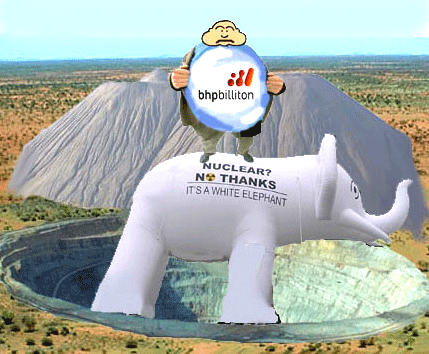 In documents filed with the federal Environment Department yesterday, BHP kicked off the approvals process for a trial plant to test heap-leaching of copper and uranium ores as a lower-cost alternative to the previous expansion plan. If all goes to plan, the earliest a demonstration plant would start construction is July next year, with a three-year operation period targeted to start in October 2016. “While the application is for a trial, a successful trial will not necessarily lead to a full-scale heap-leach project,” BHP said. “Further, the extent and nature of any potential full-scale project is not known at this stage.”
- The application is only to study processing the ore, with no mention of how BHP would access the deep orebody…………
Under previous government-approved plans, BHP had been planning a staged increase in annual production to a world-class 750,000 tonnes of copper and 19,000 tonnes of uranium, the latter being problematic given the collapse in prices and demand for the nuclear material in the wake of the 2011 Fukushima disaster. The big-bang approach to expansion was abandoned by BHP in August 2012 in line with the new era of capital austerity that swept the industry in response to weaker commodity prices. It involved the development of a super pit which would have taken more than five years to complete, with the Olympic Dam orebody sitting under 400m of overburden. The lack of cash flow during the time it would take to develop the open-cut mine spooked both BHP and the market, where agitation for greater shareholder returns over more big expansions has been become the new mantra. South Australia had been banking on the original $30bn plan to underpin an economic surge for the struggling state. Mr Mackenzie undertook in September to update the state on the way forward for Olympic Dam inside of a year. The investigation of the heap-leach option has been an open secret, with laboratory test work at Wingfield in suburban Adelaide under way since the expansion was canned….. In order to test the processing method at a larger and more integrated scale, BHP has lodged an application for assessment by the federal and South Australian governments to build and operate a demonstration plant on the existing mining lease at Olympic Dam. “Should approval be granted, and subject to BHP approvals, construction of the demonstration plant is expected to commence in the second half of (calendar) 2015, with a projected trial period of 36 months which is expected to commence in late 2016,’’ the company said. The heap-leach trial is only part of the thought process BHP has to go through to determine the best, and lowest-cost, way to maximise returns from Olympic Dam, one of the world’s biggest deposits of copper and uranium. The initial plan was supported by a mine-life capability from the underlying resource base of more than 40 years. BHP has yet to elaborate on what the move towards a heap-leach operation would mean for the end products produced at Olympic Dam. http://www.theaustralian.com.au/business/olympic-expansion-years-away-says-bhp/story-e6frg8zx-1227004910155
Doubts on whether ERA’s Ranger 3 uranium mine can go ahead
Technical hitches bedevil ERA’s Ranger mine by: Matt Chambers The Australian July 12, 2014 http://www.theaustralian.com.au/business/mining-energy/technical-hitches-bedevil-eras-ranger-mine/story-e6frg9df-1226986174550 URANIUM producer Energy Resources of Australia could face more problems at its Ranger uranium mine in Kakadu National Park, flagging potential higher costs that Credit Suisse says could stop a planned underground expansion.

The Darwin-based Rio Tinto subsidiary said its Ranger 3 Deeps exploration decline project was experiencing tougher than expected geotechnical conditions. “Some geotechnical conditions have been encountered that are less favourable than assumed,” ERA said in its June quarter report, released on Thursday.
“These findings are being factored in to the mine design and the pre-feasibility study.”
While the market was little moved by the report on Thursday, Credit Suisse analyst Matthew Hope saw red flags.“We believe the results of the Deeps resource drilling are poor,” Mr Hope said yesterday in a note to clients.“The rock is probably heavily fractured, so extensive rock bolting and meshing will likely be required to prevent the access drives from collapsing,” Mr Hope said.
Credit Suisse downgraded its rating on ERA from outperform to underperform, and cut its target price by two-thirds from $1.50 to just 50c.
Mr Hope said value in ERA was almost entirely based on whether Ranger 3 Deeps would be mined. “If ERA announces at the end of this year that Ranger Deeps is not viable, then the share price should collapse to very low levels, with only option value remaining,” he said.
“Ranger Deeps either adds value or there is close to none, and risks are increasing towards the latter.”Ranger shares slipped 0.5c to $1.16 yesterday, giving the company a market value of $600m.
Costly problems, legal battles, face owners of Four Mile uranium mine
 Four Mile mine opens amid tensions between owners, World Nuclear News, 26 June 2014 The Four Mile uranium mine in South Australia was officially opened on 25 June, but its minority owner wants to sell its stake and is preparing a legal battle against the project operator…….EdwardSterck, a senior mining analyst at London-based BMO Capital Markets, said he did not think there was “any huge significance” in the opening of Four Mile. “It appears that they are using the existing Beverley plant which suggests that production from Four Mile is replacing production at Beverley,” Sterck told World Nuclear News.
Quasar Director Dave Roberts said there is remaining ore at the Beverley mine that “can and will be” extracted at a future point in time. “But today, we are dedicating the full processing capacity of Beverley to the production of Four Mile uranium,” Roberts said during TV coverage of the opening ceremony.
ACE’s parent company Melborne-based Alliance Resources announced last week it had appointed Deloitte Corporate Finance to lead the sale of its 25% stake in the project. Alliance said the sale would “free up funds” for the company to develop its exploration portfolio.
In the meantime, the court case is looming for ACE’s 2010 filing against Quasar Resources – on the basis of “misleading and deceptive conduct” – having been set for 30 June.
ACE has said it is “seeking restitution for the 75% interest in the exploration licence for Four Mile, citing, among other issues, Quasar’s failure to disclose information relating to the prospectivity of part of the tenement.” ACE also contends that Quasar, “with the assistance or participation of” its affiliate Heathgate Resources, breached its obligations under the joint venture agreement……..
ACE said in January it had elected to vote against Quasar’s revised start-up plan for the Four Mile project, which would see uranium capture at Heathgate’s Pannikan plant, and precipitation, drying and packing at Heathgate’s Beverley processing plant. ACE said the parties should instead construct a stand-alone plant at Four Mile in order to reduce operating costs. Heathgate Resources, which like Quasar is based in Adelaide, is the owner and operator of the Beverley uranium mine in the Northern Flinders Ranges.
First discovered in 2005, the Four Mile uranium deposit is 550 km north east of Adelaide in the Frome Basin. State and federal regulators approved the mining lease for the project in April 2012 and more than AUD 120 million ($113 million) has been invested so far, the government said. The mine’s owners expect to produce up to 1.6 million pounds from the mine this year, it said. http://www.world-nuclear-news.org/ENF-South-Australias-Four-Mile-uranium-mine-opens-amid-tensions-between-its-owners-26061401.html
Japan’s plans to restart nuclear reactors – not likely to save Paladin
Japan to restart nuclear reactors: Will it save Paladin Energy Ltd? http://www.fool.com.au/2014/06/23/japan-to-restart-nuclear-reactors-will-it-save-paladin-energy-ltd/ By Mike King – June 23, 2014 Plans to restart at least two of Japan’s 48 nuclear reactors could have positive implications for the price of uranium and deliver a boost to ASX-listed uranium miners, including Paladin Energy Ltd (ASX: PDN).
According to The Diplomat, Japan’s Nuclear Regulation Authority (NRA) is about to begin safety inspections on at least one power plant. Japan’s nine nuclear power companies all have plans to restart their nuclear reactors.
But with 58% of Japanese people opposing any restart, and 59% opposing the use of nuclear energy to kickstart economic growth, the government and the energy providers will have their work cut out for them. The issue for Japan is that meeting peak summer energy demand without the nuclear power plants is going to be tough.
Uranium prices have crashed since the Fukushima incident in 2011, losing a further 30% in the last year to hit US$28.15 a pound. That’s well below the cost of production for most uranium miners. And in the short to medium term the outlook is not good, with RBC Capital Markets Analysts forecasting a price of US$31.50/lb this year and US$40 for 2015. But RBC has slashed its forecasts for 2016 to 2018 to between US$40 to US$45/lb, amid expectations that the uranium market will be in surplus until 2021.
Paladin’s cost of production in the last quarter at its Langer Heinrich mine stood at US$29/lb – and that’s not the all-in sustaining cost. The company was forced to place its other main mine Kayelekera mine on care & maintenance, with its production cost running at US$32.90/lb in the last quarter.
So it appears that the tough times will continue for Paladin and other ASX-listed uranium miners, including Energy Resources of Australia Limited (ASX: ERA) – which is majority-owned by Rio Tinto Limited (ASX: RIO). Investors may want to skip the uranium producers for now.
Energy Resources of Australia – uranium company expecting an even huger loss this time
Energy Resources of Australia expects loss http://www.marketwatch.com/story/energy-resources-of-australia-expects-loss-2014-06-05-14855444?link=MW_latest_news By Ross Kelly SYDNEY–Uranium producer Energy Resources of Australia Ltd. expects a first-half loss of up to 140 million Australian dollars (US$130 million) after a radioactive leak halted activities at its Ranger operation in the Northern Territory.

The company, which is 68% owned by Rio Tinto PLC, said it expects to restart operations at Ranger progressively beginning Thursday after cleanup and regulator approval.
The leak of about 1 million liters of contaminated slurry, which occurred in December, was caused by toxic material eating through a steel tank involved in the process of refining ore. Investigations by authorities found the leak was contained within the mine site.
The company had already stopped mining uranium at the Ranger operation in late 2012 after its ore was depleted. But it continued to process stockpiled ore while it studied the feasibility of digging a new underground pit there called Ranger 3 Deeps.
The company expects a loss of A$120 million and A$140 million for the six months through December, in large part due to costs associated with the suspension of ore processing. That compares to a A$53.4 million loss in the year-earlier period.
Energy Resources of Australia has run up a string of losses in recent years, dogged by low uranium prices, disappointing output volumes and costs associated with the rehabilitation of the old mine site.
The collapse of uranium company Paladin’s share price
Why the Paladin Energy Share Price Fell Today What Happened to the Paladin Energy Share Price? Shares of Paladin Energy [ASX:PDN] fell by 3.95% on Wednesday, closing at 36.5 cents. This was the lowest closing price in nearly 10 years of trading! , Money Morning 5 June 14 Why Did This Happen to the Paladin Energy Share Price?
Paladin Energy Limited is a uranium production and exploration company with projects currently in Australia, Canada, and Africa. The Langer Heinrich mine in Namibia is its flagship project.
Since the Fukushima uranium plant meltdown in 2011, the uranium industry has never been the same. Following this event, the Japanese government turned off all of its 54 uranium power plants.
The uranium spot price is now trading at around US$28.25 per pound, a level not seen since April 2005. Certain estimates now place up to 60% of current annual global production with costs above the current spot price, which is unsustainable.
For years, Paladin experienced financing, production, and profitability issues. And last week it officially temporarily closed its Kayelekera mine in Malawi.
For this plant to restart operations, Paladin wants to see a uranium price between US$70–75 dollars per pound, which implies that the breakeven price for Kayelekera is significantly above the current spot price. Overall the share price is declining because of a poor uranium environment. Last week, Japan announced that it won’t restart any reactors during 2014 — something that uranium punters were betting on.
Uranium company gives up – switching to property development

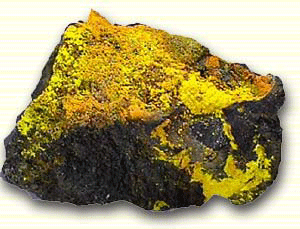 United Uranium Limited moving from resources exploration to property development United Uranium Limited moving from resources exploration to property development http://www.proactiveinvestors.com.au/companies/news/55373/united-uranium-limited-moving-from-resources-exploration-to-property-development-55373.html June 02, 2014 United Uranium Limited moving from resources exploration to property development
United Uranium Limited (ASX:UUL) is exploring opportunities that will most likely result in a shift away from resources exploration to property development in a bid to increase shareholder value.
This follows completion of a strategic review that identified the unwillingness of the investment community to invest in junior resources companies, particularly those focused on uranium.
It added the early stage status of its projects required significant funding to explore, with no guarantee of commercial success.
These add to the continued depressed uranium prices, and commodities prices in general.
In contrast, it noted that investors were willing to invest in property developments with the sector currently experiencing strong housing demand.
Permanent gloom for the uranium industry – the crisis is terminal?
We are heading for a uranium crisis , Investor Intel, June 2, 2014 by Robin Bromby“……Welcome to the “perma-gloom” with spot uranium now at $28.25/lb. But it really does portend a very troubling situation. We could be on the brink of a real uranium crisis, one that could have serious ramifications down the road. This is because, on top of all the doubts about nuclear post-Fukushima and the slowness of Japan to get reactors back on line, uranium is caught up in the general malaise affecting the mining industry ……….the uranium price has fallen by 30% over the past year. If it keeps falling, and it well might, more and more companies will either go into hibernation mode or quit the sector all together ……..
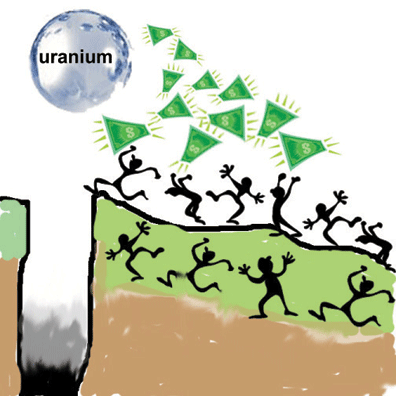
A surer sign that all is not well can be evidenced from an ominous trend — exploration companies quitting the sector. Others are making cuts: Cameco closed its Cheyenne office, while BHP Billiton has deferred its expansion at the world’s biggest uranium deposit, Olympic Dam in South Australia. Australia’s Paladin Energy (ASX:PDN) has put one of its mines, Kayelekera in Malawi, on care and maintenance.
Back in 2007-8, after spot uranium hit $137/lb, this was the place to be. Suddenly every mining explorer was keen to be in the uranium hunt. At one stage, more than 260 companies listed on the Australian Securities claimed to have uranium projects (many of them in what the Canadian miners call “moose pasture”).
Now, it seems, those small number remaining can’t wait to get out. FYI Resources (ASX:FYI), which got into uranium after quitting the eye care business (it’s previous name was Freedom Eye) in 2009, is now concentrating on potash in Thailand. Uranex (ASX:UNX) is staying in Tanzania, but has put its uranium on the back-burner in order to pursue graphite.
But possibly the most startling change was reported today. Junior United Uranium (ASX:UUL) which has six projects in Western Australia [and A$3.41 million in the bank as at March 31] is getting out of uranium and into — wait for it — property development.You can’t exactly blame the directors. The shares are trading at a discount to the company assets (the market capitalisation being just A$2 million), all its projects are early-stage ones that will require considerable sums to explore and may not turn out to be viable, no one is investing in the sector, the uranium price is depressed as is the resource sector generally.
Just two weeks ago another uranium explorer working in Western Australia, Prime Minerals (ASX:PIM), signalled it was changing direction. It is merging with Cocoon Data Holdings which has data security software. The news lifted Prime’s stock from A0.9c to A2.2c.
Back in 2007, announcing you were getting into uranium could see your stock price double. Now announcing you’re switching focus away from uranium does the trick. This is not a good trend. http://investorintel.com/rare-earth-intel/may-heading-uranium-crisis/#sthash.l5sn96vF.dpuf–
Investors flee as uranium price collapses even further
A uranium price collapse has made mining companies radioactive to investors, Quartz By Jason Karaian May 28, 2014 Here’s the latest sign that uranium-mining doesn’t pay: Paladin Energy, an Australian uranium mining group, announced today that it was ceasing production(pdf) at a key mine in Malawi. The move will take 3.3 million pounds of uranium per year off the market.
Paladin is far from alone. As uranium prices have tumbled, others have been feeling the pinch. Indeed, for some 60% of global uranium production, the cost of extraction is higher than the market price for the commodity, the firm says.
Uranium prices have been hit by a series of setbacks in recent years, from a global financial crisis that put a big dent in nuclear power demand, to a glut ofdecommissioned weapons-grade uranium, to the Fukushima nuclear disaster in Japan, which led to the shutdown of all that nation’s nuclear power plants and inspired nuclear phase-outs in places such as Germany and Switzerland.Investors in uranium mines have seen their assets plunge in value:……http://qz.com/213889/a-uranium-price-collapse-has-made-mining-companies-radioactive-to-investors/
1 This month
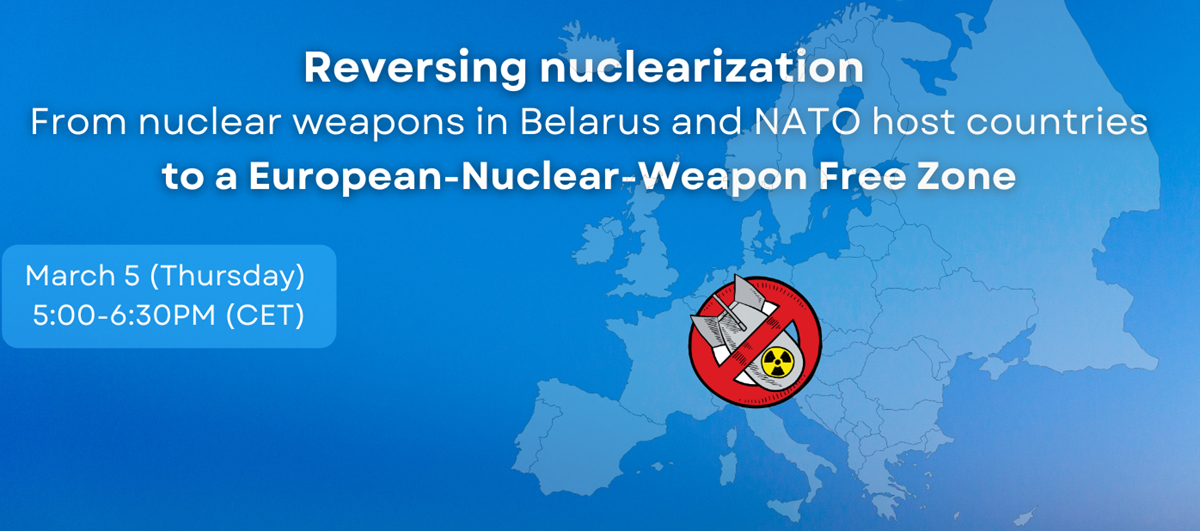
6 March -Online – Reversing nuclearization:
From nuclear weapons in Belarus and NATO host countries to a European-Nuclear-Weapon Free Zone
Mar 6, 2026 03:00 AM in Canberra, Melbourne, Sydney

of the week – Australians for War Powers Reform (AWPR)
To see nuclear-related stories in greater depth and intensity
 Antinuclear