Investors flee as uranium price collapses even further
 A uranium price collapse has made mining companies radioactive to investors, Quartz By Jason Karaian May 28, 2014 Here’s the latest sign that uranium-mining doesn’t pay: Paladin Energy, an Australian uranium mining group, announced today that it was ceasing production(pdf) at a key mine in Malawi. The move will take 3.3 million pounds of uranium per year off the market.
Paladin is far from alone. As uranium prices have tumbled, others have been feeling the pinch. Indeed, for some 60% of global uranium production, the cost of extraction is higher than the market price for the commodity, the firm says.
Uranium prices have been hit by a series of setbacks in recent years, from a global financial crisis that put a big dent in nuclear power demand, to a glut ofdecommissioned weapons-grade uranium, to the Fukushima nuclear disaster in Japan, which led to the shutdown of all that nation’s nuclear power plants and inspired nuclear phase-outs in places such as Germany and Switzerland.Investors in uranium mines have seen their assets plunge in value:……http://qz.com/213889/a-uranium-price-collapse-has-made-mining-companies-radioactive-to-investors/
Can things get any worse for Australia’s uranium industry?
Specious comparisons between Australian uranium and Saudi oil have also been made by former South Australia premier Mike Rann, pseudo-academics Ian Plimer and Haydon Manning, Access Economics, and Comrade Paul Howes from the Australian Workers Union.
But Australia’s uranium export revenue in 2011 was 466 times lower than Saudi oil revenue in the same year − Australia would need to supply entire global uranium demand 31 times over to match Saudi oil revenue. The uranium industry accounts for 0.015 per cent of jobs in Australia, and in the 10 years from 2002-11 it accounted for just 0.29 per cent of national export revenue (with most of that revenue never coming anywhere near Australia because of the high level of foreign ownership).
The uranium industry hoped that the post-Fukushima spot price would rebound after it fell to $US50/pound … but then it fell to $US40 … and now it has fallen below $US30.
The uranium spot price fell to $US29/pound U3O8 on May 5 and has not budged since. Not since mid-2005 has the price been so low. The price is less than one-half of the pre-Fukushima price, and less than one-quarter of the price at the peak of the 2007 bubble.Uranium Investing News notes that “the phrase ‘uranium renaissance’ has been uttered so often that it has begun to feel like a bad joke”.
What’s going on?
The uranium lobby has been arguing that plans to begin restarting reactors in Japan later this year (all of Japan’s 48 reactors are currently shut-down in the wake of the Fukushima disaster) will lead to higher uranium prices. But as As FNArena notes, progress towards reactor restarts in Japan “has been glacial and anti-nuclear protest has been powerful”.
Japan’s uranium inventories probably amount to around 100 million pounds (45,400 tonnes) according to David Sadowski, a Raymond James analyst.
Sadowski added that many utilities around the world “are sitting on near-record piles” of uranium. It could take a decade or more before Japanese utilities exhaust existing inventories.
China is buying uranium − but is now sitting on stockpiles sufficient to meet current annual consumption eight times over. The uranium lobby hoped that the December 2013 end of a US-Russian agreement to downblend weapons uranium for use in power reactors would stimulate a price increase. But the spot price has fallen 17 per cent this year alone.
French state-controlled nuclear group Areva’s first-quarter revenue from its uranium mining unitfell 63 per cent. The mining arm of Russia’s state-controlled utility Rosatom has frozen uranium expansion projects in Russia and elsewhere (hence the Honeymoon mine in South Australia has been put into care-and-maintenance). Canadian giant Cameco has abandonedits earlier uranium production growth targets (and scaled back uranium exploration and development work in Australia). In 2012 BHP Billiton cancelled its planned expansion of Olympic Dam in South Australia and disbanded its uranium division. Wannabe uranium miner Marathon Resources gave up on the uranium game last year, stating that the “risks were more likely to exceed rewards”. Energy Resources of Australia is struggling with the political and economic fallout of a December 2013 leach tank collapse at the Ranger mine in the Northern Territory resulting in the spillage of 1.4 million tonnes of radioactive slurry; the collapse of a ventilation shaft a few weeks ago; and the revelations of a whistleblower published in the Mining Australiamagazine on May 5.
Australian-based Paladin Energy operated two mines in Africa but production at one of those mines has been suspended and the company is at risk of going bankrupt. As Paladin Energy chief executive John Borshoff said last July, “the uranium industry is definitely in crisis”.
A nuclear insider’s view
Just about everyone in and around the uranium industry consoles themselves with the thought that uranium prices will have to rebound sooner or later to stimulate new production, which will be required even if global nuclear power capacity continues to stagnate. A contrary view comes from Steve Kidd, an independent consultant and economist with 17 years of work at the World Nuclear Association and its predecessor, the Uranium Institute.
Writing in the Nuclear Engineering International Magazine on May 6, Kidd states that “the case made by the uranium bulls is in reality full of holes” and he predicts “a long period of relatively low prices, in which uranium producers will find it hard to make a living”……http://www.businessspectator.com.au/article/2014/5/29/energy-markets/uranium-%E2%88%92-how-low-can-it-go
Terminally ill? Paladin closes its uranium mine in Malawi
 Paladin to shut its uranium mine, Australian Mining, 27 May, 2014 Cole Latimer Paladin has announced it will cease production at its Kayelekera uranium mine in Malawi.
It comes after the miner advised it would place the operation in to care and maintenance earlier this year.
According to Paladin it is ceasing production “due to reasons beyond the company’s control and related to the depressed uranium prices”.
On May 21 it halted all operations at the mine, and will now cease supplying uranium to the global market, causing a drop of around 3.3 million pounds of supply per annum.
“The outcome is an unfortunate but direct consequence of the continuing deterioration in the uranium price,” the company said in a statement. “Certain estimates now place up to 60% of current annual global production with costs above the current spot price, which is unsustainable.”…..http://www.miningaustralia.com.au/news/paladin-to-shut-its-uranium-mine
No future in sight for Yeelirrie or Kintyre uranium mines, nor for Olympic dam expansion
Uranium fall dents Olympic outlook BARRY FITZGERALD THE AUSTRALIAN MAY 27, 2014 BHP Billiton’s recasting of its expansion plans for its Olympic Dam copper/uranium mine in South Australia’s outback have been served up a new challenge — the collapse in uranium prices.
Spot uranium has fallen 30 per cent in the past 12 months to $US28.15 a pound, plunging most of the world’s uranium-only mines into losses. More telling has been the steady decline from the record price of $US137 a pound in mid-2007, due in part to the fall in demand in the wake of Japan’s Fukushima nuclear disaster in 2011.
BHP dropped plans for a big-bang expansion of Olympic Dam in mid-2012, blaming the $30 billion cancellation on the over-heated resources sector and the country’s high-cost environment. Concerns about uranium’s outlook post-Fukushima was also a factor……….
When it shelved the big-bang expansion plan, BHP said it would investigate a less capital-intensive design, and one that drew on new mining and processing technologies to improve the economics of the project.
BHP chief executive Andrew Mackenzie also undertook in September to say more about plans for the expansion “within about a year’’. While that timing is almost up, BHP’s considerations of what the price slump means for the future of what is the world’s biggest uranium deposit makes its planning for an expansion all the more complex.
Like the rest of the industry, BHP will be pinning its hopes on the restart of nuclear power plants in Japan, and the forecast surge in China’s nuclear power industry, to eventually produce more sustainable prices — in the context of being able to make a profit from the material at any rate……..
“uranium prices continue to suffer downward pressure and we do not see any reason to expect improvement soon.’’ -Tim Gitzel, the chief executive of Canadian uranium giant Cameco, which owns two of the world’s biggest undeveloped uranium deposits in Western Australia — Yeelirrie and Kintyre.
That means that neither Yeelirrie, acquired from BHP, and Kintyre, acquired from Rio Tinto, are about to be developed anytime soon…..
Glut of uranium, prices plummet, Australian company Paladin’s share price drops 4.6%
Uranium Slides as Banks Reduce Outlook Amid Japan Delays, Bloomberg, 18 May 14 By Ben Sharples Delays in restarting Japan’s nuclear reactors are prolonging a uranium supply glut that’s driven prices to an eight-year low, making banks from UBS AG to Credit Suisse Group AG less bullish on the fuel.
Uranium dropped to $29 a pound on May 2, the lowest since June 2005 and extending this year’s drop to 16 percent, according to TradeTech, a Denver, Colorado-based consultant to the nuclear industry. UBS reduced its 2014 forecast by 9 percent last month as Credit Suisse cut its projection by 7 percent.
Kansai Electric Power Co. (9503) and other utilities are taking longer than expected to restart reactors that closed after the Fukushima disaster in March 2011 as Japan’s nuclear regulator seeks more safety checks. While producers from Australia to Africa shut mines as prices retreated to unprofitable levels, Raymond James Ltd. is among those who say supply will still outstrip demand this year.
“There is too much supply floating around the marketplace and demand is highly limited,” said David Sadowski, a Vancouver-based analyst at Raymond James, a financial adviser, who cut his 2014 forecast by 14 percent to $36 a month ago. “Japanese restarts are the key catalyst to get utilities to resume long-term contracting, which should support prices.”
Uranium for immediate delivery averaged $33.93 this year, compared with $38.47 in 2013 and $46.27 in 2010, the year before the earthquake and meltdown of the Fukushima Dai-Ichi plant and subsequent closure of Japan’s reactors for safety checks. Uranium closed at $28.40 yesterday on the New York Mercantile Exchange………
Forecasts Cut
UBS reduced its 2014 forecast for uranium on April 9 to $39, while Credit Suisse cut its estimate to $38.80, according to an April 1 note. The exit of traders such as Goldman Sachs Group Inc. from the market is also reducing transactions, according to Roswell, Georgia-based Ux Consulting Co.
Deutsche Bank AG is cutting back parts of its commodities business including uranium, Nick Bone, a London-based spokesman, said by e-mail May 7. Michael DuVally, a spokesman for Goldman Sachs in New York, declined to comment in an e-mail on the sale of its unit trading the fuel………
Prices are below the marginal cost of production of $35 estimated by UBS. Paladin Energy Ltd. said in February it will halt its Kayelekera operation in Malawi while Russia’s Atomredmetzoloto last year shuttered Honeymoon in Australia. Kazakhstan, the world’s biggest producer, said in November it will halt all projects to increase output after the decline.
Paladin, which gets all of its revenue from selling uranium, fell as much as 4.6 percent today in Sydney trading………http://www.bloomberg.com/news/2014-05-15/uranium-slides-as-banks-reduce-outlook-amid-japan-delays.html
Australian uranium mining company arousing concern in Greenland
 The prospect of a relatively unknown Australian company exploiting massive untapped resources in Greenland deserves a robust public and political debate. It has thus far received nothing in Australia, and little in Denmark and Greenland. In an age of worsening climate change, mining uranium is an arguably unsafe and potentially explosive answer to the problem.
Australian uranium mining in Greenland is tearing the country in half http://www.theguardian.com/commentisfree/2014/may/15/australian-uranium-mining-in-greenland-is-tearing-the-country-in-half After Greenland’s prime minister repealed a law on uranium mining, Australian firms are staking out the country for exploitation. Local political opposition is heating up
Antony Loewenstein This is a story about an Australian company you’ve never heard of, operating in a nation that rarely enters the global media: Greenland. It’s a story about the intense search for energy sources in a world that’smoving away from the dirtiest fossil fuels.
>Aleqa Hammond, the prime minister of Greenland, is the first woman to lead this autonomous country within the Kingdom of Denmark. She also welcomes the financial opportunities from climate change and a melting Arctic Circle.
“I simply refuse to be the victimised people of climate change”, she toldBusiness Week this month. “This time we have other options than just hunting. We have the right now to our own underground.”
In October last year, Hammond pushed legislation through Greenland’s parliament to overturn a 25 year old ban on the extraction of radioactive materials, including uranium, despite countless leading environmental NGOs urging otherwise. It attracted global interest from the rare earth and uranium industries, including from China. Concerns were also raised about Greenland’s ability to manage a toxic substance in the wake of Fukushima and Chernobyl.
The company Greenland Minerals and Energy Limited (GMEL) is based in Perth, Western Australia. This year GMEL announced a major step forward in their plan to open one of the world’s largest uranium mines in southern Greenland, at Kvanefjeld. The mine will also produce fluoride, thorium and other rare earths.There is still significant opposition to the Kvanefjeld project. The Ecological Council, a Danish NGO, organised a conference to discussthe potential contamination risks in March, noting that the mine poses serious risks for the inhabitants of the nearby village, Narsaq. Many locals told the BBC that they worried about pollution and challenges to traditional ways of life if GMEL moved ahead with its plans. Unsurprisingly, Danish green groups have pushed for a continued ban on uranium mining. They claim that rare earth elements can be extracted without uranium mining in Greenland.
This would have been an important but fairly typical contest over resources, but after issues surrounding the ownership and status of Perth-based GMEL were raised in the Greenlandic parliament, the prospects of the Australian firm may be in jeopardy.Late last year, Greenland MP Sara Olsvig (tipped by some as a future prime minister) wrote to the country’s minister of industry and minerals, Jens-Erik Kirkegaard. She demanded details about any and all of GMEL’s shareholders, after Australian media outlets had raised allegations about both the company back in 2009 (here and here) and mining prospector Mihran Shemesian, also known as “Mick Many Names“.
In 2009, Fairfax media claimed that Shemesian controlled more than 20% of GMEL stock. Range Resources, another company tied to Shemesian, had earlier been accused of paying the disputed government of the Puntland State of Somalia, linked to Somali rebels, more than $US6m ($A9.3m) for resource rights to the region. Since then, there have been very few stories about him.
Kirkegaard responded that the government dismissed any concerns about GMEL – “the alleged events all occurred outside Greenland’s jurisdiction” – and claimed that the company didn’t own an exploration license anyway, so there was nothing to worry about. This isn’t quite the case: Greenland Minerals and Energy A/S (GME), the firm granted the licence, is the wholly-owned Greenlandic subsidiary of GMEL.So is “Mick Many Names” Shemesian involved with GMEL? John Mair, the company’s executive director, told me he isn’t “registered as a shareholder”. But he would not guarantee that Shemesian has no involvement with GMEL.
Mair is proud of the Kvanefjed project, where “risks can be appropriately mitigated”. GMEL was “working with Greenland to help establish a secure and viable economy that will help sustain their increasing political independence,” he told me, adding that he was “optimistic” GMEL would be granted a mining license in the foreseeable future because “we have much local community support in Greenland”.A key shareholder in GMEL is Perth-based geologist Greg Barnes, founder and CEO of Tanbreez. He told me by phone from Singapore that he has personally invested $40m towards mining possibilities in Greenland. He says he has known Shemesian for 30 years and “has heard that he has a 50% share in GMEL and I’ve heard that he has 0%. I have no relationship with him.”
But in December last year he told Grønlandsposten, a Greenlandic newspaper that, “he and Shemesian could probably fire GMEL’s board if they wanted to”. He told me that this referred to the make-up of GMEL many years ago – not today.
“[Greenland] is the size of Western Australia but it has no mines”, he said. “In Western Australia an application for mining would take three months but in Greenland it takes years.” A vast part of Greenland has been “staked out by a number of Perth companies.” Barnes isn’t concerned about climate change “because it didn’t really show up in places like Greenland apart from some ice sheets reducing”.
There is another view. Niels Henrik Hooge is a Danish consultant who works with green NGOs. He’s been at the forefront of the campaign against uranium mining in Greenland. He says to me that the people of Greenland are “split down the middle regarding the repeal of the [uranium] ban.”
Hooge explains that the “mineral authorities” have fed the public disinformation over the last years but the tide may be turning, with growing concerns over environmental effects and the leftist party Inuit Ataqatigiit pledging to roll back the repeal if it wins back power.
The prospect of a relatively unknown Australian company exploiting massive untapped resources in Greenland deserves a robust public and political debate. It has thus far received nothing in Australia, and little in Denmark and Greenland. In an age of worsening climate change, mining uranium is an arguably unsafe and potentially explosive answer to the problem.
Uranium stock prices at last come to the reality of the market decline
CHART: Uranium stocks vs spot price – something’s gotta give #auspolhttp://tinyurl.com/n25brbj Frik Els | May 15, 2014
The prospect of a Japanese nuclear reactor restart. The end of the Russia-US megatons to megawatts program last August, eliminating a huge source of supply. China’s accelerated plan to approve six to eight plants a year through 2020; part of its war on pollution. The possibility of a rethink in Germany about phasing out nuclear (coal is the only viable alternative and Putin’s gas is becoming dearer).As the stars aligned for a pickup in global uranium demand so did investors for uranium stocks.
But the rapid run-up in uranium shares – especially developers – didn’t turn out to be a leading indicator.
The spot price continued to slide going below $30 a pound to levels last seen in 2005. That dragged the long term price, where most uranium business is conducted, down to $45, a six year low.
Uranium stocks have now come down to earth as this chart from Haywood Securities shows.

The independent investment dealer with $5 billion under management says now that the spot price appears to have found something of a floor, the sell-off may begin to slow down.
But the Vancouver-based firm cautions that the shares of producers and developers “remain at or above their indexed price point of 12 months ago, when spot uranium was $40.70 U3O8, a 40% premium to current spot”.
There may be more pain ahead
Uranex company faces reality: getting out of uranium industry, changing its name
Uranex dumps uranium for graphite Brisbane Times, May 13, 2014 – Greg Roberts The 2011 Fukushima nuclear disaster killed the dreams of many an Australian uranium explorer.
One of those, Uranex, has survived by changing commodities.
It went back and kicked the dirt again on its tenements in Tanzania and discovered another resource there: graphite.
In 2012 a stubbornly weak uranium price and a 200 per cent rent hike by the Tanzanian government spurred it into action……..
Graphite is in demand because it is a necessary component in rechargeable lithium ion batteries.
An eventual predicted take-up of electric cars would spur even more demand – nearly 40kg of graphite is used in each of those batteries.
Graphite has been used in batteries for decades because it is an electrical conductor, but the technological explosion in smart phones and other portable devices has sent demand soaring.
Uranex would be in production by 2017 in a best case scenario producing 100,000 tonnes of graphite a year at its Nachu site……He also feels a bit more empowered about a name change away from `Uranex’, now that graphite rather than uranium is the main game. http://news.brisbanetimes.com.au/breaking-news-business/uranex-dumps-uranium-for-graphite-20140513-386lo.html
Uranium long-term market forecast is as bad as its short term – from Nuclear Energy Institute
 www.neimagazine.com/opinion/opinionthe-future-of-uranium-higher-prices-to-come-4259437/ Predictions of the rise in price of uranium are unjustified; they do not fully appreciate the segmented nature of the market. Steve Kidd 6 May 14
The world uranium market has fallen back substantially from the highs it sustained in the period around 2005-2010, when the spot price peaked at over $130 per pound in summer 2007. After the Fukushima accident in 2011, the price drifted down further and has been stable at the $35 per pound level since last summer. Although this is well above the $10 per pound that prevailed for the long period from the late 1980s up until 2003, it is universally agreed that very few (if any) new mines can be developed at today’s price level. The suggestion is therefore made (particularly by uranium producers and their financial sector backers) that with rising demand, there will be shortages of supply in future unless we soon have much higher prices to encourage new production. On the demand side, a lot of attention is currently being to the upcoming Japanese reactor restart programme, in terms of timing and number of reactors.
A recent report from my company (East Cliff Consulting, ‘The Fifth Age of Uranium’) shows why the case made by the uranium bulls is in reality full of holes. We are now more likely to see a long period of relatively low prices, in which uranium producers will find it hard to make a living.
Substantial oversupply in the Fourth Age
The starting point is to understand the full history of uranium supply and demand. This is covered in the WNA’s biennial fuel market report, which identifies four distinct ages running from 1945 until today. The fourth of these began in 2003, when prices started rising sharply to mark the end of the third age, which was the long period of inventory rundown and constrained production lasting from the late 1980s. Talk in 2003 was of a “renaissance” of nuclear power and lots of new mines were apparently needed to meet their fuel requirements, while previously abundant secondary supplies would gradually wither away. Not so different from what the optimists are saying about uranium today.
World production certainly responded strongly to the obvious price signal back then and it had risen by half by 2010. One curious feature, however, was that the increase was almost entirely concentrated in only one country, namely Kazakhstan. Apart from this, hundreds of “junior” uranium companies suddenly appeared but the only company successful in establishing new large-scale production facilities was Paladin, with Langer Heinrich in Namibia and Kayelekera in Malawi. The others succeeded in mining only the financial markets.
Another remarkable fact was that despite all the hype about nuclear growth plans, the level of underlying uranium demand did not rise at all during this period. This is even without the adverse impact of the accident at Fukushima in 2011. Shutdowns of ageing reactors in various countries were just balanced by the commissioning of new units (increasingly in China). Another crucial factor has been a fundamental realignment in the relationship between uranium and enrichment requirements. The closure of the inefficient gaseous diffusion enrichment plants removed the high marginal cost production which had propped up prices, while notably higher uranium prices in themselves encouraged the use of higher enrichment (through reducing the optimum “tails assay”). Enrichment is now expected to remain cheap and abundant as centrifuge plants are modular and capacity can be expanded relatively easily to meet demand, so this substitution of enrichment for uranium will continue to be important.
The impact of much higher production combined with static demand during this fourth uranium age is substantial over-supply in the world uranium market, with prices naturally falling back to lower levels. The other obvious corollary of this period has been a renewed upsurge in uranium inventory levels in the United States, Europe and (with the shutdown of reactors since Fukushima) Japan. Some of this has been entirely voluntary on the part of the fuel buyers, who want more security of supply. The biggest increase has been in China, which has been building huge inventory balances to provide security for the anticipated fuel requirements of its rapid reactor building programme. On the other hand, some of the accumulation (such as in Japan) has been involuntary and this material can be used to balance the market over the next period, effectively at the expense of fresh production.
In fact China can be seen as the mirror image of the production growth in Kazakhstan, as the majority of Chinese imports have been sourced from there. The rest of the world has continued much as before, with no overall nuclear growth and not much of any real substance happening in the development of new uranium mines, except a few key projects such as Cigar Lake in Canada.
Uranium demand to increase in China and Russia
The uranium bulls continue to point to the prospects for nuclear growth to 2030. The problem is that most of this will be concentrated in China and Russia. Over half will likely be in China and the Chinese may also become important in supplying reactors to other countries in the 2020s. The Russian domestic nuclear programme is now progressing quite well, and they too will be a key supplier of reactors to other countries in the period to 2030. When the Russians supply a reactor, they invariably include long-term fuel contracts. What is important is that uranium demand will almost certainly fall in the key markets in Western Europe and North America, which are satisfied by the established uranium producers. Many Japanese reactors will undoubtedly restart but it will take a long time to unwind the inventory accumulation there.
Those who believe in higher uranium prices take an over-optimistic demand scenario. It can now be argued that the range of possibilities has actually narrowed considerably and it is appropriate to centre discussion on just one main case to 2030. Upper scenarios showing rapid nuclear growth in many countries including plants starting up in new countries now look very unlikely, certainly before the late 2020s. If there is to be a nuclear renaissance, it is now much more likely to happen later, and with a new generation of reactors. On the other hand, predictions that another major accident would shut down nuclear in lots of countries have been negated by the experience of Fukushima. Although there remain some uncertainties, the outlying upper and lower cases are much less credible than before.
Uranium market split into three
So we are entering a fifth era of uranium, where the market is split into three.
The Chinese will favour investing directly in mines to satisfy their requirements. These (like Husab in Namibia) will not necessarily be at the low end of the cost curve: there are important geopolitical considerations too and the Chinese are keen to get involved directly in the economic development of many countries, particularly in Africa. They are also not going to “play ball” with the established uranium market. Although they will maintain a presence in the spot market and sign further long-term supply contracts with producers, they have learned their lesson from the iron ore market. In that sector their heavy dependence on imports from BHP Billiton, Rio Tinto and Vale has given these producers fantastic profits.
The Russians will continue to be significant nuclear fuel exporters but their own market will remain essentially closed to outsiders. They still have secondary supplies to tap into (plenty of surplus HEU remains to be down-blended) and they will follow the Chinese and invest directly in uranium assets if their own domestic production remains constrained. Their recent acquisition of the producer Uranium One can be seen very much in this vein.
The established uranium producers will have the remainder of the market to satisfy and that will likely be declining in magnitude. There are bright spots are South Korea and the Middle East (where Saudi Arabia may join the UAE in having a nuclear programme) but the prospects in North America and Europe are not so good. In the United States, the number of operating reactors will fall by 2030, with a small number of new units not sufficient to compensate for closures due to cheap shale gas and the incursion of subsidised renewable energy into power markets. Although reactors may well be licensed for up to 80 years, they will not operate unless the economic fundamentals are right. In Canada too, it seems unlikely that all three nuclear stations in Ontario will be refurbished, and there is a strong possibility that Pickering will close. InEurope, even in France the future of the currently operating units is now in question. It is likely that there will be a gradual reduction in the nuclear share of electricity in France towards 50% and so older units (beyond Fessenheim) will likely close by 2030. New-build in the United Kingdom will only compensate for units shutting down, while further new units will only happen in a few countries such as Finland and (possibly) the Czech Republic. So with countries like Belgium and Switzerland following Germany into a nuclear phase-out, the overall European situation is one of gentle decline.
This market segmentation and the way the Chinese and Russians will operate means that the two prime analytical devices utilised in the uranium market are both now useless. First, calculated annual world supply-demand balances (miraculously often showing a shortage after 3-5 years) are irrelevant in a segmented market, where key actors with expanding demand choose to go it alone. For a time in the early 2000s, it looked as if a globalised world nuclear fuel market could emerge, but this has not happened and it is arguably now going into reverse. Secondly, uranium supply curves (based on mine cost data), demonstrating the need for higher prices as demand expands, are also invalidated. China and Russia (and probably India too, if it eventually gets its nuclear act together) will develop uranium assets wherever it best suits them. They have the confidence to bypass the conventional market, which could increasingly become merely a sideshow.
Another issue to watch is the persistence of secondary supplies beyond Russia. Only part of the 2.5 million tonnes of uranium mined since 1945 has been utilised. Almost 2 million tonnes of depleted uranium is an attractive resource while there is overcapacity in enrichment and cheaper prices. In the very long term, China, Russia and India are committed to reprocessing their used fuel and will probably eventually succeed in tempering their uranium use by building large reprocessing plants. Any substantial replacement of uranium, however, will have to await the next generation of reactors, which will be fuelled very differently from today’s large light water designs.
Fifth Age price predictions
In this fifth age of uranium, prices will essentially be determined by the cash costs of production of operating mines (and not by the full costs of future mines). This means a reversion to the long period of low (but relatively stable) uranium prices of the late 1980s and 1990s (the third age), but at a higher level to reflect the greater level of production now, the escalation of mining costs and the movements in currency exchange rates. The shortages predicted by many analysts (leading to rapid price increases to provide good rates of return on their favourite projects) are purely a mirage.
The outlook is therefore not favourable for either current or prospective uranium producers. Only those with low-cost operations will prosper. Others will struggle to stay in business and further mine closures (beyond Paladin’s Kayelekera which is now on “care and maintenance”) are definitely on the horizon. A high-profile mine closure is one factor that could cause the price to spike, but historical experience is actually rather different: once mines get into operation, owners will usually withstand short-term financial losses so long as they are convinced that there are better times around the corner. And they tend to be incurable optimists.
Steve Kidd is an independent nuclear consultant and economist with 17 years of work in senior positions at the World Nuclear Association and its predecessor organization, the Uranium Institute.
Queensland uranium mining not to happen any time soon (perhaps never?)
 Uranium mining to face delays North West Star By CHRIS BURNS May 5, 2014,
QUEENSLAND Resources Council chief executive Michael Roche says he does not expect a rush of uranium mine development in the North West when Queensland regulations are approved later this year.
Australia’s coal mining in decline as India and China turn to renewable energy
 Australian coalmining is entering ‘structural decline’, reports says. Oliver Milman, The Guardian 6 May 14 Demand from India and China predicted to falter due to higher uptake of renewables and make huge projects commercially unattractive Coalmining in Australia is entering a “structural decline”, with projects set to become unviable due to unrealistic expectations over the potential to export the fossil fuels to China and India, according to a new report.
The study, by the US-based Institute for Energy Economics and Financial Analysis, suggests that two huge coalmining projects in central Queensland, backed by Indian cash, “are likely to prove uncommercial” due to unfavourable market conditions.
The projects, backed by Adani and GVK, which bought its coal assets from Gina Rinehart in 2011, will attempt to open up vast deposits of coal buried in the Galilee Basin region. Clive Palmer’s China First mine is also slated for completion by 2017, removing a projected 40m tonnes of coal a year for export.
But the IEEFA analysis shows that the wholesale cost of electricity in India, a key export market, is half that of Galilee coal-fired power, making it financially unattractive for the Indian government.
That, coupled with a new focus on renewable energy such as solar and wind, and a falling coal price due to the flood of new resource from the Galilee Basin, will cause significant problems for Australian projects, the study found.
“Renewables are a lower cost, cleaner solution, particularly when the deflationary impact of wind and solar is incorporated,” the study state The price of coal has dropped sharply in the past three years. The mining industry has claimed this is part of a cyclical reverse in fortunes as the resources boom cools.
However, several high-profile projects have been cancelled recently, including the departure of BHP, Anglo American and Lend Lease from the vast mine, rail and port operation required to mine and ship coal from the Galilee Basin.
Tim Buckley, director of IEEFA, told Guardian Australia that India is likely to follow China in looking more to renewable energy than coal-fired power.
“People think India will just follow the same growth of China, but India’s economy has choked on coal energy and it doesn’t need more expensive coal imports,” he said…..
Buckley said China’s huge investment in renewable energy will be replicated, albeit on a smaller scale, by India, influenced by the pro-solar policies of prime ministerial front-runner Narendra Modi. The cost of electricity generation from solar in India has fallen 65% in the last three years.
“The last thing Australia should do is flood the market with extra coal, there’s no way it can handle the number of projects currently in train,” Buckley said…….http://www.theguardian.com/world/2014/may/05/australian-coal-mining-is-entering-structural-decline-reports-claims
Uranium industry not economic for Mt Isa, and fraught with environmental problems for Queensland
 Uranium debate heats up in Mount Isa Queensland labour senator Jan McLucas says the state’s uranium deposits are too small to warrant developing the industry. ABC Rural By Virginia Tapp, 1 May 14
“These mines at Valhalla and Westmoreland are not huge deposits, they will not employ large numbers of people like Mount Isa, Cloncurry and Century have done.
“These are small mines and I don’t think they are the answer to the question of employment in the Mount Isa region.”…….Senator McLucas also claims there is not enough information about managing uranium mines in areas that experience intermittent periods of very high rain fall and flooding.
She says parts of the abandoned Mary Kathleen uranium mine, situation between Mount Isa and Cloncurry, are still radioactive.
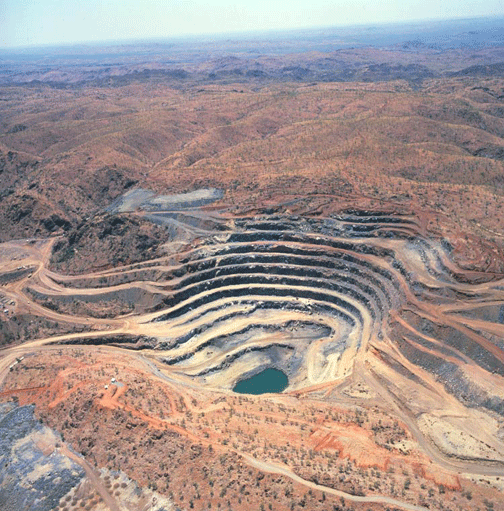
“The residents of Mount Isa are still living with the results of that mine and the inadequate capping of the spoil and the contamination of the land that even graziers today won’t go near.”…….
[Queensland Department of Natural Resources and Mines and the Department of Environment and Heritage Protection joint statement] ……”We are still assessing the condition of the Mary Kathleen site and looking at whether it could be mined again in the future.
“Contamination issues at the site may not have been properly addressed in the past.”…..http://www.abc.net.au/news/2014-05-01/uranium-debate-queensland/5423232
Australian uranium miner Paladin continues its revenue fall
Paladin’s revenue continues to slide Revenue for uranium miner Paladin Energy fell in the three months to the end of March.The company’s sales revenue of $US88.56 million in the three months to March 31 was down from $US106 million in the same period a year earlier.
Its average sales price in the March quarter was $US36.82 per pound, down from $US38.40 in the first six months of the 2013/14 financial year, and $US55.22 in same quarter a year earlier…….http://www.sbs.com.au/news/article/2014/04/22/paladins-revenue-continues-slide
Australian uranium miner Paladin’s production declines
During the quarter under review, Paladin reported a combined production of just over two-million pounds from its Kayelekera and Langer Heinrich mines. This compared with the 2.2-million pounds of uranium oxide (U3O8) in the previous quarter.
The Kayelekera operation produced 696 710 lb during the quarter, compared with the 777 015 lb produced in the previous three months.
Paladin suspended operations at Kayelekera in February this year, citing the depressed price of U3O8, and the unsustainable cash demand to maintain the loss-making operation.
Production at the Langer Heinrich operation, in Namibia, declined to 1.39-million pounds during the three months to March, compared with the 1.43-million pounds produced over the three months to December……..http://www.miningweekly.com/article/paladin-production-declines-on-kayelekera-close-2014-04-22
In lead up to Rio Tinto’s Australian AGM (May 8) signs that Rio will not pay up for fixing up Ranger uranium mine
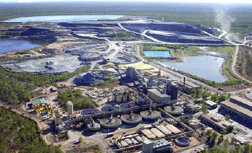 Rio chief tight-lipped on Ranger mine, SMH April 16, 2014 – Peter Ker Rio Tinto chief executive Sam Walsh has refused to guarantee that his company will cover the cost of rehabilitating the Ranger uranium mine near Kakadu, building on uncertainty that was created last month by the Rio subsidiary in charge of the mine.
Energy Resources of Australia – which is 68 per cent owned by Rio – raised eyebrows when it revealed it may need to find new sources of money to meet its rehabilitation commitments for Ranger, which is entirely surrounded by Kakadu National Park.
Under the Ranger permit, ERA must have rehabilitated the site by 2026, and a review of the rehabilitation strategy in 2013 found the cost would be $603 million on a net present cost basis. ERA has $357 million on hand and has ceased mining at Ranger, with the company now exploring for more uranium underground in a bid to find future revenue streams.
In an unusual move, ERA appeared to link the success of that exploration project – known as Ranger 3 Deeps – to its ability to pay for the rehabilitation of the site. “If the Ranger 3 Deeps mine is not developed, in the absence of any other successful development, ERA may require an additional source of funding to fully fund the rehabilitation of the Ranger Project Area,” the company said in its annual report.Such an outcome would be unusual, as miners are typically compelled to pay for the rehabilitation at the end of a mine’s life through provisions that are made each year.
In ERA’s case, some rehabilitation is already underway and it maintains a trust with the Australian Government which was holding $63.9 million at December 31.
When asked at Tuesday night’s annual meeting of Rio shareholders in London, Mr Walsh indicated he was in no mood to pick up the tab for ERA, particularly after Rio took part in a $500 million equity raising for the company in 2011. “There was a rights issue at ERA to fund the rehabilitation work and those funds are still sitting within that business,” said Mr Walsh.
”(ERA) is a public Australian company and clearly that is an issue for them.
“We are clearly shareholders, but it’s a matter for all shareholders and a matter for the ERA board.”
Environmental sensitivities of another kind were also raised at the AGM, with Rio executives forced to defend the company’s continued involvement in coal mining.
Mr Walsh said Rio did accept that “man made emissions” were responsible for changes in the climate, but the company believed the challenge could be resolved through technological developments rather than by ceasing coal production………
Rio’s Australian AGM will take place on May 8. http://www.smh.com.au/business/mining-and-resources/rio-chief-tightlipped-on-ranger-mine-20140416-36qfi.htmlSMH
1 This month
7 April – WEBINAR – Australia and the Doomsday Clock – Preventing nuclear war through NoFirstUse and other policies
Online | Tuesday April 7, 4:00-5:30pm, Australian Eastern Time / 8:00-9:30am Central Europe Time
– Access the registration link
15 April – Zoom –Nuclear Power is Not the Solution
Apr 15, 2026 01:00 AM in Canberra, Melbourne, Sydney

Join the International Physicians for the Prevention of Nuclear War (IPPNW) on Tuesday, April 14th for a timely webinar exploring the risks associated with nuclear power and challenging the myth that it offers a simple, safe, carbon-free solution to the climate crisis

21 April Webinar: No Nuclear Weapons in Australia
Start: 2026-04-21 18:00:00 UTC Canberra, Melbourne, Sydney (GMT+10:00)
End: 2026-04-21 19:30:00 UTC Canberra, Melbourne, Sydney (GMT+10:00)
Event Type: Virtual
A virtual link will be communicated before the event.
Host Contact Info: australia@icanw.org

of the week – Australians for War Powers Reform (AWPR)
To see nuclear-related stories in greater depth and intensity
 Antinuclear