Unease in share market over ERA’s Ranger uranium mine
it is unclear whether the [Rio Tinto]current leadership, which last month announced the closure of the loss-making Gove Alumina Refinery in the Northern Territory, will continue to show such strong support for a struggling mine with so many environmental and indigenous issues.
 ERA shares facing pressure over uranium leak, SMH, Peter Ker, December 9, 2013 Rio Tinto’s hopes of reviving its majority-owned Ranger uranium mine have been dealt another blow by the leak of toxic substances on Saturday….
… Shares in the Rio Tinto subsidiary that operates the mine – Energy Resources of Australia – are traded on the ASX and may come under pressure on Monday morning as federal and Northern Territory regulators conduct investigations.
Processing of uranium has been halted on site until the clean-up and testing can be completed and, with some fearing that halt could last weeks, the market will be keen to know if ERA will need to buy uranium on the market to ensure it can meet its supply contracts.
ERA shares have traded around $1.30 over the past five to six weeks and most of the value in the stock is attached to hopes of starting a new underground uranium mine beneath the Ranger pits, which ceased mining last year after more than three decades.
The underground development is still being explored and will face a heavy load of approvals before it is allowed to proceed. Continue reading
Uranium under pressure means tough times for Toro
 Toro Energy – the company seeking to open WA’s first uranium mine – will be the focus of critical attention from local residents, Traditional Owners and State and National environment groups at its annual meeting in Perth today.
Opponents of the company’s uranium mining plans will greet Toro executives and shareholders with an independent report casting doubt on the economic viability of the company as well as the broader nuclear industry.
A theatrical performance outside the AGM will also demonstrate that the nuclear industry’s vital signs are ‘flat lining’.
“Toro have expanded their proposal from one risky and unviable uranium mine in Wiluna, to a series of equally small and risky deposits in the region” said CCWA campaigner Mia Pepper. “What they won’t tell shareholders is that this expansion plan will represent more delays, more costs, more environmental problems, and more community opposition.”
“Toro have failed to fully disclose the complexity, risk and lack of formal approval for its long term plans.”
“CCWA and the Australian Conservation Foundation oppose the current proposal and will actively contest the company’s plan for seven uranium mines across 200km and 2 lake systems which will involve a doubling of water use and radioactive mine waste”.
“Toro’s shareholders will have a very long wait before this company will be profitable, if ever. The conditional approval granted for the Wiluna mining proposal prohibits the company from doing any other preparatory works for a mine until thirty six conditions are met and further management plans are approved.”
“Financial problems have dogged the uranium sector with low uranium prices, high operating costs and a lack of investor confidence following the global decline in nuclear power post Fukushima,” said Ms Pepper.
“While some companies are cutting their losses Toro is on track for tough times ahead”.
Uranium loses its glow at SA mining conference
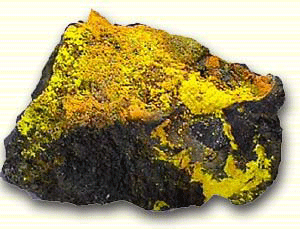 AUSTRALIAN CONSERVATION FOUNDATION, 26 Nov 13, Uranium hopefuls will be hard pressed to find a positive story about the embattled sector at a mining industry conference this week in South Australia. The last two weeks have seen further evidence of the continuing market fallout from Fukushima on SA’s embattled uranium sector with the closure of the Honeymoon operation and the decision by Marathon Resources to exit the uranium trade, declaring the sector’s ‘risks outweigh the rewards’.
 The news comes as a set of uranium junior companies join with the Beverley project’s Heathgate Resources to talk up the sector at the 2013 Mining South Australia conference, which starts today in Whyalla.
Australia’s uranium industry is suffering from:
- · The scrapping of plans for a massive expansion of BHP Billiton’s Olympic Dam mine in SA because of the ‘uncertain’ uranium market
- · A fall in the uranium commodity price of around 50 per cent and larger falls in the share value of uranium mining companies since Fukushima – a continuing crisis directly fuelled by Australian uranium
- · Sustained losses and operational failures at ERA’s Ranger mine in Kakadu
- · Attempts by Queensland uranium promoters to receive ‘royalty relief’ and public concessions even before making any formal applications to mine
- · Projects stalled, scrapped or deferred in WA, SA and the NT
“The uranium industry has long caused trouble, now it is increasingly in trouble,” said Australian Conservation Foundation nuclear free campaigner Dave Sweeney. “Uranium mining is a high-risk, low-return sector that poses unique, unresolved and long-lived threats and does not enjoy secure social license.
“It is time for politicians to stop accepting industry promises and start genuinely examining industry performance. “ACF urges state and federal governments to give effect to the UN Secretary General’s call that Australia conduct ‘an in-depth assessment of the net cost impact of the impacts of mining fissionable material (uranium) on local communities and ecosystems’.
“Instead of misplaced industry enthusiasm it is time for a comprehensive and independent assessment of the costs and consequences of the uranium sector.”
Marathon uranium project closed – unviable due to poor uranium market
 Explorer says uranium project unviable Yahoo 7 Finance 21 Nov 13, Minerals exploration company Marathon Resources has turned its back on the uranium industry for good. The company says its experience suggests the “risks were more likely to exceed rewards” in a sector hit by low ore prices.
“Both the political and regulatory regimes have deterred us permanently from the uranium industry,” chairman Peter Williams told the company’s annual meeting in Adelaide on Thursday. Marathon previously has been involved in exploring a section of South Australia’s Flinders Ranges with a view to developing a significant uranium deposit.
However, it fell foul of the South Australian government over the disposal of waste while the government eventually moved to ban all mining in the environmentally-sensitive area anyway.
Since then, the uranium industry has been hit by falling commodity prices which also has prompted mining giant BHP Billiton to mothball its plans for a $30 billion expansion of its Olympic Dam copper and gold operations…… industry is presently witnessing that part of the cycle where the spot price for product has fallen dramatically below production costs sufficient to amortise large capital costs,” he said…….. http://au.finance.yahoo.com/news/explorer-says-uranium-project-unviable-032809245.html
No price relief in sight for Australia’s troubles uranum miners
Tough times ahead for uranium miners ABC Rural By Tara de Landgrafft 19 Nov 13, “……With a number of Japanese reactors still offline after the 2011 earthquake, there is an oversupply of uranium in the marketplace…..it will be a tough two years ahead for current producers, with one Australian miner already going into care and maintenance.
“You could have up to 40 to 50 per cent of producers who are actually operating at a loss at present,” he said.
“We’ve got a shorter term surplus in the market where you’ve got reactors offline and material that would have been entering into term contracts, those have been deferred, and that’s finding its way probably more into the short, medium-term market.” http://www.abc.net.au/news/2013-11-19/nrn-uranium/5101704
Australian uranium miner Paladin: last ditch battle for survival?
Weak uranium price hurts Paladin http://au.news.yahoo.com/thewest/business/a/-/national/19838677/weak-uranium-price-hurts-paladin/ Nick Sas, The West AustralianNovember 15, 2013, Paladin Energy has underscored the enormity of its battle for survival, admitting its African uranium mines lost $US14.9 million ($15.9 million) in the September quarter despite record production.
As shareholders prepare to quiz long-standing managing director John Borshoff at the company’s annual meeting in Perth next week, Paladin last night released its financial and operating report for the three months to September 30 detailing the pain caused by the depressed uranium price.
The gross loss on operations was the result of a 17 per cent slump in quarter-on-quarter uranium price and a resulting impairment of uranium inventory at the Kayelekera mine in Namibia, more than offsetting a 37 per cent jump in sales volumes.
It was the first time in more than five years that Paladin has not reported a gross profit for the September quarter, despite a period that included bringing the company’s second mine, Kayelekera, into production to add to output from Langer Heinrich in Namibia.
The weak September quarter came despite record production at Langer Heinrich – leading to a record group output – and continued cash cost reductions.
Production at Kayelekera fell by 9 per cent. Although Paladin receives a premium over the market-traded spot price courtesy of long-standing contracts with suppliers, a yellowcake price sitting at historical lows has now pushed it over the brink of profitability.
Over the quarter Paladin received an average of $US41.38 a pound U _{-3} _
O{-8} – down from $46.22/lb in the June quarter. The average spot price over the quarter was $US36/lb – a historical low.
The gross loss for the quarter including impairments was $US40 million. It adds to the $US420.9 million loss reported during the 2012-13 financial year, largely because of big writedowns on the value of its assets.
Paladin celebrated its 20-year anniversary earlier this year but the pressures surrounding the uranium price, mounting debt and a free-falling share price have been no cause for celebration. Paladin’s shares, at 40¢, are worth less than half of the 91.5¢ they commanded on the eve of last year’s annual meeting.
Paladin has $US276 million in unsecured convertible bonds maturing in late 2015, and a further $US236.6 million falling due 18 months later, fanning fears about its ability to generate cash to repay its debt.
Shareholders are likely to vent their disappointment at Thursday’s meeting. The Australian Shareholders’ Association wants chairman Rick Crabb to retire.
Australia’s clean energy companies may go overseas, due to Abbott’s cuts to renewable energy
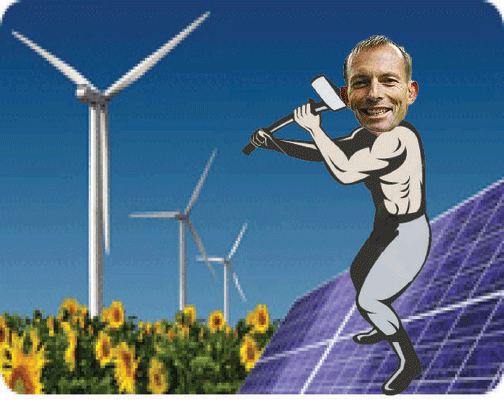 Abbot’s Cuts to Clean Energy Could Push Companies Abroad – Sourceable, 15 Nov 13 Prime Minister Tony Abbot has flagged massive cuts to funding for renewable energy which the sector’s peak body says could spur an exodus of companies overseas. – The Clean Energy Council (CCEC), Australia’s peak body for the renewable energy sector, said that the Abbot government’s proposed legislation for the repeal of the carbon tax contains a provision which will reduce funding for the Australian Renewable Energy Agency (ARENA) by $435 million over the next three years.
In an official statement Kane Thornton, CEC’s deputy chief executive, said that the cuts to ARENA funding threaten to roll back the tremendous progressive achieved by Australia’s clean energy sector over recent years, in areas including large-scale solar, marine, geothermal and energy storage.
“It is disappointing that the agency is now facing a significant budget reduction,” Thornton said.
According to Thornton the slated changes to funding for ARENA could spur many renewable energy companies to relocate abroad, to jurisdictions where government support for renewable energy is more clear-cut and consistent.
“This unstable policy environment has had a clear impact on major technology innovators, developers and financiers, who will understandably be questioning their future in Australia,” said Thornton.-………. http://sourceable.net/abbots-cuts-to-clean-energy-could-push-companies-abroad/#sthash.QHz36p6r.dpuf
Polluting industries uranium and coal make themselves look good, in with Minerals Council
Australian Uranium Association joins forces with the Minerals Council of Australia Australian Mining 14 November, 2013 Vicky Validakis The Australian Uranium Association will be integrated into the Minerals Council of Australia in a merger agreed upon by member companies of both organisations.
Departing chief of the AUA Michael Angwin said the move will enhance the uranium sector’s advocacy, reinforcing its position in the mining industry as a whole.
AUA chairman Darryl Cuzzubbo said the integration is set to secure the uranium sector stays well positioned…….The AUA has been the main advocacy body for the nation’s uranium industry, lobbying for policy changes and aiming to educate the public on the advantages of using uranium as an energy source.……
Earlier this year the Australian Coal Association was dismantled and integrated with the MCA. http://www.miningaustralia.com.au/news/australian-uranium-association-joins-forces-with-t
Uranium miner Paladin loses US $40 million in last three months
Uranium miner Paladin makes $US40m loss Yahoo 7 Finance AAP , 15 Nov 13 Uranium miner Paladin Energy made a $US40 million loss in the three months to September as uranium prices remain low…….Its average realised uranium sales price for the September quarter was US$41.38 per pound, as the spot price trades around eight year lows. Paladin is looking to sell a stake in the Langer Heinrich mine. It is also cutting jobs and costs in response to falls in the price of uranium.
The Honeymoon is over: post Fukushima reality check for Australia’s uranium industry
13 Nov 13 ACF has described reports of the imminent closure of the Honeymoon uranium mine in South Australia as further proof of the marginal and embattled nature of the uranium sector that highlights the need for an evidence based assessment of Australia’s uranium trade.
The Honeymoon mine in north east South Australia is set to close following a write down in the mine’s value of over seventy million dollars due to a combination of high costs, technical difficulties and a collapsing uranium price as the market fallout from the Fukushima nuclear crisis in Japan continues.
The Honeymoon closure is the latest in a run of bad news for Australia’s uranium industry that includes:
- Sustained losses and operational failures at Energy Resources of Australia’s Ranger mine in Kakadu
- The scrapping of plans for a massive expansion of BHP Billiton’s Olympic Dam mine in SA because of the ‘uncertain’ uranium market
- A fall of around fifty per cent in the uranium commodity price and larger falls in the share value of uranium mining companies since the Fukushima crisis began
- Attempts by Queensland uranium promoters to receive ‘royalty relief’ and public concessions even before making any formal applications to mine
- Projects stalled, scrapped or deferred across WA, SA and the NT and uranium hopefuls like Toro Energy effectively stranded without the necessary approvals or financing
- Increased shareholder anger over the poor performance of uranium companies like the Perth based Paladin Energy
- Sustained global scepticism over the role of nuclear energy following Fukushima – a continuing crisis directly fuelled by Australian uranium Continue reading
As USA’s nuclear plants bite the dust, so do Australian uranium mines?
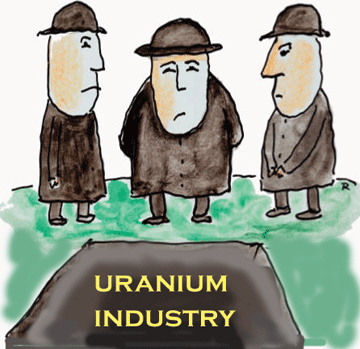 South Australian uranium Honeymoon mine to stop production, jobs in doubt NEWS.COM.AU NOVEMBER 11, 2013 THE Honeymoon uranium mine in South Australia’s far northeast is expected to be mothballed. Low uranium prices and production difficulties at the plant have put pressure on the mine. The future of about 70 employees was not immediately known but far fewer employees would be needed when the mine is put under “care and maintenance”.
Honeymoon, which began producing uranium in 2011 , became wholly owned by Russian state company JSC Atomredmetzoloto in mid-October.
Previously it had been 49 per cent owned-and-operated by Canada’s Uranium One……..
Honeymoon is about 500km north by road from Adelaide, 80kms northwest of Broken Hill.It uses an in-situ leach method – where liquids are pumped underground to dissolve the uranium with the mineral extracted from the pregnant solution at the surface. SA is Australia’s leading uranium producer with Olympic Dam and Beverley in operation. Ranger in the NT is the only other mine. The Four Mile mine – near Beverley – has been approved but is yet to be built….. http://www.news.com.au/national/south-australia/south-australian-uranium-honeymoon-mine-to-stop-production-jobs-in-doubt/story-fnii5yv4-1226757697638
Exploration company Thundelarra reduces costs, sell uranium assets
Thundelarra sells non-core Hayes Creek uranium asset November 11, 2013 byProactive Investors Thundelarra (ASX:THX) will sell its Hayes Creek uranium assets for a total value of $1.5 million, while neatly retaining an exposure to any future exploration success from the Northern Territory project…….The sale is part of a new “look” Thundelarra that has rationalised non core projects, taken costs from the system and is focusing on core copper, base metal and gold exploration..
…the deal removes the rent, rates and exploration commitment overheads that accompany the Hayes Creek interests…..Today’s deal further illustrates the new broom through Thundelarra, disposing of non-core assets, while focusing on core projects. http://www.proactiveinvestors.com.au/companies/news/50073/thundelarra-sells-non-core-hayes-creek-uranium-asset-50073.html
Defeatism emerging in the Australian uranium industry
Uranium plunge clouds outlook ROBIN BROMBY THE AUSTRALIAN NOVEMBER 04, 2013 JUST as one quarterly report hit the screen proclaiming uranium was at a new eight-year low, the spot price promptly shed another US50c — and thus was born an even newer eight-year low.Spot uranium sank to $US34.75 a pound during the week, a long way from the record $US136/lb it hit in 2007 during the yellowcake frenzy.
Then we had about 260 listed companies that each boasted at least one uranium project. Now we are left with the brave few.
In this space exactly a year ago, we took a relatively upbeat view of the sector. Australia had finally begun uranium sale talks with India (the new federal government may sign the deal by year’s end) and the new Queensland government had lifted its uranium mining ban.
Wisely, this column said it was too early to make the call that the uranium market had bottomed, but that at least the remaining players in the sector were upbeat.
Ditto for this month: still too early, and the brave are still battling on.
And, if the price falls close to $US30/lb, defeatism could emerge. The quarterly report mentioned above came from Manhattan Corp (MHC), which has an inferred 7800 tonnes of uranium at its Ponton deposit in Western Australia. It’s run by Alan Eggers, who seems never to tire of arguing uranium’s story. –
……..Toro Energy (TOE) is positioning itself to be Western Australia’s first producer. But not at current prices. http://www.theaustralian.com.au/business/opinion/uranium-plunge-clouds-outlook/story-e6frg9if-1226752388347#sthash.Wv1Mhsta.dpuf
Australian uranium company Paladin – huge losses and never a dividend
Paladin chief calls for investor calm The Age, November 4, 2013 Peter Ker Resources reporter Paladin Energy chairman Rick Crabb has urged shareholders to cool their lust for executive scalps at the troubled uranium miner, saying that succession planning was in train and that board changes would be counterproductive while an asset sell-down was under way.
 Mr Crabb and his managing director, John Borshoff, have been under extra pressure in recent times on the back of shareholder anger at the company’s direction.
An Asian hedge fund has been leading a group of Paladin shareholders that are trying to remove Mr Crabb and Mr Borshoff, and their rebel cause has been helped by proxy adviser ISS, which last week called for shareholders to reject a dilutive share placement that Paladin made in August.
The pressure is likely to continue before this month’s annual meeting, with the Australian Shareholders Association set to agree with ISS, plus name Mr Crabb at the top of its list of ASX chairmen who should stand down……..
Paladin failed to sell a stake in its Langer Heinrich mine in the September quarter, and Mr Crabb said sale negotiations were still under way, making it a bad time to overhaul the board…..
The ASA disagreed, with chairman Ian Curry saying that Paladin had not once delivered a dividend to shareholders since it started trading in 1994, yet had imposed billions of dollars worth of losses. : http://www.smh.com.au/business/paladin-chief-calls-for-investor-calm-20131103-2wusp.html#ixzz2jiZEkGKl
South Australia Power Networks punish home energy storage
Home Energy Storage Penalised In South Australia http://www.energymatters.com.au/index.php?main_page=news_article&article_id=4004 3 Nov 13, SA Power Networks seems to have taken a dim view of mains-connected solar households incorporating battery storage systems. While countries such as Germany are actively encouraging the uptake of home energy storage, it appears South Australia is actively discouraging it.
In an industry news bulletin from earlier this month; SA Power Networks have declared that customers installing energy storage will lose their feed in tariff incentive. According to the document: Continue reading
1 This month
7 April – WEBINAR – Australia and the Doomsday Clock – Preventing nuclear war through NoFirstUse and other policies
Online | Tuesday April 7, 4:00-5:30pm, Australian Eastern Time / 8:00-9:30am Central Europe Time
– Access the registration link
15 April – Zoom –Nuclear Power is Not the Solution
Apr 15, 2026 01:00 AM in Canberra, Melbourne, Sydney

Join the International Physicians for the Prevention of Nuclear War (IPPNW) on Tuesday, April 14th for a timely webinar exploring the risks associated with nuclear power and challenging the myth that it offers a simple, safe, carbon-free solution to the climate crisis

21 April Webinar: No Nuclear Weapons in Australia
Start: 2026-04-21 18:00:00 UTC Canberra, Melbourne, Sydney (GMT+10:00)
End: 2026-04-21 19:30:00 UTC Canberra, Melbourne, Sydney (GMT+10:00)
Event Type: Virtual
A virtual link will be communicated before the event.
Host Contact Info: australia@icanw.org

of the week – Australians for War Powers Reform (AWPR)
To see nuclear-related stories in greater depth and intensity
 Antinuclear