Clean Energy Finance Corp is making a profit
 Green investment bank profitable as Abbott axe looms, CEO Yates says, SMH, October 19, 2013
- Clean Energy Finance Corp., Australia’s green development bank earmarked for closing by Prime Minister Tony Abbott, is making a profit and prodding commercial banks to lend, according to its chief executive officer.
“We’re operating profitably already, with our contracted investments expected to earn an average return of around 7 percent,” which is above the bank’s capital cost of about 3 percent, Oliver Yates, CEO of the bank founded less than four months ago by the previous government, told delegates at a conference in London. He declined to comment on Abbott’s plan to close CEFC, citing public-service rules……
- The development bank has built a loan portfolio of around $536 million and helped projects get debt and equity of about $2.2 billion, including from other institutions, Yates said at the Climate Markets & Investment Association event earlier this week. The deals will cut emissions by about 3.9 million metric tons of carbon dioxide annually, he said. They include wind farms and a tomato farm that uses solar energy to desalinate seawater.
‘Meaningful impact’
“We’ve been able to make a meaningful impact offering finance on a commercial basis,” Yates said. “Though we have the capacity to provide concessional loans, for the great majority of cases that hasn’t proved necessary. Our job is not to make it easy for the banks, but to stretch them and encourage them to join into transactions with us.”
The bank has demonstrated it can generate carbon reductions at a net benefit to the taxpayer of $2.40 a ton of carbon dioxide, he said. http://www.smh.com.au/business/carbon-economy/green-investment-bank-profitable-as-abbott-axe-looms-ceo-yates-says-20131019-2vt12.html#ixzz2iNfY7eQ1
Uranium miner Paladin has to sell assets to stay afloat?
Hurt by Low Uranium Prices, Paladin Targets Asset Sale WSJ, By Ross Kelly 16 Oct 13 SYDNEY–Paladin Energy Ltd. (PDN.AU) was once among the boldest predators in the uranium industry, buying up deposits of the nuclear fuel in countries as diverse as Niger and Canada to feed a boom in global demand for non-fossil fuels.
Now, the Australian company has turned seller to ease investor concerns over its debt pile, as it racks up losses due largely to the sharp fall in uranium prices since an earthquake triggered an atomic crisis in Japan in early 2011……
It has already cut its exploration budget in half and slashed executive pay by 10% to ease pressure on its balance sheet, but this hasn’t arrested a fall in its share price to near-decade lows.
In August, Paladin said it needed the spot uranium price to average US$42.50 a pound over the coming year or it would run out of cash by the end of September next year without additional cost cuts. That price goal is well below current levels of US$35.25 a pound, near an eight-year low hit last month……
analysts think the sale process could stumble again, given the uncertain outlook for nuclear power.
“Barring a miraculous recovery in the uranium price, the only realistic way to generate enough cash to meet the US$300m convertible maturity in November 2015 is a sale of a stake in Langer Heinrich, which didn’t generate acceptable bids earlier this year,” said Clarke Wilkins, an analyst at Citigroup, who rates Paladin’s stock a sell…..http://online.wsj.com/article/DN-CO-20131016-001298.html
Poor forecast for uranium miners ERA and Paladin
 Little optimism in uranium market http://finance.ninemsn.com.au/newscolumnists/greg/8739108/little-optimism-in-uranium-market 15 Oct 13 Olympic Dam is Australia’s largest uranium source but outside of the diversified resource conglomerate that is owner BHP Billiton, Australia’s two “big” pure-play uranium producers are Energy Resources of Australia, operating in the Northern Territory and Paladin Energy operating in Namibia. Continue reading
Poor results from uranium producer ERA
Expected slump in ERA results, THE AUSTRALIAN 13 Oct 13
RIO Tinto’s listed uranium subsidiary Energy Resources of Australia has kicked off the September quarter reporting period for the group on the sour note widely expected by investors.
Output from ERA’s Ranger operation in the Northern Territory fell sharply in the quarter because of the exhaustion of open-cut reserves, restricting operations to the processing of lower-grade stockpiles.
Uranium production plunged 51 per cent to 610 tonnes (1.34 million pounds) from the previous corresponding period…..
Investors warned about the fading glow of the uranium market (The Australian!)
 The price fall that started six years ago could continue, especially with major new reserves being readily discovered in Australia and Africa. And it seems nuclear incidents are never too far away.
Those holding shares in uranium companies, or considering them, should handle them with great care.
Uranium best handled with care TONY KAYE THE AUSTRALIAN OCTOBER 05 IT isn’t all about Japan, Iran, the “China syndrome”, or even the swarm of moon jellyfish that forced a shutdown this week of all three reactors at Sweden’s Oskarshamn nuclear plant.
But the cold reality of the meltdown afflicting the uranium sector globally was best demonstrated on Wednesday when Australian group Paladin Energy announced it was slashing its operating costs across the board in the face of a further weakening in the spot price of the nuclear fuel it mines in southern Africa.
Paladin, based in Perth, has watched its share price dive more than 90 per cent since 2007 at the hands of a uranium price that has plunged about 75 per cent over the same period. Compelled to address the issue, the company has taken the knife to its cost structure, cutting head-office jobs, exploration expenses, executive pay by 10 per cent, and cash costs by $23 million.
Paladin is also attempting to sell its stake in its flagship Namibian mine to pay down $US750m ($794m) in debt. “Optimisation strategies have now become even more pertinent with the further incremental weakening of the uranium spot price,” the company said.
So what are the factors behind uranium’s fading glow? The answer is not rocket science. Continue reading
Business analysts downgrade Paladin Energy’s uranium operations
Translating business language – “outperform” – means good to invest. “Sector Perform” mean s not so good
Outperform. The stock’s total return is projected to exceed the average return of the industry (or its sector or its peers). This means the stock will perform better than the competition and is likely rated a “Buy”.
Sector Perform). The stock is expected to perform in line with the average return of the market or sector or its peers. Similar to a “Hold” or a “Neutral” rating.
 Paladin Energy Limited Downgraded to Sector Perform at RBC Capital (PDN) North fork vue.com October 2nd, 2013 Paladin Energy Limited (ASX:PDN) was downgraded by investment analysts at RBC Capital from an “outperform” rating to a “sector perform” rating in a note issued to investors on Wednesday, American Banking News reports. They currently have a A$0.80 ($0.75) price target on the stock……..
A number of other analysts have also recently weighed in on PDN. Analysts at TD Securities cut their price target on shares of Paladin Energy Limited (ASX:PDN) from A$0.90 ($0.84) to A$0.65 ($0.61) in a research note to investors on Friday, August 30th. They now have a “hold” rating on the stock. Separately, analysts at BMO Capital Markets cut their price target on shares of Paladin Energy Limited (ASX:PDN) from A$0.80 ($0.75) to A$0.60 ($0.56) in a research note to investors on Friday, August 30th. Finally, analysts at Raymond James downgraded shares of Paladin Energy Limited (ASX:PDN) from an “outperform” rating to a “market perform” rating in a research note to investors on Monday, August 5th. Three equities research analysts have rated the stock with a hold rating and one has issued a buy rating to the stock. The stock presently has an average rating of “Hold” and a consensus price target of A$0.96 ($0.90).
Paladin Energy Ltd (ASX:PDN) is a uranium production company with projects in Australia and two operating mines in Africa. http://www.northforkvue.com/finance/10712/paladin-energy-limited-downgraded-to-sector-perform-at-rbc-capital-pdn/
Paladin Energy cuts costs as uranium prices remain down the drain
Paladin cuts top-echelon base salaries, overall spending amid low uranium price TIMES COLONIST OCTOBER 2, 2013 PERTH, Australia – Paladin Energy Ltd (TSX:PDN) is cutting the base salaries of its board and management by 10 per cent as part of cost-saving measures due to low spot prices for uranium — its main commodity.
In total, the miner — which lists its shares on the Toronto and Australian stock markets — is aiming to reduce cash costs for its 2014 financial year by US$23 million.
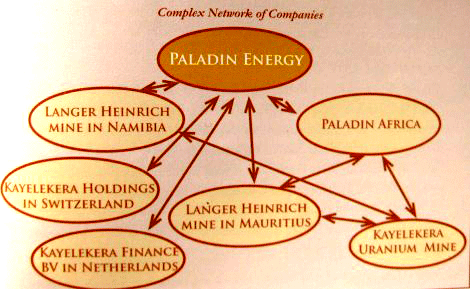
The cuts include a $10.8-million reduction in spending on overhead and exploration and a US$12.4-million reduction in discretionary capital spending at two mines in southern Africa….The Langer Heinrich mine in central Namibia will see its capital spending cut by US$10 million compared with the 2013 financial year while a further $2 million will be cut from the capital budget for the Kayelekera mine in Malawi. http://www.timescolonist.com/business/paladin-cuts-top-echelon-base-salaries-overall-spending-amid-low-uranium-price-1.645930
The end of the line for Australian uranium company Paladin Energy?
the fact remains that it has not had a profitable annual result since commencing operations. Our modelling forecasts continued negative cash flow and the company running out of cash in early 2014 and consequently [being] unable to service its substantial debt position.
Uranium price slumps, Paladin Energy in trouble Jim Green WISE/NIRS Nuclear Monitor #768, 27 Sept 2013 ” Paladin Energy ……….Australian-based Paladin Energy operates two uranium mines in Africa − Langer Heinrich in Namibia and Kayelekera in Malawi. CEO John Borshoff told a mining conference in Western Australia in July that the uranium industry faces a number of “major problems” such as the lack of greenfields development, dwindling investment capital and the sickly uranium price.[12]
Borshoff said: “[T]he uranium industry is definitely in crisis, I believe, and is showing all the symptoms of a mid-term paralysis if this situation does not demonstrably change. How can there not be a problem when you have an effective moratorium with nearly all major companies making no commitment to greenfields development until the price gets about US$70 and it is believed it can stay above that level. And how can there not be a problem when you have a strong chance that some of the more expensive, smaller operations will be mothballed − putting more pressure on current production. … Only at this price level [US$70/ lb] − and above − can sufficient capital for new products be raised and returns on investment be justified to finally give some risk reward to the shareholder. And this appears to be a long way away.” Continue reading
The uranium industry in deep trouble
The industry hopes that reactor restarts in Japan will improve the situation − but restarts will be slow and in many cases strongly contested. The industry hopes that new build in China will improve the situation − but pre-Fukushima nuclear growth projections have been sharply reduced and China now plans to approve a “small number” of new reactors projects each year.
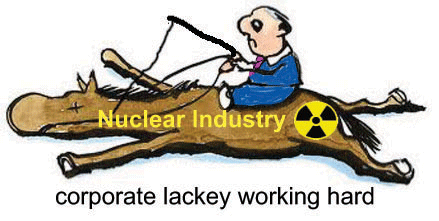
Uranium price slumps, Paladin Energy in trouble Jim Green WISE/NIRS Nuclear Monitor #768, 27 Sept 2013 The spot uranium price fell to US$34.50 / lb U3O8 in late July, a price not seen since December 2005 during the upswing of a spectacular price bubble which peaked in June 2007 at US$138 / lb. The 12% price slump in July was the biggest monthly loss since March 2011. Since September 2, the spot price has been still lower, at US$34.00. Those prices are just over half the spot price of US$66.50 / lb on 11 March 2011, the first day of the triple-disaster in north-east Japan.[1]
The long-term contract price has been reasonably stable in recent months at US$57 / lb. At that price, the value of annual global uranium requirements for power reactors is around US$10 billion.
FNArena wrote on September 17: “The issue of low uranium prices discouraging new supply is not just one of the spot price itself but one of the marginal cost of new supply. Producers suggested to Ux that the average marginal cost of production of operating mines is around where the spot price is now, but the marginal cost of developing a new mine is more like US$65-70/lb. From the nuclear energy prospective, respondents rated the most significant demand-side influences as, in descending order of influence, Japanese reactor restarts, Chinese reactor build, the premature shutdown of older US reactors and the emergence of newcomer countries to nuclear energy (about equal), and the upcoming French nuclear licence renewals.”[19]
Raymond James analyst David Sadowski expects an average spot price of $40 per pound this year, $52 in 2014, and $70 in both 2015 and 2016.[2] Michael Angwin from the Australian Uranium Association expects low prices until about 2017/18, and a nasdaq.com article states that “the road to recovery for this battered commodity will be a long haul”.[3,4] Rob Atkinson, outgoing CEO of Energy Resources of Australia, says the uranium spot price is woeful, making it extremely difficult to make the case for developing a new mine, and the market will remain difficult for at least another two years.[21] Continue reading
ERA flounders with uranium losses, cost-cutting and the prospect of financial collapse
ERA’s cost-cutting continues while uranium prices flounder The Motley Fool By Darryl Daté-Shappard – September 23, 2013 “…..The company, which is 68% owned by Rio Tinto (ASX: RIO), just recently reported a $53.55 million loss for its half-year result, with its expenses approximately the same as its $144.3 million revenue. A larger than average $129 million depreciation charge added to the net loss, its third in three years since 2010.
Its Ranger 3 Deeps mine project was discussed, and the company said that the pre-feasibility study was on schedule and on budget. Assuming all necessary approvals are granted, the commencement of production should take place in late 2015. This underground project is adjacent to its open pit mine site, located in the Kakadu National Park. The open pit mine is nearing its end, and so are mining approvals for it, so the underground project is of great importance to continue the company’s activities in this area.
This month the newly installed Brine Concentrator began operation to clean up water used in production. It will be able to process up to 1.8 billion litres per year, rehabilitating the site’s water to be safe near the heritage-listed national park. The water facilities cost $20 million annually to operate.
A total cumulative $102 million out of $150 million in projected savings has been achieved since 2011. However, will this lead to a profit in the near-term if the company in the end is producing less than before, and uranium prices are still around $30-$40/lb?
The overseas uranium market still has not recovered since the Japanese nuclear disaster in Fukushima, and downward price pressure is coming from the development of cheap natural gas within the US, seen as an alternative power generation fuel with less pollutants than coal, and no need for specialised containment and storage that nuclear energy requires……..http://www.fool.com.au/2013/09/23/eras-cost-cutting-continues-while-uranium-prices-flounder/
Yeah – let’s Australia become the world’s radioactive trash toilet!
Call to store nuclear waste to sustain uranium industry http://www.afr.com/p/business/sunday/call_to_store_nuclear_waste_to_sustain_bQJnppe7viMuI9dlCLPbmJ CLAIRE STEWART, 22 Sept 13 Australia will need to start enriching uranium and storing the nuclear waste if it is going to sustain a competitive uranium industry in the future, says senior finance and resources figure Mark Johnson.
Mr Johnson, a former deputy chair of Macquarie Bank and former chairman of AGL, said Australia had a “great opportunity” to become a participant in a “free world nuclear fuel cycle”, if it produces uranium. “But the consequence of that is we would also have to store spent uranium,” he told Financial Review Sunday.
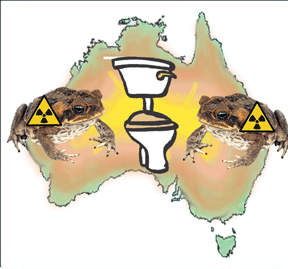
Federal government laws explicitly prohibit the building of nuclear fabrication, enrichment or power plants and the return of nuclear waste to Australia for storage. “Nobody wants spent nuclear fuel in their backyard, even if it would be right in the centre of the outback of Australia, [with] very stable geological conditions,” Mr Johnson said.
The price of uranium has halved since governments around the world promised to cut their reliance on nuclear power following the Fukushima nuclear disaster. Energy Resources Australia chief executive Rob Atkinson said the market will turn, particularly given expected demand from China.
For other democracies, nuclear power is “off the table for generations”, Mr Johnson said, prompting suggestions that enrichment and storage of waste will be a key part of expanding the industry. Australia currently processes uranium to the “yellow cake” stage, which is then exported for further processing and concentration, and in some cases turned into fuel rods.
Uranium as a fuel source can only be used for about three years before it becomes too unstable, said Australian Conservation Foundation nuclear campaigner Dave Sweeny. He said making Australia part of the global fuel cycle was about opening the country up for return of that spent material. “Industry returns are meagre and the risks are significant and continuing,” he said. “Storage is the Achilles heel . . . it highlights the political, social and technical difficulty of doing this.”
Uranium mining might commence again at Ranger, Northern Territory
 NT uranium mine gets future beyond 2021, Yahoo 7 Finance, 19 Sept 13 The Northern Territory’s Ranger uranium mine has unveiled a new water processing machine it says will prolong its future beyond a planned 2021 closure. Mining has been completed at the site, which is located within but is not a part of the world heritage-listed Kakadu National Park. It’s operated by Energy Resources Australia (ERA), which is owned by Rio Tinto.
The $220 million brine concentrator unveiled on Thursday will improve the mine’s ability to treat water and progressively rehabilitate the site, which must be completed by 2026, when it must be of a standard to be reintegrated into Kakadu.
Previous attempts to treat water properly were either too small for requirements or unsuccessful, CEO Rob Atkinson said………
Although the Ranger mine is now only processing stockpiled ore as its open pits are slowly being backfilled, exploration for a possible underground mine is underway at a neighbouring site called Ranger 3 Deeps.
If feasible, mining could begin in 2015 but would only be able to operate for five years under the current lease agreement.
Mr Atkinson said it was too early to be talking about future negotiations with stakeholders such as the Jabiru community and the Mirarr people, the transitional owners of the land….. http://au.finance.yahoo.com/news/nt-uranium-mine-gets-future-052217361.html
ERA, Rio Tinto, Paladin desperately hope that Fukushima is just a “bump in the road”
Japan goes nuclear-free The Motley Fool, By Justin Loiseau – September 16, 2013 Japan is closing down its last operating nuclear reactor for scheduled maintenance, putting the country in “nuclear-free” territory for the first time since the Fukushima crisis necessitated nationwide inspections two years ago. Japan has 50 commercial reactors nationwide, and the March 2011 Fukushima disaster marked the first time in over 40 years that the country pulled power exclusively from non-nuclear sources.
Japan is split on the future of this fuel. While Prime Minister Shinzo Abe and utilities point to the need for nuclear to meet Japan’s growing energy demands, the general public and environmental activist groups remain apprehensive about the safety of local reactors.
Japan and Australia may be oceans apart, but the two countries are closely linked. Energy Resources of Australia (ASX: ERA) is one of the largest uranium producers in the world, the secret sauce of nuclear reactors. Rio Tinto (ASX: RIO) has a 64% stake in the company as well, and Japan’s exit from nuclear could push prices down drastically if it bids adieu indefinitely. Paladin Energy (ASX: PDN) and its 82%-owned Summit Resources(ASX: SMM) subsidiary tell a similar story. Spot prices have already dropped from $65 highs in 2011 and are currently hovering around $35, similar to 2006 markets.
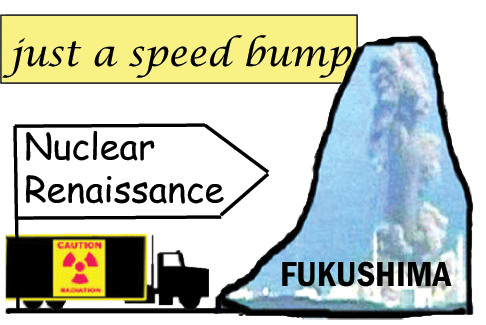
Japan’s nuclear notions are unclear, and proponents of the energy have warned of blackouts if the country doesn’t jump back on the nuclear track. Opponents, including Greenpeace Japan, are instead pushing Japan to seize the opportunity to become a leader in renewable energy.
Regardless of the ultimate outcome, this latest nuclear shutdown is another bump in the road (read “increased risk”) for nuclear energy and its uranium producers……http://www.fool.com.au/2013/09/16/japan-goes-nuclear-free/
Repealing Australia’s carbon tax will be a difficult task, with an uneconomic result
 With the carbon price, the 20 per cent Renewable Energy Target and the Clean Energy Finance Corporation, Australia has the main tools required to stay competitive in the 21st century,
Abolishing the carbon price and moving to a Direct Action grant scheme will change this. Not only will we lose the momentum of a functioning market, but we will move to a scheme most economists agree won’t work
Repealing the carbon tax is not easy, ABC, CLAIRE MARIESABC Environment9 SEP 2013 ‘Axing the tax’ will not be an easy ride for new PM Tony Abbott. While the Coalition has pledged to repeal the carbon tax, none of the steps required to do so are straight-forward. THIS WEEK TONY ABBOTT WILL be sworn in as Australia’s new Prime Minister. He has vowed to do away with Australia’s main tool for tackling climate change: the price on pollution.
Since Australia’s carbon price came into effect 14 months ago, emissions from electricity have fallen by about seven per cent, coal use for electricity is down by about 17 per cent and renewable energy generation is up by 25 per cent. We’re not going it alone on pricing carbon. More than 30 other countries have carbon pricing schemes (this figure does not include state schemes like those in California and some Chinese provinces) and 74 countries have some policy measure designed to limit greenhouse pollution. Continue reading
South Australian uranium mine to be 100% Russian owned
Honeymoon Well uranium mine to go into Russian hands ABC Rural By Babs McHugh 7 Sept 13, The Honeymoon Well uranium mine in South Australia is set to be 100 per cent Russian owned by the September quarter.
Shareholders of Canadian company Uranium One have approved a buyout offer from the Russian State Corporation for Nuclear Energy, Rosatom.
A Rosatom subsidiary already owns 49 per cent of Uranium One and, once the deal is completed, the new entity will be private.
Honeymoon Well is is the smallest of Australia’s operating uranium mines. The others are Olympic Dam in South Australia, Ranger Mine in the Northern Territory and Beverley Mine in South Australia…… http://www.abc.net.au/news/2013-09-06/russia-to-own-honeymoon-well-uranium-mine/4941128
1 This month
7 April – WEBINAR – Australia and the Doomsday Clock – Preventing nuclear war through NoFirstUse and other policies
Online | Tuesday April 7, 4:00-5:30pm, Australian Eastern Time / 8:00-9:30am Central Europe Time
– Access the registration link
15 April – Zoom –Nuclear Power is Not the Solution
Apr 15, 2026 01:00 AM in Canberra, Melbourne, Sydney

Join the International Physicians for the Prevention of Nuclear War (IPPNW) on Tuesday, April 14th for a timely webinar exploring the risks associated with nuclear power and challenging the myth that it offers a simple, safe, carbon-free solution to the climate crisis

21 April Webinar: No Nuclear Weapons in Australia
Start: 2026-04-21 18:00:00 UTC Canberra, Melbourne, Sydney (GMT+10:00)
End: 2026-04-21 19:30:00 UTC Canberra, Melbourne, Sydney (GMT+10:00)
Event Type: Virtual
A virtual link will be communicated before the event.
Host Contact Info: australia@icanw.org

of the week – Australians for War Powers Reform (AWPR)
To see nuclear-related stories in greater depth and intensity
 Antinuclear