Glut of uranium to continue – market forecast is dire, especially for Paladin
 Japan’s nuclear energy intentions are the swing factor at present. … if Japan does not start turning back on more reactors, Japanese uranium stockpiles will continue to hit the market to pay for increased fossil fuel imports. Nor is it helping at present that the US is also talking about turning off reactors.
Meanwhile, traders and speculators stuck with material and producers suffering cash flow problems are ever more desperate to offload material.
No rush to buy uranium, 9 News Finance by FN Arena 2 Sept 13, The spot market for uranium was never of much interest until the big surge took prices up well over US$100/lb in 2006. In that era, legacy contract obligations at much lower prices impacted on the earnings potential of the large and long-established players, such as Energy Resources of Australia in Australian terms, while new kids on the block, such as Paladin Energy relished the opportunity to secure contracts at more spot-aligned pricing.
Fast forward to the post-Fukushima era of 2013 and the tables have turned. Those noughties contract obligations have largely run off and the uranium price is wallowing in the depths. Lower cost, long-established producers such as BHP Billiton can at least bungle along (ERA has had its own specific production issues) while the high-cost later entrants are struggling to stay afloat. Paladin is the classic example. Continue reading
Paladin’s boss John Borschoff rails against ”diabolical” state of uranium market
 Paladin managing director John Borshoff could do little on Friday but launch yet another speech about how unreasonably low the uranium price has been, labelling it ”diabolical”, ”extremely depressed” and ”of great concern
Paladin still paying price of uranium freeze August 31, 2013 SMH, Peter Ker Resources reporter Two years after Fukushima, nuclear energy companies remain troubled. The first year after the Fukushima disaster was always going to be tough for the uranium sector, but few would have thought the second year would be even worse.
The spot price for uranium hit eight-year lows this week, and now stands 30 per cent lower than a year ago, when the industry was supposedly at its nadir.
Most of the Japanese nuclear power stations that were turned off after the deadly tsunami of March 2011 remain idle, and the prospect of new demand emerging in developing countries such as China has yet to eventuate.
While all uranium stocks have suffered over the past 30 months, few companies epitomise the struggles of the sector more than Paladin Energy, which has almost been decimated since it was fetching $5 a share on the day before the Fukushima tragedy. Continue reading
Paladin Energy’s John Borschoff puts a brave face on uranium market’s disaster
‘Price hikes will be severe’ And uranium’s rise will come sooner, not later, says Paladin’s John Borshoff Resource Clips, by Greg Klein, 31 Aug 13,
With uranium selling well under $40, “no one will or can move forward with growth, never mind maintaining current production,” said Paladin Energy TSX:PDN managing director/CEO John Borshoff. While summarizing his company’s fiscal 2013 he expressed incredulity about the uranium market’s “absolute absurdity” of low prices despite looming shortages.
He also predicted a dramatic change, emphasizing “the price can only go up sooner than some think.
”…… Addressing a conference call from his Western Australia office on August 30 (August 29 in the Western Hemisphere), Borshoff acknowledged “an extremely challenging year, what with the uranium price falling from about $50 in July 2012 to $35 this month and currently sitting on an eight-year low.”
He attributed this month’s fall in share value to the uranium price, a general weakness in world markets “still waiting by and large for Japanese nuclear re-starts post-Fukushima” and uncertainty about the sale of a minority interest in Paladin’s Langer Heinrich mine in Namibia…….
There’s absolutely no incentive for miners or juniors to develop anything today in anticipation of this shortage. This time around, prices will have to rise and stay there on a sustained basis before the time of the shortfall for the developers to commit, and the end user needs to realize this fact.”
Borshoff said new development will remain stalled “until a price of at least $70 or higher is reached to galvanize some action. It’s only at this price level, and above, that sufficient capital for new development can be raised.”…… http://resourceclips.com/2013/08/29/%E2%80%98price-hikes-will-be-severe%E2%80%99/
Uranium miner Paladin’s financial loss twice as bad this year as last year
 Struggling Paladin records $471m loss Canberra Times, August 30, 2013 Peter Ker Uranium miner Paladin has more than doubled last year’s losses with a $US420.9 million ($471.2 million) net loss for the 2013 financial year.
Despite increasing production and improving revenue, low uranium prices continue to take a toll on the company, prompting $US335.9 million worth of asset write downs.
Shares in Paladin last traded at 53 cents, meaning the stock has almost been decimated – in the literal sense of the word – since the Fukushima nuclear crisis destroyed confidence in the sector…… The Singaporean Government’s investment corporation is now the company’s biggest shareholder.
Paladin boss John Borshoff acknowledged that the recent failure to sell a stake in the company’s flagship mine was the major disappointment of the year, http://www.canberratimes.com.au/business/earnings-season/struggling-paladin-records-471m-loss-20130830-2sulp.html#ixzz2dZwCtmc0
Australia’s low return high-risk uranium industry a part of global nuclear weaponry
Time to stop the (uranium) boats, SMH, Dave Sweeney, 28 Aug 13, “…….. Time after time the uranium industry promises big but delivers little. It contributes less than 0.3 per cent of export revenue and account for 0.015 per cent of Australian jobs.
The most recent independent assessment Australia’s uranium industry – a 2003 Senate inquiry – found the sector characterised by underperformance and non-compliance and urged changes to protect the environment and its inhabitants from “serious or irreversible damage”.
Sadly, in the decade since then little has changed, even though the need to manage radioactive materials over extremely long periods with specific security and proliferation issues make uranium mining fundamentally different from other types of mining.
Uranium mining remains a contested and contaminating industrial activity that poses serious and continuing problems – now and long into the future – and continues to lack community consent and a social licence.
But Australia can – and must – do better than this.
We are a rich nation blessed with a skilled workforce and abundant renewable energy resources. Instead of literally fuelling disaster we should be leading the world in clear and sustainable energy technology and generation.
Two decades ago nuclear power provided around 17 per cent of the world’s electricity, today it is close to 10 per cent. In China, Germany and Japan – three of the world’s four largest economies – renewable energy sources generate more power than nuclear reactors.
In France, a favourite of the atomic lobby, the share value of state utility EDF, the world’s largest nuclear operator, has fallen 85 per cent over the past five years.
Talk of domestic nuclear power is fanciful but Australia is a major global nuclear player by virtue of the uranium we sell to other countries and we now need a genuine debate about our role in fuelling this trade.
As home to around 35 per cent of the world’s uranium, the decisions we make here count and – like the waste – they count for a very long time. That is why Hawke’s call for Australia to become the world’s nuclear waste dump is way off the mark. http://www.smh.com.au/comment/time-to-stop-the-uranium-boats-20130827-2snau.html#ixzz2dIOX2ZZw
Crippling losses for US nuclear weapons company’s uranium mine in Australia
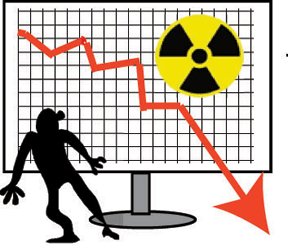 Fukushima fallout for uranium stings Heathgate Resources Financial Review, SIMON EVANS, 26 Aug 13 Heathgate Resources, the owner of the Beverley uranium mine in northern South Australia, has suffered losses totalling a whopping $60 million over the past two years.
Heathgate has operated Beverley since 2000, but has been hit hard in its past two financial years by a plunge in global uranium prices.Beverley is one of four uranium mines in Australia, and Heathgate is also involved in the nearby Four Mile uranium project, set to become the nation’s fifth uranium mine as regulatory approvals move a step closer.
Uranium prices fell by more than 50 per cent after the meltdown at the Fukushima nuclear plant in Japan in March 2011, and have failed to recover . Heathgate Resources made a loss of $34.5 million in calendar 2012 according to its latest financial statements lodged with the Australian Securities and Investments Commission.
This followed a loss of $25.6 million in 2011.
Heathgate’s total revenue in calendar 2012 was $59 million, according to its financial statements, a substantial slump from the 2011 when total revenue was $84.6 million.
Heathgate president Craig Bartels declined to comment on the results and the operating performance.
Heathgate is owned by the US-based global nuclear giant General Atomics, as is one of Heathgate’s stablemates, Quasar Resources, which holds a 75 per cent stake in the Four Mile project. The other 25 per cent of Four Mile is owned by ASX-listed Alliance Resources, but the two groups are still involved in court action over past disagreements about how best to develop the resource…… http://www.afr.com/p/australia2-0/fukushima_fallout_for_uranium_stings_7q6Q2t7EXWB2IaLsOu5w0L
BHP’s Olympic Dam uranium mine expansion again rears its ugly head
BHP ‘determined’ to push ahead with Olympic Dam but only after new mining techniques are thought through, CHRISTOPHER RUSSELL THE ADVERTISER AUGUST 22, 2013 BHP Billiton is “absolutely determined” to find a way to go ahead with expanding Olympic Dam, the company’s top executive in South Australia says.
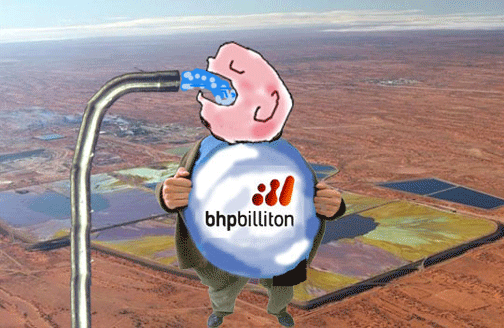
There were two key objectives for BHP in South Australia, asset president of Olympic Dam Darryl Cuzzubbo told a mining conference in Port Pirie.In his first public speech since taking command in SA, Mr Cuzzubbo said the priority was to make sure the existing Olympic Dam copper/uranium/gold operation was running at world-leading efficiency standards.
If not, he would have no credibility when asking the BHP Billiton board to fund the expansion. Secondly, the key was to make the economics of the expansion work. “We are absolutely determined to find the best way to expand Olympic Dam that competes against other investment opportunities,” he said…….
Since being granted a four-year extension by the State Government on the indenture covering the mine expansion, BHP has been working hard at rescoping the project……. There were three areas to be resolved he said – to work out a more effective mining method to get down 350m to reach the ore, to process the minerals at less cost and to split the project into “bite-size” pieces so it could generate revenue along the way.
The original expansion method envisaged spending about $30 billion but not reaching the top of the ore body for four or five years.
Deluded optimism in uranium industry, with price in free fall
Since the Fukushima disaster — a continuing nuclear crisis fuelled by Australian uranium — the price has been in free fall.
Industry advocates remain adamant or delusional that there will be a commodity price recovery but, looking at the sector’s vital signs, we find a weak pulse….. people outside of the uranium industry do not share the optimism about a uranium price recovery.
For new comers like WA uranium hopeful Toro Energy this does not bode well.
When a small inexperienced company like Toro are competing with existing operating mines for scant finance and market access, the $260 million needed to start the proposed Wiluna mine and the further $150-$260 million in upfront bonds looks more and more like “the dream that failed” a term coined by The Economist.
Uranium industry in crisis of confidence http://www.greenleft.org.au/node/54727#sthash.TOxcBrLT.dpuf August 11, 2013 By Mia Pepper, Perth While Australia’s mining sector shows signs of resilience, there is one mineral whose outlook may be terminal.
There are five significant events that have occurred recently that send a clear message about the future of the uranium sector and the wider nuclear industry.
The uranium price dropped to US$34.50 a pound Energy Resources of Australia, the operator of the Ranger uranium mine in Kakadu, announced a $54 million loss.
Perth-based uranium miner Paladin Energy failed to sell a stake in its Langer Heinrich mine in Namibia. French nuclear giant EDF announced its exit from nuclear power in the US and Duke Energy cancelled two proposed reactors in Florida.
These incidents are neither isolated nor unrelated — they are significant indicators about the health of nuclear industry. The uranium price was around US$20 through much of the 1980s and 1990s. It increased dramatically around 2005 with the promise of a “nuclear renaissance” but began a steady drop in 2007 through to the end of 2010.
Since the Fukushima disaster — a continuing nuclear crisis fuelled by Australian uranium — the price has been in free fall. Continue reading
Toro Energy and Mega Uranium making a big mistake in acquiring Lake Maitland
Toro’s mega mistake Mia Pepper – Conservation Council of WA 12 August 2013 WA uranium hopeful Toro Energy’s acquisition of Lake Maitland, another small calcrete uranium deposit in a sensitive Lake system, is based more on optimism and need rather than any measured assessment of the deeply depressed uranium price and nuclear sector said the CCWA today.
The acquisition between Toro and Mega Uranium does little to change the fundamental constraints facing each company and may well be Toro’s mega mistake.
It is a further sign of the difficulties facing junior uranium companies in a time of falling commodity prices and rising costs. Toro and Mega may share big dreams but they do not have big capacity, experience or dollars.
Toro cannot begin construction at Wiluna and do not have final and formal approval to mine at Wiluna. Instead the company has a conditional Federal approval that involving 35 conditions and requires further assessment from the Federal Minister.
The conditional nature of the approval prohibits Toro Energy from clearing vegetation or using heavy machinery for breaking ground for mining or infrastructure. Toro must also complete a mine closure plan for both State and Federal level assessment.
A recent independent economic analysis of the Wiluna project (attached) found that:
The Wiluna project’s lack of scale and high sensitivity to changes in operating or capital costs means our estimate of its position on the mine production cost curve is perilously high. The project would be highly vulnerable under our model, in the event of sustained lower long-term contract prices in the next decade. On both a cash and total economic cost basis our model suggests Wiluna is a high cost project that will struggle to compete against either existing mines or most greenfield and brownfield projects. For the full report: http://www.ecolarge.com/work/osos-sobre
For Western Australia’s Toro Energy uranium project, the outlook may be terminal
Nuclear not worth digging or dealing http://ccwa.org.au/blogs/nuclear-not-worth-digging-or-dealing#.UgWPQ9Jwo6I August 9th 2013 by Mia.Pepper Article published in the Kalgoorlie Miner 9th August 2013
At this week’s Diggers and Dealers, low commodity price and high production costs have been a focus of attention for the entire minerals sector. While, overall, Australia’s mining sector shows signs of resilience, there is one mineral whose outlook may be terminal.
There are five significant recent events that have occurred recently that send a clear message about the future of the uranium sector and the wider nuclear industry. The uranium price dropped to US$34.50lb. Energy Resources of Australia, the operator of the Ranger uranium mine in Kakadu, announced a $54 million loss. Perth –based uranium miner Paladin Energy failed to sell a stake in its Langer Heinrich mine in Namibia. French nuclear giant EDF announced its exit from nuclear power in the US and Duke Energy cancelled two proposed reactors in Florida.
These incidents are neither isolated nor unrelated – they are significant indicators about the health of nuclear industry. Continue reading
Paladin uranium miner’s troubles in Africa – near to going down the gurgler?
 Paladin shares plummet after mine sale cancelled Proactive Investors, by Fiona MacDonald 2 August 13, Paladin Energy’ s (TSE:PDN) (ASX:PDN) stock lost 15 cents on the Toronto Stock Exchange Friday from prior close of 92 cents to fall more than 16 per cent on the back of the news that the uranium miner had terminated negotiations with all parties for the sale of a minority interest in the Langer Heinrich Mine.
The announcement, released after the close of North American trading Thursday night, sparked intraday trading that saw share prices dip as low as 65 cents, marking a new bottom for the Subiaco, Australia-headquartered miner’s 52 week range.
The mine, located in Malawi in southern Africa, is owned 100 per cent by Paladin and was taken off the table as a result of low uranium prices – a legacy of the disaster at Japan’s Fukushima-Daiichi atomic power plant after the 2011 earthquake and tsunami — undercutting the company’s chances of collecting the pay day it had in mind….. It is a long fall for the miner, which was trading at $1.00 per share as recently as a week ago. http://www.proactiveinvestors.com/companies/news/46789/paladin-shares-plummet-after-mine-sale-cancelled-46789.html
Trading of Paladin uranium stock halted as its share price nosedives
Shares of uranium miner Paladin dive after cancelled sale Reuters, Aug. 02 2013, Shares of Australian uranium miner Paladin Energy Ltd. fell as much as 29 per cent in Toronto on Friday after the company cancelled plans for now to sell a minority interest in an African mine, and instead raised funds through a private placement of shares. Paladin said it ended negotiations with a potential investor on Thursday and all other parties for a stake in its Langer Heinrich mine in Namibia. The company said it was unlikely to get the price it wanted because of low uranium prices….. Trading of Paladin stock was halted in both Canada and Australia on Thursday, pending news.
Paladin’s stock was down 28 per cent, or 26 Canadian cents to 66 Canadian cents in early trading on the Toronto Stock Exchange. http://www.theglobeandmail.com/report-on-business/industry-news/energy-and-resources/shares-of-uranium-miner-paladin-dive-after-cancelled-sale/article13572589/
Bad news for Paladin Energy in drastically low uranium price
Paladin cancels uranium mine sale Yahoo 7 Finance, 2 Aug 13 Paladin Energy has scrapped the sale of a stake in its flagship African uranium mine after it failed to attract a high enough bid.
The Australian listed company instead will use a shareholder diluting $88 million capital raising to reduce about $US670 million ($A753.95 million) of debt.Paladin had been negotiating with two nuclear power companies to sell a 15 to 20 per cent stake in its Langer Heinrich mine in Namibia.
In late June, managing director John Borshoff maintained a sale would go ahead.
But the global uranium market is still depressed more than two years since Japan’s Fukushima nuclear disaster, and the spot price is at seven-and-a-half-year lows of about $US35 a pound……….
It said it would wait until prices lifted before going to the market to sell again. A uranium price of at least $US70 a pound was needed, it said.
In other bad news for Paladin, the company said it expected to have to write down the value of assets including its other producing mine, Kayelekera in Malawi, by $US180 million ($A202.55 million).
The capital raising involves the equivalent of 15 per cent of its stock being issued to private institutions.
The company’s shares went into a trading halt on Thursday at $1. http://au.finance.yahoo.com/news/paladin-cancels-uranium-mine-sale-023213073.html
Low demand, low prices, poor outlook, as Ranger uranium mine loses $54 million
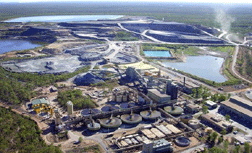 ERA boss steps down amid bleak short-term outlook The Motley Fool by Owen Raskiewicz, Thursday, August 1, 2013 Energy Resources Australia (ASX: ERA) chief executive, Rob Atkinson, has quit his position after nearly five years at the helm of the Rio Tinto (ASX: RIO) subsidiary.
ERA has struggled with massively reduced demand and prices for the past seven years. In the wake of the Fukushima nuclear disaster in
Japan, the spot price of uranium hit a low of slightly less than $US 40 per pound, its lowest point in seven-and-a-half years but it’s not
getting better…….
The one positive ERA shareholders can take away from a difficult short-term outlook is the knowledge that few new producers will come online in the near future. There was no dividend declared by ERA…
Boss of ERA bales out as Ranger uranium mine loss reported
ERA reports Ranger uranium loss of $21m and boss ABC News, By Rick Hind 1 August 13 The company that runs the Ranger uranium mine in the Northern Territory has announced a $54 million loss and the departure of its chief executive.
In its half-yearly results, Energy Resources of Australia (ERA) said losses booked up included $21 million spent on an underground exploration decline.
It said chief executive Rob Atkinson will move to Rio Tinto after five years running ERA.
ERA is majority owned by Rio Tinto….. The underground exploration decline is part of establishing the viability of future operations.
Draft EIS guidelines for the underground mining proposal are in the hands of the Northern Territory Environmental Protection Authority.
The Federal Government is expected to release environmental guidelines for the proposed expansion within weeks….. http://www.abc.net.au/news/2013-08-01/era-ranger-uranium-loss-report-ceo-goes-to-rio-tinto/4858824
1 This month
7 April – WEBINAR – Australia and the Doomsday Clock – Preventing nuclear war through NoFirstUse and other policies
Online | Tuesday April 7, 4:00-5:30pm, Australian Eastern Time / 8:00-9:30am Central Europe Time
– Access the registration link
15 April – Zoom –Nuclear Power is Not the Solution
Apr 15, 2026 01:00 AM in Canberra, Melbourne, Sydney

Join the International Physicians for the Prevention of Nuclear War (IPPNW) on Tuesday, April 14th for a timely webinar exploring the risks associated with nuclear power and challenging the myth that it offers a simple, safe, carbon-free solution to the climate crisis

21 April Webinar: No Nuclear Weapons in Australia
Start: 2026-04-21 18:00:00 UTC Canberra, Melbourne, Sydney (GMT+10:00)
End: 2026-04-21 19:30:00 UTC Canberra, Melbourne, Sydney (GMT+10:00)
Event Type: Virtual
A virtual link will be communicated before the event.
Host Contact Info: australia@icanw.org

of the week – Australians for War Powers Reform (AWPR)
To see nuclear-related stories in greater depth and intensity
 Antinuclear