Record low price for uranium, and it continues to go down fast
 The week ended with TradeTech’s Weekly U3O8 Spot Price Indicator sitting at $36.50 a pound, a decline of $1.75 over the prior week’s value. This is the lowest price that has been seen in more than seven years
The weakness was not isolated to the spot market and is starting to spill over into the term market.
Uranium Market Marches South at Double Time 9 News Finance byFN Arena By Andrew Nelson Tuesday, July 23, 2013 The crack appeared the week before last. Sellers started to buckle under the strain and gave in to lower prices. A US$1.30 drop ensued. That’s the way last week started and from there things only got worse for the uranium spot price. Continue reading
Doom and gloom in Australia’s uranium investment sector
 Uranium, rare earths miners in doldrums BY:ROBIN BROMBY The Australian July 15, 2013 A FEW years ago, talking up a well-balanced portfolio of uranium and rare earth elements assets would have been a mouth-watering come-on for investors. Not now, of course.
You’ve got Toro Energy (TOE) with most of its ducks in a row including finance and government approvals to develop Western Australia’s first uranium mine.
All except the rather important duck of a spot uranium price somewhere in the vicinity of $US70 a pound that would make the mine viable; it’s stuck with $US39.50/lb.
A few years ago, the average resources punter would have sold their children to raise money for buying such a share, but Toro languishes at just 9c.
And there was disappointment on Friday for Aura Energy (AEE), French nuclear giant Areva pulling the plug on plans to partner up with the Australian junior in its Haggan uranium project in Sweden, one of the largest undeveloped uranium projects in the world (389,000 tonnes)…..
Uranium prices just keep on – going down, down
 Spot uranium prices about $39.50/lb with ‘downward’ bias: sources Washington (Platts)- Jim Ostroff -9 Jul2013 The spot price of uranium is around $39.50 a pound, unchanged from last Tuesday, but the ongoing weak demand for U3O8 indicates that prices are more likely to soften further than rise in coming weeks, according to price publisher Ux Consulting and market sources.
Ux, in its weekly report Monday, said the spot U3O8 price was $39.50/lb, unchanged from Friday, but that the market “could see further erosion as the month wears on.” It added, “The overall demand situation may not improve anytime soon,” noting it is unlikely “that Japanese reactors will see a surge in restarts in the near future.”
Ux on Monday reduced its daily Broker Average Price — based on information from Evolution Markets and Armajaro Securities — by 6 cents to $39.38/lb. The BAP bid-offer spread Monday was $39.00-$39.75/lb, with the bid down 13 cents and the offer unchanged from Friday…..”The bias still is to the downside a bit” in the uranium spot market, one market source said in an interview Tuesday. “There remains more supply than demand and nobody seems to be motivated on either side,” to conclude deals, he said. http://www.platts.com/latest-news/electric-power/washington/spot-uranium-prices-about-3950lb-with-downward-21262350
Uranium company cuts back its NT and Queensland operations as uranium price plummets
 Deep Yellow slashes jobs, cuts pay, Minng.com, 5 July, 2013 Vicky Validakis Uranium exploration company Deep Yellow has cut jobs and reduced salaries by five per cent as it ramps up steps to reduce overhead costs, blaming the move on the weakness in the uranium sector.
The company announced board fees and executive salaries would be reduced by five per cent for at least six months, with salary scales to remain fixed at 2013 rates.
The company also said its Perth office had reduced staff to just three, comprising the managing director, financial controller and office manager.
Deep Yellow is said it is also planning to move to a smaller office by the end of the year.
The latest pay cuts follow a ten per cent reduction in base salary and fees and group-wide salary freezes in July 2012…… Deep Yellow’s chairman Mervyn Greene said the steps to reduce overheads costs was due to ongoing volatility in financial markets and a weakness in the uranium market…… In Australia the company owns the Napperby Uranium project in the Northern Territory as well as exploration tenements in Queensland. http://www.miningaustralia.com.au/news/deep-yellow-slashes-jobs-cuts-pay
More trouble hits Australian uranium company Paladin’s African empire
Some of the issues pertain to female worker’s miscarriages; [CEO] Duvenhage’s apparent failure to engage with the union; the company’s reluctance to give workers a “single cent” for an annual increment; unfair performance bonuses; nepotism and corruption.
Australian-based Paladin Energy Ltd. (TSE:PDN) owns 100% interest in the mine.
Protests hit second largest uranium mine in Namibia http://www.mining.com/protests-hit-second-largest-uranium-mine-in-namibia-85919/ Vladimir Basov | July 2, 2013 About 300 workers, including mine staff and contractor employees, picketed at Langer Heinrich Uranium (LHU) mine last Thursday over pay and working conditions, The Namibian reported.
Workers and media were barred from the minesite where the demonstration was supposed to take place although the protesters had organized the peaceful demonstration at the beginning of last week and had announced it to the mine’s management.
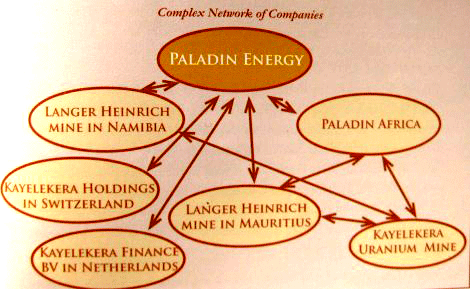
As a result, all day shift buses were forced to stop inside the concession area where workers then had to disembark – about five kilometres away from the actual site. To their dismay, the protesters were forced to picket at the concession area. The Mineworkers Union of Namibia (MUN) branch executives felt that the mine’s management snubbed what it termed a legal and democratic action. Continue reading
Western Australians stand to benefit with employment from tourism, rather than mining
 Tourism is a much more important job provider than is mining. And – it must be noted – mining is transient – and usually leaves a nasty looking degraded environment, and a dying town, when it ends. Tourism goes on, can go hand in hand with environmental conservation, and provide ongoing employment.
Tourism a jobs winner http://au.news.yahoo.com/thewest/a/-/wa/17874412/tourism-a-jobs-winner/ Yolanda Zaw, 5 July 13, Tourism will overtake mining and construction as one of the biggest employers in WA, according to statistics to be released today. Tourism accounts for 7 per cent of all jobs in the State, just behind mining with 8 per cent, construction 10 per cent and health care and social assistance, the top employer with 11 per cent.
Tourism Council chief executive Evan Hall said tourism would become more important to the WA economy as the resources boom slowed.
“The trend is for tourism jobs to grow as mining jobs decline,” he said. “With the lower Australian dollar, cheaper hotel rates and more flights to Perth, WA can win back the leisure tourists we lost over the last few years.”
Mr Hall said in all other States tourism employed more people than mining. Continue reading
Bonanza for John Borshoff. boss of Australian uranium mining company
 Paladin boss earnings increase while Kayelekera cut jobs http://www.nyasatimes.com/2013/02/14/paladin-boss-gets-massive-pay-hike-after-malawi-job-cuts/ By Nyasa Times Reporter February 14, 2013 Despite uranium miner, Paladin Energy limited claiming that its Malawi operations in the northern district of Karonga at Kayelekera are operating on massive losses and that world uranium prices are low, the company’s managing director John Borshoff elected to cash in his leave entitlementment, Nyasa Times has established.
Paladin’s annual report reveals that despite Borshoff honouring a promise to cut his salary by 25% between November 2011 and November 2012 – a promise he extended to June 2013, the CEO was able to boost his remuneration after a review of annual leave entitlements thereby pocketing a 52% rise in earnings. The review focused on annual and long-service leave in a bid to cut Paladin’s liabilities, and Borshoff responded by cashing out 220 days of leave.The transaction approaved by the remuneration Committee and the board netted Borshoff $1,717,000 and helped increase his remuneration to $3,464,000, from $2.26 million in 2012.
The uranium miner recently retrenched 110 staff from its Kayelekera mine in Malawi in an austerity drive which others commentators fault Boshoff for excercising his right to cash in the leave entitlement when local staff just had their calls for a 66 per cent pay rise rejected.
”Its total mockery to the Malawian workers at Kayelekera who were retrenched but have not had their benefits yet. These people are suffering. That’s a wake-up call to Malawi Government that Paladin is making profits despite plunge in prices” Karonga Business Community Chairperson Wavisanga Silungwe said in a statement made available to Nyasa Times.
“While production has gone up, the uranium price has not; hence Kayelekera continues to operate at a loss. We had warned government that this situation was unsustainable and would lead to job losses unless the uranium price improved, which it has not,” said Paladin’s (African) Ltd General Manager, international affairs, Greg Walker.
Walker said the staff reduction is in “response to economic pressures on the company caused by the continuing depressed uranium price” Borshoff’s contract with Paladin has one year left, and provides him with three months’ long-service leave for every five years of service. He is entitled to two years of double base salary when he retires or has his employment terminated.
|
|
Australian uranium company Paladin having more troubles, as share price falls
Uranium producer Paladin’s shares slide after stake sale delay BY:BARRY FITZGERALD The Australian June 27, 2013 SHARES in African uranium producer Paladin have been pulled back to near 52-week lows because of a delay in a planned debt-reducing sale of a minority equity position in the group’s flagship Langer Heinrich operation in Namibia.
It had been hoped that Paladin would make inroads into its $US740 million debt pile by making the sale the news of which pushed the shares from an April low of 70c to more than $1 a share in late May. But recent concerns that the previously advised June 30 target date would not be met have sent the shares lower.
The concerns were well placed, with Paladin saying yesterday that the planned sale had been delayed until mid-to-late August. Paladin shares closed 6c, or 6.8 per cent, lower at 82c.
The fall came despite Paladin managing director John Borshoff remaining confident a sale will be achieved. The planned deal is with two unnamed nuclear groups……http://www.theaustralian.com.au/business/mining-energy/uranium-producer-paladins-shares-slide-after-stake-sale-delay/story-e6frg9df-1226670445221
Rio Tinto’s Rossing uranium mine staring its terminal illness in the face
Rössing Uranium fights on for survival INFORMANTE BY FLORIS STEENKAMP 12 JUNE 2013 Rio Tinto Rössing Uranium incurred an operational loss of N$474 million in 2012, some N$10 million more than the losses the mine made in 2011. Despite this, the mine will continue to battle on and bolster cost savings and operational efficiency to ensure its long term survival.
This was the message of the outgoing managing director of Rio Tinto Rössing, Chris Salisbury, on 6 June Swakopmund.
Uranium mines globally continues to operate in adverse economic conditions…… Since Japan and many other nations started to shy away from nuclear power generation as the future of clean energy, uranium market prices plummeted by more than 36%.
Uranium mines globally continues to operate in adverse economic conditions…… Since Japan and many other nations started to shy away from nuclear power generation as the future of clean energy, uranium market prices plummeted by more than 36%.
At the Rössing mine not even a production output increase of 36% and drastic cost-saving measures could avert the 2012 losses, as this market dip was too severe….. Salisbury confirmed that he will be assuming another position in the Rio Tinto Group in Australia and said a successor would be sourced within months.http://www.informante.web.na/index.php?option=com_content&view=article&id=12165:roessing-uranium-fights-on-for-survival&catid=1:coastal&Itemid=103
| I |
Australian uranium industry should be aghast at ever lower uranium prices
Sluggish uranium prices put pressure on industry http://www.miningaustralia.com.au/news/sluggish-uranium-prices-put-pressure-on-industry 11 June, 2013 Vicky Validakis With uranium prices hitting a four-year low last week, analysts predict a resurgence of the rare earth is not expected for 12 months.
The price of uranium fell below $40 a pound for the first time since 2009, to $39.87 a pound. Despite industry claims the demand for uranium would increase, prices have not pushed through the $45/lb mark since December last year. The West Australian reported low uranium prices is causing concern on local uranium juniors such as Toro Energy who are in the bid for partners to help fund the $269 million Wiluna project.
Toro have previously said if financing arrangements went to plan the mine would be in production by the end of 2015.
The $269 million Wiluna mine, is set to become Western Australia’s first uranium mine. With world energy demands increasing, last week Resource Minister Gary said the uranium industry in Australia needs to ramp up. Speaking to the Australian Uranium Association(AUA),Gray said with the demand for uranium set to rise, Australia was in the perfect position to supply them more of the precious metal.
However, some analysts now predict a turn-around in price is still twelve months away, leaving many asking if new projects will get off the ground.
A report commissioned by Greens senator Scott Ludlam into the economic viability of Toro Energy’s proposed Wiluna project, claimed the company may struggle to make the project viable. “The Wiluna project sits very high on the cost curve of global uranium projects,” the report’s author said.
“It’s difficult to see why any of the major uranium players would invest in this project when there’s a lot of cheaper projects out there.”
In 2012, production from Australian mines rose more than 17 per cent to top 8000 tonnes. However, the level is well below the period between 2003 and 2009 when it was 9000 to 11,000 tonnes. http://www.miningaustralia.com.au/news/sluggish-uranium-prices-put-pressure-on-industry
Fear and loathing about prices hits the Western Australian uranium market
Uranium price hits four-year low Nick Sas, The West Australian June 7, 2013, A new wave of nervousness swept through WA’s already under-pressure uranium explorers yesterday after the uranium spot price hit a four-year low.
The price fell below the $40 a pound threshold for the first time since April 2009, closing at $39.87 a pound.Despite industry assurances of a price rebound over the past 12 months, uranium has failed to get any traction.
The price has not pushed through the $45/lb mark since December 14.
The lethargic price places further pressure on local uranium explorers such as Toro Energy, which is looking for a strategic partner to help fund its $269 million Wiluna project.
If funding is found, Wiluna will become WA’s first uranium mine. A hearty increase in the spot price is needed to force WA’s fledgling uranium sector into first gear, with Canadian giant Cameco indicating a price of more than $70/lb is needed before it can give the green light to its massive Yeelirrie or Kintyre deposits……http://au.news.yahoo.com/thewest/business/a/-/wa/17512668/uranium-price-hits-four-year-low/
Military and Mining to rule Woomera – an area larger than England

 Australia eases access to world’s biggest weapon range, SMH, 30 May 13 , Australia will ease access restrictions on the world’s largest weapons test range in the remote outback – an area larger than England – to unlock an estimated $35 billion in untapped mineral resources, with legislation for the change unveiled on Thursday.
Australia will ease access restrictions on the world’s largest weapons test range in the remote outback – an area larger than England – to unlock an estimated $35 billion in untapped mineral resources, with legislation for the change unveiled on Thursday.
The Woomera Prohibited Area covers 127,000 square km of mostly barren desert and has been closed to the public since 1947, when it was used for Cold War rocket and nuclear tests by Britain, Australia and the United States.
The sprawling site, which is almost free from electronic signal interference, was also chosen this year as test site for the joint British-French unmanned supersonic stealth drone Taranis, under development by BAE Systems Plc. Defence Minister Stephen Smith told MPs that new legislation would allow miners and some members of the public with reason to be there to share access to the land with the military, to better balance national security and economic concerns………
Parts of Woomera, which hosted British nuclear weapons tests between 1955 and 1963, also lie adjacent to the Olympic Dam site, which BHP Billiton decided not to expand last year as Australia’s mining boom stalled. A small number of mines already exist in the area, including Prominent Hill and Kingsgate Consolidated Ltd’s Challenger gold mine.
Under the new access arrangements, the military would remain in charge of the area, but a permit system would give civilians the right to enter Woomera. As well as miners, indigenous Aboriginal residents can also enter the zone, and environmental or other researchers.The legislation sets up a series of zones, some of which would be zoned red for “continuous defence use” and others which would exclude mining and exploration for between 14 and 70 days a year, in a timeshare arrangement with the military.
“It allows users to make commercial decisions with some assurance as to when they will be required to leave the Area because of defence activity,” Smith said……Smith said the legislation would be passed as a priority before parliament was dissolved for September elections.: http://www.smh.com.au/business/australia-eases-access-to-worlds-biggest-weapon-range-20130530-2ne3a.html#ixzz2Uuz6nLoX
Investors attracted to Australia because of the Clean Energy Finance Corporation

“The latest analysis by Bloomberg New Energy Finance (BNEF) indicates that new wind power projects in Australia are as much as 18% and 14% cheaper than new gas and oil plants respectively,”
CEFC boosting investor interest in Australian renewables: report REneweconomy, By Sophie Vorrath 30 May 2013Investment in renewable energy projects in Australia has become more appealing since the establishment of the federal government’s $10 billion Clean Energy Finance Corporation, according to the latest edition of Ernst & Young’s Renewable Energy Country Attractiveness Index.
The index, released this week, ranks Australia’s ‘attractiveness’ in the global renewables investment market – a market it says is expected to be worth $US630 billion a year by 2030 – in fourth place, below the US, China and Germany (in first, second and third positions, respectively) and ahead of the UK, Japan, Canada, India, France and Belgium. Continue reading
Toro Energy’s Wiluna uranium unlikely to make a profit
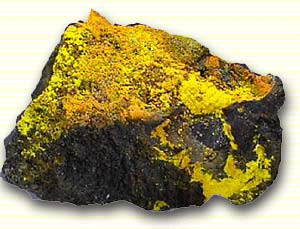
So how do the economics of the Wiluna project stack up? According to our modelling – based on Toro Energy’s own cost figures ?– not well……
Why Wiluna is worth watching, Business Spectator, Rod Campbell, 28 May 13 What could be Western Australia’s first uranium mine is unlikely to turn a profit unless costs to clean up the mine can be made to disappear.
Our modelling of the economics of Toro Energy’s Wiluna uranium project found that the mine is unviable if Toro Energy has to pay even optimistic estimates for the decommissioning and rehabilitation of the site.
The public and the environment have quite a stake in most mining projects and uranium projects in particular. Not only is it the public’s own mineral resources that are being sold – it’s often forgotten that all mineral resources are held by the Crown in the name of the public – but the environmental impacts of mine closure can be serious if not carried out properly.
Properly cleaning up a uranium mine can be an expensive business, so here’s why the public should be interested in the finances of mining projects – if in 2030 Toro Energy cannot foot the bill, Western Australians will face the unpleasant choice of paying the bill or accepting a degraded, potentially radioactive landscape. Continue reading
(? Dangerous) Australian invention Silex Laser Uranium Enrichment
Silex Systems gets closer to nuclear ambitions LISTED uranium processing pioneer Silex Systems is a quantum step closer to its long-term quest of persuading a cabal of heavy-hitting US nuclear companies to build a full-sized power station using its next-generation enrichment method.
Silex last week revealed the consortium, Global Laser Enrichment, had completed a first-stage “test loop” at its facility in Wilmington, North Carolina. …. http://www.theaustralian.com.au/business/mining-energy/silex-systems-gets-closer-to-nuclear-ambitions/story-e6frg9df-1226650934760
1 This month
7 April – WEBINAR – Australia and the Doomsday Clock – Preventing nuclear war through NoFirstUse and other policies
Online | Tuesday April 7, 4:00-5:30pm, Australian Eastern Time / 8:00-9:30am Central Europe Time
– Access the registration link
15 April – Zoom –Nuclear Power is Not the Solution
Apr 15, 2026 01:00 AM in Canberra, Melbourne, Sydney

Join the International Physicians for the Prevention of Nuclear War (IPPNW) on Tuesday, April 14th for a timely webinar exploring the risks associated with nuclear power and challenging the myth that it offers a simple, safe, carbon-free solution to the climate crisis

21 April Webinar: No Nuclear Weapons in Australia
Start: 2026-04-21 18:00:00 UTC Canberra, Melbourne, Sydney (GMT+10:00)
End: 2026-04-21 19:30:00 UTC Canberra, Melbourne, Sydney (GMT+10:00)
Event Type: Virtual
A virtual link will be communicated before the event.
Host Contact Info: australia@icanw.org

of the week – Australians for War Powers Reform (AWPR)
To see nuclear-related stories in greater depth and intensity
 Antinuclear