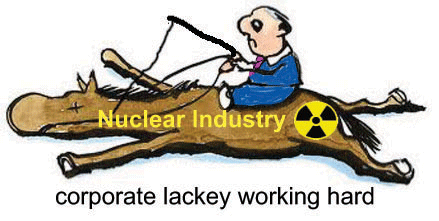
Toro Energy flogging a nearly dead uranium horse?
Claims Toro’s uranium project may struggle May 20, 2013 http://www.abc.net.au/news/2013-05-20/claims-toro27s-uranium-project-not-financially-viable/4700982 An economist is warning that the first proposed uranium mine in Western Australia may struggle to get off the ground.
The comments are made in a report, commissioned by Greens Senator Scott Ludlam and environmental groups, into the viability of Toro Energy’s proposed Wiluna project.
The study by ‘Economics at Large’ indicates the project’s profitability relies on a number of sensitive factors. The paper’s author, Roderick Campbell, says Toro may struggle to make the project viable.
“The Wiluna project sits very high on the cost curve of global uranium projects,” he said. “It’s difficult to see why any of the major uranium players would invest in this project when there’s a lot of cheaper projects out there.”
 Toro has released a statement saying the Wiluna project has won WA and Federal Government environmental approval to proceed after a rigorous three and a half year assessment process. It says, as a result, there is significant market interest from international energy utilities and global resource investors in the Wiluna project.
Senator Ludlam claims the project will just manage to be financially viable if Toro can avoid clean-up and decommissioning costs.He says Toro has not submitted a costed mine closure plan and the numbers are against the company when the cost of the clean-up is factored in.
Toro is yet to respond to that particular claim.
Toro economic report – uncovering the uranium industry bull
20 May 13, West Australia’s first planned uranium mine has been put under the spotlight and found lacking in a detailed new economic  analysis.
The viability of Toro Energy’s Wiluna uranium proposal has been examined by the independent economic consultancy Economists at Large in a report jointly commissioned by the Anti-Nuclear Alliance of WA and the office of WA Senator Scott Ludlam.
“It is time for Toro to come clean on the full costs of the Wiluna project”, said ANAWA member Mia Pepper. “Toro’s mine closure plans and costs require particular attention as the project’s viability rests on these.”
“In 2013 ERA – the operator of the Ranger uranium mine in Kakadu – estimated closure costs at $640 million. Even if you half that and half that again for this small low grade project, mine closure estimates are still around $150 million – we are yet to hear full details from Toro about this cost.”
The report outlines that for Toro to achieve a positive Net Present Value would require the convergence of a range of external scenarios including low mine closure costs, structural changes in the long term uranium contract price, a drop in Australian exchange rates, cost easing in the mining sector and better efficiency in mining, milling and recovery rates so the project proceeds on time, within budget and without technical snags. The chance of all these factors occurring is very low.
“The Toro project represents risk at every stage”, said Mia Pepper. “It is a risk to the environment at Lake Way, a risk to shareholders and investors and a risk to WA tax payers. This report confirms that the economics of the project are volatile and uncertain – however it is certain that the project will remain strongly contested”.
“From people taking action on country – like the seventy committed people walking through the region in opposition to uranium mining right now – to sounding the alarm in the board room, this flawed mine plan will be contested. The Toro Energy plan has never made sense and this report shows that it also won’t make dollars”.
The author of the report, Roderick Campbell, economist with Economist at Large, is available for comment on 0438503249.
Huge write-down in value of Paladin’s Kayelekera uranium mine
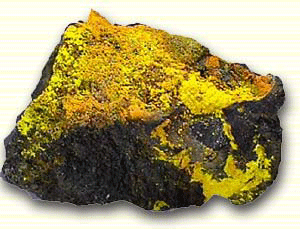 Kayelekera value cut over weak spot prices THE DAILY TIMES , 17 MAY 2013 THOM KHANJE Australian-uranium miner, Paladin Energy, has slashed a further US$45 million from the value of its Kayelekera Mine in Karonga as poor spot prices of uranium continue to negatively affect its earnings from the mine.
Following the write-down, the mine is now valued at only USid=”mce_marker”40.8 million, down from over US$200 million nine months ago.
 In its financial report for nine months to March 31 released this week, Paladin blamed continued poor uranium prices for the losses.
The spot uranium price, which has been in the doldrums since the 2011 Fukishima nuclear disaster, went down to a three-year low of US$40.75 a pound by the beginning of this week.
Paladin has since reported an overall net loss of US$247.7 million for the nine months, a sharp drop from the USid=”mce_marker”37.7 million net loss for the similar previous period…….
The falling uranium price and reduced production levels at both the Kayelekera and Langer Heinrich Mine in Namibia during the first quarter of 2013 compared to the previous three months, have also led to a fall in Paladin’s stock market value….. http://www.bnltimes.com/index.php/daily-times/headlines/business/15096-kayelekera-value-cut-over-weak-spot-prices
90% decline in share price for uranium producers ERA, Paladin Energy , and Bannerman Resources
 Coal, uranium and gold stocks among the hardest hit as good times end BY:ROBIN BROMBY The Australian May 20, 2013 “…… Among those hardest hit are coal, uranium and gold. The base metal stocks don’t seem to have suffered to quite the same degree, although few stocks have come off less than about 60 per cent.
Among those with declines of more than 90 per cent since their peak are leading uranium stocks. In their case, their peak was back in 2007. Producer Energy Resources of Australia (ERA) has come down from $18.92 then to $1.04 now. Paladin Energy (PDN) hit $10.80 back in 2007 and now sits at 94c. Bannerman Resources (BMN) with its Namibia project was a star back then at a high of $4.14, now at 5.8c…..”
Uranium price could stagnate at low levels, for years
Now here’s an unusual item from the Australian business pages. Instead of the usual big talking up of the future for Australia’s uranium companies, – darned if one investment writer hasn’t told it like IT IS!
 Uranium on the nose, The Motley Fool By Mike King – May 16, 2013 More than 26 months after the nuclear accident at Fukushima, Japan, the nuclear industry is still feeling the effects with depressed uranium prices and cost pressures that are squeezing margins……
The price for uranium has fallen 40% since Fukushima to US$40 a pound, as Japan suspended its fleet of nuclear plants, while Germany…
….. the uranium price could stagnate at current levels for many years, much like it did after previous nuclear incidents. Japan may not restart its reactors, preferring instead to seek other energy alternatives, and reactors currently under construction could still be cancelled or postponed.
That is not good news for ASX listed uranium miners Paladin, Energy Resources of Australia (ASX: ERA), Toro Energy (ASX: TOE) or Deep Yellow Limited (ASX: DYL). http://www.fool.com.au/2013/05/16/uranium-on-the-nose/
The skilled and proud work of Indigenous rangers in remote Australia
 There is a lot of unmanaged country out here. Our people want to get to work managing it. Indigenous rangers and Indigenous Protected Areas are a great success story providing real jobs and good management for our country.
In a federal election year I am calling on all leaders of state and federal political parties to support increased funding for these programs over the next decade. That’s a vision we can all support.
A proving ground for proud carers of country, Canberra Times, Murrandoo Yanner, 13 May 13 2013 A quiet evolution has been occurring in remote Aboriginal communities over the last decade, with ranger programs enabling people to earn a decent income, support their families and experience the pride that comes with that.
…….. quiet evolution has been occurring in remote Aboriginal communities over the last decade that isn’t well understood.
Up to now, indigenous-ranger programs have had bipartisan support, starting under the former Howard government and greatly strengthened by Labor. It’s an evolution because ranger programs are increasing the capacity of our mob and bringing them out of poverty, while also contributing to the evolution of attitudes in remote regions and healing the land….. Continue reading
May 3rd: antidote to uranium lobby’s lies about EMPLOYMENT
 AUSTRALIA’S URANIUM EXPORT REVENUE IN PERSPECTIVE YELLOWCAKE FEVER Exposing the Uranium Industry’s Economic Myths , Australian Conservation Foundation “…..IBISWorld’s market report (March 2013) states there are just 650 jobs across Australia in uranium mining. In May 2006, the federal Department of Industry, Tourism and Resources estimated “over 700 jobs” in uranium mining and in October 2007 the Department’s
Investors have been burned, as governments and “analysts” hype Australia’s failing uranium industry
Last year the Olympic Dam expansion was cancelled, BHP disbanded its uranium division and sold the Yeelirrie uranium lease in Western Australia for about 11 per cent of the nominal value of the resource.
Also indicative of the state of the industry was Cameco’s announcement in February of a $162.5 million write-down on the Kintyre project in Western Australia. Just months after first production at the Honeymoon mine in north-east SA in September 2011, project partner Mitsui announced its decision to withdraw as it “could not foresee sufficient economic return from the project”.
In addition to industry propaganda, governments routinely inflate the significance and potential of the uranium industry, as do industry “analysts” (some of them market traders), some business journalists and some academics. There are real-world consequences to uranium mania — many “mum and dad” retail investors have been burned, especially during the speculative price bubble in the mid-2000s.
Uranium Industry Dreams Of Paydirt http://newmatilda.com/2013/05/02/uranium-industry-dreams-paydirt By Jim Green, 2 May 13, A new report released by the Australian Conservation Foundation: Yellowcake Fever: Exposing the Uranium Industry’s Economic Myths, shows that uranium accounted for just 0.29 per cent of Australia’s export revenue in the 10 years from 2002−2011. In the last financial year, uranium revenue of $607 million was 103 times lower than the biggest earner, iron ore. Milk and cream generate twice as much export revenue as uranium — and can’t be turned into Weapons of Mass Destruction.
Uranium export revenue is still more underwhelming given that the four companies mining uranium in Australia are all either majority foreign owned or 100 per cent foreign owned; in other words, a sizeable proportion of that export revenue never leaves the Northern Hemisphere and never comes anywhere near Australia. Continue reading
May 1st’s antidote to Australia’s uranium lobby lies about: The Uranium Market
 AUSTRALIA’S URANIUM EXPORT REVENUE IN PERSPECTIVE YELLOWCAKE FEVER Exposing the Uranium Industry’s Economic Myths , Australian Conservation Foundation A serious constraint is the modest size of the global market for uranium. Even if all secondary supply is bundled into the primary market, and lower spot prices are ignored, the figure still falls short of $10 billion p.a:
 (Beverley) 100%, and Uranium One (Honeymoon)
Australian Uranium Association’s Paydirt Conference shortened to one day, in gloomy economic prospects
 PAYDIRT URANIUM CONFERENCE IN ADELAIDE THIS MONDAY Uranium industry boosters will gather this Monday April 29 at the Adelaide Hilton for the annual Paydirt Uranium Conference. This year’s conference has been downgraded to a one-day event, reflecting industry stagnation in the wake of the Fukushima disaster.
Friends of the Earth national nuclear campaigner Dr Jim Green, co-author of a new report exposing the economic myths of the uranium industry, said: “The Australian Uranium Association’s Executive Director Michael Angwin claims that Australia “has enough reserves to be to uranium what Saudi Arabia is to oil”. However Australia’s uranium export revenue in 2011 was 466 times lower than Saudi oil revenue in the same year. Others to draw asinine comparisons between Australian uranium and Saudi oil include former SA politicians Mike Rann and Kevin Foley, and Adelaide-based academics Ian Plimer and Haydon Manning.”
“For decades the uranium industry has promised great economic benefits but it never delivers. Uranium accounted for just 0.29 per cent of Australia’s export revenue in the 10 years from 2002−2011. In the last financial year, uranium revenue was four times lower than Australia’s 20th biggest export earner, eight times lower than Australia’s 10th biggest export earner and 103 times lower than the biggest earner, iron ore. Even milk and cream generate nearly twice as much export revenue as uranium − and can’t be turned into Weapons of Mass Destruction. Uranium mining and exploration accounts for just 0.015% of all jobs in Australia.”
“Last year, BHP Billiton cancelled its planned expansion of Olympic Dam, disbanded its Uranium Division, and sold the Yeelirrie uranium lease in Western Australia for about 11% of the nominal value of the resource. Just months after first production at the Honeymoon mine in north-east SA in September 2011, project partner Mitsui announced its decision to withdraw as it ‘could not foresee sufficient economic return from the project.'”
“An independent inquiry is long overdue to objectively weigh the uranium industry’s economic benefits against its effects on environmental and public health, safety and security, particularly in the shadow of the unfolding Fukushima tragedy − a tragedy directly fuelled by Australian uranium,” Dr Green concluded.
‘Yellowcake Fever: Exposing the Uranium Industry’s Economic Myths’, a report released by the Australian Conservation Foundation last Friday, is posted at:
High risk, low return: Australia’s uranium industry’s poor record demands inquiry
 Dave Sweeney, 26 April 13 Australia’s uranium industry is a minor contributor to employment and the economy, a major source of domestic and international risks and is overdue for an independent inquiry into its effects on the environment, health, safety and security, according to a report released today on the anniversary of the 1986 Chernobyl nuclear disaster.
The report, Yellowcake Fever: exposing the uranium industry’s economic myths, released by the Australian Conservation Foundation, shows uranium accounted for only 0.29 per cent of national export revenue and less than 0.015 per cent of Australian jobs in the decade to 2011.
In the last financial year, revenue from uranium was four times lower than Australia’s 20th biggest export earner, eight times lower than Australia’s 10th biggest export earner and 103 times lower than the biggest earner, iron ore. “While Australia’s uranium sector remains an economic minnow, it is a leviathan when it comes to the damage it does to communities and the environment and the risks it spreads,” said the Australian Conservation Foundation’s Dave Sweeney.
“It is time for an independent and credible cost-benefit analysis of this sector and for decisions to be based on evidence, not self-interested industry enthusiasm.”
The most recent independent assessment of the Australian uranium industry – a Senate Inquiry in October 2003 – found the sector characterised by underperformance and non-compliance, an absence of reliable data to measure contamination or its impact on the environment and an operational culture focussed on short term considerations.
“In the decade since that Senate Inquiry, leaks, incidents and accidents have continued to dog uranium mines, Australia has sold uranium to more nuclear weapon states and Australian uranium has fuelled the continuing Fukushima tragedy,” said Dave Sweeney.
“The Australian Uranium Association’s push to reduce independent scrutiny of uranium projects shows why this sector does not enjoy community confidence or a social license.
“We call on the federal government to establish an evidence-based inquiry into the operations and impacts of this industry, particularly in the shadow of Fukushima.” Contact: Dave Sweeney, 0408 317 812
Toro Energy faces a struggle to make Wiluna uranium project economic
Raising the $A269 million to build Wiluna is the obvious challenge at a time of an ultra-cautious stock market and with banking conditions as tight as anyone has seen in decades.
the question of the real cost of uranium at Wiluna because if you add 10% for other charges the $37/lb becomes $40.70/lb and an extra 20% lifts the full cost to $44.40/lb.
Equity investors and the providers of debt finance to the Wiluna project will want to see something far more concrete than investment bank estimates before they provide the capital to develop Wiluna.
Dryblower on the obstacles awaiting Wiluna http://www.miningnews.net/StoryView.asp?StoryID=798350828, 8 April 2013 DIRECTORS and staff at Toro Energy had every reason to pop the corks on a few bottles of champagne last Tuesday when the Australian government provided environmental approval for its Wiluna uranium project in Western Australia, though Dryblower hopes it was just Jacob’s Creek and not Moet.
Keeping the good stuff on ice for a little longer is probably a good idea because even though one hurdle has been cleared Wiluna and Toro have a few more to clear before the serious celebrating can start. Continue reading
Toro Energy’s uranium to be moved through Northern Territory and South Australia
New mine to ship uranium through NT, SAhttp://www.skynews.com.au/businessnews/article.aspx?id=860386 April 4, 2013 A new West Australian mine will likely ship uranium concentrate through two other states.
The federal government on Tuesday approved Toro Energy’s $269 million Wiluna uranium project, 30km south of the Wiluna township and about 960km northeast of Perth.
Toro managing director Vanessa Guthrie says shipping is likely to start from 2015 using existing rail lines between South Australia and the Northern Territory.
‘We would take it to Port Adelaide then rail through to Darwin as currently happens with the other co-shippers,’ she told ABC Radio.
The Wiluna mine will become Australia’s sixth producer of uranium and the first in Western Australia.
Impossible job of Western Australian uranium mine – given to Vanessa Guthrie?
Women call shots at U-miner Nick Butterly Canberra, The West Australian April 3, 2013,
Dr Guthrie is managing director of Toro and Dr Smyth is its non-executive chairman.
Dr Guthrie acknowledged it was unusual for a miner to have both a female chief executive and a chairman…..
Dr Smyth said the fact a mining company headed by two women was succeeding showed how the resources industry was changing and stereotypes were being broken down. http://au.news.yahoo.com/thewest/a/-/wa/16515070/women-call-shots-at-u-miner/
Christina’s comment – “Oh yeah! – more like the stereotype of giving the impossible jobs to women!”
Very little economic benefit to Queensland, in uranium mining
 NGOs release alternative report to Uranium Implementation Committee
Queensland Nuclear Free Alliance March 18, 2013
High Risk – Low Returns: the case against uranium mining in Queensland is the NGO and civil society response to the LNPs undemocratic decision to go ahead with uranium mining in our state.
Read the report http://qnfa.files.wordpress.com/2013/03/180313highcost-lowreturn-uinqld.pdf
In October 2012 the LNP government broke its clear commitment not to allow uranium mining in Queensland. This commitment was the position of the LNP at the March 2012 state election and was reaffirmed after they took office. In the absence of open, inclusive and evidence based policy making the Newman LNP government has set up the Uranium Implementation Committee. The Committee has not sought broad community input and has not been asked to assess the arguments for and against uranium mining in Queensland. The Committee’s mandate is the far narrower task of recommending how uranium mining should be managed, not whether it should occur.
Why should Queensland forego the economic benefits of uranium mining when some other states permit uranium mines? In a nutshell, it is because the economic benefits are grossly overstated and are outweighed by the wide-ranging environmental, public health and weapons proliferation problems and risks.
Uranium accounted for 0.19 per cent of Australia’s export revenue in 2011/12 (the last available figures). By the most generous estimate, uranium accounts for 0.015% of all jobs in Australia. For Queensland, there is the additional limitation that the state has around just 2% of Australia’s uranium resources. Clearly, the industry has no capacity to deliver significant economic or employment benefits.
Instead of acknowledging the extremely limited economic potential of uranium mining in Queensland the LNP state government, the Australian Uranium Association and the Queensland Resources Council have continued a pattern of extravagant and unsubstantiated claims regarding jobs, revenue and royalties. Enthusiasm is no substitute for evidence and limited sectoral self-interest is not the same as the public interest. Continue reading
1 This month
7 April – WEBINAR – Australia and the Doomsday Clock – Preventing nuclear war through NoFirstUse and other policies
Online | Tuesday April 7, 4:00-5:30pm, Australian Eastern Time / 8:00-9:30am Central Europe Time
– Access the registration link
15 April – Zoom –Nuclear Power is Not the Solution
Apr 15, 2026 01:00 AM in Canberra, Melbourne, Sydney

Join the International Physicians for the Prevention of Nuclear War (IPPNW) on Tuesday, April 14th for a timely webinar exploring the risks associated with nuclear power and challenging the myth that it offers a simple, safe, carbon-free solution to the climate crisis

21 April Webinar: No Nuclear Weapons in Australia
Start: 2026-04-21 18:00:00 UTC Canberra, Melbourne, Sydney (GMT+10:00)
End: 2026-04-21 19:30:00 UTC Canberra, Melbourne, Sydney (GMT+10:00)
Event Type: Virtual
A virtual link will be communicated before the event.
Host Contact Info: australia@icanw.org

of the week – Australians for War Powers Reform (AWPR)
To see nuclear-related stories in greater depth and intensity
 Antinuclear