Northern Territory’s only uranium mine doubles last year’s crippling loss of money!
 Ranger loses $51.5m http://www.ntnews.com.au/article/2012/07/27/312091_nt-business.html NIGEL ADLAM | July 27th, 2012 Ranger uranium mine. THE Territory’s only
 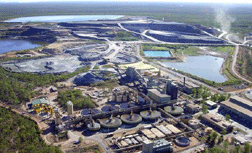 uranium mine has lost more money. Energy Resources of Australia said yesterday that Ranger suffered a loss of $51.5 million in the first six months of this year.
The operation lost $22.3 million in the same period last year. ERA said lower sales, lower prices and a strong Australian dollar were behind the result despite production doubling in the period.
Uranium miner Energy Resources of Australia cutting jobs
 Uranium mine foreshadows job cuts, ABC Rural News, By Carl Curtain , 26/07/2012 The CEO of the Ranger Uranium Mine in the Northern Territory says jobs will be cut as mining is suspended and the company begins its exploration underground.
A $60 million loss was recorded last financial year by Energy Resources Australia, outlined in its half-yearly report released today..
Mining of ‘Pit 3’ will finish at the end of the year, and only stockpiles of ore will be processed until more uranium can be
discovered and mined in coming years…. http://www.abc.net.au/rural/news/content/201207/s3554257.htm
Energy Resources of Australia (ERA) – big losses but hopeful that Japan will “embrace nuclear energy”!
 ERA looks to Japan re-embracing nuclear THE AUSTRALIAN, BY: BY KIM CHRISTIAN From: AAP July 26, URANIUM miner Energy Resources of Australia (ERA) says Japan will re-embrace nuclear power and that China will become increasingly reliant on the same technology.
The comments by ERA chief executive Rob Atkinson come as the miner’s year of reckoning approaches with its flagship mine Ranger in the Northern Territory rapidly depleting.,,,,,, Mr Atkinson said the uranium market remained challenging,… Mr Atkinson was speaking after ERA said it net losses shrank by more than 50 per cent to $59.86 million in the first half compared to the previous corresponding period. Continue reading
Australian Uranium Association resigned to inevitable fall in uranium sales
 Simon Clarke, communications director for the Australian Uranium Association, said the Fukushima incident had hurt demand for Australian uranium, and the new policy would see an overall reduction in exports
“We would very much prefer to have the whole Japanese nuclear fleet back in the game, but obviously that’s not going to happen,” he said……would mean a fall in sales for Australian producers ERA and BHP Billiton.
Tetsunari Iida, who heads Japan’s Institute for Sustainable Energy Policies, hopes Japan can become a leader in renewable technology and come to depend solely on renewable sources.
Gas the winner as Japan crafts its post-tsunami energy plan BY: RICK WALLACE The Australian July 26, 2012 “…the nation looks to reduce its dependence on nuclear energy after the Fukushima disaster. The policy will not be released for at least another month, but three scenarios have emerged from the sometimes fractious deliberations.
The impact on Australia — which provides 20 per cent of Japan’s natural gas, 66 per cent of its thermal coal and more than one quarter of its uranium — will be slightly different in each case. Continue reading
Contractor lays off Olympic Dam workers, in view of doubts on its future
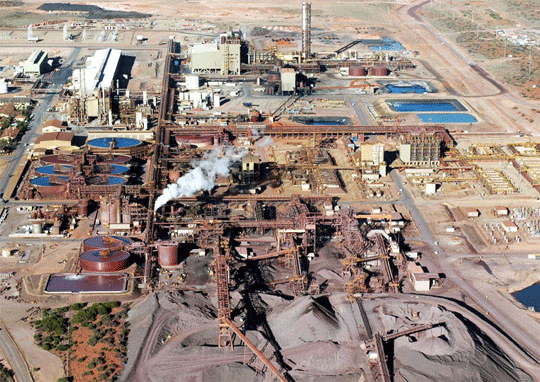 BHP reviews contractors, staff amid project uncertainty Business Spectator, 24 Jul 2012 In the latest sign that BHP Billiton Ltd may not approve the expansion of its Olympic Dam copper-uranium mine in South Australia later this year, the miner is conducting a review of contractors and staff across its mining mega-projects, looking for potential cost-saving cuts, according to The Australian Financial Review.
In the wake of BHP’s indication recently that it may not approve its three mining mega-projects before December, the company in charge of conducting a feasibility study on the $US20 billion-plus Olympic Dam project laid off several workers last week after its contract expired, according to the AFR.
The company, Jacobs Engineering, made the layoffs on the basis that it could not justify the staffing levels unless BHP’s board approved the project….. If the BHP board fails to approve the Olympic Dam project by December 15 the South Australian government will have the right to allow an indenture agreement setting royalty rates for 45 years to lapse. … http://www.businessspectator.com.au/bs.nsf/Article/BHP-reviews-contractors-staff-amid-project-uncerta-pd20120723-WGLXZ?OpenDocument&src=hp10&WELCOME=AUTHENTICATED%20REMEMBER
Olympic Dam expansion in doubt, say South Australian Liberals
 SA Libs say Olympic Dam in doubt THE AUSTRALIAN AAP July 25, 2012 A DECLINING world economy may force BHP Billiton to delay a $30 billion expansion of the Olympic Dam copper and uranium mine in South Australia, the state opposition says. Mineral Resources spokesman Mitch Williams says there is growing evidence world economic woes will prompt the company to delay the project, including an Access Economics report which points to the mining boom finishing in two years.
“There is a strong chance now that the expansion won’t go ahead next year as BHP Billiton puts the brakes on its global investments, especially long-term ones like Olympic Dam,” Mr Williams said in a statement on Wednesday.
BHP Billiton has until the end of the year to finally approve the expansion or face the need to renegotiate approvals with the state government…. http://www.theaustralian.com.au/news/breaking-news/sa-libs-say-olympic-dam-in-doubt/story-fn3dxiwe-1226434685135
Warning on over optimism about Australia’s uranium industry
 Toro boss says analysts overestimate uranium industry Australian Mining 19 July, 2012 Andrew Duffy Toro Energy managing director Greg Hall, who is leading the development of WA’s first export uranium mine, says analysts have overestimated future uranium production….
new projects must pass technical, regulatory and finance hurdles, often uniquely specific to the uranium sector, before construction and ultimately production can come online,” he said.
“In this regard Toro believes the market and a number of uranium analysts are being overly optimistic on supply timelines for new uranium projects and that as a result future production is overestimated.”
Toro Energy now postponing decision on whether to go ahead with Wiluna uranium mine
WA’s first uranium mine delayed Business Spectator, 19 Jul 2012 The timeline for Western Australia’s first uranium mine has slipped after a rigorous environmental assessment. Toro Energy Ltd announced a revised target date for a final board decision on whether to proceed with its Wiluna project in central WA, moving it back to the first half of 2013.
The company had previously expected to make a final decision by the end of 2012.
The project was approved by the state’s Environmental Protection Authority (EPA) in May and appeals are being reviewed before a final decision by WA environment minister Bill Marmion. Managing director Greg Hall said yesterday the company hoped Mr Marmion would make a decision by the end of September….
…. In 2008, the Liberal state government lifted a six-year ban on uranium mining that was imposed by the previous Labor government. WA’s Labor opposition remains has not changed its stance on uranium mining, but says it will not stand in the way of any planned uranium mine that has received approvals if the party wins state elections in March.
There are no other uranium projects in WA that would be fullyenvironmentally approved by the time of the election.
ww.businessspectator.com.au/bs.nsf/Article/Timeline-for-WAs-first-uranium-mine-slips-WC4P8?OpenDocument
BHP tightlipped about whether or not the big new Olympic Dam uranium mine will actually go ahead
For all the hype about its planned “biggest uranium mine in the world” at Olympic Dam, BHP is experiencing some jitters, as shareholders are not so keen on seeing the company blow $30 billion on this behemoth, before there’s a sign of any profit from this geewhiz dream of CEO Marius Kloppers.
BHP Seeks Friends in Volatile Times, Wall Street Journal, 19 July 12“…..fuel for volatility in BHP’s shares is the question of BHP’s spending discipline. Commonwealth Bank has said it remains concerned by the company’s capital allocation policy, and believes the market would rather see windfall cashflow returned to shareholders via dividends or share buybacks…
BHP has declined to comment on the progress of the multibillion dollar projects, including the expansion of the OlympicDam copper-uranium mine in South Australia …“Cuts to capex [capital expenditure] and growth profile are…likely if commodity prices weaken further than expected,” Citi analysts said.
Australian company selling solar technology in USA
 Australian company signs U.S. solar PV contract
http://www.power-eng.com/articles/2012/07/australian-company-signs-us-solar-pv-contract.html Jul 10, 2012 Australia-based CBD Energy Limited, a diversified renewable energy company, has signed its first solar photovoltaic (PV) installation contract in the U.S. The project is a design, engineering, procurement and construction (EPC) contract to build a solar system for a school in New Jersey. Westinghouse Solar Inc. (NASDAQ: WEST) will partner with CBD’s EPC division to deliver the project.
The project is valued at $3.8 million and is expected to begin construction in mid-July. Construction is scheduled to take three months.
Olympic Dam copper/uranium mine’s future more doubtful, with rise of RECYCLING of metals
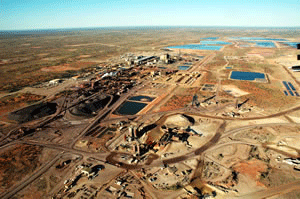 Olympic Dam is surely under review,” said UBS mining analyst Glyn Lawcock. “It’s not an issue of finding the cash,” he
said, but rather ensuring a good return on the investment……
Further curbing the appetite for refined copper, BHP now sees recycled scrap meeting up to 50 percent of China’s overall demand in the coming year for the metal, up from 35 percent now.
there is a much bigger question mark over it [Olympic Dam new mine] now
BHP Olympic Dam delay would tighten copper supply Reuters, By James Regan SYDNEY | Fri Jul 6, 2012 “….. A 25 percent drop in benchmark international copper prices since early 2011 has eroded potential returns from the project, and the economic slowdown in top base metal consumer China has dampened the demand outlook.
BHP’s scheme to quadruple output from Olympic Dam – the fourth-largest known copper deposit and largest uranium source in the world – is one a growing number analysts believe likely to be shelved until markets stabilize…. London copper prices have fallen to around $7,650 a metric ton (1.1023 tons) from a peak over $10,000 in early 2011 as big copper buyers such as car and computer manufacturers slow consumption… Continue reading
Poor market outlook for copper/uranium will make BHP delay Olympic Dam plans
BHP May Reduce Copper Supply Reduced Demand in China Hurts Production, Wealth Daily, By Swagato Chakravorty , July 9th, 2012 After a 25 percent decline in international copper prices since 2011, BHP Billiton (NYSE: BHP) may need to reduce the global supply of copper from late 2013 onward should the $30 billion Olympic Dam mine
project in Australia be delayed.
The sustained drop in copper prices has affected the potential for returns on the project, and China’s cooling economy has added on to demand woes. BHP intended to expand the mine in order to increase output fourfold from what is the world’s fourth-largest known copper deposit and biggest source of uranium.
40 percent of the world’s copper demand comes from China, which also cut its interest rates last Thursday for the second time as it increasingly focuses on shoring up its economy.
BHP is working on turning the Olympic Dam, which is currently a mine, into an open pit operation.
The board will make a decision by year-end on whether or not to continue the process, which would produce 750,000 metric tons of copper and 19,000 metric tons of uranium a year.
Right now the biggest problem is figuring out whether the current levels of copper will mean an oversupply as demand slows down everywhere…. for now, the analysts advise against the sort of mining expansion BHP is planning.
Reuters reports: “Now is not exactly the right time to be thinking of bringing more copper into the market and BHP knows this,” said Gavin Wendt, a mining analyst with MineLife in Sydney.
BHP Billiton’s open cut Olympic Dam copper/uranium project to be shelved indefinitely?
BHP (NYSE:BHP) Reports It Will Make Tighter Worldwide Copper Supply- USA Election News, 9 July 12 By: Jessica Honsinger BHP Billiton Limited (NYSE:BHP) reported on Friday that it will make tighter worldwide copper supply from late 2013 onward if it delays work on its single-biggest project, the $30 billion growth of the Olympic Dam mine in Australia.
A 25% decrease in benchmark international copper prices since early on 2011 has eroded possible returns from the project, and the economic delay in top base metal consumer China has dampened the demand
viewpoint. BHP’s system to quadruple output from Olympic Dam the fourth-biggest known copper deposit and biggest uranium source in the world is one a growing number experts consider probable to be shelved until markets
stabilize….. http://uselectionnews.org/bhp-nysebhp-reports-it-will-make-tighter-worldwide-copper-supply-bhp-pcx-vale-anr-aci/
Another Ugly Australian Uranium Mine in a World Heritage Park
Tanzania gets U.N. nod for uranium mine in game park DAR ES SALAAM, July 5 (Reuters) – Tanzania has received U.N. approval for Australia-based miner Mantra Resources to build a $400 million uranium mine in a world heritage game reserve despite pressure from environmental groups opposed to the project, it said on Thursday.
Green groups have warned that toxic mining activities at the plant would harm the ecologically sensitive Selous Game Reserve in the east African country… http://af.reuters.com/article/tanzaniaNews/idAFL6E8I57YN20120705
Australian government looks to the future with its carbon policy
 more than 50 jurisdictions around the world, with a combined population of 850 million, will have a carbon price by next year.
Far from disappearing from the face of the earth, Whyalla’s OneSteel is investing $200m in a port upgrade.
If Australia were to falter and defer carbon pricing, our industries would be stuck with old technologies in a global marketplace in which production processes are moving to lower-carbon energy sources.
Pricing carbon is essential to our nation’s future, BY: CRAIG EMERSON The Australian June 30, 2012 IF you believe the prophecies of carbon pricing opponents, the world as we know it comes to an end tomorrow. The sky will fall in, Whyalla and Gladstone will be wiped off the map, the coalmining industry will be annihilated and price rises will be unimaginable.
Now the truth: the carbon price will increase the general price level by 70c in every $100, households will experience average cost-of-living increases of $9.90 a week and average compensation will be $10.10 a week. Treasury estimates that with the carbon price in place 1.6 million new jobs will be created to 2020. Continue reading
1 This month

of the week – Australians for War Powers Reform (AWPR)
To see nuclear-related stories in greater depth and intensity
 Antinuclear