A re-elected Turnbull government wouldn’t sell the ABC, whatever scare Bill Shorten might be raising. But you’d have to be an optimist to think that if it wins, it won’t intensify its bullying and denigration of the public broadcaster.
ust a while ago, the Government was surfing on the skirmishing on refugee policy ahead of the ALP national conference, only to see that dispute put on the backburner when Labor delayed the conference because the byelections were set for the same date.
The council motion came from the Young Liberals — who over the years are variously on the left or the right ofthe party — and called for “the full privatisation of the Australian Broadcasting Corporation, except for services into regional areas that are not commercially viable.”
Unlike Labor, where conference policies formally carry heft with the MPs, Liberal council motions are non-binding.
This one has been described as “virtue-signalling” to the base. I think it is rather more serious than that. It will reinforce the anti-ABC sentiment of some in government ranks — which has reached, frankly, absurd levels.
The fact that Malcolm Turnbull and his colleagues did not, would not, could not prevent its passage says a lot, especially about the Prime Minister.
When he was clawing his way towards the leadership, Mr Turnbull was the conspicuous friend of the ABC. Now he’s critic-in-chief, as Communications Minister Mitch Fifield and the Prime Minister’s Office fire off complaints about errors and interpretations.
No-one should object when the Prime Minister or ministers call out journalists’ factual mistakes (though they make quite a few of their own). And it is absolutely their right to argue the toss on commentary.
But we know there’s a lot more to this than robust criticism. Much of it is an attempt — that to a degree has been successful — at intimidation.
This isn’t the first government to engage in ABC bashing. On the other side of politics the Hawke government at one stage had (to borrow a Turnbullism) a red hot go. But I don’t remember any government sustaining the onslaught so strongly for so long.
What makes the assault even more concerning is that it’s part of the culture wars now engulfing multiple fronts of public debate. The media provide battlegrounds and targets in these wars.
News Corp, fuelled by financial imperatives as well as ideology, relentlessly stalks the ABC. News Corp is squeezed between the strains on the commercial media’s business model and the successful expansion, especially online, of the ABC.
The ABC is cast not simply as another competitor, but one that must be discredited in terms of both professionalism and legitimacy, by portraying it as out of touch with the “mainstream” and robbing the commercial media of what’s rightfully theirs.
As parts of News Corp have increasingly become bold, self-declared standard-bearers for the right, they are ever drawn to the ABC as a useful punching bag.
A gesture of frustration?One can see what’s in this for the ABC’s commercial competitors, and indeed for a right-wing think tank such as the Institute of Public Affairs (IPA), which urges that the ABC be privatised.
It’s more difficult to discern what the Government gets out of its obsession with attacking the ABC to a degree disproportionate to the alleged sins of individual journalists or the organisation as a whole.
Perhaps it’s a gesture of frustration — kicking the car tyres when you find you have a puncture. Or the feeling that if you can just cow the buggers, they mightn’t be so “biased” — ignoring that the perception of “bias” mostly varies according to where you’re coming from, and in journalism the notion of giving diverse viewpoints a fair go can be a more manageable one.
It’s noteworthy that for all their carrying on, ministers still seem anxious to appear on the ABC. If it were so bad, so unresponsive to the “mainstream”, you’d think some might be calling for a boycott now and then.
One reason why they line up is they actually know the public regards it as a trusted and credible media outlet.
The Australia Institute at the weekend released an ABC question taken from its earlier ReachTEL poll in Mayo that showed crossbencher Rebecca Sharkie leading Liberal Georgina Downer 58-42 per cent in two-party terms. The June 5 poll asked: “In the budget the Government cut the ABC’s funding by $83.7 million. Do you think funding for the ABC should be reduced, increased, or stay the same?” Nearly three-quarters said funding should be increased (40.5 per cent) or stay the same (33.5 per cent), with only 23 per cent saying it should be decreased.
Last week Mr Shorten promised a Labor government would restore that funding. The Liberal council motion has played into his hands.
In Mayo, the council motion has handed Ms Sharkie a small gift. There will be interest in what Ms Downer, who comes from the IPA, has to say about how she would like to see the future of the ABC.
Not quite as interesting, however, as hearing members of the Turnbull team protest they really are committed to the ABC, however badly they behave towards it. That they have to do so is a sort of perverse justice — the price of overreach.
Michelle Grattan is a professorial fellow at the University of Canberra and chief political correspondent for The Conversation, where this article first appeared.
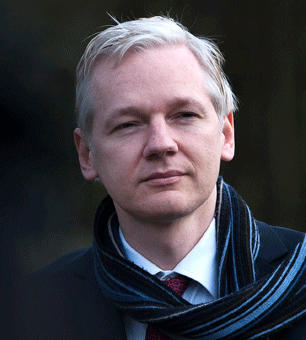
Two officials from Australia’s High Commission were spotted leaving the embassy in Knightsbridge in west London on Thursday.
It is the first time Australian consular officials have visited Assange at the embassy.
They were accompanied by Assange’s lawyer Jennifer Robinson.
Robinson confirmed the meeting to Fairfax but said she could not say what the meeting was about “given the delicate diplomatic situation”. “Julian Assange is in a very serious situation” she said. “He remains in the embassy because of the risk of extradition to the US. That risk is undeniable after numerous statements by Trump administration officials including the director of the CIA and the US attorney-general.”
Assange entered the embassy on June 19, 2012, after he had exhausted his appeals against an extradition order to go to Sweden to face rape and sexual assault allegations.
Swedish authorities have since closed their investigation, saying it couldn’t continue without Assange’s presence in their country.
However Assange still faces arrest if he steps out of the Ecuadorian embassy for breach of his bail conditions, after failing in a legal bid earlier this year to have the warrant cancelled by an English court.
His condition has recently become much worse, with his hosts repeatedly suggesting in public comments that they want the situation resolved and him out of the building. The court proceedings also revealed his worsening health, including serious tooth problems, respiratory infections, depression and a frozen shoulder.
His internet and phone connections were cut off by the Ecuadorian government six weeks ago and he was denied any visitors apart from lawyers, after Ecuador complained he had breached “a written commitment made to the government at the end of 2017 not to issue messages [on social media] that might interfere with other states”.
A spokeswoman from the High Commission said she would have to refer any questions about the meeting to the Department of Foreign Affairs and Trade in Canberra.
The Department of Foreign Affairs and Trade in Canberra confirmed it is providing consular assistance to Assange through the Australian High Commission in London.
Citing privacy obligations, however, DFAT refused to offer further comment.
Assange has complained for years that the Australian government has not offered him consular assistance, despite his being an Australian citizen.
In May last year Assange’s mother Christine Assange called on the Australian Government to give her son a new passport so that he can leave Britain.
“His passport’s been confiscated, the Australian Government should immediately issue him another one and demand safe passage for him to take up legal asylum in Ecuador,” she told the ABC.
A Senate committee report into the political influence of donations has stated there is “no justification” for imposing a further regulatory burden on charities, but Coalition Senators have expressed concerns that “politically-active charities” are seeking to influence elections. Pro Bono Australia , 7th June 2018 Luke Michael, Journalist,
The Select Committee into the Political Influence of Donations, chaired by Greens leader Senator Richard Di Natale, released its report on Wednesday.
The committee extensively examined the regulation of third parties – which include charities and not for profits – and noted they were “integral to the political process, providing important context and commentary on the issues being decided on in an election”.
The report comes in the midst of a Turnbull government push to ban foreign donations through its Electoral Funding and Disclosure Reform Bill.
The charity sector has strongly argued that the legislation – which requires registration and disclosure requirements for a broader group of non-party political actors than is the case currently – would stifle advocacy and impose unnecessary red-tape on these organisations.
The Senate committee said much of the evidence it received noted that any further regulation of third parties should reflect their unique role in the political system, and not unfairly burden them.
“The committee received consistent evidence over the course of the inquiry that the recently amended legislation and current legislative proposals before Parliament carry the very real danger of stifling the voice of third parties in delivery of their core purpose to advocate on specific issues,” the report said.
“The committee is of the strong view that only activity by third parties that is seeking to directly influence elections should be regulated.
“The committee therefore recommends that a thorough consultation exercise be carried out by the federal government before any detailed regulatory mechanisms are put in place.”
The report said the committee had heard “almost universal views” that the extensive regulatory regime that governs charities effectively made any recent legislative proposals under electoral law redundant.
Kevin Zeese, a prominent US activist and lawyer, issued the following statement this week endorsing action in defense of Julian Assange, including the June 17 rally in Sydney and vigils in London and around the world on June 19.
Zeese has spoken out against the escalating censorship of the Internet and the broader erosion of democratic rights. He is a co-director of the Popular Resistance organisation and is on the advisory board of the Courage Foundation which raises funds for the defence of persecuted journalists and whistleblowers.
Statement of Kevin Zeese endorsing protests and vigils in defense of Julian Assange
Julian Assange through his work as editor of WikiLeaks has made major strides toward democratizing the media by creating a vehicle for whistleblowers to share the truth and correct the misinformation of the mass corporate media. Assange and WikiLeaks have given people a precious tool—access to the undeniable truth about what governments and big business are doing. This is a tool we can all use to educate each other about what is really going on around us.
Assange is being persecuted because a democratized media threatens the monopoly over media control of the elites. A democratized media makes it more difficult for them to misinform, mislead and propagandize.
Through WikiLeaks, Assange with whistleblowers like Edward Snowden and Chelsea Manning have exposed war crimes, the truth about the Guantanamo Bay prison, the corporate domination of US policy and the actions of governments around the world and more. This has led to popular revolts around the world that have challenged those who abuse their power.
Freedom of speech and freedom of the press is being defined by the treatment of Julian Assange. Everyone who cares about these freedoms should speak out and take action on his behalf by joining the demonstration in Sydney, Australia on June 17 and the vigils being held in London and around the world on June 19—the anniversary of when Julian sought asylum in the Ecuadorian embassy six years ago. On June 19 at 11:00 a.m. we will be holding a protest in support of Julian Assange at the White House. Please join us to call for an end to his persecution.
Kevin Zeese, co-director of Popular Resistance, member of the advisory board of the Courage Foundation
A law shielding South Australian journalists from liability for refusing to reveal their sources has passed state parliament’s lower house.
Laws to strengthen protection of whistleblowers have passed South Australia’s lower house of parliament.
The Liberal government on Wednesday passed legislation to shield journalists from criminal or civil liability if they do not disclose the identity of their sources when the information is in the public interest.
The proposed legislation would make the default rule that journalists cannot be compelled to answer a question or produce a document that may disclose the identity of an informant.
A law shielding South Australian journalists from liability for refusing to reveal their sources will be tabled in state parliament.
Whistleblowers may soon have stronger protections under a bill introduced to parliament in South Australia.
The Liberal government on Thursday introduced legislation to shield journalists from criminal or civil liability if they do not disclose the identity of their sources when the information is in the public interest.
“This legislation enhances the public’s right to know by encouraging whistleblowers to come forward on the understanding that journalists will not be forced to disclose their identity in a court of law,” Attorney-General Vickie Chapman said.
The proposed legislation would make the default rule that journalists cannot be compelled to answer a question or produce a document that may disclose the identity of an informant.
“I anticipate it will be a very rare day that a court will deem revealing the identity of the informant is necessary to protect the public interest,” Ms Chapman said.
SA Law Society President Tim Mellor said the legislation was an important step in the protection of a free press.
“Like an independent judiciary, the fourth estate of a free press is an integral part of an open and transparent society,” Mr Mellor said
South Australian and Queensland are the only two states without shield laws.
Daniel Ellsberg’s decision to release the Pentagon Papers was an act of valor—his actions saved countless lives. He was a whistleblower who changed the course of history and curtailed an ongoing genocide which ended up preventing the needless dissolution of American soldiers and Vietnamese civilians alike. The publishing of the Pentagon Papers is a prime example of the critical part a free press plays in keeping governments in check and exposing the corrosive nature of consolidated power. This is why the First Amendment of the Bill of Rights enshrines the rights to free speech and of a free press in the United States Constitution.
Tyrants throughout history have targeted journalists and reporters for a reason.
On Wednesday afternoon, Julian Assange, who has been forced into self-imprisonment at the Ecuadorian embassy since 2012 to ward off prosecution from the United Kingdom and the United States, had his internet access cut off. Assange is our generation’s Daniel Ellsberg; WikiLeaks—the online publication he started—has been invaluable in letting the public know about the malfeasance of their elected officials and highlighting the duplicity of governments throughout the world. In an era where mainstream journalists have been turned into a corporate-state propagandists, WikiLeaks stands out in their dogged pursuit of truth and exposing deep-seated corruption and graft.
On October 12, 1969, Daniel Ellsberg copied a secret dossier with the intention of disclosing the truth about the Vietnam War. The Pentagon Papers were a chronicle of events that recorded the scope of operations in Vietnam and beyond—details which were being withheld from the American public. The Vietnam War was built on the foundation of lies; we were rushed into the war using the Gulf of Tonkin as a false flag and defending freedom as a pretext to further the interests of the defense-financial complex. The truth eventually caught up to the lies of politicians and bureaucrats; Defense Secretary Robert McNamara later admitted the Gulf of Tonkin attack never took place. Continue reading →
There are intermediate steps we can take right now, as long as we remember that that’s all they are. Bringing political parties under the remit of Australia’s mediocre privacy laws would be a start. Joining and supporting dedicated organisations like Digital Rights Watch and Electronic Frontiers Australia helps extend their reach and yours.
The question is whether we’re ready to exercise our data sovereignty, or whether we’re content to play passive victims while surveillance capitalism extends ever finer threads into every corner of our lives. For better or worse, a window is open in which to have that conversation
Emerging from several days in hiding while the Cambridge Analyticastorm swamped his company, Facebook founder and CEO Mark Zuckerberg finally spoke on Thursday.
“We have a responsibility to protect your data, and if we can’t then we don’t deserve to serve you,” his post sets out. To be clear, this is a statement, not an apology, and it would sit better if Zuckerberg had added the words “to our advertisers and other third parties,” to the end of the sentence. What has been exposed here is not some unforceeable aberration, but an ordinary consequence of what Shoshana Zuboff calls “surveillance capitalism”.
Important things can happen in these rare moments when the mask slips and some of the world’s underlying machineries are exposed to wide critique and analysis. Facebook, its business model, and the web of commercial and political agreements holding it in place are currently undergoing such a moment of slippage. Big, positive changes are possible when events conspire to blow a scandal onto the front page day after day, if the moment of outrage is channeled in meaningful ways.
As ever, this means a lot of well-paid people are scrambling right now to make sure that things change as little as possible, by making sure that we are collectively content to learn the wrong lessons and then go back to how we were. If this all dies down with a handful of executives forced to switch shell companies and an empty commitment by Facebook to work harder to earn our trust, the moment will have been wasted.
Plenty has been written about the Facebook-Cambridge Analytica tie up which boiled over after the Guardian published a whistleblower’s account of how he’d helped build Cambridge Analytica “a full service propaganda machine” to microtarget potential Trump voters in the election campaign which saw Donald Trump win the White House in 2016.
The sleazy way in which Cambridge Analytica was able to scrape Facebook’s vast collection of private information is not the real story here. Neither is the existence of these creepy little consultancies which promise to combine big data holdings with psychographic analysis to help political candidates manipulate voters.
The real question is whether we are ready, collectively, to draw a line under surveillance capitalism itself, and start taking back a measure of control.
The interests ranged against the public are huge. Corporate behemoths like Facebook and Google provide a free service in exchange for information about your most intimate personal, commercial, locational and political life, which they then sell to advertisers or other third parties. That’s the for-profit surveillance model: your inner life and purchasing habits are the product, packaged and on-sold. As you can imagine, political parties benefit hugely from data-driven micro-targeting. In Australia, political candidates are exempt from privacy law, and recent statements from the major parties indicate that’s not a privilege they are planning on giving up. Signals intelligence agencies acting within the Five Eyes network have built even greater data holdings under the US National Security Agency’s informal “collect it all” motto, material which places us all just a heartbeat away from “turn-key tyranny”, to borrow Edward Snowden’s memorable phrase. The common thread linking each of these layers is the non-consensual exploitation of private information that you might have had a reasonable expectation would be, well, private. It’s not just a simple case of opting out, either; even if you’re willing to give up Facebook’s near-ubiquitous “social graph”, the company also stands accused of amassing “shadow profiles’ of people who aren’t even signed up to Facebook. You also, as many have pointed out, will have a harder time opting out of government data collection. Continue reading →
Anti-Adani documentary screening axed for safety reasons, not politics, council says, ABC News, 21 Feb 18 ByJosh RobertsonPublic safety concerns, not politics, were behind the axing of the screening of a documentary on the Stop Adani protest movement, a north Queensland council says.
Townsville City Council’s talks with police about “emerging community tensions” in the debate around the Carmichael mine project prompted its move to halt the screening at one of its public venues a week out, according to its chief executive Adele Young.
It follows the arrest of a man in Townsville on Monday night for allegedly assaulting anti-Adani protesters, reported threats to activist Ben Pennings, and a controversy that engulfed federal MP George Christensen on Sunday over his apparent online taunt to environmentalists while posing with a gun.
However, the North Queensland Conservation Council (NQCC) insists the council did not mention safety concerns when it first revealed its decision to scrap the booking agreement last Thursday.
The environmental group had already paid to hold a local premiere of the Nell Schofield film, A Mighty Force, at Townsville’s Old Magistrates Court on February 22, along with simultaneous screenings in other cities.
President of the NQCC, Wendy Tubman, said a council officer told the group in a phone call that her supervisor had instructed her to cancel the booking as council had deemed the film “political”.
Ms Tubman told the ABC it was an “outrageous” situation and the NQCC had then written to the mayor, Jenny Hill, to say it had legal advice that the booking agreement was “valid and binding”…….
Council move ‘a real worry’
State Greens MP Michael Berkman said that “whichever way you interpret the Townsville City Council’s actions here, it seems pretty rotten”.
“If they can’t be confident that community members are able to safely attend a film screening at the council venue, that’s a real worry,” he told the ABC.”What’s perhaps more concerning is if council is deliberately stifling community engagement and censoring any backlash around Adani, especially when they’ve come under fire for their dodgy $18 million funding of Adani’s airstrip.”………..http://www.abc.net.au/news/2018-02-21/council-denies-politics-behind-axing-of-stop-adani-documentary/9468218
Julian Assange ‘has suffered enough’, his lawyers tell British judge, SMH, Nick Miller, 6 Feb 18, London: Julian Assange has suffered enough and shouldn’t face prison for absconding from justice, his lawyers have told a court.
The Wikileaks editor is depressed, in constant pain from an infected tooth, and has been stuck in the Ecuador Embassy in London’s Kensington far longer than the maximum 12-month jail penalty for breaching bail, his barrister said.
On Tuesday Assange lost a legal bid at Westminster Magistrates Court to quash the arrest warrant that has awaited him since he entered the Ecuador embassy in June 2012.
However his lawyers immediately launched a new push to end the UK government’s attempt to bring him to justice – arguing that it is against the public interest to punish him for refusing to leave the embassy.
It is a criminal offence for someone on bail to refuse to surrender to police without “reasonable cause” – and Assange refused to leave the embassy despite a court order for his arrest.
But Assange’s barrister Mark Summers QC told Judge Emma Arbuthnot that it was not in the interests of “justice and proportionality” to bring an action against Assange.
Assange went into the embassy after he exhausted his line of appeal against a decision to extradite him to Sweden to face rape allegations. Sweden last year ended its investigation into the allegations, and the European arrest warrant against Assange was cancelled. However the British warrant for his arrest still stood – and judge Arbuthnot said she was not persuaded it should be quashed simply because the underlying investigation had stopped.
Mr Summers said Assange was not “thumbing his nose” at justice and his five and a half years in the embassy were “adequate if not severe punishment for the actions that he took”.
Assange had genuine fears – later proved correct – that the US were keen to prosecute him over his work with Wikileaks, Summers said.
If arrested he would face rendition to the USA, treatment similar to that meted out against Wikileaks whistleblower Chelsea Manning – and possible “persecution, indefinite solitary confinement and the death penalty”, Summers said in a written submission……….
Judge Arbuthnot said it was a “very interesting” case.
She will rule on the public interest application on February 13.
Outside court, Assange’s lawyer Jennifer Robinson said whether or not the warrant is quashed Assange would not leave the embassy until he had an assurance he wouldn’t be extradited to the US.
“Mr Assange remains willing to answer to British justice in relation to any argument about breaching bail, but not at the expense of facing injustice in America,” she said.
Elizabeth Vos, The last two months have seen tectonic shifts regarding Julian Assange’s hopes of being able to safely leave the Ecuadorian embassy in London after what is now over seven years of arbitrary detention. The Wikileaks Editor In Chief was granted an Ecuadorian passport in December, which conferred on him the right of Ecuadorian citizenship. Potentially even more significant was Ecuador’s move to classify Assange as a Diplomat.
Wikileaks specifically noted Reuters’ coverage of these latest developments: “Depo Akande, an international law professor at Oxford University, said that Ecuador could argue that Britain had no right under international law to reject its declaration that Assange had diplomatic status.”
Additional press reports indicate that if the UK were ordered by the International Court to accept Ecuador’s decision to treat Assange as a diplomat, and were then to “declare him persona non grata, it would then ‘have to give him facilities to leave’ the country unhindered.” One hopes that the current Ecuadorian President, Lenín Moreno, will not bow to pressure from the United States to withdraw support from Assange. Ecuador’s former President, Rafael Correa, has indicated that this is a real possibility.
So far, legacy press has not taken the UK to task for attempting to “ignore” Assange’s new diplomatic role. Now more than ever, the media’s silence is important in informing or misinforming the public regarding Assange’s situation. The legal implications of Ecuador’s decision to confer Assange diplomatic status are potentially massive, but many outlets have been atrociously silent on the matter when they are not outright lying regarding Assange’s circumstances.
In light of the precariousness of recent events, human rights activist, journalist and Wikileaks supporter Randy Credico recently issued a call for Wikileaks supporters to ‘mobilize‘ in his support. This is a statement which should be taken seriously by the public and by independent media, which has increasingly been tasked with filling the void left by mainstream outlets that no longer function in the interest of honest reporting.
Telesur recently reported that former Ecuadorian President Rafael Correa had warned: “It will only take pressure from the United States to withdraw protection for Assange.” He added: “Surely it’s already being done, and maybe they await the results of the Feb. 4 (referendum) to make a decision.” Correa also referred to Ecuador’s current president as a “traitor.”
Over the last twelve months, Disobedient Media has reported extensively on the hypocrisy of legacy press, including The Washington Post. The outlet’s recent coverage of Assange’s circumstances serves as an emblem of the overall problem of intelligence agency narratives being pushed by a corporate press with which they are entangled.
The Washington Post exemplified the issue when it published an article erroneously titled: “Ecuador’s president calls Julian Assange ‘more than a nuisance.” The article in question incorrectly referenced Assange in the following incorrect terms: “the WikiLeaks founder was wanted in Sweden on sexual assault charges. Those have since been dropped. ” Assange was never charged with sexual assault, and Sweden ended their investigation into the subject.
Although false narratives around Wikileaks are nothing new for establishment press, the latest smear attempts are particularly important due to the precarious nature of Assange’s current position.
The Washington Post’s allusion to non-existent sexual assault charges dishonestly paints Assange and the reasons for his exile in the Ecuadorian embassy in a light that not only is factually untrue, but conveniently distracts from the manifold ways in which Assange and Wikileaks employees have been directly targeted as a result of their journalistic endeavors. As this author previously reported, there have been a plethora of calls to assassinate Assange from media pundits, as well as individuals associated with the Democratic Party establishment.
In light of all this, it is absurd to discuss Assange’s predicament without also addressing the intelligence community and plutocratic establishment that has fundamentally driven the situation from the beginning.
UN rulings on the matter of Assange’s detention have stated: “Assange has been arbitrarily detained by Sweden and the United Kingdom since his arrest in London on 7 December 2010, as a result of the legal action against him by both Governments, the United Nations Working Group on Arbitrary Detention said today.” In essence, even the UN has recognized that Assange’s longstanding exile in the Ecuadorian embassy is due to governments who feel threatened by the content of Wikileaks publications.
At this juncture, it bears reminding that Jeff Bezos, the current owner of the Washington Post, has a $600 million contract with the CIA in relation to his monolithic company Amazon. The Nation wrote in 2013:
“Amazon, under the Post’s new owner, Jeff Bezos, recently secured a $600 million contract from the CIA. That’s at least twice what Bezos paid for the Post this year. Bezos recently disclosed that the company’s Web-services business is building a “private cloud” for the CIA to use for its data needs. Critics charge that, at a minimum, the Post needs to disclose its CIA link whenever it reports on the agency. Over 15,000 have signed the petition this week hosted by RootsAction.”
The Nation’s coverage of the CIA’s contract with Amazon has since been removed from their web page for unknown reasons, but is available through archive services.
When discussing The Washington Post’s exercise in gaslighting, it is important to keep the outlet’s well-documented financial connection with the CIA through Bezos in mind. In so doing, it is also pertinent to note that the CIA has made its hatred for Assange very clear, especially over the course of the last year. CIA Director Mike Pompeo put the agency’s hatred for Wikileaks were on full display as recently as yesterday, when the CIA Director lambasted the journalistic organization as a threat on par with Al Qaeda. Pompeo said of Al Qaeda and Wikileaks: “They don’t have a flag at the UN, but they represent real threats to the United States of America.”
That a group who publishes information that is inconvenient for the CIA would be likened to a terrorist network speaks to the threat which Wikileaks represents not to the safety of the American public, but to the plutocratic class and the American deep state.
Pompeo is well known for his previous reference to Wikileaks as a “non-state hostile intelligence service.” The Hill wrote of the incident: “In his first major public appearance since taking the top intelligence post in the Trump administration, Pompeo took aim at WikiLeaks founder Julian Assange and former National Security Agency (NSA) contractor Edward Snowden…” The Hill also cited Pompeo’s characterization of Assange as a: “fraud, a coward hiding behind a screen.”
Pompeo’s vitriolic characterization of Wikileaks is helpful, because it demonstrates that the CIA’s response to Wikileaks is on par with the force with which terrorist organizations like Al Qaeda are pursued. In that light, the magnitude of the threat faced by Assange and Wikileaks associates cannot be over-estimated. Pompeo’s words are not only absurd in light of Wikileaks being an extremely accurate journalistic organization, but also depict the real impetus behind Assange having been trapped in the Ecuadorian embassy for years.
The CIA Director’s statements, even taken at face value, completely undercut the manipulative coverage of Wikileaks and Assange by outlets like the Washington Post. That providing evidence of corruption is considered an existential threat by the establishment is indicative of the value of Wikileaks to the public. The publisher is only a threat to those whose lies are exposed by their publications. The same plutocracy that has aggressively targeted Assange and Wikileaks has progressively strangled free press and freedom of thought in the United States and the world for decades.
The anger of intelligence agencies towards Assange and Wikileaks may seem superficially unrelated to the disgracefully inaccurate treatment of the publisher in American press. However, it is necessary to view mainstream outlet’s coverage of Assange, including both their misinformation and their resounding silence on his having been targeted by the intelligence community, as an expression of aggression from the American ‘deep state.’ This is especially noteworthy given the close ties of the intelligence community to legacy media, as encapsulated by The Washington Post.
Disobedient Media previously reported on the unanimous echo chamber of establishment political think-tanks and apparently left-wing news organizations when it comes to issues pushed by the intelligence community, including the reauthorization of deeply flawed FISA legislation. In the case of Assange, the litany of lies and gaps in coverage over the years are too numerous to recount in full, but represent a concerted effort to silence truth through deflection and manipulation.
Alternative media must refuse to be silenced by the American deep state’s fanatical crusade against Wikileaks and its supporters. If it were not for Wikileaks, the growing niche of independent journalism would have virtually zero factual standing when attempting to counter disinformation by press outlets that have completely abandoned their role as a watchdog against government abuses.
If there was ever a time to support Wikileaks and its Editor in Chief, that time is now. To abandon Assange at this critical moment would be more profound than its deleterious effect on the life of an individual: it would represent a complete forfeiture of integrity across the entire spectrum of journalistic endeavors.
But the latest attack goes beyond the sector and threatens democracy itself. The government is proposing to classify most major charities as “political campaigners”, allowing it to audit their advocacy work and their sources of income. It suggests an impurity of motive, yet nothing could be further from the truth.
This is because a new amendment to the Electoral Act would force any group to register as a political campaigner if it has spent more than $100,000 on “political expenditure” in a three-year period.
Political expenditure is defined as: “The public expression of any views on an issue that is, or is likely to be, before electors in an election (whether or not a writ has been issued for the election).”
In other words, this would apply to any comment on any policy issue at any time. Every charity that employs someone to analyse issues like aged care, homelessness, disability, living costs and virtually any other issue is likely to end up classified as a political campaigner.
The end result will be a set of requirements so complicated that some charities will be forced to hire staff simply to manage their compliance. Any charity would rather spend this money on their core mission. Others might stop speaking out altogether, deterred by the new requirements and huge penalties for getting it wrong – miscalculating the date that you become a “political campaigner” could cost up to $50,000 per day in fines.
So why, when almost everyone would agree that the most corrupting influence on public debate comes from lobbyists and big donors, is civil society being targeted?
Charities already enter the public debate with a huge disadvantage compared to moneyed interests. They are barred from endorsing candidates, donating to parties, or advocating outside their charitable purpose.
The big influencers in Australian politics can do all of this and more. Charities now have their DGR status threatened regularly, while business spending on advocacy and lobbying can be written off as a legitimate cost. Membership fees that companies pay to their own advocacy bodies are tax deductible. Even donations to political parties, from both businesses, unions and individuals, can be taken from pre-tax income. Just this week, the Minerals Council admitted that its donations are designed to buy access to decision-makers.
On top of that, big business and vested interests can afford to spend millions on lobbyists to help them secure important meetings, on advertising before elections, and on airspace to set the political agenda.
All of this is known to have a major impact on public debate, yet none of it would be curbed by the new rules. In light of that, attacking the groups who speak up for the public good, a purpose that goes beyond their own self-interest, seems perverse. Unless it was the point all along.
Maybe it simply suits governments these days for charities to provide essential services (work that many Australians would rather see done by government itself), without ever questioning the root causes of poverty, inequality, and homelessness. It serves the dual purpose of turning charities into an arm of government while also silencing the poor and protecting an unfair system from scrutiny.
The charity sector is uniting against the proposed changes. But seeing off the Electoral Act amendments won’t end the attacks. One of Gary Johns’ first major tasks as commissioner will be to review the ACNC, and there is every reason to be concerned that community advocacy will be threatened yet again.
It seems to us that all of these attacks are driven by an agenda to exclude the least powerful members of society, and those who speak up on their behalf, from public debate. By attacking charities and their ability to advocate, we’re creating a society where only those with power and access to start with have the ability to influence policy.
Community advocacy has proven to be one of the only ways we can balance the coordinated, self-interested, and privileged forces that drive decision making and policy in Australia. It is in everybody’s interests to protect it.
About the author: Kasy Chambers is executive director of Anglicare Australia. Anglicare Australia is a network of 40 agencies, more than 20,000 staff and volunteers, working with over 900,000 clients annually across Australia.
The government is crunching charities for foreign donations and tax breaks. Why, then, are the Minerals Council and other corporate lobby groups allowed tax breaks on their foreign funding?
SLAPP: a strategic lawsuit against public participation (SLAPP) is a lawsuit that is intended to censor, intimidate, and silence critics by burdening them with the cost of a legal defence until they abandon their criticism or opposition. Such lawsuits have been made illegal in many jurisdictions on the grounds that they impede freedom of speech.
— Wiktionary
It’s all happening to charities: Australian Tax Office (ATO) audits, investigations by the charity regulator and the Australian Electoral Commission (AEC), and new laws slated for early next month to stymie tax deductibility, contain advocacy and ban or restrict foreign donations. Many in the not-for-profit sector are scared to speak out for fear of reprisal.
Left-wing activist group GetUp went before the Senate inquiry into political donations last week and pulled out a report detailing the vast amount of money that is spent buying influence in Australian politics.
I should declare an interest here: yours truly did the research, which found 18 corporate lobby groups had raised $1.9 billion over the past three years.
These are vast sums, yet they only represent a few of the most powerful advocacy groups in a handful of sectors: banking, mining, property and big pharma. There must be 100 more. And, together with an estimated $1 billion in corporate political donations since 1998, the “revolving doors” between industry and government, and the hundreds of millions spent by individual companies on “in-house” government relations and external consultants, the real numbers involved in swaying politicians must be well north of $1 billion a year, or more than $4 million per federal politician, per year.
There is already a dangerous imbalance between corporate political power and people’s political power in this country.
In her new autobiography, Christine Milne: An Activist Life, the former Greens leader warns of the shift from democracy to plutocracy. “The takeover is almost complete … The rush toward the revolving door between business and politics has become a stampede. Of the 538 lobbyists registered by the Department of Prime Minister and Cabinet in 2016, 191 were former government representatives,” wrote Milne.
The farmer, and veteran of death threats, jail time and arrests as an activist, describes the hegemony of corporate influence as a “major factor in the disillusionment with politicians and democracy”.
Meanwhile, the government is slapping down its ideological adversaries with Tax Office audits and investigations by the AEC and charities regulator, the Australian Charities & Not-for-Profits Commission (ACNC).
Draft legislation is prepared and a bill is tipped to come before parliament in the final sitting week of this year. There are serious implications for democracy and free speech.
One one of the main planks of this “reform” is expected to be a ban on foreign donations. It is mostly designed to hit environmental groups such as Greenpeace, 350.org, Lock the Gate and the Australian Conservation Foundation but will also affect those charities working with Indigenous people, poor people, sick people and medical research.
If the bill gets up — and this may depend on what deal is dangled in front of Opposition Leader Bill Shorten, given the government is no longer in majority in parliament — it may see off foreign donations and tax deductibility.
Such would leave an unlevel playing field. Membership to corporate peak bodies such as the Business Council of Australia and the Minerals Council of Australia is tax deductible. Like the charities and NFPs, they pay no tax, but their funding is enormous.
Keen to contain the influence of environmental groups whose message flourishes on social media, the Minerals Council has been the chief urger in lobbying for the government crackdown on NFP advocacy.
More pertinently, while the government moves against foreign donations for environmental and other civil society groups, the corporate lobby remains untouched. The question should be asked, is this fair? The Minerals Council, its state affiliates and the oil and gas peak body, Australian Petroleum Production and Exploration Association (APPEA), have raised more than half a billion dollars for advocacy over the past 11 years …
Lina Caneva | Editor | @ProBonoNews 2 Nov 17,Australia’s international development charities have passed a resolution at the sector’s annual conference in Melbourne calling on the federal government to halt “disturbing developments” which are set to restrict Australian charities’ funding and advocacy.
The Australian Council for International Development (ACFID), the peak-body for Australian non-government organisations involved in international development and humanitarian action, also called on the federal government to “use its position on the UN Human Rights Council to become an international champion for civil society”.
In a preamble, the resolution expressed concern at a “number of disturbing developments in Australia (which) may constrain the role of charities in undertaking advocacy”.
ACFID’s members voted to call on the government not to impose proposals on expenditure-caps advocacy by charities and a ban on international philanthropy to charities who undertake advocacy……..
“Increasingly, fear and division are being used around the world as a precursor for draconian laws and regulations which are crippling democratic freedoms and stifling citizen-led groups. ACFID’s members are all too aware of this trend as they are forced to adjust to severely constrained operating environments, instituted by governments overseas.
“A free and vibrant civil society is crucial in maintaining peace; keeping governments accountable; and protecting people’s rights.
“Backed by Australia’s democratic values and with our membership of the Human Rights Council, the Australian government is well-placed to defend civil society space on the international stage. We are calling on the government to embrace this opportunity.”
ACFID said it was continuing to work with its members and a consortium of charities to support and protect space for civil society overseas and in Australia.
Earlier this year ACFID released a position paper outlining concerns about the ban on foreign donations to political parties which it said may result in charities who advocate being prevented from accepting international philanthropy.
Adani and the loggers should watch out – we have a right to peaceful protest to protect our environment, The high court has drawn a line in the sand against laws which burden the right of Australians to peaceful protest.
The court made no judgement on Tasmanian premier Will Hodgman’s decision to flatten the Lapoinya state forest in northwest Tasmania against the wishes of the local community. But it struck down his Workplaces (Protection from Protesters) Act 2014 aimed at stopping people from protesting effectively against such forests being logged.
Lapoinya is a huddle of farms southwest of the Bass Strait city of Burnie. Its rolling hills have a patchwork of lush pastures, ploughed fields and copses of trees. At the heart of the district was the Lapoinya forest, a couple of hundred hectares of wildlife-filled rainforest, eucalypts and ferneries with the crystal-clear Maynes Creek, a key nursery for the world’s largest freshwater crayfish, running through it.
When Forestry Tasmania revealed plans for the forest to be clearfelled for the distant wood-processing factory owned by Malaysian logging company Ta Ann, the people of Lapoinya remained confident that common sense would prevail. They called on the state government to intervene and ran a colourful but respectful public campaign to prevent the logging.
Neither the premier nor his minister for forests visited or intervened. Instead, draconian anti-protest laws were enacted and by early 2016 the logging was imminent.
I was invited to a dinner by the community and afterwards treated to a concert by talented local youngsters, with songs devoted to forests. The Lapoinyan dilemma was excruciating: these good people would never be violent or attack logging machinery, but would not be silenced as a distant and indifferent administration in Hobart destroyed their iconic forest.
The locals prepared for a peaceful stand. If the public could see how beautiful the Lapoinya forest was then surely, even at this eleventh hour, the resulting political pressure would cause the government to back off.
The bulldozers and chainsaws arrived in January 2016, with a cavalcade of police.
While premier Hodgman assured Tasmanians his new laws were aimed at “radical” environmentalists and not “mums and dads”, the first two people arrested were a grandfather and a mother of two. That mother, also a neurosurgery nurse, was Jessica Hoyt. Her parents, Stewart and Barbara, have a farm adjoining the forest. In her teenage years Jessica, along with her siblings, had enjoyed riding along the forest’s bridle trail. The two were charged and faced first-offence fines of $10,000.
The next day, reeling from the destruction, Jessica took friends back into the doomed forest. She was arrested again while walking through the trees and ferns. This second arrest put her in danger of being jailed for four years.
A few days later, along with several others, I was also arrested after going back to Lapoinya to make video clips, intended for public distribution, about the sheer bloody-mindedness of the government’s operation. I was standing in an adjacent forest reserve. A bulldozer had backed off and the screech of the chainsaws and roaring thud of the trees coming down was close and confronting.
The incongruity of laws stifling such a reasonable protest against the destruction of the public commons, in a democracy with a long history of advancement through peaceful protest, was compelling. This was underscored when, after our arrests, I received a number of messages from experienced legal experts from around Australia suggesting the laws breached the constitution’s implied right to freedom of political expression.
Guided by Hobart solicitor Roland Browne and joined as co-plaintiff by Jessica, I engaged Melbourne barrister Ron Merkel QC to challenge the constitutional validity of the Hodgman laws in the high court. A public appeal by my foundation raised more than $100,000 to affray the costs, especially in case we lost.
On Wednesday the high court ruled that those laws do infringe the freedom to peaceful protest inherent in the Australian constitution.
“It is necessary to keep firmly in mind that the implied freedom is essential to the maintenance of the system of representative and responsible government for which the Constitution provides. The implied freedom protects the free expression of political opinion, including peaceful protest, which is indispensable to the exercise of political sovereignty,” they said. by the people of the commonwealth. It operates as a limit on the exercise of legislative power to impede that freedom of expression.”
The Hodgman government had breached the limit of legislative power. Tasmania already had the usual array of laws to prevent dangerous or damaging behaviour. It also had a Forest Management Act which, besides guaranteeing the public its time-honoured access to the forests, empowers the police to arrest people who interfere with logging operations. The draconian new laws were not necessary for that purpose. They were designed to stymie effective environmental protests, like that at Lapoinya, which could draw public support and be politically embarrassing. The high court found the laws out, noting the deterrent effect on peaceful protest of their provisions: “The combined effect … can bring the protest of an entire group of persons to a halt and its effect will extend over time. Protesters will be deterred from returning to areas around forest operations for days and even months. During this time the operations about which they seek to protest will continue but their voices will not be heard.” It is for premier Hodgman, a lawyer, to say; but just as he did not see the unconstitutionality of these laws, so I doubt he was their origin.
It should be a warning to the other environmental wreckers.
We are in a world of gross, rapid and escalating environmental damage. Corporations profiting from exploiting non-renewable resources face growing public scrutiny and antipathy.
They cannot win the argument for wrecking ecosystems, so their alternative is to wreck environmentalists. Elsewhere in the world, scores of environmentalists are being killed each year by rampaging profiteers. But Australia is a peaceful democracy and the effective option is to lobby weak governments to clamp down on protests.
The high court’s decision does not directly affect laws in states or territories other than Tasmania. But it draws that line in the sand and will be a benchmark for more challenges if other governments pass laws to protect environmental destruction from peaceful public reaction. More widely, it bolsters that right for people standing up for any good cause.
There are growing calls for governments, already falling over themselves to grant concessions to the coral-killing Adani coalmine proposal in Queensland, to enact more draconian anti-protest laws than those already in place. The extreme right voices making those calls had better go read this judgment for democracy.
The Lapoinya forest was razed, but it has proved to be a pyrrhic victory for the destroyers. Out of the peaceful but heartfelt stand of the handful of people in Lapoinya has come a high court ruling upholding the right to peaceful protest for every Australian








 Antinuclear