Australia’s worst heatwave since black summer made five times more likely by global heating, analysis finds

Human-caused global heating made the intense heatwave that affected much
of Australia in early January five times more likely, new analysis
suggests. The heatwave earlier this month was the most severe since the
2019-20 black summer, with temperatures over 40C in Melbourne and Sydney,
even hotter conditions in regional Victoria and New South Wales and extreme
heat also affecting Western Australia, South Australia and Tasmania. In
Victoria, the heat preceded bushfires that burned through 400,000 hectares
and destroyed almost 900 buildings.
Guardian 22n d Jan 2026,
https://www.theguardian.com/australia-news/2026/jan/23/australias-worst-heatwave-since-black-summer-made-five-times-more-likely-by-global-heating-analysis-finds
Earth’s frozen regions are sending a clear warning about climate change – but politicians are ignoring it.
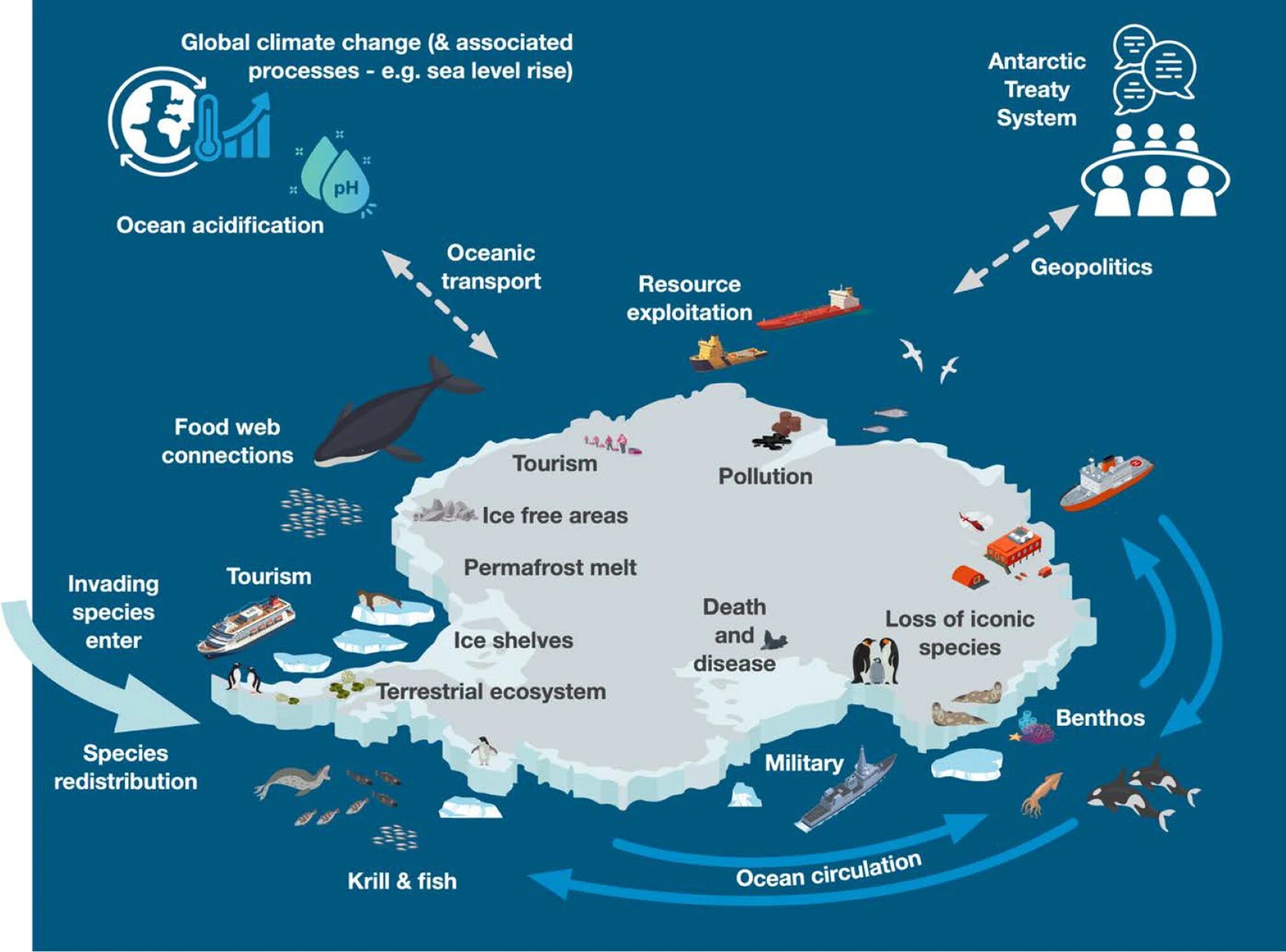
The Conversation, December 18, 2025, https://theconversation.com/earths-frozen-regions-are-sending-a-clear-warning-about-climate-change-but-politicians-are-ignoring-it-270604
- Chris StokesProfessor in the Department of Geography, Durham University
- Florence ColleoniSenior Researcher, Polar Geophysics, National Institute of Oceanography and Applied Geophysics (OGS)
- James KirkhamPostdoctoral Researcher, Antarctic Geography, British Antarctic Survey
“We cannot negotiate with the melting point of ice.” That’s the message from more than 50 leading scientists who study the Earth’s frozen regions, published in the latest annual State of the Cryosphere report.
In the past year alone, the vast polar ice sheets in Greenland and Antarctica are likely to have shed around 370 billion tonnes of ice, with a further 270 billion tonnes from the 270,000 mountain glaciers around the world, some of which are disappearing altogether.
In February 2025, global sea ice extent reached a new all-time minimum in the 47-year satellite record. Elsewhere, perennially frozen ground (called permafrost) continues to thaw, releasing additional greenhouse gas emissions each year that are roughly equivalent to the world’s eighth-highest-emitting country.
The warning lights from the cryosphere have been flashing red for several years, and governments ignore this at their peril.
Melting ice is driving an acceleration in the rate of sea-level rise, which has doubled to 4.5mm per year over the last three decades. If this acceleration continues, sea-level rise will reach around 1cm per year by the end of this century – a rate so high that many island and coastal communities will be forced to move.
The loss of mountain glaciers will affect billions of people who rely on their meltwater for agriculture, hydropower and other human activities; and the damage caused to infrastructure by Arctic permafrost thaw has been estimated to cost US$182 billion (£137 billion) by 2050 under our current emissions trajectory.
Negotiations based on ‘best available’ science
In an effort to reduce the risks and effects of climate change, including those from the cryosphere described above, the Paris climate agreement was adopted by 195 countries at the annual UN climate summit in 2015, with the aim of limiting “the increase in global average temperature to well below 2°C above pre-industrial levels” and pursue efforts “to limit the temperature increase to 1.5°C”.
Its implementation should be based on and guided by the “best available science”. That includes evidence provided by the Intergovernmental Panel on Climate Change (IPCC), a group created by the UN to provide governments with regular assessments of the scientific basis of climate change, its impacts and options for adaptation and mitigation.
This guiding principle was strengthened by the International Court of Justice in July 2025, which reaffirmed 1.5°C as the primary legally binding target for climate policies under the Paris climate agreement.
Yet recent climate negotiations, including at the UN climate summit in Brazil in November 2025 (Cop30), have seen some countries – largely fossil fuel producers – push back on previously standard language endorsing the IPCC as a source of the “best available science”.
As cryosphere scientists who regularly attend the UN’s climate summits, we have noticed recent efforts to downplay, confuse and dilute some of the latest scientific findings, especially from the cryosphere. We find this alarming.
At Cop30, observations about the complete loss of glaciers in two countries (Slovenia and Venezuela) were removed from the final draft text. Other shocking scientific findings about “irreversible changes to the cryosphere” were diluted to a rather vague “need to enhance observations and address gaps in the monitoring of the hydrosphere and the cryosphere”.
This tactic to obfuscate the science is not new, but has been increasingly used over recent years, during which the indicators of climate change and its consequences on the cryosphere have become increasingly obvious to scientists.
At Cop30, climate negotiators from several countries expressed disappointment and concern that the role of the IPCC as the best available science was not highlighted alongside some of the more alarming scientific findings, with an intervention from the UK capturing this frustration.
While the final overarching summary text from Cop30 – the Mutirão decision – references the IPCC as the source of the best available science, and contains some strong language around the need to limit warming to 1.5°C, rather than 2°C, these look like empty words when the same document fails to even mention “fossil fuels”. Emissions from fossil fuels will result in 2.6°C of warming by 2100, without urgent action.
Indeed, the final text from Cop30 is the first to explicitly reference a temperature “overshoot”, reiterating the need “to limit both the magnitude and the duration of any temperature overshoot”. Most scientists agree that overshoot is now inevitable, but that 1.5°C increase remains the legal and ethical imperative for a long-term global temperature target.
However, some scientists – including ourselves – would argue that even this is too high, committing us to losing around half of the world’s mountain glaciers and several metres of sea-level rise from the polar ice sheets.
Among the dire warnings, a recent study offers hope that it is still possible to curtail warming in the next 15 to 20 years, peaking at an increase of around 1.7°C in the 2040s before declining to an increase of 1.5°C and then 1.2°C by the end of the century. But that requires rapid and deep cuts in emissions from now on.
Climate negotiations may move at a glacial pace, but the irony is that the pace of glacier change is rapidly overtaking our ability to adapt to it and protect the most vulnerable people. The science is clear. But the perils of ignoring it are even clearer.
Australia fiddles with fossil gas while the country swelters in record heat. It doesn’t make sense.
Sydney’s record October heat; high winds battering both Melbourne and
New Zealand, causing death and destruction; the algal bloom caused by South
Australia’s marine heatwave wreaking havoc on our marine environment;
coral in both the Great Barrier and Ningaloo reefs suffering horrific
bleaching.
There’s barely an Australian who hasn’t been affected by one
extreme weather event or another, some badly. Some have lost their lives,
their homes or both. The seas around our country are suffering a marine
heatwave. Just a few degrees above normal is causing these climate
change-fuelled warmer oceans to put our weather on steroids, intensifying
heat, rainfall and wind.
And that intense rainfall will lead to increased
plant growth, so another record bushfire season is inevitable at some
point. But this is really only the beginning: global warming has reached an
average of nearly 1.5C, and we’re set to see warming of at least 2.7C by
the end of the century if we don’t take more action.
Australians have an
obvious interest in action against global warming. Focusing on gas instead
of renewables for the energy transition risks sabotaging our future.
Guardian 25th Oct 2025 https://www.theguardian.com/commentisfree/2025/oct/25/australia-fossil-gas-record-heat
Rising seas will threaten 1.5 million Australians by 2050 – report
One and a half million Australians living in coastal areas are at risk
from rising sea levels by 2050, a landmark climate report has warned.
Australia’s first National Climate Risk Assessment predicted more frequent
and severe climate hazards like floods, cyclones, heatwaves, droughts and
bushfires. “Australians are already living with the consequences of climate
change today,” Climate Change Minister Chris Bowen said, “but it’s clear
every degree of warming we prevent now will help future generations avoid
the worst impacts in years to come.”
The report looked at three global
warming scenarios – above 1.5C, above 2C and above 3C. Australia – one of
the world’s biggest polluters per capita – has already reached warming of
above 1.5C, the report said, noting that at 3C, heat-related deaths in
Sydney may rise by more than 400% and almost triple in Melbourne. The
72-page report – released days before the government announces its
emissions reduction targets for 2035 – found that no Australian community
will be immune from climate risks that will be “cascading, compounding and
concurrent”.
BBC 15th Sept 2025,
https://www.bbc.co.uk/news/articles/c930454e77xo
The Australia-Tuvalu climate migration treaty is a drop in the ocean
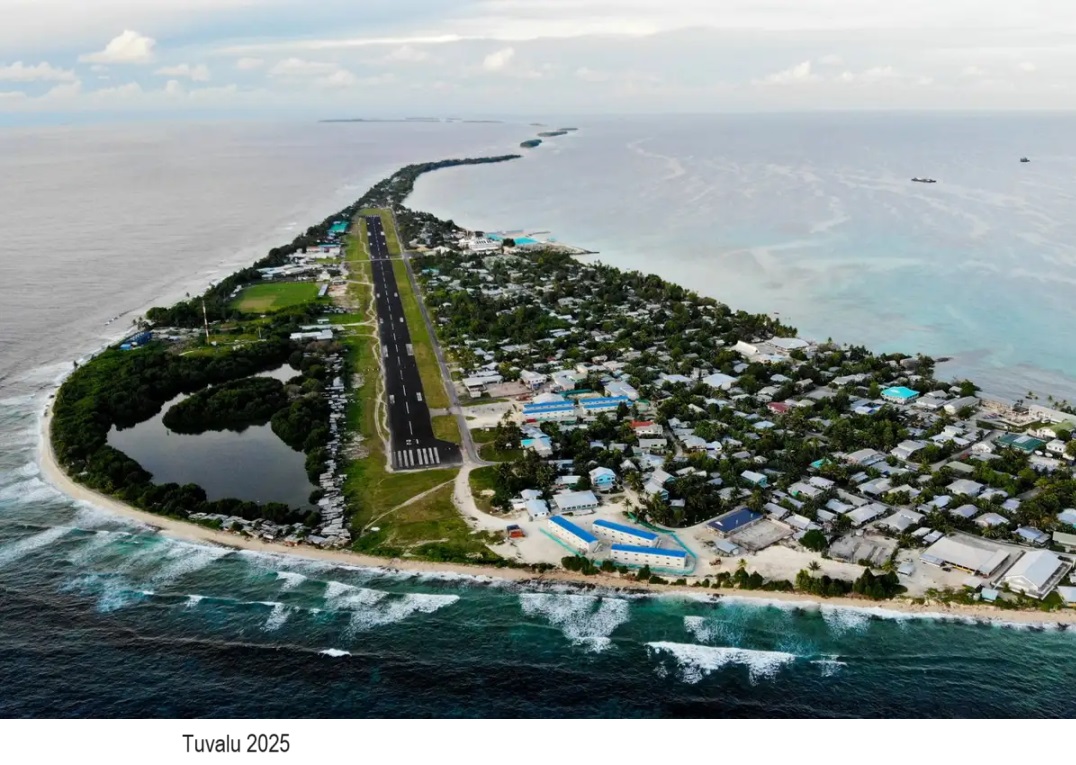
Australia has offered a lifeline to the people of Tuvalu, whose island is threatened by rising sea levels. But the deal comes with strings attached – and there will be millions more climate migrants in need of refuge by 2050
By New Scientist, 2 July 2025, https://www.newscientist.com/article/mg26635502-900-the-australia-tuvalu-climate-migration-treaty-is-a-drop-in-the-ocean/
A lifeline has been extended to the people of Tuvalu, a low-lying Pacific nation where rising sea levels are creating ever more problems. Each year, Australia will grant residency to 280 Tuvaluans. The agreement could see everyone currently living in Tuvalu move within just a few decades.
Effectively the world’s first climate migration agreement, the Australia-Tuvalu Falepili Union will also provide adaptation funds to help those who stay behind.
Is this a model for how climate migration can be managed in an orderly way, before disaster strikes? Far from it. To get this deal, Tuvalu must allow Australia a say in future security and defence matters. Few other countries are likely to agree to similar terms.
Tuvalu’s population is also very small. Taking in around 10,000 climate migrants would be inconsequential for a country of 28 million like Australia. Worldwide, it is estimated that between 25 million and 1 billion people might be forced to move by 2050 because of climate change and other environmental factors. Where will they go?
Many argue that the wealthy countries that emitted most of the carbon dioxide that is warming the planet have a moral duty to help people displaced by climate change. But these kinds of discussions have yet to be translated into the necessary legal recognition or acceptance of forced climate migrants. On the contrary, many higher-income nations seem to be becoming more hostile to migrants of any kind.
There has been a little progress in setting up “loss and damage” funds to compensate lower-income countries for the destruction caused by global warming. This could help limit the need for climate migration in the future – but the money promised so far is a fraction of what is required.
The most important thing nations should be doing is limiting future warming by cutting emissions – but globally these are still growing. Sadly, the Falepili Union is a drop in the ocean, not a turning of the tide.
Sea level rise will cause ‘catastrophic inland migration’, scientists warn

Sea level rise will become unmanageable at just 1.5C of global heating and
lead to “catastrophic inland migration”, the scientists behind a new
study have warned.
This scenario may unfold even if the average level of
heating over the last decade of 1.2C continues into the future. The loss of
ice from the giant Greenland and Antarctic ice sheets has quadrupled since
the 1990s due to the climate crisis and is now the principal driver of sea
level rise.
The international target to keep global temperature rise below
1.5C is already almost out of reach. But the new analysis found that even
if fossil fuel emissions were rapidly slashed to meet it, sea levels would
be rising by 1cm a year by the end of the century, faster than the speed at
which nations could build coastal defences. The world is on track for
2.5C-2.9C of global heating, which would almost certainly be beyond tipping
points for the collapse of the Greenland and west Antarctic ice sheets. The
melting of those ice sheets would lead to a “really dire” 12 metres of
sea level rise.
Guardian 20th May 2025,
https://www.theguardian.com/environment/2025/may/20/sea-level-rise-migration
Can Australia pay off Turkey to host COP31? The Brits did.
A previously unreported package of investment pledges and U.N. support got Turkey to back down last time.
May 8, 2025 By Karl Mathiesen and Zia Weise
LONDON — Australia’s bid to host next year’s climate conference depends on convincing Turkey to step aside.
If they need tips, there’s a British playbook — the details of which are previously unreported — that worked before, involving investment wheel-greasing and support for Turkey’s international priorities.
Riding high on his May 3 election landslide, Australian Prime Minister Anthony Albanese wants to use the 2026 climate talks to drive clean energy investment and win a decades-old political battle with his right-wing rivals over efforts to cut greenhouse gases.
“Renewable energy is an opportunity we must work together to seize for the future of our economy,” Albanese said in his victory speech, capping an election where the prime minister backed Adelaide as the COP31 host city.
But to host the climate summit, Australia needs Turkey to drop its rival bid.
Australian officials flew to Turkey last year, but failed to secure a deal. Instead, Turkish President Recep Tayyip Erdoğan reiterated his intention to bring COP to his country.
Some believe it’s only a matter of time before Turkey crumbles. Australia’s bid has backing from the European Union and other Western countries. More support is expected from the Pacific, given Canberra has offered to cohost the summit with an island nation.
Australia “should hold out until the world forces a deal,” said Richie Merzian, the CEO of the Clean Energy Investor Group and a former Australian diplomat. “The biggest impediment to the COP31 Australia-Pacific bid was the Australian election. With that sorted, it should organize accordingly.”
But Turkey has a track record of extracting more than just diplomatic pain in return for acquiescence. Facing a similar impasse with Erdoğan over the COP26 conference, U.K. officials offered a package of incentives to Turkey in order to host the talks in Glasgow in 2021.
The annual U.N. talks rotate through five groups of countries, loosely based on global regions and countries’ development stages. The “Western European and Other States” group is scheduled to host the 2026 summit. Choosing a host requires consensus.
Turkey is the only developing country in this group, which includes Australia and the U.K. And it has a track record of using the U.N. talks’ location for leverage.
In the lead-up to COP26, British officials courted Ankara intensively. British Prime Minister Boris Johnson and Erdoğan had a “good relationship on this topic in particular,” said Dominick Chilcott, the former British ambassador to Turkey who negotiated the arrangements.
But ultimately, Turkey was transactional in its demands.
Chilcott said Britain’s incentives package included a promise to host a Turkish investment conference in London, as well as U.K. backing of Turkish candidates for several international and U.N. posts. He declined to say which posts.
The U.K. also promised to speak to other countries about classifying Turkey as a “developing country” under the U.N. climate convention — allowing it to receive climate aid. “Although,” Chilcott said, “we didn’t think there was much chance of it going anywhere.”
5 huge climate opportunities await the next Australian parliament – and it has the numbers to deliver.

Australians have returned an expanded Labor Party to government alongside
a suite of climate-progressive independents. Meanwhile, the Coalition –
which promoted nuclear energy and a slower renewables transition –
suffered a historic defeat. Labor also looks set to have increased numbers
in the Senate, where the Greens are likely to hold the balance of power.
These numbers mean support for progressive climate and energy policy in
Australia’s 48th parliament is shaping as stronger than the last. So,
what does this mean as Australia seeks to position itself as a leader in
the global net zero economy?
The Conversation 5th May 2025 https://theconversation.com/5-huge-climate-opportunities-await-the-next-parliament-and-it-has-the-numbers-to-deliver-255772
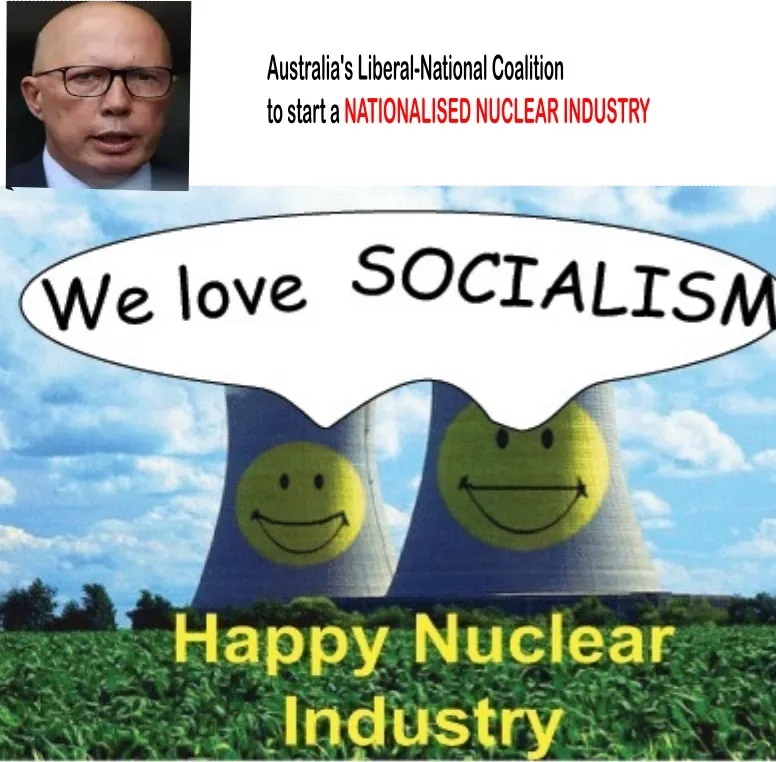
Climate Authority head Matt Kean says Liberals ‘socialist’ for ‘nonsense’ nuclear policy
In short:
Matt Kean, a former NSW treasurer and energy minister, has launched a broadside at his own party for backing nuclear energy.
Mr Kean now chairs the Climate Change Authority, which argues nuclear reactors will result in more emissions than renewable energy.
But Liberal senator Hollie Hughes told Q+A nuclear energy promised zero emissions and jobs for coal plant communities.
A former Liberal state treasurer has branded his own party “socialist” in an extraordinary broadside at the opposition’s plan to build nuclear power reactors.
Matt Kean, who now chairs the government’s Climate Change Authority, has also warned parts of Australia will become “uninhabitable” from worsening climate events such as the ongoing emergency from ex-Cyclone Alfred.
Mr Kean told the ABC’s Q+A on Monday the federal Liberal Party proposal for replacing coal-fired power plants with nuclear reactors was too expensive for governments and consumers.
“I’m not anti-nuclear, but I am anti-nonsense,” he said.
“There’s no private investors knocking down anyone’s door to build a nuclear reactor.
“In fact, under Peter Dutton’s nuclear plan, it won’t be the national energy market, it will be the nationalised energy market, because it will only be funded by the government.
“Now I forgot when the Liberal Party decided to be socialist in how it operates.”
Mr Kean is in a public spat with the federal branch of his party, with Liberal frontbencher Jane Hume suggesting he would be sacked from a Climate Change Authority (CCA) that had been “badly politicised”.
The CCA has modelled the potential impacts of the Coalition’s promise to build seven nuclear power plants by 2050, concluding it would result in an additional 2 billion tonnes of emissions…………………………………………………….
Mr Kean argued smaller reactors as proposed by the Coalition “aren’t even invented yet” and offered no short-term cost relief for consumers.
“People talking about building nuclear today are the same people that are sort of arguing that we should be building a Blockbuster Video complex when Netflix is already here,” he said.
“I don’t think anyone in this audience believes that a nuclear power station that’s not going to be built ’till at least 2035 — and that’s the most heroic assumption anyone has ever said, right? — is going to help anyone with their power bills today.
“It’s just not, OK?”
Senator Hughes said of the Liberal nuclear proposal, “I own it,” prompting Mr Kean to point out: “Not the NSW Liberals.”
Both NSW Liberal leader Mark Speakman and Queensland Liberal Premier David Crisafulli have rejected nuclear as a short-term fix for energy cost and reliability.
‘Poor planning’ on disaster risks
With ex-Cyclone Alfred still posing major a flood risk to parts of Queensland and New South Wales, Mr Kean warned of “whole communities being disrupted” by worsening climate conditions.
“There will be some parts of the coastline, there’ll be some parts that are flood prone, that will be uninhabitable,” he said.
“We need to make sure that we’re protecting those vulnerable people and dealing with the issue of carbon emissions, but also building in policies that help communities adapt to the new reality, which is a changing climate.”………………………………………….. more https://www.abc.net.au/news/2025-03-10/matt-kean-nuclear-energy-liberal-party-slammed-socialist/105033754
Global Ocean Treaty two years on: Australia’s chance for international cooperation
Greenpeace SYDNEY, Tuesday 04 March 2025 – Two years after the United Nations agreed to bring the historic Global Ocean Treaty into force, Greenpeace is urging the Australian government to make good on its pledge for ocean protection and finally ink the treaty into law.
The UN treaty to protect the high seas was agreed two years ago today in 2023. It is a legally binding pact to conserve international waters, a crucial component in global efforts to protect 30% of the world’s oceans and lands by 2030. While 110 countries have signed the treaty, only 18 countries have ratified the treaty into law so far.
Greenpeace Australia Pacific Senior Campaigner Georgia Whitaker said:
“The government has been sitting on the Global Ocean Treaty for two years while other countries rapidly move to ratify and bring the treaty into force. We are an ocean-loving nation, and the Australian government could act as a proud leader on the world stage by making good on its promise to protect the high seas now. Our oceans don’t have the luxury of time – we need to ratify now, then deliver protected ocean sanctuaries in our big blue backyard: the Tasman Sea.”
Once the treaty is in force, governments can propose ocean sanctuaries for the high seas. A 2023 scientific report by Greenpeace identified the South Tasman Sea and Lord Howe Rise – the high seas between Australia and New Zealand – as being of critical importance for protection.
Until the treaty enters into force, the management of our global oceans is very fragmented. There is no legal global instrument that allows for the creation of sanctuaries in international waters. To this day, less than 1% of the high seas – the largest habitat on Earth, comprising 64% of the world’s ocean – is fully or highly protected from human activities.
The countdown is on, as the pivotal UN Ocean Conference (UNOC) will take place in Nice, France, in less than 100 days.
“UNOC is a unique chance for Governments to show global leadership for ocean protection. Australia must use this opportunity and ratify the treaty before arriving in Nice,” added Whitaker.
Parliamentary inquiry finds nuclear is high risk, zero reward

The Climate Council 26 FEBRUARY 25 https://theaimn.net/parliamentary-inquiry-finds-nuclear-is-high-risk-zero-reward/#google_vignette
THE COALITION’S NUCLEAR SCHEME is high risk, zero reward—that’s the clear takeaway from the interim findings of the federal inquiry into nuclear power generation in Australia. The committee’s interim report confirms that nuclear energy is not a viable option to meet Australia’s energy needs or climate commitments.
The Climate Council, which appeared at the inquiry, said the inquiry’s interim findings confirm what experts have long warned: nuclear reactors are too risky for Australia. Australians need action now to cut climate pollution and secure our energy future, not a nuclear fantasy that locks us into higher costs, worsening unnatural disasters, and decades of delay.
Amanda McKenzie, Climate Council CEO, said: “The climate crisis is here, now. Australians are already facing more unnatural disasters – record-breaking floods, deadly heatwaves and bushfires, and declining rainfall. In the 15 years that we would be waiting for a single watt of nuclear energy to enter the grid, our climate pollution would soar.
Every coal-fired power station in Australia will be closed before a single nuclear reactor could be built. Already, 40% of our national grid is powered by renewables, and experts have shown that we can power our economy 24/7 with renewables backed by storage and peaking generation, and we can do it well before a single nuclear reactor is online.
“Delaying action to slash climate pollution has real consequences. The catastrophic conditions that led to the Black Summer bushfires will become the average without sustained, urgent action.
“Nuclear reactors in the 2040s is a delay tactic. The consequence is 2 billion tonnes more climate pollution endangering our kids’ future.”
Greg Bourne, Climate Councillor and energy expert, said: “The numbers don’t lie. Nuclear reactors are wildly expensive and painfully slow. The UK’s flagship nuclear project is 14 years late and facing a $60 billion cost blowout. Australians can’t afford to waste tens of billions of dollars on a major energy project that delivers too little, too late.
“There’s an explosion of misinformation and political spin, but here’s the simple truth: not a single investor is lining up to build nuclear reactors in Australia. Meanwhile, investment in renewable power is surging ahead. In 2024, investment in batteries soared, with new energy storage commitments nearly matching new generation. A total of 4 gigawatts of storage was committed, equivalent to the output of around 2,000 wind turbines. Globally, ten times as much money is flowing into renewable power as into nuclear reactors.”
“Renewable power is already delivering—cutting climate pollution, creating jobs, and keeping the lights on. Australia is at 40% renewables and on track for 82% renewable power in only five years. That will slash pollution and provide the energy security we need.”
he Climate Council is Australia’s leading community-funded climate change communications organisation. We provide authoritative, expert and evidence-based advice on climate change to journalists, policymakers, and the wider Australian community.
Peter Dutton abandons global ‘Paris Agreement’ to phase out climate pollution by 2050
February 24, 2025, https://theaimn.net/peter-dutton-abandons-global-paris-agreement-to-phase-out-climate-pollution-by-2050/#comment-1882 Solutions for Climate Australia
New analysis from the national Climate Change Authority shows the Liberal and National Parties’ nuclear scheme would breach Australia’s commitment to international climate pollution targets and break their promise to phase out climate pollution by 2050.
“This independent analysis confirms earlier assessments that under opposition leader Peter Dutton’s nuclear scheme Australia will not reduce climate pollution by 43% by 2030, which would breach our international commitments,” said Senior Campaigner at Solutions for Climate, Elly Baxter.
“The Frontier Economics modelling the Liberal and National Parties are relying on shows the electricity grid would not reach net zero climate pollution until 2049 and would be 44% smaller than the government’s proposed grid. This would make it impossible to decarbonise the rest of our economy – all our transport, all our manufacturing and all our homes.
“Australians voted overwhelmingly for action on climate change and renewable energy at the last election. Mr Dutton insists that he will maintain our international commitment to the Paris Agreement and reach no net climate pollution by 2050, but the proof is in numbers. As we head to the polls in the coming months, voters need to be aware that Mr Dutton’s words do match his scheme.
“This matters enormously for all Australians. Yet again we are facing increasing climate disasters this summer – fires in the south and floods in the north. More Australians would be killed and homes and livelihoods lost if we push billions more tonnes of climate pollution into the air,” Baxter concluded.
The Coalition’s nuclear scheme includes nuclear reactors at seven sites across Australia. Modelling by Frontier Economics, released by the Coalition, shows an electricity grid that is 44% smaller than the government’s plan to use renewable energy like wind and solar with storage. The scheme would cap renewable energy at 54% when our grid was already powered by 46% renewable energy in the December quarter.
On the first sitting day of the year, over 80 community groups representing tens of thousands of Australians endorsed a statement objecting to Dutton’s nuclear push:
“We object to the Liberal and National parties’ nuclear proposal as it is incapable of cutting climate pollution this decade and upgrading our electricity grid in a timely manner,” the statement reads.
“We call for Peter Dutton and the Opposition to abandon the pursuit of nuclear reactors. It’s never too late to do the right thing.”
Nuclear power would push Australia’s net zero back 12 years
Energy Source Distribution, 25 Feb 25,
New analysis from the Climate Change Authority shows pursuing the deployment of nuclear in Australia’s grid could add at least 2 billion tonnes to national emissions.
This approach would involve a pace of climate action consistent with a global pathway to around 2.6°C of warming, a level at which scientists, economists and governments anticipate major social, economic and environmental harm.
The Climate Change Authority has compared published modelling by the Australian Energy Market Operator (AEMO) and Frontier Economics to understand how the adoption of a nuclear pathway could impact national efforts to reduce emissions.
The analysis finds that a nuclear pathway could see Australia miss the legislated 43% emissions reduction target for 2030 by over five percentage points, and still not achieve this level of reduction by 2035.
Australia would not reach 82% zero emissions electricity until 2042—more than a decade later than current national plans.
“Australia faces a fork in the road and we need to be clear about the choices in front of us,” Climate Change Authority chair Matt Kean says.
“Continuing on Australia’s current pathway and accelerating our progress can deliver rapid cuts to emissions by overhauling our grid with renewables, firming and storage in the next 15 years.
“On the other hand, the nuclear pathway would delay Australia’s necessary transition— keeping coal in the grid for longer and leading to billions of tonnes more emissions in the process………………………… https://esdnews.com.au/nuclear-power-would-push-australias-net-zero-back-12-years/
Fake fight over nuclear a distraction from real climate issues
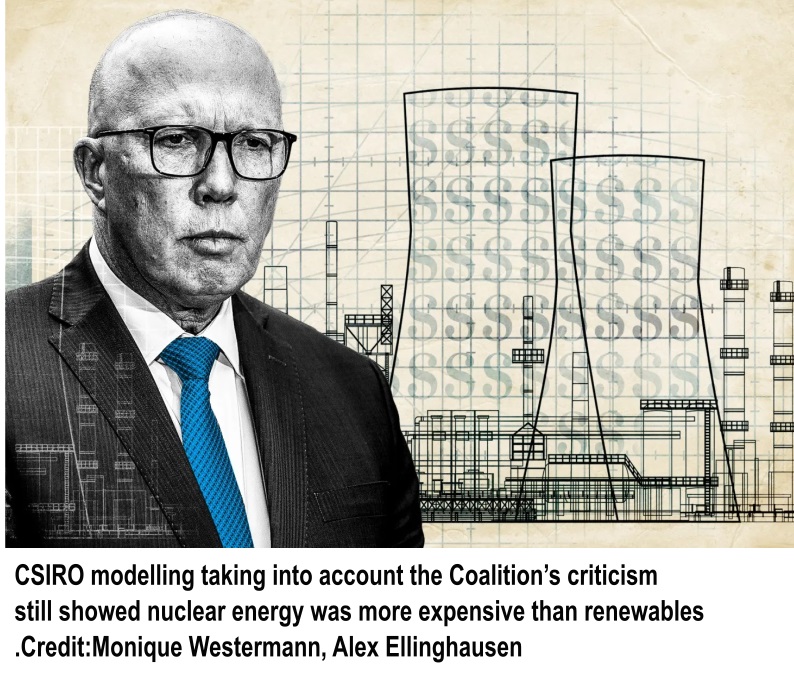
A new report which reveals the coalition’s nuclear plan would send an additional two billion tonnes of emissions into the atmosphere and send power bills even higher is yet another distraction from the real issues in Australia’s energy debate.
The Climate Change Authority report concludes that additional emissions under the coalition plan would see Australia miss its 2030 emissions target and delay the overall transition to clean energy.
“The Climate Change Authority’s slap-down of the Coalition’s nuclear proposal is welcome, but it is yet another distraction from the big climate issues,” said Rod Campbell, Research Director at The Australia Institute.
We’re talking about nuclear yet again, not about Australia’s uninsurable regions, massive fossil fuel subsidies and dodgy offset schemes.
“It suits both major parties to have a fake fight about nuclear and avoid these real problems in Australia’s climate policy, on which Labor and Liberals largely agree.
“It would be more useful if the CCA focused on Australia’s subsidised fossil fuel expansion and rising domestic emissions.
“Nuclear is a distraction that avoids scrutiny of Australia’s real climate problems.
Peter Dutton’s nuclear accounting trick #4: Assume climate change has no cost

Tristan Edis, Feb 23, 2025 https://reneweconomy.com.au/peter-duttons-nuclear-accounting-trick-4-assume-climate-change-has-no-cost/
This is the final part of a five part series of articles examining the four accounting tricks that the Liberal-National Party employed in the costing of their energy plan to slow the roll-out of renewables and rely instead on nuclear power. The first article, which provides the overarching context is published here. Part 2 is here. Part 3 is here, and part 4 is here.
These four accounting tricks act to mislead voters that the Liberal-National Party could lower energy bills through a shift to nuclear when in reality it is likely to increase power bills.
This article focuses on number four and the last of the accounting tricks covered: Assume climate change is not an important and urgent problem that is worthy of costing.
Most types of greenhouse gases last decades to centuries once released in the atmosphere and so the overall level of global warming the planet experiences will be a function of our cumulative emissions over time.
While it would be great if we can reach net-zero emissions in 2050, the level of warming we’re in for will be a result of not just emissions in 2050, but also the years prior to 2050.
The Liberal-National Party’s preferred plan for the electricity system involves slowing the replacement of coal with renewable energy over the next decade and instead waiting until the 2040’s to undertake a concerted replacement of coal with nuclear power. This leads to almost 1 billion extra tonnes of CO2 emissions compared to the so called Labor Scenario (AEMO’s Step Change) from the electricity sector.
There’s also substantial additional emissions from outside the electricity sector due to the Coalition’s preference to maintain consumption of petroleum for transport and natural gas for heating in homes and industry.
The Coalition’s consultant didn’t elect to provide any information to calculate these extra non-electricity emissions. However as detailed in part 3 of this series, it’s possible using AEMO data and the average fuel efficiency of EVs and petroleum-fueled vehicles to estimate extra petrol consumption in the Liberal Party scenario of 203 billion litres. This would add an extra 466 million tonnes of CO2 to atmosphere.
The extra CO2 carries a cost in terms of the damage global warming is expected to inflict on people.
It is interesting to note that the consultant who prepared the Liberal-National Party costing has acknowledged the existence of data prepared by the Australian Energy Regulator that would allow them to attribute an economic cost on this extra CO2.
Yet the consultant explicitly chose to place no economic value at all on carbon emissions. If they had applied the value recommended by the regulator then it would have added $392 billion in extra cost to the Liberal Party Scenario compared to an extra $75 billion to the Labor Scenario.
The end result for the aggregate cost (also taking into account the extra petrol expense to consumers) of the Liberal-National Party’s system versus that of Labor is shown in the chart below.
Overall, the Liberal-National Party system ends up close to $400 billion more expensive than that claimed to be the Labor system (AEMO’s Step Change scenario). Note this doesn’t correct for the fact that the Liberal-National costing has vastly understated the cost of nuclear power plants, which means it’s cost disadvantage is far higher than $400 billion.
No doubt for many people all of this modelling of possible alternative power systems and their cost 25 years into the future is a bit abstract and theoretical. They are right to be sceptical given the uncertainty which surrounds these estimates.
But one thing that isn’t at all uncertain is that the Liberal-National Party decided it was sensible to place a value of zero on avoiding carbon emissions in an economic evaluation of different policy options.
This is potentially far more informative about their energy and climate change policies than the 45 pages of economic modelling that supports their claimed energy policy costs.
Tristan Edis is director of analysis and advisory at Green Energy Markets. Green Energy Markets provides analysis and advice to assist clients make better informed investment, trading and policy decisions in energy and carbon abatem
1 This month

of the week – Australians for War Powers Reform (AWPR)
To see nuclear-related stories in greater depth and intensity
 Antinuclear