Your G7 greenwashing guide: How Australia will feign climate ambition — RenewEconomy

Instead of focusing on reducing emissions, Australia’s government is putting great effort into greenwashing and twisting statistics. Here’s how. The post Your G7 greenwashing guide: How Australia will feign climate ambition appeared first on RenewEconomy.
Your G7 greenwashing guide: How Australia will feign climate ambition — RenewEconomy
Australia’s Climate Change Authority now taken over by the nuclear lobby, and influenced by ”secret society” of nuclear promoters.
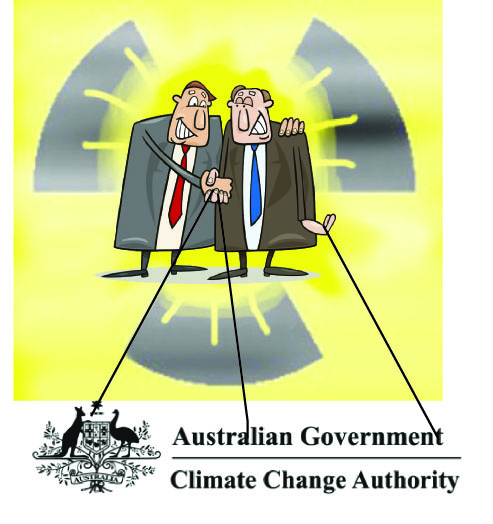
Grant King flags “secret society” working to lift nuclear power ban, https://reneweconomy.com.au/grant-king-flags-secret-society-working-to-lift-nuclear-power-ban/ .
Michael Mazengarb 7 June 2021 The recently appointed chair of the Climate Change Authority, Grant King, has spoken of his support for nuclear power, and the presence of a ‘secret society’ preparing to lobby governments to lift the ban on nuclear power in Australia.
In a speech to the Minerals Council of Australia, one of his first since his appointment to the CCA was announced in April, King also indicated that he would advocate for clean energy technologies that are compatible with continued fossil fuel use, such as carbon capture and storage.
Everything that reduces emissions is good,” King told the conference. There is no good or bad reduction of emissions. If we are storing carbon safely, that is as good as reducing emissions in some other location, and you cannot get to net zero any other way than recognising that duality exists,” King said.
“There is an enormous amount of sunk capital in old technologies, and their ability to be adapted and evolved and to make a difference today is far greater than people estimate.
“But we like the shiny new stuff, because we think new stuff is better than old stuff, even if you’ve got to wait ten or 20 years for it to be competitive.”
Interestingly, King – a former CEO of Origin Energy – indicated he would use his new position at the CCA to reinvigorate the debate around nuclear power, saying that he believed the economics of small modular reactors could be feasible.
“If we want to get into a debate, it is important that we throw nuclear into the mix and say Australia is going to have to come to grips with that issue and is going to have to decide whether or not it lifts that regulatory prohibition and allows the innovation and investment that is now happening, particularly for modular reactor technology, to be applicable here in Australia,” King said.
“The story is good in terms of risks and the things that we as a generation grew up fearing, we were taught to get under the desk just in case, that is all going to go away.”
King said there was something akin to a “secret society” that had been working in the background to advocate for legislative reforms to lift the prohibition on nuclear power.
“The prohibition has to be lifted and there is a secret society of people out there trying to figure out what conversation needs to be had with the government to lift that prohibition.”
Nuclear energy projects are currently prohibited in Australia under the Environmental Protection and Biodiversity Conservation Act, and suggestions of any lifting of the ban have long been politically contentious, even if many in the Coalition, and some in Labor, support the ban’s removal.
Small modular reactors have been touted as a potentially lower cost and safer way of producing electricity from nuclear fuels, but have had no real-world deployments as a commercial technology.
US-based TerraPower, which has received financial backing from Bill Gates and Warren Buffet, is looking to deploy one of the next-generation nuclear reactors in the state of Wyoming. The project will replace a coal-fired generator and is expected to take at least seven years to get up and running.
As CEO of Origin Energy, King oversaw the company’s significant push into the LNG gas market, and was later the president of the Business Council of Australia.
King was also commissioned to undertake a review of the Morrison government’s Emissions Reduction Fund, recommending that the fund be opened up to providing support for carbon capture projects and to pay large-industrial firms to cut their emissions.
Scott Morrison’s climate summit speech was littered with downright dodgy claims,
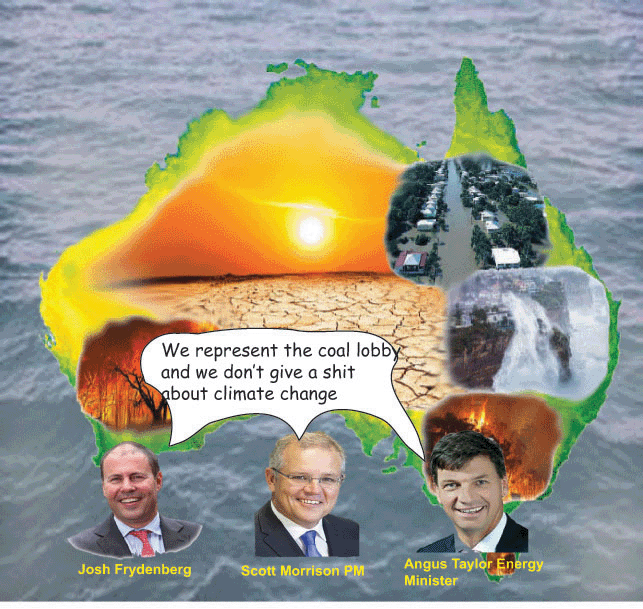
Scott Morrison’s climate summit speech was littered with downright dodgy claims, https://thenewdaily.com.au/news/politics/australian-politics/2021/04/24/scott-morrison-climate-summit-facts/ Richie Merzian, I have sat through countless speeches on climate change from world leaders, both working for the government and outside it, and Prime Minister Scott Morrison’s rant at President Joe Biden’s climate summit last night was one of the worst performances I have ever seen.
Technical glitches and the dreaded mute button were the least of Morrison’s worries, as he mounted the (virtual) stage, armed with three-word slogans, self-congratulations, and downright dodgy greenhouse gas emission numbers.
Most major nations before him (and there were many) had pledged stronger climate targets or concrete policies to curb carbon pollution. Japan and Canada vowed significant increases on their 2030 targets. India and the Republic of Korea announced new partnerships with the United States. Even Brazil, a highly problematic country in the climate space, announced it would advance its carbon neutrality target by a decade.
In contrast, Morrison’s speech was heavy on bluster, light on policy. No new commitments were brought to the table, further cementing Australia’s inadequate Paris target of a 26-28 per cent reduction in greenhouse gas emissions by 2030. Then like the dinner guest that turns up to a pot-luck empty-handed and complains about what others have brought, Morrison dismissed the serious efforts of other nations whilst offering nothing himself.
When it came time to talk numbers, Morrison’s claim that we have reduced emissions by 19 per cent broadly and 36 per cent excluding exports, had me and many others dumfounded. Where did these numbers come from? What dodgy accounting tricks were at play? Turns out 19 per cent is cherry-picked from the middle of the pandemic and the 36 per cent number is just off the reservation. The PM is reinventing UN accounting rules, asking the world to forget about the rising emissions from the production of gas and coal we export!
If there is one thing we can establish, Morrison can always be relied upon for accounting tricks. Until recently, the Morrison government tried to cash in on leftover carbon credits from the last climate agreement, to avoid reducing emissions required under the current Paris Agreement. This is What dodgy accounting tricks were at play? Turns out 19 per cent is cherry-picked from the middle of the pandemic and the 36 per cent number is just off the reservation. The PM is reinventing UN accounting rules, asking the world to forget about the rising emissions from the production of gas and coal we export!
If there is one thing we can establish, Morrison can always be relied upon for accounting tricks. Until recently, the Morrison government tried to cash in on leftover carbon credits from the last climate agreement, to avoid reducing emissions required under the current Paris Agreement. This is akin to attempting to use an old Starbucks loyalty card to pay for a Big Mac. Only after he was named and shamed by his international peers did Morrison back away from this dodgy loophole.
Much like a guest knows there are topics you do not talk about at a dinner party, every world leader knows the formalities and conventions of a climate summit. Every world leader it seems, bar Morrison. After undermining the speakers before him by belittling ‘targets’ and ‘promises’ with a tone-deaf arrogance, Morrison went on to awkwardly name-check his big-polluting industry mates, and claim Australia would somehow replicate the US’ success in Silicon Valley through our own ‘hydrogen valleys’.
Morrison rattled off ‘pioneering Australian companies’ from BHP to RioTinto, seemingly forgetting he was speaking on the international stage not addressing the Business Council of Australia at some inner-city wine bar. Perhaps most bizarre, was the name-dropping of Allan Finkel. While most Australian’s probably don’t know who Allan Finkel is, let alone the rest of the world – those who do, likely know him as the former Chief Scientist whose controversial views on gas sparked an open letter from leading Australian scientists.
In December 2019, when I watched Angus Taylor address the United Nations climate talks in Madrid without acknowledging the catastrophic bushfires that were devastating the nation, I thought I’d seen Aussie climate diplomacy at its worst. Then came Morrison’s performance at this summit.
Fortunately, the US had placed Morrison so far down the speaking list that President Biden had already left the room.
The United States – the world’s largest economy and second-largest polluter after China kicked off the event by announcing it would at least halve emissions by 2030, a target that Australia Institute research shows Australia should replicate. If it did, then we would have something to brag about.
Richie Merzian is Climate & Energy Program Director at The Australia Institute. You can follow him on Twitter at @richiemerzian.
Why Boris Johnson rejected Scott Morrison as speaker at climate summit, to Morrison’s fury
|
Boris Johnson outlines why Scott Morrison was rejected to speak at climate summit, The Age, By Rob Harris March 22, 2021 British Prime Minister Boris Johnson told Scott Morrison that Australia was denied the opportunity to speak at last year’s climate summit because he wanted to encourage nations to set more ambitious emissions reduction targets.
Mr Johnson, who is rallying the world’s leading economies towards achieving net zero emissions by 2050, explained his rationale in a letter to the Australian Prime Minister in December last year while acknowledging the domestic political challenge over climate policy. Mr Johnson had originally invited Mr Morrison to speak at the December 12 summit but later walked away from the offer amid a behind-the-scenes diplomatic tussle over whether Australia’s climate change policies were insufficient to warrant a speaking slot………. While Mr Morrison told Parliament at the time he was not bothered by the snub, the government was privately furious behind the scenes and much of its anger was directed towards the British PM, who hosted the conference in partnership with the UN and France. Mr Johnson said Mr Morrison should understand that “we have tried to set a high bar for this summit to encourage countries to come forward with ambitious commitments”………https://www.theage.com.au/politics/federal/boris-johnson-outlines-why-scott-morrison-was-rejected-to-speak-at-climate-summit-20210322-p57d2o.html |
|
Minerals Council of Australia trying to influence European Commission, to push for fossil fuels and nuclear
|
The Minerals Council of Australia has weighed into a European commission climate policy debate, urging it to back fossil fuels with carbon capture use and storage (CCS) and nuclear power on a list of environmentally friendly developments.
In a written submission to the commission, the minerals council (MCA) said a proposed EU taxonomy for sustainable activities intended to shape investment under a European green deal was inconsistent in how it dealt with clean technologies because it favoured solar, wind and biofuels over nuclear and CCS. The mining lobby group said it was concerned this approach would have a flow-on effect on the types of energy investments backed by EU-based companies across the globe and “increase the cost of reducing CO2 emissions”. It called for an overhaul. InfluenceMap, a London-based thinktank that tracks corporate climate lobbying, said the MCA’s submission suggested it wanted to export its “negative approach to climate policy” by pushing for changes in other parts of the world that would allow continued use of coal and gas. The MCA submission argued there was “no valid basis” for treating CCS and nuclear differently given EU countries currently used coal, gas and nuclear……….. But InfluenceMap’s program manager, Rebecca Vaughan, said the MCA appeared concerned a science-led approach to dealing with the climate crisis would hurt the industries it represented. “While the MCA says it wants the EU to take a technology neutral position, its submission appears to advocate for the continued use of coal and gas with carbon capture utilisation and storage, which is clearly at odds with the commission’s science-based policy,” Vaughan said. The MCA has long been accused of hindering action to tackle the climate crisis in Australia, and campaigned aggressively against Labor’s two attempts to introduce a carbon pricing scheme. In recent years it has come under pressure to change its anti-climate stance from its biggest members, BHP and Rio Tinto. It followed the big mining companies facing repeated calls from their investors to abandon the MCA over its commitment to coal. It resulted in the MCA releasing a climate plan that said it was committed to the Paris agreement and reaching net zero emissions, but did not include a timeframe in which that target should be reached. The EU taxonomy is intended to help it meet a target of at least a 55% cut in its emissions below 1990 levels by 2030 on the way to net zero by 2050 by defining what activities are considered environmentally sustainable and warrant investment support. The commission said it expected the taxonomy would “create security for investors, protect private investors from greenwashing, help companies to plan the transition, mitigate market fragmentation and eventually help shift investments where they are most needed”.
The final version of the EU’s sustainable finance rules was due in January but a decision was delayed until April after 10 countries objected to the initial proposal because they wanted gas to be deemed a sustainable energy source. Nuclear energy plays a significant role in some EU countries but has been found to be in decline in the developed world, and to be more expensive and less efficient at reducing emissions than renewable energy……….. Nuclear energy remains banned in Australia. Some Coalition MPs and industry leaders want the prohibition lifted. https://www.theguardian.com/australia-news/2021/mar/21/australias-miners-urge-europe-to-define-nuclear-power-and-fossil-fuels-with-carbon-capture-as-sustainable |
|
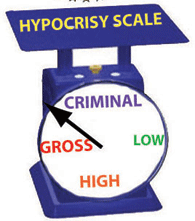
Federal energy and emissions reduction minister Angus Taylor wants to include dirty energy in Clean Energy Finance Corporation
Renew Economy 18th Feb 2021, The Morrison government is set for a fight from within over proposed changes to the Clean Energy Finance Corporation, with a growing number of
Nationals looking to lift restrictions on investments in unproven fossil fuel technologies and nuclear energy projects.
Federal energy and emissions reduction minister Angus Taylor has introduced legislation to establish a new $1 billion Grid Reliability Fund to be administered by the Clean Energy
Finance Corporation, that the government wants to use to underwrite new gas and storage projects, which would require re-defining gas as a ‘low emissions technology’.
The Clean Energy Finance Corporation is restricted to only investing in ‘low emissions technologies’, and is explicitly prohibited from investing in nuclear energy technologies and carbon capture and storage projects.
https://reneweconomy.com.au/nationals-push-nuclear-in-new-attempt-to-highjack-cefc-changes/
‘Clean Coal’ – ridiculed by experts, as just a marketing scam
 ‘Clean coal’ is nothing but a marketing scam: Energy experts, New Daily, Cait Kelly, Reporter 17 Feb 21, The Nationals’ pitch for taxpayers to invest in ‘clean coal’ is nothing but a marketing scam designed to make Australians feel better about burning carbon emissions, leading energy experts say.
It comes as the Morrison government pushes key changes to Australia’s Clean Energy Finance Corporation that would allow the green bank to invest in fossil fuel projects, and give Energy Minister Angus Taylor the power to control which investments receive funding.
Mr Taylor’s proposed bill would undo laws that stop the corporation from investing in fossil fuels and loss-making projects.
But outspoken backbencher Barnaby Joyce served up an amendment to allow for investment in clean coal, blindsiding the government and derailing the passage of the bill through Parliament on Wednesday.
Debate on the legislation started in the House of Representatives on Monday and the push was on to get ‘clean coal’ a spot at the investment table.…….
On Wednesday, Nationals Senate leader Bridget McKenzie backed Mr Joyce’s amendment intended to allow for new investment in “high efficiency, low emissions” coal-fired power.
Doctors also joined the chorus of voices warning the changes would negatively affect environment targets, saying our love of fossil fuels is already killing 5700 Australians each year, and will continue to do so until we phase it out.
Clean coal ‘doesn’t exist’
Richie Merzian, the climate and energy program director with the Australia Institute, said ‘clean coal’ was nothing more than spin.
“Clean coal doesn’t exist. That’s the first thing,” Mr Merzian told The New Daily.
“Over the last 15 years, Australian governments have invested $1.3 billion into making clean coal work.
“There isn’t a single commercial clean coal, carbon capture storage power plant in Australia. And there are hardly any overseas – you can count them on one hand.”
Australia has only one carbon capture and storage gas plant. It’s currently leaking emissions into the atmosphere, because it doesn’t work.
The Gorgon gas project in WA received $60 million in federal funding but did not start storing emissions until 2019, three years after productions started.
Recently, it has been leaking high levels of emissions out into the atmosphere because its pressure management system is broken.
“It’s still not fully operational,” Mr Merzian said.
“The level of the emissions released in the atmosphere are about the same as Australia’s annual domestic emissions of flights.
“It’s been a massive failure.”
All it boiled down to was a marketing tool, he said……… https://thenewdaily.com.au/news/2021/02/17/clean-coal-scam/
Butler dumped as Labor’s climate opposition collapses at a truly pivotal moment

Labor to dump Mark Butler as its opposition to Morrison’s inadequate climate and energy policies evaporates. Renew Economy, 28 Jan 21,
It’s odd how climate news tend to rhyme and counter itself across the world in perfect unison. Joe Biden has just announced a huge raft of major new climate policies, after coming to power off a campaign that focused heavily on climate. It’s a big moment, and it’s being received well by both the American energy industries and by the progressive activists that helped shape Biden’s policies.
Back in Australia, the news that opposition climate spokesman Mark Butler is losing the climate change portfolio to a member of the party’s right wing was leaked to media. What a contrast. As the federal government sinks even deeper into a climate and energy funk, the opposition marks this major global climate moment by sacking one of their best.
The total absence of any countering force to pressure a government that’s become stunningly and openly destructive on climate is a dark moment for Australia, and it’s worth exploring how we got here.
Missed opportunities are the norm
If you trace back through every big climate and energy moment of the past two years (and before that, too), the Labor party has failed catastrophically to summon any might or certainty or even bare sufficiency in their opposition to the federal government’s fossil expansion fantasies.
The climate-intensified bushfires were mostly ignored and there has been near zero debate about where COVID19 recovery cash flows.
In December last year, a crucial moment for Australia’s climate came and went. In the lead up to the moment when Australia’s government had to submit an ‘update’ to its 2030 Paris Agreement targets (known as ‘Nationally Determined Contributions, or NDCs), the Prime Minister and ‘Energy and Emissions Reductions Minister’ Angus Taylor were badly exposed.
Scott Morrison claimed to have been invited to an event held by the United Kingdom government – another climate summit talk-fest type thing. Turns out that Australia never made it onto the list; purely because Morrison’s government had steadfastly refused to upgrade their 2030 NDC from something weak, old and insufficient to something newer and better aligned with the country’s potential for climate action and level of ambition. Morrison was furious: he’d saved up a big announcement to promise not to cheat on those already-weak 2030 targets (a shift made possible only because renewable energy has outperformed expectations, and because a deadly disease dented emissions) – where was his congratulations?
2030 is what counts. The world’s performance this decade will largely decide whether net zero by 2050 is a pipe-dream or possible. And in the last months of 2020, Australia federal opposition, the Labor Party, had a brilliant opportunity to pressure the government into upgrading their 2030 climate ambitions to something more aligned with what’s required to keep the planet to 1.5C of warming (around 66% is a good indicator; a new ‘Climate Targets Panel’ announced today, suggests somewhere above 50% for 2C and 75% for 1.5C).
Of course, that didn’t happen. The absolute peak of opposition was leader Anthony Albanese labelling the rescinding of the Kyoto trick ‘pathetic‘. The reason why? Labor has itself not established what a 2030 target should be; they haven’t even set an interim pre-2050 target for emissions reductions.
There’s a popular conception that Labor’s 45% 2030 target, which it took to the 2019 federal election, was a major part in their loss. That’s generally justified on an ‘election review‘ that blamed opposition to the Adani coal mine for their loss; along with too-ambitious climate policies. “Labor should recognise coal mining will be an Australian industry into the foreseeable future and develop regional jobs plans based on the competitive strengths of different regions” said the review. It was co-chaired by Dr Craig Emerson, who recently wrote in the AFR that ending fossil fuel extraction is akin to an act of white supremacy. Albanese now reminds voters that Australia will be digging up and selling coal in 2050; the year the world ought to be mostly free from all emissions.
Of course, it only ‘cost’ Labor in 2019 due to a mixture of half-heartedness from Labor right leader Bill Shorten, severe misreporting of climate policy from media outlets (“What about the costings!!”) and the government’s relentless and ludicrous scare campaign around zero emissions transport. The alternative – of doing climate advocacy in an effective way, immune to those immature attacks – wasn’t even considered in that review.
The internal fight was won by the fossil industry
Mark Butler was one of the remaining forces for stronger climate action within the Australian Labor party is Mark Butler. He’d come into conflict with the party’s most aggressive advocate of higher emissions, Joel Fitzgibbon, who represents a coal-mining area in New South Wales. Whatever slight momentum existed within the party for climate ambition seems now to have been sidelined.
The alternative vision offered up by Labor – modelled on Ross Garnaut’s ‘superpower’, in which Australia becomes enriched through the export of zero carbon energy – is grand but still vague. There is little detail on the short term benefits that strong climate action would bring. There’s no commonly stated policy about a just transition for fossil workers, as that would entail admitting the likelihood that the industry’s on the way down – unthinkable for an unashamedly pro-fossil-mining party.
Butler is tipped to be replaced by Chris Bowen, a member of Labor’s right faction. Bowen’s Twitter history features no mention of wind, solar, coal, oil or gas, and the majority of climate mentions are criticisms of Liberal backbencher Craig Kelly. Bowen reassured voters prior to the 2019 election that he would not ban the Adani coal mine, but has also signalled potential enthusiasm about some parts of the US Democrat’s ‘Green new deal’ policy package. Bowen also led a push to make climate change a health priority, just prior to the onset of Australia’s Black Summer. bushfire season. It may not be all bad, but whether it translates into sufficient ambition seems highly questionable.
Albanese’s reshuffle was welcomed by Joel Fitzgibbon. “Fitzgibbon, who stood down from the resources portfolio after his clashes with Mr Butler at the end of last year, welcomed the news about the reshuffle but signalled he wanted a change on policy as well”.
It’s a weird request, given there is literally no policy to change, save for reaching ‘net zero’ domestic emissions in 2050 while still pumping out fossil fuels to the world. Presumably what Fitzgibbon is requesting is creating new policy, doing things like using government power to build new fossil fuel power stations, subsidising fossil mining operations even more, and changing regulations to roadblock renewables, EVs and other forms of decarbonisation. Capitulating to pro-fossil forces means that miles will be taken, after inches are given. Time will tell what this new-found position entails, but chances are that it won’t be good.
A new opportunity to waste again
This is all happening in the context of two global shifts.
First, the US Democrats won against an extremely popular authoritarian figure (for both the presidency and control of the Senate) by making climate action – and in particular, justice-driven climate action – a central focus. Today, Biden has made climate a central focus, announcing a wide range of additional initiatives that focus on communities of colour in the US. Biden just announced a plan to replace the government’s fleet of 650,000 vehicles with all-electric alternatives, cancelled the Keystone XL oil pipeline from Canada and has rejoined the Paris agreement. Of course, Biden has his own Fitzgibbon to contend with, but it hasn’t resulted in a reshaping of the party around total silence on climate.
It’s a winning formula: at least try to do what’s needed on climate, rather than hand-wringing about potential attacks from the opposition – which will always be in bad faith, and will always happen to matter the level of ambition. Make it about people – about jobs, and benefits and air and cities and land. Make it real. That seems to work.
Second, a major global climate conference will be held in November this year, in the UK. If you think the snub from the UK last year was bad, wait until you see what happens after another full year of fossil fuel advocacy and government support from Morrison and Taylor. The lead up and duration of this massive global climate event ought to be a red hot, near-perfect time to establish a clear alternative to the government’s stonewalling.
The final year of this stretch of government seems like it’ll end up the same as the first two: Morrison and Taylor worsen climate harm, while the opposition fails to oppose.
We can say with total confidence that if the Labor party had already created and popularised a climate plan that targets today’s ills, like the need for cleaner cities, more accessible transport, cheaper power and more varied and secure work, they’d be soaring in the polls even despite COVID19.
Of course doing this would paint a target on their back – but literally anything would invite bad-faith attacks from the government and the media. The best option in the face of those attacks is to build a plan so strong that it can withstand attacks, not to abandon climate policies altogether. The current approach means the party is hurtling towards an election loss, up against one of the most stunningly clumsy, pro-fossil governments in the world. https://reneweconomy.com.au/butler-dumped-as-labors-climate-opposition-collapses-at-a-truly-pivotal-moment/
Joel Fitzgibbon Demands Labor’s Climate Change Policy Be Solely Based On Keeping Him In A Job
Joel Fitzgibbon Demands Labor’s Climate Change Policy Be Solely Based On Keeping Him In A Job Betoota Advocate, WENDELL HUSSEY | Cadet | CONTACT, 28 Jan 21, As storms begin to brew in regards to Anthony Albanese’s leadership, Joel Fitzgibbon has today hit the media junket with another big demand.
This time, the Member for Hunter has called for the Labor Party to give up on trying to combat climate change and instead focus upon developing a policy solely based on keeping his parliamentary salary rolling in.
The man involved in every single federal Labor leadership spill since 2006 because the party never seems to be heading in the direction he wants, says ‘Labor needs to return to its roots.’
But, by roots, he doesn’t mean trying to develop policy that improves the lives of his predominantly working-class constituents in a long term sense, he means dropping all climate targets and continuing to try and cosy up to the dying coal industry despite the fact even giant profit-driven banks and investment funds are saying it’s not economically viable going forward…. https://www.betootaadvocate.com/entertainment/joel-fitzgibbon-demands-labors-climate-change-policy-be-solely-based-on-keeping-him-in-a-job/
Australia is “rapidly” moving towards a hotter, drier climate
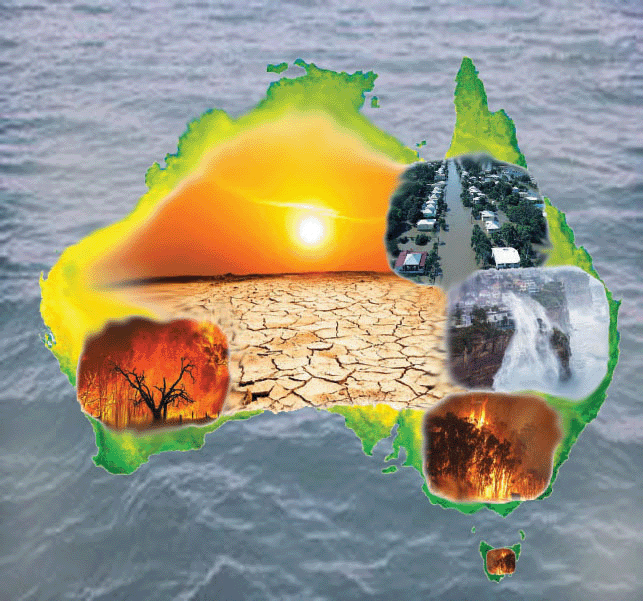
Climate change predictions: Average temps to increase, rainfall to decrease
It seems our already warmer days are only going to get hotter as weather experts paint a grim picture of Australia’s climate in the future. https://www.dailytelegraph.com.au/technology/climate-change-predictions-average-temps-to-increase-rainfall-to-decrease/news-story/c09593fdeb48648c8bfea031bbe7beea
Emily Cosenza, December 9, 2020
NCA NewsWire Australia is “rapidly” moving towards a hotter, drier climate, with average temperatures to continue on an upwards trajectory and rainfall being predicted to gradually decline in parts of the country.Climate change was a major theme in the Bureau of Meteorology’s State of the Climate 2020 biannual report as weather experts demonstrated how the country’s climate had changed since records began in 1910.
CSIRO senior research scientist Dr Michael Grose said weather trends seen in the past were very likely to continue in the future, including warmer temperatures and sea levels rising.
“Heavy rainfall – that‘s the hourly to daily intense downpours – is likely to become more intense through time, partly because that’s just what happens with a warmer atmosphere,” Dr Grose said.
“Unfortunately, that longer fire season with an earlier start and more days of dangerous fire weather is predicted to continue.
We’re heading towards what Australia would have experienced – or the equivalent for Australia – if global warming reached the 1.5 degree and 2 degree global warming level since pre-industrial, (and) we’re heading towards those quite rapidly.” ……..
“What’s really important in the report, and as we’ve seen in past reports, is that we’re experiencing climate change now, and it’s impacting on our community, many industries and other sectors as well,” Dr Bettio said.
She said some temperatures in the warmer months of 1916-89 were seen less than 1.8 per cent of the time but are now presenting more than 12 per cent on the time. “That 1 degree doesn’t sound like a big number, but it’s really impacting on that extreme heat that we experience
Defence Minister Linda Reynolds announces hypersonic missiles for Australia

Australia to begin testing hypersonic missiles within months, The Age, By Anthony Galloway, December 1, 2020 Australia will begin testing hypersonic missiles that can travel at least five times the speed of sound within months under a new agreement with the United States to develop prototypes of the next-generation weapons…….
The Australian government will now begin talking with Australian industry about rolling out a range of technologies to bring the hypersonic missiles from the testing phase to the production line for the Royal Australian Air Force.
Defence will not reveal the estimated cost of developing the new hypersonic missiles but it is expected to run into billions of dollars. A total of $9.3 billion was earmarked in this year’s Force Structure Plan for high-speed long-range missile defences.
Under the plan, the hypersonic missiles would be carried by the RAAF’s existing arsenal of aircraft including the Growlers, Super Hornets, Joint Strike Fighters and Poseidon surveillance planes. The missiles could also be attached to unmanned aircraft such as the new Loyal Wingman drones.
The Australian Defence Minister said the experiments with the US would include demonstrations to show how the weapon performs in operational conditions, which would then inform future purchases.
“Developing this game-changing capability with the United States from an early stage is providing opportunities for Australian industry,” she said…..
Michael Kratsios, the Acting Under Secretary for Research and Engineering for the US’s Department of Defence, said the agreement was “essential to the future of hypersonic research and development, ensuring the US and our allies lead the world in the advancement of this transformational war-fighting capability”. ….. https://www.theage.com.au/politics/federal/australia-to-begin-testing-hypersonic-missiles-within-months-20201130-p56j5a.html
Australia’s freedom of information system hides climate documents
 Australia’s government agencies increasingly refusing environment-related FOIs, audit finds . Australian Conservation Foundation also finds growing delays in processing requests by departments and agencies. Guardian, Christopher Knaus, 9 Nov 20,Australia’s freedom of information system is increasingly hiding documents about climate and other environmental issues from the public, a trend driven by skyrocketing refusal rates, widespread delays and rising costs, an audit has found.
The audit, conducted by the Australian Conservation Foundation (ACF), examined five years of FOI requests for environment-related documents across federal and state departments and agencies.
It found the number of outright refusals for environment-related documents has more than doubled, from 12% to 25%, while the number of requests granted in full has dropped from 26% to 16%.
Delays in processing environment-related FOI requests were widespread, the audit found, with 60% of requests late by more than a month and 39.5% by more than two months.
The cost of processing environment-related FOIs was double the average, and lengthy review processes, which often took more than a year to complete, were becoming “a key tool for denying access to information”.
“It appears from our audit that environmental information is even more odiously inaccessible than other information subject to the [Freedom of Information] Act,” the ACF’s audit said.
ACF’s democracy campaigner, Jolene Elberth, said the findings of the audit should be a “wake-up call” to anyone who cares about transparency.
“Serious systemic flaws in our system are frustrating efforts to protect our precious natural ecosystems and tackle the climate crisis,” Elberth told the Guardian………
The Office of the Australian Information Commissioner’s (OAIC) latest annual report shows delays, complaints and refusals are all increasing over time.
Complaints about the FOI system increased by 79% in a single year, according to the OAIC’s annual report.
Practical refusals – used if a request is deemed to take too much time or effort to process or if documents cannot be found – went up by 71% in 12 months.
Delays are growing more protracted.
Last financial year, about 79% of all FOIs were processed in the time required by law. The year before it was 83% and in 2017-18 it was 85%.
In some government agencies, only 50% of FOI requests are being processed within the lawful timeframe, including the prime minister’s office, the office of the environment minister, the Australian Radiation Protection and Nuclear Safety Agency, the Australian Sports Anti-Doping Authority, Sports Australia, the Australian federal police, the Australian Broadcasting Corporation, the office of the infrastructure minister and Norfolk Island Regional Council.
Delays at the Department of Home Affairs, which receives by far the most FOI requests, have also increased…… https://www.theguardian.com/australia-news/2020/nov/09/australias-government-agencies-increasingly-refusing-environment-related-fois-audit-finds
Jo Biden’s win leaves Scott Morrison looking pretty silly on climate policy
 Biden win leaves Australia ‘isolated’ and lagging on climate goals, New Daily, Josh Butler 8 Nov 20, A Biden presidency will put an increasingly “isolated” Australian government under immense pressure to adopt strong environment and emissions policies, leading climate voices say, as the United States looks to again assume a global leadership role.It comes as former prime minister Malcolm Turnbull ridicules Scott Morrison’s plans for a ‘gas-led recovery’ as “BS” and “political piffle”, in calling for his former colleagues to back more ambitious climate targets……. Biden win leaves Australia ‘isolated’ and lagging on climate goals, New Daily, Josh Butler 8 Nov 20, A Biden presidency will put an increasingly “isolated” Australian government under immense pressure to adopt strong environment and emissions policies, leading climate voices say, as the United States looks to again assume a global leadership role.It comes as former prime minister Malcolm Turnbull ridicules Scott Morrison’s plans for a ‘gas-led recovery’ as “BS” and “political piffle”, in calling for his former colleagues to back more ambitious climate targets…….
President-elect Biden spoke of “the battle to save our planet by getting the climate under control”, while vice president-elect Kamala Harris also prominently mentioned the need “to combat the climate crisis” in her speech. Ambitious climate agendaMr Biden will reinsert the US into the Paris climate agreement on his first day in office. He pledged “to get every major country to ramp up the ambition of their domestic climate targets”, and will move to get the US power grid using 100 per cent clean energy by 2035. Crucially, he will commit the US to a policy of net-zero emissions by 2050. This change, Australian experts say, will leave Mr Morrison’s federal government out in the cold as the only one of our major trading partners without a similar target. “This will have huge ramifications in increasing action around the world,” Amanda McKenzie, CEO of the Climate Council, told The New Daily. “Australia will look isolated. Most countries have a net-zero target, many are looking more ambitious than that. Australia’s ‘climate-lite’ approach, of not doing a lot but claiming we are, won’t cut it.” All of Australia’s most important partners – the United Kingdom, Japan, South Korea, China, India, Canada, and now the US – have committed to concrete net-zero targets in coming years, meaning a balance between emissions produced and emissions removed. Last month, British PM Boris Johnson told Mr Morrison of the need for “bold action to address climate change” and “the importance of setting ambitious targets to cut emissions and reach net zero”. However, Mr Morrison has only committed Australia to the goal “in the second half of this century”. The federal government has also come under fire for the controversial plan to use ‘carryover credits’ from the previous Kyoto climate agreement to count against commitments under the Paris agreement. On Sunday, Mr Morrison said he looked forward to working with Mr Biden to lower emissions worldwide……… Pushing beyond net zeroRichie Merzian, climate and energy program director at The Australia Institute, said a Biden win will further pressure the federal government. “We could always hide behind the US when they were a laggard on climate, but no more. Biden will bring that pressure to bear on Morrison,” Mr Merzian told TND……. He added that Australia should scrap its reliance on Kyoto credits and pledge stronger action. “The most important period for climate action is the next 10 years … [a Biden win] does raise this and put this back as a front and centre issue,” Mr Merzian said. Australia Institute polling from last year found 62 per cent of Australians would back a net-zero target by 2050, or even earlier……. https://thenewdaily.com.au/news/2020/11/09/joe-biden-climate-change/ |
|
Australian govt will feel the heat when a Biden administration rejoins the Paris climate agreement
 Biden says the US will rejoin the Paris climate agreement in 77 days. Then Australia will really feel the heat, The Conversation Christian Downie, Australian Research Council DECRA Fellow, Australian National University, November 6, 2020 When the US formally left
the Paris climate agreement, Joe Biden tweeted that “in exactly 77 days,  a Biden Administration will rejoin it”.
The US announced its intention to withdraw from the agreement back in 2017. But the agreement’s complex rules meant formal notification could only be sent to the United Nations last year, followed by a 12-month notice period — hence the long wait.
While diplomacy via Twitter looks here to stay, global climate politics is about to be upended — and the impacts will be felt at home in Australia if Biden delivers on his plans.
Biden’s position on climate change
Can he do it under a divided Congress?
While the votes are still being counted — as they should (can any Australian believe we actually need to say this?) — it seems likely the Democrats will control the presidency and the House, but not the Senate.
This means Biden will be able to re-join the Paris agreement, which does not require Senate ratification. But any attempt to legislate a carbon price will be blocked in the Senate, as it was when then-President Barack Obama introduced the Waxman-Markey bill in 2010.
What’s needed are ambitious targets and mandates for the power sector, transport sector and manufacturing sector, backed up with billions in government investment.
Fortunately, this is precisely what Biden is promising to do. And he can do it without the Senate by using the executive powers of the US government to implement a raft of new regulatory measures.
Take the transport sector as an example. His plan aims to set “ambitious fuel economy standards” for cars, set a goal that all American-built buses be zero emissions by 2030, and use public money to build half a million electric vehicle charging stations. Most of these actions can be put in place through regulations that don’t require congressional approval.
And with Trump out of the White House, California will be free to achieve its target that all new cars be zero emissions by 2035, which the Trump administration had impeded.
If that sounds far-fetched, given Australia is the only OECD country that still doesn’t have fuel efficiency standards for cars, keep in mind China promised to do the same thing as California last week.
What does this mean for Australia?
For the last four years, the Trump administration has been a boon for successive Australian governments as they have torn up climate policies and failed to implement new ones.
Rather than witnessing our principal ally rebuke us on home soil, as Obama did at the University of Queensland in 2014, Prime Minister Scott Morrison has instead benefited from a cosy relationship with a US president who regularly dismisses decades of climate science, as he does medical science. And people are dying as a result.
For Australia, the ambitious climate policies of a Biden administration means in every international negotiation our diplomats turn up to, climate change will not only be top of the agenda, but we will likely face constant criticism.
Indeed, fireside chats in the White House will come with new expectations that Australia significantly increases its ambitions under the Paris agreement. Committing to a net zero emissions target will be just the first.
The real kicker, however, will be Biden’s trade agenda, which supports carbon tariffs on imports that produce considerable carbon pollution. The US is still Australia’s third-largest trading partner after China and Japan — who, by the way, have just announced net zero emissions targets themselves……
With Biden now in the White House, it’s not just global climate politics that will be turned on its head. Australia’s failure to implement a serious domestic climate and energy policy could have profound costs.
Costs, mind you, that are easily avoidable if Australia acts on climate change, and does so now. https://theconversation.com/biden-says-the-us-will-rejoin-the-paris-climate-agreement-in-77-days-then-australia-will-really-feel-the-heat-149533
Zali Steggall calls on Australia’s chief scientist to clarify position on net zero emissions by 2050
|
Zali Steggall calls on Australia’s chief scientist to clarify position on net zero emissions by 2050
More than 100 businesses and organisations have supported the independent MP’s climate change bill in ads in major newspapers, Guardian, Adam Morton Environment editor @adamlmorton, 6 Nov 20, The private member’s bill, which was announced in February but delayed due to Covid-19, is supported by Steggall’s fellow crossbenchers Rebekah Sharkie, Helen Haines, Andrew Wilkie and the Greens, and has been backed by climate scientists, economists and some business leaders, including the Business Council of Australia’s Jennifer Westacott, who described it as “sensible”. It is opposed by the government, which controls whether it will be debated in parliament and has rejected a 2050 net zero target……..https://www.theguardian.com/australia-news/2020/nov/07/zali-steggall-calls-on-australias-chief-scientist-to-clarify-position-on-net-zero-emissions-by-2050 |
|
1 This month

of the week – Australians for War Powers Reform (AWPR)
To see nuclear-related stories in greater depth and intensity
 Antinuclear