Fighting climate change on the investment frontier
 Climate activism’s new frontier is targeting fossil fuel investors, The Age September 15, 2014 Michael Green In mid-July, the peak body of the Uniting Church in Australia voted to sell its investments in fossil fuels. The decision was available online for anyone who cared to peruse the church’s minutes, but it didn’t issue a media release until a month and a half later, on the last Friday afternoon in August.
“We didn’t think it was the most earth-shattering news, because it’s a pretty mainstream issue in the Uniting Church now,” explains the church’s president, Reverend Professor Andrew Dutney. Yet its resolution included a moral claim that may be confronting for most Australians, who, by way of their superannuation funds – at the very least – own a stake in coal, oil or gas projects.
“Further investment in the extraction of fossil fuels contributes to, and makes it more difficult to address climate change,” the church states. Given the harm climate change will cause, “further investment and extraction is unethical”. “A number of people have found that to be a strong statement,” Dutney says. “But it’s very hard to argue against.”……
There are dozens of campaigns targeting universities, churches, councils, superannuation funds and banks.
In Australia, there are campaigns at 19 universities, including Melbourne, Monash, Latrobe and RMIT, calling for the institutions to sell whatever investments they have in fossil fuel companies……..
In July, the World Council of Churches, an umbrella group representing over half a billion Christians, announced its plans to fully divest from fossil fuels. The same month, the Anglican Church of Australia passed a motion encouraging its diocese to divest. A global campaign for the Vatican to divest has just been launched…….
Nearly 30 city councils have pledged to divest, including San Francisco and Portland in the US and Dunedin in New Zealand, as well as 13 US universities and colleges. In May, Stanford University, in California, committed to divest from companies that mine coal for energy generation. Its endowment fund is worth about $US19 billion ($21 billion).
A fortnight ago, the University of Sydney announced it would suspend further investment in coal companies while it reviews its ethical investment policy. It is also assessing what to do with its existing $900,000 holding in Whitehaven Coal Limited, owner of the controversial Maules Creek mine in NSW. …..
One of the key divestment advocates is Market Forces, which is affiliated with Friends of the Earth. Its founder, Julien Vincent, argues that as well as an environmental imperative, there’s also a financial case for divestment, especially for long-term investors such as banks and superannuation funds……
Market Forces has just launched a website called Super Switch, which helps people compare various funds’ investments in fossil fuels………
Reverend Professor Dutney says the church’s decision was strongly influenced by the worries of its sister churches in the Pacific. “We’re already seeing the results of climate change across the globe and it affects the poorest people disproportionately badly,” he says.
“For us, the idea was simply to do the right thing, regardless of what anybody thought about it.” http://www.smh.com.au/national/climate-activisms-new-frontier-is-targeting-fossil-fuel-investors-20140912-10fxoc.html#ixzz3DRXmzQls
Is Australia ready for the financial impacts of this warming world?
Can Australia prosper in a 2°C finance world? REneweconmy, By Giles Parkinson on 11 September 2014 “……HSBC: The path to a low-carbon economy means increasing energy efficiency, scaling up low-carbon energy provision and embedding resilience to the consequences of warmer temperatures. The idea is to lower the chances of the most catastrophic climate system effects (through reducing emissions) as well as prepare for some of the impacts.
RE: Australia lags the world on energy efficiency measures, particularly in relation to vehicles and transport. Coalition governments have dismantled basic housing requirements, and the federal government is yet to act on the national energy efficiency plan. Despite all this, consumption per household has fallen more than 10 per cent in the last few years, mostly because people have installed rooftop solar and have bought more efficient appliances.
HSBC: In a 2°C world, the development of energy would take into consideration both the benefits of energy access (e.g. education, economy, time saved and spent doing other things etc.) as well as the associated costs with certain types of energy (e.g. health, climate change, pollution).
RE: Australia is not doing too well on that. It has deliberately ignored climate change and health impacts in its consideration of the renewable energy target, and sought to dismantle the Climate Change Authority (which thinks about these things) and has already abolished the Climate Commission and cut funding to the CSIRO, the leading scientific body. The only criteria for the RET Review was the cost to coal generators.
HSBC: The concept of co-benefits has gained momentum in recent years. For example, tackling the sources of pollution in China helps tackle climate change at the same time. Alternatively, tackling climate change through policy and innovation could bring other co-benefits such as reduced health costs (since the sources of pollution and climate change are similar).
A recent study by MIT, published in Nature Climate Change, finds that the “co-benefits…. May offset some or all of the near-term costs of GHG mitigation.” For instance, the study finds that a cap-and-trade system might cost $US14 billion, but the associated air pollution health benefits from implementing this system could be of the order of $US139 billion. For reference, $US6.5 trillion was spent globally on health in 2010 (WHO).
RE: Co-benefits have not entered the vocabulary of the Coalition government, with climate change deniers advising it in four key industry areas – banking and finance, renewable energy, business, and budget measures.
HSBC: The three main reasons why capital has not been channeled in the right direction for a low-carbon economy, historically, are: unfavourable economics for low-carbon, weak policy signals and the uncertain timing of high CO22 impacts.
RE: Australia exemplifies this. Having attracted billions of dollars in low-carbon investments in recent years, thanks to the short-lived carbon price and the renewables target, that capital is now drying up, with major international companies leaving, or warning they will direct capital elsewhere. Only households, keen to offset rising electricity bills, are keeping up momentum, although this is largely confined to rooftop solar and LED lighting. http://reneweconomy.com.au/2014/can-australia-prosper-2c-finance-world-35343
Non profit ASSET OWNERS DISCLOSURE PROJECT scrutinises funds investments and climate change
 ASSET OWNERS DISCLOSURE PROJECT
The Asset Owners Disclosure Project is an independent global not-for-profit organisation whose objective is to protect members’ retirement savings from the risks posed by climate change. We aim to do this by helping funds to redress the huge imbalance in their investments between high-carbon assets (50-60% of a portfolio) and low-carbon assets (typically less than 2%) and realigning the investment chain to adopt long-term investment practices. Key elements of the initiative are:
- Conducting an annual survey and assessment of the world’s 1000 largest asset owners pertaining to their management of climate change risks and opportunities.
- Publishing rankings of the world’s 1000 largest asset owners to allow members, stakeholders and industry to see which funds are better than others at managing climate risk.
- Providing and promoting climate change best practice to drive and improve climate change management and capability of asset owners.
- Developing consumer-facing programs to educate asset owner’s members or stakeholders of the financial risks associated with climate change.
- Researching trends in climate risk, member behaviour and institutional investment.
- Creating frameworks to encourage active ownership………..http://aodproject.net/about/about-us.html
Pacific nations, including Marshall Islands, call on Australia to adopt a policy on climate change
Marshall Islands calls on Australia to rethink climate change stance Marshall Islands has joined other Pacific nations in calling on Australia to reconsider its position on climate change. ABC News
The issue has dominated a UN conference on small islands developing states (SIDS) in Samoa which wrapped up on Thursday.
The four-day meeting comes ahead of the UN secretary general’s climate summit later this month, aimed at mobilising global action on climate change.
Marshall Islands’ foreign minister Tony de Brum said Australia and other polluting nations like China, India and the United States need to “deal with the problem now”.
“In our countries we have immediate need for urgent action,” he told Radio Australia’s Pacific Beat. “And for the biggest emitters to keep pushing us back as if it’s a problem for the future and not a current problem is very frustrating………Mr de Brum urged the Australian Government to reconsider its stance on climate change for the sake of the atoll nations of the Pacific……..http://www.abc.net.au/news/2014-09-04/marshall-islands-calls-on-australia-to-rethink-climate-change-s/5720990
Human activity is causing global warming – just about 100% a certainty
CSIRO almost 100% sure humans causing temperatures to rise http://www.smh.com.au/environment/climate-change/csiro-almost-100-sure-humans-causing-temperatures-to-rise-20140904-10c7y4.html September 4, 2014 Peter Hannam Environment Editor, The Sydney Morning Herald What are the chances the world could clock up 353 consecutive months with average temperatures higher than the norm of the 20th century without humans being responsible?
CSIRO’s now-defunct climate adaptation flagship crunched the numbers and found the chances were less than one in 100,000.
In other words, there’s a 99.999 per cent certainty that human activities – from burning fossil fuels to land-clearing – are responsible for the warming conditions.
“Everyone since February 1985 has lived in a warm world,” said Mark Howden, a CSIRO chief research scientist and author of the peer-reviewed report published on Thursday in the Climate Risk Management journal. “In my view, that’s pretty extraordinary.” Greenhouse gas emissions continue to rise in most countries. Figures out this week show Australia’s largest contributor – the power sector – had its fastest growth of emissions in the two months since the end of the carbon price in almost eight years.
The researchers’ model included other potential causes of unusual temperatures – solar radiation, volcanic activity, El Nino Southern Oscillation weather patterns in the Pacific – to tease out the human contribution.
The paper said periods of slowing growth or even drops in temperatures had been taken up by climate sceptics to raise doubts about the link between rising concentrations of greenhouse gases and warming.
In fact, the model found “one would expect a far greater number of short periods of falling temperatures (as observed since 1998) if climate change was not occurring”. Continue reading
Tony Abbott does not have the international clout to keep Climate Change off G20
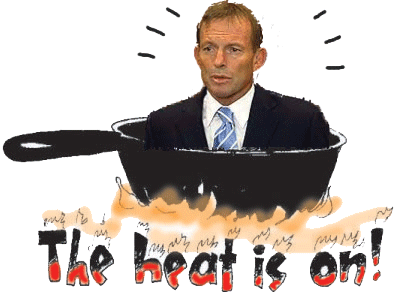 Australian opposition ‘unlikely’ to keep climate off G20 agenda RTCC 20 August 2014, Australia lacks gravitas to cast off climate talk, with US and China likely to put pressure on Tony Abbott By Sophie Yeo
Climate change is likely to be discussed at the G20 summit in Brisbane, despite Australia’s decision to leave it off the agenda. This is the finding of a new report, released this week by the centre-right think-tank Committee for Economic Development in Australia (CEDA).
Australia lacks the diplomatic weight to dismiss the issue while heavyweights such as China and the US are ramping up their own efforts to combat carbon pollution, say the authors.
“As a middle-power economy, Australia’s leadership and influence may be limited,” writes Sarah-Jane Derby, senior economist at CEDA, in the report.
“For example, members may be receptive to Australia introducing new ideas and changing the agenda, but without the support of players who are more powerful, these ideas may not be taken seriously.”
Climate criticism
Australia prime minister Tony Abbott has faced heavy criticism from environmentalists over his decision to axe many of the country’s flagship climate policies, such as the tax on carbon.
Reports from Australia suggest he knocked climate change off the G20 agenda as it did not fit with the summit’s focus on economic growth……. This year’s G20 takes place two weeks before a major UN summit on climate change takes place in the Peruvian capital, Lima.
The UN meets annually to work towards a solution on climate change, but the G20 provides opportunities for “open discussions” between the world’s major economic players that are not possible during international meetings, says the report.
It adds that the tight economic focus of the Brisbane summit could add value to climate change discussions, by considering the financial risks and consequences of heating the planet……
In June, the US ambassador to Australia said that Obama planned on raising climate change during the leaders’ summit and at “every international forum”, as it was a critical issue “not only to Americans but to the world”. – See more at: http://www.rtcc.org/2014/08/20/australian-opposition-unlikely-to-keep-climate-off-g20-agenda/#sthash.Gl6EU0Jf.dpuf
Internet trolls try to trash climate change science
What I learned from debating science with trolls, Business Spectator MICHAEL BROWN 20 AUG “………I have received an education in the tactics many trolls use. These tactics are common not just to trolls but to bloggers, journalists and politicians who attack science, from climate to cancer research.
Some techniques are comically simple. Emotionally charged, yet evidence-free, accusations of scams, fraud and cover-ups are common. While they mostly lack credibility, such accusations may be effective at polarising debate and reducing understanding.
And I wish I had a dollar each time a scientifically incompetent ideologue claimed science is a religion. The chairman of the Prime Minister’s Business Advisory Council, Maurice Newman, trotted out that old chestnut in The Australian last week. Australia’s Chief Scientist, Ian Chubb, was less than impressed by Newman’s use of that tactic.
Unfortunately there are too many tactics to discuss in just one article (sorry Gish Gallop andStrawman), so I will focus on just a few that I’ve encountered online and in the media recently. Continue reading
Former coal executive calls on corporate Australia to stop denying climate change
Corporate Australia in denial over climate change, former coal exec Ian Dunlop says, ABC News, By Nonee Walsh 15 Aug 2014, Corporate Australia is in complete denial about climate change, according to former fossil fuels executive and energy commentator Ian Dunlop.
Mr Dunlop, a former chairman of the Coal Association, said business should be condemning the chairman of the Prime Minister’s Business Advisory Council (BAC), Maurice Newman, for claiming the Earth is cooling…….
Mr Dunlop said not a single voice had been raised by peak business about the appointment of so-called climate change deniers to advise government.
 “The appointment of Maurice Newman, Dick Warbuton and David Murray are evidence of the real problem that we have,” Mr Dunlop said.
“The Government is in complete denial on this and unfortunately I believe that most of corporate Australia is in the same position.
“I would have expected that corporate leaders would be coming out and really making their voices heard, because this is the big issue that is going to affect the corporate world.”
Mr Dunlop said the scientists Mr Newman quoted had been debunked………
Mr Dunlop does not expect to see political leadership on the issue, “because it is too hard under the adversarial system”.
“We have never had in this country a serious discussion on what climate change really means, it been dumbed down by both sides of politics,” he said.
“Here it is going to have to be business that leads … it requires people at the top of the corporations to get off their backsides and start to take account of the risks that we face and the opportunities, in a genuinely objective way.” http://www.abc.net.au/news/2014-08-15/corporate-australia-in-denial-over-climate-change-dunlop-says/5674122
Crucial to have Climate Change on G20 Agenda: call to Abbott
 Push for climate change on G20 list, The Age August 11, 2014 Dan Harrison Health and Indigenous Affairs Correspondent Three former Australians of the Year, including Nobel laureate Peter Doherty, have signed an open letter to Prime Minister Tony Abbott calling for climate change to be included on the agenda for the G20 leaders summit to be held in Brisbane in November.
Epidemiologist Fiona Stanley and immunologist Sir Gustav Nossal are among a dozen health experts supporting the call, published in the Medical Journal of Australia.
 ”Current climate trends, driven by global warming, threaten the basis of future economic prosperity, regional political stability and human health,” the letter says.
The letter states that the risks climate change posed to human health included more intense heatwaves, floods and fires, and the spread of disease-carrying mosquitoes………
‘This issue warrants urgent consideration at the G20 meeting. The health of present and future generations is at risk from ongoing human-induced climate change.”
A spokeswoman for Mr Abbott confirmed that as the host nation, Australia set the agenda for the meeting in consultation with other G20 member nations…….
In an interview also published in the journal, United States economist Jeffrey Sachs, a special adviser to United Nations Secretary-General Ban Ki-moon on development, said it was not possible to end global poverty without tackling climate change.
”The G20 countries are the world’s most important economies … If the G20 gets its house in order, the world can be saved. If not, the G20 will wreck the world, pure and simple … Brisbane is therefore crucial.’: http://www.smh.com.au/federal-politics/political-news/push-for-climate-change-on-g20-list-20140810-3dgne.html#ixzz3AEzcHzfz
Press Council raps THE AUSTRALIAN newspaper over its false story of climate change denial
‘Considerable concern’: Oz in hot water over climate denial errors, Crikey, by Myriam Robin, 24 July 14 The Press Council has handed down an adverse ruling against The Australian for a front-page article published in September last year that relied on a rapidly debunked Daily Mail story claiming the Intergovernmental Panel on Climate Change had revised down the rate of global warming since 1951.
In highly unusual language for the Press Council, it says it is a matter of “considerable concern” that The Australian delayed in acknowledging its errors. Asked to explain the strong language, Press Council executive director John Pender told Crikey ”the initial error was very serious and prominent, was repeated unequivocally in a later editorial, and was not corrected with sufficient speed, clarity and prominence”.
In a September 16 article, since changed online but archived here on the Media Watch website, The Australian environment editor Graham Lloyd rehashed a British story published a week before the Fifth Assessment Report of the IPCC was released that claimed the report update would say the true figure of warming since 1951 had been 0.12 degrees Celsius per decade, and not the 0.2 degrees Celsius claimed in previous reports.
The Oz’s piece continued:
“Last week, the IPCC was forced to deny it was locked in crisis talks as reports intensified that scientists were preparing to revise down the speed at which climate change is happening and its likely impact.
“It is believed the IPCC draft report will still conclude there is now greater confidence that climate change is real, humans are having a major impact and that the world will continue to warm catastrophically unless drastic action is taken to curb greenhouse gas emissions. The impacts would include big rises in the sea level, floods, droughts and the disappearance of the Arctic icecap.
“But claimed contradictions in the report have led to calls for the IPCC report process to be scrapped.”
These reports were wrong. The Daily Mail got its numbers wrong, and The Australian repeated the error, as Media Watch and The Guardian pointed out last year. The long-term trend in the IPCC report is 0.13 degrees of global warming a decade, and has been for some time — there was no retreat from higher figures……..http://www.crikey.com.au/2014/07/24/considerable-concern-oz-in-hot-water-over-climate-denial-errors/
Science report shows Australia’s drought and flooding result of human-caused global warming
 Australia’s drought – yes, it’s climate change http://www.theecologist.org/News/news_round_up/2483139/australias_drought_yes_its_climate_change.html Tim Radford 18th July 2014 Australia’s prime minister thinks climate change is ‘crap’ and has just abolished his country’s carbon-pricing system. But scientists say that it’s rising levels of CO2 that are leaving the south of the country parched and sweltering – and it’s only going to get worse.
American scientists have just confirmed that parts of Australia are being slowly parched because of greenhouse gas emissions.
A report in Nature Geoscience shows that the long-term decline in rainfall over south and south-west Australia is a consequence of fossil fuel burning and depletion of the ozone layer by human activity. Such a finding is significant for two reasons. One remains contentious: it is one thing to make generalised predictions about the consequences overall of greenhouse gas levels, but it is quite another to pin a measured regional climatic shift directly on human causes, rather than some possible as-yet-unidentified natural cycle of climatic change.
The other is contentiously political.
Australia’s prime minister, Tony Abbott, has in the past dismissed climate science as “crap”, and more recently has cut back on Australian research spending.
Bush fires and catastrophic flooding
Australia has already experienced a pattern of heat waves and drought – punctuated by catastrophic flooding – and even now, in the Australian winter, New South Wales is being hit by bush fires.
Tom Delworth, a research scientist at the US National Oceanic and Atmospheric Administration, reports in Nature Geoscience that he and a colleague conducted a series of long-term climate simulations to study changes in rainfall across the globe.
One striking pattern of change emerged in Australia, where winter and autumn rainfall patterns are increasingly a cause of distress for farmers and growers in two states.
The simulation showed that the decline in rainfall was primarily a response to man-made increases in greenhouse gases, as well as to a thinning of the stratospheric ozone layer in response to emissions of destructive gases by human sources.
The computer simulations tested a series of possible causes for this decline, such as volcanic eruptions and changes in solar radiation. But the only cause that made sense of the observed data was the greenhouse explanation.
It began in 1970, and it hasn’t stopped yet
South Australia has never been conspicuously lush and wet, but decline in precipitation set in around 1970, and this decline has increased in the last four decades.
The simulations predict that the decline will go on, and that average rainfall will drop by 40% over south-west Australia later this century.
Dr Delworth described his model as “a major step forward in our effort to improve the prediction of regional climate change”.
In May, scientists proposed that greenhouse gas emissions were responsible for a change in Southern Ocean wind patterns, which in turn resets the thermostat for the world’s largest island.
Australian scientists report in Geophysical Research Letters that they, too, have been using climate models to examine Antarctic wind patterns and their possible consequences for the rest of the planet.
Another consequence: accelerated ice sheet melt
“When we included projected Antarctic wind shifts in a detailed global ocean model, we found water up to 4°C warmer than current temperatures rose up to meet the base of the Antarctic ice shelves”, said Paul Spence, a researcher at Australian Research Council’s Centre of Excellence for Climate System Science. This temperature rise is twice previous estimates.
“This relatively warm water provides a huge reservoir of melt potential right near the grounding lines of ice shelves around Antarctica. It could lead to a massive increase in the rate of ice sheet melt, with direct consequences for global sea level rise.”
Since the West Antarctic ice sheet holds enough water to raise sea levels by 3.3 metres, the consequences would indeed be considerable.
“When we first saw the results it was quite a shock”, said Dr Spence. “It was one of the few cases where I hoped the science was wrong.”
World criticism of Australia repealing the carbon tax
Australia’s carbon tax abolition draws international criticism Oliver Milman Guardian, 18 July 14 Al Gore calls it a ‘disappointing step’ and European Union says world is moving towards carbon pricing initiatives Australia’s repeal of the carbon price has provoked a largely negative reaction overseas, with former US vice president Al Gore calling it a “disappointing step”.
Gore said Thursday’s abolition of the mechanism means that “Australia is falling behind other major industrialised nations in the growing global effort to reduce carbon emissions and ensure a clean and prosperous future”.
“[It is] a disappointing step for a country that continues to experience the worsening consequences of the climate crisis.”
Gore, who appeared alongside Clive Palmer in a bizarre press conference in June to iterate the Palmer United party’s position on the carbon price, said be was encouraged by the support for the Renewable Energy Target, the Clean Energy Finance Corporation, the Australian Renewable Energy Agency and the Climate Change Authority.
“These programs are examples of Australia’s long and continued excellence in combating the climate crisis, and must continue,” Gore said. He added that he was “hopeful” that Australia would adopt an emissions trading scheme (ETS), as advanced by Labor and, in a radically watered down form, by Palmer.
Connie Hedegaard, the European Union’s climate commissioner, also voiced disappointment at the carbon price repeal.
“The European Union regrets the repeal of Australia’s carbon pricing mechanism just as new carbon pricing initiatives are emerging all around the world,” she said.
“The EU is convinced that pricing carbon is not only the most cost-effective way to reduce emissions, but also the tool to make the economic paradigm shift the world needs.
“This is why the EU will continue to work towards global carbon pricing with all international partners.”
The European Union has had an emissions trading scheme in place since 2005. The scheme, which covers around 45% of total greenhouse emissions from the 28 EU countries, was due to be linked to Australia’s own emissions trading scheme, but this will now not happen………http://www.theguardian.com/environment/2014/jul/18/australia-carbon-tax-abolition-international-criticism
Greenhouse gases and ozone depletion are causing southwestern Australia’s long-term dry
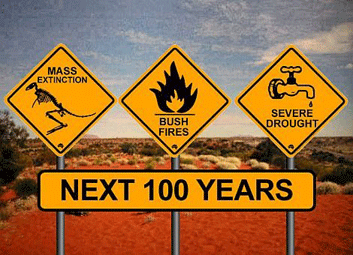 Australia drying caused by greenhouse gases and ozone depletion http://phys.org/news/2014-07-australia-greenhouse-gases-ozone.html#j Cp NOAA scientists have developed a new high-resolution climate model that shows southwestern Australia’s long-term decline in fall and winter rainfall is caused by increases in manmade greenhouse gas emissions and ozone depletion, according to research published today in Nature Geoscience. “This new high-resolution climate model is able to simulate regional-scale precipitation with considerably improved accuracy compared to previous generation models,” said Tom Delworth, a research scientist at NOAA’s Geophysical Fluid Dynamics Laboratory in Princeton, N.J., who helped develop the new model and is co-author of the paper. “This model is a major step forward in our effort to improve the prediction of regional climate change, particularly involving water resources.”
NOAA researchers conducted several climate simulations using this global climate model to study long-term changes in rainfall in various regions across the globe. One of the most striking signals of change emerged over Australia, where a long-term decline in fall and winter rainfall has been observed over parts of southern Australia. Simulating natural and manmade climate drivers, scientists showed that the decline in rainfall is primarily a response to manmade increases in greenhouse gases as well as a thinning of the ozone caused by manmade aerosol emissions. Several natural causes were tested with the model, including volcano eruptions and changes in the sun’s radiation. But none of these natural climate drivers reproduced the long-term observed drying, indicating this trend is due to human activity.
Southern Australia’s decline in rainfall began around 1970 and has increased over the last four decades. The model projects a continued decline in winter rainfall throughout the rest of the 21st century, with significant implications for regional water resources. The drying is most severe over southwest Australia where the model forecasts a 40 percent decline in average rainfall by the late 21st century.
“Predicting potential future changes in water resources, including drought, are an immense societal challenge,” said Delworth. “This new climate model will help us more accurately and quickly provide resource planners with environmental intelligence at the regional level. The study of Australian drought helps to validate this new model, and thus builds confidence in this model for ongoing studies of North American drought.”
Anglican Church urges Abbott to change his climate policies
Respect climate science: Anglicans urge Tony Abbott to change tack on climate change policies, The Age, 4 July 14, Tom Arup Environment editor, The Anglican Church has told the Abbott government to change its approach to climate change, urging it to respect and base its policy on scientific evidence.
At a meeting in Adelaide, the church’s Australian general synod passed a unanimous motion calling on the government to “respect and act upon relevant independent evidence-based scientific advice’’ on climate change.
The 23 dioceses of the church said they were gravely concerned that Australia’s target to cut carbon dioxide emissions – five per cent below 2000 levels by 2020 – was well short of what was needed.
They said they deeply regretted that it was “future generations and other forms of life” that would “bear the real cost of our heavy dependence on carbon-based energy”.
Perth Bishop Tom Wilmot, a church leader on environmental issues, told Fairfax Media that the environment was such an important issue it should not be left just to politicians and economists to discuss it.
‘‘My concern is the Abbott government seems to be deconstructing almost everything that was put in place over the last decade or so to protect the environment,’’ he said.
‘‘It seems to be neutering any scientific voice and, in fact, any voice that seeks to speak on environmental matters.’
He said the appointment of businessman and self-described climate sceptic Dick Warburton to head a review of the renewable energy target was a cynical way of pre-determining its outcome.
And he accused Environment Minister Greg Hunt of being dishonest about the effectiveness of the carbon price, which is expected to be repealed next week with support of new crossbench senators.
Bishop Wilmot said he was concerned about the government’s attitude to environmental policy generally, including handing approval powers for big developments to state governments.
The Palmer climate action conversion IS a game-changer.
The Palmer conversion is a game-changer.
By 2016, the named trading partners who already have trading schemes in various forms will have consolidated their schemes, renewable energy would have dethroned King Coal and we’ll have Labor, the Greens and PUP all campaigning for a return of the ETS.
Palmer and Gore: What are they good for? Independent Australia Sandi Keane 29 June 2014,When climate realists and coal billionaires share a stage to commit to climate change action, the end is nigh for the climate dinosaurs, says deputy editor Sandi Keane.
THE MEDIA HAS STRUGGLED since Wednesday to make sense of the Palmer/Gore shock presser with guess-which-media monopoly trumpeting it as a win for Abbott and many of the more independent-hue cynically declaring it a damp squib and Crikey even going so far as to call it a win for climate denialists.…….
Firstly, it should be noted, Al Gore – former U.S. vice-president and rightful victor in the 2000 U.S. presidential election – is no-one’s fool…….
If anyone thinks there’s been no shift in the body politic in Canberra to act on global warming thanks to Gore’s intervention with Palmer, then more fool them.
Granted, a tectonic shift it wasn’t. Gore deplored Palmer’s repealing of the carbon tax. But whenPalmer United Party (PUP) senators met last weekend, there was reluctance to break an election promise.
several high profile climate campaigners, like former Australian Conservation Foundation boss,Don Henry, and Christine Milne’s former chief of staff, Ben Oquist , who were lobbying Clive Palmer behind the scenes. Impromptu as it looked, last Wednesday’s shock announcement by the Palmer United Party had been carefully negotiated over a number of weeks.
At the risk of re-stating the facts, let’s look at PUP’s scoreboard before and after Gore’s intervention.
Pre-Gore’s visit:
Renewable Energy Target x
Clean Energy Finance Corporation x
Climate Change Authority x
Australian Renewable Energy Agency x
AGW believer x
ETS x
Carbon tax x
Post-Gore’s visit:
RET ✔
CEFC ✔
CCA ✔
ARENA ?
AGW believer ✔
ETS ✔
CT x
What benefit is Palmer United Party’s support for an ETS?…….
1 This month

of the week – Australians for War Powers Reform (AWPR)
To see nuclear-related stories in greater depth and intensity
 Antinuclear