Ian Dunlop on how Tony Abbott is gutting science in Australia

Grandees such as John Howard and Cardinal George Pell parade cynical climate denialism before international audiences, putting more peer pressure on the current incumbents to toe that line and providing rare insight into the widespread denialist groupthink within conservative ranks.
Literally and figuratively, we are witnessing a “burning of the science books”, the like of which has not been seen since medieval times. It did not work for the Catholic Church in the days of Copernicus and Galileo, nor in Nazi Germany in the 1930s. It will not work today.
Tony Abbott is gutting science just when we need it most, SMH, Ian Dunlop, June 1, 2014 Australia has an enviable reputation for scientific research, extending long before the heyday of the CSIRO in the 1950s under the visionary leadership of Sir Robert Menzies and Sir Ian Clunies-Ross. On the hottest and driest continent on Earth, our prosperity would be non-existent had it not been for the enlightened application of science. So it has been of mounting concern over recent years to see governments of all persuasions adopt increasingly anti-science agendas.
The federal government is taking anti-science to new heights. Its scorched earth approach discards virtually everything not in line with narrow, free-market ideology, centred on sustaining Australia’s 20th century dig-it-up and ship-it-out economic growth model. Continue reading
Obama might mention climate change – how embarrassing for Tony Abbott!
 Obama describes climate change as ‘creeping national security crisis’ LAURIE OAKES THE DAILY TELEGRAPH
MAY 31, 2014 WHILE Australian politicians continue to debate the Budget, Barack Obama has been talking about national security.In a speech to cadets at the West Point military academy, the US President outlined a new foreign policy doctrine based on more soft power diplomacy and less recourse to military might.
One section of the speech in particular would have attracted the attention of those involved in planning Tony Abbott’s visit to Washington in a couple of weeks. Obama described climate change as “a creeping national security crisis”.
Politics watchers in Washington were already predicting climate change would be “the elephant in the room” when the leaders meet in the Oval Office.
The Washington Post reported the President “routinely brings up climate change in closed door meetings with world leaders”.
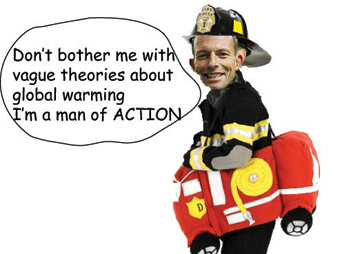 But with Abbott, there will be little common ground — and considerable potential for embarrassment.
Even if Abbott and Obama tiptoe around the issue, journalists might not co-operate at the customary joint media conference afterwards. One skilfully framed question could expose the deep differences between the Australian Prime Minister and his host on a matter that has become a key focus of the White House.
Now that Obama has made the problem of global warming part of America’s national security agenda, the subject will be even more difficult to avoid……..
The President and his advisers are all too aware that Abbott once described climate change science as “crap” — even though his public line these days is that “climate change is real”.
The White House is presumably well briefed on the way the Abbott government has been winding back action on climate change, including Budget cuts to research and renewable energy programs.
It would also know about the efforts of Australian diplomats to have climate change references removed from agendas and communiques at various international forums.
In the West Point speech Obama attacked political leaders who deny that global warming is taking place.
He was referring specifically to American politicians, but it is not hard to see why his view of Abbott is said to be unflattering.So even though it will be summer in Washington, the temperature could be a little cool when Abbott sits down in the Oval Office. “I don’t think we’d care,” a senior Liberal said yesterday — reflecting the fact that the Abbott government is not overly fond of Obama either……
Obama, as his West Point speech shows, is convinced that climate change is a factor in major fire, drought and flood events.In another speech on climate change a few weeks earlier he said: “It’s causing hardship now. It’s affecting every sector of our economy and our society — more severe floods, more violent wildfires.”
When a senior United Nations official suggested last year’s big NSW fires were linked to global warming, the PM accused her of “talking through her hat”.
If the subject comes up in Washington he’ll presumably be a little more diplomatic. http://www.dailytelegraph.com.au/news/opinion/obama-describes-climate-change-as-creeping-national-security-crisis/story-fni0cwl5-1226937966154
Pacific Island Delegates urge Australia to change climate change policy
Pacific nations urge climate change action, ask Australia for help http://www.abc.net.au/news/2014-05-27/pacific-countries-make-climate-change-appeal/5481050 Australian Network political editor Catherine McGrath 27 May 2014 Songs of the Pacific have been heard at Parliament House as islanders from countries likely to be most at threat from rising sea levels braved the Canberra winter to highlight the issue of climate change.
In traditional dress, the group performed a cultural dance and spoke about their concerns.
When it comes to high tide you can see the tide everywhere it seeps through the whole island. It kills the crops – it kills our traditional root crops.
Maina Talia
The delegates, from Kiribati, Tuvalu and Papua New Guinea, are meeting federal politicians and officials representing the Minister for Foreign Affairs Julie Bishop and Environment Minister Greg Hunt.
They are seeking a cut in carbon emissions and more assistance for their countries’ climate change mitigation.
Kiribati, which is only about two to three metres above sea level, and Tuvalu, at four metres above sea level, are already battling rising sea levels and crop losses.
The delegate from Wewak in PNG says her region in the East Sepik province is also in danger.
Apisaloma Tawati, 19, from Kiribati says the group is taking its campaign to the world.”I am here today to make everyone aware of our hardship and to convince you that we need your help and … you can help us,” he said. “As a youth I am afraid of climate change. I see our land is becoming thinner and thinner. “We live near the coast and we see a lot of things. We saw coastal erosion, the land has been eroded away, sea walls have broken.
“I come to Australia to tell the world of our hardship and our stories back in Kiribati.”Kiribati is enduring a lot of problems due to climate change.”
Delegates urge Australia to change climate change policy
Maina Talia, 29, from Tuvalu wants Australia to rethink its climate change policy. “We are the most vulnerable of the most vulnerable countries,” he said. “Since we don’t have any mountains or rivers, for us to adapt is very difficult. It is a burden to the people of Tuvalu as to how they can adapt. “Now when it comes to high tide you can see the tide everywhere it seeps through the whole island. “It kills the crops – it kills our traditional root crops. “It (the rising sea levels) are just there and we don’t know how that happens but we believe it is climate change.”
Mr Talia says it is important to keep campaigning because people from Tuvalu feel so vulnerable. “It is difficult to determine who is listening and who is not listening,” he said.”I believe they have heard our message so many times but we keep on pushing and advocating for Tuvalu and Kiribati and low lying atolls [so] that leaders of Australia and other industrialised countries will continue to hear our voice.”
Australian climate activism goes local, and rural
 Climate activism research shows new move to localism ABC Rural News 23 May 14, The protesters at various mine sites around northern NSW, and the way local farmers are actually quite supportive of the protests, are all part of a relatively new phenomenon in terms of climate activism.
Joint research by the University of Sydney and the University of Technology Sydney has found a new focus for climate change activism, localism.
Assoc Professor James Goodman University of Technology Sydney is one of the authors and researchers involved in a new book that looks at the issue.
“We have seen more and more evidence of farmers concerned about their rights when faced with mining companies demands to drill, about their right to farm and the impact of mining on water quality and aquifers. “We are seeing two types of protesters; those worried about local impacts on their environment, health and their community and others worried about the impacts on the wider environment and the longer term, the next 20 or 30 years.
“At some of those Maules Creek and Bentley protests, we are seeing the two groups come together.
“There has been a shift in focus away from the big picture to the local………..http://www.abc.net.au/news/2014-05-22/nrn-climate-activism-research-22-05-14/5471028
Australia’s climate denialist government meets the reality of climate change
Australia’s extreme budget meets extreme climate, Guardian, Alex White 22 May 14, The Abbott government’s first budget was the least popular and most extreme in forty years, and was handed down during an almost unprecedented May heatwave.……On the climate and environment front, it is genuinely difficult to narrow down the most extreme elements of this deeply and widely disliked budget.

Firstly, the fact is that this is a deeply unpopular budget, and it has been presented to the Australian people by a government that is neither liked nor trusted……..
A particularly egregious cut is the abolition of ARENA, the renewable energy agency. This action is a loud declaration that the Abbott government is addicted to carbon-intensive energy.
Tied to this, although not a budget initiative, is the review of the previously bi-partisan Renewable Energy Target, with climate denier Dick Warburton appointed as review head. Before the election, there were clear statements made that an Abbott government would continue to support the renewable energy target. Greg Hunt, the environment minister, said before the election that the Coalition “does agree on the renewable energy target” and “support the RET, the 20 per cent”.
The cut to ARENA and the review of Australia’s renewable energy target is a breathtaking assault on the $18 billion renewable energy sector, and introduces substantial elements of sovereign risk for companies and people considering investing in this area in Australia. Before last year’s election, the Coalition repeatedly promised to keep ARENA. In opposition, the Coalition supported ARENA.
The Clean Energy Council has also expressed major concerns, a rare event for a body that has to keep governments on side. In a statement, the CEC deputy CEO said: “A global race for renewable energy is on, and the removal of ARENA will see potential Australian and international investors now look to countries with much stronger support for renewable energy innovation, meaning we may well miss out on billions of dollars of investment and highly-skilled jobs.”
(The Coalition had previously promised to remove funding for the Clean Energy Finance Corporation, an ideologically motivated decision based on Abbott’s view that it was “socialism masquerading as environmentalism”.)
Other renewable and clean energy programs have also been scrapped, such as the One Million Solar Roofs program, research into carbon capture and storage technology, the Clean Technology Program, the Cleaner Fuels grant scheme, and more.
There is a real risk that the result of the RET review will see the end of the renewable energy target, once a bi-partisan policy. Removing or reducing the renewable energy target, currently 20 percent by 2020, would effectively lock Australia to a carbon-intensive, fossil fuel addicted future.
Climate change remains a serious and present threat to Australia’s society and economy. Major global economic forces are moving to clean energy and low carbon technologies. China for example is planning to triple its solar capacity by 2017, and other major economies including US states and nations in the EU are heading in that direction also.
To do nothing about climate change, as the Australian government now appears committed to, is immoral and amounts to abandoning both current and future generations……..http://www.theguardian.com/environment/southern-crossroads/2014/may/21/may-heatwave-budget-2014-abbott-renewable-energy-cuts
Now the Abbott government is wavering about its OWN “climate policy”
Doubt over emissions reduction fund , The Age, Lisa Cox 15 May 14, National political reporter The opposition says the government is preparing to slash its flagship Direct Action climate policy, the emissions reduction fund, after Tuesday’s budget showed proposed spending on the scheme would be $1.4 billion less than expected in the first four years.
But Environment Minister Greg Hunt says there has been no change to the policy and the budget still allows the government to issue contracts for the promised $2.55 billion from July 1.
Doubt over the government’s plans for its replacement for Labor’s carbon tax emerged after Tuesday’s budget papers showed $1.1 billion in projected spending on the fund, which will pay polluters to reduce their emissions, in its first four years.

The government said the figure was not a cut because the bulk of the $2.5 billion would be budgeted for in years beyond the forward estimates as polluters completed long-term projects.
But Labor environment spokesman Mark Butler said businesses could rely only on the spending outlined in the budget papers and ”the budget papers show this policy has been slashed by more than half”.
”While it barely seemed possible, last night saw Tony Abbott backslide even further on Australia’s fight against climate change,” Mr Butler said.
”This fig leaf of a climate policy now lies in tatters.”
Proposed expenditure sets out $75.5 million for the fund in 2014-15, $300 million in 2015-16 and $354.5 million in 2016-17……..http://www.theage.com.au/federal-politics/political-news/doubt-over-emissions-reduction-fund-20140514-zrcpr.html
The sorry tale of the Abbott government’s dismantling of Australia’s Climate Change Action
Australia’s Abbott Government Dismantles Climate Safeguards by News Editor in Air/Climate, Gov/Politics, Latest News, RSS on May 12, 2014 CANBERRA, Australia, (ENS) – Step by step, the Australian Coalition Government, headed by Liberal Prime Minister Tony Abbott, is tearing down the climate change mitigation and adaption measures put in place by the previous two Labor governments.
The carbon price established through a cap-and-trade emissions trading scheme that took effect in July 2012 under the Gillard Government is on its way out.
Called a “carbon tax” by opponents, it is to be replaced by an extension of the Emissions Reduction Fund introduced as draft legislation Friday by Environment Minister Greg Hunt.
Hunt said, “Australians voted for the removal of the carbon tax and for the implementation of a climate change policy that actually reduces emissions. Through the ERF, we will achieve our emissions reduction target without a tax on families and small business.” But the vast majority of Australia’s carbon price has been paid by a small number of larger companies, including 25 electricity generators.
Australia is a major coal-producing nation, and burning coal generates about 85 percent of Australia’s electricity. Coal-burning power plants emit carbon dioxide, the most prevalent greenhouse gas, and the coal industry is a vigorous opponent of the carbon price.
The Emissions Reduction Fund is the centerpiece of the Coalition Government’s Direct Action Plan to reduce Australia’s greenhouse gas emissions by five percent below 2000 levels by 2020, the same target as adopted by the previous governments.
An extension of the existing Carbon Farming Initiative, the ERF allows farmers and land managers to earn carbon credits by storing carbon or reducing greenhouse gas emissions on the land. These credits can be sold to people and businesses wishing to offset their emissions.
The latest step in the Abbott Government’s policy of scrapping all support of climate-related or renewable energy action was revealed this morning. The budget due out Tuesday is likely to eliminate the Australian Renewable Energy Agency, ARENA.
ARENA Chairman Greg Bourne warned that the agency’s remaining unallocated funds of about A$1 billion could be returned to the general revenue pool.
ARENA was established in 2012 to improve the competitiveness of renewable energy technologies and increase the supply of renewable energy in Australia. The agency has a $2.5 billion budget to fund renewable energy projects, support research, development and activities to capture and share knowledge.
The Abbott Government has also moved to eliminate the $10 billion Clean Energy Finance Corporation and may also weaken or delay the country’s Renewable Energy Target.
Australian Greens Leader Christine Milne said, “Axing the Australian Renewable Energy Agency is a damning reflection on the backward thinking of the Abbott government. The Abbott government has no vision for the future, or indeed, the present day.”
The country’s largest environmental group, the Australian Conservation Foundation, is outraged.
“If the government chooses to scrap ARENA, it is yet another instance of prioritising the profits of big polluters over Australians’ desire for a safe climate and clean energy,” said Victoria McKenzie-McHarg, the Foundation’s climate change program manager.
“The government could choose to scrap the $13 billion in planned handouts for big polluters to get discount diesel and other subsidies to miners, but instead, it seems it is choosing to scrap an agency that is helping strengthen the major growth industry of the 21st century,” said McKenzie-McHarg.
“With ARENA possibly gone, the Clean Energy Finance Corporation, the Climate Change Authority and price on pollution all on the chopping block, Australian jobs and investment in solar and other clean technology across the country will come to a stand still,” she said.
“It’s ripping the heart and soul out of Australia’s clean energy future,” said McKenzie-McHarg……..http://ens-newswire.com/2014/05/12/australias-abbott-government-dismantles-climate-safeguards/
Southern Australia will get dry winters, as Southern Ocean winds stronger
 Southern Ocean winds strongest in 1,000 years: study Rappler. Agence France-Presse 13 May 14, According to the study’s lead researcher, Nerilie Abram, ‘The Southern Ocean winds are now stronger than at any time in the past 1,000 years’ SYDNEY, Australia – Winds in the wild Southern Ocean are blowing at their strongest in a millennia as climate change shifts weather patterns, leaving Antarctica colder and Australia facing more droughts, a study showed Monday.
Rising carbon dioxide levels in the atmosphere were strengthening the winds, already dubbed the “Roaring Forties” for their ferocity, and pushing them further south towards Antarctica, researchers from the Australian National University (ANU) said.
“The Southern Ocean winds are now stronger than at any other time in the past 1,000 years,” said the study’s lead researcher Nerilie Abram of an ocean notorious for having some of the fiercest winds and largest waves on the planet.
“The strengthening of these winds has been particularly prominent over the past 70 years, and by combining our observations with climate models we can clearly link this to rising greenhouse gas levels.”
The new research, which was published in the Nature Climate Change journal, explains why Antarctica is not warming as much as other continents. (READ:Warmer Earth, humans to blame – UN panel)………..
The research helped to explain why the westerlies were further cooling already cold parts of the continent even as they were also driving “exceptionally quicker” warming in the Antarctic Peninsula, which juts out into their path, Abram said.
The strengthening westerlies drive up the temperature at the peninsula – the only part of the Antarctica that is hit by the wind – through the warm, moist air they carry from the Southern Ocean.
This has made the peninsula the fastest-warming place in the southern hemisphere, with scientists concerned about the stability of the ice sheets and sea level rises in the region……….
“Even for a mid-range climate scenario, the trend is going to continue in the 21st century,” Phipps said, adding that southern Australia was likely to experience more dry winters. – Rappler.com http://www.rappler.com/science-nature/earth-space/57830-southern-ocean-winds-strengthRappler,
Abbott govt’s draft climate action Bill could result in 30 % emissions rise by 2030
Govt releases climate action draft bill http://www.heraldsun.com.au/news/breaking-news/govt-releases-climate-action-draft-bill/story-fni0xqi4-1226911847929 10 May 14, PUTTING in energy-efficient light bulbs and cutting gas in coalmines could be eligible for taxpayer funding under the federal government’s climate policy. There could also be scope for international carbon emission permits to be counted, despite the government saying they wouldn’t be part of its emissions cuts.
Environment Minister Greg Hunt released draft legislation on Friday for the emissions reduction fund, which will replace Labor’s carbon tax and carbon farming initiative. Both major parties are committed to cutting carbon emissions by five per cent below 2000 levels by 2020.
Improving the energy efficiency of homes and factories, capturing landfill and mine gas, improving farm soil and upgrading vehicles will qualify for funding. Those seeking funding, for projects lasting up to 15 years, will need to pass a new “fit and proper person” test.
And any project for which funding is sought would have to be something not likely to have occurred “under normal business conditions”.
The Clean Energy Regulator (CER) would be responsible for registering projects and issuing Australian carbon credit units for verified emissions reductions. The CER would buy emissions reductions at the lowest available cost, generally through reverse auctions.
The draft bill does not set out the rules for a new safeguard mechanism, which would ensure emissions reductions paid for by the fund were not displaced by a rise in emissions elsewhere. The safeguard, due to start on July 1, 2015, will be the subject of a separate bill.
Climate Institute chief John Connor said the draft laws were well short of a credible alternative to the current carbon pricing scheme.
The policy could put Australian emissions on track to rise by 30 per cent by 2030, he said.
Mr Connor said the draft laws left the door open for the purchase of international permits. The CER’s new powers would enable it to use almost any process it wanted to buy emissions reduction, undermining the claim to be a market mechanism.
“This draft legislation is still well short of a package that can credibly reduce pollution, let alone reduce pollution enough to help avoid costly climate disruption,” Mr Connor said. “Parliament should instead stay with the current laws, which price and limit pollution and can reduce emissions by up to 25 per cent by 2020 with deeper reductions thereafter.”
Submissions on the emissions reduction fund draft bill close on May 23.AAP
MAY 09, 2014
Marshall Islands deplores Australia’s backward steps on climate change
 Australia risks ‘going backwards’ on climate change and straining Pacific ties Marshall Islands foreign minister says ‘it is as if our big brother doesn’t understand us’ theguardian.com, Monday 5 May 2014 17 John Vidal Australia risks going “backwards” on climate change, straining relations with small Pacific island states that are being hit by unusually powerful storms, floods, droughts and massive tides, according to the foreign minister of the Marshall Islands.
“Australia has always been our friend but the change in their government last year has resulted in problems,” said Tony de Brum on a visit to London to address British and other countries’ economic and political leaders about the physical plight that Pacific states such as the Marshall Islands find themselves in.
“We are having difficulty understanding Australia’s climate change policies and their new environmental regime. We don’t understand what they are thinking. We worry that the change in their policy may result in movement backwards.”
Australia’s Coalition government is trying to repeal carbon pricing in favour of a grants system for businesses to lower their emissions. Repeated independent analysis has shown its Direct Action plan is unlikely to achieve its target of a 5% cut on emissions by 2020, based on 2000 levels.
The Coalition has also set about abolishing climate change agencies, slashed staff numbers at the Department of the Environment and declined to send a minister to international climate talks.
Small island states around the Pacific are sending Australia the same message about climate change, according to De Brum. “Australia has always been generous,” he said. “But it is as if our big brother doesn’t understand us. The same message is going to Australia from other countries in the Pacific forum. Little brother is saying, ‘Big brother should get up and smell the flowers.’ ”
Scattered across 2m square kilometres of ocean, the Marshalls have all experienced extremes linked to climate change in the past year, he said. “We have had major drought in the north, floods in the south, seawater intrusion of groundwater, and thousands of people displaced by a king tide. That is the reality. What does Australia not understand?”
Pacific states including Kiribati, Tuvalu and the Marshalls are suffering at the present level of emissions, he said, making the prospect of future sea level rises and more powerful cyclones frightening.
“Some islands and atolls are already disappearing. One, called Enebok … is now underwater. Yet 20 years ago it had coconut palms and houses. At the moment we are [able to move] people around the islands. But any prudent leader would always have evacuation at the back of their mind.”
Climate change and the lack of cash to invest in renewable energy technologies, such as ocean thermal energy conversion, is now putting a brake on development, he said…… http://www.theguardian.com/environment/2014/may/05/australia-risks-going-backwards-on-climate-change-and-straining-pacific-ties
USA urges Australia to join in real action against climate change
US urges closer ties on climate change http://www.heraldsun.com.au/news/breaking-news/us-urges-closer-ties-on-climate-change/story-fni0xqi4-1226906292654 NICK PERRY MAY 05, 2014 UNITED States ambassador John Berry has urged Australia to work closely with its ally in Washington on climate change, pointing to the major economic opportunities available in tackling the global challenge.
The US is one of the world’s largest polluters, but has made significant progress reducing its emissions since climate change was made a top-priority issue by the Obama administration.
Data in April showed the US had slashed greenhouse gas emissions 10 per cent below 2005 levels, meaning it’s more than halfway to achieving its target of a 17 per cent reduction by 2020.
Ambassador Berry said the US had managed to cut pollution while maintaining economic growth, defying the argument that achieving green outcomes was too expensive and hard on business.
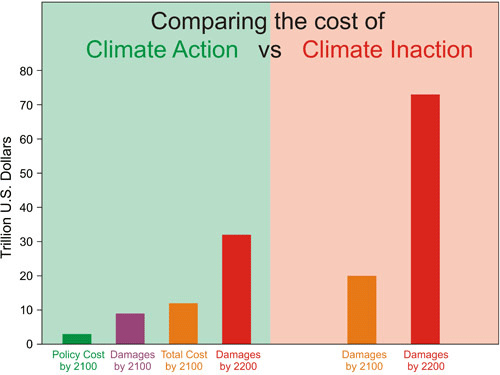
The US would lead by example and be challenging world leaders to do their part by adopting “aggressive” pollution goals of their own.
“The issue is serious, it deserves everyone’s attention,” Ambassador Berry told a climate summit attended by Environment Minister Greg Hunt on Monday. “We know you will continue to work with us – both bilaterally and in multilateral organisations – on the tremendous challenges climate change presents in the region.”
The federal government has promised to reduce emissions by five per cent of 2000 levels by 2020, but will review this target in 2015 as world leaders prepare to hammer out a new binding climate deal.
The US has forged agreements with other major polluters like India and China in the lead up to the 2015 summit, and wants to see climate change on the G20 agenda in Brisbane in November.
Ambassador Berry said the US should work closer with Australia to chase the huge economic benefits posed by the growth of renewable energy. “It’s not only good environmental policy, it’s also good business,” he said.
Greg Hunt gets his ‘do nothing’ climate policy from Bjorn Lomborg
Lomborg’s particular brand of environmentalism – which says yes, the world is warming but it is nothing to worry about – is particularly appealing to the Coalition government. It is an approach that doesn’t have to get tangled up with opposing the science and also public opinion, while it is able to take a purely economic approach to doing nothing.
Or better yet, do something, but not at the expense of big business.
In fact, it is better to pay big business not to pollute, which makes the debt levy being flagged for the upcoming budget all the more comedic. The A$2.4 billion per year fuel tax credit scheme, which managed to escape the Commission of Audit, are simply handouts that go directly to the immense profits of mining companies.
 The Direct Action path to poverty, The Conversation,5 May 14 David Holmes The current gallery of columnists at The Australian are always interesting to read. There is a core of them that display the views of Coalition politicians only with more colour and erudition, and often more transparently than Canberra soundbites and doorstops would allow.
Where government ministers might be seen attacking an institution or a policy, these columnists are adept at rallying to such an attack, be it on the ABC, human rights, education, health, foreign affairs, the public service and, of course, climate.
One such occasional columnist who chimes in over climate change is the Danish “sceptical environmentalist Bjorn Lomborg. Lomborg is well-known for subordinating the importance of climate change to other global issues such as health and development. His work effectively focuses on short-term solutions to “immediate” problems, arguing that global warming will actually provide a net benefit to the globe up until 2065 by reducing cold-related deaths and improving crop production, after which, he tells us, heat will take over as a health and food security problem.
Lomborg’s disregard for the plight of subsequent generations might appeal to politicians whose sense of time is tightly bound to electoral cycles. But it does not sit well with anyone who has even the smallest appreciation of telos.
In his column last week, Renewables pave path to poverty, Lomborg went all-out attacking renewables, just as the Renewable Energy Target (RET) and Direct Action was beginning to spike in news cycles across the country.
Lomborg is unusual. He is not your regular climate change denier and says, as government ministers do, that climate change is real and that we have to tackle it.
But also like the government, Lomborg’s suggestions for tackling climate change are so riddled with doublethink as to render his claims to have accepted the science as implausible and disingenuous.
Critics of Lomborg’s work on the economics of addressing climate change describe him as a dangerous propagandist working on behalf of vested interests (namely the fossil fuel industry); that he “advocates what he does not believe in”; and that “all he cares about is how he can make the general public react the way that he wants”.
Does this sound familiar? Continue reading
Australia to be hit by $40 billion costs due to Tony Abbott’s climate ppolicies
 Tony Abbott’s climate policies a $40 billion budget slug, says Climate Institute – Peter Hannam
Environment Editor, The Sydney Morning Herald 1 May 14, The Abbott government’s changes to existing climate change policies would cost the budget as much as $40 billion by 2020, according to the Climate Institute, and the cost will blow out even further if it weakens the renewable energy target.
The estimated costs stem in part from payments to polluters to curb greenhouse gas emissions under the government’s Direct Action emissions reduction plan. This tally includes the $2.55 billion for the first four years of the Emissions Reduction Fund and an estimated $1.2 billion annually after that.
“This is a friendless piece of policy and not many people are standing up to defend it,” said John Connor, chief executive of the Climate Institute.
A bigger blow to the budget, though, will come from the loss of the carbon tax revenues if, as expected, the new Senate votes to repeal it after July 1. Current laws indicate the price – now a tax but due to convert to a floating price by mid-2016 at the latest – will bring in more than $18 billion.
That combined tally, at about $24 billion, swells to more than $40 billion by 2020 if the Abbott government sticks with its plan to block the purchase of cheaper international emission reductions to meet domestic commitments, the institute said……..
The costs of the Direct Action will balloon further if the government undermines other policies limiting carbon emissions, such as the Renewable Energy Target. The target, now set at supplying 41,000 gigawatt-hours of renewable energy by 2020, is currently being reviewed by businessman and climate change sceptic, Dick Warburton.
The current climate policies of the government are “a growing slug on taxpayers, and barely tenable now”, Mr Connor said. “If they start to weaken other measures, they’ll have to buy more” carbon abatement, he said.: http://www.smh.com.au/federal-politics/political-news/tony-abbotts-climate-policies-a-40-billion-budget-slug-says-climate-institute-20140430-zr1yh.html#ixzz30V7Nazbj
Abbott’s Direct Action plan will cost tax-payers, not the polluting industries
Direct Action transfers emission cutting costs from polluters to taxpayers, SMH, April 26, 2014
“…..the Abbott government’s official position is that greenhouse emissions created by humans are contributing to the dangerous warming of the planet, and that it must do something about it. Precisely what this government proposes to do is a matter of great public interest.
So it was unhelpful that Hunt chose to release those details – as scant as they were – shortly before the close of business on the eve of the Anzac Day long weekend.
Taxpayers have every reason to be sceptical about his motives. They, after all, will be the ones paying for the government’s so-called Direct Action climate change strategy. Its centrepiece is an ‘‘emissions reduction fund’’, a pool of $2.55 billion of taxpayers’ money in the first four years, from which some of the nation’s biggest polluters will be paid incentives to cut their greenhouse gases.
To be clear, creating this fund will transfer the cost of cutting emissions from the polluter to the taxpayer, should the government succeed in pushing its bill through the Senate.
The fund would displace both the carbon tax and the emissions trading scheme that had been advocated not only by Labor but by the Howard government in 2007. ‘‘To reduce domestic emissions at least economic cost, we will establish a world-class domestic emissions trading scheme,’’ the Howard policy had promised.
The Liberals now in power may still believe in market forces, but not yet for carbon abatement. Instead of making the biggest emitters pay, they are asking taxpayers to reward them for reducing their pollution. This would be done by means of a ‘‘reverse auction’’. The firms proffering the lowest bids – the least expensive way to reduce emissions – would get government subsidies…….
government is asking taxpayers to relieve industry of the cost of carbon abatement at the same time that it tells Australians they must make many other sacrifices. …….
The case for shifting the carbon burden from polluters to taxpayers, however, is yet to be made. The government still needs to convince Australians and a hostile Senate.
It could have done much better than calling a news conference at 3pm on the eve of Anzac Day to produce a flimsy policy in the hope that nobody would notice. ……. http://www.smh.com.au/comment/smh-editorial/direct-action-transfers-emission-cutting-costs-from-polluters-to-taxpayers-20140427-zr04d.html#ixzz30DsXmZG3
Aboriginal climate ambassadors assess impact of climate change
 Indigenous ambassadors assess climate impact on native land SBS World News, Two young Indigenous climate ambassadors have been touring Australia to document the impact of the changing natural environment on traditional communities. By Gary Cox Source NITV News, 27 April 14 Narelle Long and Malcolm Lynch were the first young Indigenous people to set foot in Antarctica back in 2012.
1 This month

of the week – Australians for War Powers Reform (AWPR)
To see nuclear-related stories in greater depth and intensity
 Antinuclear