Australia’s Climate Commission and Clean Energy Finance Corporation – what they actually do
Australia needs climate institutions, whoever is in power, The Conversation Frank Jotzo Director, Centre for Climate Economics and Policy at Australian National University 20 Sept 13 “……The first of Australia’s independent climate change institutions to get the axe is the Climate Commission, the agency created by the Labor government to disseminate public information about climate change.
It made its mark with reports about climate change impacts and the scientific basis for prompt action. But it also explained the advantages of carbon pricing and listed mitigation policy actions that other countries are taking, and took its message to many public forums.
It is by no means revolutionary stuff. The fact the incoming government sees the Commission as a problem is an indication of just how deeply politicised the Australian climate debate has become.
Next on the block is the Clean Energy Finance Corporation, which is charged with making co-investments in renewable energy and energy efficiency projects in the commercial sector.
The Corporation has a A$10 billion investment mandate – not a subsidy, but the mandate to invest up to that amount and earn an appropriate return on the investments. The Corporation has been told to stop lending, though whether the government can legally require it to do so before new legislation is passed appears somewhat unclear.
It is slated to be abolished if and when the government repeals the Clean Energy legislation including the carbon price.http://theconversation.com/australia-needs-climate-institutions-whoever-is-in-power-18371
To shut the Climate Change Authority is an attack on future generations
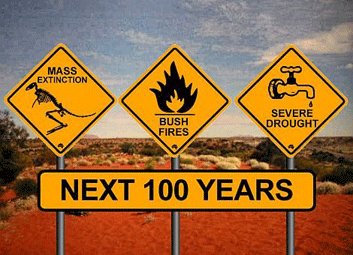 Abbott shuts down Climate Commission (includes opinion poll) Tom Arup Environment editor, The Age 19 Sept 13 A spokeswoman for Mr Hunt said he had also approved a brief to begin drafting a bill to repeal the separate Climate Change Authority as part of the Coalition’s broader efforts to remove the carbon price.
She said the government would hold more discussions with the authority in coming weeks.
While the Climate Commission could be abolished by the minister at any time, the authority can only be shut down by an act of Parliament.
The authority was created to advise the government on emissions-reduction targets and caps and to detail international efforts to combat climate change. It was due to release a draft of a report on targets and caps next month.
A Climate Change Authority spokeswoman said it believed the government intended to abolish the agency through the repeal of legislation, but it did not have any further information at this time.
 Greens leader Christine Milne said said issuing instructions to close the authority was irresponsible in the face of dangerous climate change.
“The Climate Change Authority was set up to de-politicise the process of setting greenhouse emission reduction targets. Everyone knows that a 5 per cent emission reduction target is woefully inadequate,” Senator Milne said. “Shutting down the Climate Change Authority, ahead of its first report on fair and science based emission reduction targets for Australia, is cowardly and an attack on current and future generations.” http://www.theage.com.au/federal-politics/political-news/abbott-shuts-down-climate-commission-20130919-2u185.html#ixzz2fSelP96C
Legislation needed to axe Climate Change Authority. Public to be kept in the dark
”what will the future think of the people who voted for this action?”
 Mr Hunt declined to respond to questions from Fairfax Media.
Scientists say climate cuts leave public in the dark September 19, 2013 Peter Hannam, The Age Carbon economy editor The Abbott government’s plan to make scrapping the Climate Commission and the Climate Change Authority among its first priorities will deprive Australians of independent information on global warming just when it is needed most, leading scientists say.
Staff at the Climate Commission, a federal body set up to publicise climate-change science, have all but ceased work as they await instructions from new Environment Minister Greg Hunt.
The Climate Change Authority, a statutory body that will need a change in legislation before it can be axed, is continuing work on a draft report due out next month. That report will recommend the level of cuts to greenhouse gas emissions Australia should set and also details international efforts to combat climate change.
Maurice Newman, Tony Abbott, John Howard, get behind climate denialist campaign
 Tony Abbott’s business advisor attacks “myth” of climate change http://reneweconomy.com.au/2013/tony-abbotts-business-advisor-attacks-myth-climate-change-53017 By Giles Parkinson on 17 September 2013 Maurice Newman, the former chairman of the ABC and the ASX who will be the chair of Tony Abbott’s Business Advisory Council, has launched an attack against the CSIRO, the weather bureau and the “myth” of anthropological climate change.
In an opinion piece written for the Australian Financial Review, Newman said much of the public service infrastructure would be resistant to change because of their “vested interests” in the status quo.
“The CSIRO, for example, has 27 scientists dedicated to climate change,” Newman wrote. “It and the weather bureau continue to propagate the myth of anthropological climate change and are likely to be background critics of the Coalition’s Direct Action policies.”
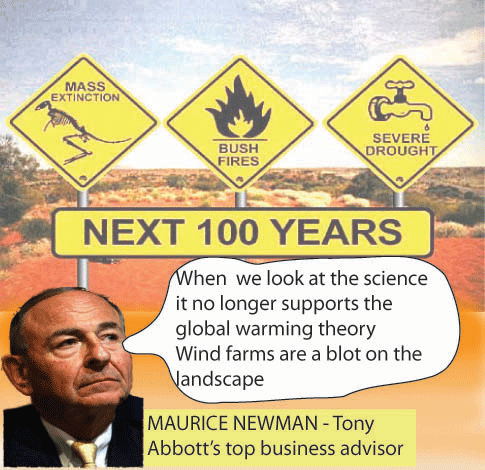
Given Newman’s dismissal of climate science, one wonders why he sees the need for Direct Action of any type. The answer possibly lies in the government’s updated policy position: Abbott has conceded that the government will no longer seek to reach even the minimum 5 per cent emission reduction target if its reduced budget of $3 billion falls short of requirements.
Newman’s comments came a day after it was revealed that Abbott’s mentor John Howard would address one of the world’s most prominent climate skeptics think tanks, and the portfolios of science and climate change had been subsumed into other ministries. Continue reading
Climate denial themes pushed by Murdoch media, in 5 stages
 In Murdoch’s The Australian, Andrew Montford took a different approach to deny that we’re the cause of the problem, attacking the expert consensus on human-caused global warming. Specifically he attacked the Cook et al. (2013) study finding 97 percent consensus on this question in the peer-reviewed scientific literature.
The 5 stages of climate denial are on display ahead of the IPCC report, The Guardian, by Dana Nuccitelli Monday 16 September Climate contrarians appear to be running damage control in the media before the next IPCC report is published The fifth Intergovernmental Panel on Climate Change (IPCC) report is due out on September 27th, and is expected to reaffirm with growing confidence that humans are driving global warming and climate change. In anticipation of the widespread news coverage of this esteemed report, climate contrarians appear to be in damage control mode, trying to build up skeptical spin in media climate stories. Just in the past week we’ve seen:
- The David Rose Mail on Sunday piece that treated scientific evidence in much the way bakers treat pretzel dough.
- Dr. John Christy interviewed by the Daily Mail;
- Christy’s colleague Dr. Roy Spencer in The Christian Post;
- Andrew Montford in Rupert Murdoch’s The Australian;
- Matt Ridley in Rupert Murdoch’s Wall Street Journal; and
- Bjorn Lomborg in The Washington Post.
Interestingly, these pieces spanned nearly the full spectrum of the 5 stages of global warming denial. Continue reading
Book ‘Dealing in Doubt’ shows who’s behind climate denialism in Australia
 Report offers field guide to the climate change denial industry, Guardian, Graham Readfearn, 13 Sept 13, “…. There is also a potted and seldom-told history of how key figures in the United States worked to connect with like-minded people in Australia to encourage efforts Down Under to counter calls to cut emissions.
One of the first efforts came courtesy of free market promotion unit The Institute of Public Affairs, which doesn’t reveal its funders, which in 1990 sponsored a tour by veteran sceptic Fred Singer around Australia. TheIPA’s magazine reported Singer’s visit: “The greenhouse theory of global warming is contradicted by the evidence, a prominent US scientist has told the IPA.”
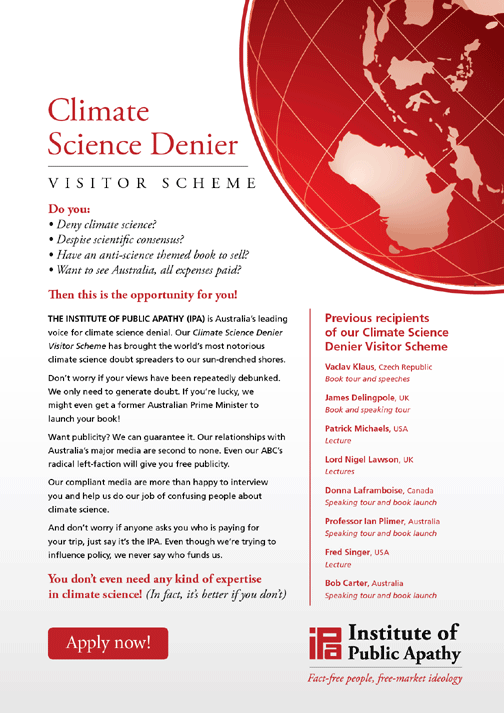
Later, Dealing in Doubt recalls planning meetings in the mid-90s with conservative think tanks in the US and Australia where strategies were developed to counter calls for action.
One of those characters, Australian businessman and former mining executive Hugh Morgan, was announced by Liberal MP Greg Hunt in 2011 as a member of the Coalition’s business advisory council on climate change………
Internal Heartland Institute documents have shown that one of the authors of the report, Australian geologist Dr Bob Carter, was to be paid $1667 a month for his work on the report (for anyone interested, Skeptical Science has a good summary of the key differences between the genuine IPCC report and the NIPCC)……. http://www.theguardian.com/environment/planet-oz/2013/sep/12/greenpeace-climate-change-denial-dealing-doubt-report
Book: , Dealing in Doubt: The Climate Denial Machine Vs Climate Science
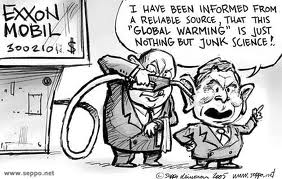
 Report offers field guide to the climate change denial industry, Guardian, Graham Readfearn, 13 Sept 13, Greenpeace report documents the who, what, when and how of a long-running campaign to block action on climate change It writes boilerplate legislation, runs extensive PR campaigns, puffs CVs with fake credibility, facilitates or promotes the intimidation of climate scientists and advocates, publishes books, organises speaking tours and conferences, gets on the telly and radio a lot, uses Freedom of Information laws as a surveillance tool, pays scientists to speak and – crucially – it manufactures doubt and confusion among policy makers, politicians and the public about climate change.
To get this work done, it has accepted many millions of dollars from fossil fuel interests or ideologically-driven conservative donors who funnel their cash through anonymous trust funds because they are too cowardly to put their mouths and their money in the same place.
We’re talking about the international climate science denial industry. Now it has a field guide, of sorts, courtesy of researchers at environment group Greenpeace.
Published this week, Dealing in Doubt: The Climate Denial Machine Vs Climate Science recounts the history of efforts to underplay the risks of human-caused climate change, to deny the scientific evidence and to misrepresent the state of the collective knowledge of genuine scientists on the issue.
Oh, and it comes with fun little caricatures of some of the key characters in the denial industry.
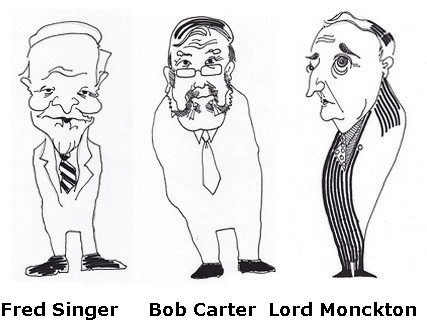
The title of the report “Dealing in Doubt” comes from a tactic employed and articulated by tobacco industry executives in a 1969 memo, which read: Continue reading
Australia’s governing COAL ition’s contradictory postures about COAL
 World’s largest carbon capture begins even as Abbott tax repeal looms SMH,September 11, 2013 John Kemp Prime minister-elect Tony Abbott has pledged to repeal the country’s carbon tax to boost economic competitiveness, so it is ironic that Australia is about to host the world’s most ambitious project for capturing carbon dioxide and storing it underground……..
But the federal and WA governments have agreed to accept responsibility for any long-term liabilities.
Commonwealth and state indemnities will protect the joint venture partners from any common law liability arising from third-party claims for loss or damage, suffered after the site closes……
Unlike most other projects, Gorgon will inject CO2 into a saline aquifer rather than a depleted oil and gas field, providing an opportunity to test how CO2 injections into a saline aquifer behave on a large scale.
The U.S. Department of Energy has identified saline aquifers as a vital storage resource if CCS is to be captured on anything like the scale that will make a difference to the climate……
Little is known about how stored CO2 behaves in saline aquifers.
But with Gorgon, Australia’s government will be sponsoring the world’s largest and most ambitious attempt to lock CO2 away safely underground, even as it tries to water down other elements of climate change policy.: http://www.smh.com.au/business/carbon-economy/worlds-largest-carbon-capture-begins-even-as-abbott-tax-repeal-looms-20130911-2tj0c.html#ixzz2ejfmzKJy
Australia’s new Prime Minister to carry out climate denialist agenda
 Australia rips up climate-change policies New Scientist, 11:57 10 September 2013 by Michael Slezak Australia’s landslide election result seems to be bad news for the climate. Following the election of a new government, Australia is to abolish its emissions trading scheme, disband a climate advisory body and institute a carbon reduction policy that experts say will fail to meet its meagre target. …
The carbon price – widely called a “carbon tax” – was set to increase gradually until 2015 when carbon credits would be opened for trading, allowing the market to set the price.
Abbott’s coalition also signalled that it would disband Australia’s Climate Commission – an independent scientific body that provides reliable information on climate change to the public. In response to a report the commission released, warning that extreme weather was made more likely by climate change, Abbott said: “When the carbon tax goes, all of those bureaucracies will go and I suspect we might find that the particular position you refer to goes with them.”
Contentious views
In 2009, Abbott said, when talking about climate change, that the “science is highly contentious, to say the least” and “the climate change argument is absolute crap”,…..
It is a “great leap backwards”, says Ian Lowe from Griffith University in Queensland, Australia. He says that no experts think the targets will be met and that the stance is ideological, because senior members of the government don’t think climate change is man-made He worries that the outgoing government will also see the election result as a reason to abandon serious effort on climate policy.
Despite one analysis suggesting that the direct action plan’s funding of A$3.2 billion represents less than half of what is needed to meet the 5 per cent target, Abbott indicated the government will not up this figure…….. http://www.newscientist.com/article/dn24173-australia-rips-up-climatechange-policies.html#.UjFX8NJwonE
Research shows Australia’s record heat linked to human activity
 Humans behind record Australian heat, research shows (good graphs) SMH September 3, 2013 David Karoly and Sophie Lewis It’s official, the past 12 months have been the hottest in Australia for more than a hundred years.
Temperatures averaged across Australia between September 2012 and August 2013 were hotter than any year since good records began in 1910. The previous record was held by the 12-month period from February 2005 to January 2006.
The new record follows a suite of broken records following last year’s “angry summer”, including the hottest summer since records began. New weather records are being set all the time. Sometimes these are record cold temperatures, but more often in recent times these have been record hot temperatures. A common question is what is the human role, if any, in these records compared with natural variations of weather and climate?
The link between global warming and human causes has been firmly established over the last two decades. Continue reading
What exactly IS the Coalition’s “Direct Action” climate policy?
 The Coalition’s climate change policy: it’s the public, not polluters, who pay The Guardian, Lisa Caripis 19 Aug 13 “….. Essentially, Direct Action is a scheme that rewards entities that voluntarily reduce their emissions. So, if you’re an emitter you can propose an emissions reduction project to the government − it might be to improve your energy efficiency, store carbon in the soil or plant trees. The government compares your proposal to other project proposals, and picks the ones that will be the cheapest to implement. If it picks yours, you enter into an agreement to cut your emissions and are paid once you’ve delivered the emissions cuts.
You don’t have to be a policy expert to see where major cracks could form in this policy model. First and foremost, if the cash reward is to be the driving incentive, how large would the pool of funds need to be to drive the level of emissions reductions necessary to meet our 5-25% target? A report published last week estimates that, depending on the level of Australia’s 2020 target, it would cost $4-15bn more than the Coalition has currently budgeted. In fact, the report claims that the funding the Coalition has pledged is so inadequate that emissions would rise by 8-10% by 2020.
Under Direct Action it is the public, not polluters who pay. Is that fair? Unlike under a carbon price, there’s no cost, no disincentive, to keep polluting at the same rate. Indeed, Hunt recently suggested that the Coalition no longer even intends to penalise polluters that increase their emissions. So, Direct Action (ie taxpayer) funded projects would need to cut enough emissions to offset the emissions of non-participants.
Predicting and controlling the trajectory of Australia’s emissions under Direct Action would be quite a challenge. Without an annual cap on emissions or price per tonne of emissions as is in place under carbon price models, how would a Coalition government ensure that we are on track to meet our international obligations and reduce emissions to safe levels? What happens if projects fail to deliver the cuts as promised? Can we afford a policy that could leave our health, communities and property exposed to the substantial risks posed by climate change? …. http://www.theguardian.com/commentisfree/2013/aug/20/coalition-climate-change-direct-action
Expected effects of climate change on Australia: sea level rise is one
Revealed: 80cm sea rise warning August 20, 2013, SMH, Ben Cubby, Peter Hannam, 20 Aug 13, The world is on track to become up to five degrees hotter, and sea levels could rise more than 80 centimetres this century, according to a leaked draft of a landmark climate change report prepared for the UN.
There is now a 95 per cent likelihood human greenhouse gas emissions are driving changes being observed globally, which in recent weeks have included extraordinary heatwaves in Asia and Alaska.
That degree of certainty has been revised up from 90 per cent in the last report in 2007, 66 per cent in 2001, and just over 50 in 1995. A sea level rise of up to 82 centimetres, which would have serious impacts on coastal cities everywhere, is now ”unequivocal”, Reuters reported.
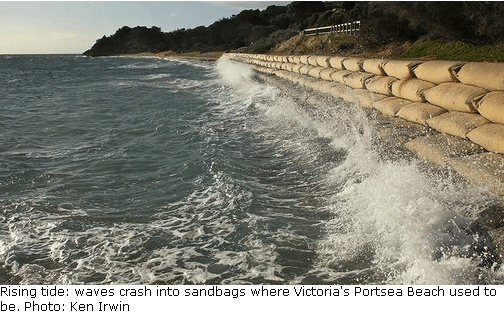
The final version of the Intergovernmental Panel on Climate Change report, which will cover the expected effects of climate on Australia in coming decades, is scheduled for release in September.
About 200 countries, including Australia, have pledged to hold temperature rises to two degrees by cutting emissions, though few nations are on track to meet that goal……
The Climate Change Minister, Mark Butler, said the Labor policy was producing results, including a 7 per cent cut in emissions from the National Electricity Market and a 25 per cent increase in renewable energy generation in the past year. ”The Coalition’s climate change policy is an expensive dud,” he said. http://www.smh.com.au/environment/climate-change/revealed-80cm-sea-rise-warning-20130819-2s7dt.html#ixzz2cYUs6TeK
Australian right wing ideas about Climate Change
 In Queensland, the state party’s rank and file members voted last year in favour of a motion to ban the teaching of climate science in schools.
Australia’s One Nation under climate science denial, The Guardian, by Graham Readfearn Friday 16 August 2013 Fringe and extremist political groups in Australia are pushing climate science denial soundbites……. One Nation appears to have gone shopping to the Climate Science Denial Mart and come back with the whole deli counter of debunked talking points.
“What’s really behind all the global warming hoopla,” One Nation’s website asks.
“Power. It’s the same old Marxist/Communist/Fascist collectivist shtick, dressed up in new clothes. Global warming is all about a power grab by a wealthy elite and their collectivist sycophants — using the (United Nations) as a cover and tool.”
Elsewhere, One Nation accuses the Bureau of Meteorology and the CSIRO of engaging in the corruption of science. Continue reading
King Island shows the way towards 100% renewable energy

“The way these technologies are being used and integrated is world-leading and another example of the clever solutions to real-world problems that have been developed in Tasmania and can be exported globally.”
100% renewables: The King Island example, Business Spectator Laurie Guevara-Stone 9 Aug 13, Halfway between Tasmania and mainland Australia, in the heart of the Bass Strait, is rugged, windswept King Island. With a population of just under 2,000 and an area of just over 400 square miles, tiny King Island is becoming a big leader in electricity generation, demonstrating that a high-renewables future is possible.
King Island, and especially greater Tasmania, face many challenges due to climate change including water availability, flooding of coastal settlements, a rise of bushfires, and decreased agriculture and aquaculture industries. Although Australia’s contribution to global greenhouse gas emissions is small – and Tasmania’s even smaller, largely due to singificant amounts of hydro – the island has a goal of reducing carbon emissions by 60 per cent from 1990 levels by 2050.
Tasmania is on track to meet that target, thanks in part to lessons learned and the success at King Island. King Island is providing a significant demonstration of the potential opportunities for Tasmania through its King Island Renewable Energy Integration Project (KIREIP). Initiated by the government-owned electricity provider,Hydro Tasmania, KIREIP’s goal is to not only reduce dependence on fossil fuels, but also to help constrain power prices on the island. Continue reading
Australia’s world-leading initiatives on climate policy

Australia is part of a growing number of key regions and countries acting to reduce their GHG emissions—including the EU, United States, and China. As Australia gears up for its federal election later this year, the country has the opportunity to set a powerful example for other nations by moving forward with ambitious mitigation strategies and making efforts to strengthen them. As Australia has learned from other countries’ experiences in setting up market mechanisms for carbon reduction, the international community should continue to keep an eye on the Australian experience, track its performance, and build on its successes.
3 Key Initiatives From Australia’s Climate Change Policy Http://Insights.Wri.Org/News/2013/08/3-Key-Initiatives-Australia%E2%80%99s-Climate-Change-Policy#Sthash.ORj7bvdO.Dpuf by Olivia Kember and Thomas Damassa on August 8, 2013 This piece was co-written with Jenna Blumenthal, an intern with WRI’s Climate and Energy Program. Australia is a major nation to watch when it comes to curbing climate change. The country made an international commitment to reduce its GHG emissions by 5 to 25 percent from 2000 levels by 2020. How Australia achieves these reductions can provide lessons on how other countries around the world can pursue their own climate change mitigation plans. WRI’s Open Climate Network and Australia’s The Climate Institute (TCI) recently analyzed Australia’s climate change plan, which includes a mix of policies to reduce emissions (check out the working paper here). We found that three initiatives stand out in terms of their potential to significantly reduce GHG emissions: a carbon pricing mechanism, a Renewable Energy Target (RET), and the Carbon Farming Initiative (CFI).
1) The Carbon Pricing Mechanism
The carbon pricing mechanism is the primary instrument for meeting Australia’s emissions reduction goals. Established by the federal Clean Energy Act 2011, the carbon price is applied to roughly 60 percent of the country’s emissions. Set as a fixed fee per metric ton for the first few years of operation (around $A 23-25), the mechanism will shortly transform into a cap-and-trade system linked to the European Union emissions trading scheme (ETS) and, to a lesser extent, the Kyoto Clean Development Mechanism. The government recently advanced the date of this transition from 2015 to 2014;experts do not expect this to have a material impact on Australia’s ability to achieve its target. Government revenue from selling carbon permits will be invested in clean energy and low-carbon technologies. Revenue from the carbon pricing mechanism will also be provided as compensation to households for possible increases in the cost of goods and services as a result of the carbon price.
It is widely expected that the price on carbon permits in Australia will be influenced by permit prices in the larger European market, and hence, by policy developments in the EU rather than in Australia. This is likely to affect the degree to which emissions reductions are achieved in Australia. For example, low prices in the EU trading scheme could encourage polluters in Australia to purchase EU permits instead of reducing their emissions domestically. On the other hand, if the Australian government were to aim higher than the minimum 5 percent target, it can do this without affecting the permit price. Given that international permit prices are projected to remain fairly low for the rest of the decade, Australia could achieve the top of its current target range for very little extra cost.
2) The Renewable Energy Target
The federally mandated Renewable Energy Target is the principal driver of investment in renewable energy in Australia. The Large-Scale Renewable Energy Target (LRET) requires utilties to generate 41,000 gigawatt hours (GWh) from renewable sources by 2020. The Small-Scale Renewable Energy Scheme (SRES) targets households and is expected to account for at least 4,000 GWh by 2020. The RET has mobilized $A 18 billion in renewable energy investments since 2001. It contributed to an additional 3.5 percent of renewable electricity generation in 2011, and projections show that the RET could help renewables gain more than 20 percent of the market share. Government estimates indicate that the RET is likely to reduce annual emissions by nearly 30 Mt CO₂e, which would be equivalent to 6 percent of net emissions in 2020 under the 5 percent target and 7 percent under the 25 percent target. Continue reading
1 This month



Help Aunty Sue Protect Her Land and Sacred Sites From Destructive Rocket Testing.
.

Australians deserve the truth
about
AUKUS – https://aukuspublicinquiry.com/

PETITION – To: Prime Minister Anthony Albanese and the Australian Labor Government

of the week – Australians for War Powers Reform (AWPR)
To see nuclear-related stories in greater depth and intensity

