Why nuclear power is utterly incapable of tackling climate change
 Despite the events in Fukushima, which many observers consider a
disaster, nuclear still gets a look in as a policy response to climate
change. Most of the commentary surrounding the release of the White
Paper focused on the favoritism or otherwise shown for nuclear power,
and public advocates like Barry Brook still poke their head up and
shout “NUCLEAR” from time to time. …… anyone seriously advocating
nuclear power as a policy response to global warming in Australia
doesn’t understand the problem……
the simple energy cost of production against the time it takes to generate that much electricity. Often called energy payback. The graphic below plots “energy return on investment” for various sources,
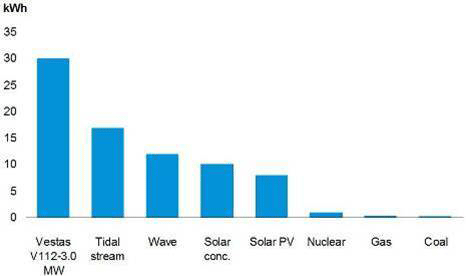
The Offshore Valuation: A valuation of the UK’s offshore renewable
energy resource. Published in the United Kingdom 2010 by the Public
Interest Research Centre. ISBN 978-0-9503648-8-9
http://www.offshorevaluation.org PE (2006)
If the answer is nuclear you don’t understand the question, evcricketenergy, 2 Jan 12
“…. Eligibility criteria are the must haves; if you are
selecting a new machine to generate electricity “does it generate
electricity” is the obvious one…
Merit criteria are what you use to split all of the options that pass.
Say you’re comparing a diesel or natural gas engine to power a remote
site, a merit criterion could be “is fuel available all year round?”
In this post I will focus on the eligibility criteria for powering
Australia while reducing the greenhouse gas emissions associated with
electricity production. I will spend a long time arguing that, no,
nuclear should not be considered, because it is utterly incapable of
solving the problem. In later posts I will discuss the merit criteria,
where again nuclear falls down….. Continue reading
Dramatic fall in greenhouse gases, as Australians, especially Victorians. use less coal-fired power
Yallourn was operating at just 56 per cent last month even after it announced it was mothballing one of its four units.
Emissions sink as consumers turn off coal, SMH, Peter Hannam, December 17, 2012 Carbon economy editor Weak demand for electricity across eastern mainland states has sparked a “dramatic fall” in greenhouse gas emissions from Australia’s power stations, the latest review of data by consultants Pitt & Sherry has found.
While demand for base-load electricity from black coal-fired power stations has been in retreat for about three years, the decline has extended in recent months to two of Victoria’s emissions-intensive brown coal-fired plants, Hazelwood and Yallourn. Changes in demand of electricity on this scale are unprecedented in the entire 120-year history of the electricity supply industry in Australia Continue reading
Queensland coast could get WEEKLY king tides, with climate change sea level rise
 Climate change tipped to bring more king tides ABC News Dec 14, 2012 A Queensland academic says extreme weather events, like this week’s king tides, could become more common as a result of climate change.
The biggest tides of the year are expected to peak this morning, reaching 5.7 metres at Port Alma, 4.7 metres at Yeppoon and 4.6 metres at Gladstone.
Professor Rodger Tomlinson, from the coastal research unit at Griffith University, says king tides could occur weekly in the future. “Some research has been done by our colleagues in the CSIRO sort of indicating that these kind of events that we now see twice a year, under the sea level rise projections for 2,100, we might be … seeing those sort of weekly,” he said.
“It’s that kind of increase in the frequency of those events under sea level rise.”
Authorities say they are not expecting any properties along the central Capricorn Coast to be badly affected by inundation during this morning’s high tide……http://www.abc.net.au/news/2012-12-14/climate-change-tipped-to-bring-more-king-tides/4427970
Methane from Coal Seam Gas has a big impact on global warming
 CSG worries hinge on timing of climate change, ABC News 10 Dec 12 by Wendy Carlisle for Background Briefing An expert in public policy says the debate over whether coal seam gas is cleaner than coal depends on the timeframe used to measure emissions.
According to a scientific paper by US academic Nathan Hultman, coal seam gas is 56 per cent cleaner than coal over a 100-year time frame, but when compared to coal over 20 years it is less than 20 per cent cleaner. Professor Hultman,  from the school of public policy at the University of Maryland, says using the “most extreme assumptions”, coal seam gas is actually dirtier than coal over a 20-year time frame.
He told Radio National’s Background Briefing the choice of timescale was a “value judgment” and “depended on when you thought the real problem of climate change was going to bite”.
“The reason you would be worried about methane in particular over a 20-year time horizon is if you are thinking we are on the verge of a kind of tipping point in climate change right now,” he said.
“If you really think right now we are very close to melting the ice caps or pushing the climate from a moderately steady state into a kind of bad outcome where you’ve got runaway climate change.”
According to the Intergovernmental Panel on Climate Change, the global warming impact of greenhouse gases can be measured across three different times frames: 20 years, 100 years or 500 years.
Each is valid and chosen by atmospheric scientists depending on what scientific point they wish to highlight.
Coal seam gas is mostly methane – a powerful greenhouse gas that has a relatively short life span.
This means that over a 20-year time frame, coal seam gas has a much higher global warming impact than if it is measured over 100 years……. . http://www.abc.net.au/news/2012-12-09/background-briefing-coal-seam-gas/4416808
“Fugitive emissions” – not measured – greenhouse gases from coal seam gas
the sources, and perhaps also the volumes, of fugitive methane releases may differ from those associated with conventional gas production, and that consequently different approaches to the measurement of fugitive emissions may be required.”
CSG worries hinge on timing of climate change, ABC News 10 Dec 12 by Wendy Carlisle for Background Briefing “……..Fugitive emissions Professor Hultman’s paper was cited by the oil and gas lobby group APPEA in their submission to the Federal Government’s review into the way in which fugitive emissions from coal seam gas are measured.
APPEA has consistently said coal seam gas is 70 per cent cleaner than coal.
But in September the Government released a report which found that the absence of published information about fugitive emissions – greenhouse gases that leak into the atmosphere during the extraction process – was a matter of “public policy concern”. Continue reading
Exceptional sea level rise on the Perth coastline.
Perth’s sea levels on the rise, Dec 05, 2012 WA Today In 2011, Sea levels on the Perth coastline are rising at three times the global average, the latest State of Australian Cities report shows.
In a statistic that federal Infrastructure Minister Anthony Albanese described as “disturbing” and “extraordinary”, readings since 1993 have indicated sea levels are rising by between nine and 10 millimetres per year. The global average is around three millimetres per year…….
http://www.watoday.com.au/wa-news/perths-sea-levels-on-the-rise-20121204-2asue.html#ixzz2EEy5FBXH
Doha Climate Talks – Australia, Qatar, and developed world – out of touch with reality
 Doha Dispatches: Mind the gap… and the science REneweconomy, By Giles Parkinson 3 December 2012 DOHA: The first slogan to greet arrivals at Doha Airport in Qatar are as optimistic as those that greeted delegates to the climate change talks in Copenhagen in 2009: “Welcome to 12 days that could have an everlasting effect,” it pronounces.
Not real catchy, and possibly a direct translation from Arabic. But worthy all the same. Sadly, judging by the lack of ambition, and the lack of progress of these talks, it’s not a likely outcome.
The second thing that attracted my attention on arrival were two payment booths at the exit of the parking lot. Barely big enough for one person to sit inside, they were each equipped with their own 1kW air conditioning system with a large hose attached, like a deep-sea diver with an oxygen supply.
They probably need it. Doha is a city that thrives because of its fossil fuel riches and it has built a western city of stunning shapes and proportions only because it is air conditioned. It has even promised to air condition the World Cup, which it aims to host in 2022 and will have to do exactly that if the competition is to run in the northern summer, where temperatures average 36°C from June to August and have peaked at 53°C, and could hit goodness-knows-what in a decade’s time. (Even the sea-water reached 37°C in 2008).
Qatar is one of a handful of Gulf states that deprives Australia of a most unwanted moniker – the highest emitting state in the world per capita. Australia gets the gong for the category of developed nations, but even it can’t compete with Qatar. Humankind would need more than two planets if the world lived like Australians do. If they lived like the Qataris – the massive buildings, the labyrinth of four lane highways that seem always often clogged, what must be the highest per capita penetration of Toyota Land Cruisers, and its need to desalinate its water – then we would need around five planets. Continue reading
Climate Change becoming irreversible as Arctic permafrost thaws
 Where even the earth is melting, SMH, November 28, 2012 Ben Cubby ENVIRONMENT EDITOR THE world is on the cusp of a “tipping point” into dangerous climate change, according to new data gathered by scientists measuring methane leaking from the Arctic permafrost and a report presented to the United Nations on Tuesday.
“The permafrost carbon feedback is irreversible on human time scales,” says the report, Policy Implications of Warming Permafrost. “Overall, these observations indicate that large-scale thawing of permafrost may already have started.”
While countries the size of Australia tally up their greenhouse emissions in hundreds of millions of tonnes, the Arctic’s stores are measured in tens of billions. Human-induced emissions now appear to have warmed the Arctic enough to
unlock this vast carbon bank, with stark implications for international efforts to hold global warming to a safe level. Ancient
forests locked under ice tens of thousands of years ago are beginning to melt and rot, releasing vast amounts of greenhouse gases into the air. Continue reading
Exposing Australian Liberal Party’s absurd climate change policies
 Turnbull calls out Abbott’s carbon hypocrisy (again) , REneweconomy,. By Giles Parkinson on 20 November 2012 Malcolm Turnbull has once again publicly outed the federal Opposition’s absurd climate change policies – playing word games over Tony Abbott’s “blood pledge” to repeal the carbon tax, and highlighting that the Coalition’s policy position is only a short-term one, at best.
It is becoming increasingly clear that the Opposition will find it nearly impossible to deliver on Abbott’s pledge to repeal the carbon price. And for months, as we pointed out in July, it has only been described as a pledge to repeal the carbon tax, not the carbon price. It’s a subtle but critically important distinction, and one that Turnbull was keen to highlight on ABC TV’s Q&A program last night…….
there is nothing to celebrate in a carbon price that is too low to inspire investment from a scheme that is too weak to meet environmental targets. This was underscored this week by a petition of 100 leading companies – including Shell, Unilever, EDF Energy, Statoil, Swiss Re, and Skanska – who complained that the carbon price was not sufficiently robust to drive the investments required in abatement technologies. And there is nothing to complain about in a renewable energy target delivering more renewable energy that planned. It’s more than just a box-ticking exercise.
It turns out that 50,000 Australians are not wrong about climate chnage
 A disproportionate amount of media airtime given to climate sceptics may lead some people to overestimate the prevalence of that view
powerful interests promoted the voices of climate sceptics.
Climate change deniers are rarer than we think http://reneweconomy.com.au/2012/climate-change-deniers-are-rarer-than-we-think-46206 By Sunanda Creagh 13 November 2012 The Conversation Australians grossly overestimate the proportion of people who deny that climate change is happening, a CSIRO study has found.
The study, published today in the journal Nature Climate Change, surveyed over 5000 Australians over two years. Continue reading
USA- Australia co-operation on climate change action
Australia’s Minister for Climate Change, Greg Combet, told the Carbon Expo conference in Melbourne on Friday that he was ”very pleased” with Mr Obama’s victory, and said he held already spoken on the issue with his US counterpart since the elections.
The minister has also been discussing the prospects of linking Australia’s planned market for greenhouse gas emissions with California. The biggest US state will auction its first pollution permits this week with the emissions trading scheme (ETS) to start on January 1.
 Obama keen to tackle climate, The Age, November 12, 2012, Peter Hannam THE Australian government has wasted little time to sound out the newly re-elected Barack Obama over his administration’s climate change policies and the potential to work more closely together.
An issue excluded from the US presidential debates, the argument over global warming was revived when superstorm Sandy slammed into north-eastern US states a week before polling day, leaving a damage bill some expect to exceed $US50 billion ($A48 billion).
Mr Obama signalled his intention to tackle climate change in his second term during his acceptance speech in Chicago, where he underlined the issue as among his top priorities.
”We want our children to live in an America that isn’t burdened by debt; that isn’t weakened by inequality; that isn’t threatened by the destructive power of a warming planet,” he said. Continue reading
United Nations praise for Australia’s lead on climate action, and signing Kyoto Protocol
 UN leader praises Australia’s climate lead http://www.heraldsun.com.au/news/breaking-news/un-leader-praises-australias-climate-lead/story-e6frf7k6-1226514100428 AAP November 10, 2012, UN leader Ban Ki-moon has called for “urgent” action on measures to counter climate change, as he praised Australia for signing on to a new round of the Kyoto Protocol environmental protection treaty.
Ban called on other governments to follow Australia’s example and “congratulates Prime Minister Gillard for her leadership,” said a UN spokesman, Farhan Haq.
“Addressing climate change is fundamental for achieving sustainable development. Urgent action is needed,” Ban was quoted as saying on Friday. “The secretary general calls on all governments to take decisive steps against climate change at the upcoming Climate Change Conference” in Qatar, said the spokesman.
Australia, one of the world’s biggest per capita polluters, earlier announced that it was ready to join a second commitment period of the Kyoto Protocol. So far, only the European Union and some smaller economies have signalled they are ready to agree new pledges.
Annual negotiations under the UN Framework Convention on Climate Change (UNFCCC) start in Qatar on November 26.
Australia to sign up to new Kyoto Treaty (in a rather cautious way)
 Australia ready to join ‘Kyoto 2’ climate agreement, Tom Arup Nov 09, 2012. The Age AUSTRALIA will sign up to a second round of the Kyoto Protocol, joining the European Union and just a handful of other major
greenhouse gas emitters in recommitting to the world’s only climate treaty.
Climate Change Minister Greg Combet will announce the decision on Friday in Melbourne, saying there has been sufficient progress in international talks to make the commitment, with some conditions.
It is understood he will also say the decision ensures business has access to cheap international offset credits (mainly created through clean energy projects in developing countries) to help meet domestic greenhouse targets.
The Kyoto Protocol was first negotiated by countries in 1997 and required wealthy nations to limit their emission of greenhouse gases. It is due to expire at the end of this year. Through UN climate change negotiations, countries have agreed to work on a replacement treaty. If successful, it would be agreed by 2015 and take effect in 2020. Unlike Kyoto, it would include emissions targets for wealthy nations and developing nations such as China and India.
At climate negotiations in South Africa last year, countries also agreed to a second round of the Kyoto Protocol until a new treaty takes effect. The European Union and a handful of small wealthy countries have committed to a second Kyoto, but some major wealthy nations including the US, Russia and Japan are refusing to sign
on…..
Australia’s support for a second Kyoto round comes with conditions, including progress on a post-2020 deal and a desire that the second round last until 2020, rather than 2017 as some developing nations proposed.
Canberra also wants rules letting it carry over some or all of about 80 million tonnes of surplus carbon permits under the protocol’s first round, which let it increase emissions by 8 per cent between 1990 and 2012. The carry-over permits could then count towards Australia’s 2020 emissions target.
http://www.theage.com.au/opinion/political-news/australia-ready-to-join-kyoto-2-climate-agreement-20121108-290×6.html#ixzz2Bkm3ObOr
Parramatta riverside sites under threat from rising sea levels
 Rising sea a threat to riverside homes November 3, 2012 SMH Nicole Hasham WATER will swamp homes and businesses from Haberfield to Homebush as rising sea levels inundate the Parramatta River foreshore over the next century, a new analysis shows. The findings are critical as valuable river frontage becomes increasingly urbanised and former industrial sites are redeveloped into housing. Continue reading
Time for Australia to sign up to the new Kyoto Protocol
Sign on now, UN climate chief says October 25, 2012 THE United Nations climate chief has called on Australia to sign up to a new round of the greenhouse-gas-limiting Kyoto Protocol, saying it already has significant clean-energy
policies in place.
EU likely to exceed Kyoto carbon-cut target
”From a national perspective it wouldn’t change that much what Australia is already doing,” the head of the UN Framework Convention on Climate Change, Christiana Figueres, said in Sydney. ”It would send a very clear message internationally that what Australia is doing at a national level is actually contributing to global interests.”
The comments by Ms Figueres come as the government weighs joining the federal opposition in backing a second round of the 1997 climate treaty. The current period of the Kyoto Protocol, under which most developed nations pledged to limit their greenhouse gas emissions, lapses at the end of the year. Continue reading
1 This month

of the week – Australians for War Powers Reform (AWPR)
To see nuclear-related stories in greater depth and intensity
 Antinuclear