Australia on fire. Scott Morrison under fire over bushfire emergency
‘Australians are paying the price’: Scott Morrison under fire over bushfire emergency, The unprecedented severity of Australia’s bushfire season is igniting calls for stronger action in response to the climate emergency. SBS, BY TOM STAYNER , 9 Dec 19, As Australia burns, public concern over the need for greater action against the devastating bushfire season and climate change is igniting.
Dozens of bushfires continue to burn across the nation’s east coast with the effects of these blazes ranging from razed homes on the frontlines to smoke choking metropolitan centres.
The fire season has captured international attention with media outlets from the New York Times to the BBC drawing attention to criticism against the Morrison government’s inaction on climate change.
The Climate Council has also laid fresh blame on the Federal government, accusing it of being “out of touch” with the action Australians are demanding.
“It is irresponsible not to connect the dots – it is absolutely clear … that climate change is exacerbating dangerous bushfire conditions,” the Climate Council’s Dr Martin Rice told SBS News.
“Australia must act on climate change it must join the global collective effort – we’re falling woefully behind and Australians are paying the price.”…..
The Department of Environment and Energy released the “Australia’s emissions projections 2019” report on Sunday citing the nation would exceed its 2030 Paris target by 16 million tonnes of carbon dioxide equivalent.
But Dr Rice said the numbers point to a “dodgy accounting” trick through using “carry-over” credits to reach the commitment, symptomatic of a failure to respond to the “escalating climate crisis”.
“Australia is on the frontline of the escalating crisis, now is not the time to cut corners on climate,” he said.
“We need to actually prepare our emergency services and our fire services and our community for the escalating threats.”…..
More than 90 fires were burning across NSW alone on Sunday evening and there are fears of worsening conditions when temperatures soar later this week.
Amid these conditions, Labor has again urged Mr Morrison to hold an urgent COAG meeting to prepare Australia for the bushfire season.
“We can see, smell and feel the changing climate but our Government says we’re only imagining it,” Opposition leader Anthony Albanese said over the weekend…..
[Morrison] has faced criticism for not meeting with a group of ex-fire chiefs, at the centre of a petition signed by more than 100,000 Australians which calls for a national emergency summit…..
Climate change is Australia’s labyrinth without an exit’
The horrific fire conditions have spawned international headlines about Australia’s response with the New York Times writing the fires revealed “once again” that Australia’s “pragmatism stops at climate change”.
The outlet cited political spats over climate changes and the link to bushfires including Deputy Prime Minister Michael McCormack’s jibe against “raving inner-city lunatics”, The Greens.
“Climate change is Australia’s labyrinth without an exit, where its pragmatism disappears,” the New York Times wrote.
One of those Greens, Senator Sarah Hanson-Young again took aim at Mr Morrison this weekend over his government’s response.
“Our nation is our fire,” she said.
“Australians deserve better than politicians with their heads in the sand.” HTTPS://WWW.SBS.COM.AU/NEWS/AUSTRALIANS-ARE-PAYING-THE-PRICE-SCOTT-MORRISON-UNDER-FIRE-OVER-BUSHFIRE-EMERGENCY
Hypocrisy of Australian Labor Party on climate change
The ALP remains far more worried about looking like it is attacking people who work in coalmines than getting on the front foot on climate change.
It is 2019 and the leader of the ALP is now repeating lines about our exports of coals that Tony Abbott used.
The ALP cannot afford to play games on this issue. You can’t say climate change is real and then ensure your messaging is about protecting coal.
|
The Coalition isn’t being honest about the climate crisis. But neither is Labor https://www.theguardian.com/business/grogonomics/2019/dec/10/the-coalition-isnt-being-honest-about-the-climate-crisis-but-neither-is-labor, Greg Jericho @GrogsGamut Tue 10 Dec 2019
Of course we need to think about those who will be affected by mine closures, but cripes, we’re all affected by climate change. In the weekend I flew up to Sydney to attend a conference held by the Chifley Research Centre, the ALP’s thinktank. As the plane approached Sydney, the site of the fire front in the Blue Mountains was stomach-churning. And then I got to experience the air quality of Sydney that has become news around the world.Upon returning to Canberra, I discovered a wind change had meant the nation’s capital was now enveloped in a haze of smoke – and expected to be so for the rest of the week. This, I need not tell you, is not normal. Because of climate change, areas of south-eastern Australia are going to be drier and hotter, the times for doing preventative hazard reduction burning will shrink, and as a result our fire seasons will become longer, and the fires will become more intense. This is due to one thing – climate change. The only way to prevent this is to reduce our emissions and to pressure the rest of the world to reduce emissions as well. We are not doing either of those things. Continue reading |
Australia is copping it at COP25 – and rightly so
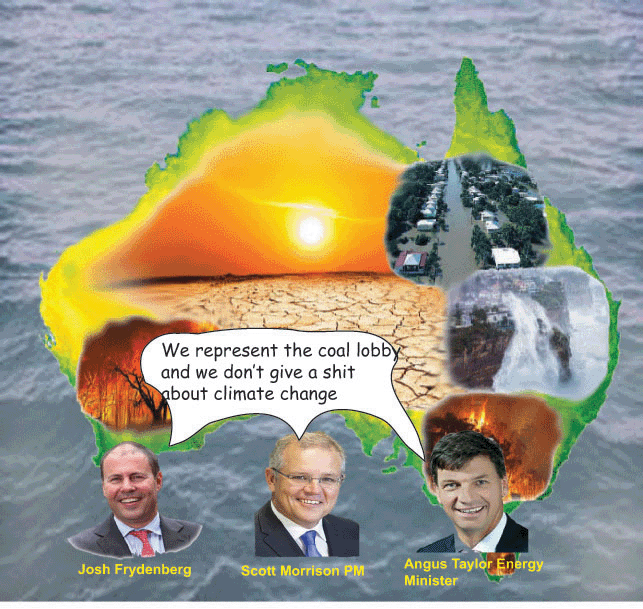 Australia is copping it at COP25 – and rightly so, Canberra Times, Dermot O’Gorman , 9 Dec 19, Australia is copping it at COP25 – and rightly so, Canberra Times, Dermot O’Gorman , 9 Dec 19,
This week the world’s climate ministers, including Australia’s embattled Minister for Emissions Reduction Angus Taylor, are meeting in Madrid for international climate talks. It has already been an inauspicious start to the COP25 UN Climate Change Conference, where Australia is receiving a well-deserved kicking from the international community for its inaction on the issue.
Australia bagged the infamous Fossil of the Day award from environment groups on the opening day. The satirical award, presented each day of the conference, was in recognition of the Australian government’s downplay of the link between climate change and the bushfires that continue to devastate communities across the country. As the talks continue, we shouldn’t be surprised to see members of the European Union, who are leading the way in tackling climate change, taking aim at Australia for our weak climate commitments. Trade Minister Simon Birmingham recently got a taste of this when France pushed Australia to adopt enforceable climate change targets as part of a planned trade deal with the EU. COP25 should be a wake-up call that our domestic climate policies and position on thermal coal exports are undermining Australia’s standing in the world…..https://www.canberratimes.com.au/story/6532512/australia-is-copping-it-at-cop25-and-rightly-so/?cs=14246 |
|
Australian govt’s dodgy climate accounting tricks to be tested in Madrid
Australia’s ‘betrayal of trust’ emissions plan to be tested in Madrid, SMH, By Peter Hannam, December 9, 2019, The Morrison government could be forced to justify Australia’s plan to count “carry-over credits” towards the country’s Paris climate target, with a global summit set to debate eliminating their use.
The 25th Conference of the Parties (COP25) meeting in the Spanish capital of Madrid is scheduled to debate the so-called “rulebook” for the goals agreed by the nearly 200 Paris signatory nations.
According to the draft “guidance on cooperative approaches“, one “option” for debate will be that “Kyoto Protocol units, or reductions underlying such units, may not be used by any Party toward its [nationally determined goals]”.
The Morrison government has repeatedly said Australia is entitled to use “surplus” units the country will generate during the Kyoto period (2008-2020) to count against the 2021-2030 Paris target.
Australia’s latest emissions projections report, released over the weekend, showed the government is planning to count 411 million tonnes of carbon dioxide equivalent (MtCO-e) from the Kyoto-agreement era. The use of such credits would mean Australia could meet its pledge of cutting 2005-level emissions 26-28 per cent by 2030 with minimal effort.
Malte Meinshausen, co-director of the Energy Transition Hub at Melbourne University and a former climate negotiator with Germany, said it was good the Kyoto option appears “to be on the table”.
The use of Kyoto credits was “a betrayal of the trust which all countries signed up to at Paris”, Professor Meinshausen said, noting New Zealand, European Union and Pacific states opposed them.
While climate laggards such as Russia and Brazil may join Australia in opposing the Kyoto “option”, “it’s a reminder that the international community does not want to give up easily the good cooperative fruits developed in Paris”, he said…….
Australia will certainly have to defend its carryover and depending on how the text evolves might find itself increasingly isolated,” said Richie Merzian, an emissions analyst with The Australia Institute and former climate treaty negotiator for the Australian government.
“There are apparently over 100 countries supporting the restriction to limit Kyoto Protocol units from being used to meet Paris Agreement commitments,” he told the Herald and The Age from Madrid.
“Australia’s usual allies – other developed countries – either have ruled out using these credits voluntarily or don’t have skin in the game,” Mr Merzian said. “Australia’s only support might come from China and Brazil keen to use their carbon market credits from Kyoto to cash into Paris.”
Adam Bandt, Greens climate spokesman, said “Scott Morrison’s dodgy climate accounting is now up in lights on the world stage.
“Australia is burning at home, and Angus Taylor is turning up at an international event asking for the right to keep on polluting,” he said…….
“[The emissions drop] is driven mainly by declines in the electricity sector because of strong uptake of rooftop solar and the inclusion of the Victoria, Queensland and Northern Territory 50 per cent renewable energy targets,” the report said.
Jamie Hanson, head of campaigns at Greenpeace Australia Pacific, said the Liberal National coalition had long been using “dodgy accounting tricks like these so-called carryover credits to mislead the Australian public on their appalling track record on emissions”.
“Scrapping the ability to rely on carryover credits and shifty accounting is a great step towards holding governments like Australia to account over their rising emissions,” he said. https://www.smh.com.au/environment/climate-change/australia-s-betrayal-of-trust-emissions-plan-to-be-tested-in-madrid-20191208-p53hyv.html
UN climate talks: what’s on the agenda in Madrid and what it means for Australia,

UN climate talks: what’s on the agenda in Madrid and what it means for Australia, Angus Taylor heads to COP25 next week, where Australia has already twice been given the ‘fossil of the day’ award, Guardian, Adam Morton Environment editor. @adamlmorton, Sun 8 Dec 2019 For two weeks at the end of every year, the world’s governments meet to work on a global response to climate change. This year is the 25th meeting of what is known as the conference of the parties under the United Nations Framework Convention on Climate Change. Those who attend know it as COP, or COP25.
Here’s what you need to know about this year’s talks, which started on Monday in Madrid, and what they could mean for Australia.
Where does Australia stand coming into the talks?
There are nearly 190 countries represented at the UN climate talks and, contrary to some perceptions, Australia is not just a bit player.
Under UN greenhouse accounting, Australia is responsible for about 1.3% of annual pollution, which places it 16th on a ladder of polluting nations. It emits more each year than 40 countries with larger populations, including G7 members Britain, France and Italy.
On other measures Australia performs worse. It emits more per person than any other developed country (and far more than most developing countries), and a recent analysis found it was third for exported emissions.
It is the world’s biggest seller of coal, particularly metallurgic coal used in steel-making, and either number one or two for natural gas. It is easily the largest emitter in the south Pacific, and has been increasingly drawing criticism from Pacific leaders for not doing more to tackle the issue.
As the talks began last week, Australia was at the forefront of the climate emergency in other ways, as drought and bushfires made global headlines. Scientists say both are unprecedented and in line with climate projections.
Observers such as Howard Bamsey, the country’s former special envoy on climate change, say events in Australia are noticed and could be used to influence other countries to do more. But the government’s message focuses on its own actions: that it has set a 2030 emissions reduction target, that it more than met previous targets it set for itself and that it will meet this one.
Who is representing Australia?
Australia has a 21-strong delegation from the Department of Foreign Affairs and Trade, led by Jamie Isbister, a senior diplomat who was appointed environment ambassador less than three weeks ago.
In the second week’s political stage, Australia will be represented by Angus Taylor, the minister for energy and emissions reduction. It is his first time at climate talks. He arrives under pressure on several fronts, including a bizarre public spat with American author Naomi Wolf.
How is Australia positioning itself?…….
Scott Morrison has indicated Australia has no plan to increase what it is doing beyond its 2030 target of a 26-28% cut compared with 2005 levels, which is less than what government advisors found would be Australia’s fair share or it could afford to do.
The prime minister has not acknowledged what groups representing business, unions, farmers, investors and the social policy sector this week spelled out in a joint statement – that the goals of the Paris agreement mean Australia will need to plan to stop emitting any carbon dioxide.
Australia’s emissions are not coming down and most experts believe it is not on track to meet its target. ……. https://www.theguardian.com/environment/2019/dec/08/un-climate-talks-whats-on-the-agenda-in-madrid-and-what-it-means-for-australia
Australia burns, as government leaders choose not to discuss this
Leading scientists condemn political inaction on climate change as Australia ‘literally burns
Climate experts ‘bewildered’ by government ‘burying their heads in the sand’, and say bushfires on Australia’s east coast should be a ‘wake-up call’, Lisa Cox, Sat 7 Dec 2019 , Leading scientists have expressed concern about the lack of focus on the climate crisis as bushfires rage across New South Wales and Queensland, saying it should be a “wake-up call” for the government.
Climate experts who spoke to Guardian Australia said they were “bewildered” the emergency had grabbed little attention during the final parliamentary sitting week for the year, which was instead taken up by the repeal of medevac laws, a restructure of the public service, and energy minister Angus Taylor’s run-in with the American author Naomi Wolf.
Escalating conditions on Thursday and Friday led to dozens of out-of-control bushfires, including in the NSW’s Hawkesbury region, where a fire at Gospers Mountain merged with two other blazes burning in the lower Hunter on Friday.
Sydney has been blanketed with a thick smoke haze that health officials said had led to a 25% increase in people presenting in emergency departments for asthma and breathing problems.
Sarah Perkins-Kirkpatrick, a climate scientist with the University of NSW’s Climate Change Research Centre, said she was “surprised, bewildered, concerned” that the emergency had prompted little discussion from political leaders this week.
“Here we are in the worst bushfire season we’ve ever seen, the biggest drought we’ve ever had, Sydney surrounded by smoke, and we’ve not heard boo out of a politician addressing climate change,” she said.
“They dismissed it from the outset and haven’t come back to it since.
“They’re burying their heads in the sand while the world is literally burning around them and that’s the scary thing. It’s only going to get worse.” Continue reading
Fire? What fire? It’s business as usual in Morrison’s Canberra bubble

|
Fire? What fire? It’s business as usual in Morrison’s Canberra bubble, SMH, Peter Hartcher, Political and international editor for The Sydney Morning Herald, December 7, 2019, Subtitles are supposed to help you make sense of what you’re seeing but can’t quite understand. Like a foreign language film. But if you saw the subtitles to Federal Parliament’s final question time of 2019, the flow of text only made it more incomprehensible.
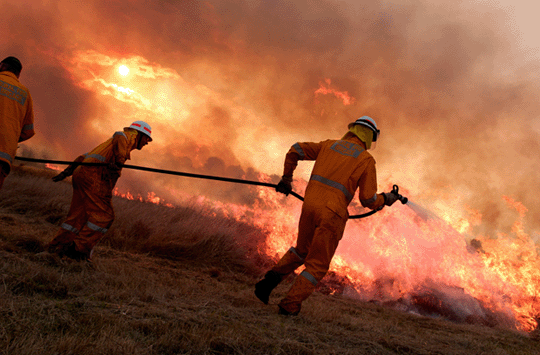
The politicians talked about a great many things. But if you watched it on TV, the subtitles were about only one. As Labor cycled through its list of grievances against the government, and the government rehashed its self-congratulatory talking points, the news crawl across the bottom of the screen announced a non-stop series of fire alerts. Did the two worlds connect? At no point in an hour-and-a-quarter did the politicians discuss the most obvious and pressing concern for most of the people they represent. The disconnect was emblematic of the week. Indeed, it’s an emerging motif of the Morrison government. There is no emerging crisis so big that the government cannot find a way to look past it. Australia, parched, baking, burning, is heading into an anxious Christmas and a joyless new year. The Prime Minister sends his best wishes but he wants to get on with talking about his real priorities. The final showcase moment for Parliament for the year only managed to showcase political self-absorption. It’s understandable that the bushfires weren’t a feature of question time. Question time is customarily a clash over highly political differences, and neither party wanted to politicise fires. It’s just that it was all business as usual in Parliament. As if there were no accelerating national emergency. The disconnect is that it’s not business as usual for the rest of Australia…….. The government, having campaigned for re-election on a minimalist platform, wants to govern with a minimalist agenda. It seeks to deliver its promised agenda to its “base”, while ignoring other demands unless — and until — they become politically overwhelming. The fires are a national emergency. They are an invitation to national leadership. And, therefore, they are an opportunity for Morrison to look beyond the 30 to 40 per cent of voters who constitute his “base” to making common cause with the other 60 to 70 per cent of the community. Besides, even “quiet Australians” are increasingly anxious ones. …… The entire pyro-hydro complex of problems and solutions does lead, inevitably, to that most delicate political question of climate change mitigation. Morrison will have to brace his party to deal squarely with this, too. At the moment, he is in frozen immobility on this because he does not want to upset the internal Coalition truce on climate and coal. This will require of him active management. It will test his skills. But this is all big and bold and demanding and, above all, risky. It’s far from the minimalist and incrementalist prime ministership that Morrison has kept to so far. More likely, he’ll just continue to preside over an unfolding disaster armed only with grudging, inadequate responses and an unending list of excuses and talking points. …… We don’t need subtitles to explain the subtext. The country is in crisis and the national government is in denial. …https://www.smh.com.au/politics/federal/fire-what-fire-it-s-business-as-usual-in-morrison-s-canberra-bubble-20191206-p53hom.html |
|
Bushfires crisis in New South Wales, smoke pollution in Sydney, and even New Zealand
The NSW bushfire crisis has people “living in fear” with more than 100 blazes burning across the state and Sydney choking on harmful smoke pollution.
Firefighters will have a brief window over the weekend to get on top of the crisis before the weather deteriorates early next week.
The Bureau of Meteorology has painted a grim picture for the coming week, with winds forecast to whip dangerous fire grounds and no rain relief in sight. At one point on Friday there were nine fires burning at an emergency level, including the massive Gospers Mountain blaze, which has merged with neighbouring fire grounds to create a “megafire”.
Smoke from the fires was drifting to New Zealand and affecting communities there, NSW Rural Fire Service commissioner Shane Fitzsimmons said on Friday.
There were 108 fires burning in NSW on Friday afternoon, with 74 of those burning out of control.
Hazardous air pollution readings were recorded in many parts of the state, with emergency departments seeing an increase in presentations for respiratory issues…….
NSW Premier Gladys Berejiklian said residents from the South Coast up the Queensland border are “living in fear”.
“The difference now as we lead into the summer months is previously [bushfires] were pretty much confined to the northern part of NSW but what we are seeing this week is our resources stretched across the entire coastline,” she told reporters……
Fire crews have arrived from interstate as well as New Zealand and Canada, while a team from the US will arrive on Saturday.
Total fire bans will be in place on Saturday for the far north coast, New England, the northern slopes, the greater Hunter, greater Sydney, the central ranges and the nortwestern regions…… https://www.sbs.com.au/news/nsw-living-in-fear-as-bushfires-continue-to-rage
Huge bushfire North of Sydney, with conditions forecast to worsen
 Australia fires: five blazes merge north of Sydney as conditions forecast to worsen, More than 100 bushfires were burning in New South Wales on Friday, more than half of them out of control, Guardian, Ben Doherty and Helen Davidson, Fri 6 Dec 2019 Five fires burning to the north of Sydney joined up into one huge conflagration on Friday, with out-of-control blazes threatening homes and lives.On a day that brought choking smog to Sydney, the premier of New South Wales said the entire coastline of the state was on fire.
Six people have died, and more than 680 homes have already been lost to bushfires in NSW this fire season, and on Friday more than 100 fires were burning, more than half of them out of control. Eight fires have emergency warnings, which means they pose an immediate risk to lives and property.
The largest fire – a conglomeration of five blazes which have joined up north of Sydney – has burned over 335,000 hectares.
The forecast for coming days is for more hot, dry conditions. Strong winds are likely to continue to fan blazes towards towns and properties.
The NSW premier, Gladys Berejiklian, said while fires had been burning across the state for weeks, the sheer scale of the current fire threat was stretching crews’ ability to fight the blazes……..
Sydney has been choked by thick smoke for almost a week.
Hospital emergency departments have seen a 25% increase in people presenting with asthma and breathing problems, and ambulance crews are responding to between 70 and 100 call-outs a day for respiratory conditions, including to school children as young as six.
Some schools across the state have been closed because of the fire risk, while others have kept children inside because of the worsening air quality…… https://www.theguardian.com/australia-news/2019/dec/06/australia-fires-five-bushfires-merge-north-of-sydney-as-conditions-forecast-to-worsen
Grim summer is forecast for Murray Darling river system
“Campaigns led by irrigators and the NSW National party to derail the basin plan do not represent the interests of all communities across the basin. Governments must listen to all voices in this debate, not just the loudest and most belligerent,”
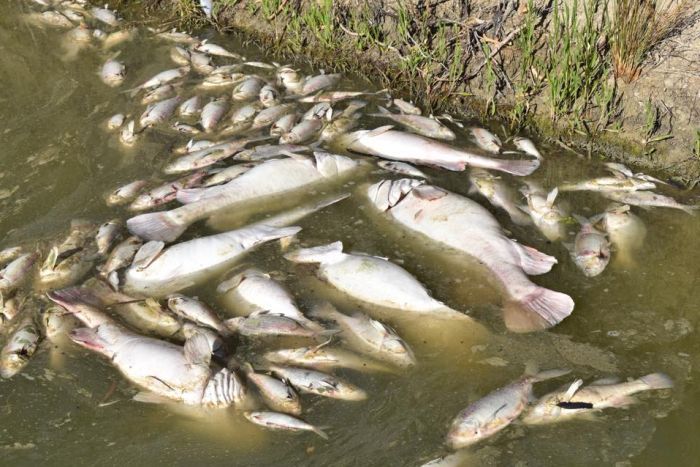
Murray-Darling authority warns of ‘dire’ summer of mass fish deaths and blue-green algae https://www.theguardian.com/australia-news/2019/dec/06/murray-darling-authority-warns-of-dire-summer-of-mass-fish-deaths-and-blue-green-algae
Alert comes as Indigenous group issues plea for states to stick with basin plan or risk marginalising vulnerable communities and endangering river health, Anne Davies, 6 Dec 19,
The Murray-Darling Basin Authority has warned of more mass fish deaths and blue-green algae events throughout the Murray-Darling River system as the peak group representing First Nations issued a plea for the states to stick with the plan.
The MDBA issued a communique on Friday saying the summer outlook from the Bureau of Meteorology was “dire”, and there was a greater than average chance of drier, warmer conditions and an elevated fire danger across the basin.
“We are already seeing the drying of critical aquatic refuges in the north, and water quality issues such as blue-green algae and stratification are becoming more widespread,” the MDBA said.
These were the conditions that led to mass fish deaths at Menindee in January this year.
The MDBA reiterated how important it is to use what little environmental water that remained available to protect critical habitats and maintain water quality.
It has produced a detailed water quality map that will be updated as the drought worsens. Continue reading
Sydney afflicted with smoke, as many fires out of control in New South Wales
|
Sydney set for more ‘poor’ air quality as NSW South Coast bushfires continue to burn, SBS, 3 Dec 19, The Bureau of Meteorology says smoke is forecast to linger in parts of Sydney on Tuesday, creating “poor” air quality in the city…….. The state government says air quality on Tuesday will be “poor due to particles” from the extensive smoke coming from bushfires burning across the state……
There were 119 bush and grass fires burning across NSW on Monday evening with 48 of these uncontained. The out-of-control fire at Currowan is burning across almost 25,000 hectares and is being pushed east towards coastal communities but tempered overnight as gusty northeasterly winds moderated…… Two million hectares of NSW land have been burnt since July in more than 7000 fires, with authorities dubbing it the “most challenging bushfire season ever”. Six people have died while 673 homes have been destroyed to date. https://www.sbs.com.au/news/sydney-set-for-more-poor-air-quality-as-nsw-south-coast-bushfires-continue-to-burn |
|
COP25, and Australia’s position at the Madrid climate talks
 Earth has a couple more chances to avoid catastrophic climate change. This week is one of them https://theconversation.com/earth-has-a-couple-more-chances-to-avoid-catastrophic-climate-change-this-week-is-one-of-them-128120 Robert Hales
Director Centre for Sustainable Enterprise, Griffith University, December 3, 2019 Almost 200 world leaders gather in Madrid this week for climate talks which will largely determine the success of the Paris agreement, and by extension, the extent to which the planet will suffer under climate change.
Negotiations at the so-called COP25 will focus on finalising details of the Paris Agreement. Nations will haggle over how bold emissions reductions will be, and how to measure and achieve them.
Much is riding on a successful outcome in Madrid. The challenge is to get nations further along the road to the strong climate goals, without any major diplomatic rifts or a collapse in talks.
What COP25 is about
COP25 is a shorthand name for the 25th meeting of the Conference of Parties to the UN Framework Convention on Climate Change (or the nations signed up to the Paris agreement).
After Paris was signed in 2015, nations were given five years in which to set out bolder climate action. Current targets expire in 2020. At next year’s November COP in Glasgow, nations will be asked to formally commit to higher targets. If Madrid does not successfully lay the groundwork for this, the Glasgow talks are likely to fail.
The United Nations says the world must reduce overall emissions by 7.6% every year over the next decade to have a high chance of staying under 1.5℃ warming this century.
The 1.5℃ limit is at the upper end of the Paris goal; warming beyond this is likely to lead to catastrophic impacts, including near-total destruction of the Great Barrier Reef.
Presently, emissions reduction targets of nations signed up to Paris put Earth on track for a 3.2℃ increase.
A global carbon market
Parties will debate the mechanism in the Paris agreement allowing emissions trading between nations, and via the private sector.
Such mechanisms could lower the global cost of climate mitigation, because emissions reduction in some nations is cheaper than in others. But there are concerns the trading regime may lack transparency and accountability.
Among the risks are that emissions cuts are “double counted” – meaning both the buying and selling nation count the cuts towards their targets, undermining the aims of the agreement.
Help for vulnerable nations
Small island states say COP25 is the last chance to take decisive action on global emissions reduction.
Fossil fuel burning in the developing world is largely responsible for the carbon dioxide that drives global warming. Developing nations are particularly vulnerable to the loss and damage caused by climate change.
Parties will discuss whether an international mechanism designed to assess and compensate for such damage is effective.
Developing nations are expected to contribute to the Green Climate Fund to help poorer nations cope with and mitigate climate change. Some 27 nations contributed US$9.78 billion in the last funding round.
Some nations have indicated they will not contribute further, including Australia, which says it already helps Pacific nations through its overseas aid program.
Arguments about cost
Nations opposed to adopting stronger emissions reduction targets often argue the costs of decarbonising energy sectors, and economies as a whole, are too high.
However, recent cost benefit analysis has found not taking action on climate change will be expensive in the long run.
Realisation is also growing that the cost of emissions reduction activities has been overestimated in the past. In Australia, prominent economist Ross Garnaut recently said huge falls in the cost of equipment for solar and wind energy has created massive economic opportunity, such as future manufacturing of zero-emission iron and aluminium.
The shift in the cost-balance means nations with low ambition will find it difficult to argue against climate mitigation on cost grounds.
Australia’s position at Madrid
At the Paris talks, Australia pledged emissions reduction of 26-28% by 2030, based on 2005 levels. The Morrison government has indicated it will not ramp up the goal.
About 68 nations said before COP25 they will set bolder emissions reduction targets, including Fiji, South Africa and New Zealand. This group is expected to exert pressure on laggard nations.
This pressure has already begun: France has reportedly insisted that a planned free trade deal between Australia and the European Union must include “highly ambitious” action on climate change.
The Climate Action Tracker says Australia is not contributing its fair share towards the global 1.5℃ commitment. Australia is also ranked among the worst performing G20 nations on climate action.
The Madrid conference takes place amid high public concern over climate change. Thousands of Australians took part in September’s climate strikes and the environment has reportedly surpassed healthcare, cost of living and the economy as the top public concern.
Climate change has already arrived in the form of more extreme weather and bushfires, water stress, sea level rise and more. These effects are a small taste of what is to come if negotiations in Madrid fail to deliver.
Johanna Nalau, Samid Suliman and Tim Cadman contributed to this article.
To National Party members. “Climate Change” is real, not “dirty words”
Nobody called the thoroughly urban mayor of Venice, Luigi Brugnaro a “raving inner city lunatic” when he said flooding due to climate change had brought his city “to its knees”.
Equally not prone to lunacy, Japan’s Prime Minister, Shinzo Abe, cautioned in the wake of Typhoon Hagibis that “making the world more resilient to natural disasters will be more important in the years to come”, in light of studies showing an “increase in cyclone intensity because of climate change”.
In contrast, amid recent Californian wildfires, US President Donald Trump tweeted the state’s Governor, Gavin Newsom, had done “a terrible job of forest management”, failing to “clean” his forest floors. Newsom retorted: “You don’t believe in climate change. You are excused from this conversation.”
In their absolute refusal to “go there” on climate change, our parliamentarians have more in common with Trump than the rest of the world when it comes to their inability to walk and chew gum on disaster response and climate change.
Fair enough, Deputy Prime Minister Michael McCormack was right to point out that what people in the grip of disaster most urgently need “is a little bit of sympathy, understanding and real assistance”. But that shouldn’t mean treating them like simpletons, and ruling out any discussion on the cause of their trauma and strategies to prevent it.
And it’s not just, as McCormack claimed, “woke capital city greenies” demanding answers. The Nationals’ own constituency wants to have the conversation.
Rural newspaper The Land surveyed its readers on the eve of the March NSW election. A “whopping 63 per cent” of respondents, the news outlet declared, “believed in climate change”. And 15 per cent said the issue would determine their vote.
The state poll delivered an average swing of 25 per cent against the Nationals in four seats. These are electorates devastated by mass fish kills and long-term drought. There’s no hesitation among some in National Party ranks about what needs to change.
WA Nationals leader Mia Davies told The West Australian that the party’s constituents expect them “to be a part of the conversation” on climate change. “When you live in regional Western Australia you see the impact of climate change … we are dealing with [it] on a day-to-day basis.”
The party’s own polling ahead of the May federal election revealed “climate change is a key issue” for voters in National-held seats. The party’s member for Gippsland, Darren Chester, remarked many of his most ardent supporters are “practical environmentalists” who “expect a balanced and rational … response to climate change”.
There. He said it. Climate change. Not so hard after all.
Sir David Attenborough hits out at the federal government over climate position,
https://www.sbs.com.au/news/sir-david-attenborough-hits-out-at-the-federal-government-over-climate-position Sir David Attenborough has taken another swipe at the Australian government’s climate policies, expressing his shock at the government’s hesitation to link recent extreme weather with global warming.
The Murray Darling water crisis and what governments must do to fix this
|
Fish kills and undrinkable water: here’s what to expect for the Murray Darling this summer, The Conversation, Jamie Pittock
Professor, Fenner School of Environment & Society, Australian National University, November 27, 2019 A grim summer is likely for the rivers of the Murray-Darling Basin and the people, flora and fauna that rely on it. Having worked for sustainable management of these rivers for decades, I fear the coming months will be among the worst in history for Australia’s most important river system.The 34 months from January 2017 to October 2019 were the driest on record in the basin. Low water inflows have led to dam levels lower than those seen in the devastating Millennium drought. No relief is in sight. The Bureau of Meteorology is forecasting drier-than-average conditions for the second half of November and December. Across the summer, rainfall is also projected to be below average. So let’s take a look at what this summer will likely bring for the Murray Darling Basin – on which our economy, food security and well-being depend. Not a pretty pictureAs the river system continues to dry up and tributaries stop flowing, the damaging effect on people and the environment will accelerate. Mass fish kills of the kind we saw last summer are again likely as water in rivers, waterholes and lakes declines in quality and evaporates. Three million Australians depend on the basin’s rivers for their water and livelihoods. Adelaide can use its desalination plants and Canberra has enough stored water for now. But other towns and cities in the basin risk running out of water. Governments were warned well before the drought to better secure water supplies through infrastructure and other measures. But the response was inadequate. Some towns such as Armidale in New South Wales have been preparing to truck water to homes, at great expense. Water costs will likely increase to pay for infrastructure such as pumps and pipelines. The shortages will particularly affect Indigenous communities, pastoralists who need water for domestic use and livestock, irrigation farmers and tourism business on the rivers………. How to fix thisGovernments must assume that climate-induced drought conditions in the basin are the new normal, and plan for it. Action should include:
Investing in these adaptation actions now would provide jobs during the drought and prepare Australia for a much drier future in the Murray-Darling Basin. https://theconversation.com/fish-kills-and-undrinkable-water-heres-what-to-expect-for-the-murray-darling-this-summer-126940 |
|
1 This month

of the week – Australians for War Powers Reform (AWPR)
To see nuclear-related stories in greater depth and intensity
 Antinuclear