250m tonnes of CO2 emitted from Australia’s bushfires
Australia’s bushfires have emitted 250m tonnes of CO2, almost half of country’s annual emissions. Forest regrowth can reabsorb emissions from fires but scientists fear natural carbon ‘sinks’ have been compromised, Guardian,Graham Readfearn @readfearn, Fri 13 Dec 2019
Bushfires in New South Wales and Queensland have emitted a massive pulse of CO2 into the atmosphere since August that is equivalent to almost half of Australia’s annual greenhouse gas emissions, Guardian Australia can reveal.
Analysis by Nasa shows the NSW fires have emitted about 195m tonnes of CO2 since 1 August, with Queensland’s fires adding a further 55m tonnes over the same period.
In 2018, Australia’s entire greenhouse gas footprint was 532m tonnes of carbon dioxide equivalent.
Experts say the pulse of CO2 from this season’s bushfires is significant, because even under normal conditions it could take decades for forest regrowth to reabsorb the emissions.
But scientists have expressed doubt that forests already under drought stress would be able to reabsorb all the emissions back into soils and branches, and said the natural carbon “sinks” of forests could be compromised.
The figures were provided to Guardian Australia by Dr Niels Andela, a scientist at the Nasa Goddard Space Flight Center and a collaborator in the Global Fire Emissions Database……….
Prof David Bowman, a fire ecologist at the University of Tasmania, said that under normal conditions the regrowth would reabsorb the CO2. But he said the ongoing drought, combined with climate change, meant conditions were not normal.
“Drought-stressed trees recover less well – carbohydrates reserves are exhausted – and under climate change tree growth may be slow and fires more frequent, meaning less tree biomass and even loss of forest cover.
“This is a nasty negative feedback cycle of a biosphere carbon sink becoming a source [of carbon].” https://www.theguardian.com/environment/2019/dec/13/australias-bushfires-have-emitted-250m-tonnes-of-co2-almost-half-of-countrys-annual-emissions
Coalition MPs squabble over climate science as Australia burns
 , New Daily, Daniel McCulloch 13 Dec 19, Nationals deputy leader Bridget McKenzie has blasted an “irrational” state colleague for daring to link the NSW bushfires to climate change.
Their ugly public stoush has dragged on for several days.
He inflamed the internal spat after suggesting he would rather listen to climate scientists than the federal frontbencher on the effects of global warming.
But Senator McKenzie said “I actually have a science degree – I am one of the few in parliament that does”.
Scott Morrison and the Coalition are fiddling as Australia burns
|
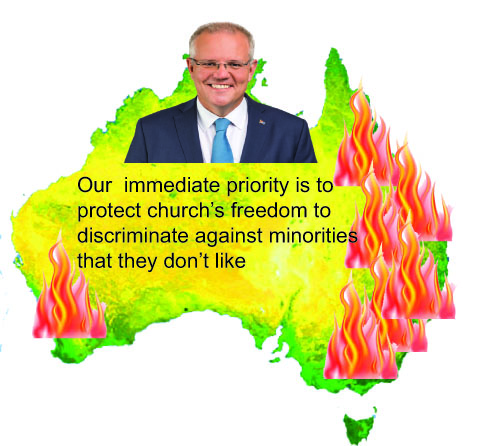
Scott Morrison and the Coalition are fiddling as Australia burns On climate action, the Coalition is the party of wreck, defer and obfuscate, the party with a shameful and indefensible record, Guardian Katharine Murphy Political editor, @murpharoo, Tue 10 Dec 2019 “………… Swathes of the country are burning, and we’ve only just entered summer. While Christian Porter was working through his various concessions on religious discrimination on Tuesday, trying to contain blowback from the churches and from colleagues, dot point by dot point, thick smoke was choking Sydney. In Canberra, the heat is also blistering, and the smoke from Braidwood rolls in and out, triggering memories of that traumatic January in 2003 that many of us lived through, our treasured possessions tucked in boxes, babies on hips, sheltering friends displaced from the western suburbs of the city; a city ready to flee, watching a red sky, raining ash and burning cinders, houses on fire, trees on fire. I flew to Brisbane on Sunday. The ground below me was dust for a thousand kilometres and the sky was a milky fog of smoke and heat haze. Dear prime minister. The country is not parched but desiccated, and it is burning like a tinderbox, and people are frightened. They are frightened about today and the terrible business of defending property and saving lives, and they are frightened about whether this is what spring and summer in Australia now looks like as droughts lengthen and deepen, and the fire season extends and intensifies because of climate change – which is what scientists have been trying to tell us all these years, so many times, in so many different ways, experts maligned and mangled in a culture war, pleading to be understood. Fear has accompanied the dry, and the heat and the flames, and that is a difficult and frankly politically unwelcome development for a prime minister who won an election just a few months ago at least in part by telling people to calm down about climate change, because the Coalition had things under control. It wasn’t true of course. That pitch has no basis in fact because the Coalition has done more than any other political party in Australia to frustrate climate action. If anyone is inclined to think wrecking is behaviour of the past, a vestige of Abbottism rather than behaviour of the present, because Morrison is so much more sensible, just remember this very week, in Madrid, Australian officials are making the case we need to use an accounting loophole to meet our Paris target. Far from meeting our 2030 target in a canter, Australia will not meet the target at all unless we invoke carryover credits to carry about half the abatement load. By taking this stance, we not only defer corrective action in our own country that should be happening now, in orderly fashion over this decade, we also validate the inclination of other countries, with higher emissions than us, to hunt for workarounds too. To cut a long story short, we make it less likely that the world will deliver the ambition we need to avert the worst of warming. So let’s be very clear. On climate action, the Coalition is the party of wreck, defer and obfuscate, the party with a shameful and indefensible record, the party that only last year bundled Malcolm Turnbull out of office in part because of a policy idea that might have settled a decade of partisan warfare that the Coalition believes is helpful to its re-election prospects. Morrison pursued an electoral strategy in May of telling voters in the cities the Coalition had climate under control, there was no need for hysterics, while in the regions, out of sight of the metro campaigns, the government weaponised climate change against Labor. So the Coalition in 2019 is the party of placate where necessary and punch on where politically profitable – which feels like the grimmest story of all. It might be grim, but it will remain the model as long at there’s enough voters in enough regional seats either not buying the science, or more worried about their immediate material circumstances than the science, to swing an election in the Coalition’s favour. As long as the status quo delivers a pathway to victory, the climate war in Australia will go on being an artefact of partisan politics rather than a practical problem to be solved. It’s hard, that truth, so hard I flinch. But truth is hard, and it’s past time truth won this argument rather than being obscured in the emoting, and the bobble head ranting, and the posturing, and the dissembling, and the clever strategising. Now by carrying on resolutely while the country burns, and being seen to carry on while things are being managed, Morrison is not avoiding the issue so much as trying to set the tone. The prime minister doesn’t want to validate the rising fear in the community by looking perturbed about the disaster currently in progress, because that obviously makes a lie of the Coalition’s “everything is fine” messaging. He wants to be getting on with ordinary business in full public view, not flapping about with special summits with the premiers just because Turnbull said he should do it on Q&A. …… The obfuscation, the false comfort, the changing of the subject, the head-patting, will keep happening as long as we let it. It will keep happening as long as soft and hard denialism is enabled in mainstream media outlets, as long as journalists prioritise other lines of inquiry over rigorously pursuing accountability on this issue, and as long as Australian voters abdicate responsibility by telling themselves all political parties are as bad as each other so it doesn’t matter who you vote for. The only way things will change is if we choose, as a country, to do something else. To take responsibility. To demand something better. Because, ultimately, this, the future, is on us. https://www.theguardian.com/australia-news/2019/dec/10/australia-is-burning-like-a-tinderbox-and-the-coalition-wont-acknowledge-voters-rising-fears |
|
Australia at the bottom of the list in global assessment of climate action
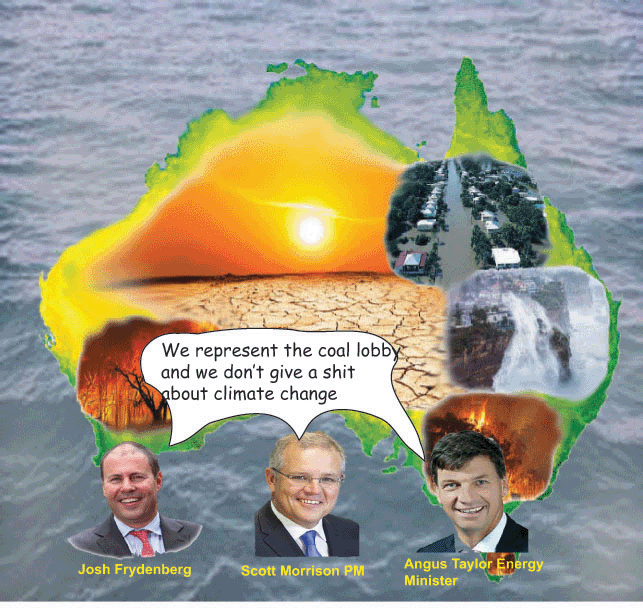 ‘Cause for great concern’: Australia ranked last in global assessment on climate action, Australia’s record on climate change has been panned in the latest Climate Change Performance Index tracking nation’s efforts to combat global warming, SBS NEWS, BY TOM STAYNER, 1 Dec 19, Australia’s climate change record has been ranked among the bottom five nations in the world in a global assessment of countries’ emissions trajectories. ‘Cause for great concern’: Australia ranked last in global assessment on climate action, Australia’s record on climate change has been panned in the latest Climate Change Performance Index tracking nation’s efforts to combat global warming, SBS NEWS, BY TOM STAYNER, 1 Dec 19, Australia’s climate change record has been ranked among the bottom five nations in the world in a global assessment of countries’ emissions trajectories.
The Climate Change Performance Index (CCPI) measures the emissions, renewable energy share and climate policies of 57 countries and the European Union. It has been released at COP25, the UN climate summit being held in Madrid, as nations attempt to thrash out the way forward on the global Paris framework responding to the crisis. According to the report, Australia, Saudi Arabia, and the United States give “cause for great concern” over their performance on emissions, renewable energy development and climate policy. Australia’s climate policy rating was ranked the lowest in the world with analysts noting that “the newly elected government continued to worsen performance at both national and international levels.” Its policies were given a 0.0 rating, in comparison the United Stated ranked one position higher held a 2.8 rating and the top-performing nation Portugal received a 98.7. National experts observe a lack of progress in these areas with the [Australia] government failing to clarify how it will meet the country’s insufficient 2030 emissions reduction target and inaction in developing a long-term mitigation strategy,” the report reads. “While the government is not proposing any further targets for renewable energy beyond 2020, it continues to promote the expansion of fossil fuels and in April 2019 approved the opening of the highly controversial Adani coalmine.” Across the assessment, Australia ranked 44th on emissions, 50th on renewable energy, 52nd on energy use and 61st on climate policy. National experts observe a lack of progress in these areas with the [Australia] government failing to clarify how it will meet the country’s insufficient 2030 emissions reduction target and inaction in developing a long-term mitigation strategy,” the report reads. “While the government is not proposing any further targets for renewable energy beyond 2020, it continues to promote the expansion of fossil fuels and in April 2019 approved the opening of the highly controversial Adani coalmine.” Across the assessment, Australia ranked 44th on emissions, 50th on renewable energy, 52nd on energy use and 61st on climate policy……. HTTPS://WWW.SBS.COM.AU/NEWS/CAUSE-FOR-GREAT-CONCERN-AUSTRALIA-RANKED-LAST-IN-GLOBAL-ASSESSMENT-ON-CLIMATE-ACTION |
|
A foreign corporation gets 89 BILLION litres of Australia’s water, as drought worsens
|
Water restrictions for you, an endless supply for them: How a foreign corporate giant is snapping up 89 BILLION litres of Australia’s H20 as the country suffers its worst drought ever
By ALISHA ROUSE FOR DAILY MAIL AUSTRALIA DAILY MAIL UK 12 December 2019 |A multi-billion dollar Singaporean food company is selling 89,000 megalitres of Australian water to a Canadian pension fund. The mega sale of Australian permanent water rights comes as the country is crippled by one of the worst droughts in its history. On Tuesday, NSW brought in a complete ban on hoses as part of the toughest water restrictions implemented for more than a decade. But no such problem existed for food and agriculture giant Olam International, which sold the 89billion litres of permanent water rights for an astonishing $490 million. The company sold it to an entity associated with the Public Sector Pension Investment Board, one of Canada’s largest pension investment managers, according to Straits Times. It will use the water to irrigate almond trees, in a business venture likely to draw criticism over foreign ownership of farms and water. The water rights are in the lower Murray-Darling Basin. The chairman of the Victorian Farmers Federation’s water council, Richard Anderson, told the Sydney Morning Herald: ‘Really, all you’ve got is a change of ownership, it (the water) has gone from a Singapore-owned company to a Canadian pension fund……. Water restrictions in Sydney, the Blue Mountains and Illawarra were upgraded to level two as dam levels in the region sank to just 45 per cent capacity, the lowest levels since the Millennium Drought took hold in 2003….. The Bureau of Meteorology has predicted a hot-than-usual summer, with no forecast for significant rain. The sale is understood to be giving Olam a ‘one-time pre-tax capital gain of about $311 million’, the paper reported. The agreement is for 25 years, with the option to renew for another 25. In March, the government released its foreign ownership of water entitlement register, showing that investors from China and the US had the largest stake in Australia’s foreign-owned water entitlements. It showed that one in 10 water entitlements is foreign owned. A water entitlement is the right to an ongoing share of water, which can be sold by irrigators, companies or investors. Acting as a property right, it gives access to an exclusive share of water from a water resource. This is different to a water allocation, which is the right to access a volume of water for use or trade. https://www.dailymail.co.uk/news/article-7780983/Foreign-company-sells-89-billion-litres-Australian-water-rights-490m-drought.html?fbclid=IwAR3wKbYP6OnXTEPhNoZiDeQ2Oj1o6uMzWUmkQSOgMxYjkZn6i0cJFj60Zo4&fbclid=IwAR3oHKAi9vQG4MctY4LMYNppX-pbY88hw0Zj4ACzypNTB_WI9nTtkc710bc |
|
Australia on fire. Scott Morrison under fire over bushfire emergency
‘Australians are paying the price’: Scott Morrison under fire over bushfire emergency, The unprecedented severity of Australia’s bushfire season is igniting calls for stronger action in response to the climate emergency. SBS, BY TOM STAYNER , 9 Dec 19, As Australia burns, public concern over the need for greater action against the devastating bushfire season and climate change is igniting.
Dozens of bushfires continue to burn across the nation’s east coast with the effects of these blazes ranging from razed homes on the frontlines to smoke choking metropolitan centres.
The fire season has captured international attention with media outlets from the New York Times to the BBC drawing attention to criticism against the Morrison government’s inaction on climate change.
The Climate Council has also laid fresh blame on the Federal government, accusing it of being “out of touch” with the action Australians are demanding.
“It is irresponsible not to connect the dots – it is absolutely clear … that climate change is exacerbating dangerous bushfire conditions,” the Climate Council’s Dr Martin Rice told SBS News.
“Australia must act on climate change it must join the global collective effort – we’re falling woefully behind and Australians are paying the price.”…..
The Department of Environment and Energy released the “Australia’s emissions projections 2019” report on Sunday citing the nation would exceed its 2030 Paris target by 16 million tonnes of carbon dioxide equivalent.
But Dr Rice said the numbers point to a “dodgy accounting” trick through using “carry-over” credits to reach the commitment, symptomatic of a failure to respond to the “escalating climate crisis”.
“Australia is on the frontline of the escalating crisis, now is not the time to cut corners on climate,” he said.
“We need to actually prepare our emergency services and our fire services and our community for the escalating threats.”…..
More than 90 fires were burning across NSW alone on Sunday evening and there are fears of worsening conditions when temperatures soar later this week.
Amid these conditions, Labor has again urged Mr Morrison to hold an urgent COAG meeting to prepare Australia for the bushfire season.
“We can see, smell and feel the changing climate but our Government says we’re only imagining it,” Opposition leader Anthony Albanese said over the weekend…..
[Morrison] has faced criticism for not meeting with a group of ex-fire chiefs, at the centre of a petition signed by more than 100,000 Australians which calls for a national emergency summit…..
Climate change is Australia’s labyrinth without an exit’
The horrific fire conditions have spawned international headlines about Australia’s response with the New York Times writing the fires revealed “once again” that Australia’s “pragmatism stops at climate change”.
The outlet cited political spats over climate changes and the link to bushfires including Deputy Prime Minister Michael McCormack’s jibe against “raving inner-city lunatics”, The Greens.
“Climate change is Australia’s labyrinth without an exit, where its pragmatism disappears,” the New York Times wrote.
One of those Greens, Senator Sarah Hanson-Young again took aim at Mr Morrison this weekend over his government’s response.
“Our nation is our fire,” she said.
“Australians deserve better than politicians with their heads in the sand.” HTTPS://WWW.SBS.COM.AU/NEWS/AUSTRALIANS-ARE-PAYING-THE-PRICE-SCOTT-MORRISON-UNDER-FIRE-OVER-BUSHFIRE-EMERGENCY
Hypocrisy of Australian Labor Party on climate change
The ALP remains far more worried about looking like it is attacking people who work in coalmines than getting on the front foot on climate change.
It is 2019 and the leader of the ALP is now repeating lines about our exports of coals that Tony Abbott used.
The ALP cannot afford to play games on this issue. You can’t say climate change is real and then ensure your messaging is about protecting coal.
|
The Coalition isn’t being honest about the climate crisis. But neither is Labor https://www.theguardian.com/business/grogonomics/2019/dec/10/the-coalition-isnt-being-honest-about-the-climate-crisis-but-neither-is-labor, Greg Jericho @GrogsGamut Tue 10 Dec 2019
Of course we need to think about those who will be affected by mine closures, but cripes, we’re all affected by climate change. In the weekend I flew up to Sydney to attend a conference held by the Chifley Research Centre, the ALP’s thinktank. As the plane approached Sydney, the site of the fire front in the Blue Mountains was stomach-churning. And then I got to experience the air quality of Sydney that has become news around the world.Upon returning to Canberra, I discovered a wind change had meant the nation’s capital was now enveloped in a haze of smoke – and expected to be so for the rest of the week. This, I need not tell you, is not normal. Because of climate change, areas of south-eastern Australia are going to be drier and hotter, the times for doing preventative hazard reduction burning will shrink, and as a result our fire seasons will become longer, and the fires will become more intense. This is due to one thing – climate change. The only way to prevent this is to reduce our emissions and to pressure the rest of the world to reduce emissions as well. We are not doing either of those things. Continue reading |
Australia is copping it at COP25 – and rightly so
|
Australia is copping it at COP25 – and rightly so, Canberra Times, Dermot O’Gorman , 9 Dec 19,
This week the world’s climate ministers, including Australia’s embattled Minister for Emissions Reduction Angus Taylor, are meeting in Madrid for international climate talks. It has already been an inauspicious start to the COP25 UN Climate Change Conference, where Australia is receiving a well-deserved kicking from the international community for its inaction on the issue.
Australia bagged the infamous Fossil of the Day award from environment groups on the opening day. The satirical award, presented each day of the conference, was in recognition of the Australian government’s downplay of the link between climate change and the bushfires that continue to devastate communities across the country. As the talks continue, we shouldn’t be surprised to see members of the European Union, who are leading the way in tackling climate change, taking aim at Australia for our weak climate commitments. Trade Minister Simon Birmingham recently got a taste of this when France pushed Australia to adopt enforceable climate change targets as part of a planned trade deal with the EU. COP25 should be a wake-up call that our domestic climate policies and position on thermal coal exports are undermining Australia’s standing in the world…..https://www.canberratimes.com.au/story/6532512/australia-is-copping-it-at-cop25-and-rightly-so/?cs=14246 |
|
Australian govt’s dodgy climate accounting tricks to be tested in Madrid
Australia’s ‘betrayal of trust’ emissions plan to be tested in Madrid, SMH, By Peter Hannam, December 9, 2019, The Morrison government could be forced to justify Australia’s plan to count “carry-over credits” towards the country’s Paris climate target, with a global summit set to debate eliminating their use.
The 25th Conference of the Parties (COP25) meeting in the Spanish capital of Madrid is scheduled to debate the so-called “rulebook” for the goals agreed by the nearly 200 Paris signatory nations.
According to the draft “guidance on cooperative approaches“, one “option” for debate will be that “Kyoto Protocol units, or reductions underlying such units, may not be used by any Party toward its [nationally determined goals]”.
The Morrison government has repeatedly said Australia is entitled to use “surplus” units the country will generate during the Kyoto period (2008-2020) to count against the 2021-2030 Paris target.
Australia’s latest emissions projections report, released over the weekend, showed the government is planning to count 411 million tonnes of carbon dioxide equivalent (MtCO-e) from the Kyoto-agreement era. The use of such credits would mean Australia could meet its pledge of cutting 2005-level emissions 26-28 per cent by 2030 with minimal effort.
Malte Meinshausen, co-director of the Energy Transition Hub at Melbourne University and a former climate negotiator with Germany, said it was good the Kyoto option appears “to be on the table”.
The use of Kyoto credits was “a betrayal of the trust which all countries signed up to at Paris”, Professor Meinshausen said, noting New Zealand, European Union and Pacific states opposed them.
While climate laggards such as Russia and Brazil may join Australia in opposing the Kyoto “option”, “it’s a reminder that the international community does not want to give up easily the good cooperative fruits developed in Paris”, he said…….
Australia will certainly have to defend its carryover and depending on how the text evolves might find itself increasingly isolated,” said Richie Merzian, an emissions analyst with The Australia Institute and former climate treaty negotiator for the Australian government.
“There are apparently over 100 countries supporting the restriction to limit Kyoto Protocol units from being used to meet Paris Agreement commitments,” he told the Herald and The Age from Madrid.
“Australia’s usual allies – other developed countries – either have ruled out using these credits voluntarily or don’t have skin in the game,” Mr Merzian said. “Australia’s only support might come from China and Brazil keen to use their carbon market credits from Kyoto to cash into Paris.”
Adam Bandt, Greens climate spokesman, said “Scott Morrison’s dodgy climate accounting is now up in lights on the world stage.
“Australia is burning at home, and Angus Taylor is turning up at an international event asking for the right to keep on polluting,” he said…….
“[The emissions drop] is driven mainly by declines in the electricity sector because of strong uptake of rooftop solar and the inclusion of the Victoria, Queensland and Northern Territory 50 per cent renewable energy targets,” the report said.
Jamie Hanson, head of campaigns at Greenpeace Australia Pacific, said the Liberal National coalition had long been using “dodgy accounting tricks like these so-called carryover credits to mislead the Australian public on their appalling track record on emissions”.
“Scrapping the ability to rely on carryover credits and shifty accounting is a great step towards holding governments like Australia to account over their rising emissions,” he said. https://www.smh.com.au/environment/climate-change/australia-s-betrayal-of-trust-emissions-plan-to-be-tested-in-madrid-20191208-p53hyv.html
UN climate talks: what’s on the agenda in Madrid and what it means for Australia,

UN climate talks: what’s on the agenda in Madrid and what it means for Australia, Angus Taylor heads to COP25 next week, where Australia has already twice been given the ‘fossil of the day’ award, Guardian, Adam Morton Environment editor. @adamlmorton, Sun 8 Dec 2019 For two weeks at the end of every year, the world’s governments meet to work on a global response to climate change. This year is the 25th meeting of what is known as the conference of the parties under the United Nations Framework Convention on Climate Change. Those who attend know it as COP, or COP25.
Here’s what you need to know about this year’s talks, which started on Monday in Madrid, and what they could mean for Australia.
Where does Australia stand coming into the talks?
There are nearly 190 countries represented at the UN climate talks and, contrary to some perceptions, Australia is not just a bit player.
Under UN greenhouse accounting, Australia is responsible for about 1.3% of annual pollution, which places it 16th on a ladder of polluting nations. It emits more each year than 40 countries with larger populations, including G7 members Britain, France and Italy.
On other measures Australia performs worse. It emits more per person than any other developed country (and far more than most developing countries), and a recent analysis found it was third for exported emissions.
It is the world’s biggest seller of coal, particularly metallurgic coal used in steel-making, and either number one or two for natural gas. It is easily the largest emitter in the south Pacific, and has been increasingly drawing criticism from Pacific leaders for not doing more to tackle the issue.
As the talks began last week, Australia was at the forefront of the climate emergency in other ways, as drought and bushfires made global headlines. Scientists say both are unprecedented and in line with climate projections.
Observers such as Howard Bamsey, the country’s former special envoy on climate change, say events in Australia are noticed and could be used to influence other countries to do more. But the government’s message focuses on its own actions: that it has set a 2030 emissions reduction target, that it more than met previous targets it set for itself and that it will meet this one.
Who is representing Australia?
Australia has a 21-strong delegation from the Department of Foreign Affairs and Trade, led by Jamie Isbister, a senior diplomat who was appointed environment ambassador less than three weeks ago.
In the second week’s political stage, Australia will be represented by Angus Taylor, the minister for energy and emissions reduction. It is his first time at climate talks. He arrives under pressure on several fronts, including a bizarre public spat with American author Naomi Wolf.
How is Australia positioning itself?…….
Scott Morrison has indicated Australia has no plan to increase what it is doing beyond its 2030 target of a 26-28% cut compared with 2005 levels, which is less than what government advisors found would be Australia’s fair share or it could afford to do.
The prime minister has not acknowledged what groups representing business, unions, farmers, investors and the social policy sector this week spelled out in a joint statement – that the goals of the Paris agreement mean Australia will need to plan to stop emitting any carbon dioxide.
Australia’s emissions are not coming down and most experts believe it is not on track to meet its target. ……. https://www.theguardian.com/environment/2019/dec/08/un-climate-talks-whats-on-the-agenda-in-madrid-and-what-it-means-for-australia
Australia burns, as government leaders choose not to discuss this
Leading scientists condemn political inaction on climate change as Australia ‘literally burns
Climate experts ‘bewildered’ by government ‘burying their heads in the sand’, and say bushfires on Australia’s east coast should be a ‘wake-up call’, Lisa Cox, Sat 7 Dec 2019 , Leading scientists have expressed concern about the lack of focus on the climate crisis as bushfires rage across New South Wales and Queensland, saying it should be a “wake-up call” for the government.
Climate experts who spoke to Guardian Australia said they were “bewildered” the emergency had grabbed little attention during the final parliamentary sitting week for the year, which was instead taken up by the repeal of medevac laws, a restructure of the public service, and energy minister Angus Taylor’s run-in with the American author Naomi Wolf.
Escalating conditions on Thursday and Friday led to dozens of out-of-control bushfires, including in the NSW’s Hawkesbury region, where a fire at Gospers Mountain merged with two other blazes burning in the lower Hunter on Friday.
Sydney has been blanketed with a thick smoke haze that health officials said had led to a 25% increase in people presenting in emergency departments for asthma and breathing problems.
Sarah Perkins-Kirkpatrick, a climate scientist with the University of NSW’s Climate Change Research Centre, said she was “surprised, bewildered, concerned” that the emergency had prompted little discussion from political leaders this week.
“Here we are in the worst bushfire season we’ve ever seen, the biggest drought we’ve ever had, Sydney surrounded by smoke, and we’ve not heard boo out of a politician addressing climate change,” she said.
“They dismissed it from the outset and haven’t come back to it since.
“They’re burying their heads in the sand while the world is literally burning around them and that’s the scary thing. It’s only going to get worse.” Continue reading
Fire? What fire? It’s business as usual in Morrison’s Canberra bubble

|
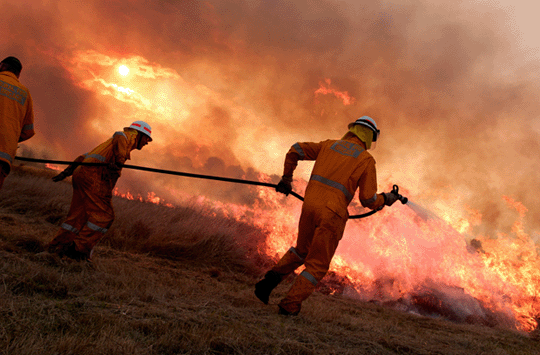
Fire? What fire? It’s business as usual in Morrison’s Canberra bubble, SMH, Peter Hartcher, Political and international editor for The Sydney Morning Herald, December 7, 2019, Subtitles are supposed to help you make sense of what you’re seeing but can’t quite understand. Like a foreign language film. But if you saw the subtitles to Federal Parliament’s final question time of 2019, the flow of text only made it more incomprehensible.
The politicians talked about a great many things. But if you watched it on TV, the subtitles were about only one. As Labor cycled through its list of grievances against the government, and the government rehashed its self-congratulatory talking points, the news crawl across the bottom of the screen announced a non-stop series of fire alerts. Did the two worlds connect? At no point in an hour-and-a-quarter did the politicians discuss the most obvious and pressing concern for most of the people they represent. The disconnect was emblematic of the week. Indeed, it’s an emerging motif of the Morrison government. There is no emerging crisis so big that the government cannot find a way to look past it. Australia, parched, baking, burning, is heading into an anxious Christmas and a joyless new year. The Prime Minister sends his best wishes but he wants to get on with talking about his real priorities. The final showcase moment for Parliament for the year only managed to showcase political self-absorption. It’s understandable that the bushfires weren’t a feature of question time. Question time is customarily a clash over highly political differences, and neither party wanted to politicise fires. It’s just that it was all business as usual in Parliament. As if there were no accelerating national emergency. The disconnect is that it’s not business as usual for the rest of Australia…….. The government, having campaigned for re-election on a minimalist platform, wants to govern with a minimalist agenda. It seeks to deliver its promised agenda to its “base”, while ignoring other demands unless — and until — they become politically overwhelming. The fires are a national emergency. They are an invitation to national leadership. And, therefore, they are an opportunity for Morrison to look beyond the 30 to 40 per cent of voters who constitute his “base” to making common cause with the other 60 to 70 per cent of the community. Besides, even “quiet Australians” are increasingly anxious ones. …… The entire pyro-hydro complex of problems and solutions does lead, inevitably, to that most delicate political question of climate change mitigation. Morrison will have to brace his party to deal squarely with this, too. At the moment, he is in frozen immobility on this because he does not want to upset the internal Coalition truce on climate and coal. This will require of him active management. It will test his skills. But this is all big and bold and demanding and, above all, risky. It’s far from the minimalist and incrementalist prime ministership that Morrison has kept to so far. More likely, he’ll just continue to preside over an unfolding disaster armed only with grudging, inadequate responses and an unending list of excuses and talking points. …… We don’t need subtitles to explain the subtext. The country is in crisis and the national government is in denial. …https://www.smh.com.au/politics/federal/fire-what-fire-it-s-business-as-usual-in-morrison-s-canberra-bubble-20191206-p53hom.html |
|
Bushfires crisis in New South Wales, smoke pollution in Sydney, and even New Zealand
The NSW bushfire crisis has people “living in fear” with more than 100 blazes burning across the state and Sydney choking on harmful smoke pollution.
Firefighters will have a brief window over the weekend to get on top of the crisis before the weather deteriorates early next week.
The Bureau of Meteorology has painted a grim picture for the coming week, with winds forecast to whip dangerous fire grounds and no rain relief in sight. At one point on Friday there were nine fires burning at an emergency level, including the massive Gospers Mountain blaze, which has merged with neighbouring fire grounds to create a “megafire”.
Smoke from the fires was drifting to New Zealand and affecting communities there, NSW Rural Fire Service commissioner Shane Fitzsimmons said on Friday.
There were 108 fires burning in NSW on Friday afternoon, with 74 of those burning out of control.
Hazardous air pollution readings were recorded in many parts of the state, with emergency departments seeing an increase in presentations for respiratory issues…….
NSW Premier Gladys Berejiklian said residents from the South Coast up the Queensland border are “living in fear”.
“The difference now as we lead into the summer months is previously [bushfires] were pretty much confined to the northern part of NSW but what we are seeing this week is our resources stretched across the entire coastline,” she told reporters……
Fire crews have arrived from interstate as well as New Zealand and Canada, while a team from the US will arrive on Saturday.
Total fire bans will be in place on Saturday for the far north coast, New England, the northern slopes, the greater Hunter, greater Sydney, the central ranges and the nortwestern regions…… https://www.sbs.com.au/news/nsw-living-in-fear-as-bushfires-continue-to-rage
Huge bushfire North of Sydney, with conditions forecast to worsen
 Australia fires: five blazes merge north of Sydney as conditions forecast to worsen, More than 100 bushfires were burning in New South Wales on Friday, more than half of them out of control, Guardian, Ben Doherty and Helen Davidson, Fri 6 Dec 2019 Five fires burning to the north of Sydney joined up into one huge conflagration on Friday, with out-of-control blazes threatening homes and lives.On a day that brought choking smog to Sydney, the premier of New South Wales said the entire coastline of the state was on fire.
Six people have died, and more than 680 homes have already been lost to bushfires in NSW this fire season, and on Friday more than 100 fires were burning, more than half of them out of control. Eight fires have emergency warnings, which means they pose an immediate risk to lives and property.
The largest fire – a conglomeration of five blazes which have joined up north of Sydney – has burned over 335,000 hectares.
The forecast for coming days is for more hot, dry conditions. Strong winds are likely to continue to fan blazes towards towns and properties.
The NSW premier, Gladys Berejiklian, said while fires had been burning across the state for weeks, the sheer scale of the current fire threat was stretching crews’ ability to fight the blazes……..
Sydney has been choked by thick smoke for almost a week.
Hospital emergency departments have seen a 25% increase in people presenting with asthma and breathing problems, and ambulance crews are responding to between 70 and 100 call-outs a day for respiratory conditions, including to school children as young as six.
Some schools across the state have been closed because of the fire risk, while others have kept children inside because of the worsening air quality…… https://www.theguardian.com/australia-news/2019/dec/06/australia-fires-five-bushfires-merge-north-of-sydney-as-conditions-forecast-to-worsen
Grim summer is forecast for Murray Darling river system
“Campaigns led by irrigators and the NSW National party to derail the basin plan do not represent the interests of all communities across the basin. Governments must listen to all voices in this debate, not just the loudest and most belligerent,”
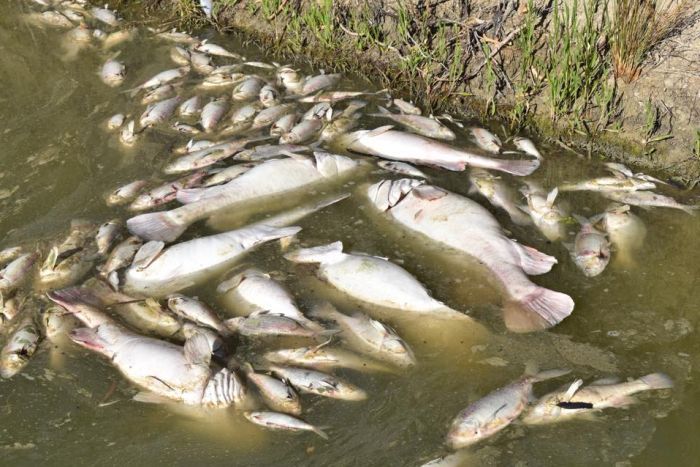
Murray-Darling authority warns of ‘dire’ summer of mass fish deaths and blue-green algae https://www.theguardian.com/australia-news/2019/dec/06/murray-darling-authority-warns-of-dire-summer-of-mass-fish-deaths-and-blue-green-algae
Alert comes as Indigenous group issues plea for states to stick with basin plan or risk marginalising vulnerable communities and endangering river health, Anne Davies, 6 Dec 19,
The Murray-Darling Basin Authority has warned of more mass fish deaths and blue-green algae events throughout the Murray-Darling River system as the peak group representing First Nations issued a plea for the states to stick with the plan.
The MDBA issued a communique on Friday saying the summer outlook from the Bureau of Meteorology was “dire”, and there was a greater than average chance of drier, warmer conditions and an elevated fire danger across the basin.
“We are already seeing the drying of critical aquatic refuges in the north, and water quality issues such as blue-green algae and stratification are becoming more widespread,” the MDBA said.
These were the conditions that led to mass fish deaths at Menindee in January this year.
The MDBA reiterated how important it is to use what little environmental water that remained available to protect critical habitats and maintain water quality.
It has produced a detailed water quality map that will be updated as the drought worsens. Continue reading
1 This month


Help Aunty Sue Protect Her Land and Sacred Sites From Destructive Rocket Testing.
.

Australians deserve the truth
about
AUKUS – https://aukuspublicinquiry.com/

PETITION – To: Prime Minister Anthony Albanese and the Australian Labor Government

of the week – Australians for War Powers Reform (AWPR)
To see nuclear-related stories in greater depth and intensity

