State of the drought – New South Wales , South Australia, Northern territory, Western Australia
State of the drought shows dams empty and NSW drowning in dust ABC Weather By Kate Doyle 12 Mar 19, It’s not good. Not good at all.
The hot dry summer has stripped the soils of moisture, water storages are down in every state and territory, and New South Wales is drowning in dust.
Key points:
- Water stores are down in every state and territory
- Keepit dam is empty and Dubbo’s dam could be empty by 2020
- A hot and dry summer has exacerbated low soil moisture, with a dry autumn forecast
So far this drought has been short but hard-hitting. The coming cold season will be a test of that descriptor.
Last year’s national farm production was down on the bumper year of 2016, but a good year in the west, decent prices and some moisture last summer softened the blow.
But with widespread low soil moisture, the pressure is on the arrival of cool-season rain.
The heat is making things worse
Lynette Bettio, a climatologist at the Bureau of Meteorology, said the big dry was affecting large parts of NSW, eastern South Australia and parts of the Northern Territory and northern Western Australia.
And despite the flooding rains in the north, even Queensland isn’t off the hook.
“The floods largely missed those areas of drought that we were covering,” Dr Bettio said.
“It did relieve some of those areas; those large totals of rainfall meant that some areas near the border with the NT are no longer in that bottom 10 per cent for those [drought-measuring] periods.
“But there’s still large parts of southern Queensland that are in that bottom 10 per cent of rainfall and lowest-on-record rainfall for those 11-month and 23-month periods.”…….. https://www.abc.net.au/news/2019-03-12/state-of-the-drought-is-not-good/10876716
Abbot Point Nine fines reduced on appeal
 Source Document: mailchi.mp/frontlineaction.org/anti-adani-activist-fines-reduced 8 March 2019
Nine anti-Adani activists, each originally fined $8,000 for disciplined non-violent direct action, which blocked coal exports from Adani’s Abbot point coal terminal for a total of 14 hours in January 2018, have expressed great relief that their fines have been substantially reduced on appeal to Bowen District Court.
The activists’ fines were reduced to between $2,000 to $3,000 each.
“Our actions were aimed to highlight the massive threat posed to a liveable planet for future generations by Adani’s railway and mine. Burning the Galilee Basin’s coal will make limiting global temperature rise to 1.5 to 2 degrees above pre-industrial levels, as agreed at Paris, an impossibility.” said Liisa Rusanen, one of the nine activists.
“In confronting the climate emergency, of course we need to phase out coal and other fossil fuels. We also need to stop billion-dollar corporations from dictating government policy. The destruction of the environment has deep roots in the current political system and our future depends on facing this.” Added Nic Avery, another of the nine activists.
Another of the nine, Ella Skerret, pointed out “our original fines totalled $72,000 compared to Adani’s $12,000 fine for exceeding their licensed release of polluted water into the Caley Valley Wetlands during cyclone Debbie. A second pollution incident occurred in the recent major rainfall event and is being investigated. Will they be handed another meagre fine?”
The nine activists thanked Caxton Legal Centre, in addition to Barristers Andrew Boe and Sian McGee for their dedicated hard work in achieving this appeal court outcome.
Environment minister Melissa Price and energy minister Angus Taylor lying to the public on Australia’s carbon emissions
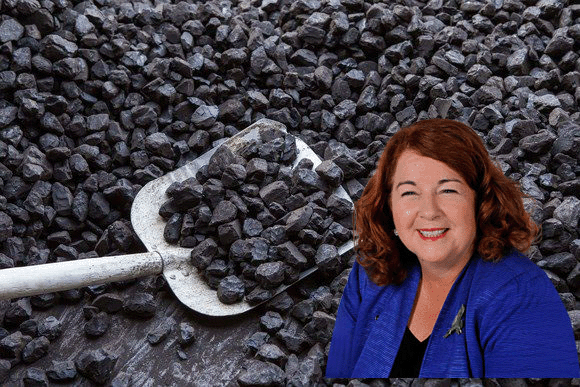
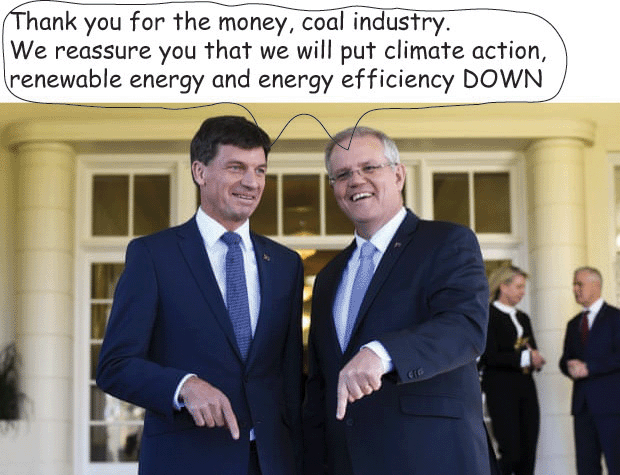
Australia’s energy policy is a tangled mess built on a foundation of lies, Guardian,
Last week, environment minister Melissa Price and energy minister Angus Taylor once again hit the airwaves, lying to the public on Australia’s carbon emissions, claiming that emissions are falling.
“Seasonally adjusted, weather normalised” emissions for the September 2018 quarter did fall by a little over 1%. However, this cherry-picked data point deceptively obfuscates the true message that Australia’s emissions have risen year on year since Tony Abbott and Greg Hunt gleefully despatched the carbon pricing mechanism in mid-2014 and replaced it with the emissions reduction fund (ERF) the next year.
The ERF, however, has demonstrably failed to arrest Australia’s growing emissions. Continue reading
Extreme weather is severely damaging Australia’s native creatures
Out of sight, out of luck: the hidden victims of Australia’s deadly heatwaves, Guardian, Graham Readfearn@readfearn 4 Mar 2019
Extreme weather events are causing severe damage to native flora and fauna, but the casualties are slipping under the radar……..
for ecosystems up and down the country – languishing far from the cities and the social media glare – there was no escape.
Australia’s Bureau of Meteorology confirmed 2018 was the hottest December since records began in 1910, while January was the hottest month ever recorded……
ere have also been less headline-grabbing climate change-related tragedies. Based on studies of past extreme heat events, the affect of this summer’s heatwaves on Australia’s flora and fauna would have been severe, fundamental and, in some cases, deadly.
“I think in a lot of places it would have been carnage,” says James Cook University ecologist Prof Bill Laurance of the January heatwave. “We have just had records after records being broken. We only tend to notice when things start dropping out of the trees. We know that basically, lots of things are dying.”……….https://www.theguardian.com/environment/2019/mar/04/out-of-sight-out-of-luck-the-hidden-victims-of-australias-deadly-heatwaves
Julian Burnside, Greens candidate will take on Treasurer Josh Frydenberg on climate change
 Burnside says Greens would not block Labor’s climate change policies, Guardian, Paul Karp, @Paul_Karp,5 Mar 2019
As Greens candidate for Kooyong, Julian Burnside sets up a four-way contest with Josh Frydenberg, Liberal-turned-independent Oliver Yates and Labor The human rights lawyer and refugee advocate Julian Burnside will run as the Greens candidate for Kooyong at the next election.
At a media conference on Tuesday the prominent barrister said he would take on the treasurer, Josh Frydenberg, in the blue-ribbon Liberal seat because he believes the “political system is broken”, with major parties listening to their donors not their constituents.
In an interview with Guardian Australia, Burnside suggested the Greens would “not treat the perfect as the enemy of the good” by threatening to block Labor’s climate change policies.
The comment suggests the candidate is keen to avoid a repeat of the Greens blocking Kevin Rudd’s emission trading scheme in favour of an interim carbon price that was later repealed by the Abbott government……… https://www.theguardian.com/australia-news/2019/mar/05/julian-burnside-takes-on-josh-frydenberg-as-greens-candidate-for-kooyong
Mining company Glencore behind global campaign to undermine climate change information
Revealed: Glencore bankrolled covert campaign to prop up coal , Guardian, Christopher Knaus@knausc, 7 Mar 2019
The mining company engaged Sir Lynton Crosby’s firm to push anti-renewables message and counter anti-coal activists The multinational mining giant Glencore spent millions bankrolling a secret, globally coordinated campaign to prop up coal demand by undermining environmental activists, influencing politicians and spreading sophisticated pro-coal messaging on social media.
An investigation by Guardian Australia can reveal the covert campaign, dubbed “Project Caesar”, was orchestrated by world-renowned political operatives at the C|T Group, the firm founded by Sir Lynton Crosby and Mark Textor.
The C|T Group used teams in Sydney and London to further Glencore’s interests across the globe, including in Australia, according to multiple sources with knowledge of the project and documents seen by Guardian Australia. …… https://www.theguardian.com/business/2019/mar/07/revealed-glencore-bankrolled-covert-campaign-to-prop-up-coal
Climate experts warn the Australian government about the nations climbing greenhouse has emissions
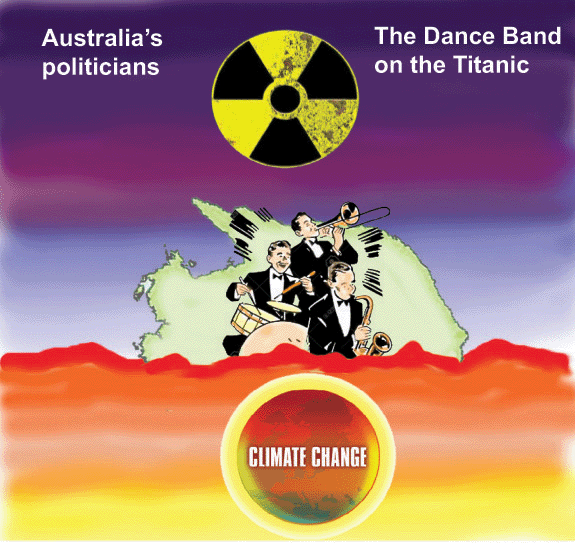 Coalition’s climate armour takes beating, SBS, News 4 Mar 19, A group of climate experts has issued a joint statement to the government, calling for a 45-to-65 per cent emissions reduction target on 2005 levels by 2030. A group of climate science experts has warned the government Australia needs more policies to cut greenhouse gas pollution in line with international obligations.
“Climate change is becoming an economic wrecking ball and it’s already having an impact,” the Climate Council’s Will Steffen said on Monday, calling for an emissions reduction target of 45-to-65 per cent below 2005 levels by 2030, instead of 26-to-28 per cent.
The joint statement was released after the government’s emissions data revealed last week showed a 0.9 per cent increase on levels in the September quarter compared to the previous year.
While emissions are declining in the electricity sector, this progress is outweighed by rises in transport and industrial energy, fuelled by a 19.7 per cent increase in LNG exports.
Climate Council spokesman and former head of BP Australasia Greg Bourne says the government’s recent policy announcements – including $2 billion for the Climate Solutions Fund – are unlikely to make a significant difference.
“Pollution has increased year on year under the government’s recently re-badged Emissions Reduction Fund,” he said.
“This is a failed policy because it does not effectively tackle pollution from fossil fuels, which contribute the lion’s share to the climate problem.”……. https://www.sbs.com.au/news/coalition-s-climate-armour-takes-beating
A climate-changed future – Australia’s marine heatwave disrupting ocean life
In the summer of 2017-18, the intense marine heatwave was combined with a land-based heatwave, together covering four million sq km. Scientists foundthe extreme weather event caused unprecedented loss of glacial ice in the New Zealand Southern Alps, changes to wine-grape harvests, and major disruption of marine ecosystems including kelp habitat loss, new species invasions and fisheries season changes.
This year the National Institute of Water and Atmospheric Research in New Zealand reported that sea surface temperatures in the Tasman were again above average.
Like coral reefs and tropical rainforests, the ocean suffers the slow torture of climate change peppered with high-intensity hits from extreme weather.
A window into the future
Marine heatwaves are generally out of sight and out of mind until one gets so bad it becomes impossible to ignore, says CSIRO research scientist Alistair Hobday.
A marine heatwave happens when the ocean temperature is much warmer than usual for the time of year from sunlight heating the surface water or warm water being brought via ocean currents – or both.
Climate change is causing marine heatwaves to happen more frequently and with more intensity. There may not be scorched earth or destroyed homes left in its wake, but a marine heatwave impacts our future in different ways – and serves as a warning. ……… https://www.theguardian.com/environment/2019/mar/05/australias-marine-heatwaves-provide-a-glimpse-of-the-new-ecological-order
Drought wipes billions from Australian farm production
ABC Rural By national rural reporter Kath Sullivan 4 Mar 19.The value of all that is farmed in Australia has fallen to $58 billion, from $63.8 billion two years ago.
In its latest commodity report, released today, ABARES found improved commodity prices and the low Australian dollar had softened the decline, largely driven by drought.
“Drought in the eastern states significantly reduced the 2018–19 winter crop, but one of the largest Western Australian harvests on record has provided a buffer to the national total,” it said.
Livestock industries also contributed to the decline, with ABARES reporting the volume of livestock products dropped by 2 per cent this year.
“Milk and wool production have been affected by the drought, and a significant decline in live animal exports also contributed to the fall,” it said.
“This is largely because of cessation in live sheep exports during the northern hemisphere summer months.”
ABARES reported that floods in Queensland last month could further reduce the volume of live cattle exports…….. https://www.abc.net.au/news/2019-03-05/value-of-australian-farm-production-drops-abares-figures/10867294
Victoria’s major bushfires still out of control
Victoria bushfires: Major blazes still out of control as residents may be allowed to return home
By 9News Staff, 6:03am Mar 5, 2019 Five of the 29 bushfires burning in Victoria this morning are still out of control this morning stretching across 59,000 hectares of land.
A cooler weather change that is moving over the state has seen yesterday’s ‘Emergency’ warning zones downgraded to a ‘Watch and Act’ level, however authorities have warned that four major fires are still out of control.
Those incidents include the largest blaze still raging in Victoria at the Bunyip State Park which is still sparking spot fires in multiple areas…….https://www.9news.com.au/2019/03/04/18/10/news-melbourne-bushfires-bangholme-dandenong-south-fire
Over 2000 firefighters working to contain bushfires around Victoria
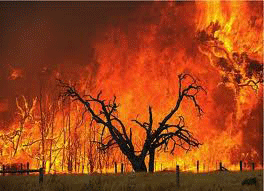 Fires rip through Victoria: ‘worse than Black Saturday’, A fire, which has destroyed properties and more than 10,000 hectares of land is burning in the same area as the deadly Black Saturday bushfires. Bushfires have ripped through Victoria’s east, with a wind change challenging firefighters working all night to contain the blaze. SBS News 4 Mar 19
Despite cooler conditions expected on Monday, firefighters may have to contend with dry lightning, which could start more fires.
The Bunyip State Park fire, burning 65km east of Melbourne, was sparked by lightning strikes on Friday and has destroyed more than 10,000 hectares.
The blaze is still racing towards the Princes Freeway and emergency warnings remain in place for the surrounding area.
“The risk of lightning redevelops in the late morning with the chance of some showers and thunderstorms,” Bureau of Meteorology’s senior forecaster Christie Johnson said.
While there was a chance of showers, it was hard to pinpoint where they would hit, and there would only be a few millimetres of rainfall, she said…..
More than 2000 firefighters are working to contain blazes around the state …..https://www.sbs.com.au/news/fires-rip-through-victoria-worse-than-black-saturday
Australia’s Energy Minister, Angus Taylor, lying about Australia’s greenhouse emissions
Angus Taylor again falsely claims Australia’s greenhouse emissions are falling, Guardian, Amy RemeikisIn an interview with the ABC program Insiders, Angus Taylor repeatedly stated emissions had decreased by 1% repeating the line first said by the prime minister, Scott Morrison, that Australia would meet its Paris commitments in “a canter”……. https://www.theguardian.com/australia-news/2019/mar/03/angus-taylor-again-falsely-claims-australias-greenhouse-emissions-are-falling
How bushfires generate their own weather
 Why Victoria’s bushfires generated their own lightning, The Age , By Liam Mannix, March 4, 2019 — There are few sights more terrifying for a firefighter: a vast, dark storm cloud brewing above a bushfire, shooting out lightning.
On Sunday, the Licola bushfire east of Melbourne burned with such intensity it generated a huge thundercloud that fired hundreds of lightning strikes at nearby forests.
The Bunyip fire, which is believed to have wiped at least one town off the map, also generated its own weather system which fed the fire with extreme winds.
“It’s absolutely terrifying. And it’s dangerous as well, because that lightning can start new fires before the main fire,” says Dean Narramore, a meteorologist at the Bureau of Meteorology’s extreme weather desk.
How bushfires generate their own weather
As a bushfire burns, it generates hot, smoke-filled air.
This air is hotter than surrounding air and rapidly rises, forming a smoke plume.
As the plume rises, atmospheric pressure falls. This causes the plume to spread out, generating a “mushroom” on top of the plume.
The smoke plume is filled with moisture which is released by burning trees. The higher you go in the atmosphere, the cooler it gets, so the top parts of the plume get chilled.
This causes the moisture in the plume to condense (turn from water vapour into tiny water droplets) and form a cloud.
As the plume rises rapidly into the sky, cool air is sucked in to replace it. This causes extreme winds near the firefront. To fight a fire, you need to know which way it is burning. But when a fire-cloud forms and starts generating strong and unpredictable winds, the fire can become chaotic.
“All this air rushes into the fire. You can imagine air coming from all different angles, feeding in – and oxygen is a very important part of fire. It causes fires to race up and down hills,” Mr Narramore says…….. https://www.theage.com.au/national/victoria/why-victoria-s-bushfires-generated-their-own-lightning-20190304-p511kd.html
Climate crisis – heating oceans affecting Tasman Sea marine life, and seafood industries
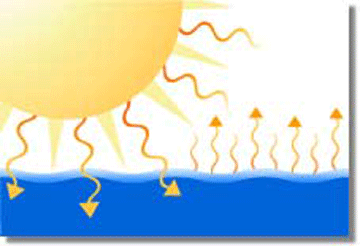 ‘Not very happy’: Tasman Sea warmth puts the heat on key fisheries, Brisbane Times, By Peter Hannam, March 2, 2019 Back-to-back summer heatwaves in the Tasman Sea that have affected marine life and seafood industries in Australia and New Zealand could be another sign of the warming climate, scientists say.
Australia has just had its warmest summer by far, with the role of so-called blocking highs in the Tasman seen by meteorologists as key to the build-up of record-breaking heat over the country’s south-east.
The still conditions brought by those highs have the effect of limiting ocean mixing, while the relatively cloudless skies allowed solar radiation to warm the waters of the Tasman to a greater-than-usual depth.
By the Bureau of Meteorology’s definition, a marine heatwave occurs when temperatures in the top 10 per cent of readings for that time of year exist for at least five days. The Tasman Sea has met the definition for months on end, two years in a row………
The effect on marine ecosystems, fishing and aquaculture industries “can be devastating, including killing off kelp forests and corals”……… https://www.brisbanetimes.com.au/environment/weather/not-very-happy-tasman-sea-warmth-puts-the-heat-on-key-fisheries-20190302-p511cr.html
New South Wales election – 3 Independent MP’s gather strength for climate action

 NSW election roundup: independents join forces on climate changeThree possible kingmakers write to premier and opposition leader. Plus: the key promises made this week , Guardian, Josephine Tovey
Polls have consistently suggested the main parties are locked in a dead heat, and a Coalition minority government is widely regarded as a likely outcome of the 23 March election.
Greenwich said that whatever the outcome, he would work with either of the major parties to deliver his priorities, with a strong focus on climate change and homelessness……. https://www.theguardian.com/australia-news/2019/mar/02/nsw-election-roundup-independents-join-forces-on-climate
1 This month
7 April – WEBINAR – Australia and the Doomsday Clock – Preventing nuclear war through NoFirstUse and other policies
Online | Tuesday April 7, 4:00-5:30pm, Australian Eastern Time / 8:00-9:30am Central Europe Time
– Access the registration link
15 April – Zoom –Nuclear Power is Not the Solution
Apr 15, 2026 01:00 AM in Canberra, Melbourne, Sydney

Join the International Physicians for the Prevention of Nuclear War (IPPNW) on Tuesday, April 14th for a timely webinar exploring the risks associated with nuclear power and challenging the myth that it offers a simple, safe, carbon-free solution to the climate crisis

21 April Webinar: No Nuclear Weapons in Australia
Start: 2026-04-21 18:00:00 UTC Canberra, Melbourne, Sydney (GMT+10:00)
End: 2026-04-21 19:30:00 UTC Canberra, Melbourne, Sydney (GMT+10:00)
Event Type: Virtual
A virtual link will be communicated before the event.
Host Contact Info: australia@icanw.org

of the week – Australians for War Powers Reform (AWPR)
To see nuclear-related stories in greater depth and intensity
 Antinuclear