Matt Canavan hijacks native title fight on Adani
 “The system, the native title system,” Tony McAvoy, SC, Australia’s first Indigenous silk said, “coerces Aboriginal people into an agreement. It’s going to happen anyway. If we don’t agree, the native title tribunal will let it go through, and we will lose our land and won’t be compensated either. That’s the position we’re in.”
It’s a big case, not only for the W&J people, but for an entire, overheating planet.
 The Saturday Paper Mike Seccombe , 15 Feb 19,
 Just before 1pm on Tuesday, most media attention in Parliament House was focused on the government’s historic embarrassment on medical evacuations of asylum seekers. So, relatively few were there to witness another embarrassment, in the senate courtyard.
Its purpose was to promulgate the line that the traditional custodians overwhelmingly support the giant coalmine. To that end, Canavan, along with his National Party colleagues Michelle Landry and George Christensen, had invited a member of the W&J people to spruik the benefits of the mine. Continue reading
A fearful future for Australia’s one big river system – the Murray-Darling basin
Focus for year ahead will be on ‘providing drought refuges and avoiding irreversible loss of species The outlook for the environment in the Murray-Darling Basin, particularly in the north, is extremely challenging and there will be almost no scope for environmental flows for the remainder of the 2018-19 year unless it rains, the Murray-Darling Basin Authority has warned.It says the focus will be “on providing drought refuges and avoiding irreversible loss of species”.
Releasing its environmental watering outlook for 2019-20 the authority warns that there are almost no reserves of environmental water in the northern basin and that, as a result of above-average temperatures and low inflows over successive years, some important wetlands and floodplain forests have not received water for long periods.
It says conditions in the Coorong, a Ramsar-listed wetland in South Australia, are deteriorating, as are conditions in the Narran Lakes, despite the federal government paying $80m for water rights aimed at restoring them. The Macquarie Marshes and floodplains along the Murray are also deteriorating.
The report says the conditions in the lower Darling are particularly severe and the length and duration of cease-to-flow events in the lower Darling has skyrocketed since 2000. It acknowledges this is due to extraction by irrigators upstream as well as climate.
“The hydrology in this area has changed in recent years … an effect which can be tied to both the volume of water extracted from the river and climate across the northern basin,” it says.
“This trend has also affected water availability in Menindee Lakes and the flow characteristics downstream through the lower Darling,” it says…….. https://www.theguardian.com/australia-news/2019/feb/15/murray-darling-basins-outlook-is-grim-unless-it-rains-authoritys-report-warns
Global events, as well as Australian politics, may spell doom for Australia’s coal industry
Australia’s coal future under threat as more changes hit fossil fuels globally, ABC
Key points:
- Germany wants to exit coal power by 2038, which could have implications for Australian coal producers
- Renewables last year overtook coal as the key source of energy in the European nation
- Environmental groups are pushing candidates to outline their position on climate change ahead of the upcoming federal election
In Germany, Chancellor Angela Merkel confirmed the country would exit coal power by 2038.
In New South Wales, a court knocked back an application for a new coal mine on the grounds it would increase greenhouse gas emissions at a time when they need to be cut.
Neither will immediately derail the freight train that made Australia $66 billion in export earnings last year, overtaking iron ore as our most valuable traded commodity, but both decisions are a snapshot of large and incremental changes in policy and legislation that are hitting the coal sector.
“We want to be out of coal in 2038,” Chancellor Merkel told students in Tokyo last week, after a government-appointed commission released its 20-year plan to completely shut the coal-fired power plants that currently provide almost half the country’s electricity……….
Politics may dictate a shift
Australia is months away from a federal election where senior Liberal Party figures — including Treasurer Josh Frydenberg and former prime minister Tony Abbott — are being threatened by independents who support a rapid shift away from greenhouse-gas-producing fossil fuels like coal.
Even people who cannot vote, but feel passionately about the impact of climate change, are entering the debate.
School student Maiysha Moin helped found “Climate Voices” to amplify the concerns that prompted a strike by thousands of students last year.
“We want the voices of young people to be heard,” she said.
“Right now we see a lot of politicians don’t represent our vision for the future, especially on climate change, and what we want to do is endorse leaders and candidates who will represent what we believe in and our values.”
The new group is vetting the climate change credentials of potential candidates, giving them stamps of approval and offering campaign support in key marginal seats.
“What we need right now is visionary leadership,” she said.
“We need our politicians to be brave, step up, take action and listen to what the people have to say instead of standing around and hoping that climate change is going to go away — that’s not going to happen.” https://www.abc.net.au/news/2019-02-15/australias-coal-future-under-threat-amid-global-changes/10812758
Climate change protesters disrupt parliamentary question time
 https://www.sbs.com.au/news/climate-change-protesters-disrupt-parliamentary-question-time 15 Feb 19, Protesters complaining about what they see as a lack of action on climate change have tried to disrupt federal parliament during question time. Climate protesters have disrupted question time in federal parliament, with at least 10 people in the public galleries standing up to shout at politicians.
The first was applauded on Thursday as he yelled about “record-breaking droughts and bushfires” before being removed by security as another activist stood up to take his place.
Ministers ploughed on with their answers amid the shouting, while backbenchers looked up at the disturbance. One woman singled out Barnaby Joyce and Tony Abbott, telling them they would be judged harshly as Mr Joyce smiled and waved to her.
Standing up one after another across the three public galleries, others said, “stop lying to us”, that their children and grandchildren would suffer and “take urgent action … you should get arrested for what you’re doing”.
The Coffs Coast Climate Action Group claimed credit, saying they wanted to deliver a statement from their community and call on MPs to examine their conscience.
One of the group, Uniting Church deacon Jason John, said it was cynical of politicians including the prime minister to ask Australians to pray for rain in a time of record drought as if God controls every drop, while not doing anything to act on climate change.
“I am not afraid of a lump of coal but I am afraid that some of our nation’s leaders seem to worship it,” Dr John said in a statement
During Julia Gillard’s prime ministership, multiple question times were interrupted by protesters against the so-called carbon tax.
Court judgment a precedent for climate to weigh more than coal business in legal cases?

 Landmark Rocky Hill ruling could pave the way for more courts to choose climate over coal, ABC, The Conversation By Justine Bell-James, 12 Feb 19, On Friday, Chief Judge Brian Preston of the New South Wales Land and Environment Court handed down a landmark judgementconfirming a decision to refuse a new open-cut coal mine near Gloucester in the Hunter Valley.
The proposed Rocky Hill mine’s contribution to climate change was one of the key reasons cited for refusing the application.
The decision has prompted celebration among environmentalists, for whom climate-based litigation has long been an uphill battle.
Defeating a mining proposal on climate grounds involves clearing several high hurdles.
Generally speaking, the court must be convinced not only that the proposed mine would contribute to climate change, but also that this issue is relevant under the applicable law.
To do this, a litigant needs to convince a court of a few key things, which include that:
- the proponent is responsible for the ultimate burning of the coal, even if it is burned by a third party, and
- this will result in increased greenhouse emissions, which in turn contributes to climate change.
In his judgement, Judge Preston took a broad view and readily connected these causal dots, ruling that:
The project’s cumulative greenhouse gas emissions will contribute to the global total of GHG concentrations in the atmosphere. The global total of GHG concentrations will affect the climate system and cause climate change impacts. The project’s cumulative GHG emissions are therefore likely to contribute to the future changes to the climate system and the impacts of climate change.
Other courts (such as in Queensland, where the proposed Adani coalmine has successfully cleared various legal hurdles) have tended to take a narrower approach to statutory interpretation, with climate change just one of numerous relevant factors under consideration.
In contrast, Judge Preston found climate change to be one of the more important factors to consider under NSW legislation.
To rule against a coalmine on climate grounds, the court also needs to resist the “market substitution” argument — the suggestion that if the proponent does not mine and sell coal, someone else will.
This argument has become a common “defence” in climate litigation, and indeed was advanced by Gloucester Resources in the Rocky Hill case.
Judge Preston rejected the argument, describing it as “flawed”. He noted that there is no certainty that overseas mines will substitute for the Rocky Hill coalmine.
Given increasing global momentum to tackle climate change, he noted that other countries may well follow this lead in rejecting future coalmine proposals.
He also stated that:
An environmental impact does not become acceptable because a hypothetical and uncertain alternative development might also cause the same unacceptable environmental impact……..
This decision potentially opens up a new chapter in Australia’s climate litigation history.
Judge Preston’s ruling nimbly vaults over hurdles that have confounded Australian courts in the past — most notably, the application of the market substitution defence.
It is hard to predict whether his decision will indeed have wider ramifications.
Certainly the tide is turning internationally — coal use is declining, many nations have set ambitious climate goals under the Paris Agreement, and high-level overseas courts are making bold decisions in climate cases.
As Judge Preston concluded:
An open-cut coal mine in this part of the Gloucester valley would be in the wrong place at the wrong time … the GHG emissions of the coal mine and its coal product will increase global total concentrations of GHGs at a time when what is now urgently needed, in order to meet generally agreed climate targets, is a rapid and deep decrease in GHG emissions.
Indeed, it is high time for a progressive approach to climate cases too.
Hopefully this landmark judgement will signal the turning of the tides in Australian courts as well.
Justine Bell-James is a senior lecturer at The University of Queensland. https://www.abc.net.au/news/2019-02-12/rocky-hill-ruling-more-courts-choose-climate-over-coal/10802930
Queensland government investigating Adani again, about coal terminal water release
Key points:
- Adani has not applied for an emergency water release permit for Abbot Point
- Water flowed into Caley Valley wetlands this month after monsoonal rain
- The Queensland Government is prosecuting Adani over a 2017 wetland water release
It comes as Adani revealed it did not apply for an emergency permit to dump more polluted water into the sensitive Caley Valley wetlands during the north Queensland floods last week.
The company told the ABC that Abbot Point operators were confident they could manage floodwaters with new infrastructure, but were then overwhelmed by flows from neighbouring properties.
Adani’s own testing showed water released into the wetlands on February 7 had almost double the authorised concentration of “suspended solids”, which included coal sediment……….
‘2017 release eight times over limit’Adani is fighting a prosecution by the department over its 2017 release of coal-laden water from the port during Cyclone Debbie.
The department alleges Adani breached a temporary emissions licence (TEL) by dumping water with more than 800mg/L — eight times the authorised concentration of suspended solids……….
Conservationists called on the Queensland Government to launch a second prosecution of Adani over Abbot Point.
Australian Marine Conservation Society campaigner Lissa Schindler said the company had “shown that it cannot be trusted with our precious reef”.
She criticised Adani’s advertising campaign designed to pressure the government into granting final approvals of its Carmichael coal project.
Ms Schindler said Adani instead “should have been ensuring its port was able to cope with Queensland’s extreme weather events”.
Mackay Conservation Group campaigner Peter McCallum said: “If you own and operate a port in Queensland on our precious Great Barrier Reef Marine Park, you must make sure it can withstand big storms.” https://www.abc.net.au/news/2019-02-13/adani-facing-government-probe-abbot-point-wetland-release/10805206
Heated exchange at Adani media event
https://www.sbs.com.au/news/heated-exchange-at-adani-media-event A press conference to showcase the support of indigenous traditional owners for Adani’s Carmichael coal mine has served to show divided opinions on the project.
A fiery war of words has broken out at a press conference designed to highlight the support of Indigenous traditional owners for Adani’s controversial Carmichael coal mine.
Spokesman for the Wangan and Jagalingou people of central Queensland, Patrick Malone, spoke up about the benefits of the project, including a boost to local employment alongside Resources Minister Matt Canavan at Parliament House in Canberra on Tuesday.
He stressed that traditional owners voted 294-to-1 in favour of establishing a land use agreement with Adani in 2016.
They did that because there are long-term benefits for Wangan and Jagalingou people,” Mr Malone told reporters.
But he was soon interrupted by fellow Wangan and Jagalingou representative Murrawah Johnson.
“Not appropriate,” Ms Johnson declared upon arriving at the scene.
Ms Johnson accused Mr Malone of having no right to represent her people, because of a native title claim still in dispute.
But Mr Malone rejected the view, lamenting that “loud mouth people” were overshadowing the majority view of traditional owners.
“Look after country,” Ms Johnson urged Mr Malone.
I know all about that,” he replied.
With the exchange showing no signs of cooling down, Senator Canavan swiftly wrapped up the conference, with security arriving to usher away the interrupters. They did that because there are long-term benefits for Wangan and Jagalingou people,” Mr Malone told reporters.
But he was soon interrupted by fellow Wangan and Jagalingou representative Murrawah Johnson.
“Not appropriate,” Ms Johnson declared upon arriving at the scene.
Ms Johnson accused Mr Malone of having no right to represent her people, because of a native title claim still in dispute.
But Mr Malone rejected the view, lamenting that “loud mouth people” were overshadowing the majority view of traditional owners.
“Look after country,” Ms Johnson urged Mr Malone.
“I know all about that,” he replied.
With the exchange showing no signs of cooling down, Senator Canavan swiftly wrapped up the conference, with security arriving to usher away the interrupters.
Australia and water: the driest inhabited continent in the age of climate change
Australia is the canary, and the coalmine, for the world when it comes to water stress,  Guardian, R Keller Kopf , 11 Feb 19,
As extreme climate events happen around the world, Australian communities are running out of water
“The skies are brass and the plains are bare,
Death and ruin are everywhere—
And all that is left of the last year’s flood
Is a sickly stream on the grey-black mud;
The salt-springs bubble and the quagmires quiver,
And this is the dirge of the Darling River.”
— Henry Lawson (1891)
The northern hemisphere faced a polar vortex, while Australia during December and January was the hottest on record. People and the environment are suffering at both ends of the planet because of the extreme events.
Australia’s heatwave has exposed cracks in our unsustainable water, land-use and climate policies.
Fish kills in the Darling River, followed by more in other waterways, are being blamed on drought. More than one million fish died following multiple events in December and January.
The public has been aghast. The catalyst for outrage has been viral videos of hundreds of Murray cod floating dead and being displayed by angry locals. Murray cod is an icon of Australian waterways and one of the world’s largest species of freshwater fish. The biggest Murray cod – allegedly 114kg – was caught in 1902, during the federation drought in a tributary of the Darling, near Walgett.
But extreme conditions and fish kills are natural here in the “land of drought and flooding rains”, right?
The Darling is the longest river on the driest inhabited continent – prone to harsh and variable conditions. Lawson’s 1891 poem, which followed one year after the largest flood, is used often to depict the naturally occurring extreme conditions of our rivers. Indeed, European explorers who set off to chart flows to the “great inland sea” were surprised instead to discover a drought-stricken river – the Darling. Though the water was too salty to drink, it abounded with pelicans, swans, ducks and leaping fish.
Heatwaves and drought have always occurred here but unsustainable levels of water extraction and climate change are much more recent. Vast quantities of water are now extracted and used, during drought and flood, to irrigate crops including rice and cotton.
The amount of water used for irrigated agriculture varies, but ranged from about 50% of all flows in the Murray during the 1980s and 90s, to more than 76% during the Millennium Drought. Standards for healthy rivers are debated, but extraction of more than 20% of flows typically results in adverse changes to biodiversity and the benefits people derive from clean water.
Worldwide the demand for fresh water is expected to increase by 55% by 2050.
Australia is experiencing this water stress now. We are thus a canary, and the coalmine, for the rest of the world………..
There is plenty of water to go around for people and the environment, but not enough to simultaneously sustain the current irrigation entitlements.
Banning cotton and rice and degrading farmers will not solve the problem.
What will solve it is reducing total water entitlements for irrigation and increasing flows for rivers and wetlands.
Environmental flows have expanded in many regions, but the Darling and northern-basin still seem to be a wild west of water extraction. Minimum environmental flow standards have either not been in place or have been insufficient to sustain dry-land rivers. Minimum flow standards and policies around land use and run-off must be sufficiently robust to prevent further large-scale blue-green algae events, which are the proximate causes of the current hypoxia and fish kills.
The best available science reviewed by the Wentworth Group of Concerned Scientists has recommend an increase in environmental flows, to a minimum of 3,200 GL per year to maintain healthy freshwater ecosystems.
So, what can the world learn from our experience on the driest inhabited continent?……….
Subsidies that perpetuate the – hydro-illogical – cycle of unsustainable irrigation around the world should stop being funded. Instead, funding for communities must be targeted at helping farmers adapt and growing industries that will be viable during water scarcity, climate change and extreme conditions. Regional communities and freshwater ecosystems are much more than irrigation ditches and will thrive if presented with new opportunities.
If global carbon emissions remain high, the 48.3C record temperature in Bourke, situated near the Darling River, a few weeks ago should be expected to become 50C or 51C by 2090. Temperatures in Death Valley are sometimes that hot, but then again no one is growing cotton or cod there.
This does not have to be the dirge of the Darling, regional communities or farming. But it is time for change.
- R Keller Kopf is a freshwater ecologist at Charles Sturt University. https://www.theguardian.com/commentisfree/2019/feb/11/australia-is-the-canary-and-the-coal-mine-for-the-world-when-it-comes-to-water-stress
Adani ramps up propaganda war, intimidation of activists

Extreme weather in Australia – the economic effects : why we need to prepare for this
Storm-o-nomics: Why Australia should be more prepared for extreme weather, The Conversation, By Matt WadeFebruary 9, 2019 Another Australian summer has been marked by disasters triggered by extreme weather. Some came out of the blue, like the Townsville floods. Others unfolded gradually, like the droughtafflicting much of eastern Australia.
But there’s one characteristic our natural disasters have in common: their high price tag when compared with the rest of the world.
The World Disasters Report 2018, prepared by the Red Cross, found Australia was ranked 10th in the world for the cost of damage caused by disasters between 2008 and 2017. It estimated our disaster damage bill over that decade to be a hefty $US27 billion ($38 billion).
A separate study by London-based charity Christian Aid rated Australia’s lingering drought as the world’s seventh most costly weather-related disaster of 2018 (between US$5.8 and $9 billion).
We’re also located in world’s most disaster-prone region. The Asia Pacific was hit by two out of every five of the 335 disasters recorded worldwide in 2017 and suffered 58 per cent of disaster-related deaths, according to the Red Cross.
The headlines typically focus on the insurance losses caused by property damage following a calamity like the Townsville floods.
A recent report by consultancy SGS Economics and Planning for insurance company IAG tallied the insurance losses in Australia due to natural perils between 1970 and 2013.
During those decades storms caused the greatest losses (27 per cent of the total) followed by hail damage (21 per cent), floods (18 per cent), tropical cyclones (18 per cent) and bushfires (10 per cent).
But there’s a difference between insurance losses due to extreme weather and the broader economic cost. Insurance losses following natural disasters only capture the losses accruing to insured assets such as homes, motor vehicles and business premises. That’s only part of the story.
The disruption caused by disasters changes the way businesses and consumers behave, sometimes for an extended period, causing losses to production that never show up in insurance claims. ……….
Professor Frank Jotzo, director of the Centre for Climate Economics and Policy at the Australian National University, says climate science shows Australians should expect more frequent, and more intense, extreme weather events due to climate change. He warns the effects of climate change will drag on the economy in two ways.
First, the destruction caused by more frequent extreme weather events, especially to public infrastructure, will require capital and labour to be diverted to rebuilding things we already have rather than creating new productive assets.
“It means we have to invest resources in things that don’t give us an additional economic output,” says Professor Jotzo.
Second, climate change will take a toll on productivity. One obvious example is the impact higher average temperatures and shifting rainfall patterns will have on agricultural production.
The health of employees, especially in cities, will be affected by more frequent and long-lasting heatwaves and that means more work days lost to illness.
“Heatwaves mean people are under greater stress and more prone to ill-health,” says Jotzo. “That’s a direct hit on the economy.”………..
So what can be done?
Rawnsley’s analysis shows governments have focused too much on post-disaster reconstruction while investing too little in mitigation.
“Out of ever $100 spent on disasters about $97 is spent post the disaster,” he says.
The upshot? A disaster-prone nation like Australia should be doing more to mitigate the effects of extreme weather. https://www.brisbanetimes.com.au/business/the-economy/storm-o-nomics-why-australia-should-be-more-prepared-for-extreme-weather-20190208-p50wln.html
Psychological aspects of the fact that climate change has arrived in Australia

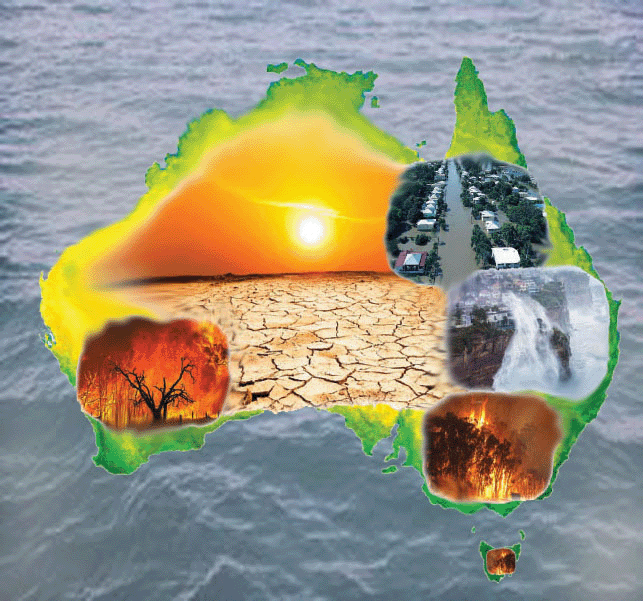 The climate crisis has arrived – so stop feeling guilty and start imagining your future The Conversation, The Conversation Principal Lecturer in Psychology, University of Brighton February 7, 2019
Evidence of the devastating impacts of anthropogenic climate change are stacking up, and it is becoming horrifyingly real. There can be no doubt that the climate crisis has arrived. Yet another “shocking new study” led The Guardian and various other news media this week. One-third of Himalayan ice cap, they report, is doomed.
Meanwhile in Australia, record summer temperatures have wrought unprecedented devastation of biblical proportions – mass deaths of horses, bats and fish are reported across the country, while the island state of Tasmania burns. In some places this version of summer is a terrifying new normal.
The climate disaster future is increasingly becoming the present – and, as the evidence piles up, it is tempting to ask questions about its likely public reception. Numerous psychological perspectives suggest that if we have already invested energy in denying the reality of a situation we experience as profoundly troubling, the closer it gets, the more effort we put into denying it.
When it comes to the climate crisis, the personal is political. I am talking about a politics that grows from opposition and critique of our current systems. This is evident in young people organising school strikes and protesters willing to get arrested for their direct action. But we also need to pay more attention to what is lost, to who and what we care for, to other possible ways of being.
Some conservation scientists, at least, see recent cultural change as a hopeful sign of a growing sense of care and responsibility. So stop feeling guilty, it’s not your fault. Be attentive to what’s going on, so that you might notice what you care about and why. What are you capable of, and what might we be capable of together, when we aren’t caught between knowing and not knowing, denial and distress?
Climate change already having drastic effects on Torres Strait islands
 Climate change eats away at Torres Strait islands, prompting calls for long-term solutions, ABC Far North
A flood prevention method that withstood wild weather this week may be rolled out to other vulnerable Torres Strait communities, including Yam Island where families were left homeless after king tides last year.
Torres Strait Island Regional Council deputy mayor Getano Lui said geotextile sandbags were used for the first time in the Torres Strait this week when abnormally high tides impacted Poruma Island, a cultural hub home to just 200 people.
“It’s getting worse every year,” he said.”Climate change is really having a detrimental effect on all the communities.
“When I was growing up the elders could predict the weather but right now it’s unpredictable.
“The worst is yet to come this year, the king tides are predicted [on February 19] and anything could happen, we could end up with the same catastrophe as Yam Island last year.”
Connection to land, culture under threat
Research from the Torres Strait Regional Authority shows sea levels are rising by 6mm each year — double the global average.
“If this trend continues, relocation is an option many of those on the Torres Strait’s 200 islands and coral cays may be faced with,” Mr Lui said.
“What is instilled in us and our ancestors is if the Torres Strait sinks, we’ll sink with it.
“We would be very reluctant to be relocated.
“Most of us would refuse to leave.”
Torres Shire Council mayor Vonda Malone said the region’s two councils would now look at installing the sandbags on other vulnerable islands such as Yam Island, Masig Island and Boigu.
“The weather over the last two weeks has been unpredictable; it has been full on,” she said…..
Sinking cemeteries a concern for State MP
….https://www.abc.net.au/news/2019-02-09/call-for-increased-flood-protection-in-torres-strait/10794696
Bob Brown to lead anti coal mine convoy from Hobart to Queensland’s Galilee Basin, and Canberra
 Dr Bob Brown leads anti coal mine convoy, Examiner, Sue Bailey 7 Feb 19,
About 100 Tasmanians have so far signed up to join an anti-Adani coal mine road convoy which organisers say will be bigger than the protest to stop the damming of the Franklin River.
Environmentalist and former Australian Greens leader Bob Brown says if the Adani coal mine goes ahead a peaceful protest convoy will leave Hobart on April 17 bound for Queensland’s Galilee Basin and then back to Canberra ahead of the federal election.
“Now that’s an economic, employment and environmental win for Tasmania and Australia.
Dr Brown said thousands of people joined the Franklin blockade and hundreds were arrested and he expected many Australians would join the convoy which would travel through Melbourne, Sydney and Brisbane.
He said the Federal and Queensland governments should not tick off the mine and Labor would be foolish to support it.
“Bloomberg says this is the most contentious coal mine on earth,” Dr Brown said.
“Climate change is the big vote changer.
“Adani is a litmus test for common sense in this age of global heating.”
Dr Brown said 1100 people,including 100 Tasmanians, had already expressed interest in joining the convoy which will be led by electric cars and other vehicles…….. https://www.examiner.com.au/story/5892738/dr-bob-brown-leads-anti-coal-mine-convoy/?cs=95
Anti Adani protesters rally outside the Sydney Mining Club
 Anti-Adani protesters outside CEO speech, SBS , 8 Feb 19,
A group of protesters have rallied outside the Sydney Mining Club, where Adani Australia’s CEO was speaking about the company’s Carmichael coal mine. More than 100 people have rallied against Adani’s controversial Carmichael coal mine as the company’s Australian boss spruiked the project to industry figures.
The protesters carried placards and chanted loudly outside the Sydney Mining Club on Thursday as chief executive Lucas Dow delivered his lunchtime speech.
“We’re not going to stop until they listen,” one speaker told the crowd……..
The Queensland government in January appointed an environmental group to review the mine’s management plan, including plans to conserve 33,000 hectares of pastoral land bought near the 1300-hectare site to offset habitat loss for black-throated finch.
The LNP believes the move has put the project at risk. https://www.sbs.com.au/news/anti-adani-protesters-outside-ceo-speech
There is still no deal on royalties for Adani coal mine with Queensland government
 Adani yet to sign royalties deal with Queensland government, Fin Rev, By Mark Ludlow, Feb 7, 2019
Indian energy giant Adani has yet to sign a royalties agreement with the Queensland government for its controversial $2 billion Carmichael mine.
In a further setback for the mine and rail project – which has become a lightning rod for environmental activists across the country – it can be revealed that while there was an in-principle agreement about a royalty framework for the project, it has yet to be finalised between the company and the Palaszczuk Labor government….. (subscribers only) https://www.afr.com/news/politics/adani-yet-to-sign-royalties-deal-with-queensland-government-20190207-h1ayhi
1 This month
7 April – WEBINAR – Australia and the Doomsday Clock – Preventing nuclear war through NoFirstUse and other policies
Online | Tuesday April 7, 4:00-5:30pm, Australian Eastern Time / 8:00-9:30am Central Europe Time
– Access the registration link
15 April – Zoom –Nuclear Power is Not the Solution
Apr 15, 2026 01:00 AM in Canberra, Melbourne, Sydney

Join the International Physicians for the Prevention of Nuclear War (IPPNW) on Tuesday, April 14th for a timely webinar exploring the risks associated with nuclear power and challenging the myth that it offers a simple, safe, carbon-free solution to the climate crisis

21 April Webinar: No Nuclear Weapons in Australia
Start: 2026-04-21 18:00:00 UTC Canberra, Melbourne, Sydney (GMT+10:00)
End: 2026-04-21 19:30:00 UTC Canberra, Melbourne, Sydney (GMT+10:00)
Event Type: Virtual
A virtual link will be communicated before the event.
Host Contact Info: australia@icanw.org

of the week – Australians for War Powers Reform (AWPR)
To see nuclear-related stories in greater depth and intensity
 Antinuclear